USFS Fire Lab and Wuerthner: Wind Drives All Large Blazes

Below are excerpts from a couple of articles about the fact that wind and weather conditions drive all large wildfires.

From the Missoulian:

Larry Bradshaw was riding his motorcycle down U.S. Highway 12 on Monday afternoon when he noted the building smoke and stiffening winds.

It was an acute observation for a meteorologist who has worked at the U.S. Forest Service’s Fire Sciences Laboratory in Missoula since 1992, and still maintains the National Fire Danger Rating System.

Bradshaw tuned into the scanner a few hours later and listened as chaos unfolded ahead of the West Fork II fire, the blaze jumping the highway he’d ridden hours earlier before making a run east down the Lolo Creek Canyon.

“The winds were really strong out of the west,” said Bradshaw. “The inversion broke there earlier than it did in Missoula.”….

“It was the same recipe used on every fire – it’s dry and it’s windy,” said Finney. “We have a canyon situation and a couple fires low in the canyon. The fires have topography working in their favor – the canyon topography helping with the winds.”

The tools used by fire managers to predict the interaction of wind, topography, weather and fuel were developed here by the likes of Bradshaw and Finney and dozens of other scientists working up and down these hallways, part of the government’s Rocky Mountain Research Station….

“The thing we have to realize is that fires are inevitable. They’re impossible to completely exclude from the landscape,” Finney said.

“By trying to do that and doing it so successfully, what we’ve done is saved up the fires for the worst conditions. When you get rid of all the fires under moderate conditions, all you have left are the extreme ones.”

The other article is a column by George Wuerthner, which appear at The Wildlife News:

As large fires have spread across the West in recent decades, we hear increasing demands to reduce fuels—typically through logging. But logging won’t reduce the large fires we are experiencing because fuels do not drive large fires….

The ingredients found in all large blazes include low humidity, high temperatures, and drought. Assuming you have these factors, you can get an ignition if lightning strikes. But even an ignition won’t lead to large fires.

The final ingredient in all large blazes is wind.

Wind’s effect is not linear. In other words, increasing wind speed from 10 mph to 20 mph does not double fire spread, rather it leads to exponential fire growth and increases the burn intensity….

Most large fires have wind speeds of 30-50 mph or more. Wind makes fire fighting difficult since embers are blown miles ahead of the burning fire front. It is also the reason why wind makes fuel reduction projects ineffective.

Wind drives flames through and over fuel treatments. Even clearcuts with little or no fuel will not halt a wind driven fire. The wind driven fire just dances around and over any fuel breaks.

The biggest problem with fuel reductions is that one can’t predict where and when fires will occur. The likelihood of a wildfire will encounter a treated forest in the time scale when fuel reduction are effective is incredibly low.

The vast majority of acreage burning around the West are occurring in higher elevation forests like lodgepole pine and various fir species that naturally burn at infrequent intervals, often hundreds of years apart. As a consequence, a fuel treatment in such forests is a waste of time because the probability of a fire occurring at all in the time when fuel reductions are effectiveness is extremely low.

Even in drier forests like ponderosa pine that burn more frequently the chances that a fire will encounter a fuel treatment while it’s most effective is around 1-2%.

There is a role for fuel reduction projects. The best ones are targeted near communities and other areas of interest. The idea being one cannot predict where a fire may start, but one can predict what you don’t want to burn up in a fire. So focus fuels reductions adjacent to those places.

The most important fuel reduction projects should occur in the communities themselves. Removal of wood piles from adjacent to homes. Clearing pine needles from roofs. Getting rid of flammable building materials like cedar shake roofs.

Reducing the flammability of homes are the kinds of “fuel reductions” that work and should be encouraged. If these fuel reductions were implemented religiously, we wouldn’t have to worry about wildfires in the hinterlands, and we could permit these blazes to do the important ecological work they perform without continual interference from humans, yet feel secure in the knowledge that our communities were safe from wildfires.

West Fork 2 Fire, Lolo National Forest

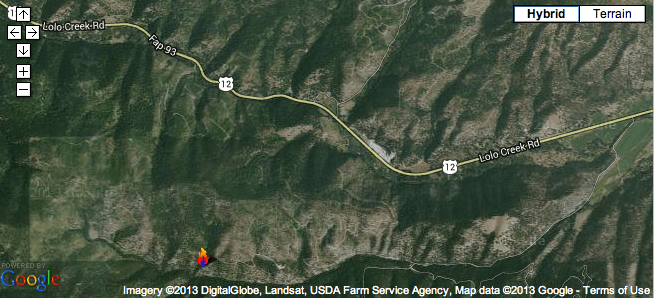
Official image from the federal government's InciWeb site showing the landscape burning as part of the West Fork 2 fire on the Lolo National Forest. The flame on the bottom portion of the image shows the general location of the start of the fire.
Official image from the federal government’s InciWeb site showing the landscape burning as part of the West Fork 2 fire on the Lolo National Forest. The flame on the bottom portion of the image shows the general location of the start of the fire.

Consider this post sort of a companion piece to Larry’s “American Fire, Tahoe National Forest” post below. The West Fork 2 wildfire started via a lightning strike early Sunday morning. Yesterday, was yet another 90+ day in Missoula (adding to the record total number of days over 90 this year). By mid-day humidity bottomed out at 16% and the winds gusted from the west at 40 mph.

As a result the West Fork 2 fire – burning through a heavily fragmented, clearcut, logged, roaded, weeded landscape just west of Lolo, Montana – ripped pretty good, burning some houses and dumping smoke, ash and charred bark into the Missoula Valley.

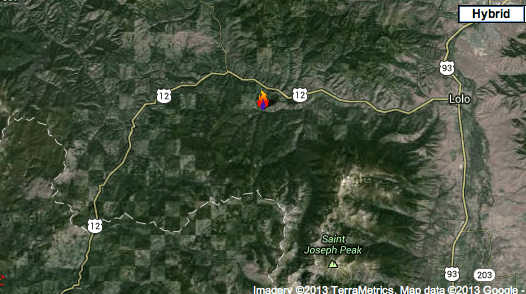
Here’s another image of the general location of the fire from a wider angle, showing more of the heavily fragmented landscape.

WestFork2_Wide Pan

P.S. And thank goodness the Tar Sands megaloads came through – and blocked all traffic – on US Highway 12 a few days ago…and not during the course of this wildfire incident. One has to wonder how the evacuation of homes, people, pets and belongings and the response of firefighters, sheriffs and emergency personal would have been impacted a few days earlier with the Tar Sands megaloads blocking the highway.

Will Enviro ‘Collaborators’ Support Rep Daines Mandated Logging Bill?

Senator Jon Tester’s (D-MT) mandated logging bill, the Forest Jobs and Recreation Act, has certainly been discussed and debate on this blog, and elsewhere, since it was introduced in the summer of 2009. See here, here and here for some of the past posts and discussions.

Back in December 2009 I had the honor of representing the Last Best Place Wildlands Campaign (a coalition of organizations, small-business owners, scientists, educators, 5th generation Montanans, hikers and backpackers, hunters and anglers, wildlife viewers, outfitters and guides, veterans, retired Forest Service and Bureau of Land Management officials and former loggers and mill workers dedicated to wildlands protection, Wilderness preservation, and the sound long-term management of our federal public lands legacy) before the U.S. Senate Energy and Natural Resources Committee. The fact that I was invited to deliver testimony by the Committee Chair, Senator Jeff Bingaman (D-NM) obviously didn’t sit very well with Senator Tester, who was hoping for more a rubber-stamp dog-n-pony show hearing, not a hearing based on the substance of the bill. (For an interesting account of the hearing read award-winning outdoor writer Bill Schneider’s piece, “What Tester’s Outburst Tells Us.”

Fast-forward to May of this year when Missoulian opinion columnist wrote a piece titled, “Tester’s Forest Jobs Bill Plus Daines Bad for Conservation.” Ochenski, certainly one of the greatest conservationists and environmental, tribal lobbyists in Montana history, ended his piece with this prophetic statement:

“It’s a mystery why the conservation collaborators failed to understand these elementary principles of the legislative process. But if Tester’s bill ever clears the Senate – and Congressman Daines (R-MT) has his way in the House – they are about to learn a very hard and environmentally costly lesson. And more’s the pity for Montana.”

Much of the “support” for Senator Tester’s mandated logging bill is being manufactured and orchestrated by the Montana Wilderness Association with the ample assistance of over 1/2 million dollars from the Pew Foundation’s Campaign for America’s Wilderness. That amount of money goes a long ways in a state like Montana, with collaborator environmental groups like the Montana Wilderness Association spending the money on internal focus groups, one-sided internal polling (which is presented to the public as independent and unbiased), “public” presentations where only supporters of the bill are allowed to present and plenty of TV, radio and newspaper ads flooding the state. All the while, MWA has engaged in a pattern of censorship and removal of any substantive comments on their social media sites which mention anything critical about Tester’s mandated logging bill.

Well, here we are a few months following Ochenski’s dire warning to the environmental “collaborators” supporting Senator Tester’s mandated logging bill. This summer, MWA staff have been heavily courting Rep Steve Daines (R-MT) to introduce Tester’s bill in the House. People may have noticed that the Montana Wilderness Association has been actively getting their members to submit glowing Letters to the Editor about how great Steve Daines is and how he should join Sen Tester and Sen Baucus to support mandated logging of national forests in Montana. In fact, this website was recently launched by MWA.

Yesterday’s Missoulian article, “Daines makes additions to U.S. House bill to speed timber harvests” gives people in Montana and across the country (especially those who value Wilderness and public lands) an indication of 1) just where Rep Daines wants to take national forest policy; and 2) just how irresponsible and naive the environmental “collaborators” are if they think Rep Daines will be their big Wilderness and public lands protection champion.

According to The Wilderness Society, which also ironically supports Senator Tester’s mandated logging bill, Rep Daines and Rep Hastings (R-WA) “Restoring Healthy Forests for Healthy Communities Act” would establish “Forest Reserve Revenue Areas” as a replacement for the current Secure Rural Schools (SRS) county payments program, simultaneously creating a legally-binding logging mandate with no environmental or fiscal feasibility limits, and reestablishing the discredited 25% logging revenue sharing system that was eliminated over a decade ago with the creation of SRS.

Furthermore, under Rep Daines and Rep Hasting’s bill, public participation and Endangered Species Act protections would be severely limited. The bill creates huge loopholes in NEPA and such biased ESA requirements that in practice these laws would almost never meaningfully apply. For example, any project less than 10,000 acres (that’s 15.6 square miles) would be categorically excluded from environmental analysis and public participation, and the Forest Service would be required to submit a finding that endangered species are not jeopardized by any project, regardless of its actual effect on the species.

Obviously, while politically mandated logging of America’s national forests is a terrible, dangerous precedent for the environmental community to push for, it goes without saying that Rep Daines and the GOP would make the bad provisions within Senator Tester’s mandated logging bill that much worse. It will also be interesting to see if any of the environmental “collaborators” supporting Tester’s mandated logging bill will actually rise up and speak out against Rep Daines mandated logging bill, or if they will continue to generate favorable Letters to the Editor about Rep Daines on public lands issues.

Research rejects past fire suppression & “unnatural” fuel build-up as factors in the size & occurrence of large fires in So Cal

The following press release and new scientific review arrived in my in-box yesterday via the California Chaparral Institute. If you have questions about the press release, or the new scientific review, please direct them to the California Chaparral Institute’s Director or Conservation Analyst listed below. Thank you. – mk

For Immediate Release, August 1, 2013

Contact:  Richard W. Halsey, Director, (760) 822-0029
Dylan Tweed, Conservation Analyst, (760) 213-3991

Fire Service Unfairly Blamed for Wildfires
 
Research rejects past fire suppression and “unnatural” fuel build-up as factors in the size and occurrence of large fires in southern California

SAN DIEGO, Calif. – A new scientific review and five major studies now refute the often repeated notion that past fire suppression and “unnatural” fuel build-up are responsible for large, high-intensity fires in southern California. Such fires are a natural feature of the landscape. Fire suppression has been crucial in protecting native shrubland ecosystems that are suffering from too much fire rather than not enough.

The research has also shown that the creation of mixed-age classes (mosaics) of native chaparral shrublands through fuel treatments like prescribed burns will not provide reliable barriers to fire spread; however, strategic placement may benefit fire suppression activities.

The research will be presented during a special California Board of Forestry hearing, August 8, 2013, 8am, at the Four Points Sheraton Hotel, in Ventura, California.

Advocates of the fire suppression/mosaic view often misinterpret the research and ignore contrary information. For example, the recent Mountain fire near Idyllwild in the San Bernardino National Forest was blamed on 130 years of fire suppression. More than half of the area had burned in the 1980s. A 770 acre portion had burned five years ago. The 2007 fires in southern California re-burned nearly 70,000 acres that had burned in 2003. The majority of southern California’s native habitats are threatened by too much fire rather than not enough. This is especially true for chaparral, sage scrub, and desert habitats. Fires less than ten to twenty years apart can convert native shrublands to highly flammable, non-native grasslands.

“All of us need to take responsibility in making our homes and communities fire safe,” said Richard Halsey, director of the California Chaparral Institute. “Political leaders also need to find the courage to prevent developments from being built in high fire hazard locations. Blaming the fire service for large, intense fires because of their past efforts to protect lives, property, and the environment from wildfires is counterproductive and contrary to the science.”

The scientific review can be found here

Additional Information

1. August 8, 2013 Board of Forestry Meeting Agenda

2. The five key research papers refuting the fire suppression/mosaic perspective:

Keeley, J.E. and P.H. Zedler. 2009. Large, high-intensity fire events in southern California shrublands: debunking the fine-grain age patch model. Ecological Applications 19: 69-94.

Lombardo, K.J., T.W. Swetnam, C.H. Baisan, M.I. Borchert. 2009. Using bigcone Douglas-fir fire scars and tree rings to reconstruct interior chaparral fire history. Fire Ecology 5: 32-53.

Moritz, M.A., J.E. Keeley, E.A. Johnson, and A.A. Schaffner. 2004. Testing a basic assumption of shrubland fire management: Does the hazard of burning increase with the age of fuels? Frontiers in Ecology and the Environment. 2:67-72.

Keeley, J.E., Fotheringham, C.J., Morais, M. 1999. Reexamining fire suppression impacts on brushland fire regimes. Science Vol. 284. Pg. 1829-1832.

Mensing, S.A., Michaelsen, J., Byrne. 1999. A 560 year record of Santa Ana fires reconstructed from charcoal deposited in the Santa Barbara Basin, California. Quaternary Research. Vol. 51:295-305.

3.  The Science Basics on Fire in the Chaparral

Lawnmower Sparks Fire Near Missoula

Mill Creek

According to today’s Missoulian:

FRENCHTOWN – A wildfire sparked by a lawnmower northeast of here quickly spread to 720 acres on Thursday afternoon, displacing livestock and prompting authorities to issue evacuation notices to hundreds of homes.

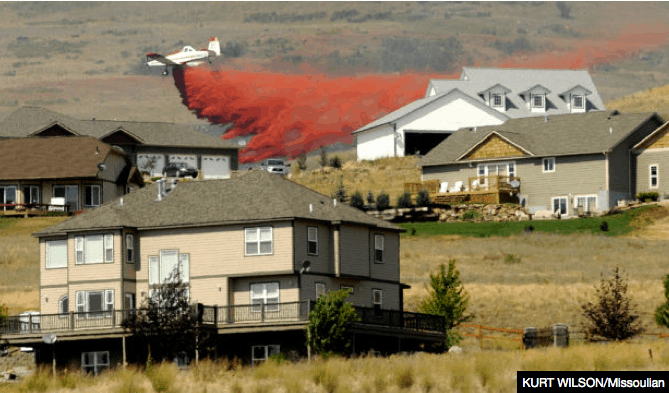
The Mill Creek fire started in tinder-dry grass before blowing up across a ridge into scattered timber and homes. Air support arrived quickly and in force, hitting the fire with water and slurry as evacuees ran for cover.

As of 9 p.m. Thursday, the fire was zero percent contained.

According to Inciweb the fire started around 2pm as the lawnmower apparently hit a rock and sparked.  The Missoula airport sits a few miles from the location of the fire and yesterday afternoon the airport reported a high temperature of 97 degrees, relative humidity down to 11% and winds gusting to 23 miles per hour.

Inciweb reports that the fire is burning in grass, brush and timber and around homes. So far, 175 firefighters are on the fire and it looks like helicopters and slurry bombers are also on the the fire. Maps indicate that the fire is burning on State of Montana land and private land and is heading headed Plum Creek Timber Company land and also US Forest Service land.  There’s also a chance that this fire will burn into the 2007 Black Cat fire area, as well as some recent Forest Service fuel-reduction projects. No word yet on the taxpayer cost of this human-caused fire. Today’s forecast for Missoula is for sunny skies and a high of 95 degrees.

Montana’s $7.2 million (and rising) West Mullan Fire human-caused

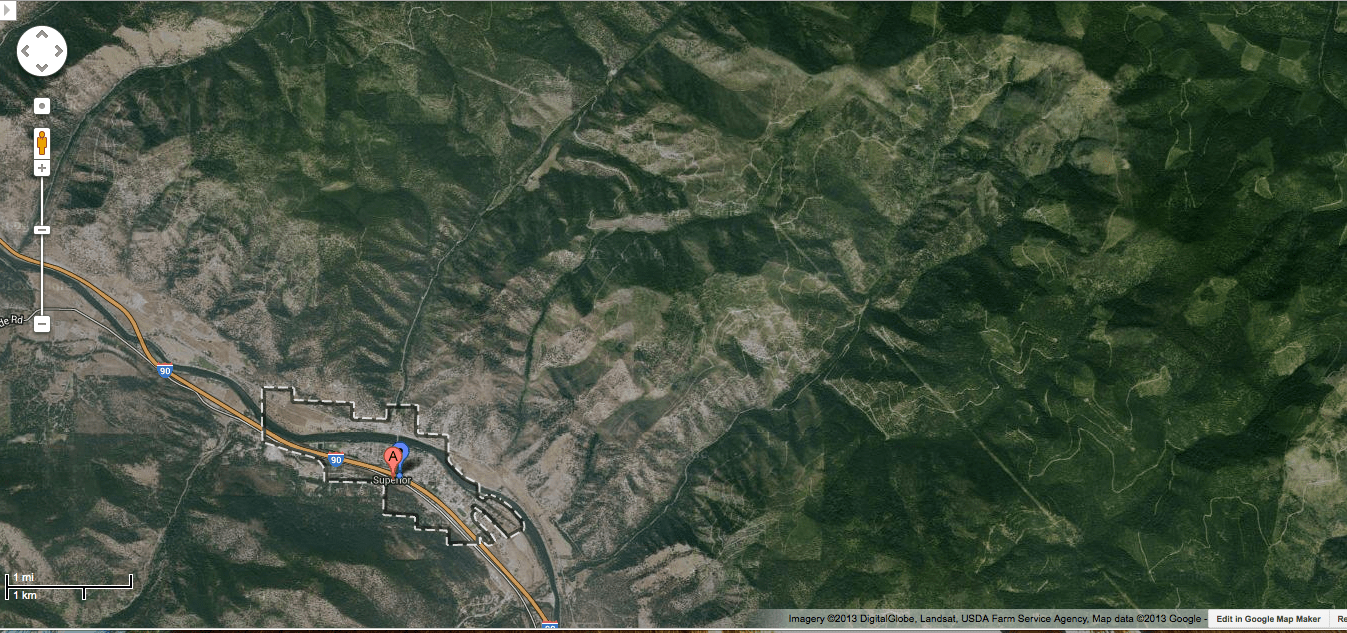
This satellite image shows the general location of the West Mullan Fire near Superior, MT.  As anyone can see, much of the Lolo National Forest lands, as well as private lands, north of Superior have been heavily logged and roaded. Some of the larger clearcuts and roads built on top of one another are impressive examples of the type of habitat fragmentation common in many areas of our national forests.
This satellite image shows the general location of the West Mullan Fire near Superior, MT. As anyone can see, much of the Lolo National Forest lands, as well as private lands, north of Superior have been heavily logged and roaded. Some of the larger clearcuts and roads built on top of one another are impressive examples of the type of habitat fragmentation common in many areas of our national forests.

This morning the Missoulian is reporting that:

A fire that has burned nearly 10 square miles north of Superior was human caused.

Officials with the West Mullan Fire said Tuesday that the fire that started on July 14 was human caused, but no further information was released.

According to Inciweb the human-caused fire started on July 14th at approximately 5pm and has burned 6,300 acres.  To date, this human-caused fire has cost $7.2 million and there are currently 821 people battling the fire.

Payson Roundup: 4FRI Contract Bombshell

This blog has had numerous posts, debates and discussions about the Four Forest Restoration (4FRI) in Arizona, including this article, “Is the US Forest Service killing the last best chance to save the Southwest’s forests?”

Well, the latest development via the in-depth reporting of Pete Aleshire with the Payson Roundup in an article yesterday titled, “Forest Contract Bombshell.” Below are extensive snips from that article:  [Note: emphasis added – mk]

Amid fresh furor, the U.S. Forest Service is considering letting a troubled timber company transfer the biggest forest restoration project in history.

The Forest Service announced on Monday that it has received a request from Pioneer Forest Products to transfer the 10-year, Four Forest Restoration Initiative (4FRI) contract to thin 300,000 acres in Northern Arizona to another, unnamed company.

“We are in the process of reviewing the application,” said Cathie Schmidtlin, media officer for the Southwest Region of the U.S. Forest Service, “to determine whether the transfer of assets is in the best interest of the government. If we determine it is not, the contract would stay with Pioneer. If it is determined to be in the best interest of the government, then the contract liability would transfer to the new owner, who would be contractually obligated to carry out the terms and conditions of the 4FRI contract.”….

At least one of the key groups that helped develop the 4FRI plan immediately responded to the announcement by calling for an inspector general’s investigation of the “potential irregularities” in the award of the contract.

“Many of us saw this one coming right from the start. Pioneer’s business plan read like a fantasy novel,” said Todd Schulke, with the Center for Biological Diversity, which helped develop 4FRI in collaboration with representatives of the timber industry, forest health researchers and local officials like Gila County Supervisor Tommie Martin. “But the Forest Service chose Pioneer despite having more realistic options. Either Pioneer misled the agency about its financial viability or the Forest Service chose to look the other way when there were serious questions. Why?”

Gila County Supervisor Tommie Martin said, “this could be the best thing that has happened to 4FRI — or it could be abysmal business as usual. Anyone who has the financial backing to buy this contract, the willingness to ‘take on’ the whole social functioning/disfunctioning that has grown around it and the desire to fulfill it definitely has my attention … and my respect if they can actually pull it off.”….

The Forest Service awarded the contract to Pioneer more than a year ago. The contract originally required Pioneer to thin about 15,000 acres in 2013 and 30,000 acres annually after that. The plan called for feeding those small-diameter trees into new mills in Winslow to produce biodiesel fuel and a type of “finger-jointed” furniture.

Several months ago, the Forest Service modified the terms the contract so that Pioneer only had to thin 1,000 acres in the next 18 months, amid reports that the company was having trouble getting financing for its proposed mills in Winslow.

The Forest Service statement released on Monday said “we cannot disclose the names of the potential new owner as this information is confidential while the proposed agreement is under review. The first task order of the contract, the Ranch task order located on the Apache-Sitgreaves National Forests is progressing satisfactorily and expected to be completed ahead of schedule.”…..

The stakeholders generally expected Berlioux Arizona Forest Restoration Products (AZFRP) to win the bid for the contract, since he had helped develop the approach behind 4FRI.

Instead, the Forest Service’s contract review office in Albuquerque awarded the contract to Pioneer Forest Products. One of the principals in the company was Marlin Johnston, who was a longtime Forest Service official who formerly ran the agency’s regional timber harvest office. In that post, he battled demands of environmentalists that the Forest Service quit cutting the remaining old-growth, fire-resistant trees.

Supporters of the 4FRI approach, like Supervisor Martin, questioned the award of the contract to Pioneer. She noted that Berlioux had not only offered to pay more money to the Forest Service for the contract, but had also agreed to monitor whether the thinning projects had the intended effects on tree growth, fire patterns and wildlife.

Moreover, Martin and others questioned Pioneer’s plan to compete with overseas markets in making finger-jointed furniture and use branches and slash to make diesel fuel, although previous efforts had failed.

By contrast, Berlioux proposed using the trees to make Oriented Strand Board — a sort of high-tech plywood that currently represents a $2 billion industry. Berlioux ran Europe’s first OSB factory.

Moreover, Pioneer principal owner Herman Hauck, 84, hasn’t operated a timber company or mill since Hauck Mill Work Company went bankrupt in 1969, according to an investigation by freelance writer and radio reporter Claudine LoMonaco, published in The Santa Fe Reporter, an alternative weekly. She had prepared a story on Pioneer’s dubious background for the public radio station in Flagstaff, but station officials killed the story.

The Forest Service contracting office declined to release many key details of Pioneer’s proposal and has never explained why it awarded the contract to the company that offered to pay the least.

Forest Service officials on Monday remained tight-lipped. In an e-mail to the Roundup accompanying the release Schmidlin said “this is all the information I’m able to provide at this time. The Forest Service will gladly share additional information in the near future, when the review process is completed. I don’t know how long the process will take.”

The swirl of questions about the contracts have forced the very people who developed the 4FRI approach to become increasingly vocal critics of the Forest Service’s implementation.

Martin, in an e-mail exchange on Monday, said she hopes the Forest Service will now seek expert, outside help. “The FS track record on the business side of this contract conversation has been so poor that unless they get ‘outside’ help evaluating the situation, the proposal and bringing business science to bear  — I’m skeptical of the outcome … even knowing that a blind squirrel finds a nut once in a while!”

Moreover, she said “for me there is still the whole social agreement concerning big tree/old tree retention that was agreed upon by the counties, enviros, industry and others that the FS have completely thrown out the window and claim that us wanting to leave them all ‘is not good science.’ Nonsense!”

She said old-growth trees constitute just 3 percent of the trees in the ponderosa pine forest of Northern Arizona, even though the Forest Service management plan calls for increasing that tally to 20 percent. “For instance, the 33,000-acre Rim Lakes thinning portion of the 4FRI proposal by Heber has only an average less than one old tree per acre to start with!”

She said she hopes the Forest Service will now agree to leave virtually all of the trees larger than 16 inches in diameter. “We’re asking that they leave ALL the big/old trees (with few exceptions) — get rid of all the dog hair thickets and get ahead of the fire danger curve — and then go back to the drawing board and see if there needs to be more mosaic, more age/structure classifications, etc. within the treated area. They claim their science shows restoration occurs faster/better with some of the old growth gone — again I say nonsense! First let them show me where they have restored a forest — ANYWHERE — and then we’ll talk about it.”

Schulke made the same point. The Center for Biological Diversity has battled the Forest Service for years attempting to prevent the harvest of old-growth trees in an effort to save endangered, old-growth dependent species like the Mexican spotted owl and the Northern goshawk. But the group promised to go to court to support 4FRI if the Forest Service agreed to leave the remaining old-growth trees.

“Ignoring the collaborative agreement was an outright breach of the social license that enabled 4FRI in the first place,” said Schulke. “Large trees are not only critically important to the survival of an array of endangered and threatened species, they’re also more fire resistant — they help to reduce the risk of catastrophic fires. We fully support 4FRI. But the Forest Service bungling has put communities at risk from the fire unnecessarily. It’s time to demand action.”

Potpourri of Recent Wildfire & Fuel Reduction Studies

(The following information was written and provided to me by George Wuerthner, author of Wildfire: A Century of Failed Forest Policy. – mk)

This study, Wildfire and Fuel Treatment Effects on Forest Carbon Dynamics in the Western United States, while focused on carbon losses and storage in forests, makes the point about probability – i.e. what is the likelihood of any fire actually interacting with fuel reductions? We can’t treat entire forests or even a significant portion of them due to cost and the undesirable impacts associated with logging, so it’s reasonable to ask the question as to whether there is a good chance as to whether a fire will actually burn through fuel reduction treated areas.

In other words since we can’t predict where a fire will occur, we can’t effectively treat forests with fuel reductions – even if they worked well – which they often don’t for a host of reasons including the fact that fuel reductions lose effectiveness over time.

We are spending a lot of federal dollars trying to treat forests to reduce fire spread and severity when the chances or probability that a high severity fire will actually interact with a treated forest is low. This, of course, again makes the case that treatments, if they are done at all, should be strategic and focused on lands near communities and other targeted areas of importance.

Abstract
Sequestration of carbon (C) in forests has the potential to mitigate the effects of climate change by offsetting future emissions of greenhouse gases. However, in dry temperate forests, wildfire is a natural disturbance agent with the potential to release large fluxes of C into the atmosphere. Climate-driven increases in wildfire extent and severity are expected to increase the risks of reversal to C stores and affect the potential of dry forests to sequester C. In the western United States, fuel treatments that successfully reduce surface fuels in dry forests can mitigate the spread and severity of wildfire, while reducing both tree mortality and emissions from wildfire. However, heterogeneous burn environments, site-specific variability in post-fire ecosystem response, and uncertainty in future fire frequency and extent complicate assessments of long-term (decades to centuries) C dynamics across large landscapes. Results of studies on the effects of fuel treatments and wildfires on long-term C retention across large landscapes are limited and equivocal. Stand-scale studies, empirical and modeled, describe a wide range of total treatment costs (12–116 Mg C ha−1) and reductions in wildfire emissions between treated and untreated stands (1–40 Mg C ha−1). Conclusions suggest the direction (source, sink) and magnitude of net C effects from fuel treatments are similarly variable (−33 Mg C ha−1 to +3 Mg C ha−1). Studies at large spatial and temporal scales suggest that there is a low likelihood of high-severity wildfire events interacting with treated forests, negating any expected C benefit from fuels reduction. The frequency, extent, and severity of wildfire are expected to increase as a result of changing climate, and additional information on C response to management and disturbance scenarios is needed improve the accuracy and usefulness of assessments of fuel treatment and wildfire effects on C dynamics.

Another long term study – this one in the Siskiyou Mountains of Oregon – demonstrates that fires are episodic and tightly bound with climate. It also points out that sediment loads increased dramatically after logging began–that has no previous analogue in history.

This paper documents how changing climatic conditions impact fire regimes and frequency. There were long periods without fires as reported in other recent studies and then periodic fire decades as well. In general this paper would support the notion that juniper and pinyon woodlands were not characterized by  “frequent fire/low intensity” fire regimes.

Wuerthner: Revisiting Fire History Studies

(The following piece was written by George Wuerthner, an ecologist, professional photographer and writer who has published over 30 books, including Wildfire: A Century of Failed Forest Policy. – mk)

One of the cornerstones of current forest policy is the assumption that western forests are outside of their “normal” density and appearance or what is termed “historic variability” due a hundred years of mismanagement that included logging of old growth, fire suppression, and livestock grazing. This idea has been used to justify logging public lands to “restore” forests to their pre-management era appearance and resiliency. Due to this past mismanagement we are told that forests are “overgrown” “decadent” and ready to burn.

Not to dismiss effects of the kind of management that largely continues unabated today, including on-going logging, grazing and fire suppression, but whether the current forest stand condition is that far from conditions that have occurred infrequently in the past is a matter of increasing debate.  This is especially important because public land management agencies feel the pressure to DO something beyond waiting for nature to do what it always does to “restore” forest conditions.

Timber harvesting is no longer done just to provide timber companies with profits or consumers with wood. Now lumber companies are involved in a much more noble enterprise—they are logging the trees to “restore” the presumed forest “health.”

The scientific basis for “restoration” is based to a large extent on fire scar studies. These studies suggest that the drier forests composed of lower elevation ponderosa pine and Douglas fir burned frequently and thus kept density low with “park-like” open stands of mostly larger trees. Keep in mind the discussion is focused on lower elevation forests since higher elevation forests like lodgepole pine, fir and spruce are characterized by much longer fire intervals, which have not experienced fuel buildups to any significant degree due to fire suppression, grazing, or timber harvesting.

So we often hear how such low elevation dry forests burned regularly at frequent intervals in “light, cool” blazes that removed the litter and killed the small trees, but did little harm to the larger trees.

Like a lot of myths, there is some truth to this generalization, and no doubt in some areas this characterization is accurate. But more recent studies using different methods have started to question this well-established story-line. These studies are finding that the intervals between fires is much longer than previously suspected, and that stand-replacement blazes (where most of the trees are killed) were likely common even in the lower elevation dry forests.

PROBLEMS WITH FIRE SCAR METHODS
The major method for determining the fire history of an area is to find trees with scars created by fires. If the tree is not killed by the blaze, it will develop a scar that can be counted in the tree rings. This record of past fires is then used to determine the “fire rotation” or the time it takes to burn an area equivalent to one’s study area.

There are four major flaws associated with traditional fire scar studies. These methodological flaws contribute to a bias toward shorter fire rotations—in other words, they tend to overstate the effect of fire suppression on forests because it appears that we are seeing more years between successive fires than we did in the past. If the fire rotation were judged to be longer, however, then much of what is being characterized as unhealthy forest may actually be perfectly normal and healthy.

The first flaw is targeted sampling. A researcher walks through the forest looking for areas with an abundance of fire scarred trees. The trees in this area are then sampled and used to determine the fire history for the area.  In the 1930s the bank robber Willy Sutton was asked why he robbed banks. Sutton is reputed to have replied with the self evident “because that is where the money is.” In a sense that is how fire researchers have gathered their data on fires—they sample in places with a lot of fire scars.

The problem with targeted sampling is that it’s non random. It’s like going into a brewery to poll people about whether they like beer. Places with an abundance of fire scars tend to have naturally low fuel loadings and frequent fires. But these sites may not be representative of the surrounding landscape such as north facing slopes or valley bottoms which may be wetter or have higher productivity and, thus, longer intervals between blazes. In fact, the reason non-sampled areas lack significant numbers of fire scarred trees is often because all trees were killed in a stand-replacement fire, but the omission of such areas from fire history studies leads to the false conclusion that stand-replacement blazes are unusual in dry low-elevation forests.

The second flaw is composite fire scars. Most fire studies add up all the fire scars recorded into a “composite” timeline. The problem with this technique is that the more scars you find and count over bigger and bigger areas, the shorter the fire interval becomes and the more risky your assumption that any fire recorded by one tree burned throughout the entire study area, even though some trees didn’t scar in the fire event. Some fire researchers now try to support this assumption by only including fire scars recorded the same year on 3 or more trees, but the trees do not have to be positioned throughout the study area, so even this will not eliminate the upward bias in frequency of fire in a given study area.

In other words, your composite may suggest a fire burned within your study area once every 5 years or whatever, but if most of these blazes burned only a few trees, then it is not accurate to say that the fire burned the entire area.  How frequent are fires that burn most or all of a large study area? These larger blazes may be far less frequent and take 100 years to burn most or all of the study area. Since the critical issue for the forest is the occurrence of the occasional blaze that burns most, if not all, of the entire study area, the fire rotation for those fires in such an area may be closer to 100 years, not the 5 years you get if you include even the tiny 1-acre fires.

The third flaw is an emphasis on the AVERAGE fire interval rather than the DISTRIBUTION of fire intervals. If you read fire studies carefully they will usually note the longest interval without any recorded fire. Often this is a significant period of many decades. Why is this important? Because the average person hears that there were fires, ON AVERAGE, every 5 years and assumes that fires operate like clocks on a regular schedule. In reality, fires burn in episodic groups usually dictated by periodic droughts that are controlled by shifts in offshore currents like the Pacific Decadal Oscillation, thus tend to be grouped together in certain drought prone decades.  The DISTRIBUTION of a fire interval shows clearly that there are always relatively long periods with little fire, even though the AVERAGE fire return interval might be 5 years.

Why is it important that we consider historic distributions of fire intervals rather than average fire intervals? Because the common assumption is that if the fire interval averages 5 years, fires would keep tree density low and reduce fuel build up. However, if it is also typical that there are also extremely long fire intervals of 80 years or more associated with the DISTRIBUTION of fire intervals, then there may not be an “abnormal” build up of fuel or increase in tree density, and nothing is out of the ordinary at all.

Finally the fourth major flaw is that traditional fire-scar studies have not been map based.  Why is a map of the distribution of trees with scars important?  It is only through such mapping that one can determine whether a scarred tree was in the middle of an extensive low-severity fire or at the edge of a high-severity patch.  One must look at the age distribution of the surrounding trees to gain real insight into the kind of fire that the scarred tree recorded.  This is what the more progressive fire ecologists are beginning to do, and they are finding that many fires in dry forest types are severe fires that burn relatively small areas within a larger fire perimeter, just like ALL fire we see burning in the same forest locations today.

Due to these flaws and errors in interpretation, many fire scar histories (but not all) misrepresent the fire regime associated with an area. If the period between fires was occasionally very long, then our forests may not be far out of their historic variability and may be well within that range of variation. If so, they do not require “restoration” because they are not out of balance.

The other major justification for logging is to reduce the chance that a community might be threatened but, as embarrassing as the facts are, there is no evidence that logging conducted miles from a town has anything at all to do with the probability that the nearest houses burn.

The fact that we are seeing more and larger fires fits perfectly with the pattern that is expected under current climatic conditions. In other words, if you have drier weather conditions, with high temperatures, low humidity and high winds, you will get more fires. You will get larger fires.

The prevailing climatic conditions are driving most of the apparent change in fire frequency and severity. For instance, the Southwest is in the grips of a drought that hasn’t been seen in five hundred years. Not surprisingly, there are fires now burning across the region bigger and more intense than any seen in the past.  However, Paleo fire studies confirm that such large fires may not be abnormal when compared to the fires that burned similar severe droughts occurred in the past centuries.

MANAGE FOR ECOLOGICAL PROCESS NOT SOME HISTORIC STAND STRUCTURE
Finally there is too much emphasis on “restoring” stand structure (in other words the presumed appearance) of forests rather than allowing natural ecological processes to occur on the landscape. It is more critical to accept and promote natural processes like beetle outbreaks, wildfires (including stand replacement blazes), and other natural ecological agents than to try to create some presumed historic forest structure that never existed in a steady state (and at taxpayer expense)! If natural ecological processes are allowed to occur on our public lands, then the forest will sort out the kind of appearance and structure that is appropriate for current climatic conditions. Critics will claim that a do-nothing approach outside the WUI will only lead to conversions of our forests to some other vegetation type, but the evidence for widespread type conversions is entirely absent.  Severe fires will restore forest conditions just fine.

All this is not to suggest that all historical reconstructions from fire scar studies are wrong—but it does suggest that most outside the pure ponderosa pine forests of the Southwest (and that’s most conifer forests in the West) are probably biased to some degree. Many of the logging proposals in the West are likely based on flawed assumptions about fire ecology and historic conditions.  And before any “restoration” logging is accepted as necessarily, the underlying assumptions should be carefully evaluated to make sure they are not skewed towards fire rotations that do not characterize the area accurately.
Fact Checking Roady, Daines and Hubbard

Last week I had to shake my head and literally laugh at some of the predictable statements of supposed fact being made during a hearing of the House Natural Resources Subcommittee on Public Lands and Environmental Regulation.  Since one of the articles about the hearing has just been posted here, I figured I’d put together a fact-checking post of sorts.

“We need to invest more resources up front to keep our forests green and healthy, rather than wait until they are dead and dying, or on fire,” -Chuck Roady of F.H. Stoltze Land and Lumber

That’s a good example of a pollyannish statement that has no basis in actual forest ecology and science.

“Rep. Steve Daines, R-Mont., said another problem hampering the federal government’s ability to manage forests is an onslaught of frivolous lawsuits filed by environmental groups against the Forest Service.”

Filing of “frivolous lawsuits” is illegal, Congressman, and any attorney that files an actual “frivolous lawsuit” would be punished by the Courts and possibly even dis-barred.  There has never been one single “frivolous” lawsuit filed in Montana, or elsewhere, concerning Forest Service timber management. I’d challenge my Congressman Daines, or anyone else, to provide one concrete example.

Also,

“onslaught of frivolous lawsuits?” Or Daines claim that: “He said about 40 percent of the 124 management projects in Region 1, which includes Forest Service land in Montana and Idaho, have been appealed or litigated.”

Fact is, according to the most-recent GAO report, of 132 total “fuel reduction” decisions in the Forest Service’s Northern Region only 11, or 8% were litigated.  And those “fuel reduction” projects that were litigated includes issues such as logging in old-growth forests miles from homes or communities, logging within habitat for threatened or endangered species, logging is areas that are already heavily logged, roaded and fragmented, etc.

Also, the truth is that the public appeal process is part of the official public review process established by the US Congress. A member of the US Congress complaining that some people or groups filed used the public appeal process set up by Congress is the same as complaining that people participate in the process at all.  What’s next Congressman Daines? Bitching that citizens actually vote?

According to the actual actual GAO report the US Forest Service Northern Region had 132 total fuel reduction decisions during FY 2006 to FY 2008. Of those 132 total fuel reduction projects 11 were litigated. That comes to about 8%.

Jim Hubbard, deputy chief of state and private forestry for the Forest Service, said “such suits have ‘virtually shut things down’ on national forest land in Montana, ‘and so environmental clearance there … has been difficult.’”

Hmmmm….”Virtually shut things down” Hubbard? Really?

Here’s a link to the Forest Service’s Timber Sale Program Cut and Sold Reports for Fiscal Year (FY) 2012 in the U.S. Forest Service Region One.

Please note that over the past five years the Forest Service in Region One (which includes 12 National Forests located within the perimeter of northeastern Washington, northern Idaho, and Montana; and the National Grasslands in North Dakota and northwestern South Dakota. the Black Hills in SD) has sold enough timber to fill 239,000 log trucks, which if lined up end-to-end, would stretch 2,048 miles, or nearly from Missoula, Montana to New York City.

According to the Forest Service’s Cut and Sold report, here are the numbers over the past five years for the Forest Service’s Region One:

• FY 2012 Region One sold 208.3 MMBF, cut 219.4 MMBF (“Virtually shut things down?”)

• FY 2011 Region One sold 211.9 MMBF, cut 202.0 MMBF. (“Virtually shut things down?”)

• FY 2010 Region One sold 253.4 MMBF, cut 188.7 MMBF. (“Virtually shut things down?”)

• FY 2009 Region One sold 292.9 MMBF, cut 186.0 MMBF. (“Virtually shut things down?”)

• FY 2008 Region One sold 229.2 MMBF, cut 167.4 MMBF. (“Virtually shut things down?”)

NOTE: MMBF = million board feet. There are approximately 5,000 board feet per logging truck.

As you notice, the volume of timber sold by the US Forest Service in our Region has stayed pretty steady, while the volume of timber cut per year has actually gone up slightly during the past five years.  But, hey, the Forest Service timber sale program in the Northern Region is “Virtually shut down,” right Hubbard?

So, consider these actual numbers and this image of log trucks lined up end-to-end across the country in the context of those calling for more logging of our national forests and spreading false, misleading and self-serving lies about “Virtually shut things down.”