Thanks to everyone, this has generally been a great discussion so far. Some themes and topics have come out that deserve their own space. I’ll start with my favorite- the People’s Database.
I. This Should All Be Public and Easily Available
When we started the PALS Database in the Forest Service WO NEPA shop(part of the E-gov initiative)(probably the early 2000s), the acronym stood for Planning, Appeals and Litigation Database. Our intention was to build out the NEPA piece, as well as appeals (and objections) and litigation, and after testing and refinement, make it publicly available.
Let’s go back to our Colorado health policy op-ed:
And far too often, our debates start from clashing assumptions instead of shared facts.
**********
And we need decisions rooted in shared, validated data rather than ideology or assumptions.
Perhaps if we are to figure out where we really disagree and what can be done about it, we should start with asking the Forest Service to provide us with validated, public data. So I went through the comments from yesterday and pulled the questions that could be answered with the People’s Database.
1. Sam said “I haven’t seen a whole lot of litigation against thinning projects in the Sierra Nevada. The few lawsuits (against thinning) in the courts over the decades have not been very successful.”
Database would include project, purpose and need, litigation, plaintiffs, dates filed, dates appealed, date settled,data project began, link to court documents, (probably other info of interest to legal folks.) Then we would know.
2. The Black Hills. I vaguely remember an amendment to the Forest Plan being required as part of a settlement agreement. So there must have been some litigation? Again, we would know from the People’s Database how many lawsuits had been brought on the Hills over time.
3. Dave said ” I would really like to see the stats of how many projects in the last year or two have been covered by Emergency Action Determination. I am going to guess that it is a majority. Maybe some lawsuits could be prevented if the Forest Service did a better job at resolving issues during the objection process.” We could easily see that if each project was entered and could be searched using that. Probably PALS has that and we could ask.
Denise said “EADs cover well over one million acres at this point maybe two million” but we don’t know. And is that the acres impacted by actions or project areas?
4. Brett said:
The paper from the Breakthrough Institute found a 28% loss rate for NEPA. This compares to Fleischman et al. (2020. US Forest Service implementation of the national environmental policy act: Fast, variable, rarely litigated, and declining. Journal of Forestry, 118(4), pp.403-418) which states that; “Of the 241 resolved cases (the others are still outstanding), the USFS won 67 percent, lost 21 percent, and settled 12 percent.” The problem with these numbers is they don’t account for the documents that are withdrawn before going to court. So, the real odds of the Forest Service losing a case is perhaps close to 50:50. And remember all ties go to the Forest Service (we get deference).
So I think the two studies probably differed by timeframes, definitions and maybe kinds of projects. We should be able to do our own analyses (IMHO) and also be able to link to settlements.
Also, Brett, when I read Science at the Bar, I didn’t think Jasanoff said that the courts are the place to resolve conflicts. I’ll have to go back and look. It seems like the political process is where ox-goring is generally decided.
II. Is it Fair to Say “the FS is trying to cut the public out by using CEs?”
I think of the HFRA CEs, for example. Congress established them because they weighed the pros and cons and came up with a tool for the FS to use. Should the Executive Branch say “sorry gals and fellas, we don’t want to use this because we don’t agree with your judgment.” That’s an interesting separation of powers question. Or are we blaming Congress for not caring about public comment? ESD’s were part of the IIJA, Vilsack had one map, the current Sec. another. Again, if Congress comes up with something specifically to help with a problem that it sees, the FS should not use that tool.. because…???
I do think the tenor of this discussion is different, because it tends to blame FS employees (incompetent timber-lovers) instead of Congress or any given Admin or party.


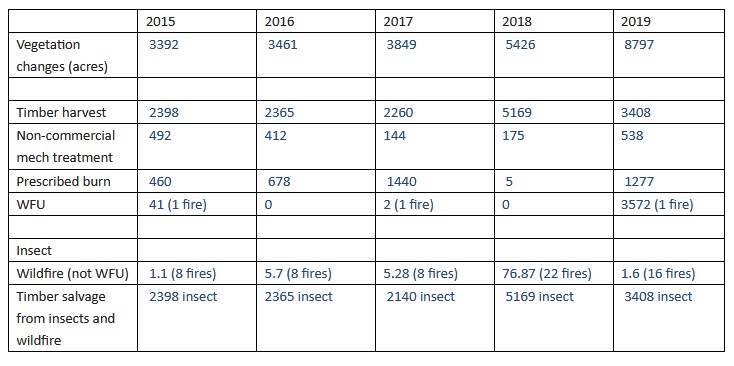

 . It is on page 9 of the annual report.