Idaho Roadless Rule Commission: Helping Implement the Rule Since 2008

Daniel Mountains (Daniel Bertram, 2020)

A theme for this week seems to be the challenge of good management practices (continuous improvement) and,  as we try to build what some call “state capacity” how that relates to what we might call “random acts of analysis” or “helicopter analysis”.   In these cases,  folks are gathered, make suggestions, and then move on (take off) to something else- without any feedback on how their recommendations worked or did not.

Yesterday I pointed out that the 2008 Idaho Roadless Rule is an example of an effort having provisions for ongoing review and improvement (at least of implementation, I don’t think anyone wants to engage in changing the rule itself.)

John Robison pointed to this webpage that talks about the ongoing Commission and its responsibilities. I’ve noticed that both Colorado and Idaho had substantial litigation on their Rules, but following their lack of success in overturning the Rule, the national groups who litigate have left implementation to the States. I don’t think the FS has proposed anything litigation-worthy with regard to the Idaho Rule, but folks can tell me if that’s not the case.  Commission members sound like Idahoans from the relevant interests.

Below are screenshots of the Commission’s webpage, please excuse the duplication between the screenshots.

Beyond the Chainsaw Debate: Finding Common Ground- Guest Post by Don Amador- Plus Designing Collaborative Processes at Larger Scales


Don Amador sent the below piece last week- he explores the world of collaboration and suggests its application to wilderness management.  What struck me, though, was the difference between national efforts to collaborate and local (and state) efforts. What has been tried nationally, and how well has it worked?

Although I’ve worked with a variety of FACA committees, my everyday kind of experience was with the RACNAC, which you might recall was that national FACA committee designed to give national input on the State Roadless Rules.  I remember some of my colleagues watching one member looking at photos of dogs on his laptop while the discussion was going on.  My colleagues thought “I can’t believe taxpayers are paying his travel so he can watch dog videos.”  At the same time, folks like Ray Vaughan and Dale Harris did amazing work in trying to bring people together. I guess I’ll just call that “differing levels of commitment.”

Comparing the State effort and the national effort (yes, I attended most meetings of both), I think the difference was that the state people were, in some sense, in relationship.  This was one of many issues that the same folks at the state level dealt with.  They were also more familiar with details of the land and the practices.  They were all committed to the state and to the effort. The group did include a  representative from  TWS, who both negotiated,  and at the same time, told us his organization would never support the Rule no matter what was in it, based on principle).  And I remember John Swartout filling the role of bringing people together, one of the unsung and invisible heroes of such efforts.

I’ve seen at least four problems with efforts to collaborate at the national level- you may want to add some others.

  1. Most annoying to me as a Designated Federal Official.. the regrettable FACA process.  One of many USG ideas with good intentions but the way it is designed has serious problems that are never fixed. See theme.. USG management.. not continuous improvement, not even discontinuous improvement, it’s more like accretion of incapacity.
  2. National people get chosen as representatives of their groups with little or no experience at the ground level.  However ideological battles get fought (e.g. slogan-slinging), outcomes are not always practical.
  3.  The voices of the people who will implement the decisions are not at the table. Nor, in the case of issues with public comment, the voices of those who actually read the public comments. The implementers may be in the room, but not allowed to take part.  Not the same as a local collaborative. Also collaborators at the local level tend to also be implementers, or implementing adjacent.
  4. There is no feedback and learning over time about implementation of ideas.   There could have been for the Planning Rule FACA, but keeping a national group together over time is much more difficult due to big P political factors. The Idaho Roadless Rule has a formal process for dealing with problems and changes, and had an ongoing group to review. I heard that interest was lost and they disbanded.  Maybe someone can tell us more?

It seems to me that at least some of the above problems could be remediated by a different design.  Perhaps the USG is not the one to do it (until someone fixes FACA).  Perhaps an NGO of some kind could start something, perhaps building via groups organized by state that then submit recommendations to a national group.   It would be interesting for our social science researchers to look at a broad range of other issues and how collaborative groups are organized and funded.  Perhaps some nice foundation would fund that research?

What are your own experiences with organized collaborative efforts at local, state, and national levels?

Anyway, here is Don Amador’s guest post:

A recent High Country News article titled, “A Ban on Chainsaws in Wilderness is Performative, Not Practical" has sparked renewed discussion about one of the most sensitive issues in public land management. While the article focuses on whether chainsaws should be used to clear trails in designated Wilderness Areas following the unprecedented destruction caused by Western megafires, I believe the larger story is not about chainsaws at all. It is about finding common ground on stewardship
of designated Wilderness areas.

For decades, wilderness stewardship has been guided by principles established in the Wilderness Act of 1964, a landmark law that has served our nation well by protecting some of America’s most treasured landscapes. At the time, few could have imagined the scale of the ecological changes that would occur during the first quarter of the 21st century. Today, millions of acres of federal forests have experienced repeated high-severity wildfires, widespread insect infestations, prolonged drought, and extensive tree mortality. Across much of the West, trails that once connected visitors to remote landscapes are now buried beneath thousands of fallen trees or surrounded by hazardous stands of dead timber.

These conditions have created management challenges unlike anything previous generations of land managers encountered. The question is no longer simply whether trail crews should use crosscut saws or chainsaws. The more important question is whether our current management framework is keeping pace with the realities on the ground.

Fortunately, this is not a new challenge for public land management. Throughout my career, I have watched federal and state agencies, conservation organizations, recreation groups, local governments, industry representatives, scientists, and volunteers come together to solve difficult resource issues that once seemed impossible to overcome. Collaborative efforts addressing post-fire recovery, watershed restoration, sustainable trail management, forest health, invasive species, wildlife habitat, and outdoor recreation have repeatedly demonstrated that the best solutions rarely emerge from one stakeholder acting alone.

That same collaborative model should now be applied to the growing challenge of maintaining access and stewardship within our National Wilderness Preservation System.
Unfortunately, much of the current discussion appears to be occurring within isolated circles rather than through an open, transparent collaborative process. Some conversations are taking place within the Forest Service. Others involve wilderness advocacy organizations, outfitters, volunteer trail groups, or local communities. Yet there has been little evidence of a broad national dialogue that intentionally brings together the full range of interests that care deeply about America’s  wilderness.

The Forest Service has not adopted a nationwide policy authorizing chainsaw use in Wilderness, nor should anyone expect such a significant policy question to be resolved through isolated project decisions. Instead, the agency continues to evaluate requests under the long-established “minimum requirements” process authorized by the Wilderness Act. While that approach provides flexibility on a case-by-case basis, it does little to answer the larger question facing land managers across the West: How should wilderness stewardship evolve as our forests continue to change?

A collaborative forum would allow participants to move beyond the emotionally charged question of  “chainsaws versus crosscut saws” and instead examine broader issues such as post-fire forest conditions, trail sustainability, volunteer capacity, workforce limitations, visitor safety, ecological impacts, and long-term stewardship objectives. Rather than debating a single tool, stakeholders could focus on identifying management strategies capable of preserving both wilderness character and meaningful public access for future generations.

Decisions developed through open dialogue are far more likely to gain public acceptance than policies developed behind closed doors or through litigation. Even when consensus cannot be achieved, participants gain a better understanding of one another’s perspectives and often discover common ground that would otherwise remain hidden.

This issue also offers an opportunity for the Forest Service to demonstrate leadership. The agency has decades of experience participating in collaborative partnerships throughout the West. Applying that same collaborative model to wilderness trail management could help establish a thoughtful path forward that respects both the intent of the Wilderness Act and the unprecedented conditions facing today’s land managers.

None of us knows what the final answer will be. It may involve increased funding for traditional trail crews, expanded volunteer training, improved post-fire restoration strategies, additional research, carefully limited administrative flexibility, or perhaps entirely new approaches that have yet to be considered. Those solutions should emerge from collaboration rather than confrontation.

Massive wildfires in the American West have changed many forested lands dramatically over the past fifteen to 20 years. Rather than asking whether chainsaws belong in Wilderness, perhaps the more important question is this: Can we bring together the people who care most about these remarkable places and work collaboratively to ensure they remain healthy, accessible, and resilient for generations to come? – That is a conversation worth having.
# # #
Don Amador has been in the trail advocacy, post wildfire recovery, and recreation management profession for 35 years. Don served as chair of the CA State Parks Off-Highway Vehicle Recreation Commission (circa 1994-2000). Don served as an AD Driver for the Forest Service North Zone Fire Cache during the 2022, 2023, and 2024 Fire Seasons.

Utah Cooperative Agreement With Forest Service I: Media Stories: Much Ado About Very Little

Well, the third state with one of the new cooperative agreements (Montana, Idaho and now Utah) seems to have much more press coverage than the others.  It seems like an organized media campaign to inflame Utahnophobia and tie the mildly innocuous agreement back to partisan politics.  Even if it’s quite a bit of a stretch.

This morning, Center for Western Priorities came up with this in its LookWest newsletter..

Utah inks deal giving it more control over national forests

Utah Governor Spencer Cox and U.S. Forest Service Chief Tom Schultz signed a 20-year agreement yesterday that gives Utah a greater role in management decisions on more than 8 million acres of national forest land. State officials say the deal will improve efficiency and collaboration, but conservation groups warn it could be bad for Utah’s national forests.

“This agreement strips federal protections, shuts the public out of decision-making, and puts Utah’s old-growth forests directly on the chopping block,” said Laiken Jordahl, national public lands advocate at the Center for Biological Diversity. Steve Bloch, legal director at the Southern Utah Wilderness Alliance, said the change “sets the stage for Utah officials to have both a heavy hand and the loudest voice” in the room, “crowding out all other stakeholders.”

My bold.. they keep saying that the stewardship agreements give more control, but never really explain how that works.  Conceivably states can be listened to now in federal decisionmaking, in fact I think RMPs are required to be run by the States.  Is there a reason States and Feds shouldn’t work together cooperatively on projects of mutual interest? Or perhaps only if there are certain partisan combinations that these groups find unfavorable?

A reasonable person, who isn’t knowledgeable of all the ins and outs, might wonder whether it’s that easy to throw out federal protections like ESA, NFMA, NEPA and all that.   We know that all projects have to be approved in forest and project plans, each of which have public comment. And old-growth forests have their own protections in forest plans, of course.  At least SUWA highlights a real concern.. that Utah officials may affect prioritization of projects based on this coop agreement.

Utah has had a Shared Stewardship Partnership with the Forest Service in place since 2019, but this deal goes further than previous agreements, giving the state and counties more say in planning and implementing watershed restoration and grazing and recreation projects, like trails and campgrounds. Utah is the third state to sign an updated stewardship agreement with the Forest Service this year, following Idaho and Montana.

More quantitatively oriented people might ask “how much say did states and counties have before?”  Through what mechanisms is this changed?  Did the FS previously blow off the opinions of states and counties? What about state forest health and fuel treatment priorities..did the FS always take them into account? I for one, would hope so, including CWPPs unless there was a reasonable argument for not doing so.

************

The CWP link went to a Salt Lake City Tribune news story  (headline: Utah, feds ink new deal to manage 8 million acres of national forests. Here’s what it means.)that digs down deeper (after the first few paragraphs of generalized timber production Trump Roadless stuff and the same ENGO quotes)

Utah has had a Shared Stewardship Partnership with the Forest Service in place since 2019, but Joel Ferry, executive director of the Utah Department of Natural Resources, said the previous agreement only dealt with timber and wildfire management.

The new partnership goes further and takes a more “holistic” approach, he said, giving the state and counties more say when it comes to planning and implementing watershed restoration, grazing and recreation projects like trails and campgrounds.

I think that this is an important point (if true).  So why are NGOs saying that it’s all about timber, when they are adding other kinds of projects?  Am I the only person who would wonder “how could both things be true?”

There are no specific projects identified in the agreement. Instead, Ferry said it will let the state help provide its insight on projects it believes could be beneficial early in the process, rather than providing comment on the backend.

For example, Ferry referenced campgrounds near Flaming Gorge that are owned by the forest service, but are dilapidated and overcrowded.

“Could we, as a state, step in and say, ‘Hey, we’re really good at managing campgrounds. Let us take these over and help manage those and we can provide a better opportunity to people that want to go up there and spend time with their families and recreate,’” Ferry said.

The state could also help provide funding and labor for the collaborative projects.

Given all that, what are people really afraid of happening?

Environmental groups said in a joint statement that the Utah agreement sets the stage for a drastic expansion of commercial logging, as well as mineral extraction and grazing, while reducing the oversight and public input.

It lays the groundwork, they said, for the state to attempt to take control of federal lands.

I’d like to see that joint statement, because it seems to be the basis for these news stories.

“The Shared Stewardship Agreement is nothing more than a sneaky way to clearcut roadless areas in National Forests in Utah,” said Mike Garrity, executive director of the Alliance for the Wild Rockies. “Roadless areas provide clean drinking water and function as biological strongholds for populations of threatened and endangered species.”

Again, the exact same federal legal restrictions via plans and projects apply.  We know that. Garrity knows that. So…

On to E&E News (headline, “Forest Service Timber Deal Has Greens Seeing Red”):

Critics also noted it was developed by the Forest Service and state without public input.

They also said it is tied to the Trump administration’s proposed rollback of the Clinton-era roadless rule that limits timber harvesting on 58 million acres, as well as attempts by Utah to gain control of federal lands.  “Good governance means including the public in discussions about the national forests we all care about,” Laura Welp, southern Utah director of Western Watersheds Project, said in a statement. “Gov. Cox is once again conducting business with the federal government behind closed doors, with little or no advance notice, bypassing meaningful public involvement.”

This is one of those statements that sound vaguely plausible. Except when you think about it. Is Laura arguing to  have public comment on all cooperative agreements?  And maybe grants as well?  After all, if we think of the Keystone Agreements, I’m sure that there was some joint prioritization going on (just not with elected officials).

As an exercise, let’s imagine a layer down in US governance.  Imagine that the State of Colorado and Larimer County developed a coop agreement to share resources and do joint work on state, county and private land, with a goal of increasing capacity to do fuel mitigation work and coordinate between CWPP’s and state priorities, make sure evacuation routes and PODs were linked, and so on.  Would that be scary? Would it be open to public comment?  I’ll file this under “much ado about very little” and  “attempt to inflame Utahno-phobia.”

It’s also of interest that all of the groups quoted are notable for their affecting policy via litigation.  And yet their capability to litigate has not been impacted by this agreement. So.. what is this really about.. someone thought that the agreement was an opportunity for rehashing the usual stuff about Utah?

What other groups are out there, and what are their views?  What do, say, the recreation groups think?  And what about grazing…what kind of cooperation might change? There are many questions that could be reported on.

**************

There’s a similar story in the Utah News Dispatch which is part of the States Newsroom.  I think they’re probably AIed to other outlets as well.

Merry Christmas! Peace on Earth and a Gift from the Colorado Healthcare Folks

The Captiol Christmas Tree is a red fir from the HT in Nevada.

The Architect of the Capitol has an interactive site with the Capitol Christmas Tree including 3D versions of some of the ornaments!
***********
Tradition of gift-giving. Not to be a pest, but next week is the new year and we are only halfway to what it takes to keep TSW operating. Please consider a donation to this site. The donation widget can be found on the right. You can donate via paper check or Paypal.

***********
“Peace on earth, good will towards people”..

What we do here is seek peace or (try to) reduce (unnecessary) conflict by hearing and sharing different perspectives. So I was surprised to see how this effort in a completely different policy arena was similar. Thanks to Colorado Politics, which gives us a reduced subscription despite not being an official 501(c)(3).

These words are from folks in the Colorado healthcare world.. but they apply to our issues.. e.g., perhaps most in need, recreation, wildfire prevention, management and suppression.

And yet, for all this urgency, Colorado’s health care system suffers from one of its most debilitating flaws: no one owns the whole system. Decisions are made in silos — hospitals over here, insurers over there, state agencies somewhere in between. Policymakers often craft solutions without genuine input from the people who deliver or rely on care. And far too often, our debates start from clashing assumptions instead of shared facts.

That fragmented approach is pushing us toward the edge of the cliff. It’s also why a broad coalition of hospitals, physicians, health plans, behavioral-health providers, rural leaders and consumer advocates came together earlier this year. In a political environment defined by polarization, this group did something unusual: we sat down, challenged one another openly and confronted the uncomfortable truth Colorado is on an unsustainable trajectory.

Across hours of candid discussions, one theme kept resurfacing: if we don’t change how we solve problems, no big or small policy changes will fix what’s broken. We need real accountability for system-wide outcomes. We need policymaking that begins with community voices, not performative “consultations.” And we need decisions rooted in shared, validated data rather than ideology or assumptions.

This isn’t about blaming state leaders or pointing fingers among sectors. It’s about acknowledging health care is simply too large and complex for anyone to fix alone. Challenges such as workforce shortages, affordability pressures, dwindling rural access and regulatory overload are interconnected. They demand a coordinated response.

That is why our coalition has put forward a clear message to the governor, legislators and candidates: Colorado cannot afford another year of fragmented policymaking. We must move toward a model built on collaboration, transparency and shared responsibility. That means engaging the communities most affected by policy decisions before choices are made. It means being honest about both what is working and what is failing. And it means grounding decisions in common data so we can actually measure effect rather than guess at it.

The challenges ahead are enormous: protecting access as Medicaid funding shrinks, stabilizing the individual insurance market before thousands more lose coverage, strengthening support for the providers who serve low-income and rural Coloradans, streamlining the regulatory thicket driving up costs and addressing workforce shortages leaving entire communities without timely care.

But enormous does not mean impossible. With shared values and collective ownership, this moment offers Colorado a rare opportunity to reset. If we choose collaboration over turf battles and evidence over ideology, we can rebuild a system worthy of the people who depend on it. Our coalition stands ready to meet this moment. And we’re asking others to join us, before the cracks in our system become consequences too big to reverse.

Note how foundational the need for shared data (in our world, the long-awaited Peoples’ Database) is, and joint work across silos among people of good will. In our world, this is a dream we can all share and have a piece, in each of our own zone of influence, of moving toward that future.

Merry Christmas! And Whatever Other Winter Light Returning Holiday you celebrate!
See you back here on Monday.

“Indirect containment” for San Juan wildfire

We’ve had some good discussion recently (which searches couldn’t find) of how to count acres burned by wildfires towards burning targets, and how to comply with project planning requirements (i.e. NEPA and ESA) for such actions.  An implication I got was that a national forest could count a lot of acres if it just let a wildfire burn, and there wouldn’t be any process requirements.

Well, this sounds like the opposite of that, and like what I think should be the proper way of doing this – a wildfire started in an area that had been “prepped” for a prescribed burn.  Assuming that “prepped” includes the usual public  participation and effects analysis.

Fire managers plan to expand the footprint of a 10-acre lightning-caused wildfire burning northeast of Dolores on the Haycamp Mesa next week, and could burn upward of 4,500 acres.

Last month, the Dolores Ranger District announced plans to burn 4,577 acres across Haycamp Mesa Units 5, 6 and 9. Fire managers plan to use existing roads as fire lines within which they would contain the blaze.

The Spruce Creek Fire started Tuesday afternoon along the northern perimeter of Unit 5.

“It’s all prepped and ready to go, conditions are ideal,” said Pat Seekins, prescribed fire and fuels program manager for the San Juan National Forest. “It’s low-intensity surface fire, it’s doing exactly what we need it to do.”

If the weather continues to cooperate, fire managers hope to burn between 4,000 and 5,000 acres. Seekins said crews have prepared around 5,600 acres to burn.

“With prescribed fire this spring, we’ve accomplished just shy of 4,000 acres, which is good – we’ve had a good spring,” Seekins said. “But we’re taking this opportunity to expand those acres.”

It’s not clear exactly how active they would be to “expand” those acres.  Interestingly,

Last year, fire managers used three natural blazes that began inside units already prepped for treatment to return fire to the landscape in the San Juan National Forest. With the help of firefighters, those three wildfires ultimately treated 4,000 acres of forest.

Is the San Juan just lucky, or well-prepared, or does this happen a lot?

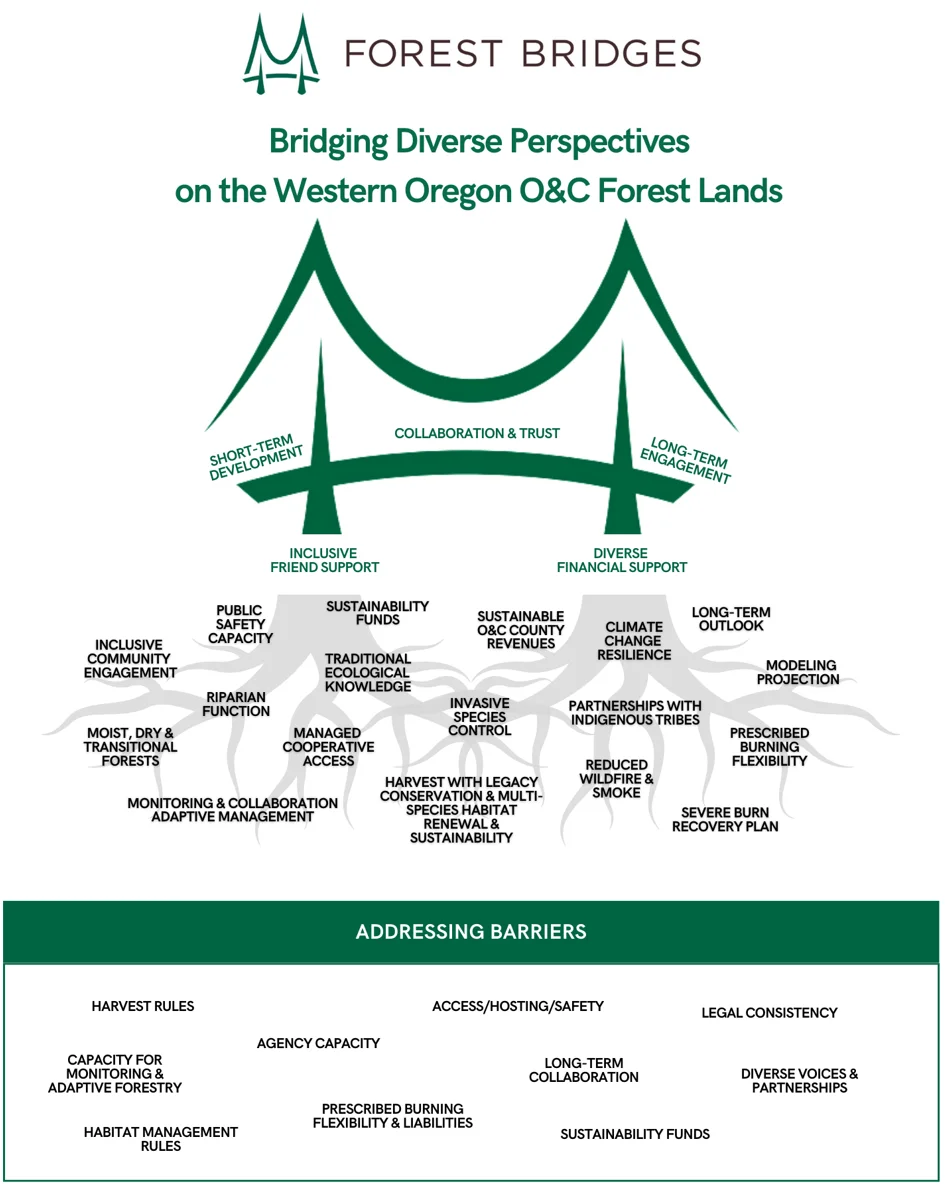
Forest Bridges: Working Toward Agreement on O&C Lands


I’m always interested in people seeking agreement about forest issues, and Oregon seems to be a long-time source of ongoing controversy.  Thanks to Nick Smith for this one.

There was an interview on Jefferson Public Radio, but I couldn’t find it.  Here’s the description.

The so-called “O&C lands” of Western Oregon have long been a focus of contention. They are lands once given by the federal government to the Oregon & California Railroad (O&C), taken back by the feds, then managed under law by the federal Bureau of Land Management.

The bone of contention comes from the sharing of timber receipts from those lands with the 18 O&C counties, which puts pressure on those lands to produce timber.

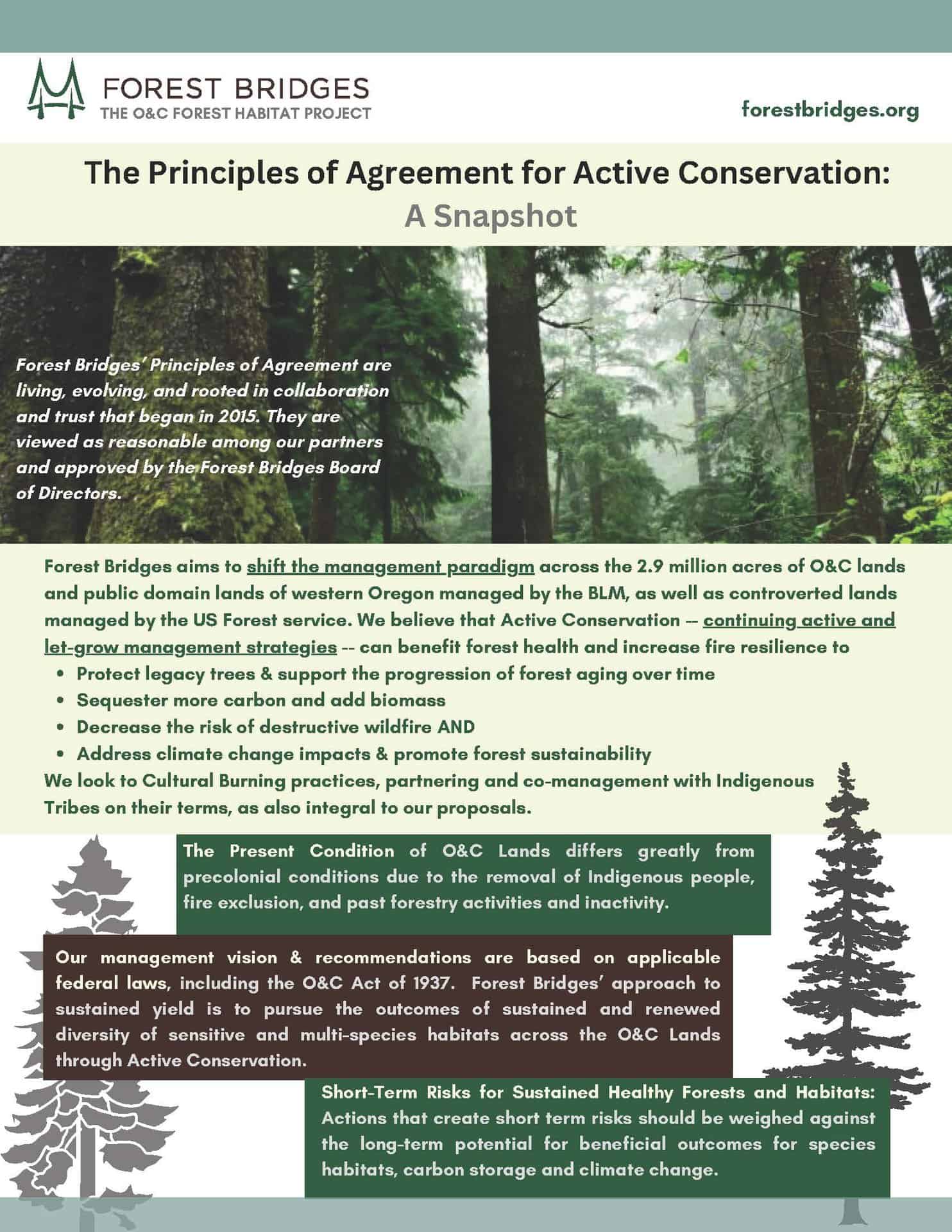
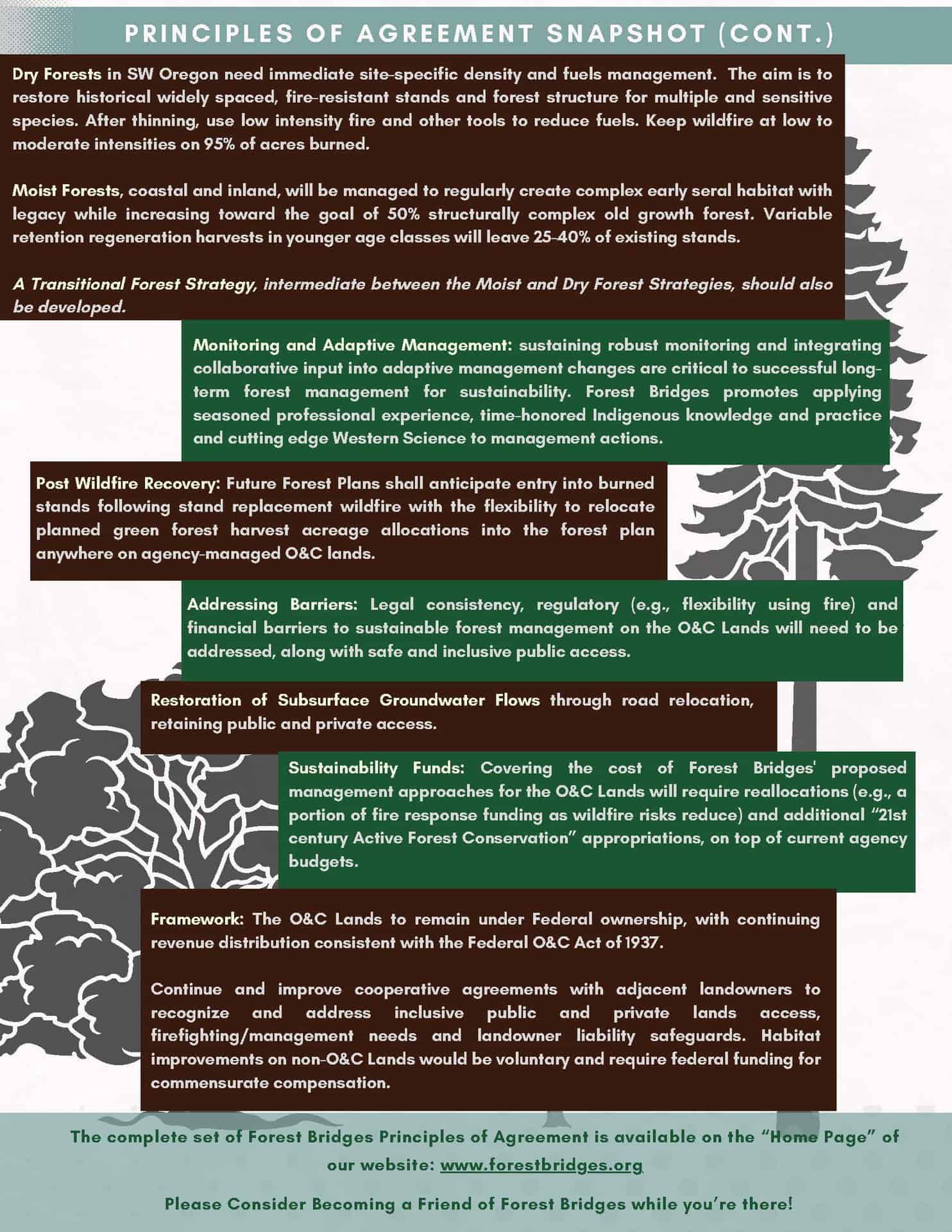
The nonprofit Forest Bridges proposes bringing the multiple sides of the debate together, to agree on timber cutting methods, and–more importantly–which land to include in the timber base. Forest Bridges Executive Director Denise Barrett gives us an interview with an overview.

Forest Bridges has a good website with lots of info. Their Principles of Agreement are here.

Below is a snapshot of their principles of agreement. Feel free to discuss anything on the website in the comments.

Is it A Time for Peace Yet? Chief Thomas Quotes our Old Friend Kohelet


PERC’s photo

Awhile back I attended a Western Governors conference, and Lesli Allison of Western Landowners Alliance asked the question “what if we think of ranchers as partners, rather than antagonists”? Could we actually make more progress toward conservation?”

I thought of her question when I recently read about PERC ‘s Brucellosis Compensation Fund.

PERC’s collaboration with—and listening to—area ranchers produced an innovative means to help them bear the burden of brucellosis risk. If successful, the fund will help lay the groundwork to address similar challenges throughout the Greater Yellowstone Ecosystem and beyond.

Yes, I realize that PERC advocates free-market solutions, but if they work, at no cost to the taxpayer, what’s not to like?  They listened and respected the ranchers.  They found a way to resolve a conflict and improve conservation.

I think free-range “enemyism” can keep us from solutions, and needlessly subject groups to a position of “forever enemy-hood.”  And we all know who the bad guys are… the forest products industry, ranchers, miners,  oil and gas folks.. and OHV people.  “Enemyism” is particularly annoying (in my view), when it co-occurs with moralizing.   For forest products, oil and gas, and mining, it seems to me that there is a certain element of hypocrisy- some people use these things, and rich people use a lot of them.  For me, as a person with a Judaeo-Christian background, it’s bit like God saying in Deuteronomy  “it’s OK to eat camels but only if the Canaanites prepare them.”

Awhile back I posted this about an interview with Michael Webber, Prof at UT, who thinks we need an “all hands on deck” approach to decarbonization.

Is there a way to work with them, rather than against them, to promote a low-carbon future?

Unquestionably, many oil and gas companies have been bad actors. At best, the petroleum industry has ignored the problem while making a profit off the products that worsened the situation. At worst, it actively worked to delay action by funding misinformation campaigns or lobbying to delay policy action.

But blaming the industry leaves out our own culpability for our consumptive, impactful lifestyles. Oil consumption is as much about demand as supply.

Rather than finding someone to blame, let’s look for who can help.

Meanwhile, around the National Forests, collaborative groups are working together across different interests. But is there anyone whose job it is to find common ground at the national or regional level?  Bless their hearts, it seems that politicians are generally more interested in rewarding their friends and punishing their enemies than seeking long-term peace and expediting things everyone agrees on.  In fact, it could be in their parochial interests to prolong and intensify divisions.  At least some think that it is in their interests. So yes, that’s a difficulty under our current system.  What would it take to change this dynamic?

I’d like to go back to this 2001 interview of Chief Jack Ward Thomas (128 pages, lots of interesting history, recommended).

HKS: You’ve introduced a subject that I’d like you to talk a little bit about. I hadn’t heard the term “conflict industry”—eco-warriors and other things. You’ve been critical of the environmentalists. You have said that they have won the war and now they’re wandering the battlefield bayoneting the wounded.  They’re not helping anything. They’re only opposing. Do you think it’s because these guys are making three hundred thousand dollars a year, that that’s part of why they are not doing something?

JWT: Let’s not go too far with that. For everybody in the environmental industry that’s making several hundred thousand dollars a year there are probably some number of hundreds working for minimum wage, if that, working for what they think is right. But it matters not what the reason is, people are dedicated to the fight for the environment. There is a time to fight. There is a time for all things under the sun. There is a time to make peace. I think the general environmental war related to the Forest Service is over. In reality, industry needs to abandon sponsoring “ghost dances” to bring back the buffalo—i.e., the good old days. Those days aren’t coming back. It is time for the environmentalists to ease up. They are not going to finish off those who extract natural resources. Now we’ve come to where we stand today. And it is time to ask, “What are some of the things that we could agree upon?” Certainly
an appropriate, well-maintained road system should be one, and there may be others. If one performed an analysis of public opinion related to the management of the national forests considering protection and extraction of resources, you would be looking at a standard U-shaped curve. You might surmise that there was no room for agreement there, but I suspect if you conducted a public opinion poll you would find that the results yield a curve that resembles a bell. This leads me to the conclusion that in a democracy decisions are made by the majority of the minority that cares about the issue. Those that care enough about national forests to participate in planning efforts seem to be split in their opinions. I don’t know how we get them to middle ground, but the general public is much more inclined to accept some middle ground.

HKS: Did you ever discuss this directly, one to one, informally over a cup of coffee with the head of one of these organizations? Why don’t you guys help us?

JWT: Yes I tried that, and most of those from the “industry” believed me to be prone to accept the environmentalists’ view, and most of the environmentalists believed me to favor the industry position. So I guess I did not do so well as a moderator and a broker for the “middle ground.” I think the American people are wearing out with this unrelenting battle, and sooner or later they will insist on some middle ground approach to management. There are management actions by the Forest Service upon which both sides ought to be able to agree. Things such as dealing with issues of forest health. Extreme environmentalists might say, “That’s just another Forest Service excuse to whack down trees.” I’ve even been told that if the trees removed were decked and burned, support for restoration activities might be forthcoming. In other words, there should be no commercial use of trees removed. Well, I think that is a bit goofy.

Here in the Bitterroot Valley of Montana you would think from reading the newspaper reports that the Forest Service is moving ahead with salvage and that dealing with forest health issues in burned areas is overwhelmingly opposed by local people. Yet public opinion polls indicate the vast majority want to move ahead with such activities. They might argue about what “something” is but the vast majority of those polled, at least at this point, are adamant that active management is required. But that is not what you would think after attending public hearings or reading the newspaper.

(my bold)

What do you think? Could we have gotten further down the “national or regional” peace path since 2001?  What opportunities have we had that may have been missed?  Do you think the NWFP revision/amendment has the ability to lead to a lasting peace? What would you recommend to lead to peace?  Do you think real collaboration is only possible at the local level?  Why?

Blue Mountain Forest Partners Make the Think Tank Big Time as Examples of “Collective Settings”

Shout out to all our friends at Blue Mountain Forest Partners!

**********

Summary: In December 2023 More in Common and the SNF Agora Institute at Johns Hopkins University published a new report that aims to re-invigorate discussion about a paradigm that long served to strengthen democracy, but which has fallen out of fashion the past several decades. “Collective Settings” describes how, by investing in the design and distribution of civic infrastructure, communities cultivate the capabilities of their residents to work across lines of difference to solve public problems. 

What are Collective Settings?

The new report, “Searching for a New Paradigm: Collective Settings,” makes the case for reinvigorating civic infrastructure as a complement to existing institutional reform and bridge-building efforts. Critically, we find that to build a more robust and vibrant democracy, Americans need more experiences where they engage directly with others to address public problems. This happens through collective settings, organizations and spaces designed to bring people to the table and enable them to hash out problems together.

These settings are what Alexis de Tocqueville described as “schools of democracy” and have been a prominent feature of the American landscape throughout history.

Think about neighbors coming together to build a new park, co-manage shared resources, or deliver aid during crises. While these sorts of activities often appear to happen almost spontaneously, we argue that where they are successful, they are the product of well-designed and developed civic infrastructure: collective settings.

Image created with DALL-E

Report Highlights

The report emerged from several years’ worth of convenings, research, and analysis of existing paradigms for how to strengthen democracy. As part of the project, scholar Isak Tranvik produced an essay that lays out the important features that healthy collective settings demonstrate.

Similarly, for this project, scholar Emily B. Campbell conducted a series of case studies to describe how collective settings play out relative to democracy paradigms rooted at the behavioral or institutional level. They feature:

  • Electoral reform (institutional) in Alaska
  • The behavioral interventions of Braver Angels of Central Texas
  • The collective settings of Blue Mountain Forest Partners in Oregon

Emily’s work demonstrates the ways these three paradigms—behavioral, collective settings, and institutional—complement one another while pursuing distinct strategies and approaches.

The intent of the report is not to highlight flaws in existing efforts to improve democracy, but to show that much greater attention needs to be placed on collective settings.

Collective settings, we argue, are where Americans build the skills, habits, and dispositions necessary to successfully navigate an unknowable future together, in ways that preserve and strengthen democratic norms and institutions.

As we write in the report, “By investing in collective settings, we hope to develop the muscles for democracy that people and communities will need to seek, identify, and implement shared solutions that do not accept the world as it is but instead create the world they need.”

Recommendations

We include in the report the following recommendations.

For Researchers: We need much more (widely disseminated) research to help us better understand multiple themes.

  • Distribution gaps: Where do well-designed collective settings exist, or not? How are they distributed across off-line and online settings?
  • Design features: What are the design features that influence whether collective settings cultivate healthy democratic capabilities?
  • Return on investment: What measures can we use to examine the impacts of collective settings? What measurement and evaluation frameworks enable philanthropists and practitioners to maintain rigor even when designing for uncertainty?

For Philanthropy: Collective settings need both funding and philanthropic organizing.

  • Address distribution concerns: New funding opportunities can invest in creating well-designed collective settings in areas where such settings are rare or absent.
  • Shift incentives to emphasize designing for contingency: Funding opportunities can emphasize metrics that focus on the cultivation of dynamic democratic capabilities at both the individual and organizational levels.
  • Empower learning: Resourcing the connective tissue between research and practice, and cultivating fellowships and other human networks to share lessons learned, can strengthen the field.
  • Nurture the philanthropic community: Funding communities organized vertically (bringing local, state, and national funders together) and horizontally (across ideological, geographic, demographic, and issue-based difference) can coordinate resources and mitigate against unnecessary politicization.

For Civil Society, Business, and Government: Civil society leaders can cultivate collective settings in their work and communities. Likewise, the state and markets each play a crucial role in creating settings (like the workplace) where people interact with each other. All three sectors impact the design and distribution of settings.

  • Invest in design: Thinking intentionally about the design features of self-governing communities (governance practices, accountability, learning systems) can make collective settings more likely.
  • Consider distribution: Local and regional groups across civil society, business, and government can consider working together to identify and fill gaps in access to well-designed collective settings.

Over the Weekend – Blue Mtn. blues, Flathead secrets and monumental benefits

I guess this is a bookend to Sharon’s “Friday News Roundup.”


BLUE MOUNTAINS

I recently provided an update on the status of the Blue Mountains forest plan revisions here.   And here’s a little more detail on that, especially on the question of “access.”  (This term gets used for a couple of different things, and this one is about closing roads on national forests rather than creating access across private property to reach public lands.)

One group says its leading the charge to fight for what they call “original rights” is Forest Access for All.  “We defend the rights that we’ve had since Oregon was a territory, free reign where we go and utilize the forests which are public lands,” says Bill Harvey, a group member and former Baker County Commissioner. “A couple decades ago the Forest Service began closing off sections of the forest and that’s when Forest Access for All was formed.” Harvey says his group’s particular ire is at the Wallowa-Whitman National Forest (WWNF), which he claims “have closed thousands of miles of roads in the forest the last twenty years.”

The group also has other “conflicts” with the Forest Service include the need for  more vegetation management, economic benefits of (motorized) recreation, and better public engagement.

“By law right now, we have an open forest. They will admit it, everybody admits it, and it’s in the books, I’ve seen it a million times. It is an open access forest,” says Harvey. “Why in God’s name would we want to give that up? Nothing benefits us to give up our rights that we have currently. We’re not asking for more rights, we’re asking for the existing rights to stay in place.

I’m going to disagree with him on this one, and I hope the Forest Service does, too (although it looks like they could have done a better job of setting the locals straight on this before now).  In 2005, Subpart B of the Travel Management Rule changed the culture of motor vehicle use on roads, trails, and areas from “Open unless closed” to a system of designated routes.  As for why?  The goal was to reduce resource damage from unmanaged motor vehicle use off that road system.


FLATHEAD

Newly revealed emails show that the Flathead National Forest under then supervisor Kurt Steele looked to keep a proposal of a tram up Columbia Mountain from public view for more than year prior to it being first proposed.

Does this sound familiar?  It sounds to me like the “Holland Lake Model” that got the forest supervisor a “promotion” to forest planning.  In this case the Forest properly rejected the proposal as inconsistent with its forest plan (thank you forest plan!).  But it does suggest a pattern of incentives and behavior that may be broader than the Flathead National Forest.

“The process where the public comes into play is when it becomes the NEPA process,” Flathead Forest spokesperson Kira Powell said about the emails.

“Bringing you into the conversation about this potential project on the Flathead NF because it’s coming from investors who apparently have the financial resources to build a tramway, meaning they likely have political savvy also … wrote Keith Lannom, who was deputy regional forester for Region 1 at the time …”

This account offers a window into the role of “political savvy” in Forest Service decision-making.


ORGAN MOUNTAINS – DESERT PEAKS NATIONAL MONUMENT

Since President Barack Obama created the Organ Mountains-Desert Peaks National Monument in 2014, visitation has tripled and the national monument has spurred economic growth in the Las Cruces area as well as other communities near the national monument, according to a new report.

According to this overview, the report looks at the various factors that made this particular monument so successful, including its location relative to population centers and the uses it caters to.  Also local community support.

“We have always recognized that the establishment of the monument was due in large part to the grassroots effort at the local community organizations and individuals,” Melanie Barnes, the state BLM director, said. “And due to this engaged and proud community, the monument has seen an increase in visitation.”

She said the BLM is working on a resource management plan that will address land use and resource protection. The public scoping period for that plan recently ended.


House of Representatives v. BLM – monuments and the public lands rule

Grand Staircase – “visitutah.com” (Larry C. Price)

Dismissal of a lawsuit against President Biden’s proclamation restoring the boundaries of the Grand Staircase and Bears Ears national monuments allows the NEPA process to develop a management plan for these areas to proceed unhindered.  Biden ordered the BLM to work on replacing the Trump Administration’s resource management plan, and the BLM published its draft RMP on August 11 for public comment.

BLM may proceed unhindered, that is unless Congress decides to hinder them.  The FY2024 Interior, Environment, and Related Agencies Bill the House Appropriations Committee passed in July, which the full House of Representatives is expected to vote on in September, includes a rider that would require the BLM to manage the Grand Staircase NM in accordance with the plan finalized after Trump reduced the monument.

Which is the better planning process – RMPs based on public involvement through NEPA or RMPs based on appropriations riders?

The bill would also deny funding to implement the BLM’s public lands rule (a popular topic with many posts here from Sharon).  Another bill would force BLM to withdraw the rule (without considering all those public comments).

Kya Marienfeld, wild lands attorney for SUWA, called the Utah congressional delegation’s lack of support for the state’s public lands disappointing but adds that opposition is offset by more enlightened members of Congress who actively support the Grand Staircase and other public lands.

Appropriation riders seem to be kind of crap-shoot in the turmoil of budget negotiations, so I have no idea what the betting line would be on President Biden signing off on this one.  The “more enlightened members of Congress” may have more of an influence on defeating the withdrawal proposal.  Is that a bad thing?