The Northwest Forest Plan (NWFP, 1994) employed concepts from conservation biology in an attempt to protect old-growth habitat and associated species, including aquatic organisms, while providing a sustained level of timber harvest. Protection was to be achieved by severely limiting timber harvest, the major contemporary source of old forest loss, primarily through an extensive network of Late-Successional and Riparian Reserves. A sustained level of timber harvest was planned in the residual Matrix lands, though planned harvest levels never materialized.
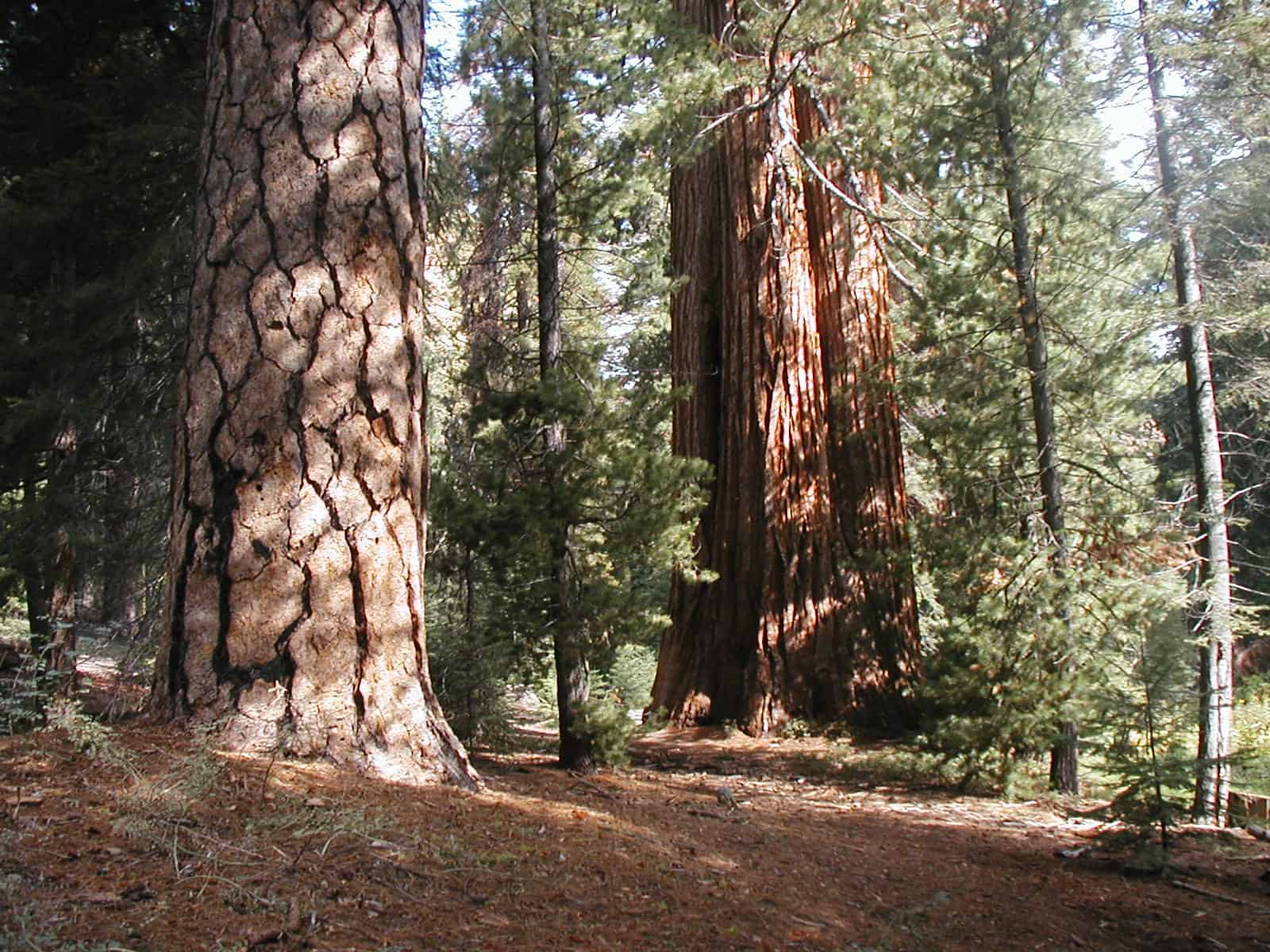
Old Douglas-fir (Santiam Wagon Road)
The NWFP successfully protected old-growth forests from logging, perhaps too successfully for those counting on the promised levels of timber harvest. But old forests continue to decline in large portions of the planning area because the plan failed to address the primary disturbance process resulting in loss of old forests in the 21st century: wildfire. Though conditions vary greatly across the region of the NWFP, widespread loss of old forest due to a renewed era of wildfire is significant and undeniable in the Oregon Cascades, the focal subregion of Johnson referenced in a recent TSW post and of particular interest to me. Neither the NWFP nor any of the proposed revisions plan for or respond to wildfire in meaningful ways, particularly for seasonally moist, westside forests.
How do I know wildfires are having significant effects on old forests in the Oregon Cascades? By going out and looking, and by documenting with text, maps and photos. As a spare-time project, I authored a series of old-growth hiking guides from 1991-2003 (out-of-print) showing the location and type of old growth along hiking trails in the Oregon and Washington Cascades. And now, 30 years later (2022-2026), I’ve gone back and revisited over 100 of these hikes in the Oregon Cascades (book in review.)
Many agents of change have been at work over the past 30 years, including those furthering development of complex old-forest habitat, but wildfire has overwhelmingly been the primary phenomenon driving loss of old forests. To put this into context, of the 120 old-growth hikes in the Oregon Cascades I documented 30 years ago, most of the old growth has since severely burned on 31 (26%) of those hikes, and an additional 16 (13%) hikes experienced a significant loss of old growth due to wildfire. Though widely distributed across forest and habitat types, these hikes are not a representative sample of the region. Nevertheless, 39% of the hikes have had significant loss of old growth along trails due to wildfire, over 30 years, most occurring over the last 20 years. A key point to understand is that these losses are occurring in seasonally moist forests on the westside.
Essentially all large fires contain a mix of fire severities, and fire effects in today’s old forests are quite varied. Large areas often burn at high severity though, and even in areas burned at lower severity the post-fire forest will take many decades to fully recover the lush and complex understory communities typical of these forests. Even with surface fires, significant mortality often arises from root and root collar damage due to uncharacteristically high fuel loads and warming summers. Recent fire history and anthropological studies point to an approximate 200-year period of fire exclusion and suppression in these forests.
Duff mound consumption (Lookout Creek)Moderate-severity fire (Chuckle Springs)High-severity fire (Multnomah Creek)
Fire is undoubtedly a natural and necessary part of these ecosystems, but old forests have been greatly diminished and fragmented from 50 years of dispersed clearcutting and recent wildfires on national forests. And on nonfederal lands old forests have been essentially eliminated. The result is greatly reduced habitat and vital ecosystem services, e.g., carbon sequestration. There simply isn’t much old forest left to carry the load while burned forests recover.
Wildfire poses many challenges that often defy control, but a NWFP for the 21st century must directly address and integrate wildland fire in all its dimensions. It is hard to imagine a successful conservation plan that doesn’t address the primary disturbance process causing loss of old forests. And wildfire will almost certainly remain the primary source of old-forest loss throughout the Oregon Cascades in the coming decades. Ideally, the full suite of fire prevention, mitigation, fuels treatment, wildfire response and recovery priorities and strategies will be integrated with protection and conservation of old forests.
What would that look like? I have notions, but a key point is that fire operations and management staff must be enlisted to help craft solutions. They are the ones with the practical experience and on-the-ground knowledge, and they are the ones who have a strong vested interest in getting this right. Resource specialists and ecologists working with fire personnel can best articulate how protection and conservation of old forests can be integrated throughout wildland fire operations.
Protection of old forests in the 21st century likely means a different conservation strategy than one based on Late Successional Reserves (LSRs.) LSRs were sized and located based on habitat needs of the northern spotted owl, a species that is functionally extirpated throughout most of the Oregon Cascades. Fire protection and management needs were not integrated into LSR siting, and significant portions of several Oregon Cascade LSRs have already severely burned. Proposed NWFP revisions appropriately include measures to protect all mature and old forests from logging wherever they are found, obviating the primary purpose of LSRs.
Potential fire refugia may provide a sounder basis for protection and conservation of old forests. Refugia, places that stand a higher probability of avoiding or surviving fire, might be locations that have a biophysical basis for protection, such as cirque basins or adjoining wetlands. Operational reasons may also define high-priority refugia, such as places where existing roads or other features delineate a defendable space. Potential fire refugia could usefully inform all aspects of fire prevention, fuels planning, and wildfire response and recovery.
My goal with this post has been to identify a clear need to update the NWFP to account for the actually occurring primary source of old-forest loss in the Oregon Cascades: wildfire. There are many issues important to the conservation of old forests beyond the scope of this post, e.g., post-fire reforestation and salvage, treatment of young stands, the importance of mature forests, and the risks from continued atmospheric warming other than fire. But wildfire can no longer be treated as an inconvenient, exogenous variable to grand plans and theories of conservation. Continued loss of old forest at the current rate will doom these forests well before the end of the century.
*****************
John Cissel is retired from a 35-year professional career, including roles as:
1) Director, Joint Fire Science Program (2007-2016), 2) Research Coordinator, Oregon BLM (2003-2006), 3) HJ Andrews Experimental Forest Research Liaison, US Forest Service and Oregon State University (1990-2002), 4) Planning Analyst and Team Leader, US Forest Service (1981-1989.)
He has also authored a series of old-growth hiking guides in the 1990s, culminating in the book “Old-Growth Forest Hikes: Washington and Oregon Cascades” published in 2003. A new book “Field Guide to Old-Growth Forests in the Oregon Cascades” is currently in review (PNWOldGrowthHikesPNW.org.)
Now, I was never a fan of the NOGA process. Keeping old trees alive can be hard. National Forest employees know where their old-growth is and forest plans already have restrictions on doing things in old-growth. I seldom agree with Andy Kerr, but even he said that the FS doesn’t say that treatments are commercial when OG stands are treated. Whether you believe that “other reasons” are mostly legitimate (as I do) or excuses to go after old-growth for sawmills (as Andy K. appears to), it doesn’t change the fact that the paperwork right now says that in very few places is cutting trees for commercial purposes allowed in old-growth.
I remember hearing from someone in the FS something along the lines that timber cutting in OG stands for commercial purposes are only allowed now in two places, Alaska and a forest in Region 1. If others know more about this, please comment. And remember, the same groups that wanted OG “protection” also wanted mature “protection.” If I looked at the list of some of the supportive NGOs, it sounded like some of the same from the old “zero cut” campaign.
But there are interesting questions to be raised. Why now? The Biden Admin recently approved the Rock Springs RMP (conservation-y, against wishes of locals and elected officials), Lava Ridge Wind Project (developmenty- against wishes of locals and elected officials), new Monuments are coming from a conservation-y perspectives, and there’s the Solar PEIS (we’ll look at that one further). Can we see a pattern of these last-minute give-aways? Maybe the Admin has friends in the renewable and conservation world and so is doing sometimes symbolic gestures of support, since many of them can be overturned in the next Admin. Against that, though, we see “no” to NOGA. Someone knows the answer, but they’re not telling, at least not now.
E&E News Story: Headline: Biden Admin Nixes Old-Growth Forest Plan
As usual, the best coverage (in terms of least biased greatest depth) is from E&E News, so thanks to reporter Marc Heller.
But proponents of old-growth protections said abandoning the plan was, in their view, a better alternative than leaving it to the next administration. Had the administration left the effort intact, the incoming Trump administration might have looked to implement it in ways counter to the outgoing administration’s goals, said Ellen Montgomery, public lands campaign director for Environment America.
My guess would be that they would stick a fork in it, not “implement it in ways counter to” Biden Admin goals. It doesn’t add up to me. I looked into Environment America a bit-here’s their form letter on old growth. It seems to be a c4.
Centuries-old trees are still growing across the country, but on federal forest lands many of them are vulnerable to logging. Once these ancient trees are cut down, old-growth trees will be lost forever. Our older forests are still being logged at an alarming rate — this directly undermines the Biden administration’s efforts to address climate change and protect 30% of lands and waters by 2030.
Old-growth and mature trees form the backbone of their ecosystems, absorbing carbon dioxide, maintaining genetic diversity and providing habitat for all sorts of life.
I urge you to take action to protect older forests and trees on public lands in the United States from logging, and to ensure federal agencies work to recover these carbon rich landscapes for their climate, biodiversity, and watershed benefits to our nation.
This is their 2022 list of funders, many of the usual groups and foundations:
Environment America Research & Policy Center would like to thank the following foundations and organizations for supporting our work in fiscal year 2022: 444S Foundation, American Heart Association, American Littoral Society, Bydale Foundation, CLASP, Clean and Prosperous America, Curtis and Edith Munson Foundation, Environmental Defense Action Fund, Gordon and Betty Moore Foundation, Hittman Family Foundation, Natural Resources Defense Council, Natural Resources Defense Council Action Fund, Oregon Wild, Overbrook Foundation, Park Foundation, Patagonia, Paul M. Angell Family Foundation, The New-Land Foundation, The Protection Campaign – a project of Resources Legacy Fund, The Stone and Holt Weeks Foundation, The Tilia Fund and Weeden Foundation.
Maybe we can see through this list where the impetus was for the proposal, and maybe these folks are so high-level and anti-logging they don’t understand that many of us see tree-users as useful partners and not enemies. Without doing a check, I’d guess many are headquartered outside dry forest country. So that explanation doesn’t ring true to me.
I did get a chuckle out of this AP headline:
Biden administration withdraws old-growth forest plan after getting pushback from industry and GOP
Hmm. I know it’s just a headline, but a) this has been getting pushback since it was introduced, and b) the Biden Admin has been getting pushback from western elected officials on the other projects that are going through in these last days. And not just public lands, think of putting millions of offshore acres off-limits to oil and gas.
But those exceptions were not enough for the timber industry and Republicans in Congress who bitterly opposed the administration’s proposal. They said it wasn’t needed since many forested areas already are protected. And they warned it could be devastating to logging companies that rely on access to cheap timber on public lands.
I read some industry comments and I don’t think the industry folks said that. I wish the reporter had quoted whoever said that.
Anyway, that doesn’t make sense either- Biden Admin suddenly realizes the idea is unpopular in some quarters.
How the U.S. got no old growth forest protections from the Biden Administration (commentary)
At least Dominick DellaSalla spreads the blame around in this Mongabay essay:
All sides are to blame for a failed NOGA policy that was the result of: (1) definition paralysis that delayed action; (2) rebranding strategies by the timber industry that positioned logging as the solution to all “forest health” issues rather than the problem itself; (3) questionable agency threat assessments that supported the industry narrative; and (4) the lack of a unified vision for forest protection by conservation groups. Let me break the failure to act down, piece by piece.
As more and more communities participate in fuel treatment projects, and see the impacts when fire comes toward their communities, and as more and more homeowners do mitigation themselves, the gap between the “no cutting narrative” and peoples’ lived experience grows. At the end of the day, people believe their own eyes and lose trust in the folks that tell them things that aren’t true. Especially when their experience is downplayed, e.g., fuel treatments as “specious arguments.”
A similarly specious argument to save forests from burning up is being played out not only in the NOGA process but in every dry forest region of the country, as logging is rebranded as community fire protection, even as fires race across logged landscapes.
*************
But none of the above effectively answer the question in my mind “why stick a fork in this before the next Admin comes in, when sister department Interior is spurting out equally, or more, unpopular decisions at a rapid rate?” My only guess would have to do with the fact that there are more politicals and fewer career folks around headquarters at the BLM, but I have to think that there is more to it than that.
There are some other recent threads here that have been discussing this question, and I thought it might be helpful to post the actual language from the draft of the amendment (Table 1) that would answer this question. It establishes criteria at the plan level that must be met by projects proposed in forests identified as old growth, as well as a guideline for removing “old trees” in other areas. I have to say my overall impression is that there are enough exceptions that it is hard to believe the Forest Service couldn’t find one that would allow removal of large/old trees in any project it proposes. On the other hand, this does put the burden on the Forest Service to demonstrate in the project record that the project would meet the exception, e.g. that it would in fact “reduce hazardous fuels.” (But any wood is a “fuel,” so what makes it “hazardous?”)
I think Standard 3 is interesting. If projects in old growth forests can not be for commercial timber production, I assume that these forests must then be classified as unsuitable for timber production?
An interesting omission: “resilience to climate change,” which is what the 2012 Planning Rule is all about.
I’ve added a few italics to help frame the structure (and I see that the copying messed up the numbering of the criteria ….).
(The comment period closes around September 21.)
Standard 2.a
Where conditions meet the definitions and associated criteria
of old-growth forest, vegetation management may only be for
the purpose of proactive stewardship. For the purposes of this
standard, the term “vegetation management” includes – but is
not limited to – prescribed fire, timber harvest, and other
mechanical/non-mechanical treatments used to achieve
specific silviculture or other management objectives (e.g.
hazardous fuel reduction, wildlife habitat improvement). For
the purposes of this standard, the term “proactive stewardship”
refers to vegetation management that promotes the quality,
composition, structure, pattern, or ecological processes
necessary for old-growth forests to be resilient and adaptable
to stressors and likely future environments. Proactive
stewardship in old-growth forests shall promote one or more of
the following:
reduction of hazardous fuels to reduce the risk of loss
of old-growth forests to uncharacteristic wildfire, and to
facilitate the return of appropriate fire disturbance
regimes and conditions;
resilience to insect and disease outbreaks that would
result in the loss of old-growth conditions;
1. ecological conditions for at-risk species associated
with old-growth forest, including conditions needed for
the recovery of threatened and endangered species;
amount, density, distribution and species composition
of old trees, downed logs, and standing snags
appropriate for the forest ecosystem type;
vertical and horizontal distribution of old-growth
structures, including canopy structure and composition;
patch size characteristics, percentage or proportion of
forest interior, and connectivity;
1. types, frequencies, severities, patch sizes, extent, and
spatial patterns of disturbances;
1. successional pathways and stand development;
connectivity and the ability of old-growth obligate
species to move through the area and cross into
adjacent areas;
culturally significant species or values, to include key
understory species;
species diversity, and presence and abundance of rare
or unique habitat features associated with old-growth
forests; or
1. other key characteristics of ecological integrity
associated with old-growth forests.
Standard 2.b
The cutting or removal of trees in old-growth forest for
purposes other than proactive stewardship is permitted when
(1) incidental to the implementation of a management activity
not otherwise prohibited by the plan, and (2) the area – as
defined at an ecologically appropriate scale – continues to
meet the definition and associated criteria for old-growth forest
after the incidental tree cutting or removal.
Standard 2.c
Deviation from Standard 2.a and 2.b may only be allowed if
the responsible official determines that vegetation
management actions or incidental tree-cutting or removal are
necessary for the following reasons and includes the rationale
in a decision document or supporting documentation:
In cases where this standard would preclude
achievement of wildfire risk management objectives
within municipal watersheds or the wildland-urban
interface (WUI) as defined in Section 101 of the
Healthy Forest Restoration Act of 2003 (16 USC
6511) and its application by the local planning unit, or
would prevent protection of critical infrastructure from
wildfire;
to protect public health and safety;
1. to comply with other statutes or regulations, valid
existing rights for mineral and energy resources, or
authorizations of occupancy and use made prior to
the old-growth amendment decision;
for culturally significant uses as informed by tribes or
for de minimis use for local community purposes;
in areas designated for research purposes, such as
experimental forests or research natural areas; or
in cases where it is determined – based on best
available science, which includes Indigenous
Knowledge – that the direction in this standard is not
relevant or beneficial to a particular species or forest
ecosystem type.
Standard 3
Proactive stewardship in old-growth forests shall not be for the
purpose of timber production as defined in 36 CFR 219.19.
Guideline 3
To preserve the cultural and historical value of old trees
occurring outside of old-growth forests, vegetation
management projects should retain and promote the
conservation and survivability of old trees that are rare when
compared to nearby forested conditions that are of a
noticeable younger age class or unique in their ability to
persist in the current or future environment, and are not
detracting from desired species composition or ecological
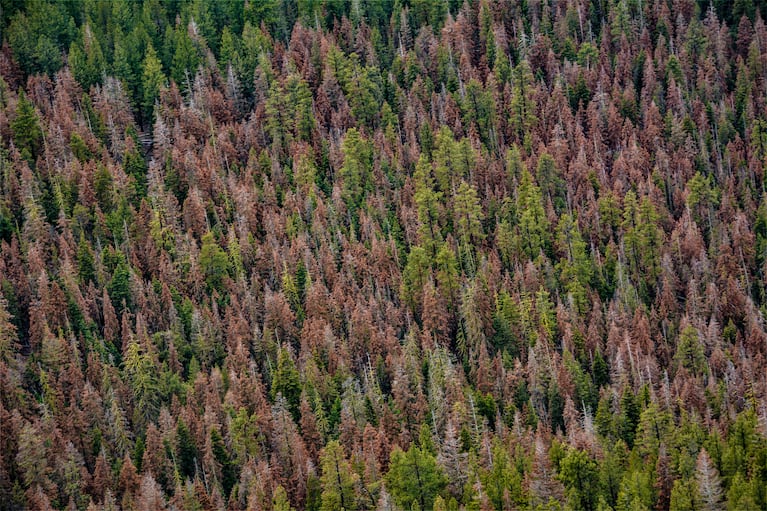
Keeping trees alive sequestering carbon is harder than it looks.Fir die-off as observed during this year’s aerial survey in the Fremont-Winema National Forest in southern Oregon.Daniel DePinte / USFS
Before I get into the weird and wonderful world of new wildfire technologies, I thought that this Anonymous comment was worthy of more discussion, because of the links to different scientific papers. It’s not unrelated to our previous discussion of the “large diameter trees” aka the East Side amendment, especially if you have spent much time working in pine/true fir country.
After reading through the links, I found some general differences in framing, approach, and language that I think may help us clarify our agreements and disagreements.
1. What specific words are used (old-growth forests vs. old trees)? As we know OG forests have all kinds of spiritual and ecological dimensions. Old trees occur in all kinds of settings, like our backyards or fence rows. And old is relative. Plus small trees can be relatively old, and large trees relatively young. Then there’s “mostly” and “generally” and other words like that- the caveats that we find in many papers. Is it generally around the planet? Generally in the Ashland, Oregon watershed?
2. What’s the goal? In some cases, it’s to maximize the area in old growth. In other cases, it’s to replicate what was in the past. Or it may be to protect some old trees from fire. Or just general forest (including conceivably, trees’) resilience to future changes. Logically, HRV can’t, by definition, be more resilient to future stressors, if climate change is unprecedented. So the goals (states or implicit) in scientific papers may not actually line up with each other, nor do they with current statutes and regulations.
3. What disciplines and data are used to make a claim? It seems like stand prescriptions are a function of silviculture, pathology and entomology, fuels, wildlife and so on. If a statement argues some generality like “don’t cut any old trees, it’s bad for (something),” what are the other disciplines that might be saying “it’s good for (something else). I think much of the current disagreement amounts to metascale pronouncements/abstractions versus site-specific prescriptions. Which brings us to ..
4. Where was the research done? Did they encounter forests directly and measure them, or use existing datasets? How much can we generalize those conclusions to other part of the country? Is the ecological term “dry forests” meaningful in the same way from Montana to New Mexico and from the Eldorado to the Black Hills? Do we lose key information when we generalize?
It’s almost as if, with some of these arguments (it’s never good to cut any old trees), some folks are saying:
We (certain forest ecologists and members of certain ENGOs) actually know more about what is a good prescription (for a site we’ve never seen) than the ID team who has been there, measured things, and contributed their disciplinary input.
a) because they are bad at their work and/or
b) they have bad motivations- even where there is no timber industry to speak of, or they are not in the timber shop,
c) not yet articulated..?
The problem I see, though, with that thinking, is that there is often much more relevant and direct knowledge, and often intense interdisciplinary dialogue and challenge on an ID team (and with the public) than with a few academics in a discipline analyzing data and exchanging emails. And if local practitioners are bad at their work, aren’t many of these researchers teaching at the same universities that award degrees in those fields? So is there some kind of technological or motivational canyon they fall into after graduation? Or possibly, no matter their continuing education and experience, they will always know less than the profs? This is a great gig for the profs, but somewhat demoralizing for everyone else.
To which my solution is “fewer abstractions, more field trips.” Anyway, back to Anonymous’s comment.
‘Removing old-growth trees is necessary for resilience’ may be your opinion, but is not where the vast majority of empirical research and expert consensus is on this issue. Some examples of forest ecologists that have emphasized this in relation to western dry forest mgmt, and there are many more —
What is an “old-growth tree” is it an “old tree”? What makes a person an expert? Certainly there are experts who are not in this “consensus.”
1.“Old-growth trees, especially large old-growth trees of all species, definitely qualify as ‘ecological keystones’ given their central roles in ecosystem function, wildlife habitat, resilience as live trees and as large persistent snags and logs after death. In general, we recommend retaining trees of all species older than 150 years of age as part of dry forest restoration projects – even if they are within the crown of an old ponderosa pine tree.” ~Franklin et al. 2013
This makes me feel like “deja vu all over again.” In the 80’s, I remember a field trip on the Ochoco with Jerry Franklin (maybe Jim Z was there?) during which we asked him how much dead and downed (fuels) he thought was a good amount. It was really a fuels practitioner question, or even maybe a fire ecology question, not a vegetation ecology question. To some extent, values are imbedded in the choice of which discipline to listen to. Meanwhile, it’s hard to argue that fuels practitioners have a secret agenda of wanting to cut big trees.
I think the “within crowns” is an interesting comment because to me that’s a tree physiology or a fuels question, not a forest ecology question at all. Although practicing applied forest ecologists (i.e. silviculturists) have years of observational experience of how this works out in the woods in their area, e.g. big old firs under pines.
From the tree physiological perspective, does the old fir tree compete with the old pine for water? Answer – of course. Look at growth rings after thinning, if the trees are young or healthy enough to release. Does that impact the health of the more fire-resistant old ponderosa? Extremely likely. From the fuels perspective, does the true fir provide a potential hot spot next to the ponderosa that could make the fire more intense or be a ladder fuel? What happens to old true firs? They tend to die and dry out.
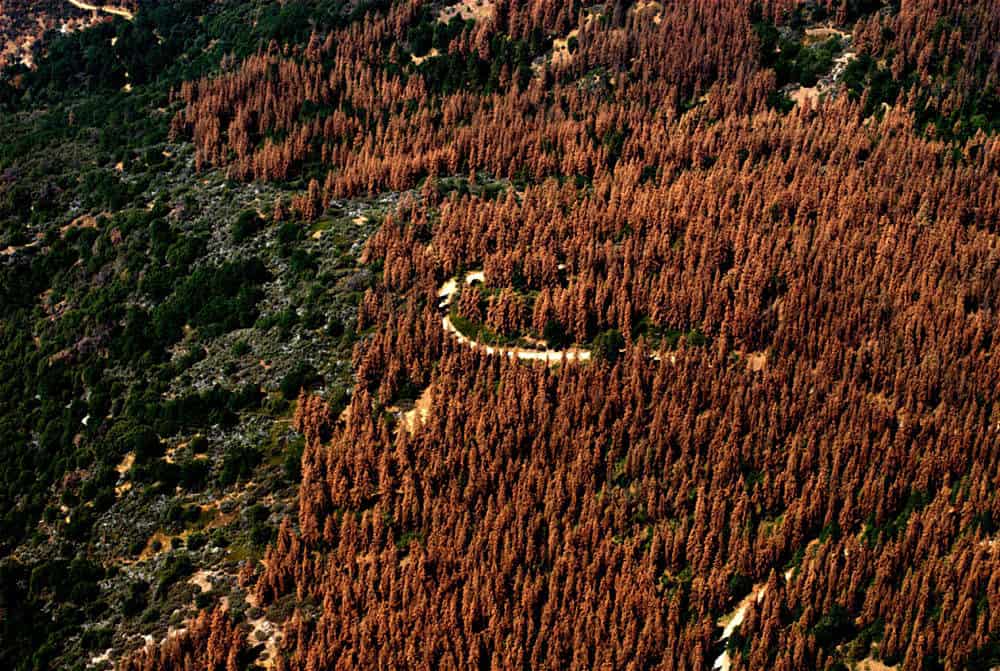
Heavily affected areas include the Fremont, Winema, Ochoco and Malheur National Forests.
The most southerly of the forests, the Fremont National Forest, was the hardest hit, according to survey data.
“We’re calling it ‘Firmageddon,’” Daniel DePinte, who led the survey for the USFS Pacific Northwest Region Aerial Survey, told a gathering of colleagues in October. “It is unprecedented, the number of acres we have seen impacted. It’s definitely significant and it’s disturbing.”
*******************
2.“In the context of forest restoration, we recommend that managers take the divisive issue of old tree harvest off the table, and instead focus on thinning young in-growth trees (i.e., those trees that established after Euro-American settlement) that have established around and among old trees and tree clumps. Focusing harvest on young trees will reduce competition, continuity of crown fuels, and contagion of host-specific tree enemies such as bark beetles, without causing conflict over proposed harvest of any remaining large trees. Such an approach is consistent with current guidelines for restoration and climate change adaptation in dry ponderosa pine and mixed-conifer forests.” ~Clyatt et al. 2016
If it’s this study, it was done by quantifying the historic range of variability for the Northern Rockies and specifically asked the question “how much is mortality density-dependent.” It also seems to argue that you can do more restoration if you don’t have conflicts, and some people (we know) don’t like cutting any old trees .
Yet many old trees are found in clumps, often in medium (5–9 trees) and even large (10 or more trees) clumps, and some managers and stakeholders express concerns over the potential for competition-induced mortality in these situations, even to the point of proposing to harvest some large, old trees occurring in clumps. Conflicts over proposals to thin out groups of large, old trees can often hinder restoration efforts (e.g., DellaSala et al., 2003, DellaSala et al., 2013).
I couldn’t find out more because the study seems to be paywalled, but I’m not on board with that argument.
**********************
3. “Enhancing forest resilience does not necessitate widespread cutting of any large-diameter tree species. Favoring early-seral species can be achieved with a focus on smaller trees and restoring surface fire, while retaining the existing large tree population.” ~Mildrexler et al. 2023
What is “widespread”..? It seem to me that a stand prescription is precisely that.. many stands won’t need any large/old trees cut, and others will. If this is the study I think it is, it’s a science op-ed in Conservation Science and Practice, whose coauthors include Law and Moomaw.
We therefore examined how often large trees (≥53 cm DBH) of these species co-mingle on USFS FIA plots (~1 acre) across the same six eastside national forests where we previously examined carbon storage by large trees (Mildrexler et al., 2020). Drawing on the same USFS FIA measurements as our prior study, we found that large ponderosa pine, grand fir, and western larch were present on 56%, 18%, and 7% of all plots (n = 3335). Large ponderosa pine co-mingle with large grand fir about 14% of the time (259 plots), leaving 86% of plots with large ponderosa pine without large grand fir (1616 plots). Similarly, large western larch co-mingle with large grand fir about 56% of the time. Large ponderosa pine and grand fir are found together on only 8% of all plots in the region, while large larch and grand fir are found together on only 4% of all plots in the region. In other words, large ponderosa pine are by far the most common tree species found in these six National Forests and infrequently co-mingle with large grand fir at the FIA plot scale, whereas large western larch are far less
So the argument is “we looked at some FIA plots and there’s not that many where they are growing together”. That could be true, but it’s not an argument for not cutting them when they are there, and provide ladder fuels/competition to old pondos. Again, see the tension between the site-specific and the larger scale data.
People might wonder about juxtaposing Firmageddon and this statement in the paper:
It is not uncommon for grand fir to reach 250 to 300 years of age (Howard & Aleksoff, 2000). Thus, large grand fir ≥53 cm DBH and <150 years of age can continue growing and play an important role in storing and accumulating carbon from the atmosphere to help abate the climate crisis.
If you remember Forplan in the 80s, the idea was to cut the ponderosa pine and promote true fir because it grows faster and produces more volume- if you assume away disease, bugs and fire. The end goal was different (timber vs. carbon) but hoping for grand fir to grow well forever is likely to run into the same, or more problems, now as 50 years ago. Because there’s increasing drought and fire, and bugs and diseases, according to some, due to climate change. Seems like it would make it less likely that true firs would thrive.
*****************************
4. “Because old trees are rare in most frequent-fire forests of western North America, it is imperative to conserve them where they exist.” ~Fiedler et al. 2007
There is no one-size-fits-all approach to managing frequent-fire, old-growth forests. However, there are general guidelines to follow: 1) set objectives for both structure (tree density, diameter distribution, tree species composition, spatial arrangement, amount of coarse woody debris) and function (nutrient cycling, desired tree species regeneration); 2) prioritize treatments according to ecological, economic, and social needs and risks; 3) identify the potential treatments (natural fire, prescribed fire, silvicultural cutting) that best meet the objectives and scale of the project; and 4) implement the treatment (s). We discuss each of these guidelines in this article.
I would also argue that people who might want to cut old fir next to old pines want to conserve old trees by helping make them more fire-resistant.
******************************
5. “[Do] not thin mature and old groups of trees except to remove young trees within these groups to reduce ladder fuel.” ~Reynolds et al. 2013
I think that that is probably this GTR which talks about restoration work on the Cibola. One thing that the site did not have is true fir. I can only go by my own experience, but that is that Doug-fir isn’t likely to grow as well in the understory of a ponderosa as a true fir would, so I’m not sure that comparison is relevant.
****************
“Cutting larger trees in a stand is likely to create future problems and should not be done if long-term landscape health is the primary objective.” ~Perry et al. 2004
I don’t know what “long-term landscape health” is, but if involves maintaining living trees, in some cases it might involve cutting some large trees in the interests of promoting more resilient larger old trees. Also a reminder that different papers suggest different “primary objectives”.
**********************
5. “Silvicultural activities that focus on removing dominant trees will not reduce potential fire intensities and stand mortality, nor will they contribute to creation of forest structure and composition characteristic of older forest.” ~Franklin et al. 2008
Again, “focus on removing dominants”; no one is proposing focusing on “removing dominants” they are focusing on making life easier for dominants by removing codominants.
Dominant – trees much taller than the general level of the canopy, receiving direct sunlight on all sides of their crown. Codominant – trees that form the general level of the canopy, but below the dominants, receiving sunlight from above their crown and some from the side.
It seems to me that if the fir was “getting sunlight on all sides of the crown” it would not be likely to be considered for thinning. And would not be “within the dripline” as per the earlier Franklin paper. I’m not disagreeing with Jerry’s statement, but I would argue that’s not what we’re discussing here.
**************************
“In management aimed at accelerating the recovery of old-growth structures, protection of all pre-Euro-American trees is needed to ensure that this restoration truly leads to old forests.” ~Baker et al. 2007
Is the point of management to “accelerate the recovery of old-growth structures” or to be “resilient to current and future stressors” and “maintain living trees on the landscape?” Even “ecological integrity” and NRV are not uniquely focused on “old growth structures.”
And how would we decide what was “pre-Euroamerican” for a given area? Was it when the first fur trapper reached the area – 1830? Or in the Southwest, the founding of Santa Fe in 1610? A couple hundred years can make a difference. Again, sometimes you may have to sacrifice one old tree to protect another.
*************************
I think everyone likes old trees, and old forests (except maybe dead ones, fallen and lying jack-strawed with dry fuels). The question are: how best to maintain them in different places? That’s for the “should we cut any old trees, ever, anywhere” question. Then there’s the broader question of “what percentage of different age classes should we manage forests for?” which is more complex.
Minimalism should be the watchword. New procedures should be greeted with suspicion and old procedures should be revisited, with an eye to cutting them back or eliminating them
When someone told me that the proposed OG amendment wasn’t pronounce OG (ahhg) but actually NOGA (nohgah, like nova), it reminded me of the word nova, or no va in Spanish. It doesn’t go. As proposed, IMHO, it’s just another layer of paperwork and talk stratigraphy overlaying the possibility of … action. To that end, I’m proposing instead, a KISS (keep it simple, stupid) old growth amendment.
So I think we need to start the discussion with the point of the NOGA (formerly MOG) exercise. It appears to me that someone in the Admin (likely above the Secretary of Agriculture) is doing this work with the rationale “we want to support our friends.” Both parties do this, and if there were a third party in office, they would do it too. So I am not criticizing this tendency, I accept it as a fact of political life.
When I worked on Colorado Roadless, I was told that we needed to do what a certain ENGO wanted. Their rep kept telling us “you have to give me somethin’-somethin'”. I think of this, and wonder “was there a way to give the Key Influential Group or Groups something that didn’t require extra work from all the forests, partners, Tribes and volunteers? ” After all, setting up desired conditions and making forests and cooperators do “adaptive management strategies” makes the majority of the work float downhill. When the titans clash, the rock pieces fall on the heads of.. Forest and District people, partners and the public at the local level. But what if we just acknowledged the reality- to paraphrase Solzhenitsyn” we know what’s going on, they know what’s going on, they know that we know what’s going on, and we know..” and so forth. What if we all just opened up about this reality and figured out a “somethin’-somethin'” with minimal extra procedures? Perhaps the FS, the Department and the White House have had that discussion, and it wasn’t satisfactory to the KIGGs (Key Influential Group or Groupss). Still.. we can talk about it here, or even suggest it in our comment letters.
In this particular moment, the Forest Service has paused hiring, plus has the Congress breathing down its neck about accomplishments. Having read and analyzed the alternatives in NOGA, I would like to suggest one designed with the idea of possibly the groups “somethin’-somethin'” and minimizing the (extra, unnecessary) work for everyone else.
My alternative would be to simply put one new standard in the national amendment. It would be the standard in alternative 3, no commercial harvest in OG as determined by on-site review of each forests’ OG definitions. No other DCs, objectives or standards. That would be the whole amendment enchilada.
What would happen with this standard ? It would cost more to do service contracts in identified OG areas. Part of the KISS alternative would be that counties would be reimbursed for the foregone receipts from timber sales in identified OG, so they would be made whole.
The EIS analysis that would be most germane, it seems to me, would be the additional costs of doing service contracts (plus the county reimbursements) rather than timber sales in OG. These additional costs could be estimated, and weighed against the costs of developing Adaptive Management Strategies, as well as the opportunity costs of the work not done by the FS employees, Keystone Agreement folks, collaborators, partners and volunteers while they are developing “strategies” and working on new objectives, and all the new analyses. Based on what Travis Joseph said in his podcast, industry doesn’t want OG anyway (at least not in the NW). So there’s that.
I went down a little bit of a sidetrail on the question of what is “commercial”, whether it’s an administrative thing (the timber sale contract or service contracts) or whether someone who received a service contract wouldn’t be allowed to sell the logs- because maybe if they were large the contractor would bid less?) I don’t know enough about this.
I am not a fan of the objectives requiring projects to do OG improvement, when people are clamoring instead for projects to reduce risks to their homes and communities. It places the FS in a difficult situation of not doing things people want them to do, and being forced to do things people in communities, elected officials and Tribes may not see as a priority. I don’t see this as good for relationships, which over the long term, is not good for federal forests nor people. Nor for building support for government programs. It’s especially not a good look to promulgate during a big wildfire season.. like this year.
This is not to be critical of the FS in any way, although the rumor is that the desired conditions and other fairly obtuse wording was contributed by a contractor with a legal background. It reminds me a bit of the language of the 2012 Rule, which I considered notable for what I called at the time “bristling with legal hooks” and what still seems to me, a jungle of unnecessarily complex verbiage.
There are positive ideas in NOGA about Indigenous knowledge and Tribal rights and sovereignty. There is also, probably equal or more excellent, language in the NWFP FAC committee report. Problem is, each of those is just a piece of the FS decisional pie. Why not select a simple, easily comprehensible, better way to treat Tribes and make that a national policy? Actually, I thought it already was. If the point is that it needs to be part of NFMA to be enforceable, then maybe a separate Tribal amendment?
And monitoring? That doesn’t have to be in a plan, nor all plans, at all. If you want it to be national, and meaningful, just do some satellite stuff, with ground-truthing, every five years. In fact, I would almost bet there are folks doing this already, or, if not, we could fund FIA/NOAA or whomever to do it.
So those are my thoughts. To summarize, (1) analyze a simple alternative that doesn’t require extra work for the FS and partners, except where old growth considerations are not already included in project analysis. (2) Prepare a Tribal/Indigenous policy or plan amendment. (3) Develop a monitoring program outside of NFMA. There.. done!
As always, ideas, suggestions, critiques, other alternatives appreciated.
I’m diving into the OG National Amendment this week. At this point, it seems to me like another pointless paperworky exercise, full of obtuse verbiage, that will load down the feds so they can do less of the work that Congress gave them megabucks to do. Plus possibly waste much local time with unclear processes that may amount to reinventing the wheel, at best. As I used to call the Wolf Creek project “Reasonable Access for Unreasonable People”, I might call this one “Consistent Frameworks for (ecologically and culturally) Inconsistent Forests”. Not that I’m critiquing the FS at all, they have been both diligent and creative in trying to make a silk purse out of a sow’s ear (IMHO).
Despite these initial impression, I’m trying to keep an open mind. If you know of drafts of letters, and can share to my email sharon at forestpolicypub.com that would help me greatly.
Also according to the amendment webpage,
Throughout the public comment period ending on September 20, 2024, the Forest Service will be engaging with the public to provide information about the draft environmental impact statement and answer questions.
Information on public engagement sessions will be shared on this website and updated regularly. A virtual information session was held on June 28.
The agency held a series of regional field meetings across the country on July 10 and a virtual summary session will be held on July 31, 2024, at 12:00 pm ET. Registration is required for this event.
If anyone was involved in any of these public meetings, especially the “regional field meetings,” please give me your impressions, either below or via email. I’m usually invited to suchlike but didn’t hear about ours.
If you had thoughts you can also put them in the comments. Is anyone actually reading this? Especially volunteers? And what parts are most important, and which do you think can be skipped?
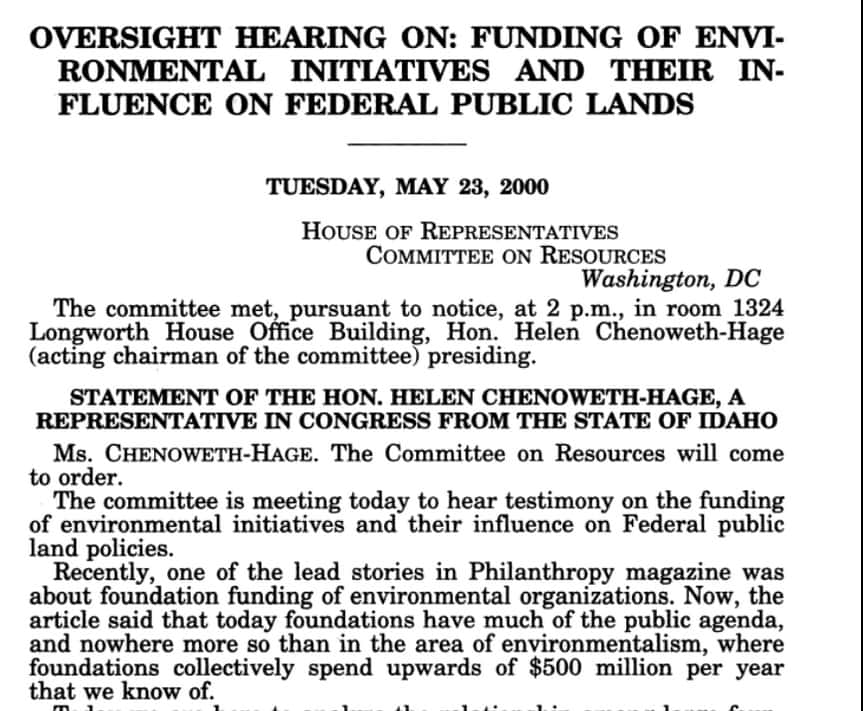
One of the points I like to make about our forest policy world is that it is a great space for folks raising families and with other commitments. You can take a few years off (or possibly decades) and come back and not really miss much. Thanks to the TSW reader who found this hearing from the year 2000. If you swapped out “Climate Forest Campaign” for “Heritage Forest Campaign” and OG for Roadless, and Biden for Clinton-Gore, and probably increased the budget figures, it sounds like the same thing, and I think the questions asked are still worth pursuing. Sorry about the formatting. This is just Chenoweth-Hage’s introductory statement, I didn’t read the rest, there are 128 pages. Might be other interesting stuff there.
Now, Rep. Chenoweth-Hage was appropriately concerned for rural communities as she represented Idaho. At the same time, today, these policies influence all kinds of communities near Federal lands. Another difference between then and now is our interest in the voices of Tribes, ethnic minorities and the poor and working class- marginalized communities. How are these folks (say folks from poor rural communities) represented on Boards and decision-making in these foundations?
“Theimportantissuehereiswhetherthefoundationstrategiesusedtofundtheenvironmentalmovementarebuyingundueinfluenceforthosegroupsonpubliclandspolicy.” IMHO this question is still valid.
Finally, what is the endgame of these foundations, if they have one? Is it the same old “no oil and gas drilling, no mining, no grazing, no commercial logging, no OHV’s”? I don’t know that we know, nor can I imagine who would have the political power to have that conversation.
First of all, let me say that there are probably people in the Forest Service who have thought all this through. I’m hoping that they will help out with their explanations in the comments.
If old growth is old growth, and mature forests are on their way to old growth, and young forests are on their way to mature forests.. then it seems like there is no ceiling on the amount of old-growth needed, and no reason to ever have openings other than “natural” ones. This can be problematic, conceptually, as some groups believe that today’s wildfires and wind events are all unnatural or caused or “supercharged by” the anthropogenic part of climate change.
And if you believe that, then does any ecosystem have “integrity”? Or is the key thing to promote resilience (including biodiversity) in the face of climate change and protect key values of ecosystems and people from these and other dangers? To keep diverse living trees alive on the landscape, and to protect water, wildlife and other values? Perhaps some will say “it’s the same thing” and if it is, then perhaps the use of plain English would save time and misunderstanding.
Let’s go back to the 2012 Planning Rule Handbook:
Assessing the status of ecosystems—their level of ecological integrity—is difficult. There is no guide that provides a comprehensive protocol, and each ecosystem has a unique body of scientific information relevant to the ecological assessment. The planning rule and supporting handbook identify departure from the natural range of variation as a criterion to assess ecological integrity. The natural range of variation refers to the variation in key ecosystem characteristics produced by dominant natural disturbance regimes, usually in a pre-European influenced reference period. This method works well for ecosystems that are relatively well-studied and their natural range of variation can be estimated through ecological modeling or other methodology.
(my bold). Now, as most readers know, I wasn’t a fan of this approach at the time. At that time, my thinking went along these lines… (1) there’s a great deal of pre-European time and yet a certain time has to be selected, humans have been around since glaciation; (2) animals and plants move around and hybridize- and evolution is part of Nature, after all; (3) time’s arrow only goes one way, at least genetically; and (4) if climate is changing faster than usual, then there is no reason to think that the past is well adapted to the future. And don’t we want forests that are adapted to the future? As described in the Handbook, it unintentionally downplays the role of Indigenous fire management and the idea “natural= pre-European” only fits if Indigenous folks are part of Nature, which some now consider to be racist. It would perhaps be clearer and more accurate to say “we want to go back to Indigenous ways of managing the landscape,” if that’s really the case, but again we’d need more Indigenous people and give them authority over federal forests plus make them do not what they think best but what they think their ancestors did. And the importance of Indigenous management and climate have only become clearer or perhaps “supercharged” in more recent discourse.
Many forests have done vegetation modeling and historic research, and came up with desired conditions of say, certain amounts of habitat with certain characteristics. For example, x acres of early successional habitat, or y acres of western white pine or oaks, or even the historic densities of some species. So logically, to recreate these conditions, we may need to thin trees for density reduction and create openings for some pine and oak species to regenerate. There are different ways of getting openings. Depending on where you are, openings could occur due to wildfire, wind events, volcanoes, floods, trees dying from old age and/or native or introduced diseases and pests, and so on. With or without attribution to anthropogenic factors of climate change, some of these are more natural than others (fire suppression and non-native species obviously not).
Generally, the only other way is to manage is via prescribed fire or some combo of mechanical treatments (aka “logging” or “tree-cutting”) and prescribed fire. So do we still want those carefully arrived at NRV distributions or not? According to some, if the opening-treatments would occur in currently mature or old-growth forests, then not. So that leaves “natural” disturbances (affected by AGW, so then unnatural, except for volcanos?) and hoping that they get to the desired ratios; or alternatively, doing openings over and over in younger forests but not mature ones, so that they don’t go through their successional stages, which seems also unnatural. Look who wrote about the importance of early successional ecosystems in this 2011 paper (abstract)
Different disturbances contrast markedly in terms of biological legacies, and this will influence the resultant physical and biological conditions, thus affecting successional pathways. Management activities, such as post-disturbance logging and dense tree planting, can reduce the richness within and the duration of early-successional ecosystems . Where maintenance of biodiversity is an objective, the importance and value of these natural early-successional ecosystems are underappreciated.
So will the new OG amendment effectively replace the concept of “pre-European conditions” with “creating as much old growth as possible”? Because we can imagine quite a possible tension between “maximizing old growth” and “ensuring diversity of tree species”, and the latter would be important to fulfill certain requirements of NFMA, specifically.
“provide for diversity of plant and animal communities based on the suitability and capability of the specific land area in order to meet overall multiple-use objectives, and within the multiple-use objectives of a land management plan adopted pursuant to this section, provide, where appropriate, to the degree practicable, for steps to be taken to preserve the diversity of tree species similar to that existing in the region controlled by the plan;”
My bold, Of course, trees and bark beetles, do their own things, unbothered by humans’ desire for shade or carbon credits, or even plan amendments, forest-specific or national. From the Fire Effects website:
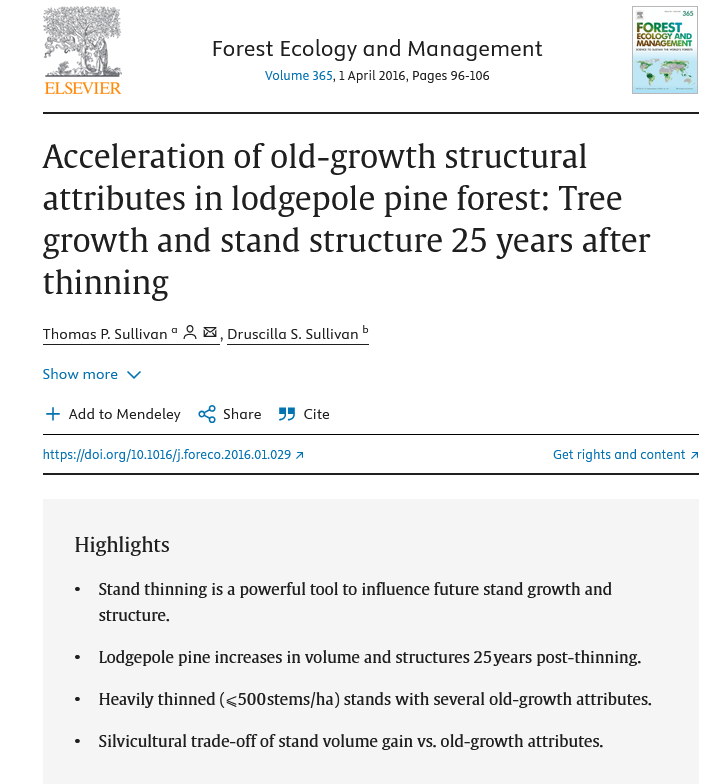
The average lifespan of Rocky Mountain lodgepole pine is 150 to 200 years [37,170], though some Rocky Mountain lodgepole pine trees live more than 400 years
Thanks to SJ for adding these .. the White House Announcement is of particular interest. Here’s a copy of the letter to forests. It reminds me a bit of the old “reviewing roadless projects in the WO” effort. As they say:
This letter only affects the process by which such activities are authorized. It does not alter or prescribe any substantive standards for the management of old growth forests
I always wondered about the legality of these kinds of review processes, it seems they are designed to provide an outcome before there is a legal reason to do so. Just saying it doesn’t prescribe anything different (perhaps on the advice of OGC?) has not, in the past, been accurate. Perhaps our legal TSW friends can clarify.
This workshop sounds interesting, and that it is joint by BLM and FS is good; after all, PJ is the most abundant old-growth and traditionally disagreements have not been timber-war-ish.
Collaborative Efforts to Conserve Pinyon Juniper: Pinyon and juniper woodlands encompass tens of millions of acres of federal lands across the West, and have significant biodiversity, climate, and cultural values. Pinyon-juniper woodlands are the most abundant forest type in the federally managed inventory of mature and old-growth forests, and are the majority of mature and old-growth forests managed by the BLM. While much management focus has been rightly placed on pinyon-juniper encroachment onto sagebrush ecosystems, less attention has been paid to the importance of mature and old-growth pinyon-juniper ecosystems. The Forest Service and the BLM will co-host a public workshop focused on the conservation of these ecosystems in 2024. Through this effort, the Forest Service and the BLM will engage the public, Tribes, land managers, experts, and stakeholders in informed discussion around management issues, threats, trends, and opportunities for climate-smart management and conservation of mature and old-growth pinyon-juniper woodlands on federal lands.
It seems like some of the quotes focused on consistency across the country (Sam Evans) and a seat at the table for developing national policy (The Wilderness Society, Defenders of Wildlife), while EDF uses that other “f” word (flexibility) and notes the role of local folks:
The proposed forest plan amendment creates a rigorous, science-based process that will both protect old-growth forests and provide flexibility for managers, local communities, and tribal nations to recommend management actions to improve resilience to catastrophic wildfire and other climate change-induced threats.”
Meanwhile our friends at AFRC also have a press release. Perhaps oddly, so far they are the only ones who seem to be concerned about loading more paperworky processes on already-overburdened and difficult-to-hire federal employees. Excerpts:
“The Forest Service’s data confirms logging poses a negligible threat to old growth forests, and existing federal environmental laws and forest plans provide direction on managing and protecting old growth. Yet the agency is now being directed to embark on a new, massive bureaucratic process – during a wildfire and forest health crisis – that will likely make forest management more complex, costly, and contentious.
“Protecting old growth requires intentional, thoughtful action on the ground – not more paperwork. It’s not clear how amending every single Forest Plan will help the Forest Service implement the Biden Administration’s own 10-year wildfire strategy that calls for a threefold increase in forest health treatments. Rather than giving our public lands managers the policy tools and support they need to sustain our forests and all the values they provide, this policy will force them to focus limited time and resources on more process and that will do nothing to address the real risks on the ground..