Wildland Fire Mitigation and Management Commission Report Missing From USDA Site

Apparently the Wildland Fire Mitigation and Management Commission Report was pulled from the USDA website, but not other USG websites.

Here’s the USDA website. With all the other stuff about the Commission but not the report. But the report is still there, but not the link to the other site, apparently.  I found it at the US Fire Administration website.

Intentional? Mistake? Over-reaction to some request?  Does anyone know?

New Admin.. if you are reading, please set up a place to receive info from the public on missing/broken links.

What Can People Do About Wildfires? Many Things. I. Improving Suppression Practices, Coordination and Technology

As promised, this is the first of (at least) two posts on “what people can do about wildfires like those in California?”.    Like many problems, there are many “little” things that can be done by a variety of people in different situations to improve the situation.  In a way, these are our toughest problems, because they require focused attention over time.   People from different disciplines with different interests need to be organized in some fashion to all work together toward the same goal.  You have to get into the weeds to make a difference, and be comfortable listening to people with whom you might not have much in common.

We can divide the different pieces of the problem in this way:

1. Improving what suppression folks do and how they do it.

2. Improving what homeowners do.

3. Improving what wildland vegetation managers do.

4. Improving what communities do, aside from strict suppression, like code requirements and evacuation planning.  Generally I’d call this “things generally found in a CWPP” (Community Wildfire Prevention Program) although CWPPs can be uneven and not updated.  How is wildfire incorporated into community planning and activities?

5. Reducing sources of ignition.

Can you think of others?

On TSW, we spend a great deal of time on 3, and despite the fact that LA fires were in coastal sage-scrub and other brushlands, I think we can skip it.

*************

So I’ll start with improving suppression.

Turns out that suppression folks have many ideas about this, from the macro to the micro.  I’ll point you first to this excellent interview by the Hotshot Wakeup with new Senator Sheehy of Montana, who founded Bridger Aerospace:

Bridger has become a leader in fighting wildfires, specializing in aerial fire-mapping operations, air attack, aerial fire suppression, and wildland firefighter technologies. We focus on providing the most effective and modern capabilities to fight fires from the air, supported by a world-class team and state-of-the-art facilities.

Our priority is to address the increasing threat of economic and environmental damage caused by wildfires and to provide support for ground-based firefighters.


The interview was interesting for a number of reasons. I asked the Sheehy media folks for summaries of his positions, because he is quite articulate on these issues, but I haven’t heard back, so you will get my interpretation (and please listen yourself, it’s not that long). First of all, Sen. Sheehy, having been a Seal and Veteran, brings the idea that “if firefighters are risking their lives, we should pay them decently and give them some of the same benefits we give veterans.” He also said something like “since so much of the FS budget goes to fire, they should have leadership from the fire community,” kind of implying that the new Chief should be from that community. Side note: ensuring casualty assistance for firefighters is included in the current Fix our Forests Act in the House.

This hearkens a bit to the old “should fire folks be put into a separate agency” which has been brewing for decades. Side note: the Fix our Forests Act requires a study by GAO which includes:

SEC. 304. GAO study on Forest Service policies.
Not later than 3 years after the date of enactment of this Act, the Comptroller General of the United States shall—

(1) conduct a study evaluating—

(A) the effectiveness of Forest Service wildland firefighting operations;

(B) transparency and accountability measures in the Forest Service’s budget and accounting process; and

(C) the suitability and feasibility of establishing a new Federal agency with the responsibility of responding and suppressing wildland fires on Federal lands; and

(2) submit to Congress a report that describes the results of the study required under paragraph (1).

Both the interview with Sheehy, and the interview with Orange County Fire Chief Brian Fennessy, had many ideas for improving suppression, including ordering difficulties, lack of communication with the water folks, and other coordination and communication issues. And some of the commenters there thought that those improvements would be good, but wouldn’t help with these kinds of fires. As a non-fire person, what I gleaned from this is that like any human institution, or inter-agency combination of such, there are tedious details about working efficiently and successfully that need to be attended to. Via after-action reviews, fire folks are better than most (I’m still waiting on the Covid response after-action review). But it requires constant attention to keep the wheels greased, the communications happening, and the old ways or systems or regulations updated. The folks who attend to this are the unsung heroes of any organization.

***************

This LA Times article cites Stephen Pyne and Jack Cohen

When catastrophic fires occur, experts often blame the so-called wildland-urban interface, the vulnerable region on the perimeter of cities and suburbs where an abundance of vegetation in rugged terrain is susceptible to burning.

Yet the fire disasters that we’re seeing today are less wildland fires than urban fires, Cohen said. Shifting this understanding could lead to more effective prevention strategies.

I agree that it’s difficult to change the narrative from “people shouldn’t build there” to “how can we make cities and suburbs manage wildfire better?”.

“We’re not recognizing, analyzing, questioning how we’re failing,” Cohen said. “We just think we need more airplanes and more helicopters flying 24 hours a day.”

More CL-415 super-scoopers or Firehawk helicopters will not help when water is being dropped into 60 mph wind gusts.

“We don’t necessarily need a trillion-dollar program and a fire czar to get control of the fire problem,” Pyne said. “What we need are a thousand things that tweak the environment in favorable ways such that we can prevent these eruptions.”

For example, municipal and fire prevention agencies must give property owners advance — and continual — warnings to clear dead vegetation and to wet dry brush within 10 feet of the house with periodic, prolonged sprinklings.

I wish the reporter had asked more questions about this:

And while climate change is increasing their frequency and severity, Pyne argues that a society dependent on fossil fuels plays a significant role as well.

“A fossil-fuel society remakes landscapes as well by affecting how humans organize agriculture, urban development, the placement of roads and power lines,” he said.

I’m not sure that that’s true. Maybe it depends on the part of the country you are from. And it’s kind of hard to imagine a fossil-fuel free society in the past, because coal was important for the development of industry and transportation. I guess another society would have stuck with horses and wood for fuel? I’m sure my ancestors came to the US on fossil-fueled ships, so maybe only immigrants from the age of sail? I’m more with Cohen on this one.

For Cohen, shifting the conversation away from climate change is important because it gives us more control over our fire environment and will ultimately make us less vulnerable to these disasters.

“We don’t have to solve climate change in order to solve our community wildfire risk problem,” he said.

Like almost all complex problems or issues, there are many moving parts that can, and should be, improved at the same time.

In the aftermath of the Great Chicago Fire of 1871 — 17,000 structures destroyed and more than 100,000 residents left homeless — city planners and local governments began to focus on fire protection engineering as a way of keeping cities safe.

“The idea was not to catch the arsonist or the mythical cow that kicked over the lantern in Chicago,” Cohen said. “Experts began to consider the role that our buildings played in creating the problem.”

Yes, but if there was a new pattern of behavior that led to many more ignitions, certainly that would be a piece of the puzzle. Or if certain things, say powerlines, had a pattern of causing ignitions, you would work on reducing the hazard. You certainly would if you were a power company who didn’t want to go bankrupt from litigation.

Meet Division With Imagination: Joint Inauguration and Dr. Martin Luther King, Jr. Day


I think it’s fairly rare that Inauguration Day and the Dr. Martin Luther King, Jr. holiday fall on the same day.

Some folks are elated by the Inauguration and the changes on the horizon. Other folks are depressed and despairing. What I’ve come to know over the last year of being in independent space, is that peoples’ views are much more complex than the standard divisions of right/left, Democrat/Republican and so on. Many people were frustrated with the Presidential choices we had and either tried to run themselves (RFK,Jr) or to get on the ballot with a unity ticket (No Labels). And even within the people at No Labels, there was a wide diversity of policy views. Outside No Labels, there were Bernie-ites, who turned to RFK-ites, who ultimately voted for Trump.

Many pundits called this “a turn to the right.” I don’t actually think so. I think numerous Ds and independents felt that their relationship with the DNC was like an abusive personal relationship. There was gaslighting,e.g. “you’re crazy, Biden is sharp as a tack!”, and court cases to keep RFK, Jr. and No Labels off the ballot. It reminded me of churches a bit “pray, pay and obey” without the praying part. Politicians probably believe they are right; and also, of more concern, that the end (staying in power) justifies the means (whatever low-down approaches they can think of).

As our 19th century pundit friends said:

Under democracy one party always devotes its chief energies to trying to prove that the other party is unfit to rule—and both commonly succeed, and are right

H. L. Mencken,

and Mark Twain

Politicians and diapers must be changed often, and for the same reason.

Rather than by politicians, who do what they do, I think that we were let down by many media outlets, who chose to become lapdogs rather than watchdogs. But in the end, that was OK, because we got in the habit of hearing directly from the source and thinking for ourselves.

Dr. King was a fan of peace. One quote that might be appropriate for us here at this time is:

Here is the true meaning and value of compassion and nonviolence, when it helps us to see the enemy’s point of view, to hear his questions, to know his assessment of ourselves. For from his view we may indeed see the basic weaknesses of our own condition, and if we are mature, we may learn and grow and profit from the wisdom of the brothers who are called the opposition.

What I learned from last year was that we (across any political spectrum) disagree about many policy issues than forests, federal lands and climate change. But if have a deeper conversation, you find out that their views most often don’t match a specific party.  The Trump Admin is a coalition of unique individuals who have different ideas about many things. So maybe it’s time for us to band together in a spirit of cooperation to try to understand their views. In some sense, we already do that here.

I am intentionally going to try to assume the best of intentions of the new Admin.  I’m going to try to get their side of the story.  This is based on the idea of judging others favorably.

We are not only to judge favorably, but to believe in the explanations that we devise as well. What you may consider to be an absurd justification may turn out to be the truth!

Rabbi Zvi Feldman (1907-1976)

In the book Every Day, Holy Day by Alan Morinis, the chapter is on judging others favorably, and the daily phrase is “there’s another side to the story.” Many times I have contacted the Forest Service or other organizations to hear their side of the story, and that is the best way (straight from the horse’s mouth). But I have no “ins” with anyone in the new Admin, so I guess I will have to use my imagination and whatever the media folks come up with, and whatever context TSW-ites can lend, and try to reverse engineer their side of the story. As an independent, I am skeptical of all Admins, but I think we should be open-minded about them and the changes they want to make. So it may sound as if I am “on their side”, but that’s just me trying to figure them out and trying to judge their intentions favorably.

What we are about together is first the truth of what’s going on. Often, if enough of us pool our knowledge, we can figure it out. Then based on our knowledge, experience and values, we can disagree, and sometimes find agreement among those who usually don’t. Some of us may be able to influence policy, but many of us don’t have those connections. So this is the best we can offer, truth and understanding of each other, and attempting to decrease the net hate in this country.

Here’s what Jennifer Pahlka wrote on her Substack today:

Cancer has been my metaphor before. The unchecked growth of policy, process, and procedure that compounds over time and strangles our government’s ability to act in the public interest is much like a cancer. When I wrote that, I believed my cancer would be excised with surgery and that would be it. Now chemo is my metaphor. It seems we may go through some scary and even dangerous changes. But I believe there is something better on the other side of this for our country, too.

Here’s more of what I wrote eight years ago:

Most importantly, remember, the status quo isn’t worth protecting. It’s so easy to be in reaction, on the defensive, fighting for the world we had yesterday. Fight for something better, something we haven’t seen yet, something you have to invent. Find a thousand collaborators. Include people you disagree with. Meet division with imagination.

I’m with Jennifer on that.

My Guide to Wildfire News Stories I. The Ideological, Political, and Generalized

It says photo by NASA but I found it at https://www.gallatinscience.org/


Well, we’ve all had a chance to read many wildfire news stories.  Reporters of all abilities and proclivities have swarmed upon the tragedy in LA like ravens on a bison carcass.

I’ll attempt to group them here.   It’s interesting to me that the blaming effort tends to be big picture, and the fixing effort tends to be lots of little things.    This is not unlike our NEPA/project planning discussion.  Similarly, the policy discussion tends to take place in “big picture” places, like think tanks, law schools, other academia, and political entities; while practitioners are often not involved in the discussions. We also  need to pay attention for how the specific can lead incorrectly to grandiose prescriptions and vice versa.  For example, these fires are not in forests… so let’s not even introduce our usual forest discussions.  This seems obvious, but folks like to ride any disaster horse toward their preferred destination.  Specific- not forest.

So let’s start with the biggest of big pictures:

(1) They shouldn’t have built there.  In this Leighton Woodhouse piece

Twenty-seven years ago, Mike Davis wrote Ecology of Fear: Los Angeles and the Imagination of Disaster. One of the chapters is titled “The Case for Letting Malibu Burn.” In it, he argued that the area between the beach and the Santa Monica Mountains simply never should have been developed. No matter what measures we take to prevent it, those hills are going to burn, and the houses we erect upon them are only so much kindling.

OK, as a former resident of a nearby and less well-off area, I would have liked it all turned into a park so I could visit.  And that (Malibu and environs) is a specific area.  But does this apply to Altadena, or other places destroyed in this set of wildfires?  In fact, some people are suggesting this about all of the west, as well as the SE (hurricanes and floods). Then there are earthquakes. 

(2) There’s nothing you can do. High winds, dry veg and houses, and ignitions.

Well, that’s a cheery, and not very helpful, way of looking at things.  And as we shall see, there are plenty of things homeowners, communities, and suppression folks can do.  In fact, other places, like the Front Range of Colorado have similar conditions in the winter (see the Marshall Fire).

(3) Various “it’s all about climate change” narratives

Then there’s “it’s all about climate change and things will get a lot worse!” and/or “it’s all about climate change so we need to change drastically to keep up.”  As you can see, climate change itself can go either way..  giving up and freaking people out, or adding to the impetus for implementing a reset of the whole interlocking systems of development, home hardening, vegetation and suppression.

So many people get stuck here at climate change . but scientists disagree on the proportionate contribution as well as on what we should do about it.  Most of us see some possible climate impact. But why is it so important for some to blame climate? Sure that gets politicians off the hook, but is that a good goal?  And I don’t understand why the details are so important.  Let’s see, what should we do differently if models predict we get these conditions 10 percent to 30 percent more often.  How much would our potential fixes change? The conversation also devolves weirdly.  Like Steve Koonin writes an article saying “not so climate change”; he’s got the political street cred (Undersecretary for Science at DOE under Obama) but is criticized because he’s “not a climate scientist.” So, as we have seen, Jon Keeley who studies wildfires has one view based on historical records and his own research.  But we’ve also seen Dan Swain say (who now works for UC Ag and Natural Resources) quoted.

Swain is big on the “whiplash” of wet springs and dry winters (this is similar to the Marshall Fire). I thought that this was an interesting take by ABC news.
“As Daniel Swain, the lead author of the research and a climate scientists with UCLA explains, “This whiplash sequence in California has increased fire risk twofold: first, by greatly increasing the growth of flammable grass and brush in the months leading up to fire season, and then by drying it out to exceptionally high levels with the extreme dryness and warmth that followed.”

Less than a year ago, Los Angeles had historic flooding and is now facing severe drought conditions. That literally adds fuel to the fire.

Finally, it’s important to reiterate that California has and will always be particularly vulnerable to wildfires simply due to its natural climate. The state historically experiences highly variable weather and climate conditions, typically shifting from periods of very dry to very wet weather.

Across the continental U.S., California has the most year-to-year variability between wet and dry conditions. As you move down into Southern California, that variability increases even more, according to Julie Kalansky, a climate scientist and deputy director of operations at the Center for Western Weather and Water Extremes at the University of California, San Diego’s Scripps Institution of Oceanography.

Conceivably, wet winters in and of themselves, are not a problem for urban areas. The LA area has a sophisticated system of flood control. An example is the watershed management plan of my home watershed of La Ballona Creek. The urban area is already managed for whiplash, so it seems to me that increased whiplashiness would mostly affect the dry wildland veg getting drier. But how much drier can they get? It seems like too much of this climate discussion gets stuck at the “it’s bad and the reason sounds vaguely plausible” rather than going deeper, into the vegetation or fuels characteristics, and how they are managed today and how that might be expected to change. Because atmospheric scientists aren’t experts on those topics. So when folks say “Koonin isn’t a climate scientist”, I’d say “impacts of climate change are mediated through vegetation, hydrology, suppression and other areas of scientific expertise. It’s the scientific equivalent of “if all you have is a hammer, everything looks like a nail.”

(4) Then there’s the political view.. articulated by Sammy Roth, who has changed from being a reporter to a columnist.

For many Angelenos, this is our most jarring confrontation yet with global warming. But hundreds of millions of Americans have faced fossil-fueled disasters, and the politics of climate obstruction have hardly budged……………

None of those climate disasters changed the fact that the Republican Party is almost totally beholden to the fossil fuel industry. None of them changed the fact that the Democratic Party, although largely committed to climate action — see President Biden’s Inflation Reduction Act — still hasn’t done nearly enough to phase out fossil fuels.

But what was running the cars that folks evacuated in? Water pumps? Fire trucks? Aviation resources? Could it be that our current physical reality needs to be dealt with alongside climate aspirations?  It makes me wonder a bit about whether there is an element in the climate change advocacy movement that was never really about rational approaches to decarbonization, but about sticking it to the the industries- who have traditionally donated and voted for the wrong people in the eyes of some. Will we see big “thank you” banners hanging out for the people who supplied the energy to fight the fires?

And just like the Marshall Fire, we seldom hear  “maybe houses shouldn’t be so close together”; “without cars, could people have evacuated safely?” “does it make sense to electrify everything if you have to turn electricity off in high winds?” “could intentional densification have downsides with regard to wildfire resilience?” or other questions that question currently dominant planning paradigms.

On the other side, it’s the “poor management by D Administrations” political view.   The political view, in either direction, doesn’t help us at all. Like the framings above, it’s too far away from the real problems and the idea that “if you vote for us everything will be fine” doesn’t seem to be working for either party, and especially not for citizens in general.

**************
Maybe, just maybe, if we paid more attention to how to fix things, we would involve more people and scientists who understand the problems, practitioners and actually, mutually, improve. With less blame and more creativity; after all that’s the culture of wildfire. Learning organizations, after action reviews, and all that.
As for me, it’s the next layer down that’s interesting.  What could communities, homeowners, fire suppression and allied folks, and planners do better? We’ll try to round up those news stories in the next installment.

If you have any other stories you’d like to draw attention to, of the generic persuasion, please post below and add the specific quotes, or describe what about it you think adds value or is off base.


Op-ed By Incoming Senator Sheehy on Wildfire and DOGE

Thanks to the Hotshot Wakeup!. THW made a case in his update today for not putting all one’s political eggs in one basket.  According to THW, Sheehy is supportive of firefighter pay.

Op-ed by new Montana Senator Tim Sheehy on DOGE and wildfire ideas.

In November, Americans made clear they want political outsiders to come in and put a stop to status quo politics in D.C. The people want change, and now is the time to bring it by reining in our runaway federal bureaucracy, cutting waste, restoring common sense, and building a transparent government that is actually accountable to everyday Americans.

With President Trump leading the charge, and Elon Musk and Vivek Ramaswamy at the helm of the newly formed Department of Government Efficiency (DOGE), we have a historic opportunity to radically disrupt business as usual, fundamentally reform the federal government, and reorient the mission back to serving the taxpayer.

One area DOGE should focus on: wildfire. Wildfires cost us hundreds of billions in economic impact, harming millions of Americans each year, yet our government response hasn’t changed in decades.

As an aerial firefighter myself, I know firsthand the devastation wildfires cause and have a unique perspective on how the federal government has failed on this issue.

Wildfire management system consists of a plethora of overlapping government agencies and private commercial ventures working within a splintered infrastructure that leads to delayed responses and devastating results – too many acres burned, critical infrastructure and structures destroyed, negative health impacts, lives lost, and communities devastated.

There are dozens of state and federal agencies responsible for wildfire suppression, yet there is no clear accountability nor a national wildfire suppression standard. To put that into perspective, the National Fire Protection Association sets the standard for structure fire response at five minutes and 20 seconds, which reduced civilian deaths by 70%. There is no similar standard for wildfire suppression.

We have brave, selfless public servants who put their lives on the line to fight these fires. I was water-bombing fires and protecting our communities as recently as August alongside these heroes. They are not the problem. The problem lies with bureaucratic leadership and layers of red tape failing the folks on the ground, meaning an overhaul of the federal wildfire system is a great place for DOGE to start.

Adopting a more proactive, aggressive initial attack policy across agencies would dramatically reduce costs and damages. Aggressive initial attack relies on utilizing private resources, which are usually the quickest, most effective response option if we want to limit the size and scope of wildfire damage.

The private sector always has and always will produce new innovations and better results faster and cheaper than the government. The same holds true in wildfire response. We must embrace this truth. Fostering stronger public-private partnerships with the wildland fire industry is essential.

DOGE can help the federal government embrace private partnerships to leverage investment in innovative technologies like advanced aircraft, wildfire intelligence systems, unmanned aerial systems (UAS), and even thermally equipped satellites to better accomplish the mission: protecting people, property, public lands and communities from wildfires.

Together we can incorporate the most innovative technologies and strategies, establish clear roles and missions for federal agencies serving alongside private entities, and build an inclusive national wildfire strategy that best leverages all available resources.

As the only aerial firefighter in the Senate, I look forward to working with DOGE to lead the charge on reshaping our approach to wildfire management in America.

We can streamline wildland firefighting efforts, remove outdated bureaucratic obstacles to getting the job done and cut government waste. We can fight fires better, stronger and faster. And we can do more for our communities threatened by wildfires at a lower cost for American taxpayers.

This is an area that is ripe for collaboration between folks on both sides of the aisle. It doesn’t matter what party you’re from; it’s clear that the federal government must do a better job protecting our communities and public lands from wildfires.

I will work with Republicans and Democrats to deliver commonsense solutions to more effectively fight the devastating threat of wildfires. Americans nationwide made it clear they expect more out of their government, and it’s time we seize the moment and deliver on the mandate voters gave us.

The Importance of Open Disagreement to Science, and Why Mean Tweeters Like Mann are Missing in Forest Science

The Mann trial was supposed to be  part of Roundup #2, but as you can see below, I got a bit carried away.

I read an op-ed this week by Loolwa Khazzoom, who said:

We are all pieces of a highly complex puzzle. When we listen instead of project, discuss instead of argue, and have a goal of learning instead of winning – approaching dialogue with an attitude of curiosity and discovery – we can benefit from the unique life experience and thought process that we each bring to the table.

Which is my belief as well. Otherwise I wouldn’t spend so much time on The Smokey Wire and similar efforts. Also this week, I followed along on the highly entertaining podcast Climate Change on Trial presented by the Unreported Story Society. I think it’s safe to say that Michael Mann, the climate scientist and plaintiff in the defamation lawsuit against two bloggers, Mark Steyn and Rand Simberg, would not agree with that statement on the utility of listening and “approaching dialogue with an attitude of curiosity and discovery.”

At first, I thought the trial was a bit ridiculous. As if what two random bloggers wrote could actually defame Mann any more than a cursory examination of his Twitter feed, and that that would effect his financial remuneration in terms of research grants. Were they kidding? Then it turned out that this defamation biz had been going on for 12 years (!), and no one knows who is paying Mann’s court fees. My view is that in a just world, the jury would have awarded the past 12 years of legal fees to Steyn and Simberg. Of course, as a random blogger myself, maybe I’m being too sensitive. But it was OK, I guess, because according to the Hill, these guys are “right-wing” bloggers and I’m not.

So, at first, I was glad that scientists in our forest fields generally don’t behave that way. And I wondered if a podcast on some of our fuels treatment court cases with key parts being reenacted would be as entertaining. But as we delved into the Mann Tweets and emails, I wondered “how could that level of meanness be tolerated?” and “why was it OK for him to do what most of us would never consider doing?,” and “whose job is it to keep our convos civil, if anyone?”

The story of how all this developed was fascinating, at least to me. For those of you who don’t know, Mann was famous for the hockey stick graph, splicing together various measures of past temperatures including our very own tree rings. When someone asked for the data, he was unwilling to part with it, at least at the beginning. He clearly wasn’t a fan of FOIA either, forwarding a message to others to delete emails. The release of the Climategate emails was not a good moment for him.  If you were to ask him, I’m sure that he saw these as efforts to impugn climate science, and (thus, naturally, to him) he became combative in its (his own) defense.  It became a “good guys vs. bad guys” thing, with him, naturally, on the self-defined “good guys” side.

At the same time, you or I could also say that science should stand up to independent scrutiny, and that if someone wants the original data, they should be able to access it. I don’t think that that would be a big problem in forest science world. So what happened here? Perhaps Mann felt that the stakes were so high, it makes usual scientific practices and conduct obsolete. Some of us might say that that correlates at .99 with his self-interest, so.. But on the other hand, billions of dollar have been spent on climate science and Mann is just one of millions of climate scientists around the world, so the hockey stick is not all that important at the end of the day. But that’s today, and perhaps not when the posts were posted.

I started to think “what went wrong here?” and “are there lessons for us in less-favored and financed disciplines to learn?” Many of us belong to scientific and professional societies, universities and agencies, with codes of conduct that incorporate ideas like collegiality and respectful communications.

Dr. Curry (she of Mann’s so-called “slept her way to the top” email to Gavin Schmidt at NASA) drafted a complaint which she never sent:

“This defamation is affecting my academic reputation and my ability to conduct business. I note that I am far from the only person being attacked and libeled by Dr. Mann.
Penn State Policy AD47 (General Standards of Professional Ethics) states that professors have obligations as members of the “community of scholars” and are required to “respect and defend” free inquiry by other members of the community and to show “due respect” for the opinions of others:

IV.As colleagues, professors have obligations that derive from common membership in the community of scholars. They respect and defend the free inquiry of their associates. In the exchange of criticism and ideas they show due respect for the opinions of others.

“The policy also states that researchers are required to be “open-minded when evaluating the work of others” even if that may “contradict their own findings”:

III…. As open-minded researchers, when evaluating the work of others, they must recognize the responsibility to allow publication of theories or experiments that may contradict their own findings, as only by free inquiry and dissemination of all facts will the fruits of the labor of the whole community be allowed to mature.

Policy HR64 says (my bold) that faculty members have “special obligations” as persons of learning and as educators and are obliged to “exercise appropriate restraint” and “to show
respect for the opinions of others” Faculty members are citizens, members of learned professions, and representatives of this University. When the faculty member speaks or writes as a citizen, the faculty member shall be free from institutional censorship or discipline, but the special position in the community held by the faculty member imposes special obligations. As a person of learning and an educator, the faculty member is expected to remember that the public may judge the profession and institution by his/her utterances. Hence, the faculty member agrees at all times to be accurate, to exercise appropriate restraint, to show respect for the opinions of others, and to make every effort to indicate that he/she is not an institutional spokesperson.”

Curry didn’t send it to Penn State because, as she says in her post .

“after all, the damage to my career was already done and I wasn’t clear where this would lead or whether it would have any effect.”

I wonder how Mann could have acted against these rules for so long with no one calling him on it.  I wonder if the folks he emailed (work emails) ever said, “hey, I’m not interested in gossip about our colleagues’ sex lives”,” or “maybe you should tone it down on  Twitter” or “I’m not sure we should try to evade FOIAs and delete emails.” From the court records, it sounded like a few people did.  If more had done so, could this all have turned out differently?

And how did he get awards from prestigious organizations for “science communication?” Was anyone reading his Tweets?

“I am truly humbled to receive the Stephen Schneider Award for Outstanding Climate Science Communications,” said Mann. “While none of us can fill the very large shoes Steve left behind, we can honor his legacy by doing our best to inform the public discourse over human-caused climate change in an objective, clear and effective manner.”

I don’t blame Mann for all of this.   People don’t always behave well when left to their own devices. This is a fact of human nature. That is why we have laws, law enforcement, codes of conduct and enforcement protocols.  It is the role of institutions to enforce their own rules.  And yet they apparently are not, at least in certain cases.

***********

Having listened to the podcast of the case, I was amused by this NPR story:

In a D.C. courtroom, a trial is wrapping up this week with big stakes for climate science. One of the world’s most prominent climate scientists is suing a right-wing author and a policy analyst for defamation.

The case comes at a time when attacks on scientists are proliferating, says Peter Hotez, professor of Pediatrics and Molecular Virology at Baylor College of Medicine. Even as misinformation about scientists and their work keeps growing, Hotez says scientists haven’t yet found a good way to respond.

“The reason we’re sort of fumbling at this is it’s unprecedented. And there is no roadmap,” he says.

**********

Imran Ahmed, chief executive at the Center for Countering Digital Hate, says any response has to include social media companies, as that’s where attacks on scientists happen every day. Research finds that social media platforms can encourage the spread of scientific and medical misinformation.

Hotez says he and Mann are working on an upcoming project, collaborating on what they see as overlap in attacks on climate science and biomedicine and how to counter it.

Was NPR even in the room? I guess you don’t have to actually observe things when you can just ask your friends what they think.

With all due respect to Hotez and Mann, having discussions and disagreeing is what science is about in the pursuit of truth; actually even outside of “science,” as in Khazzoom’s quote at the top of this post.  Characterizing people who disagree as “attackers” with “disinformation” who need to be throttled down is bad for discourse, bad for the public trust (yes, that public, the ones who vote for research budgets) and bad for science.  I’m curious as to why, of all the disciplines and subdisciplines in science and engineering, only these two fields (climate and Covid) seem to have this problem highlighted? Perhaps they have bought into a form of politics-science mutualism.  In the same way that a phone call changed the views of the virologists and led to the Proximal Origins paper on Covid origins, in the Mann case a discussion with the President of Penn State led the inquiry team to change its findings on censuring Mann.  Where disciplinary self-interest, institutional self-protection and larger world politics meet.. is probably not a good place for the rest of us, nor for any truth to come out.  And it’s definitely not “science.”

Aren’t we fortunate that we don’t have these issues in forest science? Do we manage it better, are the stakes so low no one cares for high quasi-political drama, or are we just lucky as to the character of our scientists? What do you think?

Chag Sameach and Happy Easter!

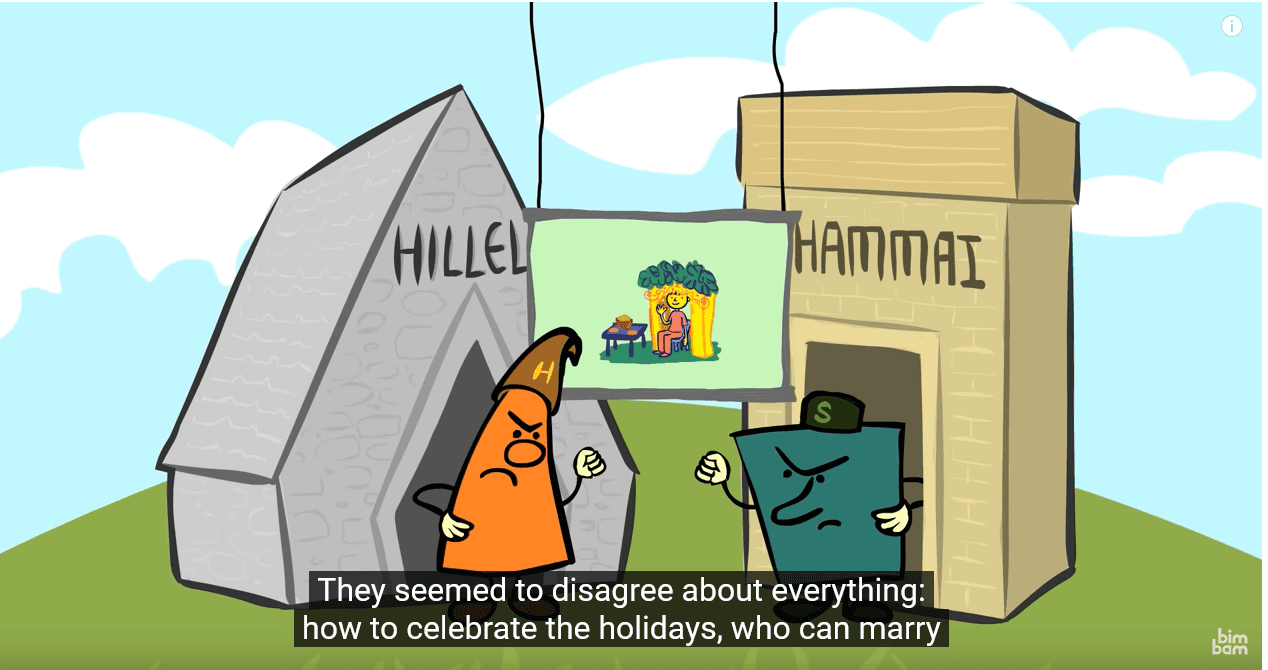
I may have posted this on a previous Passover, but this  video about the schools of Hillel and Shammai and arguments “for the sake of heaven” is one of my favorites. It’s done by the Pardes Center for Judaism and Conflict Resolution.

According to a source cited in Wikipedia (who knows?) Hillel worked as a woodcutter while studying the Torah.

For Christians, some people see that Jesus’ teachings were reflective of the Hillel school.  There’s actually a spendy book from 1997 on this topic called “Hillel and Jesus: Comparisons of Two Major Religious Leaders“.

In another part of the New Testament (Acts 22:3) Paul claimed  that he had been a student of Gamaliel, who was Hillel’s grandson.

Anyway, wisdom is wisdom and Hillel and Shammai both had it. Plus humility.  Virtues still needed today. And this reminds me a bit of TSW discussions.

Mordcha: Why should I break my head about the outside world? Let them break their own heads.
Tevye: He’s right. As the Good Book says, “If you spit in the air, it lands in your face.”
Perchik: That’s nonsense. You can’t close your eyes to what’s happening in the world.
Tevye: He’s right.
Avram: He’s right and he’s right? How can they both be right?
Tevye: You know, you’re also right.

Chag Pesach Sameach! and Happy Easter!

We’re #1! Reforestation as a Bipartisan Climate Solution: Matt Burgess (CU) Video with Some Ancient Wisdom

I’m sure that many of you are suffering from the seasonal influx of Obnoxious Political Ads. Last week, I ran across this video by a Professor Matt Burgess at University of Colorado who is studying polarization, with an eye to understanding and decreasing it. I thought it was super that an academic was looking into this instead of fanning the flames (I do see quite a bit of that), so here’s a shout out to Matt!

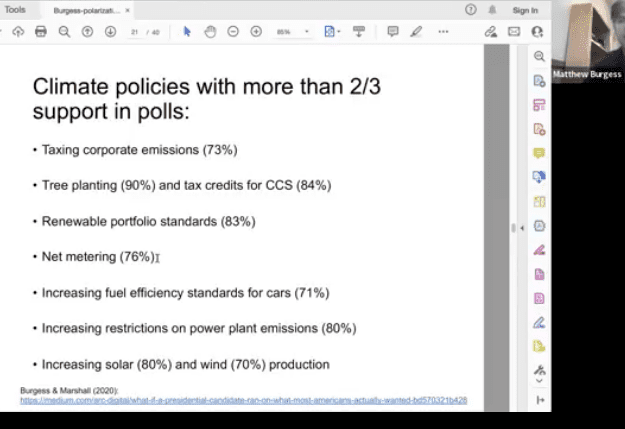
Check out his video on climate change polarization and what people agree on. I took some screenshots of some slides. They looked at climate policies that people broadly agree on.

Here’s an important screenshot for forest folks:

It’s particularly interesting as in President Biden’s Executive Order has different prongs.. MOG, wildfire risk, reforestation and economic development.

Here’s the reforestation part.

(d)  The Secretaries, in coordination with the heads of other agencies as appropriate, shall within 1 year of the date of this order:

(i)    develop a Federal goal that charges agencies to meet agency-specific reforestation targets by 2030, including an assessment of reforestation opportunities on Federal lands and through existing Federal programs and partnerships;

(ii)   develop, in collaboration with Federal, State, Tribal, and private-sector partners, a climate-informed plan (building on existing efforts) to increase Federal cone and seed collection and to ensure seed and seedling nursery capacity is sufficient to meet anticipated reforestation demand; and

We haven’t heard as much about this part of the response to the EO. Perhaps because it’s not controversial. But shouldn’t we talk about the non-controversial parts just as much?  Perhaps controversy is interesting in a way that mutually moving forward in a positive direction is not?

******************************

Discussing With Those Whom You Disagree… Burgess’s Take:

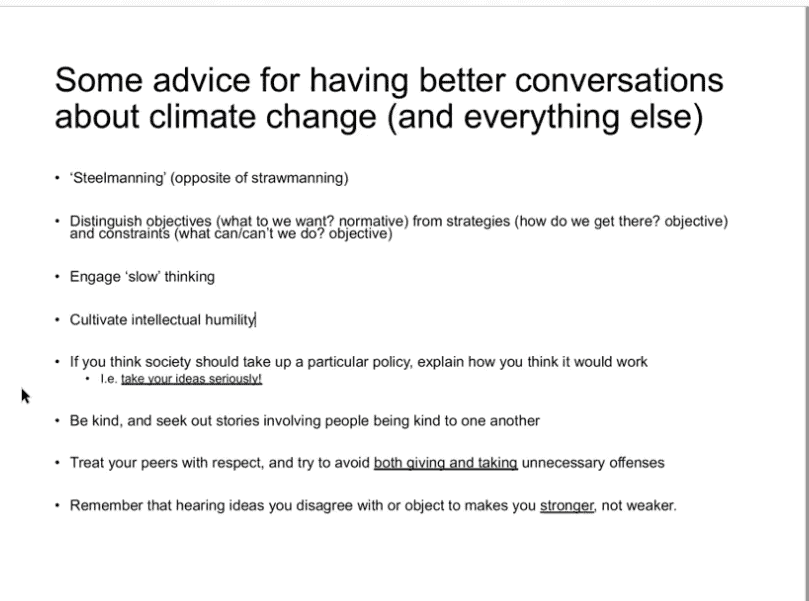
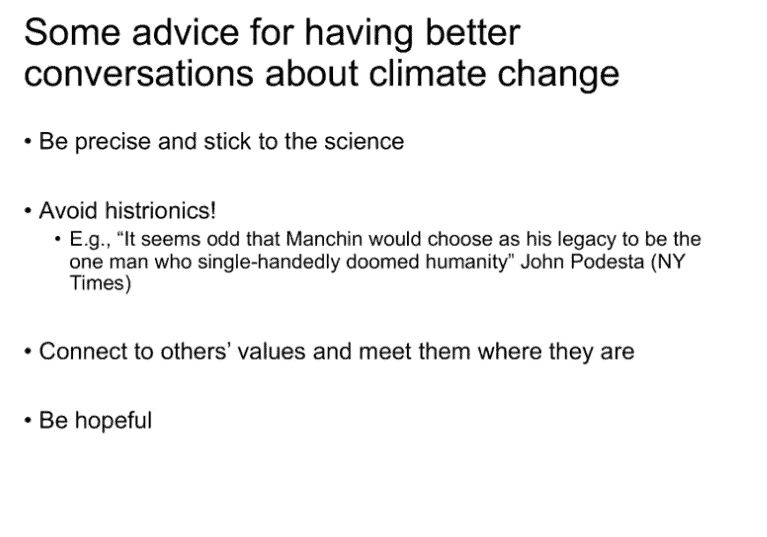
Here are a few of his slides about conversations with those people you disagree with.  Some old ideas and some new ones for us who have been doing this work. This discussion is about 45 minutes in.

Burgess explains that “steelmanning” instead of “strawmanning”  is that you want to understand the best argument for the other side before you argue for our own side.

*****************

If this reminds you of Hillel and Shammai, as well as our friend, the author of the book of Kohelet in the Hebrew Bible – “there is nothing new under the sun,” well, maybe those ancient folks knew a thing or two.

[The law is in accord with the School of Hillel] because they were kindly and modest, because they studied not only their own rulings but also those of the School of Shammai, and because they taught the words of the School of Shammai before their own.  Eruvin 13b.

*************************


How I Learned to Stop Worrying and Love a Good Argument: Essay by Patty Limerick

As many of you do, I’ve spent a great deal of time on The Smokey Wire in the last ten years. I’ve found it difficult to explain why I should feel such an admittedly peculiar calling. Frederick Buechner once said “The place God calls you to is the place where your deep gladness and the world’s deep hunger meet.” People are willing to accept that it gives me deep gladness, but I’ve had trouble articulating what utility TSW brings, or might bring, to the world.

Fortunately, the highly articulate Patty Limerick has written an essay that explains her wild dream, which is also my wild dream, in the sentence I bolded below.

I did learn to love a good argument and to embrace that opportunity without an ounce of dread; that part is certainly true. But this change in attitude has left me with more time and energy to devote to worrying: about drought and fires in the American West; hurricanes on the Gulf Coast; the grim rates of unemployment and the failure of small businesses; the many obstacles lying in the path of the creation and deployment of a Covid-19 vaccination; and the terrible polarization of the United States.

In an odd twist, it is exactly that accelerated commitment to worrying that gave rise to the wild dream that drives this essay, namely:

If I could persuade some percentage of my fellow citizens to share my enthusiasm for good arguments, the polarization would drop in intensity, and we might be able to get somewhere in dealing with all those other worrisome problems.

OK, let’s put that wild dream aside for the moment, and return to reality.

This nation’s capacity to engage in good arguments has reached the vanishing point. In the all-too-near future, the nation’s sorriest ritual—that miserable performance called “a presidential debate”—will provide unmistakable evidence to support that assessment. As millions of Americans have arrived at the conclusion that arguing is inevitably sterile and pointless, we are left with only shouting matches, blame fests, fruitless data disputes, or embittered silence. This is the bedrock problem that deepens and enhances every other dilemma we face.

Over the last years, pundits of various stripes have gone into over-production of a certain form of pep talk. In an endless loop, these people keep telling us that, to do our part to redeem our polarized society, we must take every opportunity to listen to those with whom we disagree.

Once you have listened, what can you do?

You can write a commentary of your own, telling other people they should listen, particularly to you.

The commentators telling us to devote ourselves to listening have come to resemble a sad group of recipe-writers, who have convinced themselves that the act of writing a recipe begins and ends with instructions to go out and acquire some ingredients. After the command, “acquire groceries,” these aspiring kitchen gurus skip the part of telling us what to do with the ingredients we have assembled.

To depart from analogy and opt for directness: today’s exhortations to listen go nowhere and still take a long time to reach that destination.

Here’s a better alternative.

By all means, listen. But once you have listened, and once you have reached an understanding of the ideas that other people hold and why they hold them, then invite those folks to join you in a good argument.

We should listen so that we will have all the ingredients we will need to win arguments in the only sense that matters: emerging from the exchange smarter and better oriented to life.

One way to get the right take on winning and losing arguments is to repurpose and redeem that platitude, “We will have to agree to disagree.” Understood as a passive submission to the recognition that two people are not of one mind, this unfortunate platitude has lumbered through life with the wrong meaning.

Set free from this sad message of defeat, and inevitability, those words get a new lease on life. “We will have to agree to disagree, and so we are off on adventure! We will put everything we have into taking part in a good argument, and the friendship between us will not only endure, it will gain in strength.”

I think the whole essay is worth reading. She has a concern about academia as a place for argument, which I share, based on my own experiences. If any of you currently in academia have programs to encourage and improve arguments, please post in the comments below.

You may also be interested in the Center of the American West discussions at “Lunch with Limerick,” as well as others of her “Not My First Rodeo” blog posts.

Reducing the “Bad Blood” Factor in Conflict Management: from Peter Williams

I thought I’d repost this because Peter has much experience in this area. It originally came up in the context of “what is privatization” and “why do all the big Monument designations happen in Utah? What are the dynamics of some folks picking Utah as a target, and then attacking them for reacting? What’s behind it? Brian mentioned bad blood of longstanding duration between different political figures.  But what to do when there is bad blood, lack of trust,  or past negative interactions?  If you’re in partisan politics, or the media sources that echo them,  you seek to inflame them to make yourself look better, to get more clicks or to advance your narrative. But is there an alternative path of joint story- telling, compassion and peace-making (hmm. is this touchy-feely?)

But Peter Williams has experience in trying to work through conflicts and here’s what he thinks:

What to do about “bad blood” is an interesting question in this discussion, as well as a crucial challenge in any collaborative effort. Brian Hawthorne, Sharon, and Jon all touch on it. In my experience, which I assume others can attest as well, not only can there be bad blood, there can be different stories about why it happened. And Sharon reminds us of another related problem, which is that folks may not ever talk with you about those past issues. Some call those “the undiscussables,” a pretty apt name.

This thread has strong examples of the challenges of bad blood. Taking just one, we can look at how Utah residents and others have been affected by the Utah Wilderness battles, the subsequent declarations of National Monument status, and, twenty years from when it flared up, the boundary changes and subsequent business reactions of some in the outdoor recreation industry. And that doesn’t even get into the background history going to the 19th century at least.

Maybe a question is how to find a way forward when history is hot, alive, and emotional. From a collaboration perspective, combined with ideas from conflict management, I find it helpful to recognize as early as possible what I call “competing histories” because finding a competing history tells me I need to look for the frames or lenses through which people receive their story, their version. Those frames are the source of the bad blood and, with the right approach, folks will tell you enough, even if most of the story is still largely undiscussable. If successful, I also know I reached the stage of “sufficiently trusted outsider”, not always easy, sometimes not even possible, always worth trying.

Then I do at least two things with those competing histories. First, I find ways to acknowledge those in my discussions with folks, to speak to the undiscussables myself so they don’t have to, because, as a sufficiently trusted outsider, I can do it with less emotion, less baggage. This is all part of what I call “re-humanizing” the discussion, getting beyond caricatures and stereotypes enough to have a conversation about a joint future. Folks who do collaboration work, like me, sometimes need to take on a “third-party” role of sharing what we’ve heard–with permission–because that relieves the actual participants from doing it themselves with all the emotion that can conjure.

Second, I find ways to document the history, like in presentations or documents, which acknowledges it has been heard and, where possible and needed, gets at facts instead of stories. This is a way to use validation to accomplish some needed de-escalation.

Let me leave you with this idea: Finding ways to distinguish “bad blood between people” from the history of events that produced that bad blood may give the people a better chance of finding a way forward. With hot issues, like debates about privatizing public lands, this could be helpful because you can create space between undiscussables and whatever really needs discussion.