Clearcutting, FACTS, and Many Thanks to Sean!

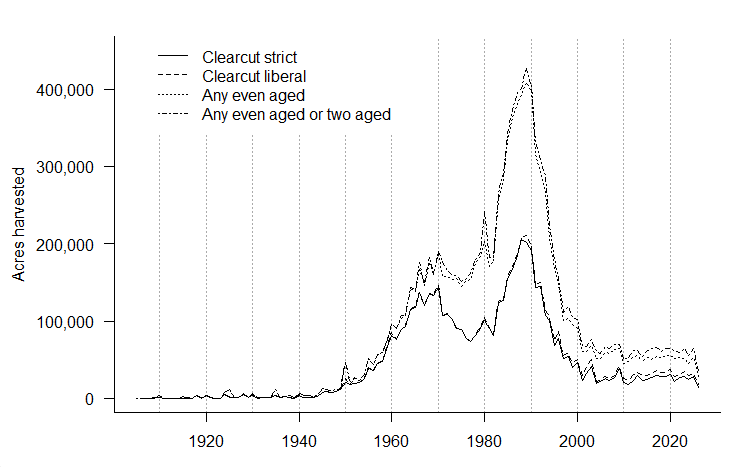
(see text for definitions)

I’m reposting this today because I’m surprised no one weighed in.. and other posts were published so maybe everyone didn’t see it?

If we had cash or non-cash awards on The Smokey Wire (and maybe we should), Sean would definitely deserve one for taking the time to dive into the mysterious world of FACTS.  So a major thank-you to him!

From Sean:

******************************

Here is a little workup of the FACTS data.

I downloaded the full FACTS dataset. Caveat – FACTS (like all huge, ongoing data projects…) is messy! I am working with it here pretending like it is perfect, but we all need to know that it is not and there are plenty of places with missing or incorrectly classified data.

I first filtered to remove anything earlier than 1905 (pre-FS – you may be surprised but some records go back to the mid-1800s, Forest Reserve days presumably) and later than 2026 (the future hasn’t happened yet as far as I’m aware). Then I filtered to include status “Accomplished” and “Completed”, but not status “Planned”.

I built this spreadsheet with the full list of Activity Names and my calls on whether they count as a clearcut. I did four versions: a strict interpretation and a liberal interpretation of what a clearcut is, one for all even-aged systems (including shelterwood and seed tree, for example), and one for all even-aged and two-aged systems (including what we would call variable retention harvest today, coded in FACTS as two-aged stand clearcut with reserves). You may disagree with my calls, in which case I invite you to propose something better.

Link to “is it a clearcut?” calls:
https://docs.google.com/spreadsheets/d/1nn6j8IbTO9g5EzrcQXA2Js04FfCGYUH7?rtpof=true&usp=drive_fs

Who knows exactly what queries were done to build the tables in the post, but what I get is pretty similar.

Clearcut (strict)
2023: 29,007 acres
2024: 24,283 acres
2025: 28,733 acres

The other three definitions are not as good of a match.

Clearcut (liberal)
2023: 34,635 acres
2024: 29,705 acres
2025: 32,917 acres

All even-aged
2023: 51,846 acres
2024: 44,898 acres
2025: 52,483 acres

All even-aged and two-aged
2023: 64,144 acres
2024: 55,520 acres
2025: 64,662 acres

Link to graph over time of National trend:
https://drive.google.com/open?id=1X3tDwWlbd_uKoQRdO5-iCRaTMMz1cjBk&usp=drive_fs

Link to acres of harvest per year by each of the four definitions by National Forest:
https://docs.google.com/spreadsheets/d/1GsaHjRcXsdzbQmFVDAMhR3ZParjVtDf-?rtpof=true&usp=drive_fs

Link to the full FACTS dataset as a table (340 MB file – no GIS required, you can open it in Excel):
https://docs.google.com/spreadsheets/d/17WiGYUn5cDWuQsvZ1mdFNYhxdkEKDfi1?rtpof=true&usp=drive_fs

************

From Sharon:

I’m a bit stuck at the varieties of definitions and how they could add up to meaningful numbers of any kind.  At the 30K level, there is only even-aged and uneven-aged management (or is there?), maybe we should ask a current silviculture prof? Uneven-aged in many places won’t get back intolerant species, which we would need for diversity; and tolerants by themselves are not resilient to wildfires and tend to be host to a variety of diseases and insects. At the same time, they tend to be fairly good (along with LPP) at reproducing themselves, while the intolerant may need more assistance.

Would concerns about NRV and fuels lead us instead to a different taxonomy of treatments, perhaps based on density reduction and ladder fuels? Or are our current definitions not exactly fit for current purposes, but not worth changing? How do these numbers crosswalk with fuels acres accomplished, or do they?

Meanwhile, what do you all think of the exercise of asking the same “why do you clearcut, if you do?” of all forests and seeing what the national story looks like?
 

Silviculture, Ecology, Means and Ends, and Terminological Confusion

Jon questioned whether the goals of the Round Star project were “ecological” or “silvicultural” and T responded (this is part of the response) that

All silviculture is applied ecology.
While the FHF’s public affairs shop didn’t clearly draw the line to their Forest Plan, that is definitely in the minds of their Silviculturists. Many of the considerations mentioned above (eg root disease, fire resilience, beetle resistance) are very likely laid out in the FHF’s Forest Plan.

On the other hand, I work under a forest plan that is 40 years old, and very divorced from ecology. The goals it lays out are largely driven by timber production, and the ecological considerations I include in management decisions are not laid out in the Plan at all.

This discussion reminds me of  when I worked in R&D (I know that some of you may find this scary, but for some time I was both the Silviculture and Genetics Program Manager, because we couldn’t get a “real” silviculture researcher to move to DC).  Anyway, part of that was helping organize the National Silviculture Workshop.  A local group handled all the arrangements and field trips, and it was a terrific experience to be there and learn from the researchers, the working silviculturists, and their interactions.  At the time I had two ideas, which turned out to be universally unpopular..

  1. The first was to change our name from silviculturist to “applied ecologist”.  I thought “hey, if ecologists are cool, and we are ecologists, why not ride in the slipstream of this popular trend?”

How does Wikipedia define ecology?

Ecology is the scientific study of how living organisms interact with each other and with their physical environment

Not to get all super-picky about language, but what biological science doesn’t involve “interacting with their environment” to some degree? Even cells on a petri dish do it.   So what we used to call forest biologists are all ecologists in that sense.  Wildlife biologists can be renamed wildlife ecologists and no one will really know the difference.  We even had a class in “genecology” in my master’s program, so conceptually I might have been a genecologist. Whatever.

Here’s Google AI’s take on the Dictionary of Forestry definition..

In The Dictionary of Forestry edited by John A. Helms (published by the Society of American Foresters), silviculture is defined as: [1]
“The art and science of controlling the establishment, growth, composition, health, and quality of forests and woodlands to meet the diverse needs and values of landowners and society on a sustainable basis.” [1, 2]

Key Elements of This Definition
  • Art and Science: It blends biological and ecological sciences with practical, hands-on management skills. [1]
  • Control of Attributes: It gives managers the tools to actively shape five critical forest elements: how a forest starts (establishment), how it develops (growth), what species live there (composition), how it resists diseases (health), and its overall economic or ecological worth (quality). [1, 2]
  • Diverse Needs and Values: It acknowledges that modern forestry is not just about logging for timber. It also prioritizes wildlife habitats, carbon storage, clean water, and recreation. [1, 2]
  • Sustainability: It requires managing resources responsibly so that the forest continues to thrive for future generations. [1, 2]

Thanks to the wonders of Google AI, I found this handy set of definitions compiled by Dr. Kristen Waring at NAU.

As Jerry Franklin once said of FS geneticists (at a biodiversity workshop?), (he was defending us against other FS employees who associated us with commercial timber production), we don’t set the goals, the landowner does.  We could be “conservation” geneticists or “exploitation” geneticists (as I was once called by an FS researcher)- the tools are the same, but the goals different.

2.  My other highly unpopular idea was to take our silvicultural definitions, with their hints of a timber-y past, and  develop a new set of definitions that could be more easily explained to the public- just for federal forests.   Then there is how things are reported in FACTS (and elsewhere?), which may have different definitions than the Harvest Report we discussed last week (or not?).

Remember Anonymous found out about those definitions:

There is a technical breakdown of the classification of activities on the last page of the report.

“Removal cut” is the final stage of seed tree or shelterwood harvest.

“Improvement Cut” is an intermediate treatment made in a stand, pole-sized or larger, primarily to improve composition and quality by removing less desirable trees of any species.

“Special cut” is harvest without restocking. Like a power line right-of-way.

Let’s go back to a discussion between Anonymous and T last week. Anonymous said:

Curious how a shelterwood with residuals is categorized on the Colville? Normally, a shelterwood harvest is considered even-aged management, but the Colville never does the second entry; therefore, the shelterwood is never removed. NTM, eastside screens includes a 21-inch dbh limit, so that also affects the result of a shelterwood. Given these caveats, is that really an even-aged harvest and how does the forest track this harvest method in FACTS? Seems more like a thinning from below, given the overstory retention and canopy cover target, and the result is a two-aged stand.

T replied:

I think that’s a good point. My understanding is there’s a specific FACTS Activity Code for Two-Aged Shelterwood With Reserves, where it is acknowledged that the shelter trees are to be retained with no intention of removal. Because the primary intent of the treatment is to regenerate the stand and establish a new cohort, it is a regeneration harvest not an intermediate treatment (ie thinning). Even if there are a lot of residual trees, it all comes down to whether the intent is to establish a new cohort or manage the existing cohort.

The Forest Service lumps single-age and two-age treatments into “even-age” systems, and anything with three or more age classes as “uneven-age” systems. This has implications for 40-acre openings: a two-age regeneration harvest over 40 acres requires public notice and approval, but an uneven-age regen harvest over 40 does not.

There is the treatment, there is what is left (some of us remember the old Ecosystem Management mantra, “more concerned with what we leave than what we take”), what the long-term intention is (reduce fuels, protect trees from …, increase species diversity). Site-specific attributes also enter the picture .. depending on the soil and wind patterns, will residuals blow down?

So folks can propose different treatments toward the same long-term goals, or the same treatment with different long-term goals. But you can’t tell the goals by driving by. You have to read the EA or talk to a silviculturist. Who knows much more about the site and what works towards the stated goals, and incorporates information from other experts (wildlife, soils, fuels etc.).  So a federal silviculturist is both an expert and a convenor of other local experts, plus does projects that move toward the DCs in the forest plan (if it is a recent one) or does things that otherwise make sense (if not).

*********************
Reflecting back, I think the “why” is very important and doesn’t show up except in EAs or if we ask the silviculturist involved.  It’s hard to argue with increasing species diversity..when it’s in the forest plan.. or is it (hard to argue with)?

Why Do Folks Clearcut on the Flathead National Forest? For the Silviculturally Curious

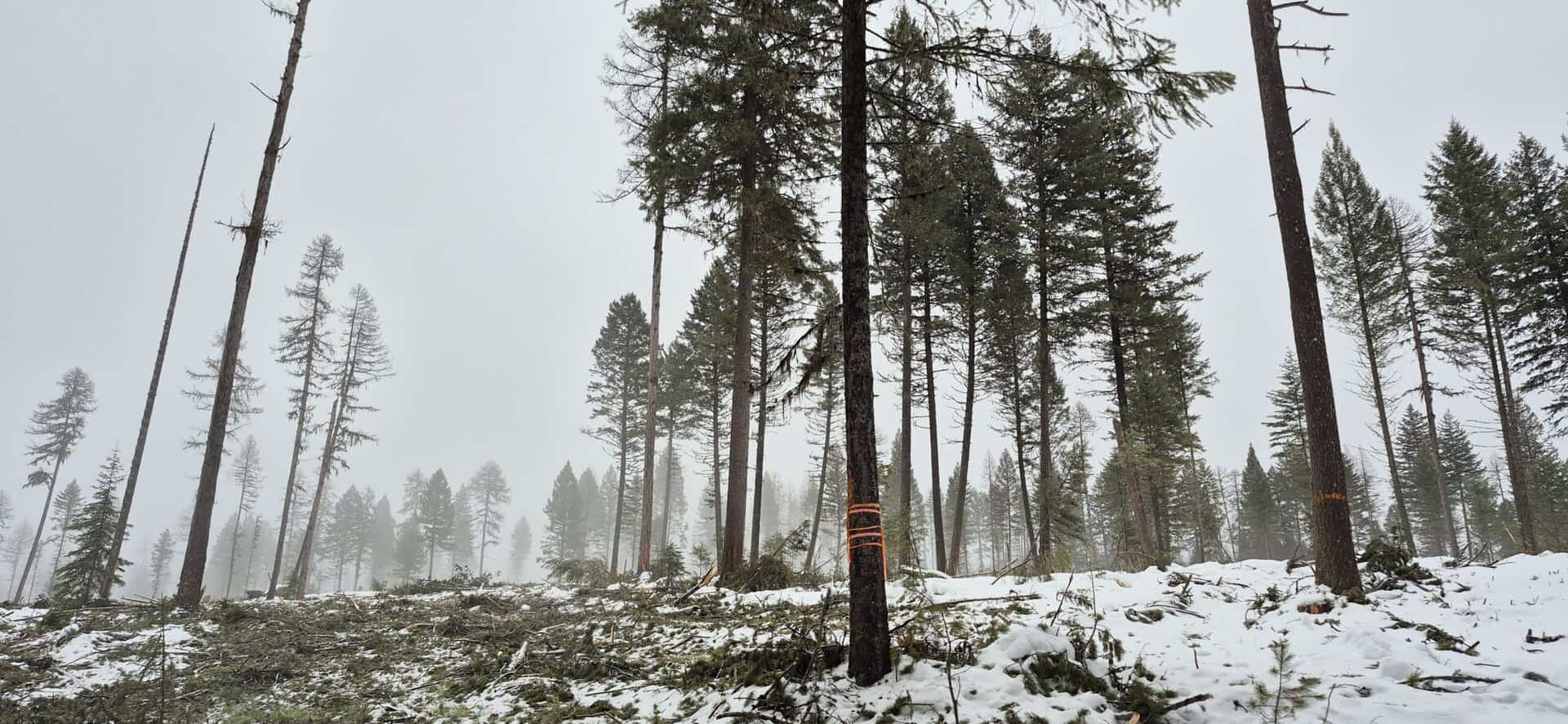
The Flathead National Forest’s Round Star Project includes many silvicultural prescriptions, including regeneration harvest which reset forest stands to trend the conditions to a more fire and disease-resistant species dominance. This photo illustrates two different regeneration prescriptions: on the left, clearcut with reserves leaves varying density of 5-10 trees per acre, depending on natural variability, to maintain a reserve of existing desirable species, and on the right, shelterwood harvest leaves varying density of 15-25 trees per acre and maintains existing trees that provide shading and microsite protection for the next generation of trees. (Note: you can click on this photo and make it larger).

***********************

Last week I asked the question “what are the reasons for choosing clearcutting as a prescription” and got a quick and well-written answer from the Flathead, so shout-out to their silviculture and communications folks!

The Flathead National Forest spokesperson answered the questions as follows:

What are the forestry reasons for clearcutting?

We have a diversity of tree species on the Flathead National Forest. Some are fire and disease-resistant while others are susceptible to root rot, bark beetles, and some are less adapted to survive wildfire. Active forest management on the Flathead targets areas with high densities of species that are less resistant to both diseases and fire, like lodgepole, grand fir, and subalpine fir), and resets the forest stand by harvesting those trees and replacing them with tree species (western larch, ponderosa pine, Douglas-fir) that are more likely to stay healthy through disturbance events like fire and disease.


Why does the Forest Service plant trees following a harvest?

When the forest managers reset a stand of grand fir and subalpine fir – shade tolerant species – with shade intolerant species like western larch, there are no naturally occurring seed sources so we plant seedlings of the species of tree that best aligns with the future desired condition of the forest. In other cases, we plant western white pine seedlings that have genetics for resistance to known diseases like blister rust.


Where does lodgepole pine fit into the picture? 

Lodgepole pine is a fast growing, naturally regenerating tree species and does well after a disturbance event. However, these trees have a tendency to get bark beetle outbreaks once they achieve a certain age.  Forest managers will identify areas with high levels of insect infestation and designate them for clearing to limit the infestation spread. Depending on the site conditions, some of the healthier lodgepole are left, but often times, in certain soils with certain wind patterns, lodgepole blow down after a treatment. Forest managers will plant western larch, ponderosa pine, western white pine, and Douglas-fir to add species diversity to the area.


How does the forest combat root disease with regeneration harvests?

Forest managers use “regeneration” harvest in areas with a high occurrence of root disease and plant tree species that are less susceptible to that disease. Sometimes, a previous treatment that released the midstory needs to be retreated with a regeneration due to the amount of disease that developed in that stand.

In other instances, forest managers use a “clearcut with reserves” that leaves individual trees or clumps of trees of western larch and doug fir scattered through the treatment area to meet objectives for both the future desired condition of the forest and for wildlife species that benefit from forest openings. These treatments usually leave 5-10 trees per acre.

************

I will only add, as a person involved with the western white pine resistance program in the earlier days, that restoring WWP seems like a good idea, for ecological value, for Native Americans, for wildlife, because it is fire-adapted, and for biodiversity.


Where is the Forest Service Clearcutting Today and Why?

We’re going to dive down to the “why,” at least on one forest, to satisfy the silviculturally curious, but this handy table shows us where clearcutting is happening in terms of Region. I’d like to step back a minute and say that my perspective depends on my observations at a specific spatial and temporal scale, and also how I perceive them, for example driving through California post-wildfire is different from info derived from satellite photos.  Point being, everyone, including researchers, can be “right” in their own observations, but not give a complete story.  It’s only in engagement with each other, and with various kinds of data, that we can get closer to an overall picture of how things are and why people think as they do.


Anyway, the tables go back to 1984.

I asked Google AI to plot clearcut acres for me from 1984 to 2025.  Google AI even made up a narrative to go with it! I don’t know how true the narrative is. Or really even the plotting, but..

So it looks like if you were in R-3 or 6, you would think “there is no clearcutting” but if you were in Rs 1,2 and 9, you might think differently. Or if your career began in the 1970’s or 80’s, it might seem like there is little to no clearcutting comparatively.

**************************

To get to Forest, I think I would have to dive into FACTS, which would be a handy thing to be able to do (and might be handy to compare fuel treatment acres over time), but here is what Google  AI said I would need to do. Maybe there’s still time to consider a Peoples’ Non-GIS Database for info people have proven to be interested in?

No, the publicly available summaries from the annual reports do not break down these totals by individual National Forest.
The standard published source for this data—Table 20 of the Annual Reforestation and Timber Stand Improvement Report—aggregates clearcutting acreage strictly at the Regional level. [1]
To obtain the 2024 clearcutting totals for individual forests within Region 1 (such as the Flathead, Bitterroot, or Kootenai National Forests), you must access the raw FACTS database layers directly using one of the following approaches:
    • Download the Geospatial Data: You can download the raw shapefiles from the USDA Forest Service Enterprise Data Portal. By uploading the Activity_TimberHarvest layer into GIS software (like QGIS or ArcGIS), you can filter the data by Fiscal Year (2024), Region (01), and FACTS Activity Codes (4110 through 4119)—which explicitly denote clearcutting—and group the results by the NATIONAL_FOREST_NAME attribute field. [1, 2]
    • Use the ArcGIS Online Portal: You can use the interactive ArcGIS FACTS Harvest and Silviculture Portal to visually filter for Region 1 projects, click on specific management boundaries, and view the attribute tables containing the exact acreage for that specific forest unit.

    • Submit a FOIA or Info Request: If you do not have GIS software, you can contact the Region 1 Regional Office in Missoula, Montana, or the specific forest’s silviculturist to request a copy of their localized FACTS tracking spreadsheet for FY 2024.

Would you like the exact list of FACTS activity codes used for clearcutting to help you filter the GIS database, or are you looking for details on a specific logging project in Region 1?

***************