***********************
Last week I asked the question “what are the reasons for choosing clearcutting as a prescription” and got a quick and well-written answer from the Flathead, so shout-out to their silviculture and communications folks!
The Flathead National Forest spokesperson answered the questions as follows:
What are the forestry reasons for clearcutting?
We have a diversity of tree species on the Flathead National Forest. Some are fire and disease-resistant while others are susceptible to root rot, bark beetles, and some are less adapted to survive wildfire. Active forest management on the Flathead targets areas with high densities of species that are less resistant to both diseases and fire, like lodgepole, grand fir, and subalpine fir), and resets the forest stand by harvesting those trees and replacing them with tree species (western larch, ponderosa pine, Douglas-fir) that are more likely to stay healthy through disturbance events like fire and disease.
Why does the Forest Service plant trees following a harvest?
When the forest managers reset a stand of grand fir and subalpine fir – shade tolerant species – with shade intolerant species like western larch, there are no naturally occurring seed sources so we plant seedlings of the species of tree that best aligns with the future desired condition of the forest. In other cases, we plant western white pine seedlings that have genetics for resistance to known diseases like blister rust.
Where does lodgepole pine fit into the picture?
Lodgepole pine is a fast growing, naturally regenerating tree species and does well after a disturbance event. However, these trees have a tendency to get bark beetle outbreaks once they achieve a certain age. Forest managers will identify areas with high levels of insect infestation and designate them for clearing to limit the infestation spread. Depending on the site conditions, some of the healthier lodgepole are left, but often times, in certain soils with certain wind patterns, lodgepole blow down after a treatment. Forest managers will plant western larch, ponderosa pine, western white pine, and Douglas-fir to add species diversity to the area.
How does the forest combat root disease with regeneration harvests?
Forest managers use “regeneration” harvest in areas with a high occurrence of root disease and plant tree species that are less susceptible to that disease. Sometimes, a previous treatment that released the midstory needs to be retreated with a regeneration due to the amount of disease that developed in that stand.
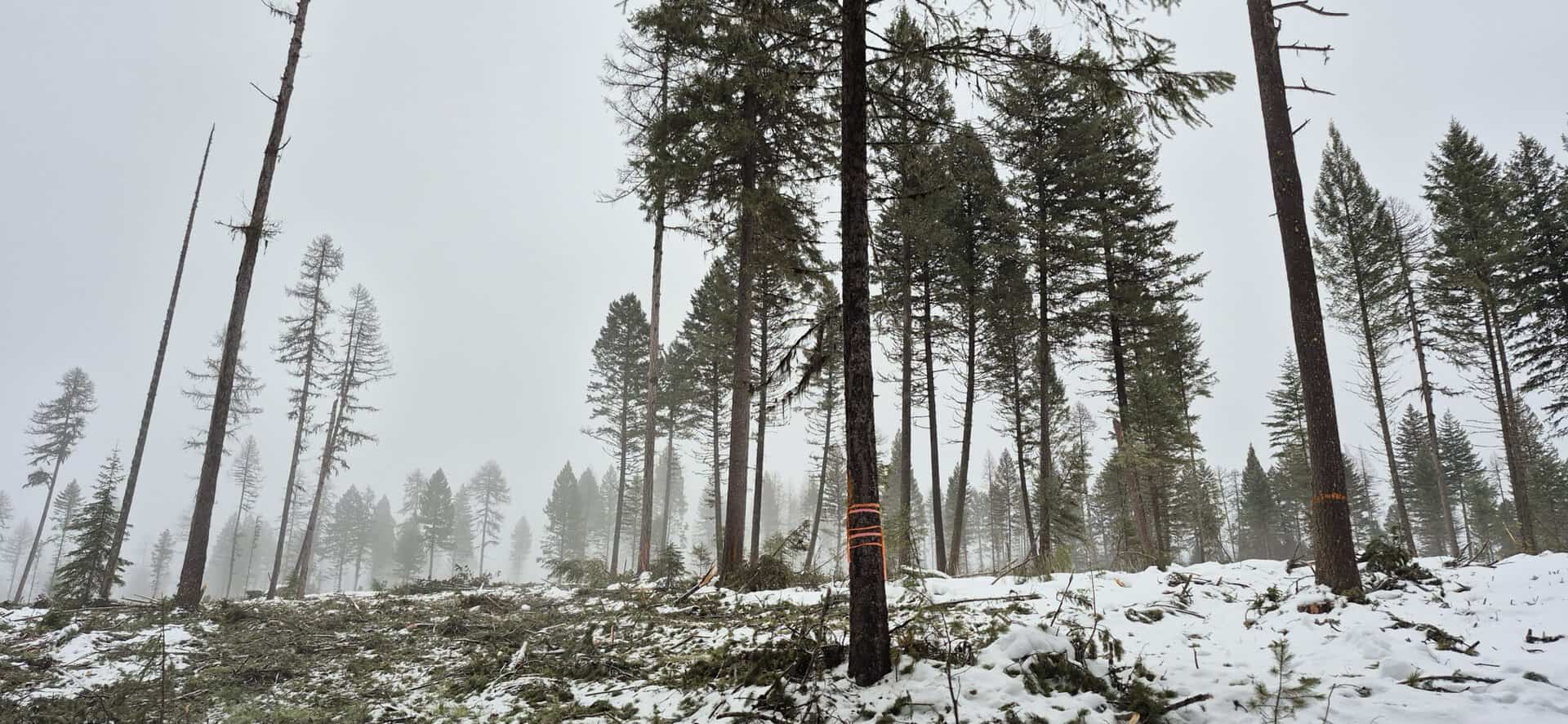
In other instances, forest managers use a “clearcut with reserves” that leaves individual trees or clumps of trees of western larch and doug fir scattered through the treatment area to meet objectives for both the future desired condition of the forest and for wildlife species that benefit from forest openings. These treatments usually leave 5-10 trees per acre.
************
I will only add, as a person involved with the western white pine resistance program in the earlier days, that restoring WWP seems like a good idea, for ecological value, for Native Americans, for wildlife, because it is fire-adapted, and for biodiversity.
This is all silvicultural – nothing ecological. The forest plan desired conditions and natural range of variation (needed for required ecological sustainability and diversity) are not mentioned. The plan should have set them up for this answer: “this is the Rx needed to achieve (desired conditions) because of (silviculture).” It sounds like their mission is to “improve” on nature instead. Especially where “there are no naturally occurring seed sources.” Did they never grow here or they only talking about salvage harvests? (Or is the forest plan desired condition/NRV to improve on nature?)
All silviculture is applied ecology.
While the FHF’s public affairs shop didn’t clearly draw the line to their Forest Plan, that is definitely in the minds of their Silviculturists. Many of the considerations mentioned above (eg root disease, fire resilience, beetle resistance) are very likely laid out in the FHF’s Forest Plan.
On the other hand, I work under a forest plan that is 40 years old, and very divorced from ecology. The goals it lays out are largely driven by timber production, and the ecological considerations I include in management decisions are not laid out in the Plan at all.
I think it’s important context that many forests in Western Montana bear the impacts of a long legacy of forest management which we may consider misguided today. In the 40s the Forest Service emphasized removing large “overmature” pine and larch which today we know as our fire tolerant, desirable trees which we seek to restore. In the 80s private lands (many of which have since been acquired by the Forest Service) were cut aggressively, creating serious forest health problems. And fire exclusion greatly increased Doug-fir and lodgepole, while pine and larch declined. These are frequently the reasons that seed sources for desirable species are missing from sites, and why they must be reestablished to restore these forests. Clearcutting, when done in the right circumstances, can be an effective tool for restoration, as counterintuitive as that seems. When a high-graded Doug-fir stand is declining, you can’t get it on a better trajectory to meet ecological goals without opening some space and regenerating desired species.
Good point that we logged the seed sources. Also a good point that it was the public affairs shop, because I thought the Flathead revised plan was kind of a leader on ecological desired conditions (maybe it’s not that big of a compliment though).
I was familiar with operating under the prior Flathead forest plan, and they seemed to find a way to establish desired conditions for projects based on historical reference conditions, even though that was not explicitly in the forest plan – it was probably tied to some general plan direction for diversity.
To be fair, I didn’t ask the forest for “how those goals relate to the forest plan”, although I’m sure that’s in the EA. I took it for granted that increasing tree species diversity was a DC. Since the forests used to have more WWP and WL, it would be interesting if somehow moving toward NRV did not include restoration of those species.
Curious how a shelterwood with residuals is categorized on the Colville? Normally, a shelterwood harvest is considered even-aged management, but the Colville never does the second entry; therefore, the shelterwood is never removed. NTM, eastside screens includes a 21-inch dbh limit, so that also affects the result of a shelterwood. Given these caveats, is that really an even-aged harvest and how does the forest track this harvest method in FACTS? Seems more like a thinning from below, given the overstory retention and canopy cover target, and the result is a two-aged stand.
I think that’s a good point. My understanding is there’s a specific FACTS Activity Code for Two-Aged Shelterwood With Reserves, where it is acknowledged that the shelter trees are to be retained with no intention of removal. Because the primary intent of the treatment is to regenerate the stand and establish a new cohort, it is a regeneration harvest not an intermediate treatment (ie thinning). Even if there are a lot of residual trees, it all comes down to whether the intent is to establish a new cohort or manage the existing cohort.
The Forest Service lumps single-age and two-age treatments into “even-age” systems, and anything with three or more age classes as “uneven-age” systems. This has implications for 40-acre openings: a two-age regeneration harvest over 40 acres requires public notice and approval, but an uneven-age regen harvest over 40 does not.