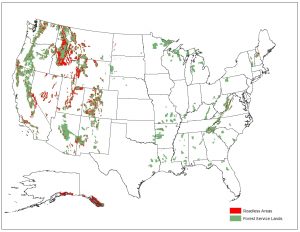
Forest planning is not often news these days, but it has shown up as a subheading in some reporting on the rescission of the Roadless Rule. As in this article from the Asheville Citizen Times (Cory Villancourt, paywalled)
“Shift to local
USDA and the Forest Service argue that forest plans are capable of protecting water, wildlife, recreation, scenery and other resources without a nationwide prohibition.
Under the proposed rescission, individual forests could retain restrictions through their own land management plans. States, tribes and other interested entities could also petition USDA for geographically specific roadless protections.
The department says that system would allow decisions to reflect local ecological, economic and social conditions instead of being governed by a single national rule.
Opponents say that is precisely the approach the Roadless Rule was created to replace.
One of the Forest Service’s own justifications for adopting the rule was that roadless-area management became a major source of conflict and local forest planning did not always account for the national importance of those lands
Without the rule, protection again could become a forest-by-forest and project-by-project fight. Mysliwiec said that would consume time and money on all sides.”
As a planner, I could see that, as a next worse alternative, returning roadless area decisions to forest planning might not lead to much change in most cases – assuming that the status quo for planning purposes is that roadless areas are protected, and that the planning process adequately addresses the values of these areas. I surmised that in most places, that “major source of conflict” would create a lot of inertia for not amending or revising a forest plan to remove current protections.
Here are excerpts from another perspective from a former Forest Service biologist who worked on forest plans in western states.
“There is something quietly hopeful about forest planning. You are, in effect, shaping the experiences of people and species who will be out in these woods in 2040 and 2050 — trying to ensure the places they inherit will still be whole…
I didn’t leave (the planning job) because I stopped believing in the work. I left because I could see, from inside the agency, what direction the wind was shifting. I sensed that my job was about to pivot away from building a resilient future for these lands to dismantling the safeguards that took decades to develop. I think of it as “unplanning” — the systematic dismantling of protections carefully built over decades…
The U.S. Department of Agriculture released its proposed rule and draft environmental impact statement — the next formal step toward eliminating the Roadless Rule outright. This time, the pitch was largely about forest plans, the same documents in which I specialized. The agency claimed that the “land management planning framework ensures each land management plan addresses similar conservation objectives as the 2001 Roadless Rule was intended to address…
Forest plans matter, don’t get me wrong. They set out a vision for what a forest should look like and, in theory, steer projects toward that vision. But forest plans were never built to be a national conservation strategy. Every forest plan is its own, relatively small-scale document, shaped by its own local pressures, its own local politics and its own planning team working through its own set of tradeoffs.
That’s precisely the patchwork approach the Roadless Rule was created to fix in the first place: the agency recognized the need to protect roadless areas consistently across the National Forest System.”
This author has been looking at the revisions of the Blue Mountains forest plans covering the Malheur, Wallowa-Whitman and Umatilla National Forests, as
“… the first real test case for what forest management looks like without roadless protections. The results are stark. The draft plan would eliminate roadless-area safeguards outright, open most of these lands to road construction and timber harvest — including old-growth and salvage logging — scrap the road-density limits that keep elk and other wildlife secure and weaken the watershed protections that keep sediment out of salmon and trout streams. This is the unplanning I sensed was coming.”
I’ve also worked a little with the Blue Mountains forest plan revision. The DEIS labels its alternative without the roadless rule as its “proposed action,” with this explanation:
“In this DEIS, the roadless area issue and alternatives aim to provide a reasonable set of forest planning options so the final forest plan can align with the decision the Department makes about future roadless regulations.”
What it doesn’t do is tell us what that means in terms of individual roadless areas on these national forests. The Department’s rescission is explicitly NOT making decisions about that, so we should expect forest planning to be clear about it. We could acknowledge that it’s hard for the NEPA process to hit a moving target, but they seem to be aiming the wrong way.
The scoped “proposed action” identified all existing inventoried roadless areas as MA 2A Inventoried Roadless Area (IRA). The no-action alternative would maintain these protections of the Roadless Rule (so the status quo is defined as the Roadless Rule, as I suggested). Alternative 3 (of 3) in the DEIS replicates this management of roadless areas. (The changes in the proposed action actually suggest a need for rescoping.)
Alternative 2 is referred to as the “Proposed Action, Active Management,” and it appears that the agency position when revising this forest plan would be to just ignore roadless areas. There is no “IRA” management area in this alternative. The description of this alternative does not explain what it actually intends to do with roadless areas. Importantly, the effects analysis does not address specific roadless areas. While the DEIS includes roadless areas as one of the five issues to address, it purports to do this by a forest-wide accounting of roads and timber management. There does not appear to be any information in the DEIS that would facilitate examining alternatives for specific roadless areas, or proposing a forest plan alternative that would protect selected areas.
The Forest Service has taken a sledgehammer approach to the history of the development of the Roadless Rule, and the rationale for reversing its policy on these national forests appears to be clearly arbitrary. The rescission of the Roadless Rule does not require them or authorize them to ignore roadless areas. In fact, the Roadless Rescission Alternative 3 would require an area-specific look that the Blue Mountains DEIS has not provided.
NEPA requires evaluating the effects of removing existing environmental protections. Moreover, if you look at the history of litigation of effects on roadless areas (going back to RARE II), it’s clear that NEPA requires disclosure of effects of decisions on specific areas identified as having roadless values (including effects on potential wilderness designation). There is nothing like that here for the Proposed Action. The only area-specific information is a listing of roadless areas and acreages protected in Alternative 3.
As a test case, it looks to me like it would flunk. I hope others (and the next try for the Blue Mountains) will take more seriously the agency’s pronouncement that individual forest plans allow for “place-based, collaborative decisionmaking that is responsive to specific on-the-ground resource conditions” with regard to each roadless area. I think there was even some agreement on this blog that what is needed is a forest-specific look at whether/how each roadless area should be protected. That hasn’t been done here. (I haven’t reviewed the DEIS for the national rescission process, which arguably could have provided such area-specific information to tier to, but the Forest Service disclaims any attempt to do this, and this DEIS does not reference anything like that).
(Note that these existing forest plans were written prior to the Roadless Rule, so this doesn’t necessarily serve as a test case for amending or revising newer forest plans to remove protection of roadless areas.)
Hmm.. “open most of these lands to road construction and timber harvest — including old-growth and salvage logging — scrap the road-density limits that keep elk and other wildlife secure and weaken the watershed protections that keep sediment out of salmon and trout streams.”
Well, I don’t know what goes on in the Blue Mountains, but I do know how forests and districts operated when the 2001 was enjoined. Most line officers don’t want to poke any environmental group bears. Why would they? So they would have to have a reason to go into formerly roadless areas. A compelling reason, to someone. The timber industry??? The same timber industry that is struggling in previous post, would pay to build roads? Who else exactly.. are there minerals- in most cases, I would guess not.
I would guess the main difference would be allowing temp roads to do fuel reduction treatments near communities.
Now I guess there could be some kind of rationale that suddenly line officers would want to go into roadless areas and cause controversies… but I think we would need to get some kind of hypothesis for why they would change their behavior so significantly from previous decades.
“Most line officers don’t want to poke any environmental group bears.” That was pretty much my assumption also, but a sample of one says we were wrong; the bears are stirring. You could say nobody should really be concerned until someone proposes a project in a roadless area because it’s not likely to happen, but that would mean the forest plan is a lie.
What do you mean “the forest plan is a lie?”.