Addressing NFMA Timber Requirements Through the Restoration Lens

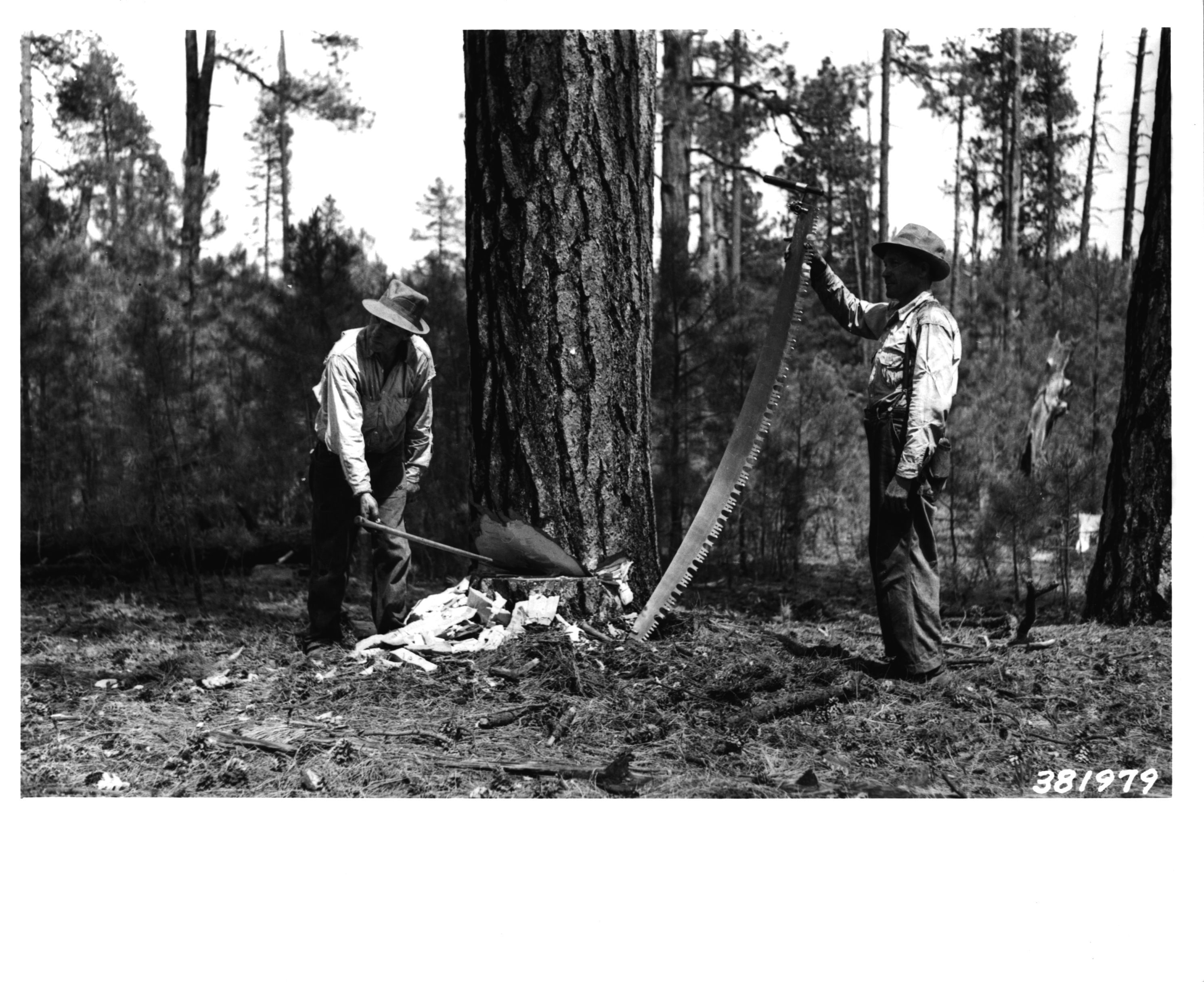
Arizona Lumber and Timber Company, Coconino National Forest, 1939, photo by Walter H. Shaffer

Sometimes language can get in the way.   Foresters are becoming aware that their traditional language for cutting trees confuses the public, and reduced their ability to explain what they are trying to accomplish.  This is especially true today when trying to reduce the chances of unwanted fire behavior, by “restoring” tree stands to conditions that were less dense.

In 2008, former associate chief Sally Collins coauthored a paper with Hutch Brown about the importance of rephrasing the purpose and need statement for vegetation projects, eliminating the use of traditional silvicultural terminology and replacing it with the language of a new collaborative process.  They pointed out that the technical language is difficult for lay audiences to understand, and because it originated in a timber culture, the language can cause confusion about a restoration project’s true purpose.  For collaboration to work and succeed, a new kind of language is needed that clearly communicates the intended restoration purpose.

In pointing out the problems with silvicultural terms such as “commercial” or “pre-commercial thinning”, “crown spacing”, “ladder fuels”, and “conifer competition”,  Collins and Brown point out: “Whereas Forest Service professionals and many interested groups are familiar with terms like these, others are not. Sustainable restoration efforts require broad public involvement and support, yet relatively few people are likely to engage in a project when they do not understand the terms used to describe it.

The same criticism of timber project descriptions also holds true for planning under NFMA.  Perhaps there is a way to be faithful with the act, but translate the terminology in ways that explain the ecological purpose of the projects.

Here are some of the possibilities:

NFMA Requirement 1982 Terminology Possible New Terminology
Determine forest management systems, harvesting levels, and procedures, and the availability of lands and their suitability for resource management Multiple-use prescription for each management area Agree on a theme for an area – what is the degree of human influence on natural processes like fire and insect and disease outbreaks?;What are acceptable changes and rates of changes to the forest?What are acceptable types of burning of the forest?
Identify lands not suited for timber production Lands suitable or not suitable for timber production Identify areas where trees can or cannot be removed and sold
Insure that cut designed to regenerate an even-aged stand will be used (for clearcuts only where its optimal) where such cuts are consistent with soil, watershed, fish, wildlife, recreation, esthetic resources, and regeneration of the timber resource Even-aged silviculture and even-aged stands Identify landscapes where we prefer trees at the same age
Insure timber will be harvested only where there is assurance that such lands can be adequately restocked within five years after harvest Restocking lands within 5 years after final harvest Provide small 6-inch trees within 5 years after a stand of large trees has been removed

Considering the Science Of Land Use Planning

submitted by Dave Loomis

Rational Planning

After World War II, the University of Chicago’s newly created Program in Education and Research in Planning was enormously influential in setting the direction of planning theory. Keynesian economists, pushed the faculty to define and systematize core areas of knowledge in planning, perceived essential to practice. It was the search for this core for the profession that led to the development of a generic model for planning in capitalist democracy and incorporation of ideas from various social scientific disciplines, including economics and political science. The rational planning model, became a guide in the profession and beyond as an approach to problem solving in the public sphere ;

1. Ends reduction and elaboration;
2. Design of courses of action;
3. Comparative evaluation of consequences;
4. Choice among alternatives;
5. Implementation of the chosen alternative.

The five steps were later simply described as “Desires, Design, Deduction, Decision, and Deeds. Reproduced, more or less, in countless presentations since, these steps describe a problem-solving framework for complex human enterprises. The model is both self-evident due to simplicity and unachievable due to its demands on resources and expertise. Chicago planners recognized complexities, including the elusiveness of the aim of serving the public interest and politics’ resistance to scientific analysis.
Even before publication, the rational planning model had its critics. It has suffered battering from countless quarters since. Yet, for about 20 years it remained the most widely subscribed planning theory. To this day, its logic can be found in the justifications and methodological outlines given in the introductions to most plans. It remains a major underpinning of planning school curricula. Moreover, theoretical and methodological work detailing and extending the model continues. This includes efforts to compare alternative rules for aggregating individual preferences, examination of the implications of risk and uncertainty, and consideration of the impact of new and faster computers on our abilities to ascertain public preferences and completion of the necessary calculations.

By drawing on Keynesian economics and policy studies in political science, the rational planning modelled to the incorporation of numerous social scientific concepts into planning offices. It highlighted planning’s role in correcting market failures related to externalities, public goods, inequity, transaction costs, market power, and the nonexistence of markets. Justifications for planning included reduction of nuisance and congestion, protection of resources, reduction of taxes or of public costs, provision of a stable business environment, and the improvement of environmental quality and livability. Planning borrowed the tools and language of cost-benefit analysis and operations research, including notions of decision criteria, multiple objectives, constraints, shadow pricing, willingness-to-pay, optimization, and minimization.

Criticisms and Extensions of Rational Planning
The incrementalist critique of rational planning gained wide circulation by the early 1960s. Political scientist Charles Lindblom (1959) suggested that comprehensive or .synoptic. planning, as he called it. was unachievable and out of step with political realities. He argued that political leaders cannot agree on goals in advance, as the rational model requires. They prefer to choose policies and goals at the same time. He thought that the rational model’s preoccupation with the comparison of all possible alternatives and their comprehensive assessment on all measures of performance exceeds human abilities. The relationship between science and policy choice was oblique at best. The real measure of “good policy” is whether policymakers agree on it. Lindblom’s alternative, incrementalism, calls for the simultaneous selection of goals and policies, consideration of alternatives only marginally different from the status quo, examination of simplified, limited comparisons among the alternatives, and the preference for results of social experimentation over theory as the basis of analysis.

If Lindblom’s late ’50s critique had shown a chink in the armor of rational planning, the social unrest of the 1960s brought a full frontal assault. Alan Altshuler’s (1965) doctoral dissertation examined the experience of land and transportation planning in the Minneapolis-St. Paul region. He found that planners were seldom able to achieve their objective I scientific aspirations. Their claims to comprehensiveness were not backed up by reality. Decision-makers often ignored their recommendations in favor of the wishes of politically connected stakeholders. Organizers of citizen input to planning processes railed against the often-futile nature of public participation.

The rational planning model gradually lost ground. Indeed, in the late 1970s, it was common to talk about a “crisis in planning theory” resulting from the loss of a center to the field.

A series of new directions emerged, focusing on planners’ facilitative roles in shaping decisions emerged. Often referred to as social learning theories, these contributions emphasized planners’ roles in bringing stakeholders together, gathering and sharing information, and helping social structures to learn from their experiences. Citizens and civic leaders, not planners, had to be at the core of planning if plans were to be implemented. The planner, acting as catalyst and boundary spanner strives to create a self-correcting decision structure capable of learning from its own errors.

By the late 1970s, planners recognized that the completeness with which they had embraced notions of science in their work had exacerbated their isolation from political decision-makers. Planning theorists began drawing from political philosophers who questioned mainstream social science.

Communicative planning theory asserted that through communicative strategies complementing their technical work, planners can alert citizens to the issues of the day, arm them with technical and political information, and otherwise encourage community-based planning actions. It would then be necessary for them to work in the midst of the wide variety of views expressed by diverse interest groups to formulate new consensus policies that might be widely supported.

Much recent activity has surrounded identifying better ways for planners to present arguments so that they will be persuasive in political and multicultural environments. One promising direction proposes that the often-quantitative orientation of urban planners matches poorly with the needs of decision-makers who are often moved by stories that convey human behaviors in terms they can understand. Storytelling is a proposed serious planning method that can accomplish what statistical analysis may never do. Other theorists are drawing on turn of the century American pragmatist philosophers to suggest that the emphasis on deductive reasoning in our statistical training is out of step with the more pragmatic. problem-solving orientation of most public decision makers.

What Have We Learned Since the COS Report?

Thanks to the generosity of the Society of American Foresters, we can post articles from the Journal of Forestry May 99 edition on this blog. This edition of the journal focused on the COS Report. Today I’ll post the Norm Johnson article here.

Since 1999, we have tried many of the ideas that the COS brought forward. I would be interested in how you all think these ideas have worked.

I will post later this week on my experience with trying out some of these concepts.

CEQ Guidance Comment Period

Since we spend some quality time on this blog talking about NEPA, you might be interested in commenting on this draft CEQ guidance. the climate change and mitigation and monitoring might be particularly relevant to our discussion, since the draft guidance seems to extend the NEPA regs to past implementation of the decision. Here are some questions relevant to federal land management, and the bolded ones seem to have to do with LMPs:

CEQ also requests comment on land and resource management issues, including:
1. How should NEPA documents regarding long-range energy and resource management programs assess GHG emissions and climate change impacts?2. What should be included in specific NEPA guidance for projects applicable to the federal land management agencies?
3. What should be included in specific NEPA guidance for land management planning applicable to the federal land management agencies?4. Should CEQ recommend any particular protocols for assessing land management practices and their effect on carbon release and sequestration?
5. How should uncertainties associated with climate change projections and species and ecosystem responses be addressed in protocols for assessing land management practices?
6. How should NEPA analyses be tailored to address the beneficial effects on GHG emissions of Federal land and resource management actions?
7. Should CEQ provide guidance to agencies on determining whether GHG emissions are “significant” for NEPA purposes. At what level should GHG emissions be considered to have significant cumulative effects. In this context, commenters may wish to consider the Supreme Court decision in Massachusetts v. EPA, 549 U.S. 497, 524 (2007).

Here’s the link.

New CEQ NEPA Guidance In conjunction with NEPA’s 40th Anniversary Celebration, CEQ is publishing three draft NEPA guidance documents for review and comment. Below are links to the draft guidance documents and instructions for submitting comments:

– ESTABLISHING AND APPLYING CATEGORICAL EXCLUSIONS

Comments are due 45 days after publication of the Federal Register notice.

Submit Comments to http://www.whitehouse.gov/ceq/initiatives/nepa

– MITIGATION AND MONITORING

Comments are due 90 days after publication of the Federal Register notice.

Submit Comments to http://www.whitehouse.gov/ceq/initiatives/nepa

– CONSIDERING GREENHOUSE GAS EMISSIONS AND CLIMATE CHANGE

Comments are due 90 days after publication of the Federal Register notice.

Submit Comments to http://www.whitehouse.gov/ceq/initiatives/nepa

Additional information is available at www.whitehouse.gov/administration/eop/ceq/initiatives

FACA Frolics- Or- When an AC Has Your Back


While I agree that federal agencies may have too many advisory committees, and that the structure of FACA committees may involve large amounts of bureaucracy and paperwork, I think they can also serve a useful purpose. So here is my experience: I was the Designated Federal Official for the Forestry Research Advisory Committee for a year or two, and I also worked with the ACAB (Advisory Committee for Agricultural Biotechnology) and tangentially with the NAREEAB , (National Agricultural Research, Extension, Education, and Economics Advisory Board). I observed advisory committees run well and not so well, making recommendations of great, and little, utility. I experienced the frustrating paperwork requirements firsthand as a Designated Federal Official (trying to get the Office of White House Liaison to accept our nominees, and restarting the process when clearance packages got lost). My most recent experience was with the RACNAC (Roadless Area Conservation National Advisory Committee) as a staff person involved with the Colorado Roadless Rule, which entailed all the fun and none of the bureaucracy for me.

Here are a couple of reasons I think a formal collaborative group for the planning rule might be useful.
1) Commitment to the process. The formality of a FACA committee means that people (generally) take their responsibility seriously and put the time in to really work on the issue and understand it. Being a FACA committee is not the only way of getting this commitment (certainly the Colorado Roadless Taskforce had that commitment, but it was not within the federal structure) but formalizing it as opposed to having a generic kind of group seems to help. Perhaps this is because, as a FACA committee, the group can make formal recommendations.
2) Today, “bipartisan” is on the lips of many. Especially for planning rules and roadless rules, there has been a history of public policy as ping- pong ball from administration to administration. A set of recommendations from a collaborative group gives an opportunity for recommendations beyond partisanship. It also potentially gives political cover for the next administration not to mess with it. The bipartisan Colorado Roadless Rule Taskforce recommendations carried forward across governors of different parties. Most of us just want a planning rule that we can live with that will stick. The “will stick” part can be helped by a FACA committee.
3) Navigating the clearance process. Many agencies weigh in, some with strange and peculiar worldviews, and if you want your rule cleared, you have to go along or the Department has to spend political capital. If the recommendations left the FACA committee and the Department went along with them, it would be pretty transparent where the changes came in. Then advisory committee members could potentially set up educational meetings with the recalcitrant agencies, or call upon their own favor networks to facilitate progress.
4) Raising the level of dialogue. Some individuals will come to a public meeting and comments about how bad a certain idea is (along the lines of “my views are clearly based on goodness and light and yours are venal and unprincipled”). I have seen the RACNAC ask useful questions like “how would you change the proposal to improve it?” that served to focus the dialogue. In one case, a person had flown in to a public meeting who clearly didn’t know the topic and hadn’t been briefed and didn’t seem to have a clue about how to improve the proposal or on anything that would veer off the written statement. The agency itself would probably have simply felt uncomfortable asking for higher level input, as our role is not generally to question or improve public comments but be hospitable to the public and listen. Having expectations for, and hopefully, generating, substantive discourse would add greatly to an involvement process.

5) Providing media cover. Members of a FACA committee can say all the things about their recommendations in colorful ways that agencies probably can’t.. and defend their recommendations in the media. This keeps the agency from becoming either a punching bag, or perceived to be defensive and argumentative.

In summary, then, a FACA committee, in my experience, can provide all kinds of useful support and cover for a complex, divisive issue and is worthy of consideration. The only addition I would have would be to include some kind of peer-to-peer discussion with agency staff or a formal devil’s advocate, as to the practicality and economic cost of the recommendations.

Some would argue that this should be a committee of scientists, but I think the STS literature and particularly Mark Brown’s book “Science in Democracy” leads us to the conclusion that representational would be best (as was the RACNAC).

P. S. I think that Brown’s book is great, but is a bit heavy on the canon of political theorists for most casual reading. I haven’t thought about Locke, Hobbes and Rousseau since I worked on the 1995 RPA, where we tried to place them along Pinchot, Leopold and Muir to describe the “serving people” part of “caring for the land and serving people.”

The Frame Game

There is power in “framing” political discourse and policy development: Those who control the frame, control the content, the context, and more. In short, “He Who Sets the Frame Controls the Game”.

What just happened in the NFMA Rule Development game? The comment period closed yesterday. The frame was set by rehashing experience in planning, then constructing five “Substantive Principles for a New Rule” and three “Process Principles” (each with a battery of related questions). How many people, do you suppose, chose to respond outside that frame? How powerful was the frame?

In my formal comment I said that I wish the Forest Service had simply established a blog, and begun with a simple question, like: “Given the noble ideas embedded in RPA/NFMA (Wikipedia link) and other principal laws related to the Forest Service, how might the planning/management process of the USDA Forest Service be improved?” Then I said that I hoped someday the FS would indeed engage the public in meaningful inquiry as to its operations and the management of the national forests. Not yet, though. I added:

Unfortunately but not unexpectedly given the RPA context, these regulations have been dubbed a “planning rule.” If one looks at RPA/NFMA through the lens of adaptive management, the process outlined in Section 6 looks much different than if one views it through the lens of comprehensive rational planning. Unfortunately, all previous “NFMA rules” (and associated forest plans) have been developed under the “comprehensive rational planning” frame.

We must remember that the Clinton era Committee of Scientists recommended that a forest plan be viewed through an adaptive management lens — viewed, figuratively, as a loose-leaf compendium of all assessments, decisions, monitoring and evaluation efforts, etc. that affect an administrative unit of the national forest system. …

If so-called “planning rule” development is viewed, once again, as yet-another comprehensive, rational planning exercise, the agency will be mired again in analysis paralysis and process gridlock. If viewed as a mandate for adaptive management with a heavy dose of collaborative engagement on the part of other agencies, other governments, and citizens, then a whole new world of opportunity and challenge opens up to the Forest Service.

Please do not fall into the ‘planning trap’ again.

Now we wait for “next steps” and for a “Draft Rule.” And we hope that we — all of us, both the Forest Service and the public — won’t be trapped in an inappropriate “frame.” It is not that I believe that the Forest Service deliberately manipulated the “frame” in this case. Just the opposite. I believe the Forest Service fell into common decision traps: “frame blindness”, “lack of frame control”, “plunging in”, others?

Related:
Adaptive Forest Management blog
Earth to FS Planning: Get a Blog!
The Forest Service as a ‘Learning Challenged’ Organization, (1999)

Adaptive Governance and Forest Planning

Army Officer at Nine Mile Camp, Mt. Baker National Forest, 1933, photo by W.L. Baker

The more we look at the literature, the more evidence we find that our current NFMA management system doesn’t align with the current thinking about land use management.  We gravitate toward adaptive management, but we don’t quite grasp it yet.

A slight twist on the adaptive management idea is the concept of “adaptive governance.” The word “governance” instead of “management” recognizes the collaborative aspects. It’s similar to the idea of “adaptive co-management”  that Dave Iverson has described in his post here and here on this blog, citing the summary from the Resilience Alliance.

The concepts of adaptive governance are worth considering in the forest planning and management system for a couple of reasons. First, it includes the idea of learning-oriented planning similar to what Jim Burchfield proposes in his earlier post on this blog. Second, the role of science is different. Instead of relying on scientific management as the foundation for policy development, adaptive governance integrates various types of knowledge in a contextual manner.  This is similar to what Sharon describes here and here about analyzing specific questions posed by land managers and the public .

In the book Adaptive Governance: Integrating Science, Policy, and Decision Making by Ronald Brunner, Toddi Steelman, Lindy Coe-Juell, Christina Cromley, et. al., the authors use five case studies across the West.  amazon.com oxford journal review

The authors make the following points about adaptive governance:

  • Planning sets goals. You try alternatives. The burden of decision making shifts to monitoring and evaluation and terminating policy alternatives that fail.
  • No policy is permanent because interests, knowledge, and other significant details of the context are subject to change.
  • There is an understanding that politics are unavoidable. Participants assume responsibility and accountability for the policy because they must live with the consequences of implementing it.
  • Best available science is integrated with other kinds of knowledge, including local knowledge.
  • Science must be contextual, necessitating interpretations and judgments that integrate what is known about the context.

These guidelines appear to converge with other ideas that we’ve noted on this blog.  There seems to be evidence that this works.  Although NFMA and the previous forest planning rules are grounded in the scientific management process, the 2000, 2005, and 2008 rules introduced the concept of collaboration in all aspects of planning, monitoring, and evaluation, and required the consideration of uncertainty and risk. But what is missing in those rules is the idea that we are committed to using dynamic monitoring and a collaborative evaluation process in order to change policy.  For those that think that the NFMA planning rule is just about writing a Forest Plan, this would be a huge surprise and some would argue, a wake-up call.  Are the concepts of adaptive governance the next step?

Weaving Discussion Threads Together


Once a week or so, I will try to weave some of the discussion threads from the past week together. There are many interesting ideas in posts that any of us may not have time to respond to in real time, but may be working in the back of our minds somewhere.

Here’s an attempt for the past couple of weeks:

There is the minimalist, timber-only, view of planning – Andy’s KISS approach, which keeps us legal with NFMA. This seems pretty well developed.

Then we have some consensus around something like an “adaptive governance” .
ADAPTIVE GOVERNANCE
On some timeframe, at some appropriate spatial scale (a forest or subsection of forest or Forest/BLM combination ?), a collaborative group (FACA committee?) would involve the public in discussions of “what’s working now and what needs to change”, determine some ideas for change and learning questions, prioritize some activities to learn about and test ideas for change, monitor, and have a formal, transparent, public process (annually?) for checking on goals and adaptive changes. Climate change would be incorporated as included in scenarios this group would consider. It’s more about public deliberation, and learning from the land in real time, than analysis. As Dave said here

“You can only hope to accomplish anything when you are able to define the scope the problem (time, space, issues, etc.) into “decision containers” that people (stakeholders, administrators, etc) can get their minds around. It seems that traditional “forest plan” containers are hopelessly over-filled when land management zoning, land management goals and objectives, program goals and objectives, and related “standards and guidelines” are all in play — and “in play” in a spatial container that isn’t really relevant to many of the objectives at hand.”

So this idea is adaptive governance for a spatial scale appropriate to the problem at hand, which would make decisions within decision space bounded by environmental law.

ENVIRONMENTAL LAWS: In addition, there is a fundamental legal framework of environmental laws that translate into standards (BMPs, species-wide standards such as grizzly) and serve as restrictions on activities, as well as ideas for improvements to help species recovery (sometimes it is about doing things, in addition to “not doing” things) that can both feed into Adaptive Governance (AG).

MONITORING: There should also be some fundamental framework of monitoring for key elements of environmental quality, such air, water and some, but not all. species, that crosses ownership boundaries and also provides some useful information to the regulatory processes. In addition to this basic monitoring, AG groups could add other monitoring related to their questions and learning objectives at hand.

NEPA : NEPA would be done for each project or at the appropriate scale for larger scale issues (power lines, oil and gas leasing, travel management, species protection). Cumulative effects would be done “just in time” as what is “reasonably foreseeable” one year may be substantially different in three to five (for example, industry is interested/is not/is in certain energy deposits, species are reintroduced or move in on their own or become threatened, bark beetles, big fires and their aftermath, roadless rules, etc.) This is the NEPA equivalent of what Dave articulates here .

“Peter Drucker used to write about the “futurity of current decisions”, that is to look at that will emanate from each decision, as it relates to all other decisions. But to act in as close to “real time” as possible, and adjust policy and program and all else to accommodate emergent realities. I call this “just in time decision-making” or “once and forever decision-making.”

(Dave, did you mean “in contrast to” “once and forever decision-making?”)

There does seem to be some dichotomy among us on the utility of predictions at the “forest plan level.” And differences in the view that somehow broader scale- say, landscape scale- NEPA will both be better and remain fresh while the projects are carried out. This may be where Martin is with his contingency/adaptive NEPA, or maybe that’s just for long term projects such as grazing.

Ray Vaughan expresses a need for something strategic at a broader level in this post, but whether it needs to be NEPA or not is another question, in my view. The idea being that we think ahead strategically so that we don’t end up in some kind of corner by focusing on a project at a time. But to me, that’s a discussion with the public about strategy about what “might could” happen under a variety of scenarios, and not an explicit NEPA analysis of alternatives.

I liked Ray Vaughan’s analogy that he discusses in the same post, but the family in the analogy doesn’t have to spend a significant part of this year’s budget on a formalized, legally defensible, construct of different alternatives to reach its goal, given that perhaps it doesn’t know a)how many children will arrive, b) their family income, nor c) costs of education, that far in the future.

So does my weaving resemble yours? Tell us about what yours looks like.

Send Benchmarks to the Bench


From Andy Stahl

It’s Friday before a three-day weekend, so here’s a short one. Twenty-eight years ago, while serving on the National Forest Products Association’s federal land planning task force, I suggested a way to use the FORPLAN model to calculate the timber opportunity cost from environmental protection. First, have FORPLAN calculate the maximum sustained yield of timber assuming no discretionary environmental protection. Second, sequentially impose environmental protections – the timber volume difference between the two is the opportunity cost of protecting the environment. Forest Planning published my article (thanks Randal) and Doug MacCleery took it with him when he made his move from NFPA to USDA as Deputy Assistant Secretary of Agriculture in the Reagan Administration. In 1982, Doug re-wrote the Carter Administration’s 1979 NFMA rules and added benchmark analysis as a planning requirement.

Benchmark analysis had only one purpose – to highlight the cost of protecting wildlife habitat, ensuring clean water, and keeping the forest pretty for people to enjoy. The thought being that if people, and decisionmakers (like OMB), only knew the dollars they were giving up, they would rally around increased national forest logging. But it was not to be. When it comes to public forests, no opportunity cost appears too high to pay for their protection.

I’m delighted to add my nail to the benchmark analysis coffin. Forest planning is challenging enough without adding gratuitous and divisive analysis that provides no information of real use to national forest managers or the public.

Earth to FS Planning: Get a Blog!

Yes I know that the FS thinks it has a Planning Rule blog. But it doesn’t. Not a real blog anyway. All it has, so far, is a poor excuse for a comment aggregator. The other day I decided to leave a comment on Peter Williams’ recent post on the “official blog”. Guess what? The so-called blog won’t accept comments that include paragraph breaks. No HTML is allowed. And, best I can tell, even simple “http” references are not converted to active links. So I decided that until and unless the FS is willing to at least fix the paragraph breaks problem—or tell folks how to use the blog so that it will include “breaks”—I will just use real blogs outside the “official” smokescreen. Here is the comment I intended to post as a response to Peter, slightly edited:

Here is my “take” on Peter Williams’ final two questions, restated a wee bit:

How might the planning rule provide for an all lands approach and address the contribution of NFS lands to local communities?

  • How can the new planning rule, by itself or as a road map for developing forest plans, reflect the interdependency of social, economic, and ecological systems in a way that supports sustainable management of national forests and grasslands?
  • How can it help provide or ensure opportunities for goods and services to support vibrant rural, regional, and national economies?

My guess is that any planning rule that is developed in the long tradition of “rules” dating back to 1979 will not be helpful in achieving the goals embedded in the questions. Why? Because the focus of each “rule” has always been on developing a “Forest Plan” as if there were wide discretion in that process and “as if” the forest administrative unit made sense as an overall “catchall” for decision-making. Neither is the case.

One problem is that there can not be wide discretion in forest-level decision-making if only because the ecosystems embedded in each administrative unit of the national forest system are themselves part of broader ecosystem wholes, e.g. larger watersheds, larger “basin and range” systems, both, and more. This means that what works for sustainability (instead of against) re: “forest subsystem contributions” to ecosystems must be informed by the needs of broader wholes. So too with social systems. An “all lands approach” must be scaled, hierarchically, to guide development of plans at subscales. Maybe a NFMA “rule” can address such, but we haven’t seen one yet. Only with such an adaptive management assessment information system could forest-level decision-making begin to make any sense. And the ecosystems/social systems scale problem is but one of many problems that impede wide discretion in decision-making. Another is what I call the “wicked problem” problem.

The Forest Service has never (to my knowledge) addressed “wicked problems” (Wikipedia link: http://en.wikipedia.org/wiki/Wicked_problem. Such problems were first introduced to the Forest Service in 1986 by Allen and Gould (Journal of Forestry) and to the world by Rittel and Webber in 1973 (Policy Sciences). Anyone who has studied forest management problems knows that they are indeed politically wicked and cry out for approaches much different from the “comprehensive rational planning” approach that the Forest Service always gravitates toward. Even when dressed up with terms like “adaptive” or “adaptive management” the reality of the approaches used always have rational-planning at their core.

One thing is certain when dealing with wicked problems: You can only hope to accomplish anything when you are able to define the scope the problem (time, space, issues, etc.) into “decision containers” that people (stakeholders, administrators, etc) can get their minds around. It seems that traditional “forest plan” containers are hopelessly over-filled when land management zoning, land management goals and objectives, program goals and objectives, and related “standards and guidelines” are all in play — and “in play” in a spatial container that isn’t really relevant to many of the objectives at hand. I have long felt that rational planning approaches simply can’t work. Here is how I put it in my Epistle to the Clinton-era Committee of Scientists (link: http://www.fs.fed.us/eco/eco-watch/cos_greenplans.html) , written when I was an employee of the Forest Service:

… [W]e have failed to learn the lesson that there is a difference between complex problems and wicked problems (see: G.M. Allen’ and E.M. Gould. 1986. “Complexity, wickedness, and public forests.” J.For 84(4):20-23, also Henry Mintzberg. 1994. The Rise and Fall of Strategic Planning). According to Allen and Gould, politically wicked problems can not be solved by any multi-step planning process designed to “collect more data, build bigger models, and crunch more numbers … [expecting that] surely the right answer would be forthcoming.” Allen and Gould suggest that the Forest Service’s general operating norm for planning–more data, fancier analysis, more computing power, more scientists–reflects a “naive hope that science can eliminate politics.” This problem went unresolved–is still unresolved–because [Forest Service] ‘professional arrogance’ wouldn’t allow [the agency] to admit that national forest management and planning is ‘political’.

Why not try adaptive management, better still Adaptive Co-Management (Resilience Alliance Link: http://www.resalliance.org/2448.php) when thinking in terms of an “all lands approach”. Note here that the adaptive management I’m talking about is multiple-scale oriented, addresses wicked problems, and involves double loop learning (More here: http://en.wikipedia.org/wiki/Organizational_learning). Maybe such adaptive co-management can be and will be fit into the NFMA “rule” rewrite. But I doubt it. As I mentioned in an earlier post, I hope I am proven wrong.

Final thought: If adaptive co-management is to work, decision-makers will have to constantly check and “be checked” to make sure that decisions (cumulatively) aren’t afflicted with policy “decision traps.” E.g. a set of decisions might be afflicted with “policy drift” — a “tyranny of small decisions” that eventually runs counter to policy aims due to the cumulative effects of sequential or segmented decisions.