- As a former FS employee who worked in reforestation, I wonder where the decision to outsource an FS program was made? As I recall when other parts of the FS were outsourced, say fleet, the work was open to competitive bids. As far as I can tell, the decision was not documented, and AF at the time, had most experience in urban forests and not so much in wildland reforestation. So why..
- Farm out an important “growingly important due to climate change” part of the Forest Service- a part where long-term, on-the-ground knowledge is important? Why not wildland fire (to a non-competitive NGO?) or engineering, or recreation? Even the Park Service competes its concessionaires.
- Why has there not been more (any) press coverage of this asking these questions and about the accompanying reduction in federal employees? After all, we are exposed to a constant barrage of “the FS got rid of people” being bad; at the same time one point of contracting out (or “granting out”) is to reduce the workforce= because other people are actually doing the work.
- Why has there been no apparent concern by the federal employees’ union (or at least not mentioned in the press). I could be wrong about this, so would like to hear from the union if that’s not the case.
- Why has neither political party been interested in this trend, or at least interested enough to request information on how much money has been spent and what has been accomplished? Again, I would think that R’s might be interested in the non-competitive part and accomplishments, and the D’s in the reduction in FS employees, but it doesn’t seem anyone at all is interested. And yet, the Forest Service is in charge of the national forests and reforestation is key for some areas remaining in forest. What could be more important to keep in-house?
- I have a a bit of direct experience that leads me to additional concerns:
-
- Reforestation is a white-hatted issue .. why would an organization farm out it’s white-hatted issues and keep the other kind (mines, roads, etc.) Again, compare this with wildfire.
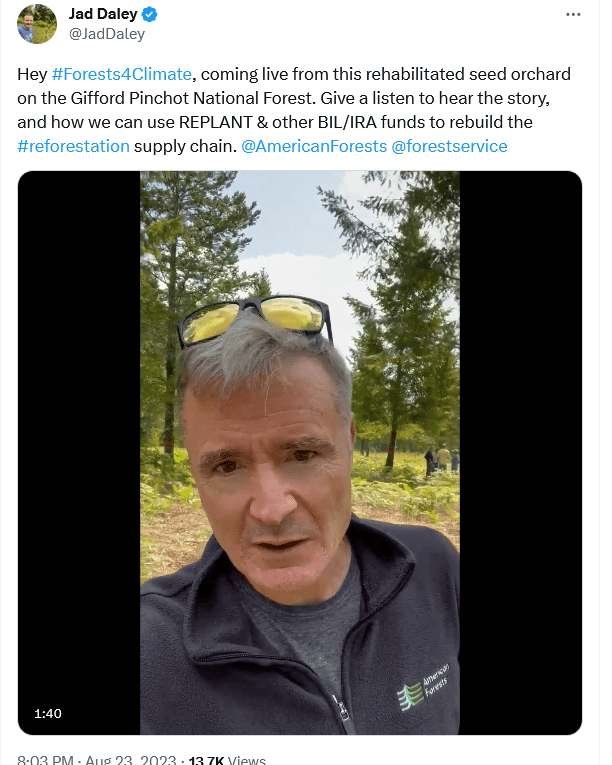
- I’ve seen coverage that highlights speakers wearing AF gear, and FS employees in the background or not there at all. Wouldn’t we want FS folks to be out front? Why not?
- The AF office wanted workers to do things that I didn’t think were the best use of joint funding.. is there anyone left in the FS knowledgeable enough to push back (or are there internal forces against pushing back)?
- Some AF folks appear to have little or no background in the body of work around reforestation. Perhaps that’s the FS’s own fault for letting too much of it go. However, I did see them promoting ideas that were rejected in the past apparently unaware of those conversations. Are we paying them to learn what employees already know- plus covering percentages off the top?
- If it’s so important to farm out a big chunk of work (and I’d argue some other Keystone work) to NGOs, why hasn’t the BLM done it? Is this an argument for moving the FS to the (possibly more business-like) Interior?
- Related- if we look at American Forests, we see that what drives them are Social Equity, Climate, Water and Wildlife.
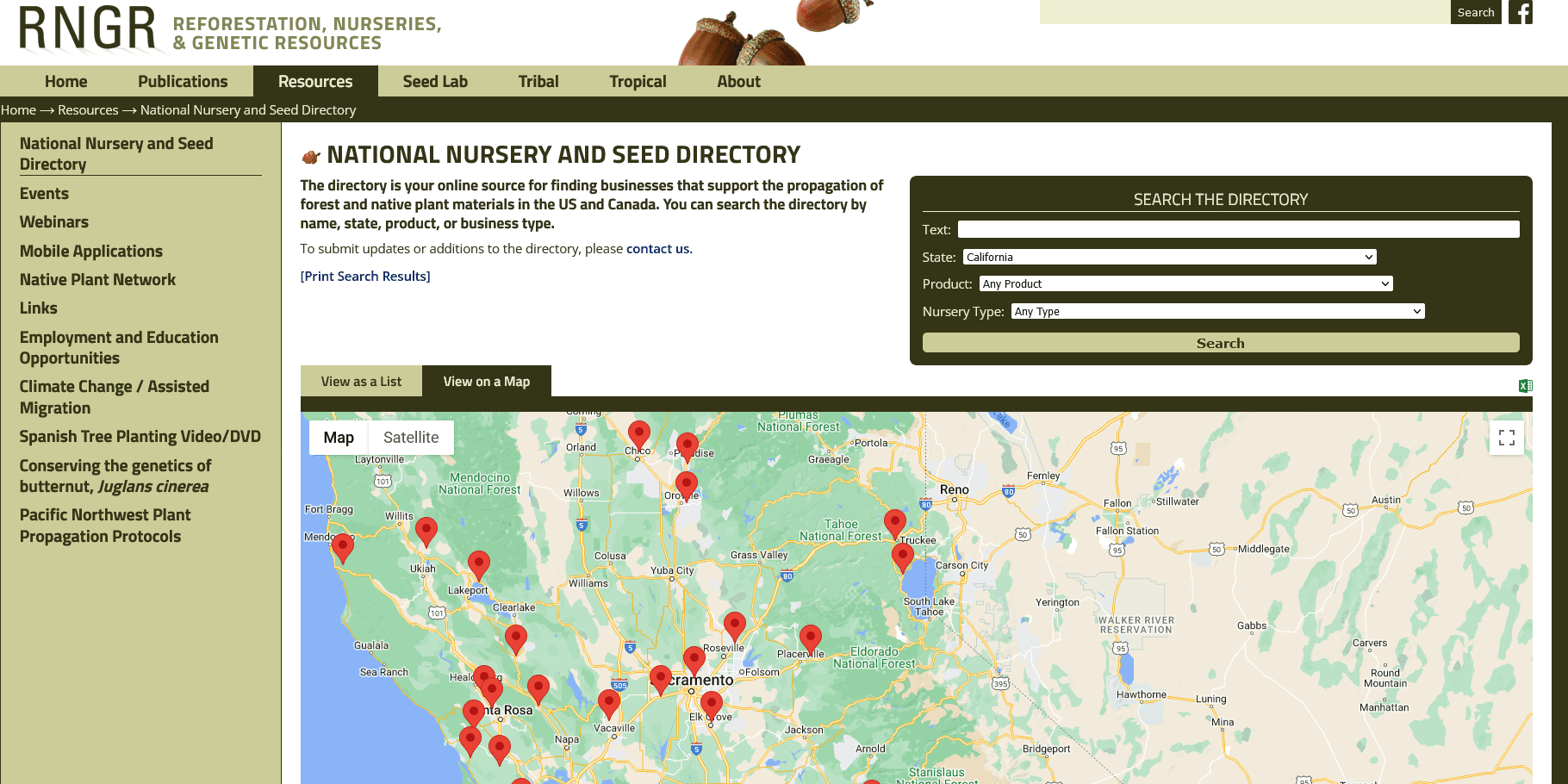
- Reforestation can have climate and social equity elements, but much of it on wildlands is plain old tree planting, genetics and nurseries, what RNGR provides the technical information for, and the programs that Forest Service employees and contractors used to conduct themselves.
- What value is added by introducing an NGO (and associated grants and agreements work, and NGO overhead) to a system that seems to have been working?
It’s interesting to me that Congress asked for a report on transferring the FS from USDA to Interior (and the FS is contracting out that work, apparently). But no Congressperson cared that a Forest Service program was more or less outsourced without competition, or public documentation or analysis? Like I said, AF is a great group, but is it effective and efficient use of USG resources for USG purposes?
It does seem ironic to me that part of this $28-37 an hour position is to do an annual report of accomplishments.. and yet in my reaching out to various NGO’s with jointly hundreds of millions of USG bucks, I was unable to get annual accomplishment reports of where the bucks were going, and any accomplishments, and had to FOIA to get them.
To the FS, if you think this is a great way to run a government program, by farming out work non-competitively, I’d ask you to make the business case… somewhere AND develop public reporting mechanisms. At first, I thought this was just a Biden Admin idea to stash IRA funds, but if the approach is supposed to be long-term- perhaps some attention to justification and transparency would be desirable.
*************
Below are the duties in the advertisement. Until recently, as I’ve said, this would have been a Forest Service position.
****************
Management of Seed Orchards and Seed Production Areas (70-85%)
-
- Managing orchards, seed production areas, native plant production areas at the Francis Marion GRMA.
-
- Managing orchards to produce cone and acorn crops, monitoring phenology, collecting, processing and shipping cones and acorns.
-
- Managing seed orchard health, diversity and productivity.
-
- Control of weeds and orchard understory and dead tree removal.
-
- Application of herbicides and pesticides.
-
- Operation and maintenance of tractor & skid steer with implements, tree shaker, lift boom and other heavy equipment.
-
- Contracting and coordinating orchard operations such as thinning, road maintenance, and fencing.
-
- Assisting with writing genetic management strategies.
-
- Application of fertilization regimes to meet project objectives.
-
- Monitoring for insect and disease damage, determining treatment options, and implementing treatments.
-
- Establishing new seed orchard plantings.
-
- Propagating and cultivating plant species used in revegetation projects (e.g., rivercane).
-
- Propagating and cultivating native plant species with conservation or cultural significance
-
- Collecting and grafting of scion to rootstock and out-planting.
-
- Establishing and maintaining tree conservation plantings.
-
- Collecting soil or foliar samples for nutrient analysis and interpreting results.
-
- Collecting, maintaining, and managing data gathered on orchard trees and cone crops.
-
- Recording growth and phenology measurements.
-
- Managing facilities and equipment associated with seed orchards.
-
- Assisting the USDA Forest Service in developing work plans for the GRMA and production or quality standards.
-
- Maintaining and updating Seed Orchard Management Plan and Seed Orchard Technical Training Guides.
-
- Mapping and tagging trees in the orchard.
-
- Creation of annual reports outlining orchard activities and accomplishments
Management of Progeny Field Tests (0 – 15%)
-
- Managing progeny field tests in partnership with USDA Forest Service silviculturists.
-
- Maintaining and monitoring for damaging agents and determining the need for control methods.
-
- Monitoring growth for cone production.
-
- Monitoring insects and diseases or other genetically controlled damaging agents.
-
- Collecting soil and foliage samples.
Partnership & Coordination (10%)
-
- Serving as the on-site liaison between American Forests and the USDA Forest Service.
-
- Coordinating closely with Forest Service staff, including regional geneticist, zone geneticist, line officers and silviculturists, to align seed production goals with regional and national priorities.
-
- Submitting timely progress reports, data summaries, and documentation, as needed.
-
- Participating in regional meetings and events as needed to support reforestation and seed strategy goals
-
- Participating in training and safety meetings
-
- Maintaining compliance with environmental guidelines.
Other Duties as Assigned (5%):
-
- Reviewing, recommending, and initiating development activities at the GRMA in cooperation with the Regional Geneticist. Preparing presentations and/or reports to explain overall genetic resource management and seed orchards.
-
- Assisting with developing budgetary needs.
-
- Co-hosting seed orchard management workshops.
-
- Assisting American Forests’ staff in the delivery of relevant in-person meetings, conferences, and events.
-
- Conducting public presentations at conferences and meetings.
-
- Planning and leading site visits and field tours as appropriate.