68 million acres of fuel reduction and landscape restoration

There’s been a lot of talk (and press) lately about wildfires, public lands logging and fuel reduction, especially related to many statements coming out of the Trump administration, including Interior Secretary Ryan Zinke (who blamed the wildfires in California on “environmental terrorist groups” and “environmental radicals”) and Agriculture Secretary Sonny Perdue, who is in charge of the U.S. Forest Service.

The basic narrative from the Trump administration, many GOP politicians and some in the timber industry is that the federal government can’t do any logging or fuel reduction because of environmentalists.

Turns out that, according to the federal government, between FY 2001 and FY 2017 the U.S. Forest Service and Department of interior accomplished approximately 68 MILLION acres of hazardous fuels reduction and landscape restoration. See for yourself right here.

We seriously live in strange times when treating over 106,000 square miles of land over a period of less than 20 years is basically characterized as doing nothing and “hands-off management.”

“The fires that are getting everybody’s attention right now are not about forest management.”

The full article from the San Diego Union Tribune is here. Below are some interesting snips, featuring the perspectives of Leroy Westerling, a professor and researcher specializing in global warming and wildfire at the University of California at Merced and Char Miller, a professor of environmental analysis at Pomona College (and sometimes a contributor on this blog).

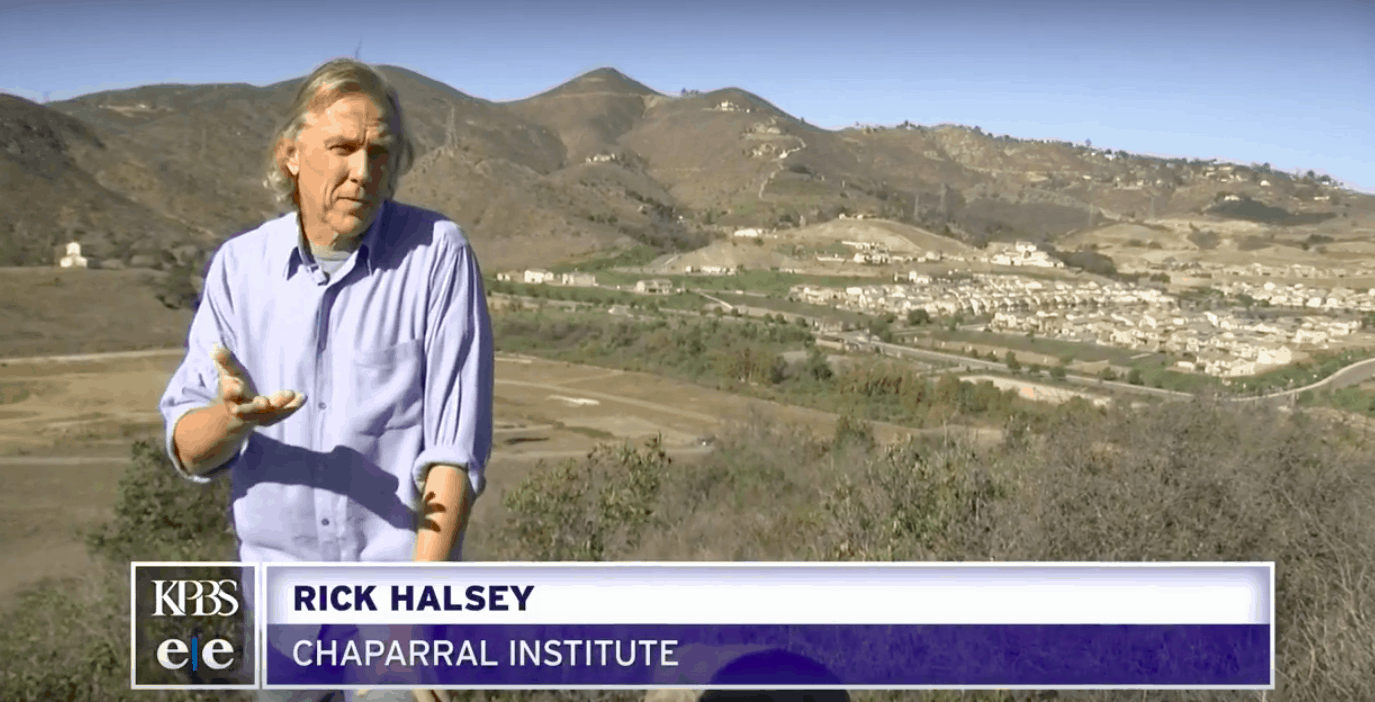
Much of what Dr. Westerling and Miller are saying in this article has also been said by America citizens that Secretary Zinke has labeled “environmental terrorists” and “radicals” while blaming them for wildfires in California. Much of what’s below has also been said by many other ecologists and scientists, such as Dr. Chad Hanson and Rick Halsey of the California Chaparral Institute, who are regularly criticized and attacked by some folks on this blog.

[A]ccording to research scientists and ecologists, wildfire’s increasing toll on life and property in recent years has been overwhelmingly driven by global warming and patterns of development — not the state’s most densely wooded areas.

“The fires that are getting everybody’s attention right now are not about forest management,” said Leroy Westerling, a professor and researcher specializing in global warming and wildfire at the University of California at Merced.

“The major factor is climate change across the west,” he added. “Regardless of fuels management, we just wouldn’t be burning like this, especially in Northern California, in a normal year.”

In fact, few if any of California’s most destructive blazes dating back to the early 20th century have been driven by densely packed forests, according to a review of records kept by the California Department of Forestry and Fire Protection, also known as Cal Fire.

The most devastating and deadly conflagrations have most often resulted from high winds whipping fire through dried out chaparral and grasslands. These blazes often torch sprawling subdivisions that abut undeveloped landscapes, such as the Tubbs Fire did in Santa Rosa last fall.

Even the Camp Fire, which occurred in the foothills of the Sierra Nevada, spread on strong easterly winds blowing down from the mountains across heavily logged forests before jumping from house to house. Trees were one of the only things that remained intact after walls of flame swept through the town of Paradise.

Now a chorus of academics and ecology and policy experts have spoken out across the state — from Stanford University to Sonoma State University to University of California at Santa Barbara — calling on regional governments to tighten zoning rules and even consider buying people out of homes in fire-prone areas.

“We’ve got to do something smarter than what we’ve been doing,” said Char Miller, a professor of environmental analysis at Pomona College, who has proposed the creation of flood and fire bonds that would allow local governments to purchase and set aside property in high-fire areas.

“This is very clear. Get people out of there. Go back to the cities and towns and counties, planning boards and zoning commissions and have a very different approach,” Miller added.

Podship Earth on Fire Myths

You can listen to Jared Blumenfeld’s Podship Earth podcast on Fire Myths here.

According to the bio on the Podship Earth website:

Jared Blumenfeld, was appointed by President Obama to be the regional administrator of the US Environmental Protection Agency (2009-2016), he also served as the Director of the San Francisco Department of the Environment, chaired the first United Nations World Environment Day held in the US, and founded the Business Council on Climate Change and Green Cities California. He worked for non-profits including the Natural Resources Defense Council (NRDC) and the International Fund for Animal Welfare (IFAW) where he helped protect millions of acres for wildlife and held corporations accountable. He thru-hiked the Pacific Crest Trail from Mexico to Canada. He is a trusted source for environmental stories and appears frequently in the New York Times, BBC, Economist, Los Angeles Times, NPR and other media outlets.

In this episode Blumenfeld interviews ecologist Dr. Chad Hanson of the John Muir Project.

Zinke: “It’s not the time for finger-pointing” Also Zinke: “I will lay this on the foot of those environmental radicals”

A day after President Trump blamed California’s wildfires on a lack of raking, Secretary Zinke told Breitbart that “It’s not the time for finger-pointing” regarding wildfires.

And then literally a few minutes later Zinke said “I will lay this on the foot of those environmental radicals that have prevented us from managing the forests for years … This is on them.”

Not climate change. Not record high temperatures. Not record drought. Not high winds. Not over-development in fire prone landscapes. Not PG&E power lines that sparked the Camp Fire. Nope.

It’s all the fault of “environmental radicals.”

Does anyone know if “environmental radicals” are also the same as “environmental terrorist groups,” whom Zinke blamed for wildfires in California back in August?

#MakeAmericaRakeAgain

“You gotta take care of the floors. You know the floors of the forest, very important… I was with the President of Finland… he called it a forest nation and they spent a lot of time on raking and cleaning and doing things and they don’t have any problem.” – President Donald J. Trump

INCHES OF RAIN DURING SUMMER (June – Sept):
Helsink, Finlandi: 12″
Los Angeles: 0.2″

DAYS OF RAIN IN SUMMER:
Helsinki: 64
Los Angeles: 2

P.S. If you do live in the wildland-urban interface it is a good idea to rank dry leaves and needles from around your home and remove dry materials from your gutters. Learn more about FireWise steps you can take as a homeowner.

California Chaparral Institute on new housing developments in very high fire-prone areas

Rick Halsey of the California Chaparral Institute says so many smart things in this TV interview…and, in my opinion, the reporter does an excellent job as well. The segment starts at the 5:33 mark and runs to the 9:10 mark. Blog readers may recall that Rick Halsey has, in the past, been a commenter on this blog and has always offered spot-on perspective on a host of issues, including wildfires and the ecology of the chaparral ecosystem in California. Also, great work by the Center for Biological Diversity to help convince the San Diego County Board of Supervisors to delay decision on approving another subdivision in fire-prone areas.

Salvage logging, planting not necessary to regenerate Douglas-fir after Klamath fires

The following press release was sent out yesterday by Portland State University. – mk

Researchers at Portland State University and Oregon State University looking at the aftermath of wildfires in southwestern Oregon and northern California found that after 20 years, even in severely burned areas, Douglas-fir grew back on its own without the need for salvage logging and replanting.

The study, published online Oct. 26 in the journal Forest Ecology and Management, is the latest to address the contentious issue of whether forest managers should log dead timber and plant new trees after fires, or let them regenerate on their own.

Melissa Lucash, an assistant research professor of geography in PSU’s College of Liberal Arts and Sciences and a co-author of the study, said that concerns in the Klamath over whether conifer forests would regenerate after high-severity fires have led to salvage logging, replanting and shrub removal on federal lands throughout the region.

But the study found that the density of Douglas-fir was relatively high after 20 years and was unaffected by whether or not a site had been managed.

“This is an area where forest managers are really worried that the Douglas-fir won’t come back, but what we found is that they come back just fine on their own,” she said. “We forget the power of natural regeneration and that these burned sites don’t need to be salvage logged and planted.”

Lucash suggests that those resources could instead be reallocated elsewhere, perhaps to thinning forests to prevent high-severity wildfires.

The research team also included Maria Jose Lopez, a research associate at Universidad del Cono Sur de las Americas in Paraguay; Terry Marcey, a recent graduate of PSU’s Environmental Science and Management program; David Hibbs, a professor emeritus in Oregon State University’s College of Forestry; Jeff Shatford, a terrestrial habitat specialist in British Columbia’s Ministry of Forests, Lands, Natural Resource Operations and Rural Development; and Jonathan Thompson, a senior ecologist for Harvard Forest.

The authors sampled 62 field sites that had severely burned 20 years prior on both north and south slopes of the Klamath-Siskiyou Mountain — some of which had been salvaged logged and replanted and others that had been left to regenerate on its own.

Among the study’s findings:

• Aspect, or the direction a slope faces, played an important role in determining the effectiveness of post-fire practices.

• Density of Douglas-fir was higher on north than south aspects, but was unaffected by whether or not a site had been managed, suggesting that Douglas-fir regeneration is inherently less abundant on hot and dry sites and management does not influence the outcome.

• On the flip side, management practices increased the density of ponderosa pine on south aspects, but had no impact on north aspects. That finding suggests that with rising temperatures and increasing severity of fires in the region, management would be most effective when tailored to promote drought-tolerant ponderosa pine on south aspects.

• Managed sites had taller conifers, which can improve fire resistance, but also had fewer snags — an important habitat feature for bird, small mammals and amphibian species in the region.

The authors recommend that forest managers should avoid applying the same post-fire management practices everywhere and should instead tailor practices to specific objectives and the landscape context.

Local Organizations Sue to Protect Wildlife Habitat and Watersheds on the Nez Perce National Forest in Idaho

The following press release is from Friends of the Clearwater and Friends of Rapid River. -mk

Friends of Rapid River, a local group of concerned citizens in Pollock, Idaho, and Friends of the Clearwater, headquartered in Moscow, Idaho, filed suit in federal court in Idaho to protect the wildlife habitat in the Little Salmon and Rapid River drainages of the Nez Perce National Forest from a large logging project that went through minimal environmental review.

The groups are challenging the Forest Service’s approval of Windy Shingle, which would log 2510 acres within the watershed of Rapid River. The project includes massive clear-cutting and roadwork covering just over 58 miles, including over 5 miles of new so-called temporary roads.

The area consists of large grassy openings interspersed with forests. The citizens are concerned heavy logging would remove needed cover for elk and other species that need older forested habitats. The two groups claim in the suit that the Forest Service’s approval of this project violates the National Forest Management Act, which requires the Forest Service to abide by its forest plans regarding protection of habitat. For example, the suit quotes from the Nez Perce National Forest Plan, which requires the agency to, “[v]erify the quality, amount, and distribution of existing and replacement old-growth habitat as part of project planning;” and, that old-growth stands will be “inventoried and prioritized [for retention] with highest priority for inventory in those drainages with proposed timber sales or other activities that could adversely impact old growth.” In particular, the forest plan identifies pileated woodpecker, goshawk, fisher and marten and indicator species of old growth habitat. The suit also asserts that the project approval violates the National Environmental Policy Act by failing to adequately look at the changed condition of this proposed timber sale in light of the recent fires.

“We, Friends of Rapid River, are concerned about keeping old growth and older forests for elk cover. This area is already diverse with large natural openings for grazing and foraging. Elk need the remaining forested areas,” stated Ray Petersen.

Gary Macfarlane of Friends of the Clearwater said, “Species like marten, fisher, and goshawks need old forests. However, the cursory analysis does not demonstrate that the timber sale meets the forest plan requirements to protect those species. In addition, the changes to the area from the Rattlesnake Fire have not been properly considered as required by the National Environmental Policy Act.” Macfarlane concluded, “It appears the Forest Service rushed through the process by using a cookie-cutter approach that does not apply to the landscape.”

What’s Wrong with Monitoring Volcanoes in Wilderness?

The following post was written by Kevin Proescholdt. Kevin is the conservation director for Wilderness Watch, a national wilderness conservation organization headquartered in Missoula and focused on the protection and defense of the National Wilderness Preservation System. For additional background information, see this other piece from Kevin titled, Growing Threat of Inappropriate Research and Instrumentation in Wilderness. – mk

Wilderness Watch recently objected to a Forest Service decision to allow permanent seismic monitoring stations in the Glacier Peak Wilderness in Washington state. If this decision doesn’t change, the Forest Service would fail to protect and preserve Glacier Peak’s wilderness conditions consistent with the 1964 Wilderness Act. Beyond Glacier Peak, any Wilderness—including those surrounding seismically-active Yellowstone National Park or elsewhere in Montana—would be damaged by the installation and servicing of any kind of permanent monitoring stations.

Wilderness is a uniquely American idea and ideal. We are incredibly lucky we still have some of it left. The framers of the Wilderness Act constantly reminded us that we would have to practice humility and restraint to keep it around. That means that all of us, visitors, managers, and other users, have to be willing to do things differently in order to preserve Wilderness for present and future generations. It’s not always easy, but it’s necessary. That’s why the recent proposal for permanent instrument installations raises concerns.

The 1964 Wilderness Act includes safeguards against permanent installations and structures in designated Wilderness, even if done for scientific purposes. Section 4(c) of this landmark law states, “…there shall be no temporary road, no use of motor vehicles, motorized equipment or motorboats, no landing of aircraft, no other form of mechanical transport, and no structure or installation within any such area.” (Emphases added.) The law therefore prevents the installation of permanent seismic monitoring stations in Wilderness as well as the landing of helicopters or use of any other motorized equipment to service the stations.

The Wilderness Act does provide a very narrow exception to allow otherwise-prohibited activities, but only where such activities are necessary to preserve the area’s wilderness character. To date, the Forest Service has utterly failed to prove that degrading the Glacier Peak Wilderness with permanent structures and installations, the landing of helicopters, and the use of any other motorized equipment is the minimum necessary for preserving the area’s wilderness character.

Wilderness Watch supports scientific research in Wilderness. It is one of the primary reasons for wilderness designation and one of its greatest values. Like other activities in Wilderness, however, scientific research has to be done in a way that protects the other values of Wilderness and doesn’t include those things that the law prohibits, such as the use of helicopters for access and the installation of permanent structures. In other words, like all other wilderness visitors, including Forest Service or other wilderness managers, researchers should walk or use packstock to access Wilderness and carry in their supplies.

Our organization also supports public safety and a better understanding of seismic activity. Warning signs of an eruption, which are usually detectable outside of Wilderness, tend to be normal for Cascade Range volcanoes. Such warning signs generally precede any eruption by a significant length of time. Increasingly, researchers are also able to monitor seismic activity remotely, even from satellites. But if monitoring must be done inside designated Wilderness, it must comply with the Wilderness Act and not degrade that specific Wilderness.

Unfortunately, the Forest Service typically does not analyze any alternatives beyond the proposals submitted by the U.S. Geological Survey or other researchers. First and foremost would be the question of whether monitoring stations near or just outside the Wilderness could provide any useful monitoring data. These data may not be quite as detailed or complete as data collected from inside the Wilderness, but would likely be adequate. Unfortunately for the Glacier Peak Wilderness, the Forest Service hasn’t even looked at this sort of analysis. The Forest Service has simply failed to uphold its obligations under the Wilderness Act to protect Wilderness and merely rubber-stamped the proposal to degrade this spectacular Wilderness.

Wilderness Watch believes the federal wilderness agencies can do better and should devise plans that uphold the letter and spirit of the Wilderness Act, and not simply cast aside this important national inheritance because it causes some inconvenience and challenge for researchers. We needn’t so easily sacrifice our shared wilderness heritage just for a few additional data points as is often proposed.