Conservation Group Critical of New Collaborative Logging and Roadbuilding Plan

The following press release was released today by Swan View Coalition.

Kalispell, MT – A Kalispell-based conservation group is critical of a huge, landscape-scale “restoration project” announced today by the Flathead National Forest as a collaborative proposal for logging and other management activities in the Swan Valley. “Even at a glance,” said Swan View Coalition Chair Keith Hammer, “this huge project does not qualify as landscape restoration. It is instead a big logging project requiring even more logging roads be built in the already over-roaded Swan Valley.”

“The proposal fails to identify logging roads as a threat to terrestrial wildlife, let alone as the primary threat research says they are for elk, bears and virtually every species of wildlife,” Hammer said. “Instead, the Forest Service proposes to build new roads through high elevation avalanche chutes that are currently roadless and rebuild roads in avalanche chutes where the culverts were rightly removed because they kept plugging up with avalanche debris.” (For example, new roads are proposed through avalanche chutes on the south slopes of Napa Ridge in the Goat Creek watershed. A road previously put to bed in North Lost Creek, on the south slopes of Springslide Mountain, would be rebuilt).

Even though the proposal claims to “stormproof” roads to reduce the chances of culverts failing during high runoff, Hammer says that’s not the same as eliminating that risk by removing the culverts so they can’t blow out. “This huge project is a significant departure from the current Forest Plan that requires culverts be removed from roads not only to protect fish, but to also render the roads impassable and fully re-vegetated to protect terrestrial wildlife,” Hammer said. “This project is a peek at the revised Forest Plan that will remove limits on the miles of road the Flathead can have in grizzly bear habitat.”

Hammer points to the fact that the proposal would require two Forest Plan amendments suspending lynx management standards as another indication this is not a true “restoration” project. “If the Forest Service and its collaborators think they need to suspend lynx habitat management standards in order to restore lynx habitat, maybe they should focus on proving the standards are wrong and changing them rather than simply sidestepping them,” Hammer said. “This is just one more example of collaborative groups working to help the Forest Service get around the law rather than comply with it.”

The Flathead’s “Mid-Swan Landscape Restoration and Wildland Urban Interface Project” and Federal Register notice can be found at: https://www.fs.usda.gov/project/?project=54853
Western forests could adapt to pine beetles, but people won’t let them

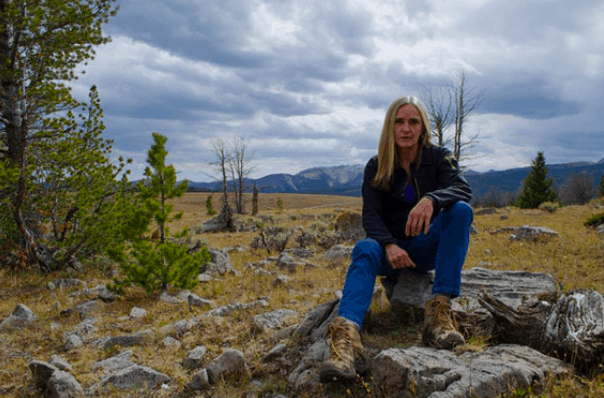
Last month on this blog we discussed and debated new research from the University of Montana’s Dr. Diana Six, one of the world-wide leader in the study of Forest Entomology/Pathology.

Today, journalist Brandon Keim (who has provided insightful comments on this blog for a few years now) had the following piece published in Anthropocene Magazine.

Western forests could adapt to pine beetles, but people won’t let them
By Brandon Keim

Though sporadic pine beetle outbreaks are a natural part of western U.S. ecosystems, a combination of climate change and drought have made them epidemic. The outbreaks are unusually large and intense, raising fears that pine forests may collapse — yet it seems that some trees are genetically predisposed to withstand attack.

They may contain the seeds of future forests adapted to warmer temperatures and pine beetle attacks. As of now, however, people are managing afflicted forests in ways that may prevent their recovery.

“Our forests have always been shaped by natural selection, and management largely ignores this,” says Diana Six, a forest entomologist at the University of Montana. “Trees contain some of the highest genetic diversity of any organisms on the planet. We should be working with this.”

In a study published in Frontiers in Plant Science, Six and colleagues describe their genetic analysis of trees in Vipond Park, a plateau in Montana’s Beaverhead National Forest where pine beetles recently killed 75 percent of mature lodgepole pines and 93 percent of whitebark pines.

The survivors proved to have a common genetic signature. That’s not particularly surprising, say the researchers: pine trees and pine beetles have shared that landscape for millennia, so natural selection would have favored resistant trees during previous outbreaks. And while the researchers don’t yet know the mechanism — perhaps survivors possess extra-hardy immune systems or produce beetle-discouraging chemicals — it certainly seems heritable.

Surviving trees, then, could be “key to developing management and trajectories that allow for forest adaptation,” write the researchers — and not just in Vipond Park, but across the west. Yet that resilience is threatened by so-called salvage logging, which often removes both dead and sick-but-surviving trees from the landscape, and large-scale replanting projects.

The latter are an even greater threat than salvage logging, says Six, because they effectively dilute the survivors’ contributions to forest gene pools. Instead of a new forest descended from trees adapted to pine beetles and climate change, the trees are just as vulnerable as before.

Large-scale replanting with adapted trees isn’t yet feasible, says Six. Eventually she hopes to develop a hand-held sensor that can identify pines with beneficial traits. In the meantime, salvage logging and replanting should be undertaken with care. The lessons of this research may also apply to other forests threatened by climate change and pests.

“Supporting forest adaptation is critical in this time of rapid change,” write the researchers. We need to “support rather than hinder natural selection for traits needed under future conditions.”

Source: Diana Six, Clare Vergobbi and Mitchell Cutter. “Are Survivors Different? Genetic-Based Selection of Trees by Mountain Pine Beetle During a Climate Change-Driven Outbreak in a High-Elevation Pine Forest.” Frontiers in Plant Science, 2018.

About the author: Brandon Keim is a freelance journalist specializing in animals, nature and science, and the author of The Eye of the Sandpiper: Stories From the Living World.

Trends in vital signs for Greater Yellowstone: application of a Wildland Health Index

New MSU study gauges health of the Greater Yellowstone Ecosystem
By Skip Anderson for the MSU News Service (Original)

BOZEMAN — A Montana State University study of Yellowstone National Park and the surrounding area shows that increased population and density, as well as a changing climate, are affecting the overall ecological health of the region.

“The study quantified trends in the condition of 35 ecological ‘vital signs’ dealing with snow, rivers, forests, fire, wildlife and fish,” said Andrew Hansen, professor in the MSU Department of Ecologyin the College of Letters and Science.

“The human population has doubled — and housing density has tripled — in the Greater Yellowstone Ecosystem since 1970, and both are projected to double again by 2050,” Hansen said. “Plus, the temperature has warmed 1.5 degrees Fahrenheit since 1950 and is projected to increase by another 4.5 to 9.4 degrees Fahrenheit by 2100.”

Hansen, who is also director of MSU’s Landscape Biodiversity Lab, co-authored the paper “Trends in Vital Signs for Greater Yellowstone: Application of a Wildland Health Index,” with Linda Phillips, a research scientist in MSU’s Department of Ecology. The science journal Ecosphere published the article in August.

“These changes in land use and climate have reduced snowpack and stream flows, increased stream temperatures, favored pest outbreaks and forest die-off, fragmented habitat types, expanded invasive species, and reduced native fish populations,” Hansen said.

The study uncovered good news, too, for the habitat and some animals that call it home. Large mammals, including bear and elk, are increasing in numbers and expanding in range, according to the study.

Also notable is the new methodology the MSU scientists used, called the Wildland Health Index, which resulted in a reader-friendly “report card.”

“Physicians use ‘vital signs’ such as blood pressure to gauge the heath of humans,” Hansen said. “What we’re trying to do with the Wildland Health Index is something similar by adding value to data that allows a variety of people to understand the trends in ecological health.”

To do this, Hansen and Phillips evaluated the data to identify the trends over times in the GYE’s vital signs and used criteria to rate them from “deteriorating” to “stable and improving.”

“We then boil down the metrics to the six or eight key vital signs that will matter to policymakers,” Hansen said. “And, this study can be applied each year across the GYE and used for other large wildland ecosystems in the United States to better inform land managers to assist them in sustaining these special places.”

Diane Debinski, head of MSU’s Department of Ecology, said the index is a new tool that can be used measure ecosystem health around the world.

“Because the Greater Yellowstone Ecosystem serves as an icon for wildland management, the Hansen and Phillips Wildland Health Index will have global reach, serving as a template for similar assessments worldwide,” she said.

Hansen noted that the ecological health of the region was strongest inside the boundaries of Yellowstone and Grand Teton national parks. That’s not surprising, he said, given the focus of its caretakers in managing the ecological health of the parks. He said this study shows that the greatest need for improvement is outside the parks, where private landowners don’t necessarily have access to data that may help them be better stewards of the land they own and the water that passes through it.

“There’s a real opportunity to let people know what they might worry about on their own property with regard to impact,” Hansen said.

He also indicated that there’s plenty of room in the near future for citizen scientists to gather and report data that will help policymakers as they consider the overall ecological health of the GYE, which includes tens of thousands of square miles beyond Yellowstone National Park, including Idaho, Montana and Wyoming.

“We have so little information about large river systems, especially on private lands,” Hansen said. “There’s just no consistent monitoring of water quality on those major rivers on a scale that can tell us how well they’re doing, and that’s surprising because so many people here love our blue-ribbon trout streams that we’re famous for.

“There’s real opportunity to engage people to do the monitoring and the science to fill in the gaps,” he added. “One could visualize high school students across the GYE doing water-quality monitoring and submitting the data to a central repository. By doing so, they become heavily engaged participants.”

Dr. Diana Six discovers genetic differences in trees untouched by mountain pine beetles

When the U.S. Forest Service logs “dead and dying” trees impacted by mountain pine beetles as part of a ‘salvage’ timber sale, might they also literally be cutting down the toughest and strongest trees that contain the best genetics?

New research from one of the nation’s leading entomologists lends some credence to that theory.

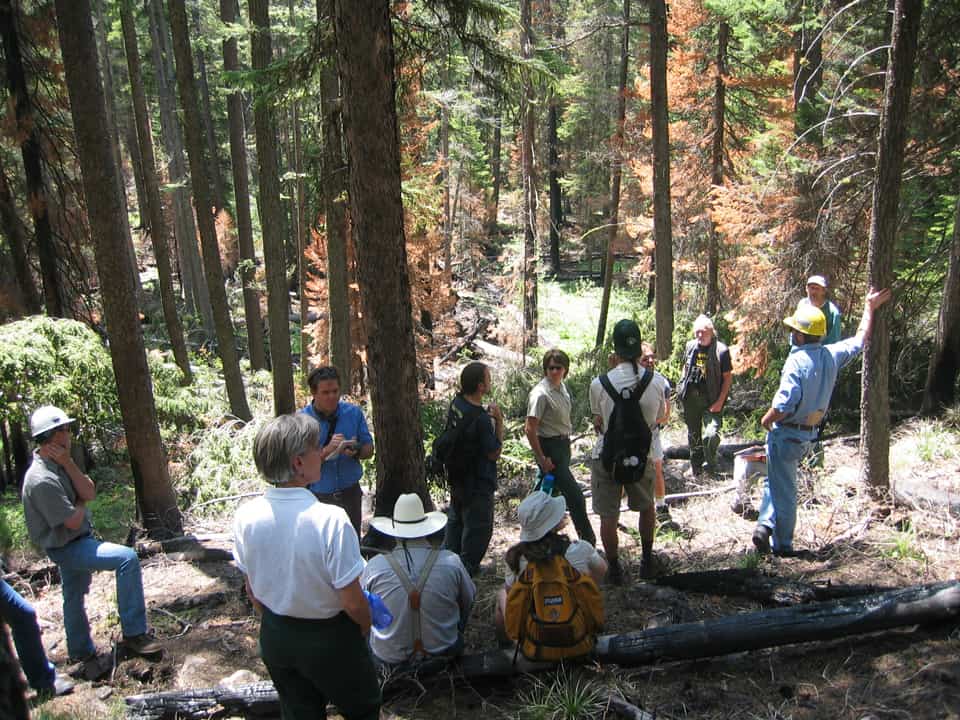
I was first made aware of this concept back around 2005, when we had just spent a day in the woods with a number of University of Montana scientists and reachers from the College of Forestry & Conservation, including Dr. Diana Six.

We were taking a look at the Bitterroot National Forest’s proposed Middle East Fork Healthy Forest Restoration Act Timber Sale. While conservation groups like WildWest Institute and Friends of the Bitterroot were generally supportive of about 2,000 acres of ‘thinning’ and ‘fuel reduction’ work immediately around a community of homes and cabins up the East Fork of the Bitterroot River, we strongly objected to the fact that the Forest Service and logging industry wanted to cut down nearly 2,500 acres of previously unlogged, native forests – including some Douglas fir that measured 3 feet in diameter – far from homes under the guise of “restoration” and “fuel reduction.”

In fact, much of the 2,500 acres of unlogged, native forests were previously considered old-growth habitat by the Forest Service until 2005 – when the Forest Service resurveyed the stands and determined they weren’t old-growth forest habitat after all supposedly because of the number of dead and dying trees, especially huge Douglas fir, which were impacted by bark beetles.

One thing back on that field tour in 2005 that Dr. Diana Six really got us thinking about was the genetics of trees that were dying as a result of bark beetles, but not yet dead. Of course, all living things are dying – including you and me – but what if the Forest Service was actually cutting down dying trees that might rebound and successfully fight off the bark beetle attack? Might these trees, if the Forest Service didn’t let the timber industry cut them down on our public lands, actually have possessed in their DNA the best genetics to fight off future bark beetle epidemics?

On September 11, 2007 I took some reporters to the Bitterroot National Forest for a tour of what the Bitterroot National Forest did under the guise of “community fire protection” and “restoring fire adapted ecosystems” over four miles away from the nearest home in the area. Here’s what we found.

Now, while I realize that mountain pine beetles (the subject of Dr. Six’s latest research) are different than Douglas-fir beetle; it seems as if the same general concept applies to all trees that someone fend off beetle epidemics.

Below is the press release from the University of Montana.

MISSOULA – A University of Montana researcher has discovered that mountain pine beetles may avoid certain trees within a population they normally would kill due to genetics in the trees.

UM Professor Diana Six made the discovery after studying mature whitebark and lodgepole trees that were the age and size that mountain pine beetle prefer, but had somehow escaped attack during the recent outbreak.

After DNA screening, survivor trees all contained a similar genetic makeup that was distinctly different from the general population that were mostly susceptible to the beetle.

“Our findings suggest that survivorship is genetically based and, thus, heritable,” Six said, “which is what gives us hope.”

In western North America, whitebark pine, a high elevation keystone species recommended for listing as an endangered species, and lodgepole pine, a widespread ecologically and economically important tree, have experienced extensive mortality in recent climate-driven outbreaks of the mountain pine beetle.

“Our results suggest that surviving trees possess a wealth of information that can be used to inform our understanding of the genetic and phenotypic bases for resistance and to develop management approaches that support forest adaptation,” Six said.

The study was published July 23 in the journal Frontiers in Plant Science and is available online right here.

Oregonian Editorial Board: Failed Rough & Ready deal warrants criminal inquiry

Back in April 2013, I wrote a post for this blog titled “Rough and Ready: The Other Story.” Here’s the opening for paragraphs of that April 2013 article:

Earlier in the week the owners of the Rough and Ready Lumber mill south of Cave Junction, Oregon announced they were closing their doors for good. There was one reason cited by the owners: A lack of logging on Forest Service and BLM lands in southwestern Oregon. Jennifer Phillippi even went so far as to describe the situation this way, “It’s like sitting in a grocery store not being able to eat while the produce rots around you.”

Well, if you wander away from the timber mill’s talking points even a little bit and talk with actual neighbors in southwestern Oregon who have witnessed Rough and Ready’s handywork over the years, you get a much different story – a story of over-cutting, mis-management, toxic contamination and political manipulation.

Also in April 2013, the NBC station in Medford, Oregon had more information on the announced closure of the Rough and Ready Lumber mill near Cave Junction, Oregon:

Today, as the last saw mill in Josephine and Jackson county announces it’s plans to close, some residents are sharing the other side of the story: one they say includes political manipulation, mis-management, and contamination. For some, the news that Rough and Ready Lumber in Cave Junction is going out of business threw up a red flag. Residents fear the threat to close is a ploy to gain access to more timber.

Residents say they’ve seen this happen before. “It’s been some years back the Rough and Ready mill was up for sale,” says South Cave Junction Neighborhood Watch member, Guenter Ambron.

“It’s just wrong,” says a neighbor of Rough and Ready, too scared to identify herself on camera for fear of retaliation. She tells us there’s more than meets in the eye in the company’s announcement to close. “I think it’s being used as a tool to push our representatives and governor into giving them O&C lands,” continues the neighbor.

She says at one point, Rough and Ready was considered a self sufficient company with private logging lands, but she says it’s their own fault they’re out of wood. “If they actually maintained their resource lands and had not clear cut and sprayed with poisons they would actually have a constant supply of timbers to harvest.”

Rough and Ready was in the news again recently. On September 5, 2018 the Oregonian published an article titled, “Oregon sawmill deal cost taxpayers millions. Was it a crime?”

Last month, the state forcefully reasserted that a corporate arm of Portland-based Ecotrust unlawfully inflated project costs and omitted material facts to get millions in tax credits it didn’t qualify for.

A question now, some legal experts say: Will the state investigate that as a potential crime?

Officials at state economic development agency Business Oregon used unusually strong language in a memo to Ecotrust managers, characterizing the tax credit deal as built on untrue and incomplete information. The deal, approved in 2014, was intended to throw a lifeline to the Rough & Ready sawmill in Southern Oregon….

The complicated transaction at issue began in 2013, when Rough & Ready was looking for a bailout and Ecotrust stepped in with the know-how to connect the sawmill to investors via tax credits. The mill owners and Ecotrust executives sought to rebuild the Josephine County economy by restarting the mothballed mill.

To get the $3.1 million in state credits it sought for the Rough & Ready deal, Ecotrust needed to show Business Oregon the mill would spend at least $8 million on qualifying expenses. Its 2013 application promised it would do just that.

However, in its August 16 memo recently released to The Oregonian/OregonLive, Business Oregon said Ecotrust managers made “material misrepresentations and omissions” and failed to “accurately describe” their plans.

The state found Ecotrust failed to disclose that it orchestrated a one-day loan of nearly $5 million from Chase Bank to Rough & Ready. That loan, Business Oregon concluded, did not “represent an arms-length transaction” and was used in essence to let the couple who own the sawmill buy it from themselves.

The transaction was included in the overall budget for the project, which meant it qualified on paper for more credits than it would have otherwise. But Business Oregon determined the transaction should not have been counted and, if it had been disclosed, the deal likely wouldn’t have been approved.

The undisclosed loan “unlawfully” boosted the project budget, and Ecotrust and Chase “improperly benefited” as a result, according to the Business Oregon memo, written by director Chris Harder.

Rough & Ready’s owners and Chase Bank knew the one-day loan was “circular” and was not used to make a valid purchase, Harder wrote. Ecotrust structured the deal so that the loan passed from Chase to Rough & Ready via a second corporate subsidiary of Ecotrust established just for the sawmill deal.

Chase, which provided the loan and then was able to buy the resulting tax credits at a deep discount, declined to comment on the appropriateness of the single-day loan. A Chase spokeswoman said the bank makes investments “supported by economic development authorities that intend to meet local needs.”

The Rough & Ready sawmill went belly up barely a year after the deal closed, erasing all 70 promised jobs. Taxpayers lost at least $7 million in state and federal underwriting on the deal gone wrong….

Some legal experts say the state should not only seek to claw back the money, but should also seriously consider a criminal investigation….

Hafez Daraee, a corporate defense attorney who is not involved in the case, said someone who knowingly makes a misrepresentation in the course of receiving public financing could face civil financial penalties.

“The rule of thumb is if you try to fudge your numbers, the government has every right to come after you, as they should,” Daraee said….

The quagmire Business Oregon now finds itself in was avoidable. There were clear signs the Rough & Ready project was doomed from the start, The Oregonian/OregonLive first reported in March.

Glaring signals included an overly rosy financial analysis and a hand-written budget proposal in which all expenditures came out to an even $100,000. But the state and federal tax credit programs that financed the project allow for little scrutiny of potential deals and rely heavily on the accuracy of submitted applications.

The memo relates that Ecotrust had to show the project had $8 million in qualifying expenses to land $3.1 million in tax credits. To reach that threshold, the memo asserts, Ecotrust inflated the project’s expenses using a “one-day” loan. Mill owners Jennifer and Link Phillippi used a $4.8 million from Chase Bank to essentially buy the mill from themselves and then paid off the loan the next day. Yes, you read that right.

Yesterday, the editorial board of the Oregonian published this editorial, titled, “Oregon sawmill deal cost taxpayers millions. Was it a crime?

[Oregon Attorney General Ellen] Rosenblum should investigate Ecotrust’s use of the New Markets Tax Credit program to determine whether its practices rise beyond sloppiness to criminal malfeasance.

Rosenblum knows more now, considering that Business Oregon officials have spent the past six months scrutinizing Ecotrust CDE’s deal. In mid-August, officials reported their findings to the Oregon Department of Revenue. Among numerous accusations, the memo claimed that Ecotrust “omitted material information,” “failed to accurately describe the sources and uses of proceeds” and “failed to disclose the intentions” of the one-day loan.

The memo relates that Ecotrust had to show the project had $8 million in qualifying expenses to land $3.1 million in tax credits. To reach that threshold, the memo asserts, Ecotrust inflated the project’s expenses using a “one-day” loan. Mill owners Jennifer and Link Phillippi used a $4.8 million from Chase Bank to essentially buy the mill from themselves and then paid off the loan the next day. Yes, you read that right….

Business Oregon shouldn’t continue to extend the deadline that would provide Ecotrust a second chance. Instead, the state should seek to recoup the tax credits that this deal never should have received. And, Rosenblum should aggressively investigate what went wrong and who was responsible.

Across the state, Oregonians could use the help that sound economic investment can provide. But the investment needs to be real and long-lasting, with money going reliably home in their paychecks — not out the mill door through management fees.

Amen.

University of Montana Ecologists: Forest Service should use wildfires to thin and restore forests

Following a wildfire in 2003, the Lolo National Forest in Montana prioritized an industrial logging project directly adjacent to the Rattlesnake Wilderness north of Missoula, Montana. The timber sale would have logged forests like this, on both sides of a popular hiking trail with direct access to the Wilderness and more than 15 miles away from the nearest home or structure. Following some public education and media tours to the proposed timber sale units (pictured here) the Forest Service dropped their logging plans in 2004 and this forest directly adjacent to the Wilderness was allowed to restore itself naturally. Photo by Matthew Koehler.

Get the full scoop from the Missoula Current. Below are some snips from the recent article.

As paleo-ecologists, Cathy Whitlock and Philip Higuera study past wildfires to better understand fire behavior. But what they see is that wildfires today are very different because of the Earth’s changing climate….

Higuera said that since the 1980s, the area consumed each year by wildfires is 10 times larger than the area that the Forest Service can log, thin, burn or restore.

“It forces you to recognize that you’re not going to get out of this problem simply by doing more treatment to the landscape,” Higuera said. “It’s unlikely that we would be able to eliminate years like 2017. So we need to expect and plan for more years like 2017.”

Whitlock and Higuera agreed that because wildfires are going to happen with increasing regularity as summers get hotter and drier, the Forest Service should use them as a tool to restore forest health. As long as they don’t threaten lives, wildfires can burn out all the dead wood and excess vegetation, setting the stage for a more healthy ecosystem.

Treatment projects tend to be small due to funding limits. So they should be focused on areas around people’s homes where they can make a difference, Higuera said.

The human factor can be a problem because people expect the Forest Service to put fires out. Also, too many people are building their homes in forested areas – the wildland-urban interface – that are bound to burn. In any given wildfire, firefighters spend an increasing amount of time and effort and risk lives to save homes rather than fighting fire.

Since 1990, 2 million new homes have been built in the wildland-urban interface – mostly in fire-prone low-elevation forests. Already 900,000 homes are in zones of high fire risk. By 2040, it is projected that 40 percent of the WUI will have an increased risk of burning, according to a 2015 University of Colorado study.

“I think that’s where the conversation needs to focus,” Whitlock said.

Education is needed to make people aware of the threats so they don’t build in risk-prone areas, but also so they understand the positive aspects of wildfire. Americans need to accept the inevitability of fire like they accept the inevitability of earthquakes or tornadoes, Higuera said.

“The forests are continually adapting to climate change and one way is by burning. I think what we’re seeing is the forests are equilibrating to climate change. The trouble is the climate is still changing. But these fires really should be thought of as a natural ecological process of adjusting to a new climate,” Whitlock said.

Heading off fires in west-side forests by ‘thinning’ every decade is a ‘fool’s exercise’ says Dr. Jerry Franklin

When most reporters cover wildfire and forest issues they seem to present an entirely false narrative (feed by the timber industry and pro-timber industry politicians, ad nauseam) that all forests in the U.S. are unnaturally over-crowded and dense and all forests used to burn frequently, but at a very low severity.

While that narrative might (generally) be true of a certain (but small) percentage of forests in the western U.S. (for example, such frequent fire, but low burn severity forests, make up only about 5% of the entire forested landscape in Montana and northern Idaho), the vast majority of forest ecosystem in the western U.S. have a much more complicated and mixed fire history. This includes huge forest ecosystems that were born of, and are maintained by, mixed- to high-severity fire regimes.

That’s why this piece in the Seattle Times by Hal Bernton is so important, and refreshing.

The article highlights a new study from a research team that included scientists from the University of Washington, Washington state Department of Natural Resources and the U.S. Forest Service scientists. Better yet, the reporter got out into the forest with some of the leading forest and fire ecologists around.

One interesting tidbit of information in this article was the fact that early in Dr. Jerry Franklin’s career, he also dove into wildland fire issues. In fact, Dr. Franklin co-authored a 1982 study of Mount Rainier National Park, uncovered evidence of huge conflagrations 900 years ago that affected nearly 50 percent of the forested areas.

Apparently, if you believe Trump’s Interior Secretary Ryan Zinke that wildfires are caused by “environmental terrorist groups,” that huge conflagration that burned nearly 50% of the forested areas around present-day Mount Rainier National Park in approximately is 1118 A.D. is a real eye-opener, proving that “environmental terrorist groups” have been living in our midst for almost 1000 years now. Tune in to Fox News, The Daily Caller and Breitbart “News” for more breaking coverage exposing this 1118 A.D. “environmental terrorist” sect. In the meantime, here’s some snips from Bernton’s latest article:

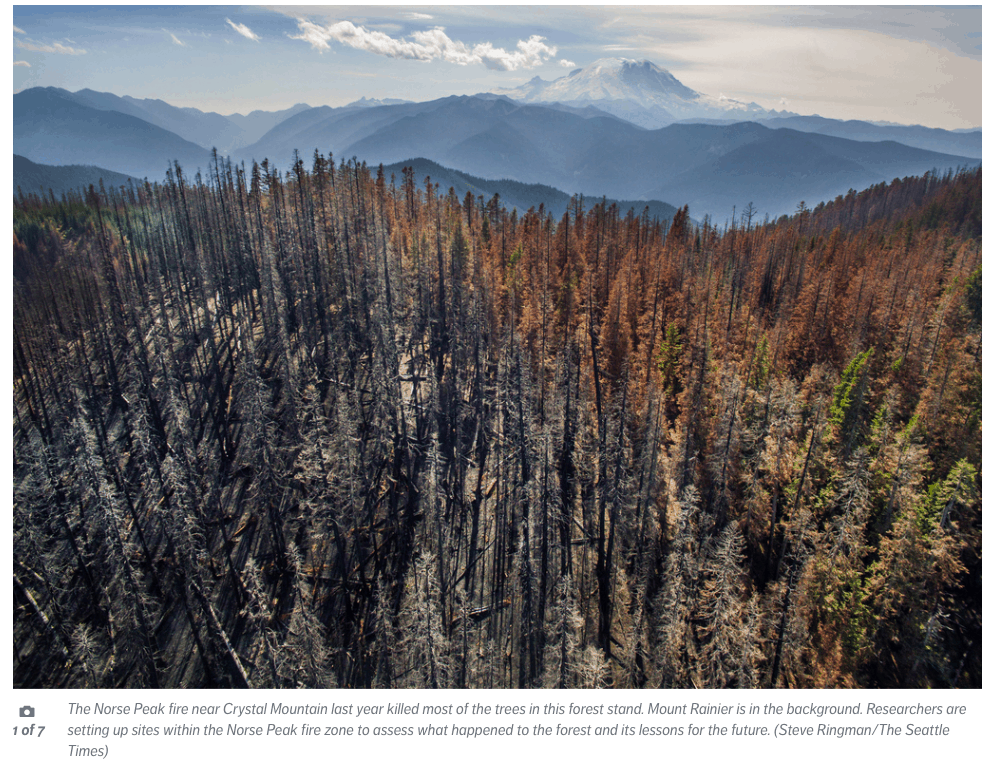
On a remote ridge, the hemlock, silver and noble firs stood for several centuries, nurtured by deep winter snow and drenching rains. Then last year, amid the searing August temperatures, the Norse Peak fire on the east side of the Cascades pushed over the range’s crest and engulfed this stand, killing most of these trees.

Now the charred trunks rise like ghostly sentinels in a forest littered with charcoal, which still gives off whiffs of the smoke that billowed from the 55,909-acre blaze. This austere burn zone is a typical aftermath to intense fires that, over the course of centuries, periodically feast upon the huge amounts of wood that grow in the west-side forests of our region.

The fire ecology of such forests, and how it may evolve amid climate change, is of increasing importance as wild-land smoke emerges as a regional concern. The polluted air that hung this summer over a vast stretch of the West Coast — from San Francisco to Vancouver, B.C. — has generated a fresh wave of support for more logging and cool-season burns to thin the forests and reduce the potential fuel.

These tactics are standard practice east of the Cascades. But in a peer-reviewed paper published this year, a research team of University of Washington, state Department of Natural Resources and U.S. Forest Service scientists caution that such tactics won’t do much to tame or head off west-side fires, which are forecast to happen more often — and burn more acreage — as climate change spurred by the combustion of fossil fuels reduces winter snowpack and increases summer temperatures.

But wetter forests, such as the stand torched in the Norse Peak blaze, have a very different relationship with fire. They burn infrequently but the toll on the trees often is severe. Trying to head off these fires would require thinning these public lands every decade or so, and that would change the natural character of these lands in what Franklin calls a “fool’s exercise.”

There also are benefits to these west-side fires, which Franklin says can act as powerful sources of forest renewal.

George Wuerthner on the Poison Pills in the GOP’s House Farm Bill

The following piece was written by George Wuerthner. – mk

In the coming week or so, Congress will be considering the Farm Bill which has numerous inappropriate amendments for our public forests approved in the House but not in the Senate version. The bill’s fate will be decided in a conference committee between the House and Senate. It is critical that Senator John Tester not support the House bill as written because of numerous anti-environmental provisions that will fail to protect communities and increase fire intensity resulting from more logging.

Among the poison pills in the bill are provisions designed to speed logging in the West under the guise of reducing large wildfires. Not only is logging ineffective at halting large fires which are primarily driven by extreme fire weather/climate, but there are many ecological “costs” to logging including the spread of weeds, sedimentation from logging roads, loss of carbon storage, and disturbance to sensitive wildlife.

The House version of the Farm Bill would reduce the requirement for NEPA (National Environmental Policy Act) which protects our public lands from unmitigated logging projects. This will eliminate government accountability.

The bill would also expand the use of “Categorical Exclusions” (CE) to 6000 acres that could lead to clearcuts as large as 9 square miles without any public review. Furthermore, there is no limit on CEs, so the agency could log one 6000-acre block and immediately adjacent log a second or third 6000-acre block.

How big is 6000 acres? A football field is about an acre—so imagine 6000 football fields being cleared of trees.

The worse thing about the proposed House Farm Bill is that these provisions are not based on science, but on flawed assumptions about the effect of logging on wildfires.

Recently more than 200 preeminent scientists signed a letter to Congress finding that proposed solutions to wildfire like thinning forests are ineffective and short-lived.

Worse, such solutions simply do not work under extreme fire weather conditions. With climate change, we are experiencing more extreme fire weather conditions.

To quote from the scientists’ letter: “Thinning is most often proposed to reduce fire risk and lower fire intensity…However, as the climate changes, most of our fires will occur during extreme fire-weather (high winds and temperatures, low humidity, low vegetation moisture). These fires, like the ones burning in the West this summer, will affect large landscapes, regardless of thinning, and, in some cases, burn hundreds or thousands of acres in just a few days.”

The letter goes on to say: “Thinning large trees, including overstory trees in a stand, can increase the rate of fire spread by opening up the forest to increased wind velocity, damage soils, introduce invasive species that increase flammable understory vegetation, and impact wildlife habitat.”

“Thinning also requires an extensive and expensive roads network that degrades water quality by altering hydrological functions, including chronic sediment loads”, the letter states.

It is critical that Senator Tester does not support phony solutions in the House Farm Bill will not work.

Over 38 Senators and over 100 Congressional Representatives signed a letter to Conferees to reject the House provisions. Hopefully, Senator Tester can join with his colleagues and reject this flawed plan for forest mismanagement.

George Wuerthner is an ecologist who has published 38 books including two on fire ecology.

Forest Ecology, Wildlife Experts Say: Reject the GOP House Farm Bill

It’s been my observation that many of the pro-logging folks that participate on this blog seem to like and agree with much of what Dr. Jerry Franklin has to say.

Well, today 16 leading experts in forest ecology and management, including esteemed professors Norman Christensen of Duke University and Jerry Franklin of the University of Washington, sent a letter to members of Congress who will conference on the Farm Bill describing their concerns on the Forestry Title of H.R. 2, The Agriculture Improvement Act of 2018, the House of Representative’s version of the Farm Bill.

Here are some excerpts from the letter:

“Many of the House bill’s forestry provisions are not supported by science. For instance, the bill seeks to aggressively expand post-fire ‘salvage’ logging on public lands to prevent wildfire, when in reality post-fire logging occurs primarily for economic reasons and rarely contributes to ecological recovery in the disturbed area. Post-fire logging of dead or dying trees is appropriate near roads where standing dead trees pose a safety hazard but should generally be avoided in areas where maintaining natural ecosystem processes is a priority. However, the House language does not recognize this key distinction.”

“By exempting controversial projects from meaningful evaluation and public engagement, the House farm bill runs counter to basic principles of science-based forest management, including the use of best available science and the application of robust decision-making processes. If they were to become law, the House farm bill’s forestry provisions would result in poorly planned, ineffective and harmful management actions that fail to address the vital need to improve the climate and fire resiliency of our national forests and the safety of our communities.”

More information and details can be found here.

Study: A 1,500-year synthesis of wildfire activity stratified by elevation from the U.S. Rocky Mountains

While Trump’s Interior Secretary Ryan Zinke lays the blame for wildfires squarely on “frivolous lawsuits” filed by “environmental terrorist groups” scientists are busily producing more research about wildfires, like this latest study.

Apparently, “environmental terrorist groups” were very active around the year 600 AD and again around 1050 AD.

A PDF of the study is available here.

Abstract

A key task in fire-climate research in the western United States is to characterize potential future fire-climate linkages across different elevational gradients. Using thirty-seven sedimentary charcoal records, here we present a 1500-year synthesis of wildfire activity across different elevational gradients to characterize fire-climate linkages. From our results, we have identified three periods of elevated fire occurrence centered on the 20th century, 900 cal yr BP, and 1350 cal yr BP. During the 20th century, fire activity has occurred primarily in the northern Rocky Mountains, with mid-elevations experiencing the greatest increase in wildfire activity. While wildfires occurred primarily in the SRM region ∼900 cal yr BP, the greatest increase in high-elevations occurred in the NRM at this time. Finally, synchronous wildfires occurred in both northern and southern Rocky Mountain mid-elevations ∼1350 cal yr BP, suggesting a potential analog for future wildfire conditions in response to warmer temperatures and more protracted droughts. We conclude that wildfire activity increased in most elevations during periods of protracted summer drought, warmer-than-average temperatures, and based on modern climate analogs, reduced atmospheric humidity.