New Forest Service Study: Summer rains, or their lack, have 17 times more impact on wildfire acres burned than winter snowpack

Last year, Spokane, Washington went a record-settling 74 days without rain. Parts of Montana went 46 days last year, and 47 days this year, without any rain.

Clearly all the frivolous “anti-precipitation” litigation from “environmental terrorist groups” is having a huge impact on wildfires, right Secretary Zinke?

Below is the press release from the University of Montana, which assisted with the new Forest Service study.

Study: Decreasing Number of Rainy Days in Summer Has Increased Western Wildfire

MISSOULA (August 20, 2018) – The number and size of large wildfires has increased dramatically in the western United States during the past three decades. New research shows that significant declines in summer precipitation and lengthening dry spells during summer are major drivers of the increase in fire activity. This is contrary to previous understanding that the increase is attributable only to warming temperatures and earlier snowmelt.

The research was conducted by a team of scientists from the USDA Forest Service and the University of Montana, funded by NASA and the USDA, and published this week in the Proceedings of the National Academy of Sciences. The paper is online here.

The research team contrasted the effects of snowmelt timing, warming summer temperatures and variations in the volume and distribution of summer precipitation on wildfire area burned. They found that summer precipitation totals and the duration of dry spells were the strongest controls on forest wildfire area burned.

“Summer dry periods are tightly coupled to how warm and dry the air is during the fire season,” said Zack Holden, USDA Forest Service scientist and lead author of the study. “Longer windows without rain lead to more surface heating which dries out woody fuels.”

“The maps of declining precipitation help us think about patterns of future drought, which can help us focus work near communities likely to experience continuing declines,” said Charlie Luce, USDA Forest Service research hydrologist and co-author of the study.

“This new information can help us better monitor changing conditions before the fire season to ensure that areas are prepared for increased wildfire potential. Further, it may improve our ability to predict fire season severity,” said Matt Jolly, USDA Forest Service research ecologist and co-author of the study.

The study was conducted as part of a larger project aimed at improving wildfire danger and drought monitoring.

UM hydrology and hydrologic modeling Associate Professor Marco Maneta was also a co-author.

“Decreases in precipitation and the increasing length of dry spells during the summer – a time when crop water demand in the arid west are highest – is not only exacerbating wildfires but could also have serious implications for western agriculture, especially in states highly reliant on rainfed crops,” Maneta said.

###
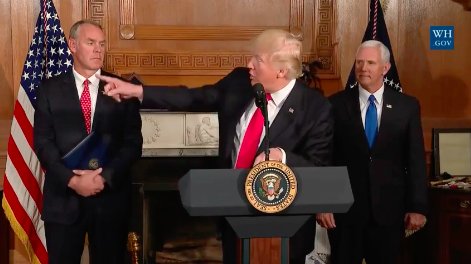
Trump and Zinke Discuss Wildfires: What could possibly go wrong?

Official Transcript from Trump’s Cabinet Meeting (08/16/18)

PRESIDENT TRUMP: I would like to ask Ryan Zinke, Secretary of the Interior, who I actually watched this morning, as he was giving a rundown on the horrible fires that are taking place mostly in California, and I thought what he said was so true and actually rather incredible. People don’t hear it, they don’t hear it like it is. There are things you can do about those fires before they start, and you wouldn’t have nearly the damage and the problems. We are spending a fortune in California because of poor maintenance and because frankly, they are sending a lot of water out to the pacific to protect the smelt and by the way, it’s not working. The smelt is not doing well. But we are sending millions and millions of gallons right out into the Pacific Ocean. Beautiful, clean water coming up from the north or coming down from the north, and I thought Ryan was great this morning so before we start on a couple of other things we will be discussing today, including very importantly, schools and education, I would ask you to give maybe a little recap of what you said this morning on television.

INTERIOR SECRETARY RYAN ZINKE: Thank you, Mr. President. First, our firefighters, 30,000 of them, are doing spectacular things. They have had six deaths related and we forget that firefighters, while they are on the front lines, their homes and families are in jeopardy, and our hearts and prayers need to be with our front line firefighters that are out there every day. It is a matter of gross mismanagement. There is no question. The density of our forest is historical. If you don’t believe me, believe your own eyes. Go out and take a look at our forest. Take a drive out there and look at the dead and dying timber. It’s been in gross mismanagement for decades but we are burning our forests, destroying our habitat and destroying our communities and neighborhoods by these catastrophic fires of 200,000, 300,000 acres. Thus far, there’s 5.7 million acres of our public lands that have been destroyed at a cost of about $3 billion this fiscal year. Americans deserve to go out and recreate rather than evacuate, so we went out, Secretary Perdue and I went out to California. We are committed to reestablishing sound science, best practices for the greatest good for all of us. But sound, active management, Mr. President, is the path that you have laid, it’s clear. This is unacceptable that year after year, we are watching our forests burn, our habitat destroyed and our communities devastated, and it is absolutely preventable, and public lands are for everybody to enjoy and not just held hostage by these special interest groups. Thank you, Mr. President.

PRESIDENT TRUMP: Ryan was saying it’s not a global warming thing. It’s a management situation and one of the elements that he talked about was the fact that we have fallen trees and instead of removing those fallen trees, which get to be extremely combustible, instead of removing them, gently removing them, beautifully removing them, we leave them to burn and actually, in many cases, catch fire much easier than a healthy tree, a healthy growing tree. Could you just discuss that for a second?

SECRETARY ZINKE: Well, Mr. President, we import lumber in this country, yet there are billions of board feet that are on the forest floor rotting. Rotting. And whether you’re a global warmest advocate or denier, it doesn’t make a difference when you have rotting timber, when housing prices are going up, when a lot of Americans are right at the border of affording a house, yet we are wasting billions of board feet for not being able to bring them to a local lumber mill. It is unconscionable we would do that to our citizens. Mr. President, we are actively engaged. Secretary Perdue and I, we went out to California- we are joined at the hip to make sure we actively manage our forests, remove the dead and dying timber, replant diversity of species and on the salvage operations, 5.7 million acres. A lot of that can be salvaged if we get to it in the first year. We are going to do it, Mr. President.

PRESIDENT TRUMP: Just to add, just to conclude, especially when Canada is charging us a lot of money to bring their timber down into our country, so ridiculous. [NOTE: In April 2017 President Trump placed a 20.83% tariff on Canadian lumber. – mk] Here we have it. We’re not even talking about cutting down trees. Which in certain areas, we can’t do. We are talking about trees lying on the floor, creating a tremendous hazard and a tremendous fire hazard, and death trap. So, I thought they were great points. Thank you very much, Ryan. Appreciate it.

Driest 45 day period on record in some parts of Montana. But, sure, wildfires are caused by “environmental terrorists.”

The National Weather Service in Great Falls, Montana has just posted the following:

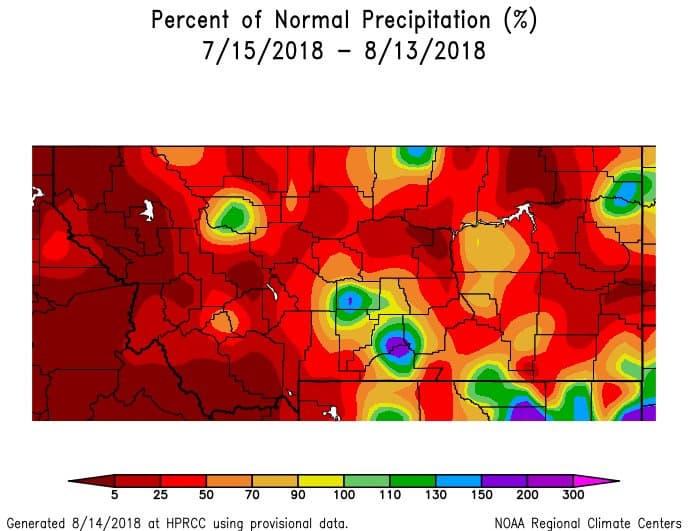
“Since July 1, 2018, only 0.01 inches of rainfall has fallen at the Helena Airport. This is the driest period on record from July 1 thru Aug 14th. The map below shows how much of MT has below normal precipitation just in the past 30 days, including in the Helena valley.”

As you can see in the graphic above, many other parts of western Montana have also had the driest 45 day period on record. Missoula has had the 2nd driest 45 day period on record, but that’s only because last year was the driest mid-summer period on record…when all those wildfires burned around Montana due to a “flash drought.”

Anyway, this “driest 45 day period on record” for many parts of western Montana follows a heavy winter snowpack and also record-break springtime flooding in many parts of Montana, including Missoula, the Rocky Mountain Front, Great Falls and Helena areas. In other words, record snowpack and flooding followed immediately by a record dry spell is a pretty good recipe for big wildfires. So we shall see….

So, what’s the solution to a couple of summers of the some of the driest mid-summer periods recorded over the past 130+ years? If and when wildfires burn in the fire-dependent ecosystems of the Northern U.S. Rockies will it be because of “environmental terrorist groups,” as Secretary Ryan Zinke insists?

Most of the forested ecosystem of the Northern U.S. Rockies is comprised of mixed conifer forests, which were born out of, and are maintained, by mixed- to high-severity fire regimes. The notion (spread often by the timber industry and certain politicians) that in the past all the forests of our region experienced frequent, but low-severity, wildfire is just totally not true. In fact, that Dry Montane, open, park-like ponderosa pine forest type makes up a tiny percentage of the forested ecosystem in the Northern Rockies. So, if and when mixed- to high-severity wildfires burn in forests that evolved with mixed- to high-severity wildfires who should be ‘blamed?’ Because we obviously have to blame someone, right?

Why is it so smokey in Canada when the timber industry essentially controls public lands?

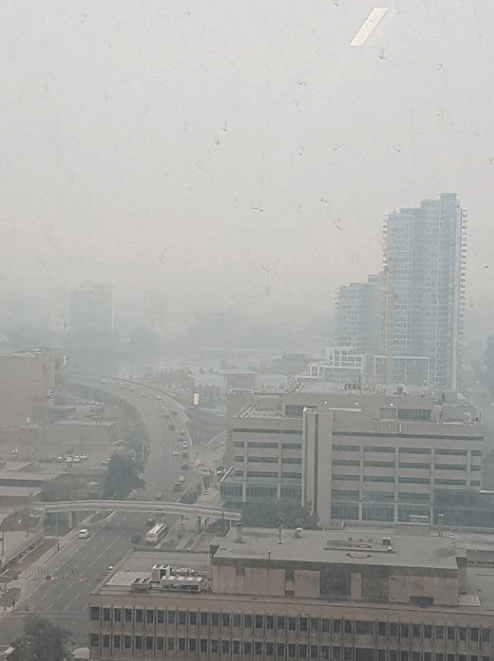
A friend just sent me this photograph taken this morning in downtown Calgary, Canada. It’s tough to see much of the city because of wildfire smoke from wildfires burning in Canada.

Just the other day Trump’s Interior Secretary blamed the wildfires on “environmental terrorist groups” and claimed we could prevent wildfires if it wasn’t for “frivolous lawsuits” from “radical environmentalists.”

Over the past twenty years, the U.S. Timber Industry and plenty of politicians have looked north to Canada for an example of the type of public lands logging system they’d like to see in America. (Ironically while some of these right-leaning U.S. politicians love the Canadian public lands logging system, that love of the Canadian system doesn’t extend to things like, basic universal health care, where they say we need a ‘uniquely American system’ [in which people and families are bankrupted and destroyed if someone simply gets sick.]) But I digress….

It’s well understood that in Canada the timber industry logs (and essentially controls) vast swaths of public lands.

Since that’s the case, why are there so many wildfires in Canada? Why is it so smokey in Calgary this morning?

Federal Court stops 85,000 acre Forest Service logging and burning project

Here’s the press release from Alliance for the Wild Rockies…. – mk

“The Ninth Circuit Court of Appeals today ruled for the Alliance for the Wild Rockies, Idaho Sporting Congress, and Native Ecosystems Council to stop the Lost Creek-Boulder Creek Timber sale in the Payette National Forest in western Idaho,” announced Mike Garrity, Executive Director of the Alliance for the Wild Rockies. “We are very pleased that the decision halts the Forest Service’s plan to log approximately 40,000 acres and burn 45,000 more acres in the New Meadows Ranger District.”

“We won today because the Forest Service tried to change existing Forest Plan standards so it could proceed with a massive logging project,” Garrity said. “It’s especially important because Boulder Creek is a tributary to the Little Salmon River and the headwaters of the West Fork of the Weiser River and the area is designated Critical Habitat for bull trout recovery.”

Reversing the district court, the Ninth Circuit Court held that the Forest Service’s decision to approve the Lost Creek-Boulder Creek Project was “arbitrary and capricious” and “constituted a violation of the National Forest Management Act.” Specifically, the Court held that the Forest Service had proposed to manage the forest in a manner that was clearly inconsistent with the Payette Forest Plan and that the agency had improperly adopted a new definition of “old forest habitat” for the Lost Creek Project area. The panel instructed the district court to vacate the Forest Service’s September 2014 Record of Decision and send the proposal back to the Forest Service to comply with the law and Forest Plan.

A Big Win for Taxpayers, Clean Water and Bull Trout

“We also challenged the Forest Service’s failure to reinitiate consultation with the U.S. Fish and Wildlife Service for the endangered bull trout” Garrity explained. “But while the lawsuit was pending before the Ninth Circuit, the Forest Service decided to reinitiate consultation for the bull trout over its entire range, including the Payette National Forest. Since that’s precisely what we wanted them to do in accordance with the Endangered Species Act when we took the case to district court, the issue was ruled moot by the Ninth Circuit decision but was definitely a win for bull trout.”

“Additionally, the Forest Service estimated that the project would have cost taxpayers a whopping $12,429,619,” Garrity said. “In essence, the Forest Service decided it was more important to subsidize the timber industry with this huge money-losing timber sale in federally-designated bull trout Critical Habitat than it is to recover bull trout as legally-required by the Endangered Species Act.”

“The principal reason bull trout habitat is trashed on the west side of the Payette Forest is Forest Service mismanagement through logging, road-building and overgrazing,” said Ron Mitchell of Idaho Sporting Congress. “This project continues the Forest Service tradition of irresponsible habitat destruction in spite of the fact that the agency’s former fisheries biologist, Dave Burns, wrote in the first Forest Plan that trout habitat on the west side is 50 percent below habitat capacity. The new roads and clearcutting would have reduced remaining habitat even further.”

“Much of the ‘mitigation’ promised by the Forest Service in the form of road-closures after the logging,” Mitchell said. “But the Payette has no record of successful road closures and no reliable monitoring system. We checked their top ten road closures and eight of them were wide open while the other two were easily driven around.”

“We’re glad the Ninth Circuit agreed with us on this project,” Garrity concluded. “It’s always tough to take the federal government to court. But this project would have cost taxpayers millions of dollars, would have resulted in more sedimentation of vital spawning streams, and resulted in fewer bull trout, salmon, and steelhead for present and future generations.”

Find a copy of the Ninth Circuit Court of Appeals Opinion here.

Federal Appeals Court rules East Reservoir logging project violates the law

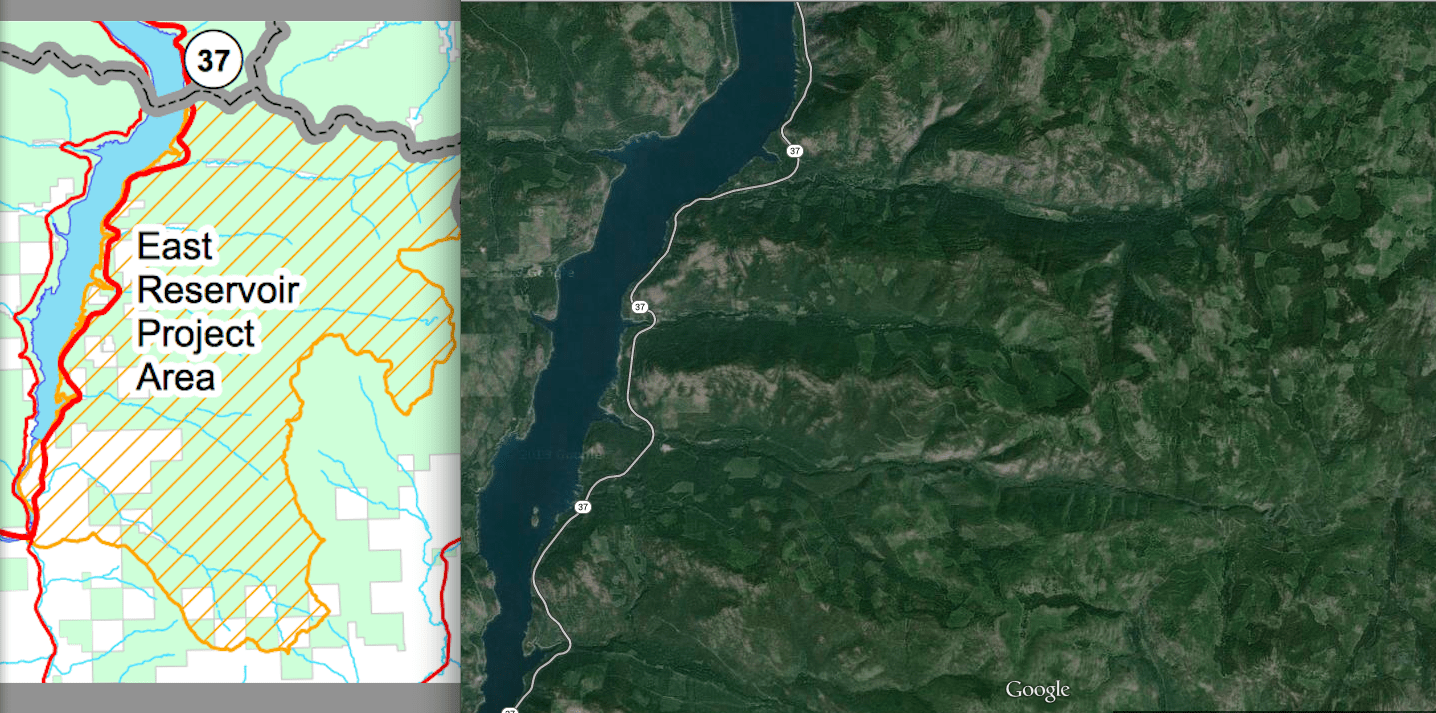
At left is the project map from the Forest Service for the East Reservoir timber sale on the Kootenai National Forest. At right is a satellite image of the project area, showing the extent of past clearcuts and logging. The Forest Service is proposing to log 8,800 acres with this project, including about 3,600 acres of clearcuts. Nearly 8,000 logging trucks would be required to haul out the trees. According to the Wild Rockies, the project area is home to bull trout, white sturgeon, Canada lynx and grizzly bears, among other wildlife species.

The U.S. Court of Appeals for the Ninth Circuit ruled in the Alliance for the Wild Rockies’ favor in its legal challenge to the East Reservoir logging project on the Kootenai National Forest in Northwest Montana.

“The Court found that the Forest Service violated its own rules for management of grizzly bear habitat“ Garrity stated. The rare and imperiled Cabinet-Yaak grizzly bear population of Northwest Montana has failed to recover to even half of its minimal goal of 100 bears after decades of management, which led to implementation of special management standards aimed to help recovery. However, the Court found that even though the agency adopted the recovery standards, it was not actually complying with them. “This grizzly bear population is less than 50 bears and in really dire straits – the Forest Service can’t just ignore that when it plans massive logging projects in grizzly bear habitat anymore,” said Mike Garrity, Executive Director for the Alliance for the Wild Rockies.

“The East Reservoir Project is huge,” Garrity continued. “But consider that there are already over 22,000 acres of clearcuts within its boundaries. Add to that the 8,845 acres of proposed commercial logging in the East Reservoir project, of which 3,458 acres will be new clearcuts, and the additional impacts to this already heavily-logged area are simply unacceptable for wildlife, water quality, hunting, fishing, and other public recreation and use of this area.”

“In addition to the environmental impacts, the project was a huge money-loser which, by the Forest Service’s own estimate, would have cost taxpayers over $2.5 million to subsidize further degradation of an already-degraded landscape at a time when the federal deficit is exploding,” Garrity explained. “Much of that cost will be to rebuild and maintain an astounding 175 miles of logging roads, build nine miles of new permanent logging roads, add an additional 13 miles of illegal, user-created roads into the legal road system, and open nine miles of previously closed motorized trails. This would occur despite the fact that all the existing science shows more roads lead directly to more grizzly bear deaths and more sedimentation of the spawning streams for bull trout, which are already listed as ‘threatened’ under the Endangered Species Act.

“As most Montanans know, there is incredible pressure from industry lobbyists and politicians to ‘get out the cut’ on our National Forests. But the bottom line is that these National Forests are public lands that belong to all Americans, not just the 1percent or corporate interests. Our federal laws are often the only thing standing between the ‘cut-and-run’ practices we’ve see on private timber lands, and the intact ecosystems we can still find on our National Forests. That’s because federal laws require retention of functioning ecosystems and diverse wildlife and fisheries on our National Forests.

“Simply put, thanks to our federal laws, our National Forests are not commercial logging lots that exist to benefit a single, private industry. In this case, we had to go to court to make this point clear, and the rule of law prevailed,” Garrity concluded.

You can view the Order here.

Longtime readers of this blog will recall that this timber sale has been discussed and debated many times. Here’s a sampling of some previous posts.

Char Miller and Chad Hanson: Gov. Brown’s wildfire plan will only make things worse

I had to chuckle today when I saw this oped co-written by Char Miller and Chad Hanson. Since this blog was established, seems like various folks on this blog have treated Char Miller with respect, while the same folks have treated Dr. Chad Hanson with….well. Anyway, enjoy this piece from today’s LA Times. Below are some snips:

“Responding to the tragic losses of homes and lives in wildland fires in California over the past year, Gov. Jerry Brown announced a “major offensive” against fire, in the form of a “Forest Carbon Plan.” The governor proposes to use $254 million of taxpayer money to double logging levels in California’s forests — to “at least” 500,000 acres a year — and to achieve it, he wants to reduce environmental protections.

Although the governor’s May 10 proposal is ostensibly designed to protect human communities from forest fires and to mitigate climate change, it ignores and misrepresents current science. The Forest Carbon Plan will exacerbate climate change while doing little to protect communities from fire….

A gift to the logging industry, the governor’s proposal will leave communities more vulnerable to wildfire, not less. It will harm forest ecosystems and accelerate climate change. Real success will only come when we advocate solutions that do not demonize nature, but manage our place within its sometimes-fiery embrace.”

PEER: Tongass “Good Neighbor” agreement goes bad, Alexander Archipelago logging did no restoration and the timber was exported to Asia

Those pesky nosy bodies at Public Employees for Environmental Responsibility (PEER) are at it again. Below is there latest press release. – mk

Washington, DC — A state-federal timber partnership in Alaska’s Tongass National Forest went badly off-course, doing environmental damage in what was supposed to be a restoration project, according to a complaint filed today by Public Employees for Environmental Responsibility (PEER). Rather than improve forest health, the group charges that the sale damaged it.

In 2014, Congress enacted “Good Neighbor” authority for timber agreements between federal and state governments to enable cooperative forest restoration projects on federal lands when similar restoration projects take place on adjacent state lands. The political sales pitch for the suggestively titled Good Neighbor program characterized it as a proverbial “win-win” in that public forestlands receive needed restoration work while local mill economies benefit at the same time.

Employees complained to PEER that the Good Neighbor timber sale conducted on Kosciusko Island in the Alexander Archipelago of southeastern Alaska did not follow the blueprint. Contrary to how the program was supposed to work, in this case –

• There is no restoration of any kind planned on either federal or state lands;

• The U.S. Forest Service contract did not provide for any reforestation, even of parcels that were clearcut; and

• Few jobs materialized at local lumber mills and processing plants because all the timber was exported to East Asia.

To add insult to injury, by law, a portion of the income generated by the Good Neighbor sale must return to the U.S. Forest Service, but in this case, the State of Alaska is apparently set to pocket the income generated by this conventional timber sale masquerading as a restoration project.

“In this timber sale, Good Neighbor authority became a license to loot,” stated PEER Staff Counsel Adam Carlesco, arguing that under the guise of restoration, damaging clear-cutting occurred. “Both the U.S. Forest Service and the Alaska Department of Natural Resources acted more like co-conspirators than collaborators for improving forest health.”

PEER is asking the U.S. Department of Agriculture Office of Inspector General to audit not only this sale but also all the other Good Neighbor agreements. The PEER complaint also asks the IG to review a pattern of timber sale maladministration by the Forest Service.

“This is one of the first Good Neighbor timber sales and we are concerned that unless these problems are cured, as the twig is bent so grows the tree,” added Carlesco. “This Good Neighbor exercise made the case for high fences rather than more cooperation.”

###

Read the PEER complaint

See continuing pattern of taxpayer rip-offs from Tongass timber sales

Allegation of illegal logging, and a cover-up, on the Tongass National Forest

Old-growth forest clearcutting was ongoing last summer on the Tongass National Forest’s Big Thorne timber sale on Prince of Wales Island. Photo by Jacob Ritley, as part of the Tongass Groundtruth Expedition, 2016.

The following commentary is from David Beebe, a regular commenter on this blog, who also happens to be a resident and commercial fisherman in southeast Alaska for the past 30 years. These timber sales, specifically the Big Thorne timber sale, have been discussed on this blog numerous times in the past.

“If a tree falls in a forest and no one is around to hear it, does it make a sound?” We’re all familiar with this thought experiment in observation and perception.

So what if an investigation by the Washington Office (WO) of the US Forest Service visits the Petersburg, and Thorne Bay Ranger Districts reviewing the Tonka and Big Thorne timber sales, and they conclude in a report never intended to be made public, that thousands of trees fell in our public forest illegally? Does it make a sound in local newsprint when finally revealed? Not a peep was heard from the Petersburg Pilot on what would surely merit the highest level of local, and regional if not national newsworthiness.

Does the loss of millions of dollars in revenues to the communities of Petersburg and Thorne Bay make a sound on local public radio? Well, no. Although there were two CoastAlaska news reports, the first one misleadingly claimed the agency findings of fact were merely accusations by an environmental group regarding “mishandled timber sales.” The title of the second news report would have us believe the Big Thorne timber Sale was “short on timber,” and simply “a mistake.” At no time was the Tonka timber sale out of Petersburg ever mentioned in either of these stories.

A timber sale requires a contract which once signed, is a binding legal agreement enforceable by law. The WO investigation team determined the contract was neither enforced, nor could a valid copy be provided upon request. But that’s not all. Many more records necessary to assure proper oversight of millions of dollars in public resources were also found— to not exist.

There’s one of two possibilities here. Either public records exist, records necessary to assure the public that laws were followed — including the prevention of timber theft — or those records were destroyed to protect the perpetrators.

These systematic failures to comply with law on two different ranger districts in two separate timber sales can hardly be a “mistake.” The WO findings of monetary losses to municipalities were raised during a recent open house on the central Tongass planning to Tongass Forest supervisor, Earl Stewart. Stewart tried to dodge the question, was heckled, but still feigned ignorance of the WO findings of fact. This exchange was omitted from CoastAlaska’s news coverage of the meeting. Large-scale timber theft on the Tongass has been well documented in a white paper published in 1996. 20 years later, all the carefully designed agency methods to assure that this doesn’t happen again were systematically ignored in the Petersburg and Thorne Bay Ranger districts.

So either there is a system of gross maladministration, mismanagement and incompetence on the Petersburg and Thorne Bay Ranger Districts, or there exists a conspiracy of willful disregard of agency protocols, public trust, and public laws.

As Ani Difranco has noted, freedom of the press is meaningless if the press refuses to ask questions. News production is often referred to as the first draft of history, and this astonishing investigation revealing millions of dollars of taxpayer losses to the Petersburg borough and the community of Thorne Bay never made the local news roundup of 2017.

This April 4th will mark a full year since the public was first alerted to this Washington Office investigation, and it is time to hold accountable, not only the agency perpetrators, but the gatekeepers of local news.

A forensic accounting of this matter is essential.

David Beebe has been a Southeast Alaska resident and commercial fisherman for over 3 decades, During that time, he has closely followed issues related to environmental, social and economic policy, and has served on several non-profit boards, and council seats.

PBS NewsHour: Tony Tooke, head of U.S. Forest Service, stepping down amid sexual misconduct allegations

Breaking news from PBS Newshour:

The chief of the U.S. Forest Service is stepping down amid allegations of sexual misconduct and an investigation commissioned by the United States Department of Agriculture into his own behavior.

Tony Tooke, who became chief in September after nearly four decades with the agency, wrote in an email to staff Wednesday that his retirement was effective immediately.

The news comes days after a PBS NewsHour investigation revealed a widespread culture of sexual harassment and assault within the agency, and retaliation against those who reported it.

That investigation also revealed claims of sexual misconduct against Tooke, including relationships with his subordinates before he became chief.

The United States Department of Agriculture confirmed last week it had “engaged an independent investigator” to look into claims about Tooke’s behavior.

In his email Wednesday, Tooke wrote: “I have been forthright during the review, but I cannot combat every inaccuracy that is reported in the news media. What I can control, however, are decisions I make today and the choice of a path for the future that is best for our employees, the Forest Service and the U.S. Department of Agriculture. I must also think about what is best for my family. Therefore, I have decided that what is needed right now is for me to step down as Forest Service Chief and make way for a new leader that can ensure future success for all employees and the agency.”

“We are in a moment at the Forest Service when we have a tremendous opportunity to mold a bright and successful future in delivering our mission. To seize this moment, however, the right leadership must be in place to create an atmosphere in which employees can perform their very best work. Each employee deserves a leader who can maintain the proper moral authority to steer the Forest Service along this important and challenging course,” he also wrote.

PBS Newshour had a bunch of the background:

U.S. Forest Service chief under investigation after complaints of sexual misconduct (here)

They reported sexual harassment. Then the U.S. Forest Service retaliation began (here)