PBS Newshour: They reported sexual harassment. Then the U.S. Forest Service retaliation began

A must read from PBS NewsHour. Will U.S. Forest Service Chief Tony Tooke and President Donald Trump take these reports of sexual harassment and assault, bullying by U.S. Forest Service supervisors and crew members seriously?

Harassment of women in the Forest Service has been a problem for years. As far back as 1972, women have joined together to file class action complaints and lawsuits about gender discrimination and sexual harassment. More recently, in 2016, a congressional hearing was held to address the problem within the Forest Service’s California workforce, which had also been the focus of previous complaints. The PBS NewsHour investigated what’s happened since then, and found the problem goes much deeper.

In interviews with 34 current and former U.S. Forest Service women, spanning 13 states, the women described a workplace that remains hostile to female employees. They complained of a pattern of gender discrimination, bullying, sexual harassment and assault by crew members and supervisors. Three women said they were raped after-hours by co-workers or interagency firefighters while working for the Forest Service. Many women alleged retaliation after reporting these incidents….

Seven of the 34 women interviewed asked to remain anonymous for fear of further retaliation. Fear was a common theme in the interviews. One woman said she went to the hospital multiple times for “her nerves” after reporting harassment. Another asked the NewsHour to destroy her interview transcript, because she became too afraid of the consequences. A third, a firefighter who resigned from her position in 2016 after she reported to police that she was raped on assignment in Montana, said: “We all live in this fear … So if I have to speak up I will. But it’s frustrating because there’s so many more out there who are not talking.”

Read the entire article here.

Groups File Objections to Protect Fish, Wildlife and Recommended Wilderness on the Flathead National Forest

The Swan View Coalition put together the following blog post, which includes links to a bunch of official objections filed on the Flathead National Forest’s revised forest plan (including one from my organization, the WildWest Institute).

Conservation groups wanting better protection for fish and wildlife in the Northern Rockies filed Objections to the revised Flathead Forest Plan and Amendments to four other Forest Plans in the Northern Continental Divide Ecosystem.

The plan revision and amendments are intended to pave the way for delisting of threatened grizzly bear in the NCDE, which would remove their Endangered Species Act protection.

The groups launched a letter writing campaign in 2016. This resulted in 98% of the 33,744 comments the Forest Service received on its Draft Environmental Impact Statement calling for protection of all remaining roadless lands as wilderness and continuation of the road decommissioning program that agencies credit with improving grizzly bear security and helping restore critical bull trout watersheds.

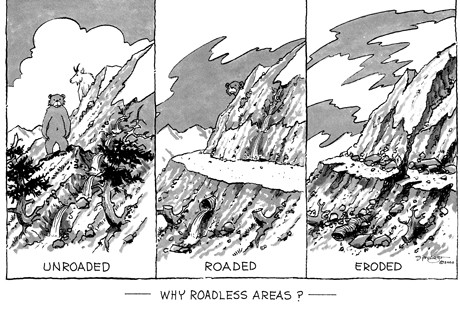
The revised Flathead Forest Plan instead abandons its road decommissioning program and recommends for wilderness designation only 30% of the areas it found suitable for wilderness. The Kootenai, Lolo, Lewis and Clark, and Helena Forest Plans would similarly be amended to abandon road removal as a primary means to restore fish and wildlife habitat that has been damaged.

The groups rallied around the principles of the Citizen reVision alternative Swan View Coalition and Friends of the Wild Swan asked the Forest Service to include in its DEIS. The DEIS included some of these principles in its Alternative C, which it then assigned the highest marks for maintaining water quality and wildlife habitat connectivity. The FEIS and revised Flathead Forest Plan, however, select Alternative B-modified even though it is assigned “the highest risk of impact to aquatic species” and “is likely to adversely affect” already threatened grizzly bear, bull trout, and Canada lynx!

The Objections were due at Forest Service Region One headquarters in Missoula on February 12. The Region now has ten days to “publish a notice of all objections in the applicable newspaper of record and post the notice online.” The Region’s responses to the Objections are due within 90 days, unless it grants itself extensions.

Below are links to some of the Objections filed by groups supporting the principles of the Citizen reVision:

Swan View Coalition Objection and Supplemental Objection.

Friends of the Wild Swan Objection.

Independent Wildlife Consultant Brian Peck Objection.

WildEarth Guardians, Western Watersheds Project and Sierra Club Objection.

Alliance for the Wild Rockies, Montana Ecosystems Defense Council, Friends of the Wild Swan Objection.

Flathead-Lolo-Bitterroot Citizen Task Force, Wilderness Watch, WildWest Institute, Friends of the Bitterroot, Friends of the Rattlesnake, Friends of the Clearwater, Independent Consultant Mike Bader Objection.
Citizens’ Objection filed by WildEarth Guardians on behalf of 4,000+ signors.

Montana Chapter Sierra Club Objection.

The 3,000 pages of FEIS, Forest Plan and Forest Plan amendments can be found here.

The Bureau of Land Management is “chaining” our public lands, and BLM’s next stop could be within Grand Staircase-Escalante National Monument

In my opinion, “chaining” looks straight outta Isengard from Lord of the Rings.

The Southern Utah Wilderness Alliance (SUWA) has launched a statewide television and online media campaign in Utah to focus public attention on the Bureau of Land Management’s destructive practice of “chaining” native pinyon and juniper forests to create more forage for cattle on public lands. Now the BLM wants to chain in Grand Staircase-Escalante National Monument. Call the BLM at 801-539-4010 or learn more at suwa.org/chaining

Oregon Raises Protections for Rare Seabird: Logging, Loss of Prey, Climate Change All Endanger Marbled Murrelet

Here’s the press release from the successful conservation groups.

PORTLAND, Ore.— Responding to a petition from conservation groups, the Oregon Fish and Wildlife Commission voted today to change the status of marbled murrelets from threatened to endangered under the Oregon Endangered Species Act.

The decision to uplist the murrelet reflects the increasingly imperiled status of the species in Oregon and represents an important step in reversing its ongoing decline toward extinction in the state.

“We applaud the commission for recognizing that the marbled murrelet warrants endangered status in Oregon,” said Nick Cady, legal director at Cascadia Wildlands. “This decision sets the stage for the state of Oregon to take the steps that will be necessary to recover this species in Oregon.”

The marbled murrelet is a seabird that nests in old-growth and mature forests and forages at sea. Its population has declined dramatically over the decades because of extensive logging in Oregon’s Coast Range. The commission’s decision could have implications for forest protection on state and private timberlands.

“While federal laws have stabilized habitat loss on federal lands, the state of Oregon has continued to allow logging of older forests at an alarming rate and failed to adequately address new threats to the species,” said Bob Sallinger, conservation director for the Audubon Society of Portland. “Changing the murrelet’s status to endangered will help ensure that Oregon takes the steps necessary to do its part to save this species.”

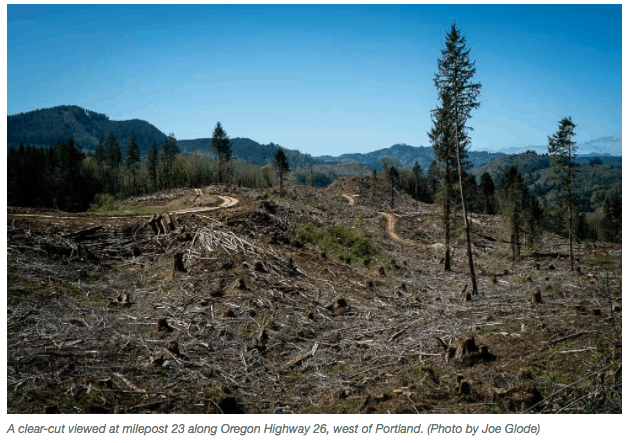
In response to a petition from multiple conservation organizations, the Oregon Department of Fish and Wildlife developed a status review to assess the murrelet’s condition. The review demonstrated that murrelets need increased protections under the Oregon Endangered Species Act due largely to loss of nesting habitat from ongoing clear-cut logging. State protections are critical, because although many of Oregon’s Coast Range old-growth forests have been logged and converted into industrial tree farms, some of the best remaining older forests occur on state-managed lands.

“We’re pleased commissioners made a sound, science-based decision that’s exactly what these desperately imperiled seabirds need to survive,” said Tierra Curry, senior scientist at the Center for Biological Diversity. “The science was absolutely clear that the murrelet warrants endangered status in Oregon. This protection will be critical to preserving an amazing part of our state’s natural heritage.”

The murrelet was listed as threatened in 1995. However, the recent status review conducted by Oregon’s Department of Fish and Wildlife concluded that the “key threats identified at the time of listing have continued or increased, and many new threats have been identified since the 1990s … the life history exhibited by this species provides little opportunity for the population to rapidly increase even under the most optimal circumstances.” It also noted that the primary causes of marbled murrelet declines — loss and fragmentation of older forest habitat on which the bird depends for nesting — have “slowed, but not halted … since the 1990s,” with greatest losses occurring on lands managed by the state. The review specifically notes that existing programs and regulation have “failed to prevent continued high rates of habitat loss on nonfederal lands in Oregon.”

The Oregon Endangered Species Act requires that the commission adopt survival guidelines for the species at the time of reclassification. Survival guidelines are quantifiable and measurable guidelines necessary to ensure the survival of individual members of the species. Guidelines may include take avoidance and protecting resource sites such as nest sites or other sites critical to the survival of individual members of the species. They would serve as interim protection until endangered species management plans are developed by applicable state agencies and approved by the Fish and Wildlife Commission.

“It is remarkable that this species has been listed as threatened for more than 20 years but the state of Oregon has never developed a plan to actually protect murrelets on either lands owned by the state of Oregon or private timber lands,” said Quinn Read, Northwest director of Defenders of Wildlife. “The status quo has failed this iconic Oregon seabird. We look forward to working with ODFW and other agencies to developing a plan that will truly protect this species and allow it to recover in Oregon.”

“This is an important step for ODFW. The agency has struggled to faithfully act on it’s core mission of protecting all native fish and wildlife in our state, but with this action to protect the marbled murrelet we hope they have turned the page,” said Steve Pedery, Conservation Director for Oregon Wild.

The conservation groups that initiated the petition to declare the marbled murrelet endangered in Oregon were Cascadia Wildlands, Audubon Society of Portland, the Center for Biological Diversity, Oregon Wild, Coast Range Forest Watch and the Oregon Chapter of the Sierra Club.
Does Interior Secretary Ryan Zinke Want to Log America’s National Parks?

It sure sort of, kind of, sounds that way.

Check out this piece from Outdoor Life:

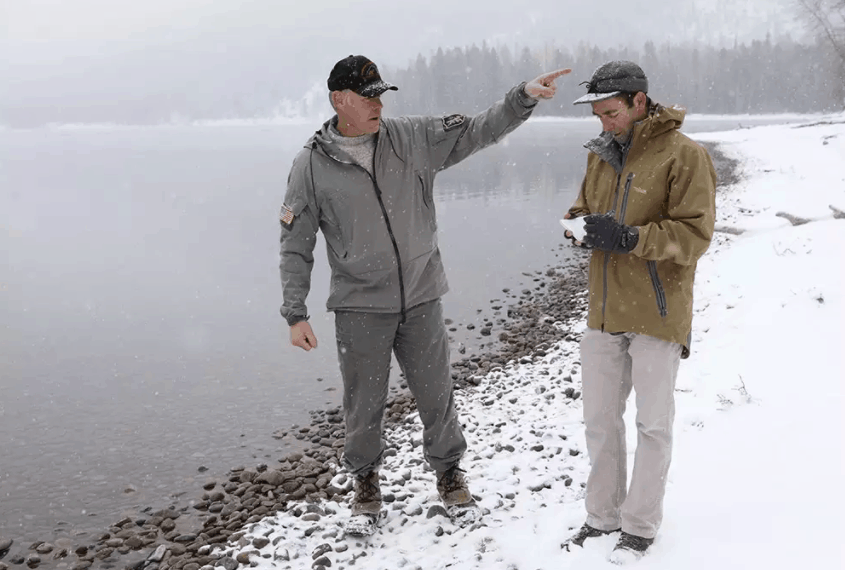
The Sprague Fire that burned the [Sperry] chalet was part of a wider trend last summer that saw the worst fire season in Montana in 30 years. As we walk, Zinke points to the dense stand of Douglas fir on the slopes above [Glacier National Park’s Lake McDonald]. It’s an uninviting desert of same-aged trees, too thick to hike through, a monoculture unbroken by a larch or an aspen.

“Those trees are a fire waiting to happen. We spent $2 billion on fire suppression this year. We can’t afford to keep doing that. The first step in fire management has got to be prevention. The reality is that our climate is changing. We are having longer fire seasons, and fires are bigger and burn hotter. So we need to reduce the fuel load. We need proactive timber management, including using prescribed burns in times of the year when it makes sense.”

“Are you recommending that we log our national parks?” I ask Zinke. National parks are among the most restrictive of the many designations of land use in the Department of Interior’s 500-million-acre real-estate portfolio, a fifth of the nation’s land mass. You can’t hunt in national parks, there’s no resource development, and many other activities are categorically prohibited, including commercial logging.

His answer — I think — is contained in a looping, obtuse answer that characterizes much of our day-long conversation. The Secretary of the Interior tells me that in his meeting with Glacier’s administrators, he raised the question of timber management inside the park. Zinke wants to see more cutting and thinning, both to reduce the intensity of wildfire and to boost biodiversity in critical ecosystems.

“I had a parks administrator tell me that timber management wasn’t his priority, that his priority was managing visitors. I told him, ‘Then what do I need you for? If managing visitors is your only job, then all I need is a ticket-taker at the entrance gate.’ So many people get into park management because they’re preservationists. I’m a conservationist, and that means actually managing what we’re stewards of.”

Does wildfire create home sweet home for bees?

In case you haven’t heard, bees are in serious trouble all around the world. If you like to eat food, that’s a big concern.

Turns out, researchers with Oregon State University are also finding that with increased wildfire severity they are also noticing a higher abundance of bees.

I have to wonder if that higher abundance of bees would also be found on corporate and industrial timber lands, which are often sprayed heavily with a cocktail of various pesticides and herbicides. My guess is not.

Get the full scoop here. Below are some snips:

“We’re looking at a few different (habitat) characteristics. And one of the big ones is canopy cover. In the moderate-high and high fire severity categories, there’s pretty low canopy cover. So you get more flowering plants that come in,” Oregon State University researcher Sara GalbraithGalbraith says.

In these places where more than 50 percent of the canopy burned, it’s also warmer and there’s potentially more nesting habitat. These aren’t hive-dwellers; these bees look for mineral soil to burrow into.

“The story so far has been pretty straightforward,” she says, “in that we’re finding that with increased disturbance at our sites — so increased fire severity — we get higher abundance of bees. And we also get more bee species.”

“We have millions of acres of forests in Oregon that we’re managing. And at this point, we don’t have really good information about how those management practices influence bees. If I do ‘X’ how does that influence the number of bees and the species composition?” – Jim Rivers of the OSU Forest Animal Ecology Lab…

Study lead Sarah Galbraith is beginning to think about this possibility. She thinks there could be a critical link between native bees that live in forests and nearby farmland.

“By protecting our pollinators in the forest, we are potentially protecting our food security now and into the future.”

Report: Timber harvesting is by far the largest source of greenhouse gas emissions in Oregon

A new analysis released this week by the Center for Sustainable Economy found that:

Timber harvesting is by far the largest source of greenhouse gas (GHG) emissions in Oregon. Since 2000, annual emissions associated with removal of stored carbon, sacrificed sequestration, and decay of logging residuals averaged 33 million metric tons carbon dioxide equivalent (mmt CO2-e).Nationwide, logging emits more carbon than the residential and commercial sectors combined.

According to the Center for Sustainable Economy:

The report – entitled Oregon Forest Carbon Policy: Scientific and technical brief to guide legislative intervention – is a synthesis of scientific and technical information about the effects of industrial forest practices on climate change and climate resiliency and a discussion of legislative options for moving forward. It builds on a 2015 report published with Geos Institute that helped lead to a reconvening of the Commission’s forestry task force to revisit their assumptions – published in their Interim Roadmap to 2020 report – that forestry’s effects on climate were an unqualified benefit. Today’s report paints a drastically different story.

More information and context is available here.

What if our efforts to stop wildfires actually make them bigger?

Yes, what if. The full article from today’s Missoulian is here, and some interesting snips are below.

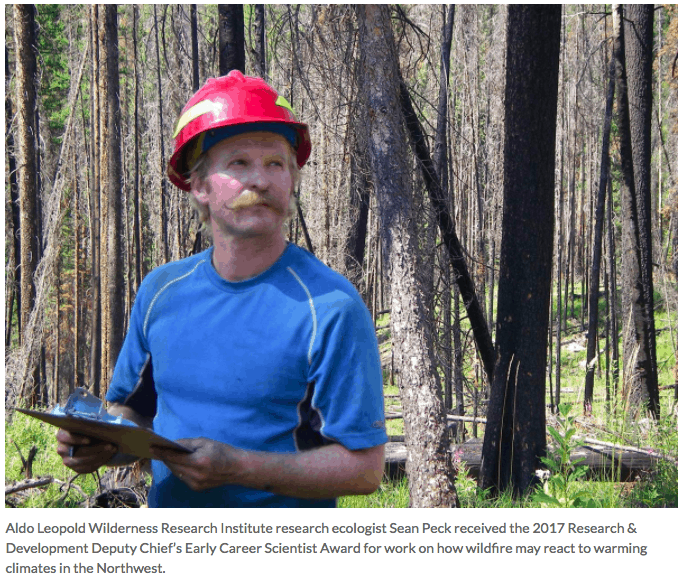
“It’s a counter-intuitive result,” said research ecologist Sean Peck. “We put out the fire, but in the long run, there are negative unintended consequences. If we’re putting out all fires under moderate weather conditions, the fire we can’t put out will burn under extreme conditions.”

Peck’s work at the Aldo Leopold Wilderness Research Institute on the University of Montana campus recently earned him the 2017 Research & Development Deputy Chief’s Early Career Scientist Award. Since earning his doctorate from UM in 2014, he’s been lead author of nine peer-reviewed journal articles and co-authored another 11.

Much of Peck’s work focuses on wildfire in federal wilderness, including the Bob Marshall Wilderness Complex and the Selway-Bitterroot Wilderness. Forest fires there typically burn without the swarms of yellow-shirted firefighters and red-tailed aircraft trying to suppress them….

“I think outside wilderness areas, we’re selecting for high-severity fire,” Peck said. “It’s like selecting for a gene in corn crops. It’s not done on purpose, but it happens with certain management practices. We’re not allowing fires to burn in non-extreme years. So fires only occur during extreme events. Those fires are the ones we could not put out.”…

Peck’s current work looks at how future climate changes may affect the tempo of fire seasons. He’s testing the idea that we’re likely to see more extreme fire events in the short term, but less severe fires several decades from now as the climate warms.

“We think we may see the spruce-fir forests converted to something else that may be more resistant to fire, like Douglas fir and ponderosa pine,” Peck said. “And at some lower elevations, dry-forest types are projected to convert to non-forest vegetation, grassland or shrub land. Dry forests are barely hanging on now.

“As Montanans, we’ve grown up with certain kinds of forests,” Peck added. “They are going to change. We can accept it, but it will happen whether we want it to or not.”