U.S. House OKs bills paving way for mining near the Boundary Waters Wilderness

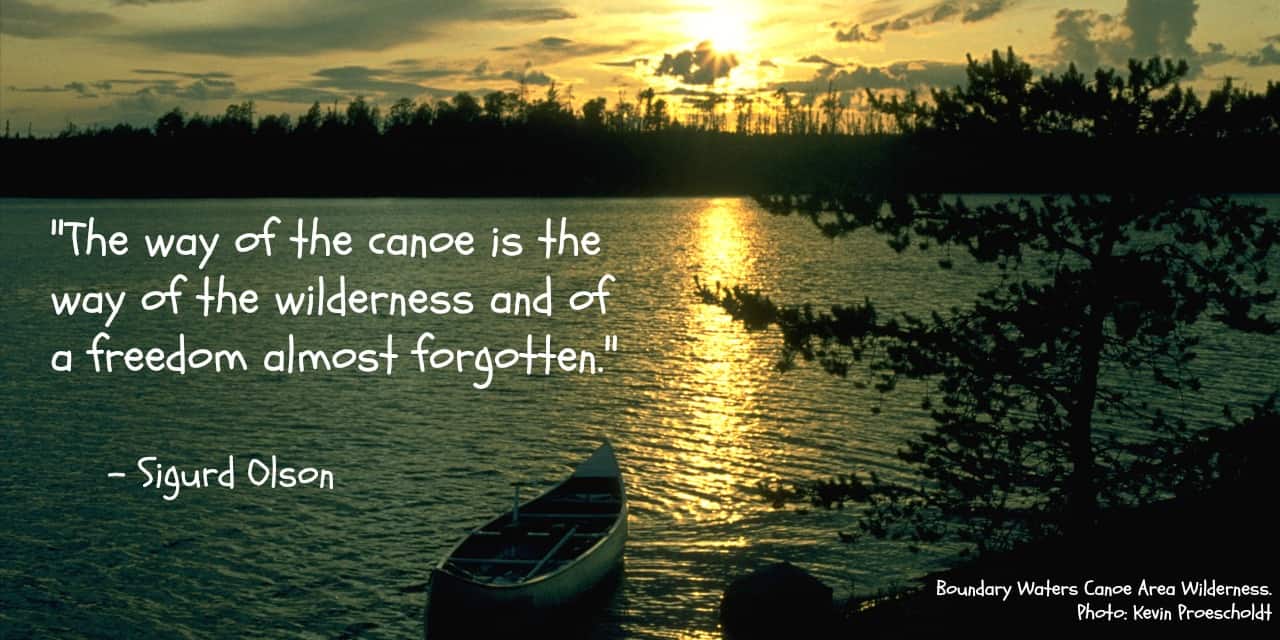
In the (very dry) summer of 1988 I did an extended Outward Bound trip in the Boundary Waters Canoe Area Wilderness, which for a variety of reasons, changed my life forever.

According to Minnesota Public Radio:

The U.S. House of Representatives passed a bill Thursday to reopen Superior National Forest land near the Boundary Waters [Wilderness] to mineral exploration and, potentially, to new copper-nickel mines on the doorstep of one of the nation’s most popular wilderness areas.

The bill, introduced by Minnesota Republican Rep. Tom Emmer, would allow a company called Twin Metals to continue developing a potential copper-nickel mine near Ely, Minn., on the edge of the Boundary Waters Canoe Area Wilderness.

The bill would restore the company’s mineral leases — which the federal government declined to renew at the end of President Barack Obama’s administration — and stop a two-year study into the effects of mining within the watershed that flows into the Boundary Waters [Wilderness]. That process that could lead to a 20-year ban on mining in the area.

When enduring much longer and drier portages in the Boundary Waters Canoe Areas Wilderness back in 1988 there’s no way my 16 year old self could’ve imaged that year’s later the U.S. Congress would be circumventing our nation’s bedrock environmental laws to make it easier for a foreign company (with a terrible history of environmental violations) to build dangerous sulfide-ore copper mines on the edge of the Boundary Waters Wilderness…but there you have it.

Also this week, the U.S. House passed H.R. 3115, a bill that would require that 6,650 acres of the Superior National Forest be traded to PolyMet Mining for the construction of an open-pit copper-nickel (sulfide) mine. Thousands of acres of irreplaceable wetlands at the headwaters of Lake Superior were valued for exchange at $550 per acre, five times less than what other mining companies have paid. There are currently four lawsuits pending against the land exchange. H.R. 3115 would essentially declare these lawsuits null and void and undermine the Endangered Species Act to ram through the land exchange, bringing PolyMet’s open-pit copper-nickel (sulfide) mine a few scary steps closer to reality.

These anti-Boundary Waters Wilderness bill are just a drop in the bucket. Essentially, unless Congressional dysfunction saves the day, America’s public lands, wildlife and Wilderness legacy will be laid to waste in the next couple of weeks. There are literally too many terrible bills pending in Congress, and certainly being hatched behind closed doors as we speak, to even keep track of them all.

GOP Bill Would Amend Wilderness Act to Allow Bikes in All Protected Wilderness Areas

On December 7, 2017 the House Natural Resource Committee’s Subcommittee on Federal Lands will hold a hearing on H.R. 1349, a bill from Rep. Tom McClintock (R-CA) [Lifetime 4% LCV rating,], which would “amend the Wilderness Act to ensure that the use of bicycles, wheelchairs, strollers, and game carts is not prohibited in Wilderness Areas and for other purposes.”

The text of H.R. 1349 is only one paragraph in length, and based on the wording, ALL Wilderness areas in America would be open to bicycles, wheelchairs, strollers, and game carts.

Here’s some more information and an action alert on this issue from Wilderness Watch:

For over 50 years, the Wilderness Act has protected Wilderness areas designated by Congress from machines of all types. This has meant, as Congress intended, that Wilderness areas have been kept free from cars, trucks, ATVs, snowmobiles, bicycles, and all other types of motorized and mechanized transport.


Unfortunately, a loud contingent of some mountain bikers and an off-shoot mountain biking organization, the Sustainable Trails Coalition (STC), have convinced notoriously anti-Wilderness Congressman Tom McClintock (R-CA) to introduce H.R. 1349, a bill which would amend the Wilderness Act to allow bikes, strollers, wheelbarrows, game carts, survey wheels and measuring wheels in every unit of the National Wilderness Preservation System.

In an especially cynical and disingenuous move, the mountain bikers seem to hide behind people with disabilities in their effort to make America’s wildest places merely a playground for cycling! The mountain bikers list “motorized wheelchairs” and “non-motorized wheelchairs” as the first uses to be authorized in Wilderness under their bill (even prior to the listing of “bicycles”), though the 1990 amendments to the Americans with Disabilities Act (ADA) have clearly allowed wheelchairs in designated Wilderness for more than a quarter-century.

For more information regarding “Fake News” being spread by some mountain bikers, see Five Lies Being Used to Get Mountain Bikes into Wilderness.

You may recall that the STC had a bill introduced last year in the U.S. Senate by the Utah Senators Orrin Hatch and Mike Lee, whose lifetime conservation voting records as compiled by the nonpartisan League of Conservation Voters are just a paltry 9% and 10% respectively. That bill would have opened the Wilderness System to mountain bikes, and also to chainsaws.

Fortunately, last year’s bill went nowhere, in no small part to the actions taken by Wilderness defenders around the country!

Unfortunately, the new bill could very well advance in the current anti-Wilderness Congress, allied with the new Trump Administration that seems hostile to environmental protection. Rep. McClintock, a member of the House Natural Resources Committee, also chairs that panel’s Subcommittee on Federal Lands. This means he is in a significant position of leadership, and could mean that this year’s mountain bike bill might well advance in Congress. McClintock’s lifetime conservation voting record is even worse than those of the Utah Senators, at a barely-registering 4%.

Last year, anticipating the 2016 Senate bill to open Wilderness to mountain bikes, Wilderness Watch spearheaded a sign-on letter to Congress in opposition to opening up the National Wilderness Preservation System to bikes. It resulted in a total of 114 wilderness-supporting organizations from around the nation signing on, clearly showing that the conservation community is united in its opposition to the mountain bikers’ efforts. We are in the process of putting together a similar sign-on letter for 2017.


Now we need your help! Please take a few minutes to urge your representative and senators to oppose H.R. 1349 and all attempts to amend and weaken the Wilderness Act to allow mountain bikes in Wilderness.


At a time when Wilderness and wildlife are under increasing pressures from increasing populations, growing mechanization, and a rapidly changing climate, the last thing Wilderness needs is to be invaded by mountain bikes and other machines!

More Domestic Cows and Sheep Coming to Your Favorite Wilderness Area?

I just got a heads up that there is a provision in the Interior Appropriations bill that would require the U.S. Forest Service and Bureau of Land Management to give grazing permits to ranchers on any vacant allotment to replace lost grazing opportunities to due to fires or anything else “beyond the permittees control.”

The permits would be issued with the same rules in place as at the time the allotment was last grazed, which may have been decades ago. There would be no NEPA and there are no exceptions for Wilderness.

Folks might not know this, but there are a lot of vacant Wilderness allotments that were never “closed,” they are still on the books as “vacant.” The grazing guidelines clearly prohibit what the requirement in the pending Interior Appropriations bill does, but this new provision may well trump the grazing guidelines. Moreover, the guidelines don’t apply to any of the pre-1980 Wildernesses.

I’m in the process of trying to find more information and will provide it here when obtained.

Forest Service releases soil burn severity maps for some Montana wildfires

The U.S. Forest Service has just started releasing detailed soil burn severity maps for wildfires that burned in the Northern Rockies this year. Hopefully some of this information and these maps are shared by the news media and political leaders.

The Inciweb homepage is here.

Individual maps of some specific fires are here.

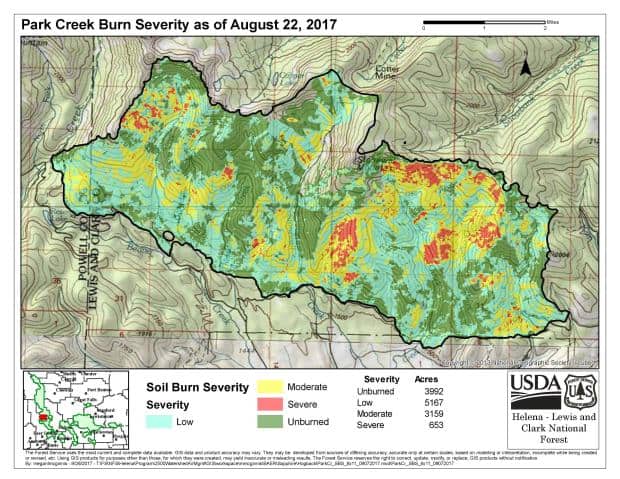
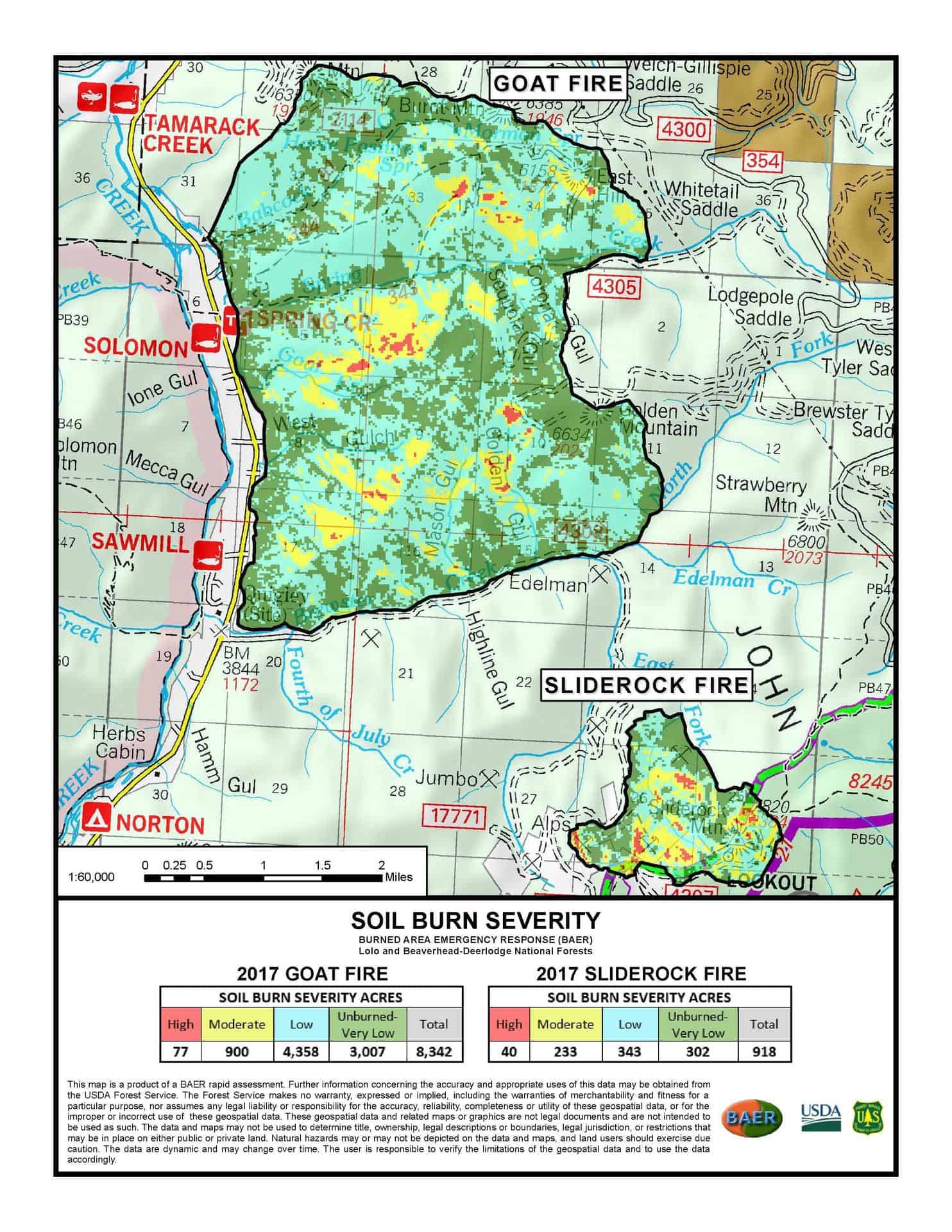
What’s the take home message from these soil burn severity maps? Looks like the 2017 wildfires burned in a mosaic pattern with lots of unburned, very low, and low to moderate soil burn severity.

SOME EXAMPLES FROM SPECIFIC WILDFIRES:

Only 3% of the acres burned in 45,000 acre Sapphire Complex Wildfires on Lolo National Forest had soil burn severity measured as “High.” Meanwhile, 78% of acres in Sapphire Complex Wildfires on the Lolo NF had soil burn severity measured as “Unburned” “Very Low” or “Low.”

The vast majority of the lightening-caused Park Creek fire was either unburned, or burned at low to moderate severity. Senator Daines, Rep Gianforte and the Montana timber industry – especially Ed Regan, resource manager for RY Timber – blamed this wildfire on a lawsuit by the Alliance for the Wild Rockies. The soil burn severity map for the Park Creek fire is below. Ed Regan complained that the wildfire was going to “destroy” the forest and wildlife habitat. Sorry to disappoint you Ed, but it doesn’t look that way!

Meanwhile, when Interior Secretary Ryan Zinke, Ag Secretary Sonny Perdue, Rep Gianforte and Senator Steve Daines toured the Lolo Creek Fire on the Lolo and Bitterroot National Forest – they blamed wildfires on “environmental extremists.” This was despite the fact that there was NEVER ANY lawsuit filed to stop any logging project near the Lolo Peak Fire. Turns out that 66% of the Lolo Peak Fire acres had “unburned” “very low” or “low” soil burn severity, while only 9% had “high.”

More fire severity maps will be posted by the U.S. Forest Service as they become available, so make sure to check back at this link.

Also, two weeks ago I contacted U.S. Forest Service Burned Area Reflectance Classification (BARC) data-producing team to get a satellite-derived data layer of post-fire vegetation condition for Montana wildfires. I was told the U.S. Forest Service no longer releases initial BARC data to the public for “political reasons.” So we will have to patiently wait for that information.

Take a Flyover of the Chetco Bar Fire


How cool is this? I’ve been meaning to post this for the past week.

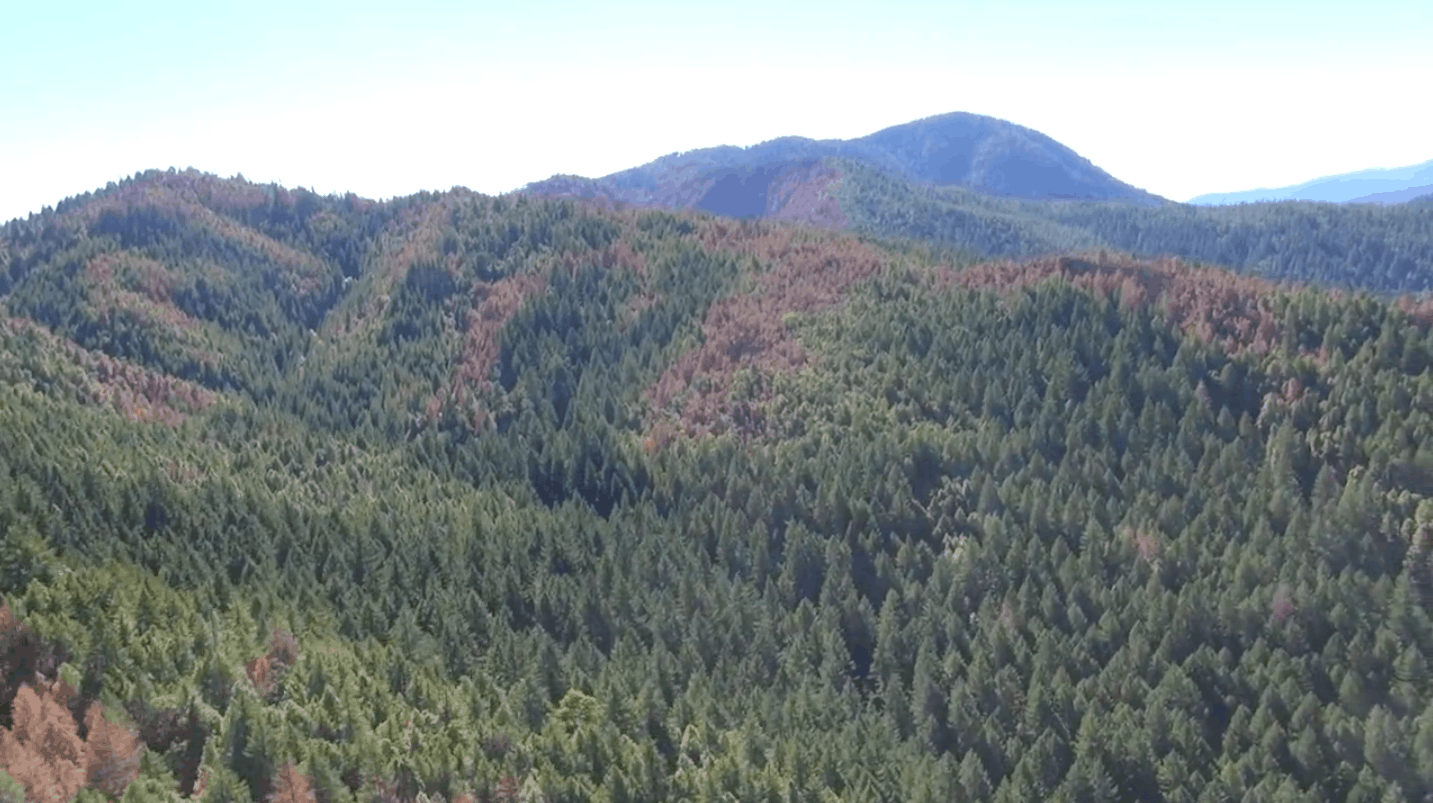
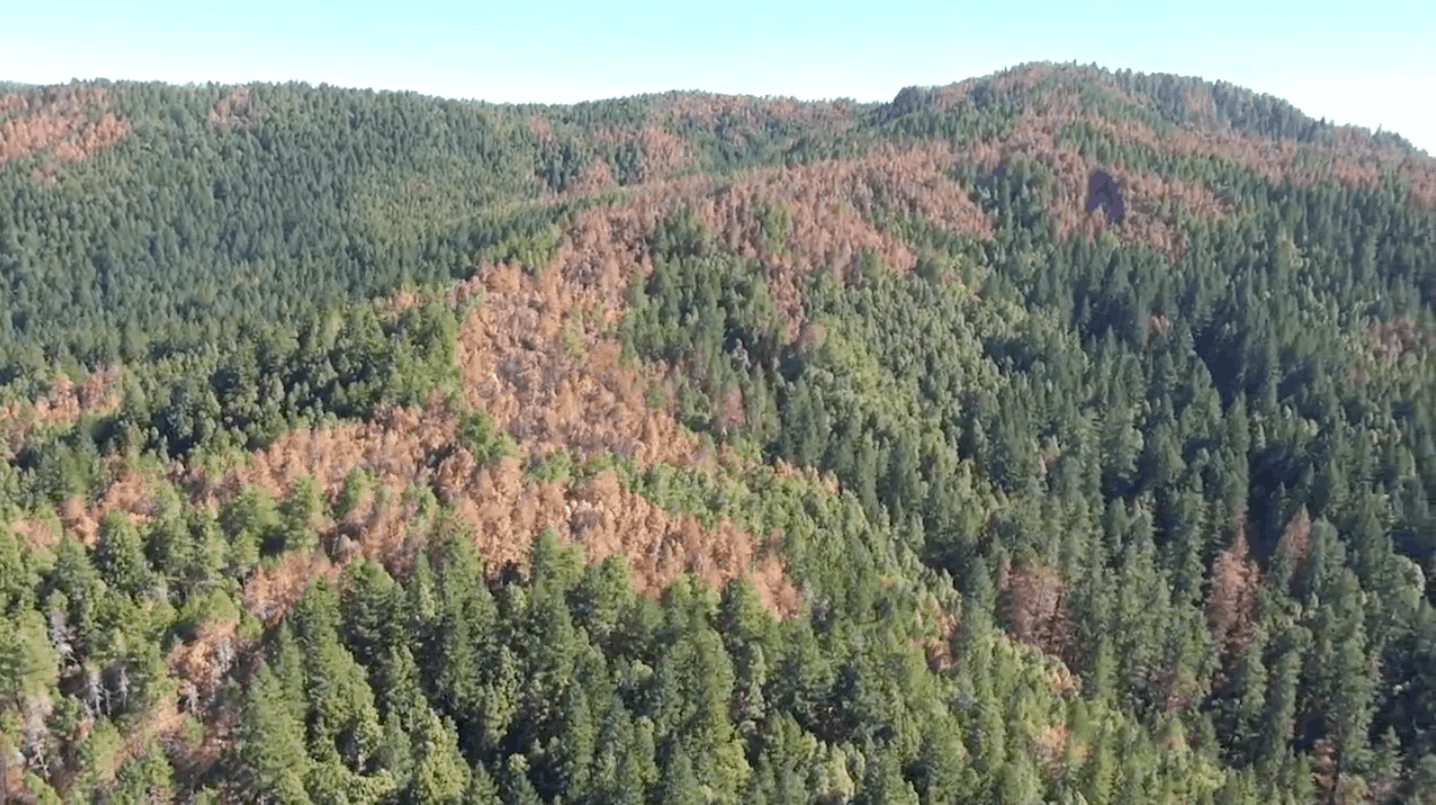
From the comfort of your own computer screen you can take a flyover of the 191,000 acre Chetco Bar Fire in southwestern Oregon with the National incident Team!

The thing that strikes me right away is the very clear mosaic pattern of the burned area. In fact, it appears that large chunks of the 191,000 acre fire were completely, 100% un-burned. I’ve always wondered about that dynamic over the past 20 years that I’ve paid close attention to wildfires. If, let’s say 20% of the area within a fire perimeter was totally unburned shouldn’t all that acreage be subtracted from the total burn area? Seems reasonable. Also seems like it never happens, we just continue to add up all the acres within the fire perimeter and say that the wildfire destroyed, or ravaged, or burned all those acres.

CLICK HERE for a “Narrated Flyover of the Chetco Bar Fire from Chetco River to Emily Ridge: September 26th, 2017”

CLICK HERE for a “Flyover of the North Point of the Chetco Bar Fire: Illinois River Corridor & Dead Man’s Bar.”

CLICK HERE for a “Indigo Fire Flyover: September 26th, 2017 by Operations Chiefs Reggie Bray & Barry Schullanberger.” This fly-over includes a good discussion about fire management decisions related to ensuring fire-fighter safety. The Indigo Fire was just north of the main Chetco Bar Fire.

Senator Tester’s 100% untrue statement about USFS Forest Plan Revision process: “Everything Stops.”

Last night on Montana Public Radio and Yellowstone Public Radio there was a story about Senator Tester’s and Senator Daines’ effort to overturn a U.S. Federal District Court ruling (which was affirmed by the Ninth Circuit Court of Appeals and the U.S. Supreme Court also refused to rehear the case) that they don’t like.

Here’s more information about Cottonwood Environmental Law Center v. United States Forest Service.

The Tester/Daines public lands logging bill (S.605) has been called “just another cynical attack to weaken a key provision of the Endangered Species Act” by the Center for Biological Diversity.

On statewide Montana Public Radio Senator Tester said this:

“But Tester says a new forest management plan can take decades to write. So in the meantime:

Everything stops. All the recreational opportunities stop, the tree cuts stop, trail maintenance stops while they redo this forest plan.’”

The public must know that this statement from Senator Tester is 100% not true and doesn’t even contain an ounce of truth.

The truth is that all National Forests in Montana, and across America, are required by the National Forest Management Act to go through a Forest Plan Revision process every 15 years. At NO POINT during that Forest Plan Revision process does “Everything stop.”

At NO point during the Forest Plan Revision process does “All the recreational opportunities stop, the tree cuts stop, trail maintenance stops while they redo this forest plan,” as Senator Tester told Montana citizens.

I appreciate the fact that the reporter talked to someone at the Lewis and Clark National Forest who said revising a forest plan doesn’t stop work. But revising a forest management plan also doesn’t “hamper” it either, as the Forest Service employee apparently claimed.

This isn’t the first time Senator Tester has taken to Montana Public Radio and Yellowstone Public Radio and demonstrated a complete lack of understanding of National Forest Management.

In February 2015 Senator Tester said on Montana Public Radio: “Unfortunately, every logging sale in Montana right now is under litigation. Every one of them.”

That statement was so entirely not true that the Washington Post’s official Fact-Checker (Glenn Kessler) investigated the statement and gave Senator Tester “4 Pinocchios” for telling “a whopper.”

This time, Senator Jon Tester has just told Montana citizens on statewide radio a huge lie about a very basic public lands management process.

Perhaps it was just a mistake, but regardless, Senator Tester’s statement is 100%, entirely not true and his office should immediately issue a correction so that Montana citizens don’t go around thinking that every time the U.S. Forest Service goes through a forest plan revision process that “Everything stops. All the recreational opportunities stop, the tree cuts stop, trail maintenance stops while they redo this forest plan.”

Forester (and former Forest Service spokesperson) Frank Carroll says Environmentalists are “arsonists” and “bomb-throwers;” Mike Garrity is a “henchman;” and there’s a whole “enviro-terrorist industry.”

You can read the entire opinion piece from Frank Carroll, co-owner of “Professional” Forest Management out of South Dakota right here.

I find it shocking that the Rapid City Journal would published such a piece. Also, somewhat shocking is the fact that Frank Carroll was the official public affairs officer for the Black Hills National Forest and worked for the U.S. Forest Service for 31 years.

Here’s a snip featuring Frank Carroll’s own words:

“Most of the wood we will use to rebuild after the hurricanes will come from outside of the United States. Why? Because the Alliance Wild Rockies’ Gary MacFarlane and henchman Michael Garrity think the Earth will somehow plummet into the abyss if a few loggers cut a few trees to feed a few sawmills so people can use the dead wood before it rots. And they’re not alone. A whole enviro-terrorist industry is backing them, bringing reasonable use of dead timber to a complete halt in the most devastated areas.

Native Ecosystems Council’s Sara Jane Johnson; Friends of the Swan’s Arlene Montgomery; Swan View Coalition’s Keith Hammer; Wild Earth Guardians’ John Horning; Rocky Mountain Wild’s Tehri Parker; Defenders of Wildlife’s Jamie Rappaport Clark and a host of other bomb-throwers have joined these suits. If you know these people, call them. If not, call anyway. Tell them to just stop it.”

Experts: More logging and thinning to battle wildfires might just burn taxpayer dollars

On Sunday, the Missoulian published on their homepage and Facebook page – and then about 4 hours later, deleted – this in-depth story about public lands logging, fuel reduction and wildfires.

The editor claims it was a ‘mistake’ that it was published and that the article isn’t finished and needs editing. The complete version of the article the Missoulian published on Sunday is cached here.

The editor has told interested and curious members of the community that the article may re-run this coming weekend, or next weekend, or eventually. – mk

In the wake of one of the worst fire seasons in Montana history, Montana lawmakers in Washington, D.C., and many others have called for more logging and thinning in forests as a way to “fireproof” the state and create more jobs at timber mills.

But several wildfire experts say the simplistic notion that fuel reduction will somehow stop wildfires or reduce their severity is deeply flawed. And at worst, it could waste taxpayer dollars.

That’s because, according to years of research, fire managers would need a crystal ball that tells them when and where to thin forests, and even then drought and heat are still going to drive fires. One fire expert likens it to playing the lottery, because the odds of a fire starting in an area that’s been managed are so low.

Logging and thinning every one of the hundreds of millions of acres of the vast Western forests every 10 years or so would be the only way to rig that lottery, and that would be nearly impossible, expensive for taxpayers and quite likely a natural disaster.

“We can’t let politicians make promises for us that we can’t deliver on,” said Andrew Larson, an associate professor of forest ecology at the University of Montana.

***

Despite significant increases in areas burned since 1970 due to rising temperatures, wildfires only burn about 1 percent of Western U.S. forests even in the worst years. As the climate gets warmer and drier they will continue to burn not only near communities, but also in remote, high-elevation, inaccessible terrain.

A recent study conducted by researchers at the University of Montana found that only about 7 percent of fuel-reduction treatment areas in the entire United States were subsequently hit by wildfires since 1999. This past summer, fires burned more than 1 million acres of Montana’s 94 million acres of land, but they were scattered around the state in both low-elevation wildland-urban interfaces and deep in the high-elevation backcountry.

That means there are very few opportunities for fires to actually burn in places that have been thinned or even could have been thinned in the last 10 years before they regrow.

So why not just thin more and increase the chances of hitting that lottery? It could work if it’s done strategically in the wildland-urban interface, according to many experts. But the fires like the 160,000-acre Rice Ridge fire near Seeley Lake that choked western Montana with smoke this summer burned large amounts of areas in wilderness areas.

If someone had the magical ability to predict, within the past decade, that a major fire was going to strike that particular portion of the 240,000-acre Scapegoat Wilderness, then thinning and logging theoretically could have helped. But it doesn’t work that way, and fires are sparked in random places by lightning and humans, and they are pushed by erratic winds and weather.

***

According to Tania Schoennagel, a forest landscape ecologist and fire researcher at the University of Colorado, a warming climate in the western United States means that fires are here to stay and fire managers would be better served using taxpayer dollars if they focused their efforts on fuel treatments around homes and infrastructure.

“Thinning can help protect the things we value where people live in the wildland-urban interface, but it will not make wildfires and large-acreage burns go away,” she said. “Thinning, no matter how much we increase the rate of it, will not be able to outpace the influence of warming on wildfire area burned.”

Schoennagel, who specializes in the implications of forest management policy, said the argument that more logging and thinning would reduce or prevent catastrophic wildfires is “hard to break apart” because it seems so sound without looking deep into the scientific research that’s been done on the subject.

“Did they know last year that those areas were going to burn this year?” she asked of the fires that burned in Montana this year. “It’s always easy, especially ex post facto, looking back to say, ‘Darn it, if only we had thinned or logged, we would be psyched.’ But it’s little bit of a crapshoot probability game whether the treatment you put in is going to encounter wildfire in the 10 to 15 years it remains effective in reducing fire severity. Simply because forests in the West are so vast, the chance of burning in a place we’ve pre-treated is so low. It’s not a very effective lever. We don’t know where fires are going to happen.”

On May 17, Schoennagel testified in front of the U.S. House of Representatives’ Subcommittee on Federal Lands hearing that was titled “Seeking Better Management of America’s Overgrown, Fire-Prone National Forests.”

She said that most forests in the West are not overgrown due to past suppression, and forest management tools like thinning and prescribed burns can’t outpace the rise in wildfires.

“However, if strategically placed, such management can reduce fire severity, help firefighters protect communities and hopefully reduce the cost and risk of suppression,” she said.

Schoennagel and a team of other fire and forest experts recently published a research paper called “Adapt to more wildfire in western North American forests as climate changes.”

In it, they argue that the current approaches to fighting and attempting to prevent wildfires through suppression and fuels management are inadequate.

The team contends that fuels reduction “cannot alter regional wildfire trends” and that new approaches are needed. Those include targeting fuels reduction to increase adaptation by some ecosystems and residential communities to more frequent fire, actively managing more wild and prescribed fires with a range of severity, and giving incentives and planning for residential development to withstand inevitable fire.

Schoennagel told the subcommittee that a wide range of scientific studies has found that since the 1970s, temperatures have risen by an average of 2 degrees Fahrenheit, snowpack is melting one to four weeks earlier than historically normal, and fire seasons are almost three months longer. In the 1970s, there were 20 large fires per year and now there are more than 100 large fires every year.

“Further warming is expected, 2-4 degrees Fahrenheit in the next few decades, which will spark ever more wildfires, perhaps beyond the ability of many Western communities to cope,” she testified.

“The area burned is tightly correlated with warming in the West, no matter how much thinning we do,” she told the Missoulian. “Thinning can reduce fire severity if that thinned area burns, and help us fight some fires, but it’s not going to stop the increase in area burned in the West. Fires simply burn when it’s hot and dry, and it’s getting hotter and drier on average.”

***

Back in September, Interior Secretary Ryan Zinke directed all land managers at all levels under the Department’s supervision to “adopt more aggressive practices, using the full authority of the Department, to prevent and combat the spread of catastrophic wildfires through robust fuels reduction and pre-suppression techniques.”

Sen. Steve Daines and Rep. Greg Gianforte, both Montana Republicans, have called for more forest management in recent months. Both have also assailed what they call “environmental extremists” that they say stall logging projects with lawsuits.

“Here’s one of the problems we have in Montana,” Daines said during a recent teleconference in which he took calls while on a video screen broadcast on a Facebook live feed. “We have radical environmentalists who are blocking projects to remove dead trees even in some cases, lodgepoles that died from insect infestation. We have radical environmentalists that do not represent the vast majority of Montanans who believe in a common sense balanced, approach. They stop these projects.”

Larson, the fire ecologist at UM, doesn’t want to take sides, but he is pushing back on the notion that “environmental extremists” are the bogeymen causing wildfires.

“I don’t think there is a scientific basis to blame environmentalists who have litigated and held up individual projects,” he said. “We can’t prevent fires. It’s not an attainable goal. Environmentalists are acting entirely within the law. They’re not doing anything illegal or unethical, and they’re using the same mechanisms available to all the rest of us to participate in public land management.

“So where does responsibility lie there? If we take away the ability for those environmental groups to participate, we also would be removing our own ability as private citizens, as engaged participants in public land management. It cuts both ways.”

Larson said he realizes that smoky air is a terrible burden for people in the summer, but he also agrees that aggressive thinning and logging wouldn’t help.

“The smoke issue in a year like this is intractable, but we’re not going to stop it,” he said. “Imagine a scenario where we had aggressively restored forests all over western Montana so that those forests were resilient to fire. In a year like this, once a fire is ignited, the spread is so rapid it’s going to burn into mountain forests where there is no ecological or economic rationale to have ever done logging in those forests. Even if you had treated those, we would still be breathing smoke. The scale of area so greatly exceeds what we could ever treat, so we’re still going to have those smoke problems.”

Larson said he understands that people are looking for a scapegoat.

“It’s a difficult thing to hear,” he said of the scientific conclusion that preventing wildfires is impossible. “The natural tendency is to blame somebody. But fire is overwhelmingly driven by summer drought. About 80 percent of the year-to-year variation of fire frequency and size is explained just by summer climate. There is also an overwhelming amount of evidence that humans are causing these global climate impacts.”

Daines, on a tour of the Lolo Peak fire earlier this summer, said the “climate has always been changing.”

“Go back to 1910,” he said. “We had the Big Burn, 3 million acres. In 1930s we had the Dust Bowl. My ancestors living up on the Hi-Line had to leave our state to go to Canada. The climate has always been changing. We go through warmer cycles, cooler cycles, droughts, etc., extra precipitation. We are in a warm cycle right now. We are in drought conditions here in Montana and consequently we’re having a severe fire season.”

Larson agreed that 1910 was an “epic” drought year.

“It’s absolutely true that there is variability in the climate and drought is worse in certain years,” he said. “That doesn’t somehow negate the fact that humans are causing the climate to warm.”

Larson also said that fires are an essential part of the ecosystem. For example, although most people associate wildfires with a short-term loss in the water quality of nearby streams because loose soil erodes into the waterway, it provides long-term benefits.

“Over the long term you can only have healthy stream habitat with periodic delivery of large wood and sediment into aquatic network,” he said. “There are short-term negative consequences to waterways after a fire, with turbidity and fine sediments, but it’s better over the bigger, longer-term picture.”

Larson also said that many species, such as the black-backed woodpecker, have evolved to live in burned areas. He also said fires play an important role in cycling organic matter into forests.

***

Schoennagel is trying to convince more people that dry, low-elevation forests are where thinning is both most ecologically appropriate and where fires tend to burn more frequently. She said that’s where fire managers should focus their efforts, especially around the wildland-urban interface near communities. Research has shown that humans start the majority of wildfires, so thinning there is also probably more likely to encounter fire than in the backcountry.

High-elevation forests tend to burn very infrequently because they are cooler and wetter on average, she added, so the chance of a thinned area to burn there is much lower and these forests burn at high severity naturally, so there is no ecological need to reduce severity there.

“Combined, strategically thinning dry low-elevation forests and near the wildland-urban interface is a win-win,” she said. “It reduces fire severity where it’s needed ecologically, and helps protect people and homes. But importantly, such treatments would have a better chance of encountering a fire.”

***

Kevin Barnett, a research associate in the Department of Economics at the University of Montana, collaborated with a team of researchers to quantify the frequency and extent of fire and fuel treatment interactions on federal lands across the U.S.

“The Hazardous Fuels Reduction Program received a lot of financial investment and resources over the past 15 years,” he explained. “We treat quite a lot of landscapes each year. And less than 10 percent of that had even burned by a subsequent fire. So that raises more broad general questions over the efficacy of fuel treatments to change regional fire patterns.”

Since 2006 when the Forest Service allocated about $290 million per year for the hazardous fuels reduction, there has been a steady rise in the discretionary funding allocated to that program. Barnett said in fiscal year 2017 the Forest Service spent roughly $375 million on the program.

“It boils down to: Not a whole lot of the treated area we’ve put in has been impacted by fire,” he said. “It raises questions about the cost-effectiveness of fuel treatments.”
Struggling Oregon county spent $490,000 in federal safety net money on pro-timber video, animal trapping

Douglas County, in southwestern Oregon, is so broke it had to close all its public libraries earlier this year.

However, according to an investigation in the Oregonian, Douglas County Commissioners “have awarded Communities for Healthy Forests a total of $490,000 in federal money over the last two years, $250,000 of it to make videos. Only one has been released.”

After originally reading the story, I went to Guidestar and looked up the most recent 990 tax report for Communities for Healthy Forests. Turns out, according to their 2015 990 report to the IRS, Communities for Healthy Forests paid their executive director, Javier Goirigolzarri, $77,258 in 2015 for a 30 hour work week. That comes to almost $50 an hour.

Below is the opening few paragraphs of the Oregonian story. Click here to read the entire thing.

The six-minute video opens to ominous music and burning trees. After the flames are out, a narrator says, forests suffer from devastating neglect, turning into a “vast sea of dead, charred trees” that aren’t reforested because of a maze of confusing, contradictory environmental regulations.

The music brightens as the answer appears: Salvage logging. The video concludes by urging viewers to call their elected officials “and tell them these federal lands… are too valuable to simply walk away.”

The clip credits a tiny nonprofit called Communities for Healthy Forests and went online in early September, a day before Oregon Republican Rep. Greg Walden introduced a bill to harvest trees burned this summer in the Columbia River Gorge. Timber companies support the plan.

It’s become routine for cryptically named interest groups to push changes in federal policy that industry wants. The surprising twist this time: Federal money paid for it.

Douglas County, a local government so broke it closed all its public libraries earlier this year, funded Communities for Healthy Forests to create the video. And it did so with federal safety net money meant to ease rural Oregon’s dependence on timber revenue.

Commissioners have awarded Communities for Healthy Forests a total of $490,000 in federal money over the last two years, $250,000 of it to make videos. Only one has been released.

The Douglas County commission’s spending raises questions about a federal program called Secure Rural Schools, which has suffered from a lack of oversight since it was co-authored in 2000 by Sen. Ron Wyden, an Oregon Democrat.

WILDFIRES: Politicians out of step with science, serve up myths promoted by commercial interests

I’ve been a contributor on this blog for a long time, and if there are two people and/or organizations that some folks on this blog love to hate more then the rest it’s the Alliance for the Wild Rockies and Dr. Chad Hanson.

So, how cool is it that AWR’s director Mike Garrity and Dr. Hanson, research ecologist with the John Muir Project, have this opinion piece in today’s Washington Post?!?

The American West is burning, Sen. Steve Daines (R-Mont.) tells us in his recent Post op-ed. He and officials in the Trump administration have described Western forest fires as catastrophes, promoting congressional action ostensibly to save our National Forests from fire by allowing widespread commercial logging on public lands. This, they claim, will reduce forest density and the fuel for wildfires.

But this position is out of step with current science and is based on several myths promoted by commercial interests.

The first myth is the notion that fire destroys our forests and that we currently have an unnatural excess of fire. Nothing could be further from the truth. There is a broad consensus among scientists that we have considerably less fire of all intensities in our Western U.S. forests compared with natural, historical levels, when lightning-caused fires burned without humans trying to put them out.

There is an equally strong consensus among scientists that fire is essential to maintain ecologically healthy forests and native biodiversity. This includes large fires and patches of intense fire, which create an abundance of biologically essential standing dead trees (known as snags) and naturally stimulate regeneration of vigorous new stands of forest. These areas of “snag forest habitat” are ecological treasures, not catastrophes, and many native wildlife species, such as the rare black-backed woodpecker, depend on this habitat to survive.

Fire or drought kills trees, which attracts native beetle species that depend on dead or dying trees. Woodpeckers eat the larvae of the beetles and then create nest cavities in the dead trees, because snags are softer than live trees. The male woodpecker creates two or three nest cavities each year, and the female picks the one she likes the best, which creates homes for dozens of other forest wildlife species that need cavities to survive but cannot create their own, such as bluebirds, chickadees, chipmunks, flying squirrels and many others.

More than 260 scientists wrote to Congress in 2015 opposing legislative proposals that would weaken environmental laws and increase logging on National Forests under the guise of curbing wildfires, noting that snag forests are “quite simply some of the best wildlife habitat in forests.”

That brings us to myth No. 2: that eliminating or weakening environmental laws — and increasing logging — will somehow curb or halt forest fires. In 2016, in the largest analysis ever on this question, scientists found that forests with the fewest environmental protections and the most logging had the highest — not the lowest — levels of fire intensity. Logging removes relatively noncombustible tree trunks and leaves behind flammable “slash debris,” consisting of kindling-like branches and treetops.

This is closely related to myth No. 3: that dead trees, usually removed during logging projects, increase fire intensity in our forests. A comprehensive study published in the Proceedings of the National Academy of Sciences thoroughly debunked this notion by showing that outbreaks of pine beetles, which can create patches of snag forest habitat, didn’t lead to more intense fires in the area. A more recent study found that forests with high levels of snags actually burn less intensely. This is because flames spread primarily through pine needles and small twigs, which fall to the ground and soon decay into soil shortly after trees die.

Finally, myth No. 4: that we can stop weather-driven forest fires. We can no more suppress forest fires during extreme fire weather than we can stand on a ridgetop and fight the wind. It is hubris and folly to even try. Fires slow and stop when the weather changes. It makes far more sense to focus our resources on protecting rural homes and other structures from fire by creating “defensible space” of about 100 feet between houses and forests. This allows fire to serve its essential ecological role while keeping it away from our communities.

Lawmakers in Congress are promoting legislation based on the mythology of catastrophic wildfires that would largely eliminate environmental analysis and public participation for logging projects in our National Forests. This would include removing all or most trees in both mature forests and in ecologically vital post-wildfire habitats — all of which is cynically packaged as “fuel reduction” measures.

The logging industry’s political allies have fully embraced the deceptive “catastrophic wildfire” narrative to promote this giveaway of our National Forests to timber corporations. But this narrative is a scientifically bankrupt smoke screen for rampant commercial logging on our public lands. The American people should not fall for it.

Chad Hanson is a research ecologist with the John Muir Project and is co-editor and co-author of “The Ecological Importance of Mixed-Severity Fires: Nature’s Phoenix.” Mike Garrity is executive director of the Alliance for the Wild Rockies.