Forest Service tried to quash paper debunking Montana wildlife authority

This is a must read! Public lands, wildlife management and Forest Service censorship, oh my!

Dr. Martin Nie is not only the director of the distinguished Bolle Center for People and Forests at the University of Montana…but Dr. Nie was one of the founders of this blog. The Missoulian article also includes quotes from current blog contributor Jon Haber. – mk

Forest Service tried to quash paper debunking Montana wildlife authority
By Rob Chaney, Missoulian | Full article here

The U.S. Forest Service has disavowed a legal analysis it commissioned that showed federal land managers have given state wildlife departments more authority than they really possess.

In June, the agency asked the University of Montana to remove the draft report five days after “Fish and Wildlife Management on Federal Lands: Debunking State Supremacy” appeared on the Bolle Center for People and Forest’s website.

Three weeks later, it terminated a two-year contract with the center and its director, Martin Nie, citing the “provocative title” as a reason.

“This is some of the most tedious, boring work I’ve ever done,” Nie told a group of UM students Wednesday. “That’s what’s amazing — how much controversy this has generated.”

The beehive Nie and his colleagues whacked concerns who owns and controls wildlife in the nation: state fish and game departments or federal land managers.

In 126 pages of Supreme Court citings, legislative history and case studies, the Bolle team argued that “the U.S. Constitution grants the federal government vast authority to manage its lands and wildlife resources … even when states object.”

“The myth that ‘the states manage wildlife and federal land agencies only manage wildlife habitat’ is not only wrong from a legal standpoint but it leads to fragmented approaches to wildlife conservation, unproductive battles over agency turf, and an abdication of federal responsibility over wildlife,” the report stated. It found that claim “especially dubious when states assert ownership as a basis to challenge federal authority over wildlife on federal lands.”

One case study Nie looked at took place just over the Montana border last winter. An Idaho Department of Fish and Game helicopter team trapped and radio-collared two wolves in the Frank Church-River of No Return Wilderness while ostensibly conducting an elk study. The action violated several requirements of the federal Wilderness Act as well as a federal court warning against such activities. In June, a federal judge ordered Idaho to destroy all the elk and wolf data gathered from the study and chastised the Forest Service for allowing the project to go forward.

“Congress has no interest in usurping the role of states in managing hunting and fishing,” Nie said. “But the federal government can’t say it doesn’t manage public land just because they don’t want to manage the take of big-game animals. What’s baffling to us was we reminded them they have the power, and they don’t seem to want to hear it.”

Forest Service officials at the Rocky Mountain Research Station in Fort Collins, Colorado, and in Washington, D.C., did not respond to requests for comment on this story Friday. A spokesperson said they may be able to discuss the issues next week.

Nie stressed the report didn’t call for a federal claw-back of authority over wildlife. Rather, it suggested a more constructive “co-trusteeship” that balances state management goals with federal obligations to conserve all kinds of fish and wildlife in the public trust.

Take it down

Nie’s team posted a draft version of the study on June 2 on the Bolle Center’s website for feedback and criticism before sending it for publication in Environmental Law, a law review at Lewis & Clark Law School dedicated to environmental issues.

Five days later, Rocky Mountain Research Station Director John Phipps contacted Franke College of Forestry and Conservation Dean Tom DeLuca and asked him to take down the report. Nie said Phipps told him, “I hope that the consequences of this decision will not be as serious as I fear they will be.”

DeLuca declined to remove the report.

“To be told you have to take that down or face consequences — that sure seems like censorship to me,” DeLuca said. “No other Forest Service research project we have has encountered something like this, and we have a very close relationship with the Forest Service. I don’t know Phipps personally, but we’ve always had a very positive relationship. When he says ‘consequences,’ I don’t know how to interpret that. Does he mean for the college or for Martin?”

Lucy France at UM’s Office of Legal Counsel said the university has and intends to continue its positive working relationship with the Forest Service. But it also considers Nie a well-respected faculty member and scholar, and supports the academic freedom of all its faculty.

“The university supports, and to the extent it can be helpful, will continue to help facilitate continuing dialogue between Dr. Nie and the U.S. Forest Service,” France said. “The university position is that neither it nor Dr. Nie did anything to violate the terms of the joint venture agreement.”

DeLuca said UM and the Forest Service have deeply interwoven research ties, with more than $2 million a year in joint venture agreements and related funding supporting student and faculty activity.

On June 26, Phipps sent a letter to UM stating that the Forest Service was terminating Nie’s contract. Phipps stated the contract required all work to be produced in collaboration with the agency, and “to date, the Forest Service has not collaborated on the content of any final or draft reports or other publications produced(.)”

Nie found this confusing. He had been invited to formally brief Forest Service leadership in Washington, D.C., twice in 2015 and 2016 while the research was in progress (for the first time in his career).

He added that the contract laid out what the Forest Service was supposed to do on its end: “I fail to understand the rationale of terminating an agreement based on a perceived failure of the USFS, not by me and my research team,” he wrote to Phipps.

Phipps followed up on July 27 with a clarification letter. He wrote the agency wasn’t accusing Nie of failing to carry out the obligations of the contract: “Rather at the time the decision was made to terminate the agreement, the Forest Service simply had not seen the results of any research or content of any draft or final work product.” Phipps added the agency “looks forward to working with Dr. Nie” and UM on future projects.

That further confounded matters. “On what basis would you ask that the article be taken offline if the agency had not yet seen it?” Nie asked.

On August 30, Forest Service Deputy Chief for Research and Development Carlos Rodriguez-Franco wrote Nie another response.

“The concerns which led to the termination … arose when a draft article, with a provocative title challenging state legal authorities, was placed on a public website without prior substantive comment from the Forest Service,” Rodriguez-Franco wrote.

“(I)t became apparent that the work being conducted by the University was entering the realm of legal services — including interpreting the Constitution, laws and court cases as they pertain to the administration of Forest Service programs — rather than scientific research.”

The Forest Service, he explained, was required by law to get its legal advice from the federal Office of General Counsel.

But the contract itself never asked for scientific research. It requested “an authoritative review of the policy-legal issues related to wildlife management on federal lands … to explain the more relevant public land laws, regulations, case law, agreements and plans relevant to fish and wildlife management on federal lands and wilderness(.)”

The contract came from the Aldo Leopold Wilderness Research Institute, a Forest Service-funded center that Nie can see from his office on the fourth floor of UM’s Clapp Science Center. Center Director Susan Fox wrote Phipps a letter supporting Nie and protesting the contract termination.

“Blue-ribbon panels are used when it is important that they are independent from political influence or agency authority,” Nie quoted from Fox’s letter to Phipps. “Blue-ribbon panels are often appointed by government to report on a matter of controversy.”

What’s the controversy?

Nie described the final version of the report as “four parts Nyquil and one part Red Bull.” It charts the legal reasoning from dozens of federal court cases confirming that federal law trumps state law where wildlife is concerned. It also chronicles the history of states carving out exceptions to that federal authority, or challenging federal oversight when it conflicts with state plans.

For example, the U.S. Fish and Wildlife Service in 2016 attempted to protect grizzly bears and wolves on national wildlife refuges from hunting practices promoted by Alaska’s state predator control policy to boost elk, moose and caribou populations. Congress this year used the Congressional Review Act to nullify the FWS regulations, although it didn’t take away the agency’s obligation to protect predators on its lands.

The underpinning for public land management is something called the North American Model of Wildlife Conservation. Nie’s work poked that historic philosophy of big-game hunting.

The North American Model dates back to the 1860s, when habitat loss to settlement and commercial hunting of wildlife for sale drove much of the continent’s deer and elk off the landscape. Hunting advocates, including Theodore Roosevelt and George Bird Grinnell, helped lead a movement to professionalize wildlife management and preserve habitat.

As noted in the Missoula-headquartered Rocky Mountain Elk Foundation’s website, the model has two core principles. “That our fish and wildlife belong to all Americans, and that they need to be managed in a way that their populations will be sustained forever.”

Montana’s five-week, general big-game hunting season stands testament to the success of the idea. The state enjoys one of the longest and most liberal opportunities to kill deer, elk, black bears, fish and antelope anywhere in the continental U.S. Its Department of Fish, Wildlife and Parks gets almost all its funding directly from hunters and anglers through the sale of licenses and permits to hunt and fish.

The problem, according to the study, is that approach assumes the point of public wildlife is to serve the needs of the community that hunts it. That perspective excludes or demotes the needs of non-game animals, people who watch but don’t hunt, ecosystems that depend on a balance of predators and prey, and places that don’t support popular game animals.

“When we got into all those cases, we were surprised to see the states constantly citing this (North American) model,” Nie said. “They’ve been making these arguments for a century. But the constitutional issues have been resolved for a long time.”

Nevertheless, the presumption got woven into federal policy without proper support. For example, federal Bureau of Land Management policy 43 CFR Part 24 states in part: “BLM lands … explicitly recognized and reaffirmed the primary authority and responsibility of the States for management of fish and resident wildlife on such lands.” In fact, Nie argued, underlying federal law does not grant such state primacy.

Montana Fish, Wildlife and Parks Director Martha Williams said that tension is a constant factor in land management.

“In these political times, looking at wildlife management and public lands is timely and, frankly, tricky,” Williams said. “I firmly believe in public trust wildlife. It’s a responsibility that states, especially Montana, need to take seriously. I think the authors are asking for more understanding of the need for collaboration between the states and federal government on wildlife.”

Giving states ownership of public wildlife also pushes the federal government out of the land-management arena. DeLuca said that may be a clue to why the report generated such a swift shut-down.

“It’s more than just the title,” DeLuca said. “It’s the content of the work and the definitive conclusion that there’s no primacy of states over wildlife. That pushes against the supposed agenda to shift responsibility for federal land management down to the states.”

The report documents efforts by organizations like the Association of Fish and Wildlife Agencies to cement state primacy into federal law. It noted that AFWA has been attempting that “through legally questionable policy channels and nontransparent agreements between federal agencies and (AFWA).” Montana FWP is a member of AFWA.

The ideas also show up in bills like the Sportsmen’s Heritage and Recreational Enhancement Act, which passed out of the House Natural Resources Committee on Sept. 13. The bill blocks federal restrictions on lead ammunition and fishing tackle and gives states expanded approval of federal fishing restrictions, among other things. Its final section, “Respect for State Wildlife Management Authority,” states: “Nothing in this act shall be construed as interfering with, diminishing, or conflicting with the authority, jurisdiction or responsibility of any State to exercise primary management, control or regulation of fish and wildlife under State law, on land or water within the State, including on Federal land administered by the Bureau of Land Management or the Forest Service.”

“Some of us were aware of the SHARE Act, but we chose not to include that in the scope of paper,” report co-author Jon Haber said. “It wasn’t targeted at the SHARE Act or other legislation. This is information that could be used anywhere. That’s all it was intended to be.”

Haber is a retired Forest Service planning specialist. He was joined in the project by Christopher Barnes, recently retired wilderness specialist from BLM’s Carhart Center, and Kenneth Pitt, a retired attorney from the USDA Office of General Counsel. On the academic side, Nie brought in law professor Sandra Zellmer and former University of Alaska associate professor Julie Joly.

Nie opted to keep the dispute quiet over the summer, hoping to get an explanation of the Forest Service’s reaction and perhaps an apology. At one point, it appeared the agency was going to provide a formal review through its Office of General Counsel. That fizzled after several weeks of anticipation. It wasn’t until students asked about the project at the start of the fall semester that he decided to air the dispute publicly.

At Wednesday’s gathering, UM environmental sociologist Jill Belsky played devil’s advocate and asked about the decision to keep the “debunking” title. If the goal was to promote better state and federal cooperation, getting silenced by a federal agency wasn’t the intended outcome.

Nie said the team considered changing the title. But once they got the order to take the paper offline, they dug in.

“This is what we do,” Nie said. “These are myths, and they need to be debunked. If they can’t get past a title, there’s no hope the agencies will ever change.”
University of Montana Forest Ecologist Takes Senator Daines to the Woodshed for Wildlife Blame-Game

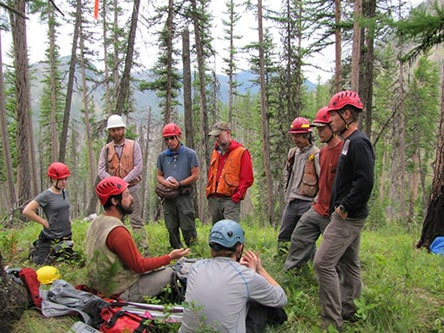
Dr. Andrew Larson (center, seated) is an Associate Professor of Forest Ecology at the University of Montana.

Last night Montana Senator Steve Daines, who hasn’t hosted an in-person town hall meeting in over 1,000 days hosted a ‘teletownhall’ to blame ‘radical environmentalists’ for wildfires.

Montana Public Radio News Director Eric Whitney sat in the studio and listened to Senator Daines’ phone call with University of Montana Forest Ecologist Dr. Andrew Larson.

You can listen to the interview here, and the transcript is below. Suffice to say, Dr. Larson took Senator Steve Daines to the woodshed and dumped cold water on his incendiary and childish “radical environmentalist” rhetoric.

P.S. For at least the past twenty years us ‘radical’ ‘fringe’ and ‘extremist’ environmentalists have been basically delivering the same message and points that Dr. Larson does in this excellent, in-depth Montana Public Radio interview. – mk

Last night Senator Steve Daines held what he calls a “tele-townhall,” one of the periodic conference calls he invites Montanans to join, in which he takes a few questions from callers. This one was also live streamed on his Facebook page. The topic was forest management and wildfires.

Senator Daines said Montanans are angry about the fires and smoke they’ve been enduring this summer, and placed the blame for the fires on, “Radical environmentalists, who are blocking projects to remove dead trees, even in some cases, trees, lodgepoles, that died from insect infestation,” Daines said. “We have radical environmental groups that do not represent the vast majority of Montanans, who believe in a balanced, common sense approach. They stop these projects.”

As he’s done before, Daines offered the Stonewall project outside Lincoln as an example of a logging project proposed by the U.S. Forest Service that could have reduced fire danger, had it not been stopped by a lawsuit. The Alliance for the Wild Rockies sued to stop the Stonewall, which was proposed for an area now being partially consumed by the 18,000-acre Park Creek Fire.

“The environmentalists are not responsible for that fire burning, and had the Stonewall project advanced, it’s very likely that the site would be burning today,” says Andrew Larson. He’s not an environmental activist. He’s an associate professor of forest ecology in the forestry college at the University of Montana.

“As an ecologist, as someone — I’m trained as a forester — I would expect and hope that that forest, that hypothetical treated forest, would burn. Because that’s what it needs to function, to be a healthy forest ecosystem. Montana forests are only going to function when they have fire in them. That’s a healthy forest,” Larson said.

I listened to Senator Daines’ conference call with Larson, who said he detected a change in the senator’s comments about wildfires. Daines has been saying that more logging would prevent forest fires. Last night he said more logging and forest management won’t entirely eliminate fire from the landscape, but will reduce risks from and severity of wildfires.

“I really was pleased to hear him say that. That’s, I think, a really important incorporation of some forest ecology, fire ecology knowledge into the types of things he’s saying,” Larson said.

“However, the entire conversation tonight on the tele-townhall mingled them, sometimes explicitly. More often there was the implication that, if we do more logging, more vegetation management, more thinning, we won’t have as many acres burned, and we won’t be breathing as much smoke; and that’s just absolutely not true,” Larson said.

“What we might be able to achieve with a more active vegetation management program are areas that don’t burn with as high a severity, we also might have safer working environments for fire managers.”

Larson acknowledged that it may seem counterintuitive that not removing vegetation from forests will have no impact the number of acres that burn in a given year, or the amount of smoke, but, “The total biomass that’s consumed might be less, but the only time you do not have enough fuel to carry a fire is going to be in the first year or two after a fire has burned,” he said.

“Even after you go and thin a forest, when it’s dry like it is now, it’s still going to carry a fire, it’s still going to generate smoke. So, in terms of day to day life, the experience we have during the fire season, we need to not get our hopes up,” Larson says. “You can anticipate more smoke. Even if we were to double, triple, increase the amount of area logged or thinned by a factor of ten or 20, we’re still going have smoke, we’re not going to stop the fires. We may change how they burn, and that’s an important outcome, it’s something that a lot of my research is directed at. But we need to make sure people don’t get their hopes up and expect something that the forestry profession, that managers in the Forest Service, the Department of Interior, can’t deliver on.”

A woman identified as Patricia from Ft. Benton, was one of the eight callers who were able to speak to Senator Daines last night. She asked about trees killed by pine beetles.

“And I was troubled, because I couldn’t understand why those trees were remaining, because they are a fire hazard, they are dead trees, so there is no reason for them to remain.”

Daines agreed, and said only, “radical environmentalists” would try to stop efforts to remove dead trees from Montana forests.

“That’s an attitude that I’m always kind of disappointed to encounter,” Larson said, “because a healthy forest has dead trees and dead wood. The snags — standing dead trees — and dead logs are some of the most important habitat features for biodiversity. You can’t have an intact, healthy wildlife community without dead wood in your forest.”

One of the lines Senator Daines often uses when talking about public lands management is, “a managed forest is a healthy forest.”

“One of the problems is, ‘healthy’ doesn’t have a scientific definition,” Larson said, “so, when we come at it from a technical perspective, it can mean whatever we want it to mean. Some of the most intensively managed forests in the world are in Northern Europe, and they are in a biodiversity crisis, because they have mismanaged their dead wood. They never let their trees get old, they never let ’em die. They cut ’em down and take them to the mill, and there is a horrible deficit of dead wood in those forests. And as a consequence, they’re compromised, they’re not functioning, they’re not providing the habitat for all the native biodiversity, the native wildlife species.

I asked Professor Larson what he thinks is important for Montanans who listened to Senator Daines’ conference call to keep in mind.

“My main points are, climate and weather drive fire. Healthy forests have to have dead trees in them. That’s not saying that we can’t cut some of the dead trees down. But you can’t have a functional forest without dead trees, they’re incredibly important for habitat,” Larson said.

“And the forestry profession, we need to be careful to not promise things that we can’t deliver,” he said. “And we’re never going to stop fire. We can help society live with fire, but that’s going to be a big team effort. We have to change our expectations. We need to expect that fire to come at some point, and not be surprised. We need to be planning for it — individual land owners, home owners — because that’s the environment we live in.”

The Science of Fighting Wildfires Gets a Satellite Boost

This piece, “The Science of Fighting Wildfires Gets a Satellite Boost” from Megan Molteni in Wired is certainly worth a read.

While the news media in Montana seems entirely intent on just letting Montana’s politicians – especially from the GOP – engaged in childish name calling like calling Montana citizens who are environmentalists ‘extremists’ ‘fringe’ or ‘radicals’ (thereby inciting hatred, and maybe even potential violence against environmentalists in Montana)….

Numerous national media outlets (here and here, for example) seem to have no problem picking up the phone and contacting actual, real-life Montana scientists and researchers who actually do things like study wildfires. Crazy, right?

This part of the Wired article caught my eye (emphasis added):

Here’s the straightforward logic of Zinke’s scapegoating: Environmentalists block the Forest Service from lowering the fuel load on the land, land catches on fire, and now it’s harder to put out. Thanks, tree-huggers.

But fire scientists say it’s more complicated than that. Many question the ecological (and economic) value of thinning forests out, for three big reasons. One, the evidence for its efficacy is both scant and at times contradictory. Two, probabilistic risk assessments show that the thinning doesn’t really help much because the likelihood of a fire starting close enough to interact with thinned areas is negligibly small. And three, in the worst weather conditions — dry, hot, and most importantly, windy — no amount of thinning or selective logging is going to make much difference.

[Geez, where have we heard these points before… – mk]

A case in point: that Park Creek fire burning outside of Lincoln. It started on a remote slope that wasn’t slated for any prescribed burns or dead tree removals. But such treatments wouldn’t have made much difference anyway, according to Carl Seielstad, a fire ecologist at the National Center for Landscape Fire Analysis at the University of Montana, because the closest road is more than mile away, at the bottom of a slope.

If you know anything about fire behavior, you know it moves much faster uphill. And in this case there wasn’t much in that direction, except more trees. “Without any roads in this area there was nothing for firefighters to anchor to,” says Seielstad, pointing at a 3D rendering of the fire’s path he’s pulled up on his computer. “It’s fair to say that regardless of treatment, this area would probably have been impossible to contain.”

Well, as careful readers of this blog will recall, Montana’s Republican politicians including Secretary Ryan Zinke, Senator Steve Daines, Rep Greg “Gonna Body Slam Ya” Gianforte and even Sec of Ag Sonny Perdue all pointed to the Park Creek Fire in an effort to blame ‘fringe’ ‘radical’ ‘extremists’ environmentalists for wildfires throughout Montana. And of course the Montana timber industry had to jump on that blame the environmentalists bandwagon too.

Over the past 22 years, as I went from a seasonal wildland firefighter to a year-round forest and public lands activist, I’ve come to realize that one of the first things torched during wildfire season is the truth.

Hopefully more national news outlets continue to reach out to actual scientists and researchers in Montana to get their side of the story. Maybe someday soon more media outlets in Montana will be able to locate the wildfire scientists, researchers and experts literally living right under their noses, or maybe even right next door.

Fire ecologist explains why this summer’s wildfires are so dramatic, and why the West will have to learn to live with a more severe burning season

This interview with Dr. Philip Higuera, a professor of fire ecology at the University of Montana, is excellent. It was conducted by Joe Eaton, who teaches at the University of Montana School of Journalism. Unfortunately, this piece didn’t appear in any Montana media outlets, but rather was printed in CityLab, which is run by The Atlantic.

Imagine how different the discussion and debate about wildfires, public lands management and logging would be if experts and facts like this were part of the discussion. Well, in defense of the environmental movement, we’ve been bringing up many of these same points and facts both this year, and in many wildfire seasons over the past few decades. – mk

The West Is on Fire. Get Used to It.

A fire ecologist explains why this summer’s wildfires are so dramatic, and why the West will have to learn to live with a more severe burning season.

By JOE EATON SEP 11, 2017

The West is burning, and there’s no relief in sight. More than 80 large wildfires are raging in an area covering more than 1.4 million acres, primarily in California, Montana, and Oregon, according to the National Interagency Fire Center. Taken together, that’s a wildfire larger than the state of Delaware.

California has declared a state of emergency as wildfires burn outside Los Angeles and threaten giant sequoias in Yosemite National Park. In Oregon, the Eagle Creek fire is tearing through the scenic Columbia River Gorge. Seattle, Boise, and Denver are socked in under a haze of smoky air and ash that experts predict could linger until the first snowfall in the mountains.

But nowhere are the fires more devastating than in Montana, where more than 1 million acres of forest burned this summer, and more than 467,000 acres are currently burning in 26 large fires that line the mountainous western side of the state.

Philip Higuera, a professor of fire ecology at the University of Montana, is used to seeing smoky air from his office window in September, but nothing like the thick smoke filling Missoula Valley right now. He recently spoke to CityLab about the fires raging across the West, what we can do about them, and why this year’s big burn might be the new normal.

Breathing the air in Missoula today feels like chain-smoking Chesterfields. Schools aren’t letting the kids out at recess, and public health authorities are saying active adults and children should avoid outdoor exertion. It’s easy to get the impression that this is an extraordinary and unprecedented fire season. But you study forest fires over a timespan of thousands of years. How unusual or unique is this fire season?

It’s not—even in the context of the 21st century. In the Northern Rockies, we had a very large fire year in 2012, in 2007, in 2000, and to an extent in 2003. In this region, 1910 remains the record-setting fire season. If we surpass that, I would be surprised. Events like these are not common on a year-to-year scale. On the other hand, when you look at the role fire plays in ecosystems, you have to look at a longer timescale, and these rare events are what’s expected every once in a while.

Why is this fire season so dramatic?

The main reason there is so much burning right now is the strong seasonal drought across the region. The term we use is that these fires are “climate enabled.” The drought makes most of the vegetation, live or dead, receptive to burning. In Missoula, we had the driest July and August on record and the third-warmest July and August. With those types of conditions, we expect widespread burning. But people underestimate the role that seasonal climate plays in these events, and we start to grasp at lots of other things to explain it.

Aside from the bad air, are most urban residents in fire-affected parts of the West safe?

Aside from that really important impact, I give a cautious yes. There is a risk. And that risk is highest in the wildland-urban interface. If you are living there, you should know that you are living with a much higher risk for exposure to wildfire. And part of the job of educators and U.S. Forest Service outreach is to make that risk known. Eventually insurance companies will also get on board. Floods are obviously on insurance companies’ radar front and center. Wildfire is still not frequent enough that they design programs around it.

Should people in the fire-prone West be living in places like that—in the suburbs and exurbs out in the forested edges of urban areas?

Every place on our planet has some natural phenomenon that is not friendly to humans. If you live on the East Coast, you are going to experience hurricanes. If you live in the Midwest, you are going to experience tornadoes. If you live across forested regions in the West, you are going to experience wildfires. We need to develop in a way that is cognizant of these processes—that is not ignorant of the way the planet, and the environment you live in, works.

Why are these fires so hard to put out?

This goes back to why the fires are happening. The fuels are extremely dry. And most areas burn during extreme weather conditions—the days when it’s hot, humidity is low and there are high winds. These are the conditions in which fires quickly double in size. They are also the conditions where it’s most dangerous to put people in front of the fire. Also, a lot of these fires start in very remote areas with rugged terrain, and just putting people on the ground comes with some risk.

Montana alone has already spent tens of millions of dollars trying to suppress wildfires this summer, and two firefighters have been killed. Is that having any impact, or is it like driving down the expressway throwing bags of money out the window?

When you say it’s not working, the key question is, What’s the goal? “It’s not working” assumes the goal is to have no fires. We will fail if that is the goal. Most of these ecosystems that are burning have evolved with fire. We expect them to burn. We need them to burn if we want them to continue to exist.

So it’s like trying to stop rain?

It’s like trying to stop an earthquake. Trying to stop a volcano. To me, the goal can’t be to have no fire. That’s gotten us into trouble when we pursued that goal. I think the metric should be how much area has burned that we wanted to burn compared to how much burned that we didn’t want to burn. Or closer to the nugget, how many resources were harmed—how many houses were lost, how many people were either directly or indirectly killed?

You don’t see raging forest fires as a failure of suppression efforts?

No. Knowing how climate enables and drives these large fires, I think that it would be impossible to put these fires out.

There is a school of thought that says we should not suppress wildfire because it allows smaller trees and underbrush to accumulate, which leads to larger, hotter fires later. So why not just let it burn?

I think as soon as you live in these environments you will quickly abandon that too-simplistic view. Maybe when I was a graduate student living in Seattle that seemed more like a possibility, but you can’t just let it burn. That would not be wise. It really comes down to what you can afford to burn and what do you want to protect. If the fire is in the wilderness, that’s great. If it’s burning toward a community, that’s not so good.

There’s good fire and bad fire?

There is a spectrum. On one end of the spectrum would be the wilderness fire that is not going to impact anyone—good fire. The fire that burns down your house or kills people—bad fire.

Another school of thought says we should allow more logging to clear trees and help prevent wildfires. Does that hold water?

I don’t think that holds water. That is based on the assumption that fires are occurring because there is more fuel available to burn than in the past. That’s generally not what’s driving this. It’s the drought. It’s true that if cut, there is less fuel in the forests. But in a lot of cases, there is what’s called slash—woody debris—left on the ground that will carry fire across the forest floor, which is what you need for it to spread.

The simple answer—if you want to eliminate fire, then pave it. There will be no fire.

Is climate change partly to blame for this year’s fires? Are wildfires in the West set to get worse because of it?

That’s what future climate models project. We can’t say this individual fire was because of climate change. We can’t say this year was because of climate change. But these types of years are what we expect to see more frequently. I heard an analogy that I think is useful. If a baseball player is using steroids and hits a home run, can you attribute that home run to steroids? You can’t—but you know that at some point some component of that was brought to you by this artificial input to the system.

There was a study that came out last year, which looked at fire occurrence in the Western United States over the last 40 years using climate modeling. The conclusion was almost half of burning we have seen over the past several decades can be attributed to climate change due to anthropogenic sources. The fire season has gotten significantly longer across the West, on order of 30 days or more during the past few decades.

What are you and your family doing to live through the fire season?

Personally, I made the decision to not live in the wildland-urban interface. I live in the urban part of Missoula. We had one HEPA air filter. Last week we ordered two more. That’s our adaptation.

Wild Virginia Calls for Investigation of Forest Service on Draft Pipeline Decision

For whatever reason the focus on this blog is often westward-leaning and forest-focused. I received this press release from the folks at Wild Virginia regarding a potential pipeline through the George Washington National Forest and the Monongahela National Forest, so thought I’d post it below. – mk

Wild Virginia Files Objection and Calls for Investigation of United States Forest Service on Draft Pipeline Decision

Wild Virginia, a state-wide forest conservation group, filed a formal objection today against the United States Forest Service (USFS). This was in opposition of the draft Record of Decision (ROD) that could allow the Atlantic Coast Pipeline (ACP) to be built in the George Washington National Forest (GWNF) in Virginia and in the Monongahela National Forest (MNF) in West Virginia. Joining Wild Virginia in the objection are Heartwood, the Dominion Pipeline Monitoring Coalition and various individuals.

“By filing this formal objection to the United States Forest Service Record of Decision, Wild Virginia is doing what the Forest Service has refused to do; defend the ecological integrity of our public lands,” said Misty Boos, Wild Virginia Director.

The draft ROD proposes to allow numerous exceptions to the Land and Resource Management Plans for both national forests that could allow the ACP to cross the GWNF. The current GWNF Plan, which took 7 years to complete and had input from over 10 thousand individuals and groups, was finalized in 2014, the same year that Dominion Resources and Duke Energy rolled out plans for the ACP. Neither company participated in the planning process or offered any input to forest planners, knowing full well that their planning for the ACP, then named the “Southeast Reliability Project” were in the works.

“It is criminal that the Forest Service would bless Dominion’s proposed plans for the ACP when this should have been part of the forest planning process ten years ago,” said Ernie Reed, President of Wild Virginia and Heartwood Council member. “The Forest Service has disregarded 7 years of work and thumbed its nose at the entire forest plan to pave the way for the most damaging proposal that Virginia’s forests have ever seen.”

The ROD stands in striking opposition to virtually all the input that the USFS had submitted on environmental impacts on the forest from the proposed pipeline up to the point that the draft ROD was signed. The USFS has been perhaps the most vocal critic of the process, the content and the conclusions that Dominion has submitted to the Federal Energy Regulatory Commission as the basis for its Final Environmental Impact Statement which is a regulatory requirement for all federal projects of this nature. The Draft Record of Decision was signed July 21 by Tony Tooke, then Southern Forester in Atlanta. Virtually all of the previous submissions and comments by the USFS on the project were generated at the local level by GWNF and MNF staff.

Subsequently, one month after signing the ROD, Tooke was appointed as Chief of the United States Forest Service by Sonny Perdue, the Secretary of Agriculture.

“For whatever reason, the Forest Service has suddenly dropped its formerly responsible approach to project review and is now proposing to authorize construction of the destructive ACP across the National Forest prior to receipt of detailed and site-specific plans,” said Rick Webb of the Dominion Pipeline Monitoring Coalition. “The Forest Service has seemingly adopted the same deferred-analysis model of environmental review as the other dysfunctional federal and state agencies. It’s bad news for the remaining wild landscape in the central Appalachian mountain region.”

“The stark contrast of Forest Service filings before the draft Record of Decision demonstrates a breech in agency procedure which should be scrutinized by senate and congressional committees,” said David Sligh, Wild Virginia Conservation Director. “We are making this request for an investigation today to Virginia’s senatorial and congressional delegation.”

“It becomes the responsibility of citizens to hold the USFS accountable for its actions,” Boos asserted. “Wild Virginia is taking this action on their behalf.”

Link to Wild Virginia’s Objection to the USFS

Analysis: Sportsmen’s Heritage and Recreational Enhancement (SHARE) Act Guts the Wilderness Act

Here’s a press release from Wilderness Watch, which includes a detailed analysis of the so-called “Sportsmen’s Heritage and Recreational Enhancement (SHARE) Act of 2017” – mk

MISSOULA, MT – A new analysis by Wilderness Watch calls the discussion draft of the “Sportsmen’s Heritage and Recreational Enhancement (SHARE) Act of 2017” nothing more than a thinly disguised measure to gut the 1964 Wilderness Act and the protections afforded to every unit of America’s 110 million-acre National Wilderness Preservation System.

The analysis corresponds with a leaked memo McClatchy obtained and reported on last week that found the Trump Administration has so far prevented the National Park Service from voicing its serious concerns over the National Rifle Association (NRA)-backed SHARE Act. When the Park Service shared such concerns in a memo to the Department of Interior (DOI), the DOI responded by crossing out the Park Service’s comments, and the agency was told not to go to Congress.

The SHARE Act would give hunting, fishing, recreational shooting, and state fish and wildlife agency goals top priority in Wilderness, rather than protecting the areas’ wilderness character, as has been the case for over 50 years.

The SHARE Act would allow endless, extensive habitat manipulations in Wilderness under the guise of “wildlife conservation” and for providing hunting, fishing, and recreational shooting experiences. The Act would also allow the construction of “temporary” roads in protected Wilderness areas to facilitate such uses and would allow the construction of dams, buildings, or other structures within Wildernesses.

“Taken in combination, the provisions in the SHARE Act would completely undermine the protections that wilderness designation should provide, and dramatically weaken wilderness conservation for the entire 110 million-acre National Wilderness Preservation System. These wilderness provisions in the SHARE Act must not be enacted into law,” explained Kevin Proescholdt, Conservation Director for Wilderness Watch.

The discussion draft of the SHARE Act was scheduled for a legislative hearing on June 14, 2017, but was canceled due to a shooting before the Congressional softball game.

The SHARE Act would also exempt road, dam, and building projects within protected Wilderness areas from the National Environmental Policy Act (NEPA) — eliminating critical environmental analysis of potential impacts and alternatives, and public comment and involvement.

“Sadly, the SHARE Act would eviscerate the letter, spirit, and fundamental ideals expressed in the Wilderness Act,” said Wilderness Watch Executive Director George Nickas. “While the Wilderness Act prohibits the use of motorized vehicles or equipment and the building of roads and other structures, the SHARE Act essentially throws Wilderness areas wide open to motorized use by agency managers and a nearly unlimited variety of wilderness-damaging manipulations and developments. Make no mistake— Wilderness as we know it will cease to exist if the SHARE Act becomes law.”

Wilderness Watch is America’s leading organization dedicated to defending and keeping wild the nation’s 110 million-acre National Wilderness Preservation System. Its work is guided by the visionary 1964 Wilderness Act.

Trump administration falsely blames lawsuits for forest fires

The following guest column appeared in the Missoulian today, and was written by Mike Garrity with the Alliance for the Wild Rockies.

It is clear that the Trump administration is leading on one thing: making stuff up. Ryan Zinke, Sonny Perdue, Steve Daines and Greg Gianforte followed Donald Trump’s lead in using alternative facts in their recent press conference near the Lolo Peak Fire. The Trump administration apparently believes that it is because of lawsuits that we have forest fires during this exceptionally hot, dry and windy summer.

The Alliance for the Wild Rockies is a powerful group and we fight hard to preserve forests, but we certainly don’t control the weather or the warming climate. Moreover, there is no lawsuit in the Lolo Peak area, and the Lolo Peak area has already undergone extensive logging.

In the Trump administration’s alternative reality, climate change has nothing to do with forest fires because, as Trump has pronounced, “global warming is a Chinese hoax.” The 2014 National Climate Assessment estimates wildfires in Montana will increase by 400 percent to 700 percent in the next 50 years if climate change is not addressed.

Protecting old growth forests from logging is one way to do this. National forests absorb an astounding 10 percent of the carbon that America creates and unlogged and old growth forests absorb the most.

The politicians at the Lolo Peak Fire press conference could do something about the main driver of wildfire — they could commit to addressing climate change – starting with participation in the Paris Climate Accord. But instead they promote more coal burning and taxpayer-subsidized logging on public lands, which will only exacerbate climate change.

The Trump administration has even complained that our lawsuit temporarily pausing the Stonewall timber sale resulted in the wildfire burning in the northern part of the Stonewall project area. Not surprisingly, their argument is not supported by facts. That wildfire started with a lighting strike outside of the planned treatment units, so the fire would have started regardless of whether the project units were logged. Indeed, natural wildfires regularly burn in this area, as evidenced by the fact that the Park Creek fire is now surrounded on three sides by formerly burned areas, which have mostly stopped the spread of this fire. Significantly, it also does not appear that any of the timber sale’s commercial logging units have burned.

These fact-challenged politicians also claimed that we have shut down half the timber sales in Montana, a contention that even the U.S. Forest Service denied. Instead, our region of the Forest Service has met 89 percent of its timber logging targets over the last 15 years and the target has been increasing almost every year. 2017 is not over yet, but a February Great Falls Tribune article titled “Logging in Helena-Lewis and Clark National Forest best in decades” reported that loggers had never seen this much timber available.

These politicians also neglected to mention that the state’s largest wildfire — 270,000 acres that destroyed 16 homes in eastern Montana — burned mostly through grasslands, not forests, which is probably why they held their pro-logging press conference in front of Lolo Peak rather than in eastern Montana.

The Trump administration calls it “frivolous” when citizens prevail in lawsuits forcing the government to comply with its own laws. To the contrary, it is the basis of our democracy and civil justice system that citizens have the power to force the government to follow its own laws. So despite the barrage of lies, insults, fear-mongering and scapegoating directed at us, we will not back down. We will continue to fight to protect and conserve our priceless public lands and the fish and wildlife that depend on them for survival. Join us.

Court rules in favor of AWR’s effort to save Cabinet-Yaak Grizzly Bears from extinction

Some people on this blog “don’t think AWR is an objective source of info.” Apparently, Dana L. Christensen, Chief Judge of the Federal District Court in Missoula, thinks otherwise, at least in this case.

Yesterday, Chief Judge Christensen ruled in favor of the Alliance for the Wild Rockies in its lawsuit challenging the federal government’s refusal to provide enhanced protections for imperiled Cabinet-Yaak grizzly bears in northwest Montana.

The Court agreed with the Alliance and vacated the newly-issued “not warranted” status, reinstated the 2013 “warranted but precluded” status, and remanded the issue back to the U.S. Fish and Wildlife Service.

Here’s some more background information from the Alliance for the Wild Rockies:

After being reduced to only two percent of their historic range, grizzly bears in the Lower 48 states were listed as “threatened” under the Endangered Species Act in 1975, sparking efforts to recover the species, which have had positive outcomes in some areas. However, in the Cabinet-Yaak ecosystem in northwest Montana, which is isolated from other grizzly bear populations, grizzlies continue to teeter on extinction primarily due to human-caused bear fatalities, habitat destruction, and motorized intrusion into core grizzly areas. There are fewer than 50 bears in this area; mortality rates are high; and the population chronically fails all recovery goals.

Since the early 1990’s, the U.S. Fish & Wildlife Service has admitted every year that this small grizzly population should be upgraded to ‘endangered’ status,” explained Mike Garrity, Executive Director of the Alliance for the Wild Rockies. “But for almost a quarter of a century the agency has used administrative loopholes to avoid making that formal designation, which would require the agency to delineate federally-protected ‘critical habitat’ that is essential to the recovery of these grizzlies

In 2014, conservationists filed suit to challenge the agency’s 20-year delay listing this population as an endangered species, and in response, the agency abruptly changed course to issue a determination that the upgrade to “endangered” status is no longer warranted for this imperiled population. “The agency’s cursory one-paragraph decision that the Cabinet-Yaak grizzly bear no longer qualifies as ‘endangered’ fails to cite a single scientific paper or other source of evidence to support its rationale,” Garrity said. “But in sharp contrast to its public statements, internal agency documents obtained through a Freedom of Information Act request by the Alliance found that the agency had no intention to issue a ‘not warranted’ decision and, in fact, found the isolated and small population and excessive human-caused mortalities warranted uplisting to ‘endangered’ status. Once we filed our first lawsuit, however, the agency issued the ‘not warranted’ determination as a strategy to render our first lawsuit as moot.”

After the first lawsuit was subsequently dismissed as moot due to the agency’s strategic and manipulative decision to issue a “not warranted” finding, Alliance filed a second lawsuit that argued that the “not warranted” finding itself was arbitrary and capricious. Yesterday, the federal court agreed, finding that it was arbitrary for the agency to apply a new policy redefining “endangered” at the eleventh hour. Because the agency’s decision relied on the new policy without sufficient explanation, its decision was arbitrary and unlawful and was vacated by the court.

“The facts present a stark picture,” Garrity explained. “Since 2007, the agency’s estimate for this population has dropped from 47 to 41 bears. For the bears native to the Cabinet Mountains, the population estimate has dropped from 15 to 5 bears – with the other bears being transplants. Added to that is the fact that the total mortality rate for the bears has tripled from 0.9 per year from 1982-1998 to 3.1 per year in the period 1999-2014.”

Garrity pointed to the agency’s monitoring report published in January 2015 which found: “The two periods (1983-1998 and 1999-2013) correspond to a decline in long term population trends beginning in 1999. Grizzly bear survival of all sex and age classes decreased from 1999-2013.” Garrity noted that “the population also consistently fails all agency targets for recovery. Grizzly bears fared no better in 2015, with at least six reported mortalities, including a mortality of a female, radio-collared bear in the Cabinet Mountains.”

“”It has been 24 years since the Fish and Wildlife Service first decided that this this small grizzly population should be upgraded to ‘endangered’ status, including over 20 years under a federal recovery plan. But the population of Cabinet-Yaak grizzly bears is simply not recovering,” Garrity said. “Instead, mortalities are increasing and we believe the population is actually dropping. That’s why we had no choice but to file our recent lawsuit seeking to force the uplisting of the Cabinet-Yaak grizzlies to ‘endangered’ status, which would ultimately allow the bears to obtain the “critical habitat” designation that “endangered” status requires.

“Since the court just struck down this latest excuse to not list them as ‘endangered’ the Fish and Wildlife Service should do its job, list the Cabinet Yaak grizzlies as ‘endangered,’ and designate critical habitat so that the population will finally recovery,” Garrity concluded. “Until the agency takes those vitally necessary actions the Alliance for the Wild Rockies will continue to fight in both the courts and the public arena to recover the Cabinet-Yaak grizzlies.”

Please find the court order attached.

Wild bees thrive after severe forest fires


In case you haven’t heard, wild bees around the world aren’t doing that great. If you like to eat food, or enjoy having trees and other plants in your world, that’s a big cause for concern.

But, it turns out, according to this article from PHYS.org, that wild bees thrive after moderate and severe wildfires:

“Early results from a two-year study in southern Oregon suggest that moderate and severe forest fires create conditions that lead to greater abundance and diversity of wild bees. Because Oregon’s more than 500 species of native bees are important pollinators of wild plants and crops, the study suggests that fires may promote bee populations that in turn may influence agricultural productivity and overall floral diversity.”

In 2016, scientists began trapping bees at 43 sites in forests burned by the 2013 Douglas Complex fire north of Grants Pass. The sites ranged from places where fire severity was low—flames were confined to low-growing vegetation and failed to reach the canopy—to places where severity was moderate and high.

“In low severity spots, if you weren’t looking for the markers of fire, you wouldn’t know that it had burned,” said Sara M. Galbraith, a post-doctoral researcher in the College of Forestry at Oregon State University. “The canopy is completely closed, and the trees are usually older. There isn’t a lot of evidence of fire except for some blackened areas on some of the tree trunks.

“And then, when you go to some of the high-severity fire sites, it’s a completely open canopy. There are a lot of flowering plants in the understory because the light limitation is gone. It just looks completely different,” she added.

In a study led by Jim Rivers, OSU forest wildlife ecologist, Galbraith and a team of field researchers collected bees with blue-vane traps, which attract the insects by reflecting ultra-violet light. “The bees basically think it’s a huge flower,” said Galbraith. “Once they get inside the trap, they are unable to fly out because of the shape of the entrance.”

In addition, researchers recorded the characteristics of each site, such as the types of plants, the degree of forest cover and whether or not logging had taken place after the fire.

Such studies are important, Galbraith said, because the early stages of forest development – what researchers call early seral forests—have become less common. “This research adds to the evidence that there is high biodiversity in early seral forests relative to older stands, and moving forward, this could have an impact on services like pollination in the landscape overall. Without this fundamental information, we can’t be sure of the best management actions to conserve pollinator populations within managed forests.”

Live Debate: Can Logging Forests for Biomass Prevent Wildfire?

Join The Biomass Monitor on Wednesday, August 16 at 8 PM Eastern (5 PM Pacific) as they host a debate between Dr. Chad Hanson, Director and Principal Ecologist for the John Muir Project and Marcus Kauffman, Biomass Resource Specialist for the Oregon Department of Forestry, over the effectiveness of cutting trees in backcountry forests to limit the spread and intensity of wildfire.

RSVP and email [email protected] for the call-in number and code to listen in and participate in Q&A.