Dr. Michael Soule: The “New Conservation”

Conservation Biology, October 2013
Volume 27, No. 5, 895-897
(c) 2013 Society for Conservation Biology
DOI: 10.1111/cobi.12147

Editorial: The “New Conservation”
By Dr. Michael Soule

A powerful but chimeric movement is rapidly gaining recognition and supporters. Christened the “new conservation,” it promotes economic development, poverty alleviation, and corporate partnerships as surrogates or substitutes for endangered species listings, protected areas, and other mainstream conservation tools. Its proponents claim that helping economically disadvantaged people to achieve a higher standard of living will kindle their sympathy and affection for nature. Because its goal is to supplant the biological diversity-based model of traditional conservation with something entirely different, namely an economic growth-based or humanitarian movement, it does not deserve to be labeled conservation.

Institutional allies and supporters of the new conservation include the Gordon and Betty Moore Foundation, the Long Now Foundation, the Nature Conservancy, and the social-justice organization The Breakthrough Institute (Nordaus & Shellenberger 2011). The latter write – in the style of the Enlightenment – that, “We must open our eyes to the joy and excitement experienced by the newly prosperous and increasingly free [persons]. We must create a world where every human can not only realize her material needs, but also her higher needs.”

The manifesto of the new conservation movement is “Conservation in the Anthropocene: Beyond Solitude and Fragility” (Lalasz et al. 2011; see also Kareiva 2012). In the latter document, the authors assert that the mission of conservation ought to be primarily humanitarian, not nature (or biological diversity) protection: “Instead of pursuing the protection of biodiversity for biodiversity’s sake, a new conservation should seek to enhance those natural systems that benefit the widest number of people, especially the poor” ). In light of its humanitarian agenda and in conformity with Foreman’s (2012) distinction between environmentalism (a movement that historically aims to improve human well-being, mostly by reducing air and water pollution and ensuring food safety) and conservation, both the terms new and conservation are inappropriate.

Proponents declare that their new conservation will measure its achievement in large part by its relevance to people, including city dwellers. Underlying this radically humanitarian vision is the belief that nature protection for its own sake is a dysfunctional, antihuman anachronism. To emphasize its radical departure from conservation, the characters of older conservation icons, such as Henry David Thoreau, John Muir, and Edward Abbey, are de-famed as hypocrites and misanthropes and contemporary conservation leaders and writers are ignored entirely (Lalasz et al. 2011).

The new conservationists assume biological diversity conservation is out of touch with the economic realities of ordinary people, even though this is manifestly false. Since its inception, the Society for Conservation Biology has included scores of progressive social scientists among its editors and authors (see also letters in BioScience, April 2012, volume 63, number 4: 242-243). The new conservationists also assert that national parks and protected areas serve only the elite, but a poll conducted by the nonpartisan National Parks Conservation Association and the National Park Hospitality Association estimates that 95% of voters in America want continued government support for parks (National Parks Conservation Association 2012). Furthermore, Lalasz et al. (2011) argue that it should be a goal of conservation to spur economic growth in habitat-eradicating sectors, such as forestry, fossil-fuel exploration and extraction, and agriculture.

The key assertion of the new conservation is that affection for nature will grow in step with income growth. The problem is that evidence for this theory is lacking. In fact, the evidence points in the opposite direction, in part because increasing incomes affect growth in per capita ecological footprint (Soule 1995; Oates 1999).

Other nettlesome issues are ignored, including which kinds of species will persist and which will not if the new economic-growth agenda replaces long-term protection in secure protected areas?

Related questions include:

Would the creation of designated wilderness areas be terminated? Would the funds to support the new conservation projects be skimmed from the dwindling conservation budgets of nongovernmental and government agencies? Is conservation destined to become a zero-sum game, pitting the lifestyles and prosperity of human beings against the millions of other life forms? Is it ethical to convert the shrinking remnants of wild nature into farms and gardens beautified with non-native species, following the prescription of writer Marris (2011)? Will these garden-like reserves designed to benefit human communities admit inconvenient, bellicose beasts such as lions, elephants, bears, jaguars, wolves, crocodiles, and sharks-the keystone species that maintain much of the wild’s biological diversity (Terborgh & Estes 2010; Estes et al. 2011)?

The new conservationists assume the benefits of economic development will trickle down and protect biological diversity. Even if that assumption were borne out, I doubt that children growing up in such a garden world will be attuned to nature or that the hoped-for leap in humanity’s love for the wild will occur once per capita consumption reaches a particular threshold.

Most shocking is the dismissal by the new conservationists of current ecological knowledge. The best current research is solidly supportive of the connection between species diversity and the stability of ecosystems. It has firmly established that species richness and genetic diversity enhance many ecological qualities, including productivity and stability of terrestrial and marine ecosystems, resistance to invasion by weedy species, and agricultural productivity; furthermore, research shows that greater species and genetic diversity reduces transmission rates of disease among species (Tilman 2012).

In contrast, implementation of the new conservation would inevitably exclude the keystone species whose behaviors stabilize and regulate ecological processes and enhance ecological resistance to disturbance, including climate change (Terborgh & Estes 2010). For these reasons and others, conservationists and citizens alike ought to be alarmed by a scheme that replaces wild places and national parks with domesticated landscapes containing only nonthreatening, convenient plants and animals.

The globalization of intensive economic activity has ac- celerated the frenzied rush for energy and raw materials and is devouring the last remnants of the wild, largely to serve the expanding, affluent, consumer classes in industrialized and developing nations. At current rates of deforestation, dam construction, extraction of fossil fuels, land clearing, water withdrawal, and anthropogenic climate change, it is expected that the 2 major refugia for biological diversity on the globe–the wet, tropical forests of the Amazon, and Congo Basin– will be gone by the end of this century (Mackey et al. 2013).

Is the sacrifice of so much natural productivity, beauty, and diversity prudent, even if some human communities and companies might be enriched? No. The worth of nature is beyond question and our obligation to minimize its gratuitous degradation is no less.

There is no evidence for the proposition that people are kinder to nature when they are more affluent, if only because their ecological footprints increase roughly in proportion to their consumption. We also know that the richer nations may protect local forests and other natural systems, but they do so at the expense of those ecosystems elsewhere in less affluent places. A third thing we know is that anthropogenic climate change is probably the greatest threat to civilization (Gleick et al. 2010).

I must conclude that the new conservation, if implemented, would hasten ecological collapse globally, eradicating thousands of kinds of plants and animals and causing inestimable harm to humankind in the long run.

Finally, I believe that those who donate to conservation organizations do so in full confidence that their gifts will benefit wild creatures and their habitats. The central issue is whether monies donated to the Nature Conservancy and other conservation nonprofit organizations should be spent for nature protection or should be diverted to humanitarian, economic-development projects such as those proffered by the new conservation on the dubious theory that such expenditures may indirectly benefit biological diversity in the long run.

Traditional conservationists do not demand that humanitarians stop helping the poor and underprivileged, but the humanitarian-driven new conservationists demand that nature not be protected for its own sake but that it be protected only if it materially benefits human beings.

A more literary version of this essay that highlights the intrinsic value of biological diversity can be accessed at www.michaelsoule.com.

Literature Cited
Estes, J. A., et al. 2011. Trophic downgrading of plant earth. Science 333:301-306.

Foreman, D. 2012. Take back conservation. Raven’s Eye Press, Durango, Colorado.

Gleick, P. H., et al. 2010. Climate change and the integrity of science. Science 328:689-690.

Kareiva, P. 2012. Failed metaphors and a new environmental- ism for the 21st century. Available from http://www.youtube. com/watch?v=4BOEQkvCook (accessed April 2013).

Lalasz, R., P. Kareiva, and M. Marvier. 2011. Conservation in the an- thropocene: beyond solitude and fragility. Breakthrough Journal 2: http://thebreakthrough.org/index.php/journal/past-issues/issue-2/ conservation-in-the-anthropocene/.

Mackey, B., I. C. Prentice, W. Steffen, J. I. House, D. Lindenmayer, H. Keith, and S. Berry. 2013. Untangling the confusion around land carbon science and climate change mitigation policy. Nature Climate Change 3:552-557.

Marris, E. 2011. Rambunctious garden. Bloomsbury, New York. National Parks Conservation Association. 2012. New poll of likely voters finds unity in public support for national parks. National Parks Conservation Association, Washington, D.C. Available from http://
www.npca.org/news/media-center/press-releases/2012/poll_ parks_support_080712.html (accessed June 2013).

Nordaus, T., and M. Shellenberger. 2011. From the editors. Break- through Journal 2:7-9.

Oates, J. F. 1999. Myth and reality in the rainforest: how conservation strategies are failing in West Africa. University of California Press, Berkeley, California.

Soule _, M. E. 1995. The social siege of nature. Pages 137-170 in M. E. Soule _ and G. Lease, editors. Reinventing nature? Response to postmodern deconstruction. Island Press, Washington,D.C.

Terborgh, J., and J. A. Estes. 2010. Trophic cascades: predators, prey and the changing dynamics of nature. Island Press, Washington,D.C.

Tilman, D. 2012. Biodiversity & environmental sustainability amid human domination of global ecosystems. Daedalus 141:108-120.
Alliance for Wild Rockies threatened with gun violence

HELENA — A man angered by a recent lawsuit aimed at protecting a dwindling population of grizzly bears on Monday fired-off a threatening email to the group that filed it.

The emailer, who identified himself as Steven Connly of Eureka, wrote to the Alliance for the Wild Rockies’ general email address warning the group to “stay the hell out of our forests.”

“GET THE HELL OUT,” Connly wrote in the penultimate sentence before adding his first and last name to the note. “We in Lincoln county carry guns and would just love the chance to use them on worthless pieces of garbage such as yourself.”

The Tribune contacted Connly by email Tuesday, but he declined to be interviewed.

“Nothing to really to discuss,” Connly responded via email. “Stay the hell out of our business.”

Michael Garrity, executive director for the Helena-based environmental group, said he takes the threat seriously and reported it to the FBI.

Garrity said in the more than 15 years he has volunteered and worked for the Alliance he’s seen plenty of threatening or angry letters and emails. But none of the previous letters or emails explicitly used the threat of gun violence to intimidate, Garrity said.

“My concern is we’re filing a lawsuit, it’s our constitutional right to challenge a government decision, and this person thinks the appropriate response is to threaten me with a gun,” Garrity said. “Discourse has really sunk in this country when people think that’s appropriate. We’re exercising our constitutional rights and their response is to threaten us.”

Read the entire story from the Great Falls Tribune here.

Tongass Timber Sale Update: How an endemic species can halt a timber sale

Earlier in September, a press release from the Greater Southeast Alaska Conservation Community (GSACC) was shared with this blog. It opened with:

On August 16, GSACC and four other organizations filed an administrative appeal of the Tongass Forest Supervisor’s decision to proceed with the Big Thorne timber project. The appeal went to to the next highest level in the agency, Regional Forester Beth Pendleton. The appeal is known as Cascadia Wildlands et al. (2013), and other co-appellants are Greenpeace, Center for Biological Diversity and Tongass Conservation Society.

The project would log 148 million board feet of timber [enough to fill 29,600 log trucks], including over 6,000 acres of old-growth forest from heavily hammered Prince of Wales Island. 46 miles of new logging roads would be built and another 36 miles would be reconstructed.

Today, we get an update on the Big Thorne timber sale on the Tongass National Forest in Alaska in the form of this article, written by Dr. Natalie Dawson, one of GSACC’s board members.

Wolf

“When you spend much time on islands with naturalists you will tend to hear two words in particular an awful lot: ‘endemic’ and ‘exotic’. Three if you count ‘disaster’. An ‘endemic’ species of plant or animal is one that is native to an island or region and is found nowhere else at all.”
-From Last Chance to See by Douglas Adams, author of A Hitchhiker’s Guide to the Galaxy

by Natalie Dawson

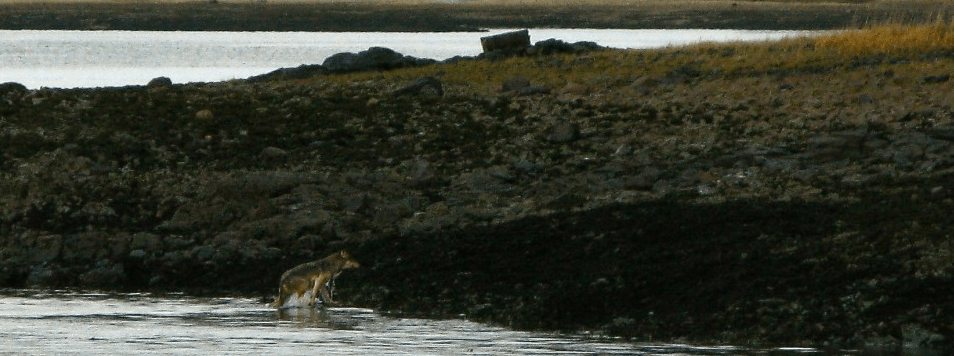
On the Tongass National Forest, we hear mostly about trees – whether it be discussions about board feet, acres of old growth, percentage of forest converted to “second-growth” or “the matrix”[*], our conversations tend to focus on the dominant plant species group that defines the rare “coastal temperate rainforest” biome. However, the Tongass is more than a forest, it is a conglomerate of islands, islands of different sizes, islands of different geologic and cultural histories, islands with or without black bears, grizzly bears, or wolves, the iconic species of Alaska. Because of these islands, there are unique, or, endemic, species of various size, shape and color across the islands. Though they have played a minimal role in management throughout the course of Tongass history, they are now rightfully finding their place in the spotlight thanks to a recent decision by regional forester Beth Pendleton.

On Monday (Sept. 30), the US Forest Service announced its decision to reconsider the Big Thorne timber project. This project would have been the largest timber project on the Tongass National Forest in twenty years, taking 6,200 acres of old growth forest (trees up to 800 years old, 100 feet tall, and 12 feet in diameter) from Prince of Wales Island, an island that has suffered the most intense logging in the region over the past six decades. It is also an island that is home to endemic animals found nowhere else in the world.

Citizens of southeast Alaska and environmental organizations including GSACC jointly filed an administrative appeal on the Big Thorne timber project on August 16th of this year. Monday’s response comes directly from regional forester Beth Pendleton. In the appeal, Pendleton cited an expert declaration written by Dave Person, a former Alaska Department of Fish and Game (ADFG) biologist with over 22 years of experience studying endemic Alexander Archipelago wolves on Prince of Wales Island, with most of his research occurring within the Big Thorne project area. Pendleton cited Person’s conclusion that “the Big Thorne timber sale, if implemented, represents the final straw that will break the back of a sustainable wolf-deer predator-prey ecological community on Prince of Wales Island…” Her letter states, “This is new information that I cannot ignore.” The response to the appeal requires significant review of the timber project before it can move forward, including cooperative engagement between the Tongass National Forest and the Interagency Wolf Task Force to evaluate whether Dr. Person’s statement represents “significant new circumstances or information relevant to” cumulative effects on wolves (including both direct mortality and habitat).

As one of my students today in class asked me pointedly, “So what does all this mean?” Well, it means that the largest potential timber sale in recent history on our nation’s largest national forest, on the third largest island under U.S. ownership, is temporarily halted under administrative processes due to an endemic species. It does not mean that this area is protected. It does not mean, that our work is done. Pending the outcome from conversations between the Forest Supervisor and the Interagency Wolf Task Force, especially under the current political climate within the state of Alaska, we may have plenty to keep us busy in the near future. It does mean that, even if only briefly, the endemic mammals of the Tongass National Forest received a most deserving moment in the spotlight. This could result in a sea-change in how the Tongass National Forest is managed.

This also means that science is being given a chance to play an important role in an administrative decision on our nation’s public lands, and two endemic species, the Alexander Archipelago wolf, and its primary prey species, the Sitka Black-Tailed deer, are forcing federal and state agency personnel to reconsider their actions. Science must continue to play an important role in the future of all activities on Prince of Wales Island. It is home to many endemic animals found only on a small percentage of islands on the Tongass National Forest, and nowhere else in the world. This lineup includes the Prince of Wales Island flying squirrel, the spruce grouse, the Haida ermine, and potentially the Pacific marten, which was only recently discovered on nearby Dall Island. The future of the Tongass timber program and human development on these complex islands are inextricably tied to ensuring a future for all other species in one of the world’s only remaining coastal temperate rainforests.
____

Dr. Natalie Dawson has done years of field work on endemic mammals throughout much of Southeast Alaska, studying their population sizes and distributions through field and laboratory investigations, and has published peer-reviewed scientific papers on these topics. She presently is director of the Wilderness Institute at the University of Montana and a professor in the College of Forestry and Conservation.

[*] What is the matrix? The conservation strategy in the Tongass Forest Plan establishes streamside buffers (no logging) and designates minimal old growth reserves, in an attempt to ensure that wildlife species on the Tongass remain viable. (Whether the strategy is sufficient for this is at best questionable.) The matrix is the expanse of habitat that is allocated to development (such as logging) or that is already developed, and which surrounds those patches of protected habitat.

UPDATE: Readers may notice that in the comments section a claim is made that the Sitka black-tailed deer are not endemic, but were were introduced. The Sitka black-tailed deer (Odocdileus hemionus sitkensis) were not introduced to Southeast Alaska; the Sitka black-tailed deer is indeed an indigenous, endemic species there.

Also, another commenter suggested referring to the article on the GSACC website, as at the bottom of the article one can find much more information about the Big Thorne timber sale and also the declaration of Dr. David Person regarding Big Thorne deer, wolf impacts. Thanks.

Forest Service timber contracts to be suspended amid federal shutdown

From today’s Missoulian:

Montana lumber mills are bracing for an expected suspension of timber contracts on national forest lands Monday as part of the growing impacts from the federal government shutdown.

A Washington, D.C.-based agency spokesman confirmed Friday the agency plans to send out notifications that logging operations will be required to cease.

“Due to the federal funding lapse, early next week the U.S. Forest Service must notify 450 timber purchasers across the country that timber sales and stewardship contracts will be suspended,” said Forest Service communications director Leo Kay.

The agency plans to work with individual timber purchasers to suspend work in an orderly manner, he said.

“We regret the continued impact to the American public,” Kay said. “However, we must cease activities that require Forest Service oversight and management during the funding lapse.”

Kay said he was not able to provide details on how the suspension will occur, but several representatives from Montana mills said it appeared the agency would give loggers seven days to finish whatever work they could.

At this time of year, Montana mills are feverishly stockpiling enough logs to keep their operations running though the winter months and spring breakup.

“It would really hurt to have to shut down this time of year,” said RY Timber resource manager Ed Regan. “Most of the sales we have are up in the high country.”

Read the entire article here.

Dr. Hanson Oped: Yosemite’s burned areas are alive

Earlier in the week the LA Times featured an oped from Dr. Chad Hanson. I will post the opening paragraph below, but you can read the entire piece on the LA Times website.  The bottom of the LA Times piece has this biographical and contact information: Chad Hanson is a forest and fire ecologist with the John Muir Project of Earth Island Institute. He is based in the San Bernardino mountains. http://www.johnmuirproject.org.

Once again, I’d like to respectfully request that if anyone has questions about the content of the oped please contact Dr. Hanson directly.

It was entirely predictable. Even before the ashes have cooled on the 257,000-acre Rim fire in and around Yosemite this year, the timber industry and its allies in Congress were using the fire as an excuse for suspending environmental laws and expanding logging operations on federal land.  (Continue reading….)

Science Policy Forum: Managing Forests and Fire in Changing Climate

Scientists claim policy focused on fire suppression only delays the inevitable. Read more here. The opening paragraph and names of the authors are below.

With projected climate change, we expect to face much more forest fire in the coming decades. Policymakers are challenged not to categorize all fires as destructive to ecosystems simply because they have long flame lengths and kill most of the trees within the fire boundary. Ecological context matters: In some ecosystems, high-severity regimes are appropriate, but climate change may modify these fire regimes and ecosystems as well. Some undesirable impacts may be avoided or reduced through global strategies, as well as distinct strategies based on a forest’s historical fire regime.

Authors: S. L. Stephens, J. K. Agee, P. Z. Fulé, M. P. North, W. H. Romme, T. W. Swetnam, M. G. Turner

What Rep Daines Mandated Logging Bill Would Mean for National Forests in Montana

Here’s some new information to consider regarding Rep Doc Hastings (R-WA) and Rep Steve Daines (R-MT) mandated logging bill, the so-called “Restoring Healthy Forests for Healthy Communities Act” (HR 1526), which passed the US House on September 20.

In Montana, it’s estimated that Rep Daines’ mandated logging bill would result in a 6 fold increase in National Forest logging across the state. However, the logging mandates contained in Daines’ bill would impact each National Forest differently. As such, it’s estimated that Daines’ bill would result in:

•  300 X’s more logging on the Helena National Forest;
•  150 X’s more logging on the Lewis and Clark National Forest;
•  30 X’s more logging on the Beaverhead-Deerlodge National Forest;
•  13 X’s more logging on the Lolo National Forest;
•  7 X’s more logging on the Gallatin National Forest;
•  6 X’s more logging on the Kootenai National Forest; and
•  4 X’s more logging on the Flathead National Forest.

(Note: Compared with 2012 National Forest timber sale volumes)

These dramatic increases in logging would be achieved by undermining America’s public lands legacy by simply having members of Congress mandate dramatic increases in industrial logging by exempting all National Forest logging sales up to 15.6 square miles in size from public input, environmental analysis and gutting the Endangered Species Act.

Rep Daines’ “Logging Without Laws” bill also has the US Congress simply closing the US Federal Court House doors, forbidding any citizen lawsuits on certain types of industrial logging projects, which is inherently undemocratic. Daines’ bill applies to all of America’s 155 National Forests, not just those National Forests in Montana.

New information also reveals that, contrary to claims by Rep Hastings and Rep Daines, rural counties throughout America would get less money for roads and schools under the Hastings/Daines mandated logging bill than what they current receive through Secure Rural Schools funding.

While Rep Daines, Senator Tester (D-MT) and the timber industry claim “gridlock” prevents National Forest logging, between 2008 and 2012 the US Forest Service sold enough logging sales in Montana and North Idaho to fill over 239,000 logging trucks, which if lined up end-to-end, would stretch for 2,048 miles.

Fortunately, President Obama has threatened to veto Rep Daines mandated logging bill.  The battle now goes to the US Senate, which in theory should be against mandating huge increases in National Forest logging through “Logging Without Laws” and gutting the Endangered Species Act, limiting public input and environmental analysis.However, the fact that Senator Tester and Senator Baucus (D-MT) have their very own mandated National Forest logging bill (the Forest Jobs and Recreation Act) already introduced in the US Senate all bets are off and basically anything can happen in the Senate.

Certainly it doesn’t help the political situation that Sen Tester, Sen Baucus and groups like the Montana Wilderness Association, National Wildlife Federation and Montana Trout Unlimited also support politicians mandating huge logging increases of our National Forests through Tester’s Forest Jobs and Recreation Act (FJRA). Make no mistake, both the Daines and Tester bill would be an extreme and radical departure from over 100 years of America’s public lands legacy.Remember, Montanans have been bombarded since 2009 with a million dollar plus advertising and public relations campaign supporting Tester’s mandated logging bill paid for largely by the out-of-state Pew Foundation.

According to official tax forms, as far back as 2009 the Pew Foundation’s Campaign for America’s Wilderness actually hired the Montana Wilderness Association as an “Independent Contractor” to the tune of $304,500.00 in just 2009 alone. Montanans have also witnessed one-sided, down and pony show “public meetings” on Tester’s bill in which only hand-picked supporters of Tester’s bill were allowed to speak to the crowd. And who hasn’t noticed the dozens of canned, scripted Letters to the Editor (most of which from college students without a firm grasp on these issues) cheerleading for Congress to mandate more logging through Tester’s bill?

Let’s also not forget that all summer long we watched the Montana Wilderness Association spend some of their money on an Ad campaign making Rep Steve Daines (a “Tea Party” member of the House) out to be some great “bi-partisian” and encouraging Daines to work together with Senator Tester and Senator Baucus to support Tester’s mandated logging bill. Honestly, how good of a strategy is it to publicly encourage a “Tea Party” member of the US House to work together to support mandated logging of our public national forest lands? How naive must you be to actually think that getting Rep Daines involved with Tester’s mandated logging bill wouldn’t actually make Tester’s bill that much worse?

While the Montana Wilderness Association was busy all summer courting Rep Daines to be their new BFF not one single person from the Montana Wilderness Association (or any of the other environmental ‘collaborators’ supporting Senator Tester’s mandated logging bill) managed to uttered one single peep of protest, concern or opposition about Rep Daines’ very own mandated logging bill, which cuts the public process, NEPA analysis and effectivness of the ESA.

And what about the Montana Wilderness Association’s “timber mill partners” from their much lauded private “collaboration?” Do you think the Montana timber industry supports Rep Daines mandated logging bill? Of course they do! And one can assume the timber industry has no problem dropping Montana Wilderness Association like a bad habitat once the industry gets what they really wanted in the form of Rep Daines mandated logging bill.

In December 2009, as I sat in the US Senate’s Energy and Natural Resource’s Committee hearing room, I heard Montana Wilderness Association’s director Tim Baker (who is now Gov Bullock’s “Natural Resource Adviser”) tell the Committee that MWA wouldn’t support Tester’s bill is the logging mandates were removed. So too, Sun Mountain Lumber owner Sherm Anderson told the Committee the timber industry wouldn’t support Senator Tester’s mandated logging bill without the Wilderness acres. Well, looks to me like Montana’s timber industry has dumped MWA in front of Daines’ mandated logging bus. All is fair in love and legislation, I guess.

“Restoring Healthy Forests for Healthy Communities Act” (HR 1526)

• Creates a legally-binding public lands logging mandate with no environmental or fiscal feasibility limits, and reestablishing the discredited 25% logging revenue sharing system with counties that was eliminated over a decade ago.

• Public participation and Endangered Species Act protections would be severely limited in Rep Daines’ bill. The bill creates huge loopholes in NEPA and such biased ESA requirements that in practice these laws would almost never meaningfully apply. For example, any project less than 10,000 acres (that’s 15.6 square miles) would be categorically excluded from environmental analysis and public participation, and the Forest Service would be required to submit a finding that endangered species are not jeopardized by any project, regardless of its actual effect on the species.

• Rep Daines successfully attached an amendment to the bill that would forbid the US Federal Courts from ever issuing injunctions against Forest Service logging projects based on alleged violations of procedural requirements in selecting, planning, or analyzing the project.

• Another amendment successfully added to the bill has the US Congress closing the US Federal Court House doors for any national forest timber sale resulting from the 2013 wildfires. Essentially this results in “Logging Without Laws,” as one entire branch of the US Government (the Judicial branch) is forbidden from hearing this issue.

If you’d like more “policy-wonky” information about Daines’ mandated logging bill check out this fact sheet.

CO Task Force: Homeowners should pay to live in burn zones; developers/real estate industry oppose parts of plan

The Denver Post’s Bruce Finley had this article in the paper a few days ago.  Below are some highlights from the article:

Gov. John Hickenlooper’s wildfire team unveiled an overhaul of how Colorado deals with the growing problem of people building houses in forests prone to burn, shifting more of the responsibility to homeowners.

The overhaul recommends that lawmakers charge fees on homes built in woods, rate the wildfire risk of the 556,000 houses already built in burn zones on a 1-10 scale and inform insurers, and establish a state building code for use of fire-resistant materials and defensible space.

Sellers of homes would have to disclose wildfire risks, just as they must disclose flood risks. And state health officials would adjust air-quality permit rules to give greater flexibility for conducting controlled burns in overly dense forests to reduce the risk of ruinous superfires….

Protecting homes from wildfires is increasingly costly, with the state’s share going up from around $10 million a year to $48 million in 2012 and $54 million this year – some of which may be reimbursed by the federal government.

Yet construction in the mountains and foothills is accelerating. A Colorado State University study found development will cover 2.1 million acres in wildfire-prone areas by 2030, up from about 1 million today.

But parts of the plan face opposition from developers and the real estate industry.

“When you put a number 10 on a house, it can change the game. In a lot of cases, it could make property un-sellable,” said Colorado Association of Home Builders chief Amie Mayhew, a task force member.

Under the risk ratings recommendation, a home classified as high-risk would go through a “mitigation audit” to specify how to protect it against wildfire. Homeowners who do so could have their risk ratings reduced, said Barbara Kelley, director of the Colorado Department of Regulatory Agencies, who ran the task force.”Homeowners in the wildland-urban interface should take on more of the responsibility” for protecting against wildfire, Kelley said.

Developers and the real estate industry also oppose a state building code unless implementation and enforcement is left up to local authorities.

And the Colorado Association of Realtors – not represented on the task force – rejects requiring disclosure of wildfire risks before home sales, vice president Rachel Nance said. House contracts could simply include a website address where buyers could conduct their own research into risks, she said.

Tour Red Shale Wildfire in the Bob Marshall Wilderness

RedShaleMap
The Great Falls Tribune and Helena Independent Record recently teamed up (whether they knew it or not) to present a fairly cool multi-media education about the Forest Service’s “let it burn” policy as it applies to the Bob Marshall Wilderness complex and this summer’s Red Shale wildfire.

Not surprisingly, the Forest Service is finding that following nearly 30 years of following such a policy in the Bob Marshall Wilderness complex, fuels have been reduced, wildlife habitat has been created and US taxpayers have enjoyed significant wildfire suppression cost savings (again, whether they know it or not).

First, I highly recommend watching this short video from the Great Falls Tribune. Mike Munoz, Rocky Mountain District Forest Ranger on the Lewis and Clark National Forest is interviewed and gives some of the recent wildfire history in the Bob Marshall, as well as some of the rationale and justifications for the Forest Service’s “let it burn” policy. The video includes some pretty cool GoPro footage from high about the Bob Marshall, so enjoy some of those images.

Next, Eve Byron of the Helena Independent Record has a more extensive story, parts of which are highlighted below.

Twenty-five years ago this month, the Canyon Creek fire roared out of the Scapegoat Wilderness after slowly burning unfettered for more than three months, deep within the mountains, under part of the so-called “let it burn” U.S. Forest Service policy.

Eventually, the Canyon Creek fire burned across more than one-quarter of a million acres, forced the deployment of shelters by more than 100 firefighters and threatened the town of Augusta.

The local firestorm of criticism over the Forest Service’s handling of the Canyon Creek fire lasted even longer than the conflagration. But valuable lessons were learned, and this summer, as the Red Shale fire was allowed to burn relatively unchecked through the wilderness, it did so with little fanfare.

Brad McBratney, the fire staff officer for the Helena and Lewis and Clark national forests, and Rocky Mountain District Ranger Mike Munoz smile at questions about various firefighting tactics used by the Forest Service, well aware that the public typically has a limited understanding of how decisions are made as to whether to try to extinguish wildfires in wilderness areas or let them burn. They pull out two yellowed documents from the early 1980s, which foresters have used in the ensuing decades to put policies into practice on the ground, and half a dozen maps showing how fires have shaped the 1.5 million-acre Bob Marshall Wilderness Complex landscape since then.

“In 32 years, we have seen some significant fire activity on the landscape,” Munoz said….

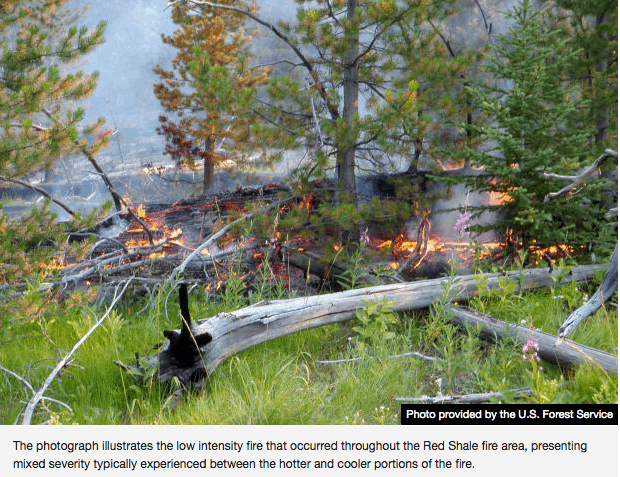
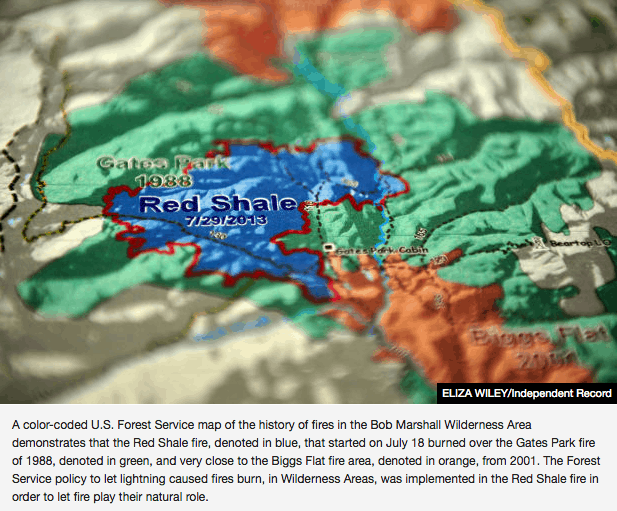
McBratney and Munoz point toward this summer’s Red Shale fire as a textbook example of fire management, even though it is still burning after being started by lightning on July 18, about 35 miles west of Choteau. The fire has spread over 12,380 acres in a typical mosaic pattern, burning trees in one area but leaving others standing. Most of the burned area is within the footprint of the Gates Park fire, which ended up totaling about 52,000 acres.

They do more up-front planning, which includes examining various long-term scenarios. They get daily briefings on weather. More resources are in place — both people and equipment — if it’s needed. They map using satellites and infra-red radars. The develop models on where the fire is expected to burn and revisit those models regularly to tweak them.

Public information officers posted daily updates on a fire’s size, location and the number of resources assigned to it in Choteau and Augusta. There’s even an “app” that allows cell phones to scan it and go directly to the online “InciWeb,” a national incident management website that posts fire information, to learn more about the Red Shale fire.

Even if they’re not actively trying to extinguish the flames, they still use helicopters to drop water to cool the blaze and try to direct it away from some areas. They’ve wrapped historic cabins with fire-resistant materials and installed sprinklers as protective measures.

At the height of the Red Shale fire, about 25 people were assigned to it, including about 10 people on the ground. Today, four people are watching the fire, which is mainly smoldering after recent rains and cooler fall temperatures.

Today, after 100-plus fires in the Bob Marshall Complex have burned hundreds of thousands of acres since 1980, there’s less fuel to add to the fires. Munoz points to the Red Shale fire map, which shows how it burned to the edge of the 2001 Biggs Flat fire, then stopped without human intervention.

In addition to the natural fires within the wilderness area, forest officials have used prescribed burns to remove fuels outside the boundaries, with the hope that will make it easier to catch a fire that makes a run toward private property.

They’ve also worked on building relationships with local and state firefighters. McBratney is a member of the Augusta volunteer fire department, and Stiger said that during the recent fire season local volunteers meet weekly with state and federal representatives to talk about potential issues.

RedShaleBurn

Study: Is fire severity increasing in the Sierra Nevada?

new study published in the International Journal of Wildland Fire found that, contrary to what has been claimed in some of the news coverage of recent forest fires, there is not a trend toward increasing fire severity in the Sierra Nevada. Previously, those who claimed that fire severity was increasing relied primarily on two publications by Jay Miller of the Forest Service (Miller et. al 2009, Miller and Stafford 2012).

However, Dr. Chad Hanson and Dr. Dennis Odion found that the Miller studies left out hundreds of thousands of acres of fire data from their analysis. In contrast, Hanson and Odion used all of the available fire severity data for the Sierra Nevada, and that data showed no trend toward increasing fire severity.

Furthermore, they found that rate of high severity fire since 1984 has been lower than it was historically. These results refute some of the main claims we see on this blog and elsewhere.

Abstract
Research in the Sierra Nevada range of California, USA, has provided conflicting results about current trends of high-severity fire. Previous studies have used only a portion of available fire severity data, or considered only a portion of the Sierra Nevada. Our goal was to investigate whether a trend in fire severity is occurring in Sierra Nevada conifer forests currently, using satellite imagery. We analysed all available fire severity data, 1984–2010, over the whole ecoregion and found no trend in proportion, area or patch size of high-severity fire. The rate of high-severity fire has been lower since 1984 than the estimated historical rate. Responses of fire behaviour to climate change and fire suppression may be more complex than assumed. A better understanding of spatiotemporal patterns in fire regimes is needed to predict future fire regimes and their biological effects. Mechanisms underlying the lack of an expected climate- and time since fire-related trend in high-severity fire need to be identified to help calibrate projections of future fire. The effects of climate change on high-severity fire extent may remain small compared with fire suppression. Management could shift from a focus on reducing extent or severity of fire in wildlands to protecting human communities from fire.