FS’s Rocky Mtn Research Station: Rural homes must be more fire resistant

Sometimes you wake up in the morning and the newspaper has an article that basically re-states what you’ve been saying for nearly the past twenty years, at least as far as home wildfire protection is concerned.

Making rural homes more resistant to fire is the best way to reduce the number of homes lost to wildland fires, according to a recent paper published by Missoula researchers.

That statement may suggest a “duh, right,” but in the past much of the pressure to reduce the intensity and occurrence of wildland fires has been on federal and state land managers to remove fuels from public lands through logging.

“We have the ability to change the character of the fires that come out of the wildlands,” said David Calkin, of the Forest Service’s Rocky Mountain Research Station in Missoula, the principal author of the research. “But if we’re concerned about homes burning up, then we need to think about the home ignition zone.”

Jack Cohen, Mark Finney and Matthew Thompson collaborated on the research paper.

The home ignition zone is the home itself and the area immediately around it. If a homeowner’s land is left untreated to prevent fire ignition, even low-intensity fires from far away have produced firebrands carried by the wind for miles that have burned houses, Calkin’s research showed.

Read Brett French’s entire article here.

In-Depth: How Tester’s mandated logging bill has divided conservationists

“If there’s any reason that the Tester bill has not moved along better than it has, it’s because of its mandates that there not only be logging, but that certain amounts of timber be extracted.  Conservation-minded Senators are very hesitant to vote for that, even though they recognize the Montana wilderness dilemma. They don’t want to set a precedent for other bills to do the same thing….I do worry about the mandate of it.  If I was in the Congress, and all this time had gone by without success on designating new wilderness, I would try to amend the Tester bill in one way or other.” 
– Former Montana Congressman Pat Williams 

Collaboration conundrum – Wilderness advocates sharply divided on ‘consensus’ proposals
By John S. Adams, Great Falls Tribune

At a June 8, 1997, gathering in Kalispell, former U.S. Forest Service Chief Jack Ward Thomas foretold a vision of the future for national forest management in Montana.

According to a newspaper account of Thomas’ address to the Montana Logging Association, President Bill Clinton’s former forest chief predicted a “golden decade of conservation” in which environmental groups and timber interests would work side by side to reach “consensus” on the future of management of federal forest land.

Thomas predicted those collaborative projects on the national forests would break down the barriers to logging on public lands and “marginalize extremists.”

“I don’t see any other game in town,” Thomas said in a report in the Daily Inter Lake.

More than 16 years later, Thomas’ prediction has partly come to pass, but with as-yet-undetermined results.

If Thomas’ “golden decade of conservation” relies on the success of consensus and collaboration, then there may be no better test of that theory than Sen. Jon Tester’s Forest Jobs and Recreation Act.

FJRA is the first major piece of federal land management legislation in Montana to spring from the well of “collaboration,” and it is by far the most ambitious and controversial. Many wilderness advocates have fiercely opposed the measure since its introduction in 2009. Their primary criticism of the bill, though they have many, is that it mandates the Forest Service log tens of thousands of acres in the Beaverhead-Deerlodge and Kootenai national forests.

Sen. Max Baucus followed Tester’s bill with a proposal of his own in 2011. The Rocky Mountain Front Heritage Act has many of the same detractors who say it designates a paltry amount of wilderness while locking-in grazing, logging and motorized recreation. However, with its lack of logging mandates and fewer carve outs for permanent motorized recreation, the opposition from the environmental community is less severe.

Both bills rely on the idea of bringing the timber industry groups, conservationists and other stakeholders together to hammer out consensus proposals for public land management. That concept, particularly when it comes to Wilderness proposals, has fierce detractors in the environmental movement.

Count 88-year-old Stewart “Brandy” Brandborg among them.

Brandborg was director of Wilderness Society from 1964 to 1977. His grass-roots organizing and advocacy were pivotal in the passage of the 1964 Wilderness Act.

Brandborg, the son of former Bitterroot National Forest supervisor and early Selway-Bitterroot Wilderness advocate G.M. Brandborg, spent much of his youth traipsing around in the places that would much later be designated as federal wilderness thanks in large part to his efforts.

Collaboration, as demonstrated by the process that created FJRA and the Heritage Act, is antithetical to the original concept of the 1964 Wilderness Act and threatens to undermine the bedrock administrative laws that demand public involvement and transparency in land management decisions, Brandborg said.

“Good management of land prescribed by public land agencies, and good protective measures for water and our environment in general, are being subjected to a rash of proposals and policies that defy every rule and every restriction we’ve placed on resource management,” Brandborg says. “I take gross exception to the go-along policies of those state and local organizations who say we can embrace collaboration.”

Four-and-a-half years since Tester’s Forest Jobs and Recreation Act was first introduced, the bill continues to languish in the Senate, and wilderness advocates remained locked in a bitter internecine battle that some say could undermine the entire future of wilderness in Montana.

On the one side are the fiery wilderness conservationists whose work and advocacy centers on the prevention of new roads and industrial resource extraction on Montana’s remaining roadless landscapes.

On the other side are the pragmatic conservationists who say collaborative proposals built on consensus and compromise among various stakeholders are the only realistic approach to the larger goal of adding more wilderness in Montana. Large-scale “wilderness-on-its-own” legislation that doesn’t include “place-based solutions” that appeal to local community interests — including the timber industry — don’t stand a chance of passing, they say.

Poster child

First introduced in 2009, the core of the FJRA proposal sprang from a series of private meetings that began in 2005 between Sun Mountain Lumber, Roseburg Forest Products, Pryamid Mountain Lumber, RY Timber, Smurfit Stone, Montana Wilderness Association, National Wildlife Federation and Montana Trout Unlimited.

In its current form, it calls for approximately 666,000 acres of new wilderness while mandating a minimum of 5,000 acres of logging per year on the Beaverhead-Deerlodge National Forest until at least 70,000 acres have been logged.

Another 30,000 acres would be mandated for logging on the Kootenai National Forest.

Conservation groups who support the measure, including the logging mandates, point to the trade-offs in the FJRA as the key to breaking the gridlock that has left Montana without a new “Big W” wilderness designation for more than 30 years.

“To me, personally, I can’t accept the idea that wilderness is something that other states get to enjoy the benefits of and protect — 29 other states in the last 30 years — but not Montana. Because we have lands that are superbly qualified to be in the wilderness system,” said John Gatchell, conservation director for the Montana Wilderness Association.

Only Idaho, with 9.3 million acres, has more roadless land in the lower 48 than Montana, with 6.3 million acres. Idaho and Montana are the only states with vast tracts of roadless wildlands that have not passed large-scale statewide wilderness designation bills in the past three decades.

MWA’s supporters say it’s high time to make new wilderness happen, even if that means turning over some of Montana’s roadless land to logging, mechanized recreation and other activities that are nonconforming to wilderness characteristics, as part of the deal.

Gatchell says the alternative is to continue to wait and watch as wildland currently suitable for wilderness designation are degraded by activities and uses that would forever exempt them from future designation.

A pure, large-scale wilderness bill, such as the 20-year-old Northern Rockies Ecosystem Protection Act has no chance of passing Congress, Gatchell says. NREPA has been introduced five times since 1993, and though it has drawn many congressional co-sponsors over the years, it has failed to make it to the floor for a vote.

“A bill that doesn’t get voted on cannot protect, will not protect and has not protected a single acre of Montana,” Gatchell said. “I just think that what’s important here is we need legislation and we need the Montana delegation, or some members of the delegation, to champion that legislation for it to pass Congress.”

New precedent

Other wilderness advocates see the collaborative process behind FJRA as monumental threat to the future of America’s public lands legacy.

With its mandated logging on the Beaverhead-Deerlodge National Forest, release of wilderness study areas and carve-outs for motorized recreation and mountain biking, the precedents set by FJRA would make it too tempting for members of Congress in other states to follow its lead, some detractors say.

The possibility of new era of congressionally mandated levels of public lands resource extraction is not worth the tradeoff for a few hundred thousand acres of wilderness, say environmental critics of the bill.

Matthew Koehler, executive director for the Missoula-based WildWest Institute, testified against FJRA during a 2009 Senate committee hearing on the bill. Koehler has been highly critical of the substance of FJRA since it was first introduced. Koehler’s main critique of the measure, though he has many, is the precedent it could set for future lawmakers.

“At a time when the approval rating of politicians in Congress is at 10 or 15 percent, these groups want to take management authority away from the Forest Service and the public and they want to put it in the hands of politicians to mandate resource extraction levels on public lands,” Koehler said. “If Tester’s bill passes, it will open up the door in years to come for politicians all around the country to say, ‘You know what? In my state we’re going to tell the Forest Service that we want this amount of grazing, or this amount of fracking, or this amount of coal mining.’

“I don’t feel like getting a few more acres of wilderness in Montana is worth forsaking America’s entire public lands legacy,” Koehler said. “That’s not a fair trade in any way shape or form.”

Bruce Farling, executive director of Montana Trout Unlimited, says critics such as Koehler are lone voices in the wilderness who don’t represent the viewpoint of the majority of Montanans.

Farling says “individual environmentalists” such as Koehler are sour grapes detractors who refuse to offer up proactive solutions to the “gridlock” that exists in public land management, and instead choose to appeal and litigate timber sales.

“They’re hypocrites,” Farling says. “They cut deals all the time. They appeal, sue the Forest Service, sit down and negotiate behind closed doors and say ‘OK, you guys stay out of here, we’re OK with you going over here.’”

Farling said the public knows what the collaborators are doing and the process is open and transparent, a point to which Koehler takes exception.

“Some of the worse examples of collaboration in Montana are nothing more than invite-only, self-selective groups that are dominated by politically connected and well-funded organizations and the timber industry,” Koehler said.

“If the litmus test for participating in their invite-only processes is that you must agree that politicians, through legislative riders, mandate the amount of logging or resource extraction on public lands, well we’re not going to participate, nor are many other people going to participate in such a tainted process,” Koehler said.

Internecine conflict

Brandborg, the octogenarian wilderness organizer, takes a harsh view of the collaborators who are at the heart of the FJRA. Brandborg believes moneyed interest closely tied to Democratic Party politics are to blame for the conservation movement’s willingness to “cut the baby in half” on wilderness protection.

“We’ve had an evolution in the strategies of our opponents, who have said, ‘Let’s go find these weak elements in Montana. Let’s go cultivate them and get them money so they can go about this job of … bringing down their forceful campaigns to protect wild- lands,” Brandborg said.

Larry Campbell, a longtime grass-roots wilderness advocate with Friends of the Bitterroot and close friend of Brandborg’s, said there’s always been a rub within the environmental community between those groups that appeal and litigate and the larger, better-funded, membership-based groups that take a more mainstream approach to conservation advocacy.

Campbell maintains wilderness advocates lost very few wilderness-eligible acres to development and other non-conforming activities since 1988, when President Ronald Reagan pocket-vetoed the last Montana wilderness bill to pass Congress.

That measure was supported by all three Democratic members of Montana’s federal delegation at the time, Sens. John Melcher and Max Baucus and Rep. Pat Williams. Republican Rep. Ron Marlenee opposed the measure, which would have designated 1.4 million acres of Forest Service land into wilderness and released approximately 4 million acres of protected wildlands to development. With Reagan’s veto most of those lands remained under protected status until Congress acted to change it. So far that hasn’t happened.

Campbell says most of Montana’s wildlands have remained undeveloped since then thanks to grass-roots wilderness advocates who actively organized and participated in federal administrative appeals processes and litigation.

Campbell said the new wave of collaboration threatens to undermine years of work by groups like Friends of the Bitterroot, Alliance for the Wild Rockies, WildWest Institute and other grassroots organizations who fought hard to keep those lands protected.

“We did not lose very many wilderness acres between 1988, when Pat Williams’ wilderness bill went down, and when this thing (FJRA) was hammered out,” Campbell said. “We were protecting all of them — the wilderness study areas, the inventoried roadless areas as well as the small ‘r’ roadless areas — from projects, timber sales, whatever, and we won.”

Campbell said the smaller, grass-roots activist groups were content to maintain that track of protection until the political conditions were ripe for another shot at a large-scale wilderness proposal. When President Bill Clinton in 2001 implemented the Roadless Area Conservation Policy directive, known as the “roadless rule,” it gave groups like Friends of the Bitterroot even more tools to protect Montana’s wildlands.

“We had going for us the appeals and litigation administrative process, the roadless rule protections, and also some court decisions that were adding to our toolbox all the time,” Campbell said.

Campbell said at the time MWA, TU and others began sitting down with the timber industry, wilderness conservation advocates “had more tools” to protect wildlands than ever.

“They started cutting up our babies,” Campbell said. “The true grass-roots activists who had been fighting for these wildlands in force on the ground, were not invited to be a part of the process. Those grass-roots groups are the groups who appealed and litigated and actually protected those wildlands that went on the table and started getting diced up by the junior politicians.”

Peter Aengst, senior regional director for the Wilderness Society, says Montana’s wilderness advocates shouldn’t be airing their differences and disagreements in the public sphere. The Wilderness Society, which Brandborg once helmed, supports FJRA and other collaborative conservation projects including the Heritage Act.

“We’ll have disagreements, I think that’s fine, I think hopefully we can all learn from each other,” Aengst said. “The idea of labeling, the idea of in the media attacking one another, that doesn’t help anyone.”

Aengst said it’s unrealistic for groups such as Friends of the Bitterroot or WildWest Institute or the Helena-based Alliance for the Wild Rockies to expect the entire wilderness conservation movement to follow the beat of their drum.

“It’s not realistic to expect that we’re all going to agree on everything, but that doesn’t have to stop us from moving forward and exploring collaborative place-based solutions,” Aengst said. “I think generally we all share the same end goals. I don’t think that’s where the disagreement is.”

Williams has been contemplating the rift between the two main camps in Montana’s wilderness advocacy community.

“Interestingly enough, both sides are right and both sides know it,” Williams said. “On the one hand, the people who want one large, intact, statewide bill are ecologically correct. In other words, that side understands that grizzly bears don’t know where the county lines are.

“However, the place-based people, while sometimes setting aside ecological importance, are more correct in their political strategy,” Williams said. “That is, a huge bill, would likely not pass the congress, whereas a series of smaller place-based bills might.”

Unknown outcomes

So far Tester’s bill has not made it out of committee, but the collaborative process that led to the first wilderness proposal in the state in more than 20 years has managed to drive a deep wedge in the state’s wilderness conservation community.

Williams said he believes the only wilderness bill that has a strong change of passing in Montana anytime in the near future is Baucus’ Rocky Mountain Front Heritage Act. Williams said if the measure makes it to the floors of Congress for a vote, “voting against it would be akin to voting against protecting the Statue of Liberty.”

Tester’s Forest Jobs and Recreation Act, with is controversial logging mandates, faces a much tougher row to hoe.

“The Tester bill, with its protections of place combined with logging mandates, should long ago have appealed to both sides, and yet it sits unpassed in the U.S. Senate,” Williams said. “That surprises me and says to me that Montana may have some very rough legislative patches ahead in trying to protect its landscape.”

Williams, an FJRA supporter, said no other wilderness bill before Congress has ever taken the approach FJRA has.

“If there’s any reason that the Tester bill has not moved along better than it has, it’s because of its mandates that there not only be logging, but that certain amounts of timber be extracted,” Williams said. “Conservation-minded Senators are very hesitant to vote for that, even though they recognize the Montana wilderness dilemma. They don’t want to set a precedent for other bills to do the same thing.”

Williams said if he were still in Congress, he would try to amend FJRA, but if the only way to pass it was to keep it intact as written, he would vote for it.

“In some ways it would be an environmental improvement, but I do worry about the mandate of it,” Williams said. “If I was in the Congress, and all this time had gone by without success on designating new wilderness, I would try to amend the Tester bill in one way or other. Success or not, in the end I would vote for it.”

According to GovTrack.us the prognosis for the FJRA is not good.

The congressional bill tracking website gives it just a 4 percent chance of getting out of committee and only a one percent chance of being enacted.

Last session the Senate Energy and Natural Resources Committee passed 11 percent of the bills brought to it, and of those only three percent were enacted.

Meanwhile, U.S. Rep. Steve Daines, R-Mont., has signed on as co-sponsor of a public lands bill Montana conservationists are united in their opposition to.

Washington Republican Rep. Doc Hastings’ “Restoring Healthy Forests for Healthy Communities Act,” would result in an estimated six-fold increase in logging on Montana’s national forest land. The bill also prohibits litigation on certain types of timber sales and exempts certain timber sales of up to 15.6 square miles in size from environmental review.

Farling, Gatchell and Aengst said the Daines-Hastings proposal is a “top-down” “bad bill” that was “developed in Washington, D.C.,” as opposed to “on the ground in Montana.”

“It’s not going to go anywhere,” Farling said. “It’s really kind of a really radical departure from what the public wants and what is appropriate.”

Brandborg, Koehler and Campbell point out that many of the same timber partners who publicly supported FJRA are also backing the Hastings-Daines bill. They say participation by groups such as MWA, TU and the Wildernss Society in the FJRA collaborative has hamstrung those groups from publicly speaking out against the logging mandates in the Daines-Hastings bill.

“They went off the slippery slope and into the crevasse with this Daines bill,” Campbell said. “It wasn’t hard to predict.”

Restoring Healthy Forests for Healthy Communities Act

H.R. 1526
Sponsor: Rep. Doc Hastings, R-Wash.
Co-Sponsors: Rep. Steve Daines, R-Mont.; Rob Bishop, R-Utah; Louie Gohmert, R-Texas; Paul Gosar, R-Ariz.; Morgan Griffith, R-Va.; Jaime Herrera Beutler, R-Wash.; Doug LaMalfa, R-Calif.; Cynthia Lummis, R-Wyo.; Tom McClintock, R-Calif.; Cathy McMorris Rodgers, R-Wash.; Steve Pearce, R-N.M.; Reid Ribble, R-Wis.; Steve Southerland, R-Fla.; Glenn Thompson, R-Pa.; Don Young, R-Alaska; Dan Benishek, R-Mich.; Greg Walden, R-Ore.; Tom Cotton, R-Ariz.; Markwayne Mullin, R-Okla.; Mike Coffman, R-Colo.; Spencer Bachus, R-Ala; and Steven Palazzo, R-Miss.

First introduced: April 2013

Status: Passed the House

Key provisions of the bill:

Would direct the Secretary of the U.S. Department of Agriculture to establish at least one “Forest Reserve Revenue Area” within each unit of the National Forest System designated for logging and forest reserve revenues. The purpose of an area is to “provide a dependable source of 25 percent payments” and economic activity for each beneficiary county containing System land that was eligible to receive payments through its state under the Secure Rural Schools and Community Self-Determination Act of 2000.

• Creates a legally binding public lands logging mandate with no environmental or fiscal feasibility limits and reestablishes the 25 percent logging revenue sharing system with counties that was eliminated over a decade ago;

• Within the areas covered under the measure public participation under the National Environmental Policy Act would be limited and Endangered Species Act protections would be greatly reduced;

• Would bar federal courts from issuing injunctions against Forest Service-logging projects based on alleged violations of procedural requirements in selecting, planning, or analyzing the project;

• Lawsuits over National Forest timber sales resulting from the 2013 wildfires would be barred from federal court.

Forest Jobs and Recreation Act

S. 37
Sponsor: Sen. Jon Tester, D-Mont.
Co-Sponsor: Sen. Max Baucus, D-Mont.

First introduced: June 2009

Status: Assigned to Senate Energy and Natural Resources Committee January, 2013

Key provisions in the bill:

• Designates about 666,000 acres of wilderness on Beaverhead-Deerlodge, Kootenai, and Lolo National Forest and Bureau of Land Management lands in southwestern Montana.

• Designates 1.9 million acres of the Beaverhead-Deerlodge National Forest, including Inventoried Roadless Areas, as “timber suitable or open to harvest;”

• Mandates that the Forest Service log a minimum of 70,000 acres on Beaverhead-Deerlodge National Forest and 30,000 acres on the Kootenai National Forest;

• Releases seven Wilderness Study Areas, covering 76,000 acres, and opens them up to other uses, such as timber harvest and motorized recreation.

Rocky Mountain Front Heritage Act

S. 364
Sponsor: Sen. Max Baucus, D-Mont.
Co-Sponsor: Sen. Jon Tester, D-Mont.

First introduced: October 2011

Status: Passed by the Senate Energy and Natural Resource Committee

Key provisions of the bill:

• Adds 67,000 acres of designated wilderness to the Bob Marshall Wilderness Complex;

• Designates 208,000 acres as a conservation management area that allows motorized recreation and access, logging, grazing mountain biking and other existing uses;

• Supports noxious weed prevention programs for agricultural and public lands across the Rocky Mountain Front.
Wilderness is more than a playground for bikers

The following opinion piece was written by Howie Wolke. Wolke is a former Jackson resident who now lives north of Gardiner, Mont. Along with his wife, Marilyn Olsen, he runs Big Wild Adventures. He has been guiding in the Greater Yellowstone and elsewhere in western North America since the mid-1970s.

Wilderness is more than a playground for bikers
By Howie Wolke

Whenever I begin to think that the Forest Service is becoming more conservation-minded, count on it to provide a reality check.Begin with the Bridger-Teton National Forest’s logging proposal, allegedly to reduce forest flammability, that’s partially within the Palisades Wilderness Study Area. That’s a claim, by the way, refuted by most scientists. Also, the Forest Service has recently cut mountain bike trails through the same WSA.

Unfortunately this disregard for laws designed to maintain the option for future wilderness designations is systemic, not local. For example, near my home the Forest Service was recently court-ordered to curtail illegal vehicle abuse in the Gallatin Range WSA. The agency had violated the 1977 Montana Wilderness Study Areas Act.

And east of Togwotee Pass, instead of clamping down on illegal mountain bike use in the DuNoir area, the feds plan to designate a bike route through the heart of this exceptionally wild and beautiful place. Yet the 1984 Wyoming Wilderness Act designated the DuNoir a Special Management Unit, and its language clearly forbids all vehicles.

Arguably no roadless area anywhere deserves wilderness protection more than the magnificent DuNoir. The scenery is stunning, and its deeply wooded basins and sprawling tundra provide habitat for a plethora of wild creatures, including wilderness-dependent species such as grizzly, lynx and wolverine. (To prove the point, in 2012 I watched a wolverine scale a cliff near the DuNoirs’ Bonneville Pass.)

Allowing bikes a slippery slope

Oddly, in their land management planning process, which is nearly final, the Shoshone National Forest has failed to recommend wilderness designation for a single acre of unprotected Shoshone roadless lands, including the DuNoir. So other world-class Shoshone wildlands such as the Francs Peak, Wood River and Trout Creek Roadless Areas will also remain vulnerable to mechanized vehicular abuse and resource extraction.

Wisely, the 1964 Wilderness Act, our national wilderness law for public lands, forbids resource extraction and “mechanized,” not just motorized, travel.

When mechanized mountain bikers demand access to proposed and even designated wilderness, they fail to understand that if we allow this, then owners of who-knows-what future contraptions will certainly demand equal treatment. So will snow machine and ATV owners.

To loosen wildland restrictions starts us down a steep slippery slope. And mountain bikers are not traditional users, like hikers or horse-packers. These machines didn’t even exist until the early ’80’s. By allowing them to proliferate in roadless areas the Forest Service nourishes yet another anti-wilderness constituency. A cynic might suggest that’s no accident.

The infusion of former U.S. Sen. Al Simpson into the DuNoir equation is a recent twist. His son-in-law is a vocal mountain bike advocate who runs a Cody-area bike club. Simpson now advocates biking in the DuNoir and claims that maintaining future wilderness options for the DuNoir was not a goal of the 1984 legislation. But that’s misleading. I worked on that bill and maintaining the wilderness option was important.

Backcountry biking damages the resource. Bikers simply don’t stay on trails. Often they veer off trail just to keep from crashing.

Last year I sent the district ranger photos of recent mountain bike damage to vegetation at Kissinger Lakes, in the DuNoir, but the problem persists.

Due to the speed factor, mountain bikes startle wildlife more than hikers or horseback riders. Their speed also renders remote areas more accessible, thus reducing solitude for the many in favor of the few.

Like trail runners with ear pods, mountain bikers “troll for grizzlies,” as demonstrated by the 2004 mauling of a DuNoir mountain biker. And speaking of danger, the steep unstable Pinnacles Trail above the Brooks Lake Road (along the proposed route) is a future disaster. One day when bikers speed around a corner smack dab into a pack string where there’s no place to go except down the steep scree, it will happen.

Let’s face it: Mountain bikers don’t wear all that protective gear because they’re always in control.

At this point in our history, public land decisions should be about wildness and what’s best for the land and wildlife. Recreation can adapt.

Our public lands are not outdoor gymnasiums; nor are they pies to be divvied up among user groups, “interested publics” or local “stakeholders” to use a bit of bureaucratese.

As a backpacking trip outfitter, I’ve been guiding throughout the West and in the DuNoir since the late ’70s. When these lycra-clad speedsters zip past our groups, ripping up native vegetation and spooking critters, it diminishes the clients’ hard-earned wilderness experience.

But that’s not why the DuNoir — and other qualifying wildlands — should be designated wilderness. It’s because wilderness designation is best for the land.

Wilderness about humility

Wilderness is about humility, a statement that humans don’t know it all and never will. It takes us beyond “self,” and I think that’s a good thing. More than any other landscape, in wilderness we are part of something much greater than our civilization and ourselves.

Perhaps above all, wilderness is a statement that nonhuman life and wild landscapes have intrinsic value, independent of their benefits to humans. That’s why most remaining roadless areas should be designated Wilderness. And it’s why the Forest Service and some politicians are so wrongheaded, stuck in an outmoded and myopic worldview regarding the DuNoir, the Palisades, Francs Peak, the Gallatin Range and so many other fragile wildlands throughout the United States.

Another invite-only “collaborative” leads to unprofessional Forest Service conduct

Yet another invite-only, exclusive “collaboration” involving public U.S. Forest Service land management has sprung up in Montana. This time the collaborative group is called the Whitefish Range Partnership (WRP), and they are focused on roughly 350,000 acres of the Flathead National Forest’s portion of the Whitefish Range above the cities of Columbia Falls and Whitefish.
As you will see below, the leaders of the Whitefish Range Partnership completely admit that they made a conscious decision to exclude certain members of the public. Notably, the WRP admits to purposely excluding any conservation organization that had worked within the established public participation processes outlined within the National Environmental Policy Act (NEPA) in order to comment, appeal and, if necessary, file a lawsuit against a timber sale on the Flathead National Forest. It also appears that the WRP purposely excluded some of the “multiple-use” folks.  Also of note is the fact that Flathead National Forest officials were invited to attend all the meetings of the WRP in an advisory capacity.
The WRP leaders conducted a media blitz last week, announcing an agreed upon deal that, among other things:

• Increases the “Suitable Timber Base” by 45% in order to supposedly achieve “commercial certainty for the timber industry” (in an era where lumber consumption and home construction are down more than 50% and not expected to rebound anytime soon).
• Decreases recommendations for areas protected as Wilderness.
• Increases motorcycle recreation in the southeast portion of the Whitefish Range.
• Provides a large increase in recreation opportunities for snowmobilers.

Q: Has there even been a public lands “collaborative” group that didn’t decide to increase logging, decrease Wilderness and increase motorized recreation?

At the time the WRP deal was made public there were no plan details or maps available to the public.  In fact, board members of at least one organization that did participate in the invite-only, exclusive collaboration also didn’t know any details, except what they read in the newspaper.  A few days after framing the debate and controlling the media messaging, the leaders of the WRP did make this copy of the agreement available to some of people, although I’m pretty sure it’s not available to the general public.

Keep in mind that starting tonight the Flathead National Forest is hosting “Stakeholder Collaboration Orientation Meeting” from 4 to 8:30 pm Kalispell to kick off their Forest Plan revision process.  The weather forecast calls for a low tonight in Kalispell of 8 below zero, with wind chill values dropped to 32 below zero.  Many roads in the area are snow-covered and icy.

Ask yourself this question:  If you are a member of the public who cares about the management of the Whitefish Range and the Flathead National Forest, and you were excluded from the Whitefish Range Partnership “collaboration” and plan, would you venture outside in the cold and dark to attend the Flathead National Forest’s “Stakeholder Collaboration Orientation Meeting?”

Before you decide, read the information below, where you will see that Chip Weber, the Supervisor of the Flathead National Forest, has already publicly claimed that the plan developed by the invite-only, exclusive Whitefish Range Partnership “may be very close to, if not exactly what we end up doing.”

What follows below are some reactions and more information to the Whitefish Range Partnership plan, and the Flathead National Forest’s “advisory” role in this invite-0nly, self-selected, exclusive “collaboration.” The views expressed below (which are shared with permission) come from long-time conservationists who live in the immediate area, but were not invited to participate in the WRP’s “collaboration” on account of supposedly being too radical or extreme.

——————————–

[Founded in 2006, James Conner’s Flathead Memo is an independent journal of observation and analysis that serves the Flathead Valley and Montana. Below are some of Mr. Conner’s thoughts, including a number of recent posts about the Whitefish Range Partnership plan made at the Flathead Memo. – mk]

Matt Koehler asked my permission to repost some of my essays on www.flatheadmemo.com. Permission granted, and granted with pleasure.

Collaboration is not an intrinsic evil. In fact, when conducted in an ethical manner, it can do good. There’s never any point to fighting over common ground. But, as with the Frenchwomen who “collaborated” with the Wehrmacht’s soldiers, it also can be an act of desperation and betrayal, a lesser of evils in an effort to survive, or simply an outcome of weak character. It can can and does turn colleagues against each other in the pursuit of ephemeral gains, poisoning relationships and weakening communities.

One collaborative effort I encountered involved citizens, who, frustrated with a county commission’s heads-in-the-sand approach to planning in a rapidly growing northwestern valley, decided to take matters into their own hands. They wrote their own master plan which, wrapped in bells and bows, they presented to the commissioners, expecting swift approval. “Here, we’ve done your job for you,” they said in effect. The rump master plan never was adopted, and the collaborationists never realized they were practicing vigilante politics. When government is broken, it must be fixed, for it cannot be sidestepped.

We’re now beginning another round of national forest planning. The U.S. Forest Service, desperate to adopt new plans that enjoy widespread public support, hopes a collaborative process will rally the public around the plans. It won’t, certainly not to the extent the agency desires. The public is too diverse for that. Moreover, not all uses and practices are compatible, not all collaborative efforts will produce wise, or even legal, agreements, and no amount of collaboration can relieve the agency of its legal and moral duties to decide what the plan includes and does.

As these collaborative efforts move forward, those involved must remember that the objective is not compromise, for compromise is not an intrinsic good, but support for that which best protects the land in ways consistent with the needs and aspirations of humanity and the world of living things. – James Conner

Unprofessional conduct at the Flathead National Forest

By James Conner, © James Conner, www.flatheadmemo.com

The man in charge of revising the forest plan at the Flathead National Forest, Joe Krueger, and his boss, forest supervisor Chip Weber, exercised questionable professional judgment in their remarks on the forest plan alternative developed by the Whitefish Range Partnership.

Here’s what the InterLake’s Jim Mann reported:

Joe Krueger, the forest plan revision team leader, said forest officials are impressed with the work done by the Whitefish Range Partnership.

“That’s a very big group,” Krueger said, referring to a membership roster that included representatives for raft companies, timber interests, conservation groups, business owners, hunting and angling, mountain biking and much more. “Anytime you can get a group of diverse folks together and problem solve like that … we’re going to give that a lot of weight.”

♦ ♦ ♦ ♦ ♦

Now it will be easy for people who weren’t part of the process to take pot shots at it,” Krueger said. “The hard part was working through this.”

At the Flathead Beacon, Tristan Scott reported:

“This may be very close to, if not exactly what we end up doing,” [Flathead National Forest Supervisor] Weber told the group at its Nov. 18 meeting, after the members presented him with a lengthy draft plan, the product of more than a year of bi-weekly meetings. “You were first out of the gate, you’ve put in an incredible amount of work and you’ve given us a lot to think about.”

“What the people did here was some yeomen’s work,” he added later. “This group helped set a good example and a model for others to look at.”

One can defend Weber and Krueger by arguing they were trying to be positive and diplomatic, but expressed praise for the WRP’s work in a way that inadvertently endorses the WRP’s proposal. I’m sure someone will make that argument. I won’t. This is more than a case of not being artful — it’s a case of playing favorites, and not in a subtle way.

Had Weber said only “…you’ve put in an incredible amount of work and you’ve given us a lot to think about,” and followed with “your proposal will accorded the same fair consideration as all proposals,” he would have been on solid — and neutral — ground. But he couldn’t curb his enthusiasm.

But Weber’s statements are weak tea compared to Krueger’s “ …we’re going to give that a lot of weight,”and “…it will be easy for people who weren’t part of the process to take pot shots at it.” He’s both endorsed the WRP’s proposal and denigrated as cheap shot artists those who may criticize the proposal. Quite clearly, Krueger is invested in the WRP’s proposal. That’s old school Forest Service favoritism and bully boy behavior, and highly toxic to a successful forest planning effort.

The FNF’s unprofessional conduct imperils the forest planning process from the gitgo, and sullies the hard work of the Whitefish Range Partnership.

[Addition: Here’s an example, captured on video tape, of the Flathead National Forest’s Joe Krueger (at left with yellow hard-hat) mocking a very sincere question from a concerned citizen about the role of science in timber sale management targeting old-growth forests and grizzly bear habitat during a Forest Service public tour of the Beta Timber Sale on the Flathead National Forest in 2005. – mk]

Whitefish Range rump agreement far from a done deal

By James Conner © James Conner, www.flatheadmemo.com

Another rump caucus, the Whitefish Range Partnership, has reached agreement on how a tract of National Forest land, this time in the Whitefish Range, west of Glacier National Park, should be managed. Rob Chaney of the Missoulian has the story.

The agreement has no force of law, but it does have political weight that will be recognized by Congress, which has the power to designate wilderness, and the U.S. Forest Service, which is starting another round of forest planning. Many of the WRP’s proposals are intended to be incorporated in the next forest plan, which will have the force of law.

Here, from Chaney’s report, is what we know so far:

In the final agreement, the [mountain] bikers gained recognition for their trail-building efforts around Whitefish, as well as their interest in using mountain roads and trails elsewhere. Loggers saw their suitable timber base go from about 55,000 acres to 90,000 acres. Wilderness advocates outlined 85,000 acres they want federally protected. Forest homeowners concerned about having federal wilderness bordering their property borrowed an idea from the Flathead Indian Reservation and proposed a buffer zone that would allow reduced logging or hazardous fuels management around their land before the nonmotorized territory began.

All of this remains tentative, as the Forest Service adds it to the public process for its forest plan. The radical fringe of all camps will likely object. But few will have put in the 13 months of Monday nights to present a case as convincing as the Whitefish Range Partnership.

According to the North Fork Preservation Association, maps will be released in early December. They could, of course, have been released now, but the absence of maps makes it easier for the WRP to shape the public discussion, and I’m concerned that part of the shaping will include an attempt to characterize those who disagree with the agreement as radicals or ignoramuses. That was the tactic employed by the rump caucus that engineered the agreement leading to Sen. Jon Tester’s ill-fated wilderness-forest management bill, so I won’t be surprised it’s employed here. (My 2010 comments on Tester’s bill and the rumpery leading to it.)

The agreement was reached not just because the WRP’s members worked hard. It also was reached because the “radical fringe” was excluded. Rump caucuses can do that, but the U.S. Forest Service and Congress cannot. Those excluded from the WRP’s rump caucus have the same right as the rumpers to petition their government. Furthermore, the excluded are not by definition radical or fringe. Some may endorse the agreement. Others, I suspect, will object to parts of it.

Speaking for myself, based on what I know about the Flathead National Forest’s history of logging in the Whitefish Range, I’m skeptical that a 64 percent increase in the suitable for timber management acreage can be justified. There was a lot of old growth mining in the North Fork 40–50 years ago, and the lands not permanently damaged are still recovering. Some never should have been logged or defiled with roads. In the rump agreement leading to the Tester bill, conservationists got rolled by the timber beasts. I hope that didn’t happen here.

I’m keeping an eye on the situation, and from time-to-time will offer my analysis, comments, and recommendations.

See also The WRP agreement – grand bargain or deal with the Devil? by James Conner. © James Conner, www.flatheadmemo.com.

——————————-

Keith Hammer, a former logger who is the Chair of the Swan View Coalition, brings up some additional concerns about the Flathead National Forest’s “advisory” role in the WRP invite-only, exclusive “collaboration” process in this recent letter to the editor:

Dear Editor;

It is truly disappointing to watch the Flathead National Forest make a mockery out of the Whitefish Range Partnership collaborative and its Forest Plan revision public involvement process. In local newspapers the past week, the Forest Service demonstrated its utter lack of objectivity and fairness when it comes to public input.

The Flathead Forest Supervisor told the WRP “This may be very close to, if not exactly what we end up doing,” praising them also for being “first out of the chute.” (Flathead Beacon 11/27/13). This even though he has not yet had his staff or the general public assess the environmental impacts and merits of the proposal.

The Supervisor’s right-hand man made things even worse when he said that those folks that weren’t invited to be a part of the WRP could later “take pot shots at it.” (Daily Inter Lake 11/30/13). What better way to disenfranchise an American public only recently invited by the Flathead to participate in revising its Forest Plan through both a collaborative and a broader public review and comment process?

Ethics, common sense and the law require that the Forest Service not play favorites. The Forest Supervisor and his staff should have thanked the WRP for its proposal and said it would be considered right alongside the many other proposals it will be receiving during the Forest Plan revision process.

The Flathead National Forest belongs to all Americans, not just those that live locally or able to participate in a lengthy collaborative process. That is why the law requires that all proposals be submitted to the entire public for comment – and that those comments be regarded as something more than just “pot shots.”

Sincerely,

Keith J. Hammer
Chair, Swan View Coalition

——————————-

Brian Peck, a sportsman and wildlife advocate from Columbia Falls, MT recently shared some good background information about the history of Wildereness advocacy in the Whitefish Range:

I just ran across a Montana Wilderness Association proposal for the Winton Weydemeyer Wilderness in the Northern Whitefish Range from 2005. It noted that in 1925, Weydemeyer proposed a 485,000 acre Wilderness in the Whitefish Range, back when that was still possible.

However, by 2005, just 171,000 (or 35%) of potential acres remained after decades of trashing by the Kootenai and Flathead National Forests. About 100,000 of those acres are on the Flathead NF, but the Whitefish Range Partnership would only recommend 83,000 as Wilderness – a further loss of 17,000 acres of Wilderness.

That means that when the conservation members of the Whitefish Range Partnership agreed to sit down at the table with long-time adversaries, 65% of the Whitefish Range had already been lost to logging, roading, motorized Wreckreation summer & winter, and more recently to “combat mountain biking.”

Clearly, the only responsible environmental position to take was that not so much as 1 additional acre of the remaining 35% would be given up. Yet, by agreeing to a format where all 30 groups had to agree or there was no deal, conservationists guaranteed that that they’d have to compromise away thousands of additional acres – unless they were willing to say no and walk away from the table – something that Dave Hadden said he would do “if things started to go sideways,” but clearly didn’t follow through on.

Arizona Agency Is Faulted in Deaths of 19 Firefighters

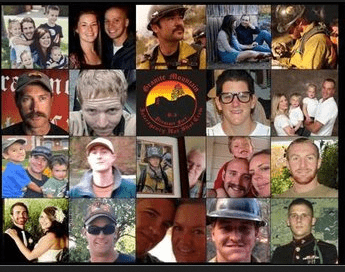
Yarnell Crew

From the New York Times:

PHOENIX — A state safety commission recommended fines totaling $559,000 against the Arizona State Forestry Division on Wednesday, saying the agency wrongly put the protection of “structures and pastureland” ahead of the safety of firefighters battling a wildfire in central Arizona last summer, including 19 who died trapped by the flames at the base of a mountain.

A commission report said the forestry division had kept the firefighters on the mountains even after commanders realized that they could not control the flames burning through the parched, thick chaparral along the western edge of the old gold-mining village of Yarnell, 80 miles northwest of Phoenix.

In the report, inspectors for the Arizona Division of Occupational Safety and Health said the agency’s actions resulted in “multiple instances of firefighters being unnecessarily and unreasonably exposed to the deadly hazards of wildland firefighting.”

The inspectors wrote that the agency did not protect the firefighters from “recognized hazards that were causing or likely to cause death or serious physical harm.”

The investigators recommended that the forestry division pay a penalty of $70,000, and $25,000 per firefighter who died, to be paid directly to their families or estates, a total of $545,000. Penalties of $14,000 were recommended for other safety infractions.

Read more at the New York Times.

How likely is a home to burn in wildfire? New scale rates the risk

Below are excerpts from Rob Chaney’s article in today’s Missoulian:

It’s common to assume the walls of flame under a towering smoke column pose the biggest threat in a wildfire, said Jack Cohen, a scientist at the Rocky Mountain Research Station in Missoula. That’s true for people, but not for houses.

“The same heat radiation that on my exposed skin will give me a second-degree burn in 5 seconds, takes 27 minutes to ignite wood,” Cohen said. “Firefighters are way more vulnerable to big flames than a house is. That tends to skew what we pay attention to.”

In most of the lost-house incidents he has studied, Cohen found the residential destruction took place eight to 10 hours after the big flame front moved through. That’s when embers finally ignited piles of pine needles in a rain gutter, or leftover lumber under a deck, and eventually burned the house down.

“Unless houses are mitigated to be ignition-resistant, firefighters can’t be effective in well-developed residential areas,” Cohen said. “There aren’t enough firefighters and resources to assist and suppress ignitions on all houses exposed.”

Several new tools have appeared in the past year that may make the homes lost in Lolo Creek less common. A fire hazard scale developed by the National Institute of Standards and Technology and U.S. Forest Service can suggest changes in building codes similar to how the Richter Scale defines risk in an earthquake region.

Last month, a task force gathered by Colorado Gov. John Hickenlooper proposed a way to rank homes based on fire risk. [Note: We discussed the findings of the task force on the blog here.]  Montana Building Association government affairs specialist Dustin Stewart attended the conference where it was unveiled.

“Every home would be given a grade on a sliding scale from 1 to 10 to determine its susceptibility to wildland fire,” Stewart said. “It’s not entirely clear who would use the grade. Insurance companies could potentially use it when developing policies for wildfire. Or it could trigger a mandatory fire mitigation for those homes with high grades.”

Stewart said the Colorado Homebuilders Association members he talked with were not in favor of the plan, warning it could “hang a scarlet letter on the house.”

“It could severely impact resale value,” he said. “And it becomes very politically unpopular when you tell 10,000 residents across the state they have to disclose this number when they sell their house.”….

“The ignition zone is usually on private property, and that changes the social dynamics,” Cohen said. “We don’t have the authority to go in and tell people to make changes or to make changes ourselves. We have to have homeowner agreement, engagement and participation in reducing their vulnerability.”

In other words, labeling people from space won’t save any houses next summer. Stewart, at the Montana Homebuilders Association, had a similar observation.

“I think incidents like Hurricane Sandy, the Oklahoma tornadoes, the wildfires in Colorado – they’re going to become a bigger part of the public discussion in new construction standards,” Stewart said. “But there are things people can do without creating another level of government. That’s a nice thing about living in Montana. We don’t need to reinvent the wheel every time there’s a storm or fire. We can find a solution that isn’t heavy handed and gets the job done. There may be a big national debate, but the tenor is different as a result of where we live. It would help everyone if a few more homeowners would take care of a few simple things on the to-do list before we enter that debate.”

See also:

Fire Prevention Plans: “Almost impossible unless we have a different mindset”

CO Task Force: Homeowners should pay to live in burn zones; developers/real estate industry oppose parts of plan

Lolo National Forest: “Hunter” Shoots Pet Malamute with Rifle while Dog was 15 yards from Cross-Country Skiing Owner

Dog shot

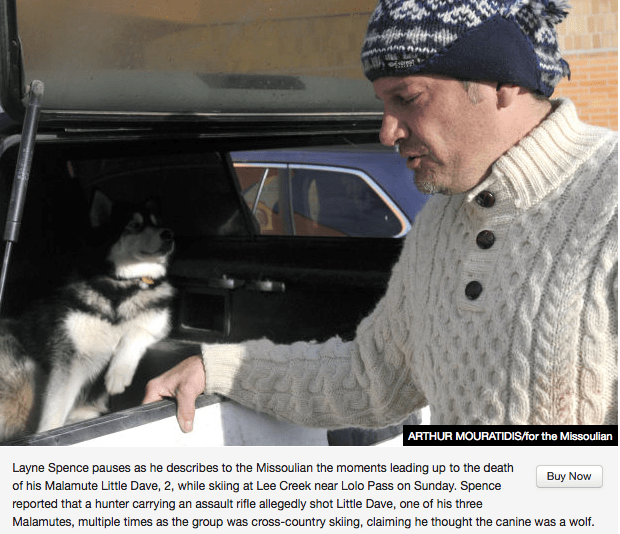
I’m just back from a few days of elk hunting in the Beaverhead-Deerlodge National Forest and woke up this morning to learn about this terrible, irresponsible, unnecessary tragedy, which happened to a guy well-known in Missoula simply as the “Malamute Guy.”

Layne Spence was cross-country skiing on a popular portion of the Lolo National Forest near Lolo Pass when, according to this morning’s Missoulian, this happened:

Layne Spence was skiing with his three dogs on a quiet logging road in Lee Creek when, according to Spence, a rifle shot echoed through the air.

Then, Spence saw his 2-year-old brown and white dog, “Little Dave,” fall down with a shot to a leg.

About 15 yards away from him and his dogs, Spence saw a man in camouflage holding an assault weapon.

“I started screaming ‘Stop, stop,’ and the man kept shooting,” said Spence, 48, and who is often seen walking his dogs around Missoula’s river front. “And he kept shooting.”

“My dog is lying there, dead and I shouted ‘What are you doing?’ and the guy said, ‘I thought it was a wolf.’ ”

After the man allegedly shot Spence’s dog six times, he took off without another word, leaving Spence to deal with the tragedy of his dead dog….

“This doesn’t have to happen,” said an obviously distraught Spence. “Not every big dog is a wolf. These are pets, they all had their collars and lights on, they were all with me the entire time.

“People need to know what a wolf looks like before they start shooting,” he said. “And I was standing right there.

“What if I had a child on a sled, what would have happened if a bullet ricocheted?”

“There are other people who use the woods besides hunters this time of year.”

Make no mistake, I’m seething in anger about this tragedy.  Mr. Spence is entirely correct that other people besides just hunters use their public National Forest lands this time of year.  What about their rights as tax-paying Americans?  They have every right to use their public lands for hiking and crossing country skiing.

One question I have is should the Forest Service allow assault-rifle carrying wolf “hunters” to roam the woods in the middle of popular, high-use recreation areas? Another question deals with the increased use of assault rifles by some hunters. Should it be allowed? [UPDATE:  The Missoulian has updated the story and now says an assault rifle wasn’t used in the shooting of this pet dog.] However, the question still remains.  The practice seems to be taking off among some hunters, at least here in Montana, and this year I’ve heard more rapid “herd shooting” with these modified assault rifles than ever before.

UPDATE: In his own words, this is the account of the tragedy posted on Facebook by Layne Spence, owner of the dog:

What is on my mind is the tragedy that has taken place and the miss quotes from the media and the Sheriffs dept. So I am setting the record straight. This is what happened….

I went crosscountry skiing up at Lee Creek campground where I have gone in the past. Knowing it was hunting season I put the bright lights that are on all three of my dogs collars.

After skiing for about 200-300 yards I here “tat”, my dog in front of me, his rear leg is blown off.  I scream “no,no,no,stop stop” and as I near my dog who was 15 yards in front of me I hear “tat,tat,tat,tat.”

I look up and there is the “hunter” and I screamed “what have you done?” Screaming hysterically, the man says ” I thought it was a wolf.”

I said “You just killed my dog, you killed one of my kids.”

I started screaming “noooooo.”  He started to say something like “can I do something,” not I am sorry.

I said “Do you know what a wolf looks like? You killed my dog.”

The man took off, I just screamed “noooooooo” and tried to put him back together but his leg was torn off and yes 15 yards in front of me and yes he was shot with an ASSAULT rifle, I know I have seen them it was either an AR 15 or AR 14. It was all black had a sound supressor and that was why no big BOOM BOOM semi automatic.

I know guns, I don’t have any but I have shot them before, and yes I have hunted both Bow and Rifle. It is the irresponsible hunters who think they can shoot any animal they see if they are in the woods.

The MT Fish and Wildlife said they couldn’t press any charges because it wasn’t a game animal on the road, it was a domestic animal. What???? Bullshit, So I left my skiis and poles there, put my Little Dave’s bloody and broken body on my shoulder and hiked out to also get my other dogs to safety.

So no charges, I call the police dept who gives me examples of people getting hurt because of the public outcry and are afraid of vigilante violence. But the truth is still one of our rights and so is freedom of speech. I don’t want this guy to get hurt , but something needs to be done…I am heart truly heart broken, everything I do is for my dogs, from where I live, to what I drive, and what I do is predicated on the lives of my dogs…Thank you to everyone who has wished myself and my other dogs Frank and Rex well…Layne

Could You Participate in Gallatin Collaborative’s 3 Day, 27 Hour Workshop on Thurs, Fri, Sat?

We’ve had many discussions and debates on this blog over the past few years about the roll of collaboration in federal public lands policy and management. For example, last week we shared an opinion piece from the Swan View Coalition (Montana) offering up that organization’s perspective on how some of the collaborative processes in their neck of the woods are playing out.  Keith Hammer wrote:

Swan View Coalition will always follow the legally required National Environmental Policy Act (NEPA) public involvement process and will participate in optional collaborative processes as time and funds allow. We appreciate both as avenues to better understand all interests and issues.

For my money, one of the more interesting dynamics of all this “collaboration” springing up regarding public lands management is the tremendous amount of time, resources and funding needed for an individual, organization or private business to fully participate in the plethora of optional collaborative processes.  Off the top of my head I can think of at least 10 different optional collaborative processes taking place across the state of Montana (Size: 147,164 sq miles) that deal directly with US Forest Service management.

Complicating the issue – at least here in Montana – is the fact that some of those able to participate in the more controversial optional collaborative processes in Montana aggressively and endlessly take to the media to publicly criticize those individuals and groups that lack the time, resources and funding to participate in these optional collaborative processes.  Of course, ironically some of these collaborators don’t actually fully participate in the legally required NEPA public involvement process.  Unfortunately such facts don’t stop some of these folks from intentionally confusing the public by making it seem that those who fully participate in the legally required NEPA public involvement process aren’t participating in any public process.

In March of 2012 I shared a new, extensive report from Caitlin Burke, Ph.D., with the Department of Forestry and Environmental Resources at North Carolina State University, who wanted to know about the factors that affect state and local environmental groups’ participation in collaboration, and how that affects representation, diversity, and inclusion in collaborative processes.

Burke set out by collecting data from eleven western states (Arizona, California, Colorado, Idaho, Montana, Nevada, New Mexico, Oregon, Utah, Washington, and Wyoming), conducting a survey of 101 environmental groups that addressed forest-related issues and operated in the study area.  The survey gathered information about the organizations and their attitudes and behaviors toward collaboration to test relationships between organizational characteristics and strategy choice.  Here’s what Burke found:

“The results show that large, more professionalized organizations and those with multiple values use a collaborating strategy; small, less professionalized organizations and those with a single environmental value use a confronting strategy. In other words, collaboration is not representative of all environmental groups – smaller groups and more ideological groups are not involved. This research serves as a caution to those who would use, or advocate the use of, collaboration – its use must be carefully considered and its process carefully designed to ensure the most balanced representation possible.”

“If smaller, more ideological environmental groups are not involved in collaborative decision-making, then collaboration is not representative of all affected interests and collaborative decisions do not reflect the concerns of all stakeholders.”

Now, while Burke’s research was limited to environmental groups that addressed forest-related issues, it’s not a stretch to assume that these same time, resource and money constraints impact the ability of other individuals, smaller organizations of all kinds and private businesses to fully participate in these numerous, optional collaborative processes. For example, while it’s likely that a timber mill with 150 employees could afford to send a representative to an all day, mid-week optional collaborative meeting, it’s less likely that a logging contractor with 5 employees could afford the same luxury for an optional process.  The same goes for a working family with kids, or a college student with 18 credits and a part time job.

So, the reality is that most of the time these optional collaborative processes are made up almost entirely of paid Forest Service staff, paid environmentalists from well-funded, politically-connected organizations, paid logging industry representatives (who also happen to be very politically connected) and retirees (which often times, based on observations, are recently retired from the Forest Service or the logging industry).

So, if that’s the case, as Dr. Burke pointed out, such forms of “collaboration [are] not representative of all affected interests and collaborative decisions do not reflect the concerns of all stakeholders.”  I’d even go a step further and question how such a dynamic and make-up in some of these “collaborations” is really much different from the concept of the “King’s Forest” that existed throughout much of Europe at one time, and which was subsequently entirely rejected by early Americans going back to the late 1700s.

What got me re-thinking about these dynamics this morning was the following announcement from the “Gallatin Community Collaborative,” which was established in May of 2012 around management issues in the Hyalite-Porcupine-Buffalo Horn Wilderness Study Area on the Gallatin National Forest, Montana.

The announcement raises a number of questions.  Would you be able to participate in 27 hours worth of optional collaborative process meetings over 3 straight days (including 9 hours on Thursday and 9 hours on Friday)?  How about other working people, or college students, who aren’t paid to sit around the table?  And if you can’t manage to set aside 18 hours over two entire mid-week days and 9 hours on a Saturday to travel to Bozeman, MT to participate in an optional collaborative process in an attempt to come to some agreements on how to manage a Wilderness Study Area that equally belongs to all Americans, how would you feel if some of those paid to be at the table publicly criticize the inability of others to participate in such a laborious optional collaborative process?

As more and more optional collaborative processes spring up around the country concerning the management of America’s federal public lands hopefully others will rise up and ask similar questions.

Dear friends interested in the Gallatin Collaborative:

First, to those of you who participated in the initial workshops for the Gallatin Community Collaborative (GCC) earlier in October, thank you for the time and energy that you invested in those workshops.

In those five community workshops, held in Big Sky, Bozeman, Livingston, and Emigrant, participants respectfully listened to each other to develop an initial list of unresolved issues, identified concerns, began the development of a common vision, and began exploring steps to accomplish that vision. During the next several months, we will work together toward successfully resolving many of those issues. A report will be forthcoming from these first workshops and will be posted mid-November on the GCC website.

We have a few things to share coming out of that October workshop:

NOVEMBER WORKSHOP: As our next step, the Collaborative will undertake a three-day workshop, bringing the interested parties from the various communities together, to begin resolving issues related to community empowerment and begin building community capacity to resolve the numerous issues identified in the first workshops. The dates and locations of this workshop are:

Nov. 21 (Thursday), 8am – 5pm in Bozeman at the Gallatin County Fairgrounds, Bldg. 4*

Nov. 22 (Friday), 8am – 5pm in Bozeman at the Gallatin County Fairgrounds, Bldg. 4

Nov. 23 (Saturday), 8am – 5pm in Bozeman at the Gallatin County Fairgrounds, Bldg. 4

Continental breakfast and lunch will be provided each day of the workshop.

The workshop is designed as a 3-day workshop, in which participants would ideally come for the full three days. We recognize that this is a significant time commitment for participants, and we hope that participants are able to be present for the full period of time. This is a complex issue and very important to the wider community. Many of you have already spent substantial time over numerous years. It requires a different approach to successfully resolve. Two hours here, four hours there… hasn’t been sufficient in the past. People will need to decide what works best for them in terms of participation. We hope you will give as much time as you can to this workshop; we’d like to make sure we invest the time to get this issue resolved successfully.

While participating for all three days is important, we understand that may not be feasible for everyone. You will be welcome at whatever sessions you can attend, but you may need to rely on other participants to bring you along and update you on what you may have missed.

Since we want to ensure as much opportunity as possible to provide your input into the process and to build on what we learned from the October workshops, we will provide another chance to engage for those of you who cannot attend the three-day workshop, bringing the Collaborative discussion into more Gallatin Range communities: we are adding a few evening meetings earlier in the week. These meetings will take place at the following locations and times:

Nov. 18 (Monday) from 6-9pm in West Yellowstone at the Holiday Inn (315 Yellowstone Ave.)

Nov. 19 (Tuesday) from 6-9pm in Gardiner at the Best Western Plus (905 Scott St. W.)

Nov. 20 (Wednesday) from 6-9pm in Livingston at the Best Western Yellowstone Inn (1515 W. Park St.)

Refreshments will not be provided at these meetings; please bring what you need to be comfortable.

If you plan to participate in the workshop or evening meetings, please register using this link on the Gallatin Collaborative website.

We will have a second three-day workshop in January or February, addressing issues around the themes of change and/or scarcity, depending on what we learn in November. We will be able to announce those dates at the November workshops.

ROLE OF THE US FOREST SERVICE: A number of you asked questions about the role of the US Forest Service in the Collaborative process, given that the government shutdown was underway during the October workshops. The Forest Service will be participating in the November workshop and is looking forward to getting back on track with this group. For more on the Gallatin NF’s role in this process, see the Collaborative website.

SUPPORTING THE GCC: Finally, a foundation supporting the work of the Collaborative has provided a “challenge grant,” offering to match dollar-for-dollar each dollar raised from local individuals and organizations by the end of 2013, up to a total of $7,000. This support will help the Collaborative by providing needed funds for meeting space, meals and refreshments, and other costs. We still have $4,000 to go to achieve this match, so if you’re interested in helping to support the Collaborative, please send a check to our fiscal sponsor: Park County Community Foundation, PO Box 2199; Livingston, MT 59047 and please note “GCC” in the memo line of your check. Thanks so much for your support.

Thank you again for your time and interest in this important process,

Jeff Goebel, Facilitator
For the Exploratory Committee of the Gallatin Collaborative

UPDATE: The following information was just sent to me from Travis Stills….thanks Travis.

From: Federal Advisory Committees: An Overview, Wendy R. Ginsberg, Analyst in American National Government, April 16, 2009, Congressional Research Service,  7-5700, www.crs.gov, R40520

According to GSA’s FACA Database, in 2008, the federal government spent more than $344 million on FACA committees — including operation of advisory bodies, compensation of members and staff, and reimbursement of travel and per diem expenses. According to GSA, $39.8 million was spent on committee member pay (both federal and non-federal members) and $166.2 million was spent on staff. An additional $14 million was spent on consultants to FACA committees.

UPDATE 2:  Another 3 days worth of meetings, covering 24 hours, was just announced by the Gallatin Collaborative.  I hear Bozeman, MT is really easy (and cheap) to drive into or fly into during January.

Dear Friends,

On behalf of Jeff Goebel, the GCC Exploratory Committee wants to sincerely honor and thank you for your hard work and participation in the recent 3-day workshop at the County Fairgrounds.

It was a powerful and insightful time together. As you all know, this is a marathon not a sprint, but significant progress is being made. The issues we covered and questions answered are not what many of us expected, but they are equally as important as any of the traditional on-the-ground concerns. We are off to a great start.

The entire group of October Collective Statements, along with updated FAQs and materials from the November workshop,  will be posted on the GCC website at www.gallatincollaborative.org before the next scheduled sessions beginning January 9.  Below are the details on the January GCC workshop. Please forward this to anyone interested in the process, and encourage them to attend any or all of these meetings.

The purposes of the January meetings will be to explore the change that is desired for the communities surrounding the Gallatin Range, design the operating structure of the Gallatin Community Collaborative, and develop new and more effective ways of valuing the people involved in the region.

Thursday, January 9 – 1:00pm to 9:00pm

Friday, January 10 – 1:00pm to 9:00pm

Saturday, January 11 – 9:00am to 5:00pm

Best Western
1515 W Park St

Livingston, MT

Food and refreshments will be served.
RSVP at www.gallatincollaborative.org

If any of you are interested or planning on practicing the consensus building skills Jeff has been sharing with our community and you are looking for support or have questions, please don’t hesitate to reach out to the Exploratory Committee at [email protected]. Be sure to include this email in your Contact list to avoid it getting sent to the junk folder.

May you all have an enjoyable and safe Holiday season and we look forward to working with you all again soon.

With Respect & Gratitude,

Jeff Goebel

Swan View Coalition Shares Perspective on Collaboration

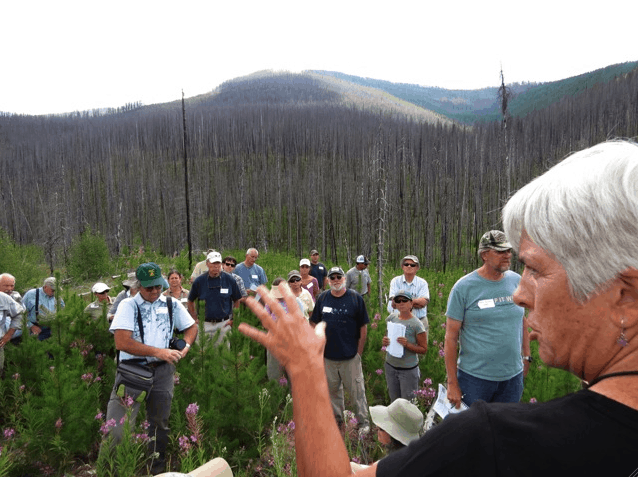
Snapshot of the Flathead National Forest (MT) Plan Revision field tour on the Tally Lake Ranger District, August 2013. That's New Century of Forest Planning commenter Dave Skinner with the camera, green hat and snazzy shirt. Photo by Keith Hammer.
Snapshot of the Flathead National Forest (MT) Plan Revision field tour on the Tally Lake Ranger District, August 2013. That’s New Century of Forest Planning commenter Dave Skinner with the camera, green hat and snazzy shirt. Photo by Keith Hammer.

(The following two columns are guest posts from Keith Hammer with the Swan View Coalition in Kalispell, Montana. Feel free to make comments below, but if you have any specific questions regarding the Swan View Coalition’s perspective on collaboration, please contact Swan View Coalition directly. Thank you. – mk)

Swan View Coalition on Collaboration
By Keith Hammer

Swan View Coalition will always follow the legally required National Environmental Policy Act (NEPA) public involvement process and will participate in optional collaborative processes as time and funds allow. We appreciate both as avenues to better understand all interests and issues.

But we have seen the collaborative process abused by federal agencies and key “stakeholders.” In 1997, national “conservation” groups joined industry in insisting its Flathead Common Ground logging plan be called “ecologically-driven vegetation treatments,” even though the scientific panel they asked to review their proposal disagreed and concluded “The desire to harvest timber products should be explicitly recognized here as the driving force.” This oft-repeated collaborative myth allows industry to argue old logging roads are ecologically necessary to log the forest back to health!

In 2012, the SW Crown Collaborative down-played opportunities for road decommissioning to benefit fish and wildlife in the Swan Valley, based on a mistaken report by the Flathead Forest Supervisor that “the Swan RD has already decommissioned 800 miles of roads . . .” We had to correct the record by providing the Supervisor’s own spreadsheet indicating less than 10 miles of road have been decommissioned in the Swan Valley! Who’s on watch here?

Forest-based collaboratives are skewed toward logging as “forest restoration,” rather than including a robust consideration of road decommissioning and other time-proven means to restore over-logged and over-roaded forests. Indeed, National Forest Foundation’s “A Roadmap for Collaboration Before, During and After the NEPA Process” helps institutionalize the assumption that trees must be removed to restore forest ecosystems. It offers the following tip: “It can be helpful when in the field to ask stakeholders what they would do to improve the condition of the project area. In the case of forest restoration, it can be as simple as asking stakeholders which trees they would leave on the landscape and why.”

We will continue to provide the Forest Service with the scientific research – most of it its own – indicating most forests suffer from too many roads and motorized vehicles, not too many trees. We’ll always do so through the NEPA process and will via the collaborative process when able. But we’ll continue to file lawsuits when necessary to prevent the Forest Service from continuing to create a landscape “pocked with clearcuts and criss-crossed by roads” (see the comments of Former USFS Chief Jack Ward Thomas below) and we’ll refuse to be marginalized simply because we dare speak up and advocate for fish and wildlife.

Why Collaboration and What’s the Fuss?
by Keith Hammer

Definitions of collaboration include “working together” and “traitorous cooperation with an enemy.” Over the past several decades, the Forest Service has increased its use of collaboration to forge consensus among key “stakeholders.”

This has allowed it to marginalize those of lesser means or not in agreement with social compromises that again “cut the baby in half” and perhaps violate laws protecting fish, wildlife, and water quality. Indeed, the National Forest Foundation’s “A Roadmap for Collaboration Before, During and After the NEPA Process” warns of the significant expenditures of “time, effort, funds and social capital necessary for an ongoing collaborative process.”

Current Forest Planning regulations urge that an optional collaborative process precede then parallel the National Environmental Policy Act’s (NEPA) public involvement process. And therein lie two aspects of the rub: 1) collaborators get to front-load the process with their proposals while, 2) many folks who can’t afford to do both must choose whether to collaborate or follow the legally required NEPA process.

The process of seeking consensus through collaboration remains contentious, especially when the Forest Service and industry use it to enlist enough folks to agree with them so they can marginalize those who disagree. Consider these quotes:

“Between private lands and public lands the world that was once covered with a sea of green was now pocked with clearcuts and criss-crossed by roads. But we still continued until we were faced with a segment of the public that had a differing view of what their national forests should be.”
– Former USFS Chief Jack Ward Thomas (Chronicle of Community Vol. 3, No. 1, 1998)

“[W]hen local environmental groups and timber representatives learn to reach consensus . . . that will marginalize extremists.”
– Former USFS Chief Jack Ward Thomas (Daily Inter Lake 6/8/97)

“We need to find common ground so the people who want to litigate are marginalized.”
– Former Assistant Secretary of Interior Rebecca Watson (Missoulian 11/28/02)

“The Collaborative Forest Landscape Restoration Act . . . is largely being used to circumvent existing environmental laws and give control of the management of our National Forests to local special interests.”
– Al Espinosa and Harry Jageman, retired USFS fisheries and wildlife biologists (Letter to Senate Subcommittee on Public Lands and Forests 8/21/10)

“I believe that we . . . have public lands that belong to all people . . . I fear that localized decisions are usually based on ‘How much can I get now?’”
– Former Lewis and Clark National Forest Supervisor Gloria Flora (Chronicle of Community Vol. 3, No. 1, 1998)

“There’s something unreasonably comfortable about focusing primarily on alternative structures for decision making instead of the issues that lie at the heart of the debate.”
– Economist Tom Power (Chronicle of Community Vol. 3, No. 1, 1998)

“Consensus is the process of abandoning all beliefs, principles, values and policies in search of something in which no one believes; but to which no one objects; the process of avoiding the very issues that have to be solved, merely because you cannot get agreement on the way ahead. What great cause would have been fought and won under the banner, ‘I stand for consensus’?”
– Former UK Primer Minister Margaret Thatcher

Fire Prevention Plans: “Almost impossible unless we have a different mindset”

Huge kudos to Missoulian/Ravalli Republic reporter David Erickson for one of the best, factual and most candid looks at the issue of home/community wildfire protection, which appeared in today’s paper. Honestly, I have to believe that one of the reasons this article is so complete and interesting is because the reporter must have taped the entire conversation. So instead of a garbled collection of one sentence sound bites, the public gets huge chucks of information from Montana DNRC and U.S. Forest Service fire experts, spoken in their own words.

From my perspective, the heart of the article is the simple fact that way, way too many homeowners living in the Wildland-Urban Interface simply don’t take responsibility for conducting proven and effective FireWise measures, which need to occur on a pretty regular basis, and certainly long before a wildfire is cresting the ridge. Remember, on the Lolo Creek Complex fire professional “firefighters [from as far away as North Carolina] had been relegated to raking pine needles from yards while others cleared brush and limbed up trees surrounding homes.”  Yet,  many times (as the article points out) these are the same people who complain the loudest when U.S. Forest Service, state DNRC and even local volunteer fire department crews aren’t able to save their house during a wildfire.

The article really cuts to the heart of the issue regarding some of the politics in Montana, including what can best be described as simply anti-government sentiments.

The situation described by US Forest Service and Montana DNRC fire experts also seems to contradict one of the common refrains I hear all the time in Montana, and also on this blog when we talk about wildfire in places like Colorado’s Front Range. Basically, while some people want to give the impression that homeowners, neighborhood associations and communities have done absolutely everything possible to get FireWise and prepare for the wildfire, and all that’s left to do is increase “fuel reduction” efforts on public Forest Service lands, the experts in this article paint a much different picture. Perhaps this is just the situation and mindset in Montana, so I’m curious to see what others have experienced.

Finally, I also must highlight that the point made by Montana State Forester Harrington regarding the fact that “thinning and pre-treating forests” really doesn’t work when you have single-digit humidity, 95+ temperatures and high winds is basically the same exact point that environmentalists have been trying to make for the better part of two decades now. Reader’s may recall George Wuerthner’s piece “Wind Drives All Large Blazes,” posted on this blog as the Lolo Creek Complex fire was burning.

Please do read David Erickson’s entire article. Below are some highlight snips:

LOLO – How do you reconcile the fact that many private landowners in Montana are resistant to the government and local fire managers telling them what to do with their land when those same private landowners become outraged after a wildfire burns their property that wasn’t properly taken care of beforehand?

That’s the question a group of state legislators grappled with when they met with Bitterroot Valley fire managers and Montana Department of Natural Resources forestry officials on Thursday to tour the remains of the 11,000-acre Lolo Complex fire that ripped through the Highway 12 corridor west of Lolo this past August….

State Sen. Cliff Larson of Frenchtown, who represents Senate District 50, said he lives near where the Black Cat fire torched 12,000 acres in 2007.

“I know the Frenchtown Fire Department tried to work with local landowners on fuel reduction programs and protecting against fire hazards,” he recalled. “People said, ‘Just get off my property, don’t tell me what to do.’ And there are two people that I know of personally that were outraged when the fire department didn’t come there right away and because they had 15 cords of wood stacked behind their house they had to hose them down to protect their house.

“And they are outraged that they didn’t get that attention, even though the fire department went there in advance and warned them that they have some serious fire hazards right there on their property. And those two families are still complaining. So how do we force people to cooperate with the DNRC and the fire departments and the Forest Service? It’s frustrating.”

Bob Harrington, the Montana DNRC state forester, said that community wildfire prevention plans are really good in some counties but not great in others.

“We in the fire service have been at it for 15 to 20 years now, really intensely trying to impress on those homeowners that live in the wildland/urban interface to treat their property,” he explained. “We do public media, we do workshops, and there are individual consultations that the fire departments do, that our folks do. A lot of the landowners do it and take advantage of it. But we have a lot folks that that isn’t enough of an incentive yet. Whether it’s pressure from insurance, pressure from banking or peer pressure from their neighbors. Sometimes that works, sometimes that doesn’t. Unfortunately, sometimes we as Americans, there’s a lot of us that don’t respond unless it hits us in the wallet.”…

The fire managers agreed that the Lolo Complex’s main blowup was the type of fire behavior that is not easily controlled….

Harrington said a variety of factors contributed to the fire’s wild blowup.

“That’s a part of the public dialogue that we’ve been having since this fire happened,” he said. “We have folks on one side who are saying, ‘See, forest management doesn’t do anything to stop forest fires,’ because there was so much Plum Creek land that had been managed, and that also burned. The reality is, when we are talking about thinning and pre-treating forest, we’re not talking about fires like this. This was one of the most extreme fire days that you are going to see in western Montana. Single-digit humidity, close to triple-digit temperatures, and then winds 20, 30 and 40 miles per hour.

“The analogy I always give is that we still give flu shots even though we have influenza outbreaks because we are trying to minimize the effect of that, so we’re still treating forests. Reducing fire risk and prioritizing some sections in the wildland urban interface, and it gets a little bit trickier on private land and industrial forest land, which the majority of this fire happened on, areas that had been intensively managed in the past. A lot of what carried the fire was second-growth trees. Everything was burning, grass and downed logs, everything.”

Harrington said he has noticed that some landowners take advantage of educational programs and cost-sharing programs to prepare their land for fire danger, but others do not….

“So the innovators that understand where they live, they’ve taken advantage of it. But even then, like these guys saw managing this fire, we had a lot of folks in Sleeman Gulch where we had firefighters out there doing that work at the last minute.”….

Ehli said that in his experience, telling property owners what they need to do on their land to mitigate fire danger isn’t going to work.

“When we start talking about a wildfire prevention plan, I was the chief of the Hamilton Volunteer Fire Department when that came through and there was a huge pushback,” he said. “Oh my God, the resistance you got from county personnel, county commissioners and huge, huge pushback. So when you start talking about a community wildfire prevention plan, it’s not as simple as drawing lines on a map. Not only because of the enormous amount of property you have to think about, but also the political aspect as well.

“So we have got to be honest with ourselves when we start talking about prevention plans, I’m going to say it, it’s almost impossible unless we have a different mindset put in. And maybe we’re going to get there someday within the state of Montana and get people on board and get property owners on board about what we need to do, but we’ve really got to talk about the near impossibility of getting something like this in play, mostly from the political standpoint.”….

Liane said that he hopes a fire like the Lolo Complex will convince people to listen to local fire departments about taking steps to protect their property during the winter.

“Those of us who have served in natural resources committees would love to hear more about how do you convince those individuals who are knotheads to take the firewood off their back porch?” he said. “We need to build a plan that encourages people through local service activities, and the fire department in Frenchtown is very proactive. They have the same problem that Lolo does. People are sitting ducks when a fire like this comes through.”

Hansen said not a lot has changed since the big fires of 2000 rolled through the Bitterroot Valley.

“It’s the short-term memory thing that kills us,” he said. “I mean, if you had come down here last winter knocking on doors to sell people on the idea of fuel treatment, they would have told you to pound sand. Now the next three years, they’ll be begging for it. And three years from now they’ll have forgotten how bad the fire was. And we’ve seen it happen since the fires of 2000. You know, two years after the fire, they are back to not wanting anybody to tell them what to do.”

“Until the fire comes knocking at their door,” Ehli added.