GOP attack on ESA fueled by “Tea Party Fantasies” by Bob Berwyn

You can read Bob’s entire article over at the Summit County Voice.  Apparently the House GOP report also failed to cite any peer-reviewed science.

Below is the first paragraph of Bob’s article.

Anti-environmental Republicans in the House are once again twisting the facts and distorting science in their efforts to dismantle the Endangered Species Act on behalf of various extractive and environmentally harmful industries.

Also, last Thursday, Rep Doc Hastings (R-WA), the GOP Chair of the House Resources Committee, announced that he will not seek reelection this year.

Of Wolves and Wilderness

The following guest column was written by George Nickas, executive director of Missoula-based Wilderness Watch, and one of the nation’s leading experts on  Wilderness Act policy and management.  Please consider this opinion piece a follow-up to this January 8 post. – mk

Of Wolves and Wilderness
By George Nickas

“One of the most insidious invasions of wilderness is via predator control.” – Aldo Leopold, A Sand County Almanac

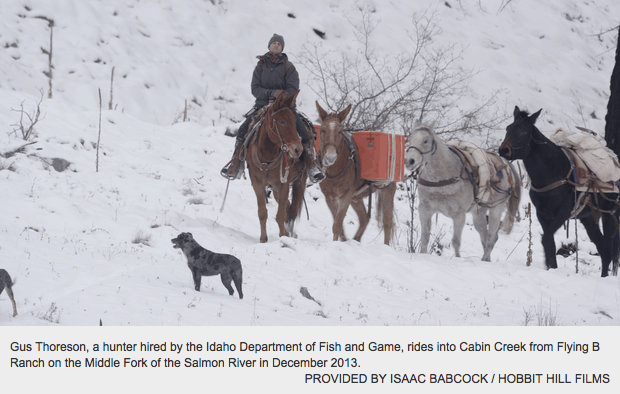
Right before the holidays last December, an anonymous caller alerted Wilderness Watch that the Forest Service (FS) had approved the use of one of its cabins deep in the Frank Church-River of No Return Wilderness (FC-RONRW) as a base camp for an Idaho Department of Fish and Game (IDFG) hunter-trapper. The cabin would support the hired trapper’s effort to exterminate two entire wolf packs in the Wilderness. The wolves, known as the Golden Creek and Monumental Creek packs, were targeted at the behest of commercial outfitters and recreational hunters who think the wolves are eating too many of “their” elk.

Idaho’s antipathy toward wolves and Wilderness comes as no surprise to anyone who has worked to protect either in Idaho. But the Forest Service’s support and encouragement for the State’s deplorable actions were particularly disappointing. Mind you, these are the same Forest Service Region 4 officials who, only a year or two ago, 
approved IDFG’s request to land helicopters in this same Wilderness to capture and collar every wolf pack, using the justification that understanding the natural behavior of the wolf population was essential to protecting them and preserving the area’s 
wilderness character. Now, somehow, exterminating those same wolves is apparently also critical to preserving the area’s wilderness character. The only consistency here is the FS and IDFG have teamed up to do everything possible to destroy the Wilderness and wildlife they are required to protect.

Wilderness Watch, along with Defenders of Wildlife, Western Watersheds Project, Center for Biological Diversity, and Idaho wildlife advocate Ralph Maughan, filed suit in federal court against the Forest Service and IDFG to stop the wolf slaughter. Our suit alleges the FS failed to follow its own required procedures before authorizing IDFG’s hunter-trapper to use a FS cabin as a base for his wolf extermination efforts, and that the program violates the agency’s responsibility under the 1964 Wilderness Act to preserve the area’s wilderness character, of which the wolves are an integral part. Trying to limit the number of wolves in Wilderness makes no more sense than limiting the number of ponderosa pine, huckleberry bushes, rocks, or rainfall. An untrammeled Wilderness will set its own balance.

The FS’s anemic defense is that it didn’t authorize the killing, therefore there is no reviewable decision for the court to overturn, and that it was still discussing the program with IDFG (while the trapper was in the field killing the wolves). Unfortunately, the district judge sided with the FS and IDFG, so we filed an appeal with the Court of Appeals for the Ninth Circuit. Rather than defend its action before the higher court, Idaho informed the court that it was pulling the trapper out of the Wilderness and would cease the program for this year. In the meantime, nine wolves are needlessly dead.

We will continue to pursue our challenge because the killing program will undoubtedly return. The Forest Service can’t and shouldn’t hide behind the old canard that “the states manage wildlife.”  Congress has charged the FS with preserving the area’s wilderness character and the Supreme Court has held many times that the agency has the authority to interject itself in wildlife management programs to preserve the people’s interest in these lands. Turning a blind-eye is a shameful response for an agency that used to claim the leadership mantle in wilderness stewardship.

Wilderness Watch expresses its deep appreciation to Tim Preso and his colleagues at Earthjustice for waging a stellar legal battle on our behalf and in defense of these wilderness wolves.

George Nickas is the executive director of Wilderness Watch. George joined Wilderness Watch as our policy coordinator in 1996. Prior to Wilderness Watch, George served 11 years as a natural resource specialist and assistant coordinator for the Utah Wilderness Association. George is regularly invited to make presentations at national wilderness conferences, agency training sessions, and other gatherings where wilderness protection is discussed.

Examining Historical and Current Mixed-Severity Fire Regimes in Ponderosa Pine and Mixed-Conifer Forests of Western North America

The other day I got the following note and link to some new relevant research from Douglas Bevington, author of The Rebirth of Environmentalism: Grassroots Activism and the New Conservation Movement, 1989-2004.  Bevington’s note is shared below with his permission, along with a link to the new study and article. . – mk

——————

I wanted to let you know about an important new study that was just published by the high-profile science journal PLOS ONE. The article, titled “Examining Historical and Current Mixed-Severity Fire Regimes in Ponderosa Pine and Mixed-Conifer Forests of Western North America,” was co-authored by 11 scientists from various regions of the western US and Canada.

Their study found that there is extensive evidence from multiple data sources that big, intense forest fires were a natural part of ponderosa pine and mixed-conifer ecosystems prior to modern fire suppression. These findings refute the claims frequently made by logging and biomass advocates that modern mixed-severity forest fires (erroneously called “catastrophic” fires) are an unnatural aberration that should be prevented through more logging (“thinning”) and that more biomass facilities should be built to take the resulting material from the forest.

In contrast to these claims, logging done ostensibly to reduce fire severity now appears to be not only unnecessary, but also potentially detrimental when it is based on erroneous notions about historic forest conditions and fire regimes. These findings have big implications for biomass and forest policy, so I encourage you to take a look at this article.

The full article in PLOS ONE is available here.

Here are a few key points from the abstract and conclusion:

Abstract, p. 1

“There is widespread concern that fire exclusion has led to an unprecedented threat of uncharacteristically severe fires in ponderosa pine and mixed-conifer forests of western North America. These extensive montane forests are considered to be adapted to a low/moderate-severity fire regime that maintained stands of relatively old trees. However, there is increasing recognition from landscape-scale assessments that, prior to any significant effects of fire exclusion, fires and forest structure were more variable in these forests….We compiled landscape-scale evidence of historical fire severity patterns in the ponderosa pine and mixed-conifer forests from published literature sources and stand ages available from the Forest Inventory and Analysis program in the USA. The consensus from this evidence is that the traditional reference conditions of low-severity fire regimes are inaccurate for most forests of western North America….Our findings suggest that ecological management goals that incorporate successional diversity created by fire may support characteristic biodiversity, whereas current attempts to ‘‘restore’’ forests to open, low-severity fire conditions may not align with historical reference conditions in most ponderosa pine and mixed-conifer forests of western North America.”

Conclusion: p. 12

“Our findings suggest a need to recognize mixed-severity fire regimes as the predominant fire regime for most of the ponderosa pine and mixed-conifer forests of western North America….For management, perhaps the most profound implication of this study is that the need for forest ‘‘restoration’’ designed to reduce variation in fire behavior may be much less extensive than implied by many current forest management plans or promoted by recent legislation. Incorporating mixed-severity fire into management goals, and adapting human communities to fire by focusing fire risk reduction activities adjacent to homes, may help maintain characteristic biodiversity, expand opportunities to manage fire for ecological benefits, reduce management costs, and protect human communities.”

Timber Changes Reflect Inequality: Wood products companies have busted labor unions and pay less in taxes, all to the benefit of the 1%

The following opinion piece is from Ernie Niemi, president of Natural Resource Economics Inc. based in Eugene, Oregon.

From leaders as diverse as Barack Obama and Newt Gingrich, we’re hearing a desire to rein in the nation’s extreme inequality — inequality in incomes, wealth and political power. It’s about time. The forces underlying inequality have harmed Oregon’s workers, families and communities for several decades, and they undermine our children’s economic future.

Today’s economic inequality is staggering. The top 1 percent — 1.6 million families with incomes more than $394,000 in 2012 — currently captures about 20 percent of the nation’s total income. In contrast, from the end of World War II until 1980, that group collected only about 10 percent of total income.

In recent decades, as the nation’s total income has grown, the top 1 percent has captured an increasing share of the aggregate growth: more than two-thirds since 1993, and 95 percent of all increased income since 2009.

Inequality in Oregon shows similar characteristics. Between 1990 and 2012, the median income (half have more, half have less) of year-round workers remained essentially unchanged, at about $35,000 in 2012 dollars. Not so the richest Oregonians. Over the same period, the top 1 percent saw their incomes increase by about 40 percent, to almost $240,000.

The growth in inequality likely stems from several factors, but two stand out: the decline in labor unions and reductions in taxes. The changes in Oregon’s timber industry illustrates the importance of those trends.

Before the mid-1980s, most timber workers belonged to strong unions and the industry employed about 70,000 to 80,000 workers. Then the industry busted the unions and began cutting labor costs. It did so largely by eliminating jobs, so that it now employs only about 25,000 workers statewide.

Contrary to common belief, most of the job losses have not resulted from environmental restrictions that reduced logging on federal lands. In the 1990s, when most logging reductions occurred, for example, the Forest Service estimates that those restrictions caused only about one-third of the industry’s job losses.

Most job losses stem, instead, from management’s efforts to get rid of workers, replace workers with technology, and avoid hiring workers by shipping logs overseas.

Management also has reduced wages for the industry’s remaining workers. Before the unions were busted, the industry’s average wage was about 40 percent higher than the statewide average for all workers. Now, it has fallen to near or slightly below the statewide average.

If unions had remained in place and kept timber-industry wages 40 percent above the current statewide average, wages in the industry would be about $17,000 more per worker. Do the math.

Statewide, 25,000 loggers and mill workers lose about $425 million in wages per year. For the 3,300 wood-products timber-industry workers in Lane County, the loss is about $56 million per year.

Where does all that money go? Nobody knows for sure. It seems safe to say, though, that much of the money that otherwise would be going to middle class workers now goes, instead, to upper-income owners and managers of timber companies.

The shift has real, negative economic impacts on Oregon’s workers, families and communities. It also negatively affects our children’s future: The greater the degree of income inequality in our society, the greater the consequences if they become stuck on rungs of the economic ladder where incomes remain stagnant or decline.

The timber industry has accentuated these negative effects by obtaining tax reductions. In the early 1990s, the industry paid a severance tax of about $50 million per year on the volume of timber harvested in Western Oregon, with the proceeds going to support various types of public services. In 1993, though, it used the spotted owl’s impacts on federal logging and other arguments to persuade the state Legislature to begin phasing out this tax.

That arrangement contrasts with timber harvest taxes that timber companies — often the same companies that are doing business in Oregon — pay in Washington and California.

In Washington, for example, the industry pays a timber harvest tax dedicated to county governments. If Oregon had a similar tax, it would have provided Lane and other counties in Western Oregon with about $40 million in 2011. That amount would have filled much of the funding gap that has caused counties to lay off workers in their transportation, public safety, health and other departments.

The timber industry’s experience is not unique. The crippling of labor unions in other industries and changes in taxes at all levels of government have shifted income away from workers and middle-class families and to the very rich.

The extreme inequality we see today is not an unavoidable result of natural forces, however. It results, instead, from political decisions our parents and we made in the past.

We can reverse the effects of these decisions. We must do so if we are to arrest the growth in inequality that increasingly is producing an economy, a political system and a society of the people and by the people, but for the rich.

Ernie Niemi is president of Natural Resource Economics Inc. in Eugene.
Research survey does not support logging as beetle outbreak remedy

sixOne of the nation’s leading mountain pine beetle experts is Dr. Diana Six, professor of Forest Entomology/Pathology at the University of Montana’s College of Forestry and Conservation.  As the Bozeman Chronicle reported yesterday, “On Friday, in the online journal Forests, University of Montana pine-beetle biologist Diana Six and two University of California-Berkeley policy experts published a review of the scientific evidence to date on whether forest manipulation is effective at preventing pine-beetle outbreaks. The answer is generally ‘No.’”

You can download the full PDF of the study here.  Meanwhile, the full abstract follows below:

ABSTRACT:  While the use of timber harvests is generally accepted as an effective approach to controlling bark beetles during outbreaks, in reality there has been a dearth of monitoring to assess outcomes, and failures are often not reported.  Additionally, few studies have focused on how these treatments affect forest structure and function over the long term, or our forests’ ability to adapt to climate change.  Despite this, there is a widespread belief in the policy arena that timber harvesting is an effective and necessary tool to address beetle infestations.  That belief has led to numerous proposals for, and enactment of, significant changes in federal environmental laws to encourage more timber harvests for beetle control. In this review, we use mountain pine beetle as an exemplar to critically evaluate the state of science behind the use of timber harvest treatments for bark beetle suppression during outbreaks. It is our hope that this review will stimulate research to fill important gaps and to help guide the development of policy and management firmly based in science, and thus, more likely to aid in forest conservation, reduce financial waste, and bolster public trust in public agency decision-making and practice.

Here’s a large chunk of Laura Lundquist’s article, “Research survey does not support logging as beetle outbreak remedy” from yesterday’s Bozeman Chronicle:

Logging trees in a forest can serve certain purposes, but preventing pine-beetle damage doesn’t seem to be one of them, and policy makers should stop making such claims, according to a University of Montana researcher…..Yet politicians and agency policy makers increasingly push logging projects with the claim that they will help stop the spread of pine beetles.

During the past decade, a handful of bills were introduced each year that promise bark beetle control. That number rocketed to 13 in 2013 and included bills such as Rep. Doc Hastings’, R-Wash., Restoring Healthy Forests for Healthy Communities Act.  Meanwhile, the U.S. Forest Service has a number of projects intended to ward off beetle attacks such as one in the Bass Creek area of the Bitterroot National Forest.

“We wrote this paper because we’re seeing less of an interest for policy makers to include science in policy. We don’t really have the time to write things like this but someone has to do it,” Six said. “There’s this big push to do ‘something’ and people take for granted that there’s science behind these claims. Often there is not.”

Six poured through the scientific literature for any and all studies dealing with the control of pine beetles, from direct controls, such as traps, insecticides or wholesale salvage that gets rid of infected trees, to indirect controls, such as thinning, that seek to improve the health of remaining trees to improve their odds of holding off beetle attacks.

Six points out that the problem with both types of controls is they don’t address the underlying conditions of a beetle outbreak, which is tree stress due to drought and ultimately, climate change.

“People tend to think that it’s the forest’s fault, because the trees are too thick,” Six said. “In an outbreak situation, the trees are doing worse while the beetles are doing better because of the underlying conditions.”

Direct controls are expensive and deal only with a particular section of forest, so their effect appears to be limited.

It’s actually hard to nail down the effect of various controls, Six wrote, because there has been little monitoring of forests after controls were used, in spite of the fact that the U.S. and Canadian governments have spent millions to counter recent beetle outbreaks.

In one the few large studies conducted that compared treated areas to untreated areas in Canada, results seem to show that traps and tree removal limited infestation only when beetle populations were small.

When beetle populations increase, such as during an outbreak, no treatment made any difference.

Studies showed that direct efforts to keep beetle populations down must be extensive, long-term and work only at the beginning of infestation.

Six wrote that the mechanism of thinning is not well understood as far as how it improves tree health. Many studies that record success were done right after thinning occurred and could have more to do with changes in local climate than tree health.

Six said that thinning operations that don’t diminish beetle kills are often not reported, leaving a gap in the information that could further inform scientists.

No long-term studies have looked at the effect of thinning during outbreaks.

Six noted that researchers struggle to accurately assess beetle density, which is not surprising when dealing with a flying insect the size of a grain of rice. So often, efforts to keep beetle populations low may already be too late because the population is larger than what people assumed.

During winter cold snaps, many hope that the temperatures dip low enough to kill the beetles hunkered down under the pine bark. Scientists know that temperatures need to go below minus 30 degrees and stay that low for several days to do the trick.

Six said even extended cold is no guarantee.

“Even when there’s a cold snap, there will always be some that survive. That’s what happened in the Big Hole a few years ago. Ninety percent were killed, but now they’re back,” Six said.

The paper concludes that weakening environmental laws to combat beetle outbreaks is unjustified given the high financial cost of continual treatment, the negative impacts such treatment can have on other values of the forest, and the possibility that trying to control beetles now could hurt forests as they try to survive climate change in the future.

Democratic Sen. Jon Tester’s spokeswoman, Andrea Helling, said Tester’s Forest Jobs and Recreation Act evolved out of concern over beetle outbreaks but does not argue that the mandated logging would control beetle populations.

“That said, dead trees in the urban interface are a significant fire hazard to forested communities and harvesting some of the dead trees would reduce some of the risk,” Helling wrote in an email.

———————–

NOTE: Here’s the opening paragraph of Sen Tester’s website devoted to his mandated logging bill, the Forest Jobs and Recreation Act:

“Montana’s forest communities face a crisis. Our local sawmills are on the brink and families are out of work while our forests turn red from an unprecedented outbreak of pine beetles, waiting for the next big wildfire. It’s a crisis that demands action now.  That’s why I wrote the Forest Jobs and Recreation Act.”

It’s also worth pointing out that during the first two Senate Committee hearings on the Forest Jobs and Recreation Act, Senator Tester opened the hearing sitting right next to huge blown up pictures showing bark beetle outbreaks. But, hey, Sen Tester “does not argue that the mandated logging would control beetle populations” right?

“Wild Buck” Timber Sale Undercuts Forest Restoration

Screen shot 2014-02-03 at 7.52.58 AM
By Jay Lininger
http://www.azcentral.com/opinions/articles/20140202old-growth-logging-undercuts-forest-restoration.html

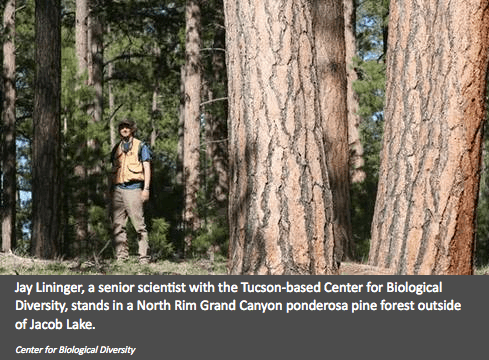
The old “yellow-belly” ponderosa pines anchoring the majestic forests of the Grand Canyon’s North Rim grew up long before European settlement. Precious few remain.

More than 1,000 of them will be lost forever in the “Wild Buck” timber sale later this year, undercutting U.S. Forest Service claims that it is restoring this fire-adapted forest ecosystem.

Data obtained under the Freedom of Information Act shows that 38 percent of timber volume in the Wild Buck sale will come from logging 1,174 trees larger than 24-inches diameter. Field surveys by the Center for Biological Diversity revealed that many of those giant trees stood tall when the United States declared independence well over 200 years ago.

Old-growth pines are rare as a result of past logging. Their towering canopies and thick bark make them naturally fire resistant.

Hundreds of thousands of smaller trees that would have burned off as saplings during natural fire events have encroached on the forest during a century of fire suppression. Small trees now blanket Arizona’s forests like kindling.

Wild Buck is part of a larger project spanning 20,000 acres on the north rim with a stated purpose to reduce fire hazard and restore historic forest conditions.

The Forest Service assured the public last year that “little more than 1 percent” of trees to be removed from the North Rim are larger than 16 inches diameter.

However, nearly 30 percent of trees to be cut in the Wild Buck sale — 78 percent of total volume — are larger than 16 inches diameter. In other words, the Forest Service’s first move out of the gate in a “forest restoration” project is to sell thousands of large and old trees for commercial purposes rather than meeting its own mandate to clear small trees for fire safety.

Ponderosa pine forests need small-tree thinning to safely reintroduce natural low-intensity fires without causing undue harm to wildlife and the amenities that people cherish.

Recognizing this, the Center for Biological Diversity collaborated with partners of all political stripes to develop an old-growth protection and large-tree-retention strategy for the historic Four Forest Restoration Initiative (4FRI) that will expedite thinning across millions of acres.

Unfortunately the Forest Service dismissed the collaborative 4FRI strategy and routinely rejects good-faith restoration proposals from the public, opting instead to log big, old trees, as evidenced by the Wild Buck timber sale.

Wild Buck is separate from the 4FRI, but it is on the same national forest (Kaibab) dressed with the same restoration purpose. It demonstrates the Forest Service’s willingness to exploit a lack of accountability and mine large, fire-resistant trees from the landscape.

At a time when the Forest Service claims to be working with stakeholders to do the right thing, the Wild Buck timber sale is a vivid example of what’s wrong with the agency. Its addiction to logging big, old trees and its refusal to collaborate in management of public forests demonstrate a need for better leadership and reform.

Reform should start with permanent protection of the irreplaceable old-growth pillars of our region’s unique natural history.

Jay Lininger is a senior scientist with the Tucson-based Center for Biological Diversity. Read him via email at [email protected].

Farm Bill Rider Amends Clean Water Act in Giveaway to Timber Industry

What follows is a press release from WildEarth Guardians:

Seattle, WA (January 28, 2014) – The House and Senate agreed today to reduce oversight for our Nation’s clean water. Under the guise of protecting the timber industry, Congress included a rider in the compromise Farm Bill that significantly weakens the Clean Water Act by exempting certain silvicultural activities from permitting under the Act’s National Pollutant Discharge Elimination System. The Clean Water Act has been incredibly successful in cleaning up polluted water in the United States. As a victim of its own success, it is now under regular attack in Congress by democrats and republicans alike. This controversial amendment was unlikely to succeed had Congress used normal legislative channels for making this change. Instead, they attached this unnecessary legislation as a rider to the Farm Bill, short-circuiting the regular legislative process.

“Congress has decided to protect the timber industry instead of protecting America’s drinking water. This new provision allows the timber industry to continue to pollute our nation’s drinking water with sediment,” said Bethanie Walder, Public Lands Director for WildEarth Guardians.

The Forest Service estimates that well over 50% of the American public lives in communities that rely on public and private forest lands for their drinking water supplies. Numerous studies have identified forest roads as the principal source of accelerated erosion in forests throughout the western United States. With so much of the Nation’s drinking water impacted or potentially impacted by sediment pollution from logging roads, the Clean Water Act provides an important regulatory backstop.

“This fundamental change to the Clean Water Act undermines our Nation’s clean water and was unnecessary. It will tie the EPA’s hands. Now, even where logging roads are causing significant water quality problems, citizens and the EPA will not be able to ensure that landowners address those impacts,” said Paul Kampmeier, Staff Attorney at the Washington Forest Law Center.

Oregon Senator Ron Wyden and Congressman Kurt Schrader were key spokespeople promoting the rider. Oregon has 70,000 miles of roads on Forest Service lands; Washington has 22,000 miles. Together the two states account for nearly 25% of the entire Forest Service road system. A recent study from the Forest Service found that 78% of all Forest Service watersheds in Washington and Oregon are being negatively affected by roads. “We are extremely disappointed that some members of the Oregon delegation not only supported but championed this effort to diminish Clean Water Act protections. With so many Oregonians dependent on forests for our drinking water, and so many roads bleeding sediment into our streams, our delegation should be putting the people’s need for clean water above corporate profits,” said Chris Winter, Co-Executive Director of the Crag Law Center.

“This rider is a giveaway to the timber industry that threatens our drinking water and fisheries. But reducing regulation of logging roads under the Clean Water Act doesn’t change the fact that logging roads remain a primary cause of sediment pollution,” added Bethanie Walder.

The Farm Bill has not been finalized by Congress yet, but votes in the House and Senate are expected imminently now that the compromise has been finalized and introduced. Assuming the bill passes, this rider to amend the Clean Water Act will become law.

Groups Sue USFS/IDFG Over Hunter Hired to Kill Wolves in Frank Church Wilderness

Hired Wolf Hunter
The following is a press release from the groups:A coalition of conservationists, represented by the non-profit environmental law firm Earthjustice, today asked a federal judge in Idaho to halt an unprecedented program by the U.S. Forest Service and Idaho Department of Fish and Game (IDFG) to exterminate two wolf packs deep within the largest forested wilderness area in the lower-48 states.In mid-December 2013, IDFG hired a hunter-trapper to pack into central Idaho’s 2.4-million-acre Frank Church-River of No Return Wilderness to eradicate two wolf packs, the Golden and Monumental packs, in the interest of inflating elk populations for outfitters and recreational hunters. The U.S. Forest Service, which administers the wilderness, approved the extermination program by authorizing use of a Forest Service cabin and airstrip to support wolf extermination activities.

“A wilderness is supposed to be a wild place governed by natural conditions, not an elk farm,” said Earthjustice attorney Timothy Preso. “Wolves are a key part of that wild nature and we are asking a judge to protect the wilderness by stopping the extermination of two wolf packs.”

Earthjustice is representing long-time Idaho conservationist and wilderness advocate Ralph Maughan along with three conservation groups—Defenders of Wildlife, Western Watersheds Project, and Wilderness Watch—in a lawsuit challenging the wolf extermination program. The conservationists argue that the U.S. Forest Service’s approval and facilitation of the program violated the agency’s duty to protect the wilderness character of the Frank Church Wilderness. They have requested a court injunction to prohibit further implementation of the wolf extermination program until their case can be resolved.

“Idaho’s program to eliminate two wolf packs from the Frank Church Wilderness Area for perceived benefits to elk hunting is just the most recent example of the state bending over backwards to accommodate the wishes of people who hate wolves,” said Jonathan Proctor of Defenders of Wildlife. “Wilderness areas are places for wildlife to remain as wild as is possible in today’s modern world. If Idaho’s wildlife officials won’t let wolves and elk interact naturally in the Frank Church Wilderness, then clearly they will allow it nowhere. The U.S. Forest Service must immediately prohibit the use of national forest wilderness areas for this hostile and shortsighted wolf eradication program.”

The region of the Frank Church Wilderness where IDFG’s hunter-trapper is killing wolves is a remote area around Big Creek and the Middle Fork of the Salmon River. Even though this region hosts one of the lightest densities of hunters in the state, IDFG prioritized elk production over protection of the area’s wilderness character. The Forest Service failed to object to IDFG’s plans and instead actively assisted them.

“As someone who has enjoyed watching members of the Golden Pack and spent time in the area where these wolves live, I am startled that IDFG thinks it is acceptable to kill them off. If wolves can’t live inside one of America’s biggest wilderness areas without a government extermination program then where can they live?” asked Ken Cole of Western Watersheds Project. “The value of wilderness is not solely to provide outfitters elk to shoot,” Cole added.

“The 1964 Wilderness Act requires the Forest Service to protect the wilderness character of the Frank Church Wilderness,” added Gary Macfarlane of Wilderness Watch.  “By allowing Idaho to exterminate wolves in the Frank Church Wilderness and degrade that wilderness character, the Forest Service is violating the Wilderness Act.”

Read the Complaint

UPDATE: From the court filing:

Plaintiffs learned from counsel for defendant Virgil Moore that, as of January 2, 2014, IDFG’s hired hunter-trapper had killed seven wolves within the targeted wolf packs, six by trapping and one by hunting, and that more wolves may have been killed as of today. Defendant Moore’s counsel further advised that IDFG’s only means of communication with the hunter-trapper is a satellite telephone in the hunter-trapper’s possession, and that, to preserve the phone’s batteries, the hunter-trapper turns on the phone only when he places a call.

Conservationists Sue to Stop Wolf and Coyote Killing Contest on Public Lands

Visit www.wildearthguardians.org to learn more. Below is a portion of their press release.

Pocatello, ID – On December 23 a coalition of conservation organizations sued the U.S. Forest Service for failure to require permits and environmental impacts analysis for the advertised “Coyote and Wolf Derby” in Salmon, Idaho, December 28 and 29. The lawsuit seeks an order requiring the agency inform the killing contest sponsors and participants that shooting wolves and coyotes on public lands as part of the contest is illegal without the required environmental analyses and permits.

“Killing contests that perpetuate false stereotypes about key species like wolves and coyotes that play essential roles in healthy ecosystems have no place on public lands.” Said Bethany Cotton, wildlife program director at WildEarth Guardians. “The Forest Service is abdicating its responsibilities as steward of our public lands. We are asking the agency to comply with the law: require a permit application and do the necessary environmental analysis, including providing a public comment process, to ensure our public lands and wildlife are protected.”

The killing contest is charging an entry fee, advertising prizes for the largest wolf and the most coyote carcasses, among other award categories, and specifically offering opportunities for children as young as 10 to kill for prizes. Commercial activities like the killing contest are prohibited on public lands without a special use permit. An application for a special use permit triggers application of the National Environmental Policy Act. Highly controversial activities are exempted from fast track permitting. In contrast to the Forest Service, the Bureau of Land Management (BLM) informed the killing contest sponsors that a special use permit is required. To date, BLM has not received an application. Hunting on BLM administered public lands as part of the killing contest is therefore illegal.

Here’s a copy of the brief.

Flathead NF Skews Forest Plan Revision Process, Deceives Collaborative Group

Please consider the following memo from Keith Hammer, Chair of the Swan View Coalition, an update and addition to the previous post, “Another invite-only collaborative leads to unprofessional Forest Service conduct.”

The Flathead National Forest has front-loaded its Forest Plan Revision process to reduce wildlife security while increasing motorized access and logging, playing favorites of folks willing to go along with it!

After telling its newly convened Forest Planning collaborative to use its draft 2006 Plan revision as a starting point, the Flathead has now instead distributed a Modified 2006 revision to the collaborative.

The modifications most importantly would:

1. Abandon Forest Plan Amendment 19 and its securing of grizzly bear habitat through limits on roads and motorized vehicles.

2. Greatly expand the “suitable timber base” where commercial logging is scheduled, partly by logging in areas previously set aside as grizzly bear “security core” under Amendment 19.

3. Retain and expand already extensive snowmobile areas established by Forest Plan Amendment 24, while not proposing to reduce snowmobile areas to protect grizzly bear denning, wolverine and lynx.

To make matters worse, the Flathead is playing favorites to the Whitefish Range Partnership collaborative, which has already largely agreed with the Flathead’s modifications for the North Fork Flathead.

Click here to read our letter to local newspaper editors, which includes links to a couple news articles demonstrating the Flathead’s unacceptable favoritism and skewing of the Forest Planning process.

We’re working hard to insure your voice can be heard during the Flathead Forest Plan revision process and will advise you of specific points when your comments will be most useful.

Meanwhile you can track or join the revision process at the Flathead National Forest’s web site and at Meridian Institute, the contractor the Flathead has hired to attempt to sidestep certain requirements of the Federal Advisory Committee Act (the Forest Service cannot ask for collective advice during meetings that it controls, so it hires a contractor to control the meetings).