New Rim Fire Study: Extreme Weather Trumps Fuel Reduction

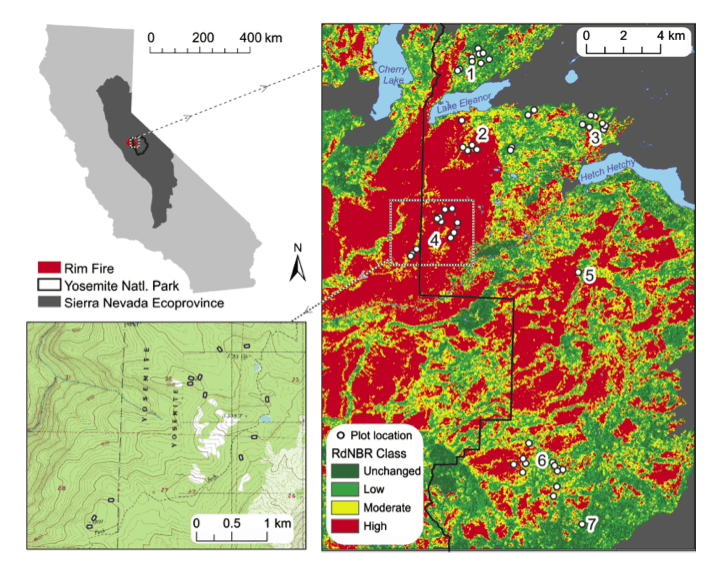
Rim fire studyA new scientific study on the Rim Fire has just been published. “Severity of an uncharacteristically large wildfire, the Rim Fire, in forests with relatively restored frequent fire regimes” by Jamie Lydersen, Malcolm North and Brandon Collins is available here.  What follows is the abstract, with some emphasis added.
Abstract

The 2013 Rim Fire, originating on Forest Service land, burned into old-growth forests within Yosemite National Park with relatively restored frequent-fire regimes (P2 predominantly low and moderate sever- ity burns within the last 35 years).

Forest structure and fuels data were collected in the field 3–4 years before the fire, providing a rare chance to use pre-existing plot data to analyze fire effects. We used regression tree and random forests analysis to examine the influence of forest structure, fuel, fire history, topographic and weather conditions on observed fire severity in the Rim Fire, as estimated from an initial fire severity assessment based on the relative differenced normalized burn ratio (RdNBR).

Plots that burned on days with strong plume activity experienced moderate- to high-severity fire effects regardless of forest conditions, fire history or topography. Fire severity was also highly negatively associated with elevation, with lower severity observed in plots over 1700 m.

Burning index (a composite index of fire weather), time since the last fire, and shrub cover had strong positive associations with fire severity. Plots that had experienced fire within the last 14 years burned mainly at low severity in the Rim Fire, while plots that exceeded that time since last fire tended to burn at moderate or high severity.

This effect of time since last fire was even more pronounced on days when the burning index was high. Our results suggest that wildfire burning under extreme weather conditions, as is often the case with fires that escape initial attack, can produce large areas of high-severity fire even in fuels-reduced forests with restored fire regimes. 

Bob Berwyn: Forest health crisis ends with a whimper

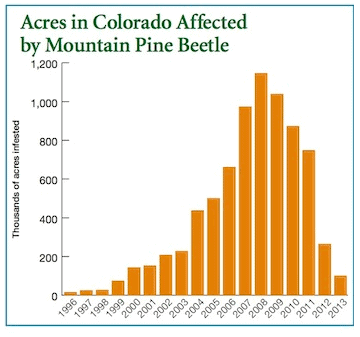
Read the entire article here. Below is a snip:Co Beetles

We may be cutting down the very trees we need to save the forest,” said Diana Six, a Montana-based U.S. Forest Service biologist who studies bugs and trees right down to the genetic level.

Along with the salvage harvest of dead trees, many of the logging projects authorized under federal emergency forest health laws also cut down trees that have survived. Those trees may hold the genetic key to the future of Colorado’s forests, Six said.

“It’s natural selection. The bugs wiped out the trees that are not adapted to current conditions … Underlying genetics will determine future forests,” she said, challenging the conventional wisdom that logging is needed to restore forest health.

From an economic standpoint, logging beetle-killed lodgepole pines rarely yields a profit. In fact, many projects in Colorado are subsidized. Overall, the U.S. and Canadian governments have spent millions of dollars on massive logging projects aimed at directly trying to halt the spread of the bugs, with no signs of success on a meaningful scale, Six said….

The forests laws that were passed put the U.S. Forest Service on a questionable path of shortcutting environmental reviews for logging on big tracts of national forest lands, according to conservation groups who tried to slow the congressional rush to more tree cutting.

And now, with the insect epidemic waning, research by forest scientists suggest that those politically motivated logging projects are the “wrong choice for advancing forest health in the United States,” Six said.

Update: Montana Citizens Given Zero Notice or Opportunity to Participate in Gov Bullock’s 5.1M acre “Fast Track” Logging Proposal

Last week Steve shared this article about Montana Governor Steve Bullock nominating 5.1 million acres of National Forest lands in Montana for “fast track” logging under the recently passed Farm Bill.

Since that article appeared in the Missoulian I attempted to gather basic information from the Gov’s office and the MT DNRC regarding what type of public notice or public process was used to come up with these 5.1 million acres of National Forest land.  For days both the Gov’s office and MT DNRC refused to provided the information, and then when they finally said they’d provide basic information, such as “Was there public notice? Were notes taken?” they stonewalled by telling me I’d have to pay them to answer these basic questions.  After I told them that as a Montana citizen I have a constitutional right to an “open government” (and after a reporter got involved) they finally sent me 3 pieces of paper.

Many of you may have an interest in the fact that, with zero notice given to the public and with zero notes taken, Gov Bullock’s office hand-picked a total of 7 people who met 5 times on the phone and came up with 5.1 million acres of Montana’s National Forest lands that they have nominated for priority “fast track” logging through a weakened and streamlined “Categorical Exclusion” NEPA process that also significantly reduces meaningful public input.

It’s estimated that this “fast track” logging would apply to 60% to 75% of the forested acres of the Lolo, Bitterroot and Kootenai National Forests outside of designated Wilderness areas, but would include previously unlogged forests and critical wildlife habitat.

It should be noted that with the exception of one of the 7 hand-picked people, all of them are also big supporters (and in some cases the authors) of Senator Tester’s mandated logging bill, the Forest Jobs and Recreation Act.

This whole situation should also lend further evidence to what I’ve been saying for years now, and that’s the fact that not all “collaboration” is created equal, and when it comes to Montana public land and National Forest issues we have some incredibly rotten examples of “collaboration.”

The Great Falls Tribune’s John Adams has the story in today’s paper.

HELENA – Critics of Gov. Steve Bullock’s recent nomination of 5.1 million acres of U.S. Forest Service land as priority for “restoration” say the public was left out of the process.

On April 7, Bullock, a Democrat, announced he submitted a letter to the Forest Service nominating more than 8,000 square miles of timber land from northwestern to southcentral Montana to increase the pace of scale of restoration on federal public land.

Bullock said the lands he nominated under a provision in the recently passed farm bill are declining in health, have a risk of increased tree deaths or pose a risk to public infrastructure or safety.

But critics of Bullock’s recent action said there was no notice of the process and no opportunity for meaningful public input on a plan that could potentially open up the majority of non-wilderness timber lands across the state to fast-track timber harvests.

“I didn’t know anything about this until I read about it in the newspaper,” said Michael Garrity, director of the Alliance for the Wild Rockies.

State forester Bob Harrington, of the Department of Natural Resources and Conservation, acknowledged in an email to the Tribune that the process for choosing the lands Bullock would nominate was not open to the public.

While Harrington, in earlier media reports, couched the process as a “collaboration,” on Monday he said just six people were invited to join an “ad-hoc group” to advise him on identifying priority landscapes national forest lands.

Members selected for the ad-hoc group included Bruce Farling of Montana Trout Unlimited; Barb Cestero of the Greater Yellowstone Coalition; Sanders County Commissioner Carol Brooker; Julia Altemus of the Montana Wood Products Association; Keith Olson of the Montana Logging Association; and Gary Burnett, of the Blackfoot Challenge and Southwest Crown Collaborative.

All participants except for Brooker were involved in drafting and promoting Sen. Jon Tester’s proposed Forest Jobs and Recreation Act.

According to Harrington, the ad hoc group met five times via conference call between Feb. 28 and April 4. Only the Feb. 28 meeting had an agenda, and the meetings were not noticed to the public and no meeting minutes or audio recordings were made.

“They were primarily discussions about the proposed landscape boundaries and focused on a series of maps that were produced along the way, as well as timelines for each of the collaborative groups and/or USFS staff to submit proposed changes to us,” Harrington said in an email.

Matthew Koehler is a longtime Missoula-based forest activist with the nonprofit WildWest Institute. Jake Kreilick, WildWest’s restoration coordinator, is an active member the Lolo Forest Restoration Committee, one of the collaborative groups cited by Bullock in his proposal to the agriculture department.

Koehler pointed out that the agenda for the first ad-hoc conference call, which took place Feb. 28, listed an April 1 deadline for submitting a proposal to the governor “after broader public review/input.”

But the broader public review and input never happened before the governor submitted his letter to the Forest Service, Koehler said.

“What just transpired here is that the governor’s office and the Department of Natural Resources and Conservation hand-selected a group who got together, with no public notice, and over the course of five phone calls they decided that 5.1 million acres of Montana forests should be opened to logging under weakened and streamlined public input processes and limited environmental impact analysis,” Koehler said. “Over the course of five conference calls, seven people came up with 5.1 million acres of fast-track public lands logging. That’s more than a million acres per conference call.”

Bullock’s spokesman, Dave Parker, said there will be future opportunities for the public to weigh in.

[Update: The Billings Gazette newspaper reports that on 4/16/14 Bullock’s spokesman, Dave Parker, “threatened to exclude The Gazette from further advisories from the governor….” – mk]

“This is only the first step in the process, one which ensures vigorous public participation on a project-by-project basis,” Parker said. “The process of designating the landscapes was necessary due to the time frame established by the passage of the farm bill.”

Governors had 60 days from the enactment of the farm bill in February to make their nominations to the Department of Agriculture.

“Governor Bullock is proud to have an incredibly diverse coalition, from the Greater Yellowstone Coalition and Trout Unlimited, to the Wood Products Association and Montana Logging Association, working on this project,” Parker said. “We look forward to creating jobs, restoring the health of our forests and improving habitat for fish and game. We understand that there will be some who instinctively throw rocks at collaboration, which is their right, but they are in the minority.”

Garrity argued that there is no scientific basis for declaring the 5.1 million acres of forest outlined in Bullock’s nomination as “characterized by declining forest health, a risk of substantially increased tree mortality, or an imminent risk to the public infrastructure, health or safety.”

Garrity said the bark beetle epidemic has run its course across much of the state, and that the dead and dying trees that remain in the forest provide important habitat for birds and other native species as well as food sources for grizzly bears — which eat ants and other insects that live in dead trees — and denning habitat for endangered lynx.

“By any ecologist’s definition of what is healthy, these forests are healthy,” Garrity said. “When Teddy Roosevelt decided he wanted to protect our National Forests, he didn’t want them protected just to be tree farms. He wanted to protect them because they are important watersheds for the American public and they provide habitat for native species. Based on that they are healthy forests.”

Koehler estimates that if Bullock’s nomination is approved as it stands now, between 60-75 percent of all the forested acres outside of designated wilderness in the Kootenai and Lolo National Forests would be prioritized for timber harvests under the categorical exclusion provision, which limits the requirement for rigorous environmental analysis.

“What that means is less public involvement, and less analysis about how the timber sale could affect bull trout, or Westslope cutthroat trout, or threatened and endangered species such as the grizzly bear, and lynx, and wolverines,” Koehler said. “Does the public want a say in how their lands are managed, or do they want hand-selected groups meeting secretly behind closed doors undermining America’s public lands legacy and the ability of Americans to fully participate in the management of their public lands?”

Rim Fire trees sailing to China, domestic mills “pretty much at capacity”

Screen Shot 2014-03-19 at 7.39.09 AM
From Reed Fujii, staff writer with the The Record, Stockton, California:

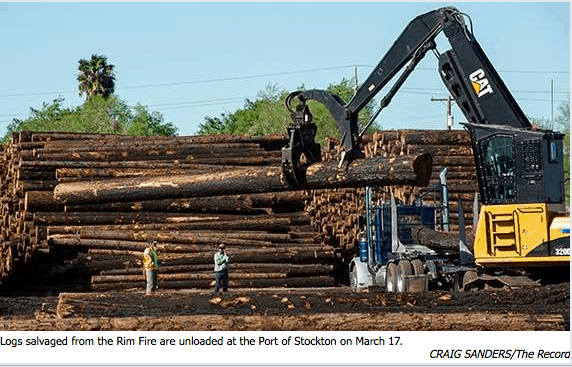
If there’s a silver lining to last year’s Rim Fire, California’s third-largest recorded wildfire, scorching more than 257,000 acres around and in Yosemite National Park, it may be in the piles of logs now being stacked up at the Port of Stockton.

MDI Forest Products, an Oakland-based timber and lumber export company, is staging the logs at the port for shipment to Far East lumber mills.

The logs will be stripped of bark, then loaded into shipping containers and moved via the port’s Marine Highway barges to Oakland and from there on to China, primarily, and perhaps Japan and Korea, said Gary Liu, MDI chief executive and managing partner.

Fire-damaged or weakened trees need to be salvaged quickly, before insects or diseases further reduce their value.

“The Rim fire is bringing a lot of private timber onto the market,” Liu said.

And there is demand for logs from Asian lumber mills.

“There just hasn’t been an alternative,” he said Monday. “The domestic mills are pretty much at capacity.”

Read the entire story here.

Here’s some more posts about the Rim Fire from the NCFP blog archives.

NOTE: Since Gil DeHuff has previously questioned my attempts to research, obtain and use links to provide NCFP readers with additional context and information about frequent topics on this blog, I’d like to point out that the links to more posts about the Rim Fire were obtained by simply typing in the words “Rim Fire” to the search box on the homepage of this blog. Therefore, any credit or conspiracy or fault as to what’s included – or not included – in the archives should be directed towards the creator of WordPress’ search engine program. Thank you.


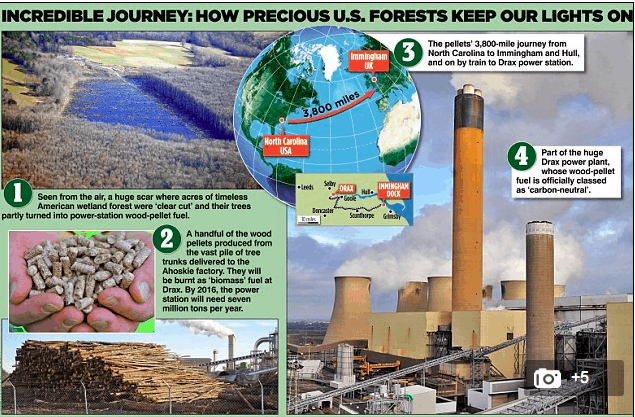
The bonfire of insanity: Woodland is shipped 3,800 miles and burned in Drax power

Screen Shot 2014-03-17 at 8.25.54 AM

This weekend an article ran in the UK titled “The bonfire of insanity: Woodland is shipped 3,800 miles and burned in Drax power.”  The article was written by David Rose and provides an additional look into the issue of cutting down forests in North Carolina, chipping those forests into pellets and then shipping those pellets nearly 4,000 miles across the Atlantic Ocean to be burned in the United Kingdom.  Some previous NCFP posts on the topic are here, herehere, here, here and here

Snip:

But North Carolina’s ‘bottomland’ forest is being cut down in swathes, and much of it pulped and turned into wood pellets – so Britain can keep its lights on.

The UK is committed by law to a radical shift to renewable energy. By 2020, the proportion of Britain’s electricity generated from ‘renewable’ sources is supposed to almost triple to 30 per cent, with more than a third of that from what is called ‘biomass’.

The only large-scale way to do this is by burning wood, man’s oldest fuel – because EU rules have determined it is ‘carbon-neutral’.

So our biggest power station, the leviathan Drax plant near Selby in North Yorkshire, is switching from dirty, non-renewable coal. Biomass is far more expensive, but the consumer helps the process by paying subsidies via levies on energy bills.

That’s where North Carolina’s forests come in. They are being reduced to pellets in a gargantuan pulping process at local factories, then shipped across the Atlantic from a purpose-built dock at Chesapeake Port, just across the state line in Virginia.

Those pellets are burnt by the billion at Drax. Each year, says Drax’s head of environment, Nigel Burdett, Drax buys more than a million metric tons of pellets from US firm Enviva, around two thirds of its total output. Most of them come not from fast-growing pine, but mixed, deciduous hardwood.

Drax and Enviva insist this practice is ‘sustainable’. But though it is entirely driven by the desire to curb greenhouse gas emissions, a broad alliance of US and international environmentalists argue it is increasing, not reducing them.

In fact, Burdett admits, Drax’s wood-fuelled furnaces actually produce three per cent more carbon dioxide (CO2) than coal – and well over twice as much as gas: 870g per megawatt hour (MW/hr) is belched out by wood, compared to just 400g for gas.

Then there’s the extra CO2 produced by manufacturing the pellets and transporting them 3,800 miles. According to Burdett [Drax’s Head of Environment], when all that is taken into account, using biomass for generating power produces 20 per cent more greenhouse gas emissions than coal.

And meanwhile, say the environmentalists, the forest’s precious wildlife habitat is being placed in jeopardy.

Drax concedes that ‘when biomass is burned, carbon dioxide is released into the atmosphere’. Its defence is that trees – unlike coal or gas – are renewable because they can grow again, and that when they do, they will neutralise the carbon in the atmosphere by ‘breathing’ it in – or in technical parlance, ‘sequestering’ it.

So Drax claims that burning wood ‘significantly reduces greenhouse gas emissions compared with coal-fired generation’ – by as much, Burdett says, as 80 per cent.

These claims are questionable. For one thing, some trees in the ‘bottomland’ woods can take more than 100 years to regrow. But for Drax, this argument has proven beneficial and lucrative.

New Dogwood Alliance Video Exposes Wood Pellet Industry Impact on Rural Communities

The following is a guest post from the Dogwood Alliance’s Scot Quaranda. mk

We thought you might be interested in our new video…

Dogwood Alliance is proud to release our investigative video Our Forests Aren’t Fuel: Injustice in Northampton

While Southern wetlands are going Up in Smoke so European Governments can meet their renewable energy targets, our forests and communities are hit the hardest. From Virginia to Florida, along the Mississippi River and throughout the South the negative impact on our communities has become clearer every day, and the Injustice in NorthamptonCounty in northeastern North Carolina is no different.

Residents in this rural community close to the Enviva Northampton plant now face 24/7 extreme noise and lights, dust that coats cars, buildings and lungs in just a few minutes of exposure, along with dangerous, heavy truck traffic. The Northampton community quickly rallied and are working with Dogwood Alliance and Clean Water For North Carolina to bring the attention of local officials to the conditions that Enviva forces them to live with every day.

For more information on the Our Forests Aren’t Fuel campaign visit here.

To read more about the situation in Northampton and how locals are fighting back visit here.

Best,

Scot Quaranda
Dogwood Alliance

Dr. Law: Role of Forest Ecosystems in Climate Change Mitigation

Dr. Beverly Law recently gave a presentation titled, “Role of Forest Ecosystems in Climate Change Mitigation.”   Here’s some information on Dr. Law’s background, education and area of expertise, via  Dr. Law’s website at Oregon State University:

Dr. Beverly Law is Professor of Global Change Forest Science in the College of Forestry, and an Adjunct Professor in the College of Oceanic and Atmospheric Sciences at Oregon State University. She is an Aldo Leopold Leadership Fellow. Her research focuses on the role of forests, woodlands and shrublands in the global carbon cycle. Her approach is interdisciplinary, involving in situ and remote sensing observations, and models to study the effects of climate and climate related disturbances (wildfire), land-use change and management that influence carbon and water cycling across a region over seasons to decades. She currently serves as the Chair of the Global Terrestrial Observing System – Terrestrial Carbon Observations (supported by UNEP, UNESCO, WMO), and on the Science/Technology Committee of the Oregon Global Warming Commission.

You can view a PDF copy of Dr. Law’s presentation right here. Below, the text-only version of Dr. Law’s presentation does a nice job of summarizing the myth and reality regarding “thinning,” bioenergy/biomass and climate.

Role of Forest Ecosystems in Climate Change Mitigation
B.E. Law – Oregon State University, February 23, 2014

Key Points:

Activities that promote carbon storage and accumulation are allowing existing forests to accumulate carbon, and reforestation of lands that once carried forests.

Natural disturbance has little impact on forest carbon stores compared to an intensive harvest regime.

Harvest and thinning do not reduce carbon emissions. Full accounting shows that thinning increases carbon emissions to the atmosphere for at least many decades.

Carbon returns to atmosphere more quickly when removed from forest and put in product chain.

1. Role of forest ecosystems in mitigating climate change – Carbon storage and accumulation

Allowing existing forests to accumulate carbon is likely to have a positive effect on forest carbon in vegetation and soils, and on atmospheric carbon. Wet forests in the PNW and Alaska have some of the highest carbon stocks and productivity in the world. Fires are infrequent in these forests, occurring at intervals of one to many centuries. Old forests store more carbon than young forests. Old forests store as much as 10 times the biomass carbon of young forests (Law et al. 2001, Hudiburg et al. 2009). The low hanging fruit is to allow these forests to continue to store and accumulate carbon.

A key objective is to reduce GHG emissions. Changes in management should consider the current forest carbon sink and losses in the product chain when evaluating management options.

2. Role of natural disturbance in forest carbon budgets
Natural disturbance from fire and insects has little impact on forest carbon and emissions compared with intensive harvest.

Although wildfire smoke looks impressive, less carbon is emitted than previously thought (Campbell et al. 2007). In PNW forests, less than 5% of tree bole carbon combusts in low and high severity fires (Campbell et al. 2007, Meigs et al. 2009). Most of what burns is fine fuels in low and high severity fires, making actual carbon loss much less than one might expect. For example, from 1987-2007, carbon emissions from fire were the equivalent of ~6% of fossil fuel emissions in the Northwest Forest Plan area (Turner et al. 2011). If fire hasn’t significantly reduced total carbon stored in forests, it isn’t going to materially worsen climate change.

In the western states, 5-20% of the burn area has been high severity fire and the remaining burn area has been low and moderate severity (MTBS; www.mtbs.gov). In the PNW, 50-75% of live biomass survived low and moderate severity fires combined, which account for 80% of the burn area (Meigs et al. 2009). Physiology measurements show that current methods used to determine if trees are likely to die post-fire lead to overestimation of mortality and removal of healthy trees (Irvine et al. 2007, Waring data in Oregon District Court summary). Removal of surviving trees from a burned area will reduce carbon storage, and in many cases regeneration.

The release of carbon through decomposition after fire occurs over a period of decades to centuries. About half of carbon produced by fires remains in soil for ~90 years, whereas the other half persists in soil for more than 1,000 years (Singh et al. 2012). Similarly, after insect attack and tree die-off, there isno large change in carbon stocks. Carbon stocks are dominated by soil and wood, and wood in trees that are killed transfers to dead pools that decompose over decades to centuries.

3. How do forest management strategies such as thinning affect carbon budgets on federal lands?

Forest carbon density could be enhanced by decreasing harvest intensity and increasing the intervals between harvests. For example, biomass carbon stocks in Oregon and N California could be theoretically twice as high if they were allowed to continue to accumulate carbon (Hudiburg et al. 2009). Even if current harvest rates were lengthened just 50 years, the biomass stocks could increase by 15%.

Harvest intensity – The Northwest Forest Plan (NWFP) was enacted to conserve species that had been put at risk from extensive harvesting of old forests. Prior to enactment, the public forests were a source of carbon to the atmosphere. Harvest rates were reduced by ~80% on public lands, which led to a large carbon sink (increase in net ecosystem carbon balance, NECB) in the following decades. Direct losses of carbon from fire emissions were generally small relative to harvest (Turner et al. 2011, Krankina et al. 2012).

Thinning forests – Landscape and regional studies show that large-scale thinning to reduce the probability of crown fires and provide biomass for energy production does not reduce carbon emissions under current and future climate conditions (Hudiburg et al. 2011, Hudiburg et al. 2013; Law & Harmon 2011; Mitchell et al. 2009, 2012; Schulze et al. 2012; Mika & Keeton 2012). If implemented, it would result in long-term carbon emission to the atmosphere because many areas that are thinned won’t experience fire during the period of treatment effectiveness (10-20 yrs), and removals from areas that later burn may exceed the carbon ‘saved’ by reducing fire intensity (Law & Harmon 2011; Campbell et al 2012; Rhodes & Baker 2009). Thinning does not necessarily reduce fire occurrence, particularly in extreme weather conditions (drought, wind).

Slow in and fast out – opportunity cost. Today’s harvest is carbon that took decades to centuries to accumulate, and it returns to the atmosphere quickly through bioenergy use. Increased GHG emissions from bioenergy use are primarily due to consumption of the current forest carbon and from long-term reduction of the forest carbon stock that could have been sustained into the future. The general assumption that bioenergy combustion is carbon-neutral is not valid because it ignores emissions due to decreasing standing biomass that can last for centuries.

Bioenergy still puts carbon dioxide in the atmosphere when a key objective is to reduce greenhouse gas emissions. The global warming effect of carbon dioxide in the atmosphere does not depend on its source. Per unit of energy, the amount of carbon dioxide released from biomass combustion is about as high as that of coal and substantially larger than that of oil and natural gas (Haberl et al. 2012).

Summary
Comprehensive assessments are needed to understand the carbon consequences of land use actions, and should include a full accounting of the land-based carbon balance as well as carbon losses through the products chain. In mature forests, harvest for wood product removes ~75% of the wood carbon, and 30-50% of that is lost to the atmosphere in the manufacturing process, including the use of some of that carbon for biomass energy. The remainder ends up back in the atmosphere within ~90-150 years, and there are losses over time, not just at the end of the product use). These loss rates are much higher than that of forests. Full accounting of all carbon benefits, including crown fire risk reduction, storage in long- and short-term wood products, substitution for fossil fuel, and displacement of fossil fuel energy, shows that thinning results in increased atmospheric carbon emissions for at least many decades.

Incorrect Road Data Presented to Flathead NF Collaborative

Here’s another letter from Swan View Coalition Chair Keith Hammer to the Flathead National Forest and the Meridian Institute.  The letter is shared with Mr. Hammer’s permission, as it is part of the public record. The letter also highlights more problems and frustrations with the “collaborative” process as being carried out by the Forest Service in regards to the Flathead National Forest’s forest plan revision process. Previously this blog has devoted more attention to this specific issue on the Flathead.

Dear Folks and Flathead National Forest and Meridian Institute;

You have presented inaccurate and misleading road data to the Flathead Forest Plan revision collaborative. We ask that you make the following corrections and insure it is brought to the attention of the entire collaborative and other public participants.

We dowloaded the attached document from the Meridian web site and have attached it for your convenience; “Access Information for Desired Condition Discussion.”

1. On page 5, this Access Information states “A total of about 887 miles of road have been decommissioned” since 1995.

This is not true. Some 130 miles of those roads have not yet been decommissioned and the majority of those have languished on the landscape since 1996.

An example is the 72 miles of road never decommissioned though authorized under the 1996 Crane Mountain Salvage timber sale.

This is important because the Access Information continues on page 7 to claim “the amount of decommissioning each year has decreased as the backlog of decommissioning is reduced and the A19 commitments under project level planning have been largely accomplished” – which is also not true.

The above statement does not fairly or accurately explain why the amount of annual road decommissioning has decreased from an average of 43 miles/year from 2006-2010 to just 4 miles in 2013 – when there are some 130 miles of “shovel-ready” road decommissioning NEPA decisions sitting on the shelf collecting dust.

If this is due to a lack of funds, the Access Information should make that clear. Instead, the Access Information essentially states the Flathead is already at the one-yard line, a touchdown is imminent, and all is fine concerning road decommissioning.

The Access Information needs to make clear that the timber sales which authorized the road decommissioning did not raise enough money to pay for the decommissioning, nor has the Flathead secured enough funding elsewhere to accomplish 15% (that’s one out of seven) of the road mileage it has already decided is necessary to adequately protect fish, wildlife and other resources.

2. The remaining section of the Access Information dealing with road maintenance and budgets is equally misleading and remiss:

The Flathead’s 2004 Analysis of the Management Situation clearly indicated the Flathead receives less than one-sixth of the budget needed to maintain its road system to applicable standards for the protection of water quality, fish, wildlife and human safety. See page 4-2 of this 2004 document at: http://www.fs.usda.gov/Internet/FSE_DOCUMENTS/stelprdb5432382.pdf

The attached Access Information at 7, however, presents a table that makes it look like a budget of as little as $1.3 million will adequately maintain 99% of passenger car roads and does not adequately summarize the environmental damage that occurs when roads are not maintained up to standards, including closed roads in Maintenance Level 1.

While the Access Information makes it clear that road management budgets continue to decrease, it does not – but must – contain a succinct summary of what budget the Flathead needs to meet all applicable maintenance standards and what budget it can reasonably expect to receive in coming years (as did the 2004 Analysis).

3. Finally, the Access Information does not provide the summary of road maintenance and road decommissioning costs necessary for the public to determine what mix of roads to retain on the Flathead and which to remove – nor does it provide the summary conclusion that it is cheaper to decommission a road than it is to maintain it with the required Best Management Practices. This is a conclusion announced by the Flathead in a 11/16/98 press release and subsequent 11/20/98 Missoulian news article. This conclusion was most recently confirmed in the Flathead’s 2/14/14 proposed Chilly James Restoration Project.

We ask that you make the above corrections to the Access Information and resubmit it to the collaborative with an announcement of the changes that have been made. And let’s be clear we are not suggesting a more complex presentation of the data. We find you must present it in a more accurate and summary manner in order for the public to grasp the relationship between roads, road funding, resource protection, and fiscal reality. As it stands now, the Access Information is incorrect and misleading.

Please respond and indicate what you intend to do about this.

Thank you,

Keith Hammer – Chair
Swan View Coalition

More Flaws in Flathead NF “Collaborative” Process

For a few years now some of us have been trying to hammer home the point – based on our actual experiences – that not all Forest Service “collaborative” processes are created equal, and in some cases, lead to even greater feelings of mistrust and frustrations.

One such recent example of a questionable “collaborative” process has been on the Flathead National Forest in Montana, concerning the Forest Plan revision process, which has been highlighted on this blog with the following posts:

Swan View Coalition Shares Perspective on Collaboration

Another invite-only “collaborative” leads to unprofessional Forest Service conduct

Flathead NF Skews Forest Plan Revision Process, Deceives Collaborative Group

The following letter from Keith Hammer of the Swan View Coalition was provided to the Flathead National Forest leadership and the private Meridian Institute, which the USFS has contracted with to help run the “collaborative” process on the Flathead’s forest plan revision process.  The letter is shared with Hammer’s permission, as it is part of the public record.

Dear Folks at Meridian Institute and Flathead National Forest;

While we appreciate being involved in the Jan 20 conference call discussing problems with the Flathead Forest Plan revision collaborative process, we are very disappointed in the outcome. It seems at most every turn this process has turned into more sub-groups, more meetings, and less transparency – making it increasingly difficult for folks to be meaningfully involved and to provide informed input.

At the Sept 25 Process Workshop, Connie Lewis made it clear that folks “Encourage transparency and accessibility throughout the process.”

More meetings and more groups do not provide more accessibility or transparency. Well facilitated meetings faithfully recorded in written form and posted publicly in a timely manner does provide better accessibility and transparency.

We appreciate that Meridian has begun posting written summaries of the meetings on its web site and has begun sending emails with links that go directly to those summaries and other recently posted materials.

The summaries, however, do not provide an accurate record of who said what at the meetings. This makes it impossible for people to determine what differences or common ground exist between who, or whom to turn to if they would like to know more about what they have said. Recording and associating the names of the people with their comments is absolutely essential to providing accountability and the building blocks necessary for any progress to be made in common understanding of the issues.

Having people keep their name placard on the table in front of them at the Jan 22 meeting was a step in the right direction, but we are at a loss why, in the summary, those names were not then recorded in association with comments being made. It should be standard practice that folks state their full name before commenting – for the benefit of the record keeper and all others in the room.

From an accountability standpoint, folks should be required to provide their first and last names when commenting at meetings or in the forums provided on the Meridian web site – for the reasons provided above and to keep things from running amok in an unaccountable manner. In this regard, we found it troubling that one person speaking at the Jan 22 Vegetation group had only what we assume to be a nickname on his pre-printed placard – something along the line of “Boomer.” Are you allowing folks to participate in this process without firstly identifying themselves, or is this person’s full given name actually “Boomer” or whatever?

We offer these criticism after having attended all of the collaborative meetings thus far, but having also been promised full transparency and accessibility via eCollaboration and other means for when folks can’t make the meetings. Can you imagine not being able to attend these meetings and trying to track who is involved and what is being said via the meeting summaries you have thus far provided?

We ask that you follow up on your promise to make this process transparent and accessible to everyone. We urge you to put yourselves in the shoes of someone that can’t make a single meeting and then conduct this process accordingly.

Keith Hammer – Chair
Swan View Coalition


Wildfire: Study questions U.S. policy of forest ‘restoration’

Please consider this article from E&E a companion to this February 10th post on this blog. – mk

WILDFIRE: Study questions U.S. policy of forest ‘restoration’
By Phil Taylor, E&E reporter, 2/14/14

Western forests today experience fewer high-severity wildfires than they did more than a century ago, depriving some fire-dependent species and stifling biodiversity, according to a new study.

The study challenges conventional wisdom held by politicians and the Forest Service that the West is experiencing an unnatural burst in uncharacteristic wildfires as a result of a century of wildfire suppression.

In fact, some Western forests are experiencing a “deficit” in high-intensity blazes and in some cases should be encouraged to burn, said the study published this month in the journal PLOS ONE.

It questioned the government’s policy of mechanically thinning, or “restoring,” backcountry areas to ensure fires stay low to the ground and create “park-like” conditions. Thinning to reduce high-severity wildfire can reduce habitat for the imperiled black-backed woodpecker, often requires new roads and can introduce invasive species into the forest, the study authors said.

It’s bound to spark some controversy considering high-severity wildfires threaten lives and property and drain billions of dollars in taxpayer money each year. Moreover, aggressive forest thinning and restoration policies are politically popular because they create rural jobs and seek to mitigate wildfire threats to communities.

“Given societal aversion to wildfires, the threat to human assets from wildfires, and anticipated effects of climate change on future wildfires, many will question the wisdom of incorporating historical mixed-severity fire into management goals,” the study said. “However, a major challenge lies with the transfer of information needed to move the public and decision-makers from the current perspective that the effects of contemporary mixed-severity fire events are unnatural, harmful, inappropriate and more extensive due to fire exclusion — to embrace a different paradigm.”

The study was funded by Environment Now, a nonprofit foundation in California whose goals include “preserving and restoring coastal, freshwater and forest ecosystems.”

It was independently conducted by 11 scientists from several Western universities, the Canadian Forest Service, the Earth Island Institute and Geos Institute.

The study used U.S. Forest Service data and other published sources to explore the historical prevalence of “mixed-severity fire regimes” in ponderosa pine and mixed-conifer forests in western North America and to try to determine whether mixed-severity fire patterns in those forests had changed as a result of the past century of fire suppression.

On the latter question, it concluded that the past century of fire suppression has not “greatly increased the prevalence of severe fire,” even though fuel levels in Western forests are believed to be much higher.

Since 1930, the rate of young forest establishment fell by a factor of four in the Sierra Nevada and Southwest, by a factor of three in the Klamath, and by half in the eastern Cascades and central and northern Rockies, it said.

The study recommends the government focus its fire mitigation work adjacent to homes in the wildland-urban interface instead of in the backcountry, where managed wildland fires could promote ecological benefits.

“The need for forest ‘restoration’ designed to reduce variation in fire behavior may be much less extensive than implied by many current forest management plans or promoted by recent legislation,” the study said. “Incorporating mixed-severity fire into management goals, and adapting human communities to fire by focusing fire risk reduction activities adjacent to homes, may help maintain characteristic biodiversity, expand opportunities to manage fire for ecological benefits, reduce management costs, and protect human communities.”

But other scientists and policymakers have argued that the societal benefits of taming mega-fires often trump whatever ecological benefits they may produce. In addition, climate change is expected to intensify droughts that create dangerously dry fuel conditions. Fire seasons are more than two months longer than in the 1970s, the Forest Service has said. (Editor’s note: using 1970s as the starting point is disingenuous–the 1950s-1980s were cooler and moister)

A study commissioned by the Interior Department and led by Northern Arizona University last spring found that although hazardous fuels treatments near communities can reduce wildfire risks to homes and people, backcountry fuels treatments are important to prevent mega-fires that can scorch watersheds and drain federal wildfire budgets (E&ENews PM, May 28, 2013).

While fire in the backcountry can be beneficial if it stays low to the ground, landscape-scale “crown” fires can damage watersheds, tarnish viewsheds and threaten communities, NAU’s Diane Vosick, one of the study authors, said last spring.

“In order to get ahead of the cost of large and severe fire, more treatments will be needed outside the wildland-urban interface,” Vosick told the Senate Energy and Natural Resources Committee last June.

The Forest Service and Interior Department also face political pressure to restore backcountry areas.

In December 2011, Congress inserted language in its appropriations report ordering both agencies to halt policies that direct most hazardous fuels funding to the wildland-urban interface, spending it instead on the “highest priority projects in the highest priority areas.”

For now, “restoration” across the National Forest System remains popular policy in Congress and in Western states.

According to the Forest Service, the states of Florida, Georgia, Utah, California, Texas, Arizona, New Mexico and Colorado have all experienced their largest or most destructive wildfire in just the last several years. Wildfires burn twice as many acres annually compared with the 1970s, and the number of wildfires annually that cover more than 10,000 acres has increased sevenfold.

Forest Service Chief Tom Tidwell last week told Congress there are nearly two dozen landscape-scale collaborative forest restoration projects underway that seek to “re-establish natural fire regimes and reduce the risk of uncharacteristic wildfire.”

“Our findings are sure to be controversial as each year federal agencies spend billions of dollars in fuel reduction costs in the backcountry based on the assumption that we have more high-severity fire now than we did historically,” said Dominick DellaSala, chief scientist at the Geos Institute, one of the study’s authors. “Fuel treatments are best targeted immediately adjacent to where people live, given that the increasing costs of suppressing fires is not ecologically justifiable and may, in fact, produce artificially manipulated landscapes that need more fire to remain healthy and productive.”