BNIK Monument: Protected Only From Future Mining Claims? A Look at What Will Continue on the Monument

Note: this post has been updated to reflect corrections on the mineral leasing vs. locatable question supplied by a member of the TSW community.

Having read through the Proclamation, my impressions were that 1) there’s a lot of human roads, powerlines, and other human development within the Monument, 2) not much is going to change except for some things about new minerals*, and 3) there’s a lot more planning and advisory groups and and public involvement. Which will keep agency folks likely tied up from doing the fuels and prescribed burning funded by Congress and managing recreation pressure. With reduced numbers of people and difficulty hiring- on the other hand, I didn’t see a required plan timeline (maybe I missed it). And it often takes two years to get all the FACA paperwork done, which would potentially take us past the beginning of the next Admin. It might have been simpler to say “hey FS and BLM, you’re doing a swell job at protecting things, we’re just going to order no new mineral leasing..”. But perhaps there’s no legal way to do that kind of surgical intervention focused on what appears to be the real target.

*update-“Uranium is not a leasable mineral under the Mineral Leasing Act. It is locatable under the Mining Law of 1872. So DOI is closing off the land to entry under the Mining Law to stop uranium development. Those holding mining claims will likely be required to go through a validity determination to determine if they have a commercially viable mine under the tests established by that process. It’s possible that the withdrawal from all forms of entry under public land law could prohibit wind and solar facilities that are permitted under FLPMA title V ROW. They are only allowed to use public land for wind and solar if they obtain a ROW permit under FLPMA the public land law statute. All the existing infrastructure is a FLPMA Valid Existing Right and protected by Fifth Amendment, FLPMA and terms of proclamation.”

“History: 1. Clinton designated a number of BLM monuments at the end and when Bush administration arrived they were left with the planning that does go through NEPA.
2. Obama’s 20 year withdrawal of this same area was challenged by NMA (National Mining Association) unsuccessfully in AZ and Ninth Circuit. NMA v. Zinke [Salazar] (2017) arguing the Secretary lacked withdrawal authority among other reasons. The litigation started in 2011 over the NEPA prepared for the withdrawal by Salazar.”

And going back to the previous post, remember that to the GAP 1 and 2 types, the whole Monument is now more Protected (roads and all) than a Forest Service Roadless Area, or even than it was two weeks ago.

****************************

Interesting story by Bobby Magill in Bloomberg Law..

The monument will help the US atone for forcibly removing tribes from parts of the Grand Canyon when Congress declared it a national park more than a century ago, a senior White House official said, speaking to reporters Monday on condition of anonymity.

Hmm.. helping “atone”.  Why not just give the Park back to the Tribes directly?

Anyway..

The monument will help address past injustices and protect lands that many tribes refer to as their ancestral home, the official said. The land around the Grand Canyon shouldn’t be open to new mining claims, the official said. Mining companies are interested in the area to help boost a domestic uranium industry they see as key to bolstering emissions-free nuclear energy. Environmental and tribal groups worry uranium mining will contaminate water flowing through tribal land and harm the Grand Canyon.

But the monument isn’t expected to block Energy Fuels Inc. from mining for uranium at its existing Pinyon Plain Mine, which will be within the monument about 13 miles south of the Grand Canyon.
Some Mining Continues
The company’s rights to uranium and high-grade copper deposits at Pinyon Plain have been affirmed by federal courts, Energy Fuels Vice President Curtis Moore said. Even with the monument designation, the company is preparing for production to begin sometime within the next two years, he said. The company has other uranium prospects in the area, and if the monument threatens any valid existing rights to those minerals, “we’d probably have to pursue a takings challenge,” Moore said.

“It just doesn’t seem like great policy to be locking up our best uranium deposits,” Moore said, calling them “carbon killers” because they provide fuel for nuclear power plants. All valid existing rights to minerals within the monument, including uranium, will be preserved, White House officials said. The monument affects only future mining claims.

Back to the Declaration:

 All Federal lands and interests in lands within the boundaries of the monument are hereby appropriated and withdrawn from all forms of entry, location, selection, sale, or other disposition under the public land laws or laws applicable to the Forest Service, other than by exchange that furthers the protective purposes of the monument; from location, entry, and patent under the mining laws; and from disposition under all laws relating to mineral and geothermal leasing.

**************

Public Involvement, some Service-Firstiness and Joint Planning

The Secretaries shall provide for maximum public involvement in the development of the management plan, as well as consultation with federally recognized Tribal Nations and conferral with State and local governments.  In preparing the management plan, the Secretaries shal1 take into account, to the maximum extent practicable, maintaining the undeveloped character of the lands within the monument; minimizing impacts from surface-disturbing activities; providing appropriate access for livestock grazing, recreation, hunting, fishing, dispersed camping, wildlife management, and scientific research; and emphasizing the retention of natural quiet, dark night skies and scenic attributes of the landscape.  In the development and implementation of the management plan, the Secretaries shall maximize opportunities, pursuant to applicable legal authorities, for shared resources, operational efficiency, and cooperation, and shall, to the maximum extent practicable, carefully incorporate the Indigenous Knowledge or special expertise offered by Tribal Nations and work with Tribal Nations to appropriately protect that knowledge.

I wonder if they need alternatives and an EIS ? “The Important People made all the Important Decisions without involving you, but you folks directly impacted are allowed to color within the lines we’ve drawn” -kind of demoralizing, I would think.

Tribal Nation Co-Stewardship

Lots of Secretaries’ “exploring” this and that language. again it sounds like standard policy under the 2021 Joint Secretarial Order number 3403. But maybe there are differences, perhaps knowledgeable people can point them out?

 The Secretaries shall explore opportunities for Tribal Nations to participate in co-stewardship of the monument; explore entering into cooperative agreements or, pursuant to the Indian Self-Determination and Education Assistance Act, 25 U.S.C. 5301 et seq., contracts with Tribes or Tribal organizations to perform administrative or management functions within the monument; and explore providing technical and financial assistance to improve the capacity of Tribal Nations to develop, enter into, and carry out activities under such cooperative agreements or contracts.  The Secretaries shall further explore opportunities for funding agreements with Tribal Nations relating to the management and protection of traditional cultural properties and other culturally significant programming associated with the monument.

The Secretaries shall consider appropriate mechanisms to provide for temporary closures to the general public of specific portions of the monument to protect the privacy of cultural, religious, and gathering activities of members of Tribal Nations.

There’s a Tribal Commission to give input on the plan and management of the Monument.  There’s also a FACA Committee with a RAC-like list of the usual suspects.

 The advisory committee shall consist of a fair and balanced representation of interested stakeholders, including the Arizona Game and Fish Department; other State agencies and local governments; Tribal Nations; recreational users; conservation organizations; wildlife, hunting, and fishing organizations; the scientific community; the ranching community; business owners; and the general public in the region.

The Monument Already Has Lots of Human Structures  and Those Things Can Be Expanded and  New Ones Built

Nothing in this proclamation shall be construed to preclude the renewal or assignment of, or interfere with the operation, maintenance, replacement, modification, upgrade, or access to, existing or previously approved flood control, utility, pipeline, and telecommunications sites or facilities; roads or highway corridors; seismic monitoring facilities; wildlife management structures; or water infrastructure, including wildlife water developments or water district facilities, within the boundaries of existing or previously approved authorizations within the monument. Existing or previously approved flood control, utility, pipeline, telecommunications, and seismic monitoring facilities; roads or highway corridors; wildlife management structures; and water infrastructure, including wildlife water developments or water district facilities, may be expanded, and new facilities of such kind may be constructed, to the extent consistent with the proper care and management of the objects identified above and subject to the Secretaries’ authorities, other applicable law, and the provisions of this proclamation related to roads and trails.

Transportation Planning

For purposes of protecting and restoring the objects identified above, the Secretaries shall prepare a transportation plan that designates the roads and trails on which motorized and non-motorized mechanized vehicle use, including mountain biking, will be allowed.  The transportation plan shall include management decisions, including road closures and travel restrictions consistent with applicable law, necessary to protect the objects identified in this proclamation.  Except for emergency purposes, authorized administrative purposes, wildlife management conducted by the Arizona Game and Fish Department, and the retrieval of legally harvested elk and bison, which are otherwise consistent with applicable law, motorized vehicle use in the monument may be permitted only on roads and trails documented as existing in BLM and Forest Service route inventories that exist as of the date of this proclamation.  Any additional roads or trails designated for motorized vehicle use must be designated only for public safety needs or the protection of the objects identified above.

It’s not clear to me if temp roads for fuel treatments would be OK..”public safety” “protection of species (species being an object identified above)?” But those wouldn’t be system roads so.. and here’s more on veg management:

The Secretaries may carry out vegetative management treatments within the monument to the extent consistent with the proper care and management of the objects identified above, with a focus on addressing ecological restoration; wildlife connectivity; or the risk of wildfire, insect infestation, invasive species, or disease that would endanger the objects identified in this proclamation or imperil public safety.  Nothing in this proclamation shall be construed to alter the authority of any party with respect to the use of prescribed fire within the monument.

Grazing and Fire Suppression

Nothing in this proclamation shall be deemed to prohibit grazing pursuant to existing leases or permits within the monument, or the renewal or assignment of such leases or permits, which the BLM and Forest Service shall continue to manage pursuant to their respective laws, regulations, and policies.

Nothing in this proclamation shall be construed to alter the authority or responsibility of any party with respect to emergency response activities within the monument, including wildland fire response.

Military Uses and Fish and Wildlife

 Nothing in this proclamation shall preclude low-level overflights of military aircraft, flight testing or evaluation, the designation of new units of special use airspace, the use or establishment of military flight training routes, or low-level overflights and landings for wildlife management conducted by the Arizona Game and Fish Department over the lands reserved by this proclamation.  Nothing in this proclamation shall preclude air or ground access to existing or new electronic tracking communications sites associated with special use airspace and military training routes.

Nothing in this proclamation shall be deemed to enlarge or diminish the jurisdiction or authority of the State of Arizona with respect to fish and wildlife management, including hunting and fishing, on the lands reserved by this proclamation, or to affect the State’s access to the monument for wildlife management, including access prior to and during the development of the management and transportation plans provided for above.  The Secretaries shall seek to develop and implement science-based habitat and ecological restoration projects within the monument and shall seek to collaborate with the State of Arizona on wildlife management within the monument, including through the development of new, or the continuation of existing, memoranda of understanding with the Arizona Game and Fish Department.
 

Does Monumentizing Really “Protect”? And Various Admin and Other Groups’ Thoughts on 30 x 30


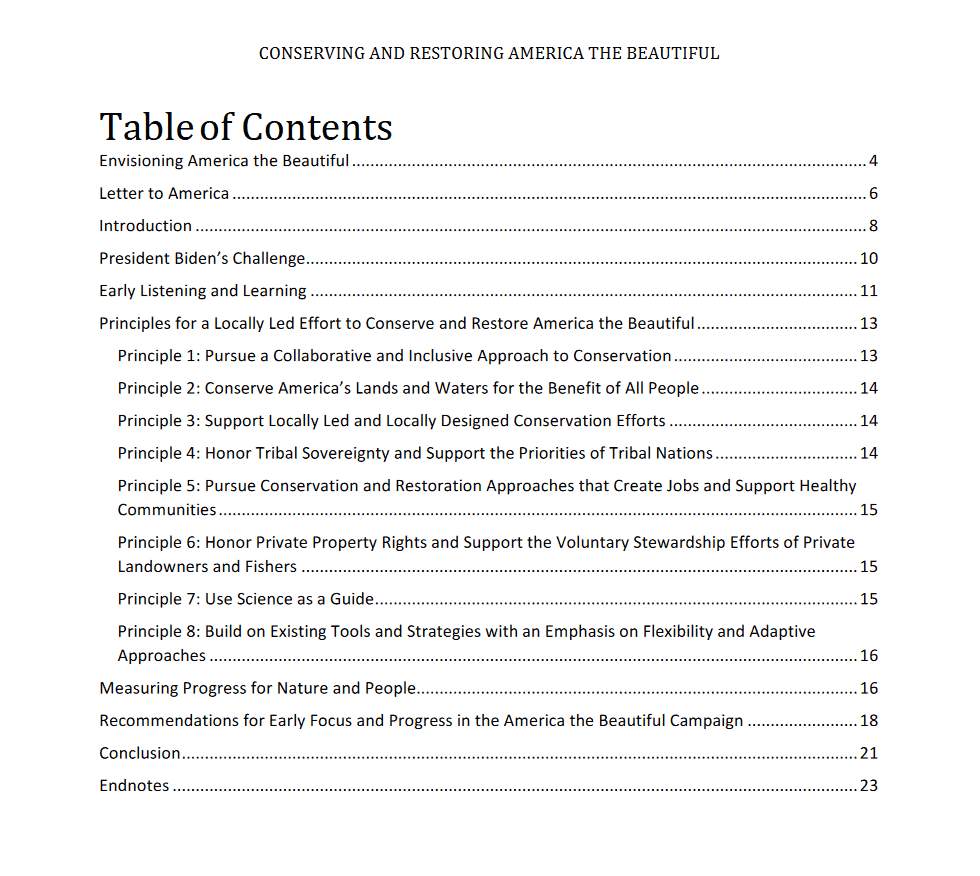
This is the CEQ USDA DOI and Commerce joint write-up on how to achieve 30 x 30


I am going to go out on a limb here..I think the way some groups in tight with the Admin, or possibly the Admin itself (can’t easily tell), have chosen to classify federal lands for “counting” in 30 x 30 is messed up and potentially meaningless. To get started,  I think it’s important to define terms.   I’m going to capitalize Protection when I mean “protected areas as defined by various entities, that is, GAP 1 and 2, for the 30×30 effort.” In the next post, we’ll look at what’s in and what’s out based on the recent Baaj Nwaavjo I’tah Kukveni — Ancestral Footprints of the Grand Canyon National Monument (BNIK NM) declaration.  It seems to me mostly like BAU for the BLM and FS, but requiring another planning process :(.  I’m not sure that most of the reporters read the declaration itself and not just the press release.

The Center for American Progress (CAP) is a very powerful political entity and here are their policy recommendations.. it sounds like a laundry list of what the Biden Admin has been doing recently.

In a November 2022 report from its series on executive action to address the nature crisis, CAP took a deeper look at some of the most powerful conservation tools available to President Biden. In particular, the report identifies the top eight most impactful opportunities for near-term executive action. These include opportunities to designate new protected areas; expand national wildlife refuges; exclude sensitive and sacred places from drilling and mining; and establish national rules to guide conservation of U.S. Bureau of Management lands and the country’s oldest federally owned forests. In another publication from the same series, CAP highlights specific community and Tribally-led proposals for national monuments and marine sanctuaries already primed for executive action, from the proposed Avi Kwa Ame National Monument in Nevada to the Chumash Heritage National Marine Sanctuary in California. Enacting these recommendations will deliver real conservation benefits and should be prioritized.

They also indicated that to them, talking about “what counts” is beside the point.

However, heated arguments about “what counts” can miss the much bigger point behind this national “30×30” conservation goal. The ambitious 30×30 target can, and really must, be an inclusive call to action—a promise to jointly address the climate and biodiversity crises by accelerating the pace at which the country is protecting nature.

As a scientist,  I see two problems with CAP’s formulation. First, if you are indeed thinking about climate and biodiversity, then to make progress you would absolutely need to define what you want specifically, and various risks, and identify tradeoffs.  Second is that, of course, just Protecting something does not actually address both climate and biodiversity.  Not a burned tree nor a cheatgrass seed cares much about lines on maps (back to the BLM sage grouse habitat paper).

A simple example is this Oregon Public Broadcasting story about the Bootleg Fire and carbon credits (which is a good article to read anyway).  If you take out the cap’n’trade carbon credits part of the story, you have “adios, carbon we thought we had” from the area.  You can say that somehow this wouldn’t have happened if it had been in a Protected area, or somehow wouldn’t have had negative effects on biodiversity and carbon simply by drawing a line! How cool is that? But not actually real in terms of biology.

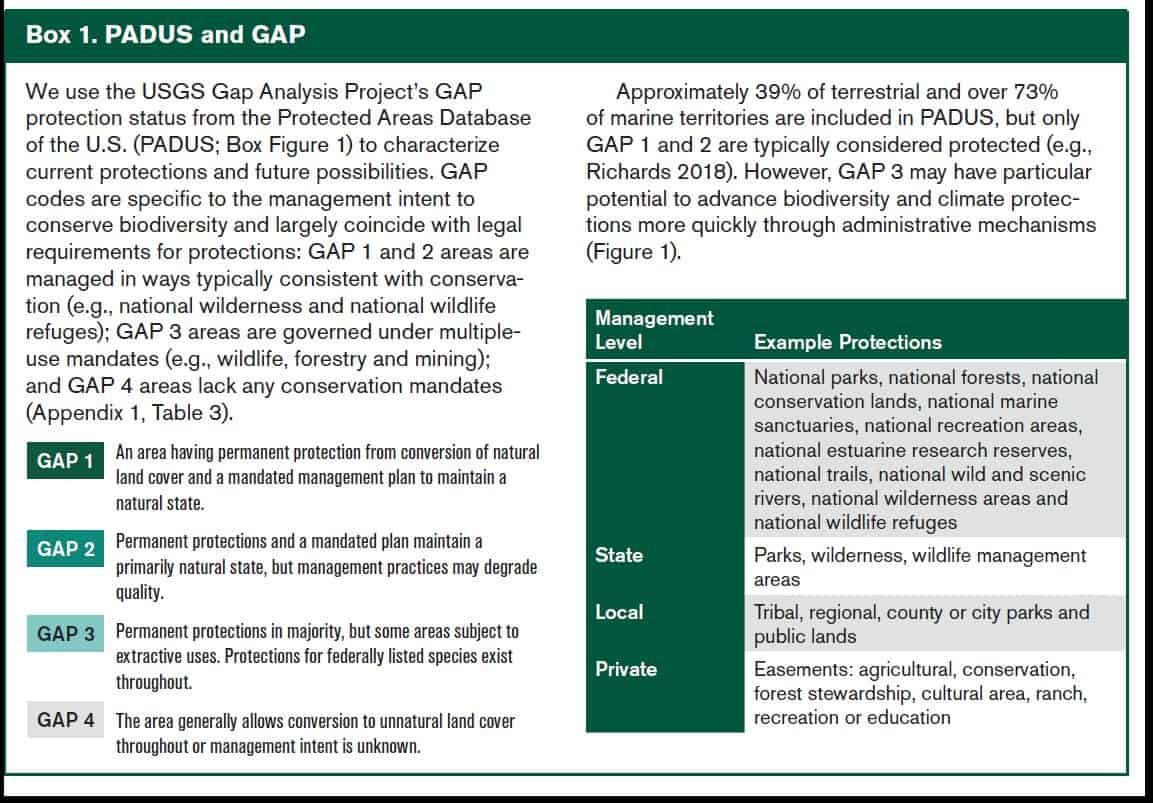
So the question that CAP raised is actually pretty important.. what’s in and out for 30 x 30? Defenders of Wildlife, for example, and the State of California, think it should only include Gap 1 and 2 acres.

*************

I couldn’t find a place where the Biden Admin says what counts to them  toward 30 x 30.  I did find that CEQ, Interior, USDA and Commerce wrote an interesting paper on how to achieve 30 x30 that leads with “Pursue a collaborative and inclusive approach to conservation” (see table of contents above).  There were also statements by the Admin about how working lands should count.

The interesting thing about using Gap 1 and 2, as per Defenders and others, is that, say Forest Service Roadless Areas are not included, as they are not “permanent,”  but places like the San Gabriel National Monument are included as Protected.  Having worked for years on Roadless, they seem pretty permanent to me.  I’m sure if you tried to measure “intactness” they would beat the SG National Monument or even parts of Yellowstone (Gap 1) by a mile.   It seems like a serious general flaw that these definitions consider recreation-even industrial scale- as no barrier to Protection. And in GAP1 all you need is a “management plan” to maintain a natural state.. not actually a.. “natural state” whatever that is.

Which as far as I’m concerned from any biological point of view, is pretty meaningless.  So let’s move on to the new National Monument.

Here’s a link to the Monument Proclamation- now remember that all these acres were managed by BLM and the Forest Service under their multiple- use mandate.  But GAP- wise, just the President’s signature on a piece of paper transforms them into Protected.

There’s lots of verbiage about how declaring the area a Monument will “address the legacy of dispossession and exclusion” but the actual actions in the Monument sound like BLM and FS current policy.

Conserving lands that stretch beyond Grand Canyon National Park through an abiding partnership between the United States and the region’s Tribal Nations will ensure that current and future generations can learn from and experience the compelling and abundant historic and scientific objects found there, and will also serve as an important next step in understanding and addressing past injustices.

Then they make the case for historic and scientific significance that they need to make for the Antiquities Act and to argue that 1.1 mill acres is the least amount of acres necessary  I do see this as heading to the Supreme Court if some people with lawyers care enough.

If you read through the paragraphs, it sounds like the BLM and the FS have been doing a swell job. You could also get the impression that almost any area could equally qualify with historic habitation by Native people, early Euro-American history, biodiversity and scientific interest. Here’s an example:

Protecting the areas to the northeast, northwest, and south of the Grand Canyon will preserve an important spiritual, cultural, prehistoric, and historic legacy; maintain a diverse array of natural and scientific resources; and help ensure that the prehistoric, historic, and scientific value of the areas endures for the benefit of all Americans.  As described above, the areas contain numerous objects of historic and scientific interest, and they provide exceptional outdoor recreational opportunities, including hiking, hunting, fishing, biking, horseback riding, backpacking, scenic driving, and wildlife-viewing, all of which are important to the travel- and tourism-based economy of the region.

Yup, sounds like the point is to keep protecting what the BLM and FS already protected..

Next post:  let’s see what is going to continue, and what will change, at BNIK NM.


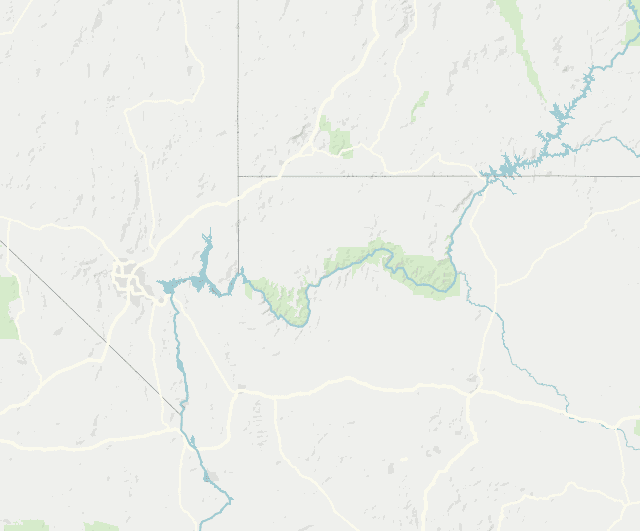
Baaj Nwaavjo I’tah Kukveni Grand Canyon National Monument:1.1 Mill Acres of Not-Mining?

Exact size and boundaries of monument are not yet known.
Source: Bureau of Land Management

As for me, to know that with a flick of a pen the President can undo the painful and laborious work of RMPs and Forest Plans, it would not encourage me to spend volunteer hours working on them.  For employees, it reminds me of my old expression about planning.. “the pay’s the same” and “if you’re not the lead mule, the scenery never changes.” But maybe that’s just me.

The WaPo has an interesting story on the  Baaj Nwaavjo I’tah Kukveni Grand Canyon National Monument (proposed with so far unknown boundaries).

Federal officials have started telling tribal and environmental groups to be available for a potential Grand Canyon announcement early next week, which would fall during Biden’s travel, said four of the people, all of whom spoke on the condition of anonymity to discuss an announcement not yet public.

Who needs those pesky old maps.. or talking to people in the area in some kind of public process?

“No decisions have been made,” White House spokesman Abdullah Hasan said in an email. “But I can tell you that President Biden has conserved more land and water in his first year than any president since JFK, and his climate protection record is unmatched.”
Apparently there are Important People and Groups who think that Biden hasn’t done enough things they want, so we can expect a flurry of “things those groups want” prior to the election.  Again, as  a volunteer, commenting on the FS MOG ANPR, the BLM public lands rule,  reducing royalties for solar and wind, the CEQ NEPA regs, more regs for oil and gas.. it’s a lot.
The way that the WaPo describes it, it’s all about uranium and Tribes that don’t want it.

Advocates have been lobbying for a monument designation in part to honor long-standing Native American connections to the Grand Canyon. For the Havasupai Tribe, Baaj Nwaavjo means “where tribes roam,” and for the Hopi Tribe, I’tah Kukveni means “our ancestral footprints.” Other tribes, including the Hualapai, which means “people of the tall pines,” also have advocated the designation.

“This monument will show that we are beginning to protect the lands of the world,” Dianna Sue WhiteDove Uqualla, a Havasupai Tribal Council member, said in a July statement anticipating the decision and provided by a coalition of monument advocates.

This is one of those areas in which it looks like low-carbon energy sources runs into the 30×30 idea, as well as Tribal spiritual values.  But we might be able to figure out who’s really holding the cards by comparing the Biden Admin position across different projects.  Anyway, here’s the industry position:

Industry officials said they will explore ways to fight the decision. They said it would lock up some of the country’s highest-grade uranium deposits at a time when such fuel would be useful to the country’s clean energy and geopolitical goals. Russia provides more than 20 percent of U.S. nuclear fuel, and Congress is actively exploring new laws to boost U.S. uranium production and enrichment in response to Moscow’s war on Ukraine.

In an email, Curtis Moore, senior vice president of marketing and corporate development for Energy Fuels — one of the few uranium miners with operations in the United States — blasted the decision as making “zero sense.”

He said it contradicts several of the administration’s stated policies, including “supporting clean energy production and punishing Russia’s aggression in Ukraine.”

Monument advocates have said only 1.3 percent of U.S. uranium reserves are in the Grand Canyon region.

That’s not my question.. mine would be “why do you need 1.1 mill acres to say “no uranium mining here”?”  Maybe that will come out in the announcement.

The announcement would help kick off an effort to promote Biden’s climate agenda, including progress from last year’s major climate-spending law, the Inflation Reduction Act. Biden is planning a three-state tour, with other stops in New Mexico and Utah, to talk about billions of dollars of investment that the law has prompted manufacturing companies to commit to making equipment that produces cleaner energy.

Arizona has become a major focus for Biden and other Democrats as they have gained ground politically in the state. The state has been one of the biggest beneficiaries of their big spending bills, with more than $8 billion in planned investment in a giant battery factory and other manufacturing developments, especially near Phoenix, according to the advocacy group Climate Power, which tracks such announcements.

In case you’re curious, here’s what the Biden Admin Energy Department had to say about the IRA and nuclear

Momentum is building for U.S. nuclear energy and the investments and tax incentives included in IRA guarantee a commitment to nuclear energy that will continue well throughout the nation’s journey to net-zero.

Wouldn’t a serious climate policy identify areas where renewables and mining are to occur? Otherwise it seems a bit like a leaf fluttering on random political winds.

For example, Tribes and environmental advocates tried to block the Thacker Pass lithium mine, also land considered to be sacred.  The Biden Admin was on the side of the mine. I guess we’re left to think that some Tribes are more important than others, some ENGOs are more important than others, or some States are more important than others based on some kind of political calculus.

Monumentizing Doesn’t Magically Produce More Funding: San Gabriel Version

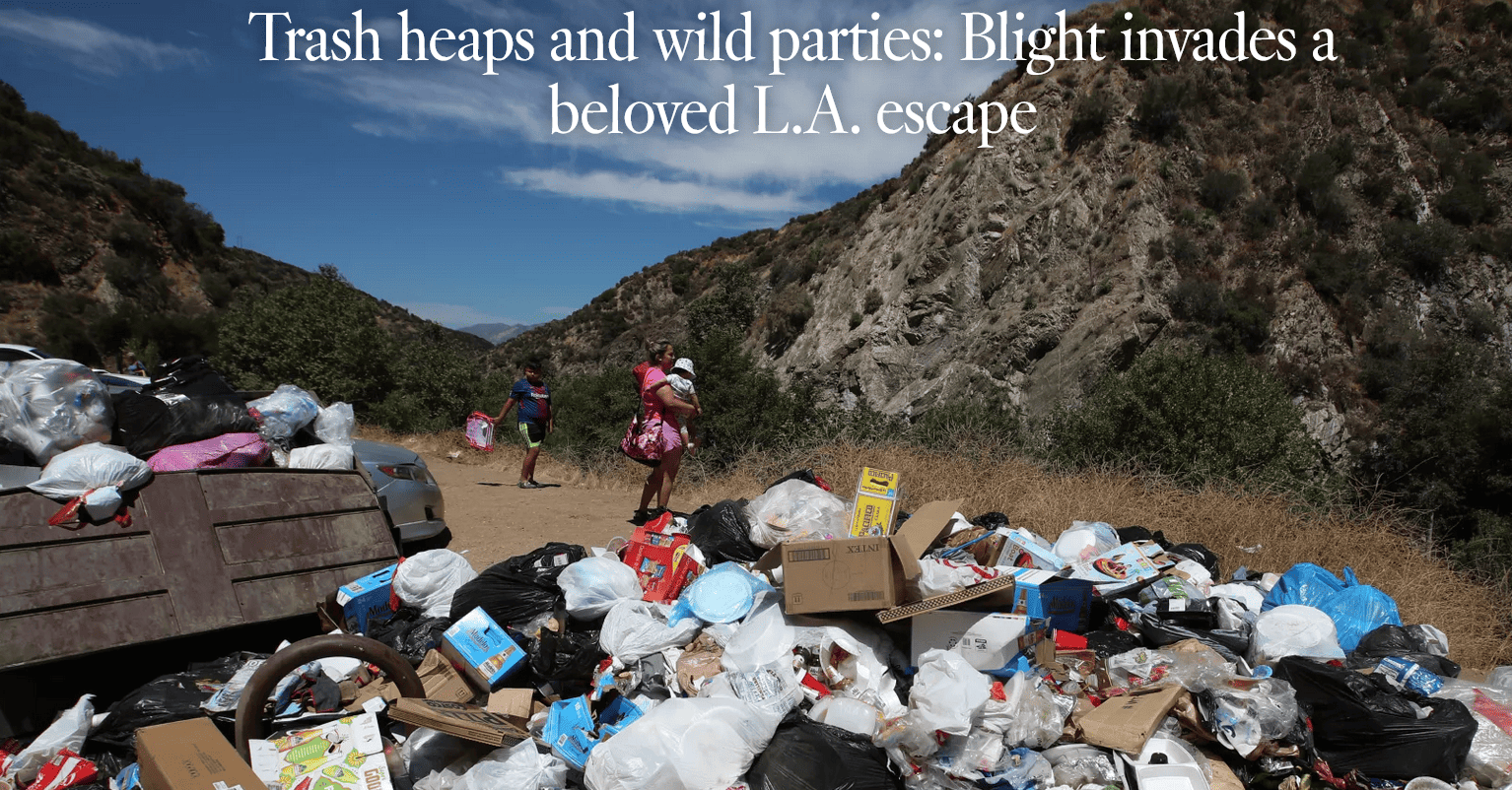
There’s an interesting LA Times article on the San Gabriel National Monument.  It’s easy for a Prez to designate something.. it’s easy to to claim that it’s now under “permanent protection”.. not so easy to have enough money to manage visitors..

Nine years after President Obama upgraded the region to monument status — an act intended to foster a cleaner and safer wilderness — park officials and volunteers have been struggling to cope with the consequences of surging visitation, particularly in summertime.

**********

But how exactly would making a Monument itself make something cleaner and safer?  And it’s not a Wilderness (granted I don’t exactly know what the reporter meant by wilderness). Maybe the Angeles needed more funding, not a Monument designation. I wonder how often this kind of “magically more money” thinking is involved in Monumentizing.

Refuse has been a health concern in the area since 2000, when the California Regional Water Quality Control Board ordered the Forest Service to reduce trash levels in the East Fork to zero within three years.

In response, rangers and volunteers were stationed at popular picnic sites to direct visitors to roadside trash bins and provide them with information about environmental issues and litter laws. They also posted “No Littering” signs printed in English and Spanish.

That strategy was abandoned a few years later because of budget cuts.

Now, there is renewed talk of devising strategies to limit visitors and instruct them on how to be better stewards of the environment.

*****************

The flood of ill-behaved tourists isn’t the only reason for the area’s problems. Implementation of a management plan for the East Fork, finalized in 2019, was stalled by COVID-19 and a lawsuit.

“We desperately need an East Fork stewardship plan that is adequately funded and staffed,” said Isaac Brown, a senior scientist at Stillwater Sciences, a consulting firm specializing in restoring rivers and floodplains.

The Forest Service has long complained of high turnover rates in management, chronic budget cuts, and being unable to pay wages high enough to attract sufficient numbers of “forestry technicians” to remove all the trash that accumulates each day along the East Fork. Pay for such positions in Angeles National Forest start at about $43,600 a year, officials said.

Most of the Forest Service’s budget is set aside for wildfire protection, as well as repairing campgrounds, roads and infrastructure damaged by torrential rains earlier this year, officials said.

Some critics see a connection between chronic overcrowding and the promotional efforts of large nonprofits that seek to increase access to the monument. Critics say the organizations have failed to take into account the toll on wildlife and habitat.

A discarded BBQ grill rests atop a heap of trash beside a river.
Piles of trash have not only blighted the landscape in San Gabriel Mountains National Monument, they have also raised contamination concerns for one of the region’s largest watersheds.
(Allen J. Schaben / Los Angeles Times)

Belen Bernal, executive director of Nature for All, a coalition of environmental and community groups that has long campaigned for more parks and safe outdoor opportunities in one of the largest metropolitan areas in the United States, agrees — up to a point.

“It’s true that we are looking at increased access,” Bernal said. “But during the summer months it’s a whole different ball game. This is a management issue.

“We’re not entirely happy about the situation in the monument. Just a year away from its 10th anniversary, it still doesn’t have enough restrooms, dumpsters or even a visitor center.”


Some litigation and other loose ends from November-December 2021

A holiday gift?  Header links are to news articles.

(New case.)  In a December 7 lawsuit against the U.S. Department of Labor, a group of Colorado river guides claim the federal government has arbitrarily imposed a $15 minimum wage on the outdoor industry, rendering extended tours through public lands less attainable.  The article includes a link to the complaint.

(New case.)  On November 29, the Center for Biological Diversity sued the U. S. Fish and Wildlife Service over a Trump administration rule that expanded hunting on national wildlife refuges when it determined that listed species found in or near the refuges would not be adversely affected by the expansion.  Species mentioned the grizzly bear, jaguar, ocelot, jaguarundi, Audubon’s crested caracara, wood stork, and whooping crane.  The article includes a link to the complaint.

(Update.)  The U.S. Fish and Wildlife Service and multiple conservation groups reached an agreement to conduct a new Endangered Species Act status review of California spotted owls by Feb. 25, 2023. The stipulated settlement stems from a suit the Center for Biological Diversity and other groups filed against the Trump administration in 2020 for not adding the spotted owl to the list of endangered species.

(Follow-up.)  A proposal to add the Pearl River map turtle to the federal endangered species list was published on November 23 by the U.S. Fish and Wildlife Service after two environmental groups sued the agency last year for missing the determination deadline by a decade.  The proposed listing (the article contains a link) mentions the Bienville National Forest in Mississippi favorably.

The U.S. Fish and Wildlife Service (Service) published a final rule revising the critical habitat designation for the northern spotted owl.  The final rule rescinds a previous rule issued by the Trump Administration on January 15, 2021, which would have excluded approximately 3.4 million acres from the species’ critical habitat designation.  We talked more generally about critical habitat and spotted owls here.  Related litigation was discussed here.

Oregon Democratic Sens. Jeff Merkley and Ron Wyden announced legislation to establish a new national monument in central Oregon on BLM lands.  According to Merkley’s press release, the proposal has the support of several conservation groups as well as the city of Mitchell, which has seen economic benefits from Painted Hills tourism and visiting cyclists.

The Rio Grande National Forest announced the inclusion of an administrative change in its revised  forest plan. The change addressed recently acquired lands that were not included in the Rio Grande National Forest’s land base when the plan was revised.

The 2012 Planning Rule allows administrative changes for “corrections of clerical errors to any part of the plan, conformance of the plan to new statutory or regulatory requirements, or changes to other content in the plan (§219.7(f)).”  Hmmm.


Promoting Unity in Biden Administration Policies: Alternatives to Monument Proclamations

President Biden said in his inauguration speech:

History, faith, and reason show the way, the way of unity.

We can see each other not as adversaries but as neighbors.

We can treat each other with dignity and respect.

We can join forces, stop the shouting, and lower the temperature.

For without unity, there is no peace, only bitterness and fury.

No progress, only exhausting outrage.

No nation, only a state of chaos.

This is our historic moment of crisis and challenge, and unity is the path forward.

OF course, the more cynical among us will say “beautiful words but the President has no choice but to hire people he owes- political operatives- to carry out his policies, and they have made no such pledge.” In fact, I’m not sure that those operatives have the skills or patience that even the humblest member of a humble forest collaborative might have.

Still, folks are always talking about “holding people accountable” and I don’t see anyone else attempting to hold the Biden Admin accountable, except possibly R’s- but it’s hard for me to see any truths through the murk of partisan mud-slinging. So I think I’ll rate Biden Admin efforts on a 10 point scale, where 10 is unifying and 0 is pointedly not “lowering the temperature..” that being what I have previously called “a sharp stick in the eye.”

I would give the Bears Ears decision a zero. Here’s what I would have done instead.

First of all I’d make an announcement.

This back and forth over Monuments has gone on too long. We need to establish a solution that takes into account the views of all parties and that all parties can live with over the long-term, that will stand the test of time. These decisions should not be made by strokes of the pen in DC nor by the federal courts, but by the people- including all the people who are affected. That’s the only way we can understand and incorporate social and environmental concerns as well as justice and equity, in an open and transparent way. My goal is to provide support for a long-term solution, considering all previous efforts, and building on the agreements that we already have. These lands are important to all of us, and deserve the best we can give them through formal and public deliberation on an array of ideas and approaches. I want the success of my Administration to be measured by the relationships we have improved, and the trust we have built, as well as the end-product of an agreement. I want to honor the role of peacemaking inside our country as we honor it in the international realm.

Process-wise, I’d try to take down the temperature and deal with on-the ground questions with a wide range of alternative and collaborative approaches:

* Sit down with political leaders in Utah, all Tribes, as well as other stakeholders, and design a collaborative process with the help of professional environmental conflict resolution folks. The FS does this for humble regulations, so why not a massive land use decision?

*As part of that, starting from a ground based process.. what do you want to protect the area from? Mining, oil and gas, OHV’s, vandalism?

*Have an opportunity for public comment on specific issues.

*Intentionally find people to serve that both “sides” respect as well as folks from both “sides”, including Tribes who hold different views. Have them analyze the current protections. Which ones are working well and which ones aren’t working? Where and why? Does the solution (say, to vandalism or illegal ATVs) require something that drawing lines on maps won’t provide? If so, what are mechanisms to make that happen?

* The BLM and the FS have a variety of other land designations of various protections. What are the advantages of a Monument over other designations? Is it marketing tourism or something more concrete?

* Have Tribes look at different options of “advisory committees” and “co-management” and design a process for being involved, what kind of decisions, what level, what kind of authority?

Overall, the point would be to take the issue from a partisan political football to an atmosphere of place-based joint problem-solving, which… we have a long history of doing. Colorado and Idaho Roadless were examples of such processes. They took the symbology of Roadless Protection and crunched through the details- specific concerns in specific places- with people who are affected. And at the end, even with partisan politics and litigation in various forms, did deals that everyone can live with.

For those interested, Stacy Young wrote an interesting article in the Canyon Country Zephyr on the legalities and some legal history.

I tend to think of the Antiquities Act as perhaps a red herring. The legal case seems to follow from the idea that “having a Monument is the Right Thing” and using this tool we can override other views. Pragmatically, though we all could save ourselves a lot of legal and communication work and vast amounts of NGO money (and spend it on law enforcement around Bears Ears instead?) by the Administration instead simply saying.. “we believe we can work through this together in an atmosphere of mutual respect. That is our passion and our promise.”

We can join forces, stop the shouting, and lower the temperature.

For without unity, there is no peace, only bitterness and fury.

No progress, only exhausting outrage.

No nation, only a state of chaos.

This is our historic moment of crisis and challenge, and unity is the path forward.

Those are powerful words, Mr. President and if you need help translating them into action (in our humble area of federal lands and forests), I and others are right here.

Hundreds of Giant Sequoias Considered Dead From Wildfires

It appears that rumors of ‘natural and beneficial’ wildfires in the southern Sierra Nevada have been ‘greatly exaggerated’. Even the Alder Creek grove, which was recently bought by Save the Redwoods, was decimated. Of course, this eventuality has been long-predicted.

https://www.latimes.com/environment/story/2020-11-16/sierra-nevada-giant-sequoias-killed-castle-fire

A Unification Approach to Bears Ears: Let’s Swear Off Political Sharp Sticks in the Eye

Conservation Lands Foundation board member and former Interior Secretary at a meeting in Durango, Colorado. Photo by Steve Lewis, Durango Herald.
Lisa Friedman of the New York Times wrote an interesting article about the top things the new administration could do for the environment.

Most of her nine are about climate change. Of most interest to us, is perhaps one she calls “Restore Wildlife Areas”

According to her, Mr. Biden has pledged to take “immediate steps to reverse the Trump assault on America’s national treasures” including major cuts in 2017 to Bears Ears and Grand Staircase-Escalante National Monuments as well as opening parts of the Arctic National Wildlife Refuge to oil exploration. He has said on the first day of his administration that he will sign an executive order to conserve 30 percent of US lands and waters by 2030.”

We’ll be continuing to discuss the details of a 30 x 30 goal.

One concept I’ve never heard political writers talk about is what I would call the “sharp stick in the eye” factor, which I think deserves more exploration. Bears Ears was monumentized following the loss of an election. We have heard from the same people that it’s bad for Supreme Court nominees to be picked too close to an election, but the same folks argue that it was fine to Monumentize an area where many elected officials are of the opposing party after an election. It seems to me that these positions are inconsistent, and I’ve found that inconsistent and or illogical positions are often guideposts to decisions that are ultimately political (in the sense of pleasing someone at the expense of others). Anyway, to me that was an intentional sharp stick in the eye. It will be interesting to see if we agree on the SSE (sharp stick) factor. I’d give Bears Ears an 8 on a 1-10 scale.

I don’t think the “uniting” approach would be to “immediately reverse” what the Trump Administration did. That would be just another sharp stick in the eye.. haven’t we had enough of those? What about sitting down again with folks in the area and concerned groups looking at a variety of alternatives without the drama of the Nationally Significant Focus by Some Groups as a Symbol. Certainly the only choice is not “these 2016 lines with these 2016 restrictions”. As Chris Wood said about the 2001 Roadless Rule, “it wasn’t written on stone tablets.”

Despite the fears, we didn’t see any oil and gas nor additional uranium development. Maybe, as we have seen, increasing recreation in the area would be bad for the environment, or people come whether or not it’s a Monument, or people overuse trails and spread Covid to locals. Seems like the last four years have had changes that could be considered in such a discussion.

Mark Squillace, a professor at the University of Colorado Law School, tells the story of when he accompanied Interior Secretary Bruce Babbit to affected communities to discuss Grand Staircase-Escalante national Monument. The way his story goes, talking person to person with Babbit may have actually changed minds, or at least reduced the atmosphere of antipathy. (Of course, that’s Mark’s side of the story, but we don’t have another one, so I’ll go with it.)

Here’s my unifying approach based on that:
1. Send the Secretary out there (presence is a great symbol) as part of a public comment period
2. Determine to listen respectfully to the other sides, including elected officials from the other party (!). As the President-elect said, they are not your enemy.
3. Do a deal with the goal of stability.. “can everyone live with this?”

Actually, it sounds a lot like plain old collaboration. It’s also what states have to do regularly, which is why I like former western governors and DNR directors for Interior Secretaries.
It’s interesting to think about why it is that when the stakes are higher than at the State level, it seems like collaboration takes a back seat and “winner takes all” takes over. But internationally, we’d reject that approach in supporting peace processes. Perhaps national politics are some kind of anomaly. Not in a good way.

I ran across this article from only five years ago from the Durango Herald on Babbitt’s then-current activities:

The pushback from the energy production industry is a major obstacle, but Babbitt said he has long held the belief that the two, preservation and industry, can co-exist.

“How many of you know, that there is gas production at the Canyon of the Ancients?” Babbitt asked the crowd of about 30 members and non-members. “The opponent says you’re taking things off the slate of use and production, that the land is just being set aside for weak environmentalists. But (oil and gas) can be managed with minimal impact. It is possible to make them work together.

And one reason the BLM is taking such good care of that place is because they’re looking over their shoulder,” he said. “That’s the model for the entire West, and it began right here in Durango.”

I think by “they” in the last sentence Babbitt meant local people given the context. Also Babbitt talks about BLM’s National Conservation Lands which sounds like it could be an alternative to monumentizing, especially when an Administration starts with enough time for such a process.

Public land developers getting financial pushback

An interesting observation from the Washington Post.  As investors become more enlightened about the financial risks caused by climate change they are starting to hold corporations accountable.  That includes their operations on public lands – and litigation is part of the risk.

A dozen-and-a-half senators wrote letters to 11 of the largest U.S. banks asking them to back down from financing any oil and gas activity in an unspoiled expanse of Arctic wilderness.

“The scale of your banks’ assets individually, let alone together, give you the ability to drive change in protecting the Arctic National Wildlife Refuge and in shifting towards a U.S. financial sector that effectively analyzes and plans for climate risks,” the group of a senators, led by Sen. Martin Heinrich (D-N.M.), told Wells Fargo, Bank of America, Citigroup, Morgan Stanley, JPMorgan Chase and six other banks in a letter sent last Thursday.

Democrats hope these banks follow the lead of one key peer: In December, Goldman Sachs said it is ruling out financing new drilling or oil exploration in the entire Arctic.

The world’s largest asset management firm, BlackRock, said last month it would divest from coal burned in power plants and make climate change a “defining factor” of its investing strategy.

And just last week, a group of investors representing nearly $113 billion in assets under management issued a similar letter to energy, mining and timber companies. Their warning: Don’t invest in certain federally controlled areas once protected but now open to development by the Trump administration.

These areas include not only the oil-rich Arctic refuge but also Alaska’s Tongass National Forest, the largest intact temperate rainforest where the U.S. Forest Service wants to allow new logging, (discussed here) and Minnesota’s Boundary Waters Canoe Area Wilderness (the Twin Metals mine litigation is discussed here), a popular lake-pocked forest near where the administration wants to allow a copper and nickel mining operation.

The institutional investors, which include several religious funds as well as a fund established by the late oil heir David Rockefeller, warned companies that many of the administration’s rollbacks of public land protections are legally precarious, and may be struck down by the courts or the next presidential administration. The letter went out to ExxonMobil, the timber company Weyerhaeuser and 56 other firms, according to Reuters.

“Many of these projects are mired in litigation,” the letter stated, “challenging the legality of any current or future industrial activity initiated in these regions and providing evidence of the risks associated with conducting commercial development on lands that the American public has deemed valuable for protection.”

The institutional investor letter also mentioned other areas, including protected sage grouse habitat (litigation discussed here) and the national monuments that have been reduced in size by the Trump Administration that are also under litigation (discussed here).  Here’s the latest on that.

Brown’s Canyon Monument Planning, BLM’s Use of the Online Story Map, and the “Sustainable Alternative”

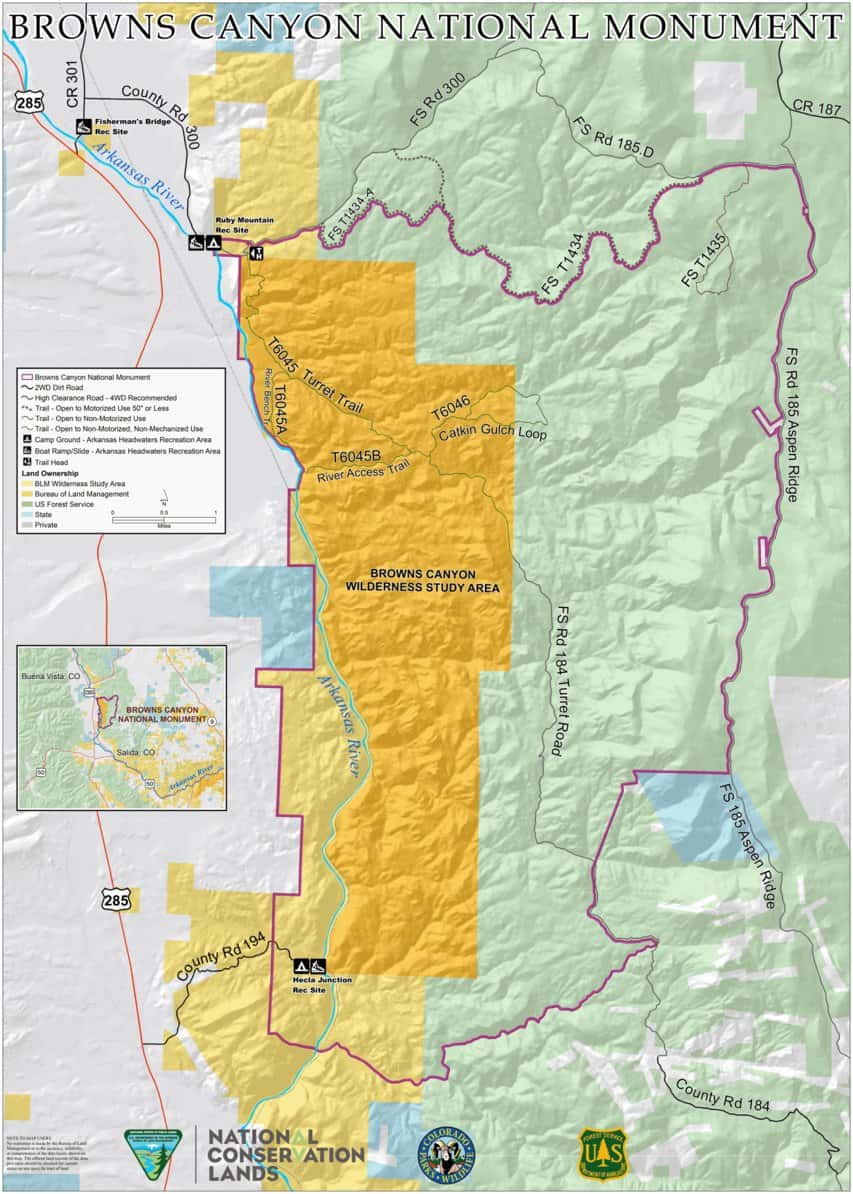
I hope that this is a correct map.

I received an email from the Colorado Mountain Club this morning asking me to weigh in via public comments on the Brown’s Canyon management plan, which is joint between the BLM and the Forest Service. The Sustainable Alternative is interesting from the “how local collaborative work should be considered” perspective, and also “what people disagree about when there is no oil and gas nor fuel treatments, and grazing is off the table based on the legislation.” This is the message from CMC about what our comments should say.

Main messaging:

The Sustainable Alternative was developed through a collaborative process by a group of over 20 local Chaffee-county based citizens and organizations who represent decades of use and close observation of the area now designated as Browns Canyon National Monument. The Sustainable Alternative has broad community support from over 100 local businesses, residents, and decisionmakers, as well as various regional and national organizations. The Sustainable Alternative also has local government support, including the City of Salida, the Town of Buena Vista, Chaffee County Commissioners, and the Town of Turret.

The development of the Sustainable Alternative was very intentional in prioritizing the protection of Monument resources, objects, and values, while balancing increased need for recreational access and conservation. The vast community support signifies the balanced and reasonable approach put forth. The Sustainable Alternative seeks to ensure the Monument is protected for generations to come. We believe local residents, businesses, and cities should have a voice in creating reasonable management for Browns Canyon National Monument – we are asking the Bureau of Land Management and the US Forest Service to adopt recommendations put forth in the Sustainable Alternative, rather than a top-down from political voices in Washington, DC.

OK then, but I don’t think that those are the only two alternatives. From the text of the Sustainable Alternative:

In general, the BLM and USFS, in collaboration with cooperating agencies, should provide enough professional staff and law enforcement officers to ensure compliance with BCNM regulations and pertinent laws. The monument should be managed to accommodate current and future uses. Most importantly, the agencies should be careful not to invite more activity than can be sustainably managed, such as by providing maintenance-intensive infrastructure, developments requiring frequent staff patrolling, and by undertaking high-visibility programs to promote visitation to the Monument.

It does seem like folks pursue a Monument designation hoping to get more management bucks. Then they are many times disappointed by not getting more bucks,  and also having more visitation due to the enhanced visibility.  This could lead ultimately to a net loss in funding per visitor.   But has anyone ever seen the BLM or FS spending money to promote visitation to a spot? It seems to me that that is usually the role taken by local businesses and governments, whom I’m guessing are not going to do that, given what they say in these comments.

They also suggest that it’s more efficient for the PSICC to do the monument plan under the 2012 Rule than to do an amendment regarding this piece of land. It’s hard for me to agree that it would be either efficient or particularly straightforward.

As an alternative approach and as previously stated in Friends of Browns Canyon and The Wilderness Society’s comments on the Planning Assessment, submitted in September 2018, it is much more efficient and straightforward to develop the monument management plan under the USFS 2012 planning regulation rather than trying to stitch 2012 rule amendments into a 1982 rule plan.

So I read on and in the Sustainable Alternative there were some surprising (to me) thoughts about roadless:

Similar to recent Federal legislative initiatives to release on WSAs, there are currently state-based pressures to remove roadless area protections. For example, Utah Governor Herbert recently petitioned the U.S. Department of Agriculture to revoke and rewrite the national Roadless Rule as applied to The Aspen Ridge Roadless Area provides a uniquely undamaged landscape with wilderness qualities. Utah’s forests to open these lands to development. (See https://governor.utah.gov/2019/03/01/utah-submits-request-to-the-department-of-agriculture-regarding-federal-land-maintenance and https://ourforests.utah.gov/wp-content/uploads/2019/02/UtahRoadlessRulePetition_28Feb2019.pdf.) In light of these known and anticipated pressures, as well as the need for clear management prescriptions to be outlined in the RMP for future agency officials, it is important for the USFS to consider proactive management to preserve the wilderness character of the lands within the Aspen Ridge Roadless Area, such as those suggested in the following recommendations.
2. Recommendations
• The USFS should use the current planning process as an opportunity to recommend wilderness for the entirety of Aspen Ridge Roadless Area within the monument.
• The USFS should include language in the RMP, providing commitment to manage the Aspen Ridge Roadless Area under the same protections even if the roadless area designation were to be removed.

Holy Smoke! The folks who wrote this either didn’t know that the FS and Colorado had spent a great deal of in developing our own State Roadless Rule and that that is currently the law of the land in Colorado, or are generally promoting Utah-phobia just for the heckuvit.

Anyway, I did think that the BLM’s use of the “online story map” was interesting, and the webinar. The webinar seems like a great idea so many people can easily participate. Maybe FS plans have something similar, but I have not been keeping up. Check it out!