The myth of “coordination”

In recent years this the idea of “coordination” has been sold to local governments as a legal tool to make federal land managers do what the locals want with national forest plans.  It’s a myth that periodically needs busting.  This article describing the response of the Malheur National Forest and a document from the Northern Region provides a pretty good summary of the history and reality.

“Based on recent local government resolutions or ordinances and letters to some national forests, it appears that some local government officials believe the (National Forest Management Act) coordination requirement means the Forest Service must incorporate specific provisions of county ordinances into forest plans or that the Forest Service must obtain local government approval before making planning decisions,” Hagengruber said.

“This position overstates the NFMA obligation of the Forest Service,” he continued. “The statute does not specify what actions are required to coordinate Forest Service planning with local government planning, and it does not in any way subordinate federal authority to counties.”

“Rather,” he continued, “the Forest Service must consider the objectives of state and local governments and Indian tribes as expressed in their plans and policies, assess the interrelated impacts of these plans and policies, and determine how the forest plan should deal with the impacts identified.”

Idaho county votes down wilderness

Follow-up:                                   

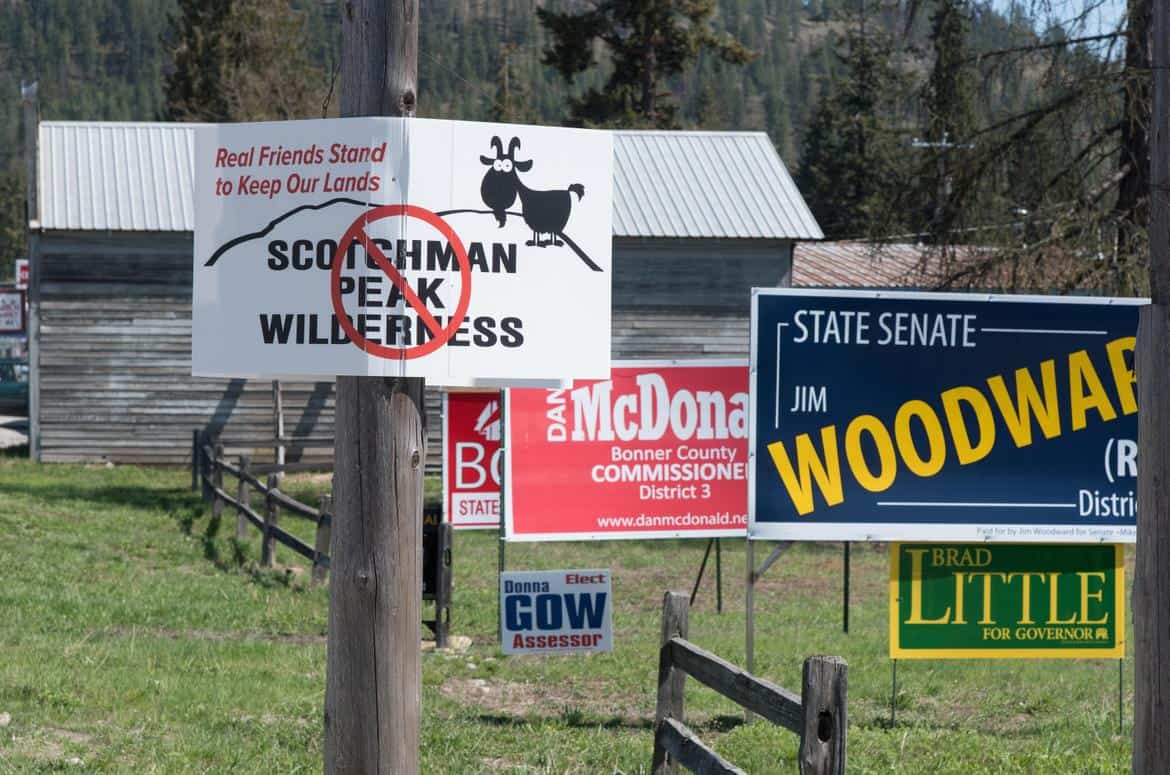
Voters rejected the proposal for the Scotchman Peaks Wilderness, 5,672 to 4,831.  As a result, Senator Risch will not reintroduce his legislation to designate the area, and wilderness legislation has no chance of passing without local Congressional support.  So to a limited degree we have local control of a national forest, but as the article points out, management under the forest plan, which recommends the area as wilderness, won’t change.  (The article suggests that Congress couldn’t change the forest plan; of course it could, but I don’t think there is a precedent for it.)

The unfortunate thing is that the voters seem to have been misinformed (which is something I would hope a congressman would take into account).

“The philosophy with wilderness areas is let it burn,” said Bonner County Commissioner Dan McDonald.

And, perhaps most importantly, (Forest Service spokesperson) Cooper said Forest Service personnel can and do manage forest fires in both recommended and designated wilderness areas. “We still do manage wildfire,” she said.  In 2017, the Forest Service sent smokejumpers into the Salmo-Priest Wilderness area to fight a forest fire.

My own interpretation is that suppression response depends on the values at risk, and wilderness area values, aren’t lost when they burn (in fact probably the opposite) – like other areas managed primarily for conservation or recreation, which is how this area is being managed now. 

Federal lands, “Utah-style”

Three Republicans running for election this year discussed weakening the Antiquities Act and Endangered Species Act, dropping the filibuster rule in the U.S. Senate and rewriting federal public lands policy to require state approval of new regulations.

“It’s not that lawmakers in the East — and for me that’s everything east of Denver — it’s not that they’re evil, they’re just stupid,” he (Bishop) said, drawing chuckles from some in the audience. “When we talk about public lands to Easterners, they just don’t have the same concept. They think everything is Yellowstone.”

I would say they might think everything “should be” Yellowstone, and who’s to say they are wrong.  It’s their land too.  Maybe Bishop is the one who is stupid.

“”It’s going to take an educational effort, not just a political effort” to push back against what he called radical environmental groups, he (Romney) added, referencing decisions such as Trump’s national monuments order, which has been challenged in court by Native American groups, environmental groups and others.  “There are some in the environmental lawsuit industry that may not care very much about the underlying facts,” he (Romney) said. “They’re just going to file lawsuit after lawsuit after lawsuit because that’s how they get paid.”

The underlying facts are what the lawsuits are based on.  And apparently “radical” means “willing to go to court.”

Maybe they should just sell this national forest land?

Steve Sanders addressed the board on the issue of the landfill nearing capacity. Sanders stated the landfill is expected to meet capacity sometime in the summer 2018. The plan for expansion has been on the books for a number of years. The expansion will cap in 5-7 years and then will require Gila County to have a new site to continue to collect municipal solid waste to dispose of for the northern part of the county. They have already started discussions with the Forest Service to acquire land around the Buckhead Mesa Landfill as it’s on a special use permit from the Tonto National Forest.

When someone argues that the Forest Service isn’t complying with the Multiple-Use Sustained Yield Act because a particular use excludes others, show them this example.  I suppose you could camp here … or how about a shooting range?

Local plans for federal lands – the latest

This is a continuation of the “sagebrush rebellion” in the form of local government plans that purport to exert local control over federal land management.  They are being peddled to rural counties by Karen Budd-Falen, an attorney with a history of promoting private property rights (who some expect to be the new director of the BLM).  Since she certainly knows what she is talking about, she must also know that there is no legal basis for some of the expectations she is generating.  It’s just another way of stirring up local sentiment against federal land management.

A new local plan was just adopted in Oregon:

Earlier this month, Crook County leaders passed a plan designed to give county residents more say in how local public lands are managed by the federal government. However, discussions over how the plan will be implemented and what it will mean for the county’s oft-contentious relationship with its local public land managers are just getting started.

In addition to articulating county priorities for how federal land should be managed with regard to mining, agriculture and recreation, the plan states that the county expects state and federal agencies to meet with county officials on an ongoing basis.

Still, Michael Blumm, professor of law at Lewis & Clark College in Portland, said federal agencies don’t have any obligation to follow the county priorities set out in the plan, which range from mandating no reduction to grazing allotments on federal land, to ensuring that roads providing access to public lands stay open year-round.  “It’s a political move,” he said. “It’s not legally enforceable.”

And another is being discussed in Montana:

A controversial land-use attorney drew more than 100 protesters and as many supporters to Hamilton Middle School Saturday, but the topic of her talk with county residents was interpreted differently by people attending the event.

Budd-Falen’s talk centered around having a more detailed county land-use plan that would be used to strengthen its own management desires carried out by federal agencies, including the Forest Service. She said that federal policymakers in Washington, D.C., were out of touch, and local governments could help guide more micro-level policies.

While Budd-Falen never spoke about public land transfer, state Sen. Jennifer Fielder, R-Thompson Falls, gave a presentation about her efforts to support federal land transfer to states. 

Actually Ravalli County has already has a “natural resource use plan” it developed in 2012, and Commissioners changed their minds about asking Budd-Fallon to speak about adding “teeth” to it (she was invited instead by a local state representative).  Maybe their experience with that plan has helped them understand that its greatest value is probably in helping them articulate their interests rather than as something to beat up the Forest Service with.

Utah counties make plans for federal lands

Sagebrush Rebellion light?

The state required counties to make these plans, which by itself should be a good thing (especially where there has historically been anti-planning sentiment). “This helps us to work with our federal partners to ensure Summit County’s interests are part of the conversation on how federal lands are managed,” said Sean Lewis, a Summit County planner and project manager for the drafting of the plan.  “This provides a template for us to work together with our Forest Service managers,” (Summit County Council member) Carson said. “We want to be partners with them. We don’t want to take stuff over from them and I am confident we will have a lot in common.”  This makes sense.

However, Summit County is a recreational drive from Utah’s urban centers, and we should expect other more isolated counties, with encouragement from anti-federalists, to want to use these plans to impose local control when federal land planning occurs there.  The article refers to the BLM requirement for a “consistency review” of local plans, but the 10th Circuit (New Mexico ex rel. Richardson v. BLM) held that, “A meaningful opportunity to comment is all the regulation requires.”  Nevada was similarly unsuccessful in using this provision to challenge federal planning for sage grouse (Western Exploration v. USDI).

The Forest Service Planning Rule also has requirements to “coordinate” national forest planning with local planning, which some would like to view as a consistency requirement.  But the Planning Rule also says, “The Forest Service retains decisionmaking authority and responsibility for all decisions throughout the process.”  The bottom line is that states have no authority over federal land management.

Personnel, politics and public access to public lands


Yes, it looks like Forest Service employees should be concerned about how Trump might affect their careers.  Here’s an example about offending private landowners who block access to national forests.  (And, without any facts beyond earlier stories, I’ll suggest that you not think of these as long-term rural residents, but more likely some recent, possibly seasonal transplants, with money and political connections.)

Here’s one version of the story from a private property rights promoter:

Such cooperation, however, changed under the Obama administration as the Forest Service took a more strident approach in asserting claims to “traditional public access” routes. The dramatic change is reflected in a posting by Yellowstone District Ranger Alex Sienkiewicz who publicly advocated “NEVER ask permission to access the National Forest Service through a traditional route shown on our maps EVEN if that route crosses private land. NEVER ASK PERMISSION; NEVER SIGN IN. … By asking permission, one undermines public access rights and plays into their lawyers’ trap of establishing a history of permissive access.”

According to Sienkiewicz and access advocates, traditional public access is sufficient to establish a legal right, known as a prescriptive easement, to cross private property. Centuries of legal practice, however, have required that individuals or agencies wanting to establish prescriptive easements must prove that access was continuous, open, notorious, and hostile to the owner. In other words, the access must be without expressed permission by the landowner, a burden of proof that has been difficult, to say the least.

This doesn’t sound like the complete story.  The federal government does try to protect its existing legal interests, and that includes historic access that may not have been formalized, which it tries to negotiate.  I doubt if it often pursues litigation, but does sometimes end up in court to defend public access, as in this case involving access to the Lee Metcalf Wilderness on the Indian Creek trail, cited by the author of the op-ed above as a good example of negotiation (at least until it apparently went bad).  The Forest Service met its “difficult” burden of proof in this case.  There is a risk that asking permission now could undo the historic rights that already exist, but I don’t think it’s large, and I am a little skeptical that the Forest Service would “post” statements like that above except in cases where a particular landowner had made it clear that they were declaring war on public access, such as in this example.

Here’s another version of the same story from a recreation outfitter:

Recently, the U.S. Forest Service removed District Ranger Alex Sienkiewicz from his position in the Yellowstone Ranger District pending an internal investigation into his efforts to defend historical Forest Service trails and easements along the Crazy Mountains.

When legal access to public land does exist, I believe Montanans fully expect the Forest Service to defend and maintain that access for Montanans. As with so many of these issues involving political pressure on public agencies, a look behind the curtain reveals a very troubling story. According to media reports, U.S. Sen. Steve Daines, and Congressman Pete Sessions from Houston, Texas, both contacted Agricultural Secretary Sonny Perdue regarding Sienkiewicz’s efforts to protect legal, established accesses to landlocked public lands. According to Mary Erickson, forest supervisor, “the reassignment was made after allegations from an assortment of landowners in the Big Timber area were raised to the level of the Secretary of Agriculture, Sonny Perdue, and Sen. Steve Daines.“

Here’s the background on the Crazy Mountains access.

Blocking and posting no trespassing signs at the head of Trail 115/136 prompted Yellowstone District ranger Alex Sienkiewicz to organize a trail clearing and marking trip this past summer. Prior to that the agency traded letters with the Langhuses’ Livingston attorney, Joe Swindlehurst, who has denied there is an old forest trail at that location.

It’s not a stretch to see this as politicians ordering a personnel move to keep public lands from public hands.  Dangerous on both counts.


Federal lands and transitional economies

Headwaters Economics has released this update to a report discussed at length here last year:

 “Rural counties in the West with more federal lands performed better on average than their peers with less federal lands in four key economic measures.”

“This update of research from last year finds that from the early 1970s to the early 2010s, population, employment, and personal income on average all grew significantly faster—two times faster or more—in western rural counties with the highest share of federal lands compared to counties with the lowest share of federal lands. Per capita income growth was slightly higher in counties with more federal land.”

An article on “transitional communities” adds:

“Rural decline is a large and complex issue that appears to be accelerating. According to the Pew Charitable Trust, during the period between 1994–2010, 38.4 percent of U.S. rural counties lost population; since 2010, over two-thirds of rural counties lost population.  This level of decline has far-reaching national and international implications for food and energy production, tourism, and national culture and identity.”

Putting them together, it looks like public lands can be an important asset for minimizing or avoiding rural decline, if communities can get their act together to embrace this potential and plan for it.

“Particularly in declining communities where long-established residents remember the charm of life in simpler times, residents can have considerable resistance to change. This connection and preservation of the past, while a rural virtue, can impede its adaptation into the future. Resistance to any proposed solution that “hasn’t been done before” simply impedes innovation or positive transition.”

The beginning of state management of national forests

A group of Western senators, including Sens. Jim Risch and Mike Crapo, both R-Idaho, have introduced a bill to allow states to implement their own conservation plans to protect sage grouse and their habitats, in lieu of federal management.

Congress would be allowing states to override the decisions by the Forest Service and BLM to amend their plans to protect sage grouse, which would amount to letting states take over planning for national forests to the extent that it can be tied to sage grouse in any way.

Interior nominee Zinke talks about federal lands

He had a lot of interesting things to say that generally put him within the normal range of political appointees to this position (a nice surprise, given some of Trump’s other nominees), including retaining federal ownership and understanding of climate issues, and this:

An admirer of President Theodore Roosevelt, Zinke said management of federal lands should be done under a “multiple-use” model set forth by Gifford Pinchot, a longtime Roosevelt associate and the first chief of the U.S. Forest Service.

Zinke also pledged to tackle an estimated $12 billion backlog in maintenance and repair at national parks, saying parks and other public lands should be a key part of Trump’s infrastructure improvement plan.

But the former Navy SEAL said his most important task at Interior will be to “restore trust” between the agency and the states and Indian tribes it serves.

“One of the reasons why people want to sell or transfer public land is there’s no trust, because they feel like they don’t have a voice,” Zinke said, referring to elected officials and residents of many Western states. “They feel like they don’t matter. Well, they should matter.”

The question of how much local interests and which local interests should matter to decisions for federal lands has always been a matter of degree and circumstances.  For example he might be talking about the “bi-partisan solutions” mentioned by Trout Unlimited.  But note the “nuanced” comment from Senator Tester, because “Zinke had last June endorsed a bill handing management of federal lands to state or local governments, while leaving ownership of those lands to the feds.”  (We should expect that USDA Forest Service policy under whomever is selected as Secretary would line up with USDI.)