I’m reposting this today because I’m surprised no one weighed in.. and other posts were published so maybe everyone didn’t see it?
If we had cash or non-cash awards on The Smokey Wire (and maybe we should), Sean would definitely deserve one for taking the time to dive into the mysterious world of FACTS. So a major thank-you to him!
From Sean:
******************************
Here is a little workup of the FACTS data.
I downloaded the full FACTS dataset. Caveat – FACTS (like all huge, ongoing data projects…) is messy! I am working with it here pretending like it is perfect, but we all need to know that it is not and there are plenty of places with missing or incorrectly classified data.
I first filtered to remove anything earlier than 1905 (pre-FS – you may be surprised but some records go back to the mid-1800s, Forest Reserve days presumably) and later than 2026 (the future hasn’t happened yet as far as I’m aware). Then I filtered to include status “Accomplished” and “Completed”, but not status “Planned”.
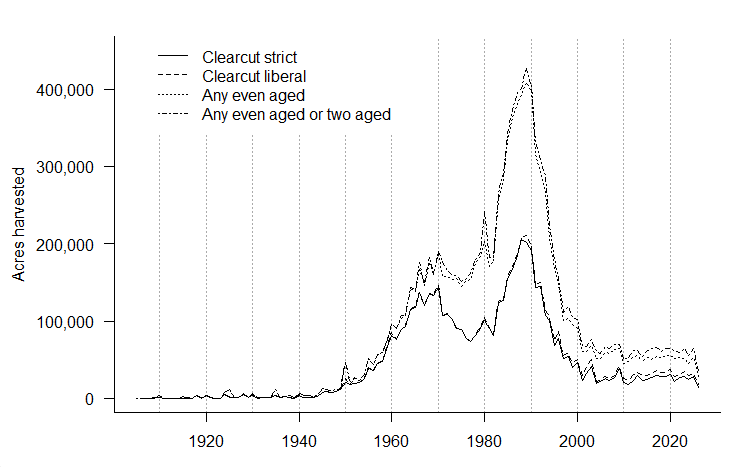
I built this spreadsheet with the full list of Activity Names and my calls on whether they count as a clearcut. I did four versions: a strict interpretation and a liberal interpretation of what a clearcut is, one for all even-aged systems (including shelterwood and seed tree, for example), and one for all even-aged and two-aged systems (including what we would call variable retention harvest today, coded in FACTS as two-aged stand clearcut with reserves). You may disagree with my calls, in which case I invite you to propose something better.
Link to “is it a clearcut?” calls:
https://docs.google.com/spreadsheets/d/1nn6j8IbTO9g5EzrcQXA2Js04FfCGYUH7?rtpof=true&usp=drive_fs
Who knows exactly what queries were done to build the tables in the post, but what I get is pretty similar.
Clearcut (strict)
2023: 29,007 acres
2024: 24,283 acres
2025: 28,733 acres
The other three definitions are not as good of a match.
Clearcut (liberal)
2023: 34,635 acres
2024: 29,705 acres
2025: 32,917 acres
All even-aged
2023: 51,846 acres
2024: 44,898 acres
2025: 52,483 acres
All even-aged and two-aged
2023: 64,144 acres
2024: 55,520 acres
2025: 64,662 acres
Link to graph over time of National trend:
https://drive.google.com/open?id=1X3tDwWlbd_uKoQRdO5-iCRaTMMz1cjBk&usp=drive_fs
Link to acres of harvest per year by each of the four definitions by National Forest:
https://docs.google.com/spreadsheets/d/1GsaHjRcXsdzbQmFVDAMhR3ZParjVtDf-?rtpof=true&usp=drive_fs
Link to the full FACTS dataset as a table (340 MB file – no GIS required, you can open it in Excel):
https://docs.google.com/spreadsheets/d/17WiGYUn5cDWuQsvZ1mdFNYhxdkEKDfi1?rtpof=true&usp=drive_fs
************
From Sharon:
I’m a bit stuck at the varieties of definitions and how they could add up to meaningful numbers of any kind. At the 30K level, there is only even-aged and uneven-aged management (or is there?), maybe we should ask a current silviculture prof? Uneven-aged in many places won’t get back intolerant species, which we would need for diversity; and tolerants by themselves are not resilient to wildfires and tend to be host to a variety of diseases and insects. At the same time, they tend to be fairly good (along with LPP) at reproducing themselves, while the intolerant may need more assistance.
Would concerns about NRV and fuels lead us instead to a different taxonomy of treatments, perhaps based on density reduction and ladder fuels? Or are our current definitions not exactly fit for current purposes, but not worth changing? How do these numbers crosswalk with fuels acres accomplished, or do they?
Meanwhile, what do you all think of the exercise of asking the same “why do you clearcut, if you do?” of all forests and seeing what the national story looks like?
Looking at the most recent years numbers for the California Forests, clearcut acres appear to be related to fire salvage (looking at the Eldorado and Plumas in particular).
I’ve worked on a lot of salvage projects, and have never seen a clearcut unit in any of them. Every salvage prescription has snag retention rules. Additionally, trees that don’t meet salvage guidelines are not cut anyway, due to possible ‘convenience’ for silviculturalists. Finally, oaks trees and other hardwoods are not cut, to facilitate plantation efficiency.
(although I have seen my boss decide to cut trees which I specifically left for snag requirements)
Do snags (dead trees) count as trees for the purpose of categorizing the type of harvest?
Of course they do, in salvage projects. ‘Regular’ clearcuts cut all the trees down, to turn that land into a plantation. Oddly enough, sometimes Culturists don’t want ANY snags in their green sale plantations but, it seems OK in severely burned areas. Some like to paint it as a safety issue.
A “Clearcut” is only a clearcut, officially, when it is in the project documents. When I did salvage projects, that was always…… never. I always considered my work to be on display, assuming that eco-groups would be looking for problems. (That did happen to me once, but the things that they thought were wrong, were easily disproven by a series of my photos. The eco-group seemed pretty inept, to me.)
Tom, thanks for weighing in. I thought wildlife people wanted to leave snags?
Given the discussion, it makes me wonder about what FACTS codes are being entered as technically clearcuts. And if they truly fit the definition of a clearcut. The Sierra Nevada Framework removed that option out of the silviculture tool box for the Forests I cited above.
In the graph above, I was struck by how stable things have been for the last quarter-century. Is this a reflection of “sustainability” and an indicator of “community stability” so no “need for change” (including the amount of resistance like litigation)?
Wouldn’t the ecological answer to “why do you clearcut” be “because large openings with no trees are the nature (NRV) of this ecosystem?”
I also like Sharon’s idea of a different taxonomy focused on fire as a natural “harvest” system instead of logging.
The “snags in the clearcuts” took me back to a rather significant discussion over snag retention for the black back woodpecker. Our Forest Plan apparently had the snag requirement, and at that time, the Forest Plan was 35 years old. A note: current Forest Plan on a particular Forest in Colorado is in its 43’d year.
Anyway, I always enjoyed a good discussion on EA’s, but had to be careful since I also signed the Decision Notice’s. Anyway, the approximately 2,000 acre salvage still had to have the snag requirement! That only left 536,049 acres of snags that were never cut. To say these snag requirements provided excellent habitat would be incorrect. Snags of ponderosa only last about five years before they begin to fall in great numbers.
Does that make sense? I think not! At any rate, it took so long to get the document to signature stage, most of the usable wood lost its usefulness due to decay.
Got’ta love it!