Whoops, this section should have gone with the previous post, quote from Fennessey (all quotes are from the transcript on the THW substack)
I remember when the district office would empty when there was a fire on the district or on the forest. I mean, everybody grabbed a tool, grabbed a yellow shirt, and went out there. And, you know, you didn’t know that the district ranger was a hell of a firefighter.
You know, the forest supervisor was a hell of a firefighter. Well, you know, over time, that’s changed. That’s not what it is today anymore. They’re still… You know, line officers that are amazing firefighters. I don’t want to take anything away from that. But the guys I used to work with, you know, the Joe Stutlers.
I think about Ray Quintanar. I mean, there’s all these names in my head that, man, were just incredible line officers and firefighters. Well, it’s not like that anymore. And it just is the way it is. And, you know, when it comes to public safety, And decisions need to be made as it affects communities, infrastructure, lives.For me, again, this coming from a firefighter that’s been doing this for 48 years, 25% of those years as a fire chief, that needs to land on the fire service. We need to be responsible. We need to be held accountable for lives, property, and infrastructure.And I don’t think it’s fair to the line officers that have to take that responsibility because they’re filling that position. I think it is time for a change. And I do see where one agency just makes a lot of sense. Will it be smooth? Will it be easy? No. Are we laying the framework now?And have we shown that, hey, look, this can be done? Absolutely. Tim, how many people did you hear say, well, if the Department of Interior does this, who’s going to be spending the time on the landscape? You cannot detach these firefighters from the landscape. Nobody has. Nobody has. And should the Forest Service firefighters, should Congress decide to move them over and there be one agency, it’s the same thing. People’s offices aren’t going anywhere. Those same firefighters are going to be doing the work on the landscape. And I think it’s scale. I think when the budget for the firefighters… It’s moved over. And if you look at the FY27 budget today, that’s where it is, is we’re going to do a lot more work at scale on the landscape. And man, it’s got to be, I keep saying at scale, 24-7. We’ve got a long road ahead of us. But that’s what it’s going to take. Can we do that with two separate agencies? I suppose we could.
I’m suspicioning that someone has asked and answered the set of question we might have. Who is going to do project planning for fuels and prescribed fire- the same bureau people who do it now? How will that work, if charge as worked, then USFWS will have to pay them for that work for fuels projects. Even more potentially confusing, though, is what about mixed purpose projects? Let’s take a thin and underburn.. would have fuel goals but also forest health goals and maybe timber. How to proportion the funding? If some folks wanted to negotiate out important units or change prescription to suit some publics, would the fuels folks be able to say “hey if you don’t do x, we’re not funding it?” Maybe those aren’t questions on the Interior side, but seem relevant to the “should the FS fire folks move?” discussion.
Remember Don Yasuda’s presentation from 2009? Almost 20 years ago..it’s worth looking back…
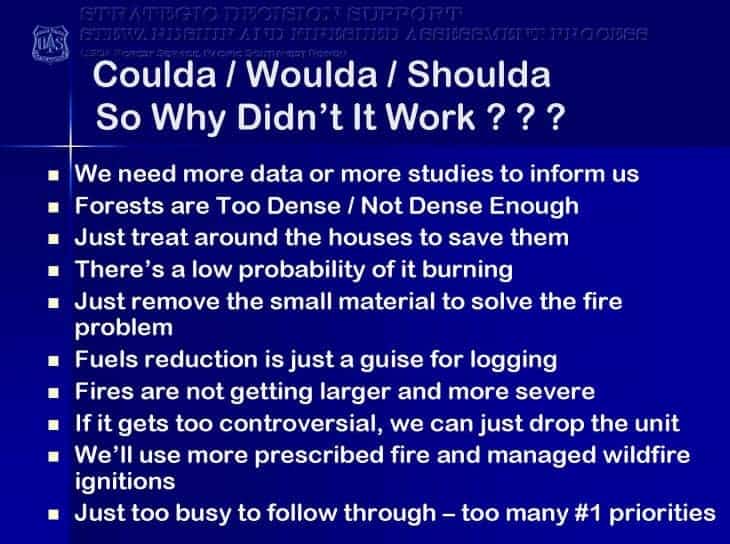
It’s too hard to get projects through.. too many competing priorities. Again, not sure that these are relevant to Interior, except I have seen BLM fuels projects hung up in litigation.
But.. what if.. the USWFS had its own project planning shop? My former boss, Fred Norbury, used to say that he thought the FS NEPA planning should operate more like a NIKE factory but then operated as a set of cobbler shops. We can imagine all kinds of AI helped documents; when a court case came down, all ongoing documents could immediately be tagged for updating.. Perhaps even (wildfire is a national security issue!) a separate set of DOJ litigators focused on fuels projects, with continuous feedback to the NEPA factory. Maybe all housed in the same building. Of course, local folks would review and do the fieldwork, but at the end of the day the analysis is a document. For example, a case where a judge determines that an air quality model is controversial, everyone working could automatically switch. Lawyers (and apparently, judges) already use AI.. so…according to Reuters..
An Oklahoma judge has acknowledged that a ruling he issued contained fictitious citations generated by artificial intelligence, according to state records, adding to a growing number of cases in which judges have faced scrutiny over AI use.The judge, Lawrence Wheeler of the District Court of Stephens County, told an investigator with the Oklahoma State Bureau of Investigation that he used OpenAI’s ChatGPT for research, and that an order he drafted contained two citations to cases that do not exist, according to an August 17 letter from a prosecutor to the state attorney general’s office.
It’s a new world out there, and maybe fire folks, just like they have the best tech, could have the best litigation and project planning shop.
One story, as many of you know, I came to planning from silviculture. When someone in silviculture found something out, we wrote it down and shared the document. We also had forest, area, and regional training. We had certification through CEFES and SI.
When I started to work with litigation, the advice was never written down because “the other side might get hold of it and learn our strategy.” This was no doubt true as some folks on our side seemed to think that sharing with the other side was a good thing to do, because the other side was right and we were wrong. When I was in DC, my boss asked me (and JR) to write a paper for the NEPA folks on “when NEPA applies.” No OGC attorney wanted to write things down because they felt each case is special (which it is). Finally one of the OGC folks helped us out and we published the document. Why am I telling these stories? Because the continuous learning process from NEPA through appeals/objections (that part worked OK) to litigation did not work as effectively as it might have. I hope it is greatly different nowadays. But it would be interesting for the USWFS and its contractor base to take a run at the process and see what they could do. When we worked with e-NEPA as part of E-gov (PALS was part of that effort) our contractor talked about the culture of how the FS does NEPA, but that was too heavy of a lift for us. Perhaps it’s worth the USWFS doing a pilot experiment. What if folks used all the tools currently at their disposal? What if litigators, Solicitors, and project planners directly communicated differently and frequently? Even a review of how things are working in the project planning to litigation assembly line.. by some outside folks, might be helpful.
In Fennessey’s terminology, “Does accomplishing the mission require changes to how we do business?”