You’ve got to give Megafire Action much credit for thinking up creative interventions. Home hardening through making it so homeowners can more readily access funding and contractors for doing the work is one challenge. As for me, I’d be happier with many state programs testing different approaches than one federal program to address these problems.
From an email message from one of their policy folks on their testimony on a bill..
One of the issues is that there is not a universally accepted “standard” or “certification” for home hardening. We have IBHS base and plus but the state doesn’t recognize those, the Safer From Wildfire Regs are basically an ala carte approach, and so it’s challenging for homeowners to understand what exactly they must do.
We support the development of a certification program that makes clear what scopes of work project managers or contractors need to achieve, clear what kind of insurance discounts can be expected, etc.
Easy to navigate also may include technology pathways that connect homeowners and contractors that are qualified to do this work to the selected standard, so that folks fon’t have to “open the phone book” so to speak for 5+ contractors.
Here’s a memo from them with more detail. There are so many bills, I get distracted by the numbers, and this memo goes to the ideas.
The problem
CAL FIRE estimates that 2.12 million homes sit within the highest fire hazard areas, the vast majority of which were built before modern wildfire construction standards.
1 Home hardening can more than double the odds of a home surviving a wildfire and can disrupt urban conflagrations.
2 However, adoption remains dangerously low, with 50% of homeowners in high-risk areas citing cost as the biggest barrier to home hardening.
The current grant-based approach—serving just 155 homes in five years 3—cannot scale to meet the state’s wildfire risk. A new approach is urgently needed to expand state capacity. The opportunity
California can adopt a homeowner assistance model capable of reaching tens of thousands of homes (see Table 1 below) within the next few years through three key elements:
1) Reposition ember resistance (IBHS Essential) as the target standard (~$15k retrofit)
2) Leverage proven loan financing models that stretch state dollars (SB 894)
3) Recalibrate CWMP to complement loans with smaller, targeted grants
Many of you know that I am skeptical of financing creativity, with concerns that it lines the pockets of middlepeople at the expense of those it’s intended to help. However, I’m also pragmatic, and if this has proven itself with the GoGreen financing platform.
Leverage proven loan financing models that stretch state dollars (SB 894) California needs a financing model that can stretch limited public dollars to reach tens of thousands—not hundreds—of homeowners. SB 894 would establish the California Wildfire Resilience Loan Program, administered by the California Alternative Energy and Advanced Transportation Financing Authority (CAEATFA) and modeled after the State Treasurer’s successful GoGreen financing platform. The bill creates a loan loss reserve that leverages public (or private) dollars at roughly 12-to-1 to unlock private capital, dramatically lower interest rates for homeowners, and finance home hardening and defensible space improvements across residential and small business properties. A revolving loan structure recycles repayments to support new lending, allowing modest public investment to unlock substantial private financing and scale mitigation to hundreds of thousands of homes statewide. Additionally, CAEATFA has the administrative expertise to stand up such a program with low overhead, and private creditors can process demand without state resources (Department of Finance estimated $3.9 million in the first year for operational costs to establish the Wildfire Mitigation Loan Program to serve 1,000 homes; crucially,
additional funds would be needed to capitalize the loan loss reserve fund).
Under SB 894’s roughly 12:1 leverage structure, about $1,250 in public credit support could help finance a 5-year, low interest $15,000 IBHS Essential retrofit loan. Because more than 98% of loans are expected to be repaid (current GoGreen rate), the same public dollars can finance thousands more homes over time, dramatically expanding statewide reach.
And here’s a screenshot of the GoGreen site:
Circling back to my first post today, it’s hard for me to see how more climate-WUI modeling would have helped these policy makers.
Phil’s comment on the last post reminded me that I had wanted to post about these California State efforts, especially the California Board of Forestry and Fire Protection’s Adoption of Zone 0. Our friends at Megafire Action track this, so I don’t know the exact current status.
Zone 0
What exactly it means to homeowners is made clear in this What Homeowners Need to Know” by the Sonoma Valley Fire District. They say the rules are not yet finalized, so again, I don’t know.
1. They don’t apply everywhere.
The proposed Zone 0 regulations apply to properties located in:
State Responsibility Areas (SRA); and
Very High Fire Hazard Severity Zones (VHFHSZ) within Local Responsibility Areas (LRA).
Not sure about your property? Use the State Fire Hazard Severity Zone lookup tool – CLICK HERE
2. The requirements are easy to understand and fairly granular, e.g.
Except for the limited vegetation specifically permitted by the regulations, combustible materials would not be allowed within Zone 0.
Examples include:
Bark, wood chips, and other combustible mulch
Fallen leaves, needles, and combustible debris
Firewood
Combustible items stored beneath decks, balconies, stairs, or pergolas
Dead or dying vegetation
New combustible fences or gates within five feet of the structure
Combustible outbuildings within Zone 0
Roofs and rain gutters must also be kept clear of leaves, needles, and other combustible debris.
The vegetation section is about as granular as it gets..
Limited vegetation would be permitted in portions of Zone 0 that are outside the required vegetation-free areas.
Allowed vegetation must be well maintained, non-woody, and free of dead or dying material.
Examples include:
Lawns and low ground covers under 3 inches tall
Non-woody plants between 3 and 18 inches tall, when planted in areas no larger than 1 square foot and properly spaced
Potted plants up to 18 inches tall in unaffixed, noncombustible containers no larger than 5 gallons and properly spaced
Plant spacing is based on the height of the tallest plant, with required separation equal to at least 1.5 times the plant’s height.
Those in favor of more protective standards are now focused on assisting homeowners who are willing to voluntarily meet stricter insurance-backed guidance. Some may do the work for insurance discounts; others may do it for a chance to get insurance in the first place.
Both sides find hope in a provision that allows local governments to adopt alternative versions of Zone Zero, which San Diego and Berkeley have already done and Los Angeles is in the process of doing.
******************************
What I’d like to highlight here is the complexity of the process. Yes it was long, yes it was messy, but they followed through and accomplished something that responds to both concerns of homeowners and those of fire departments and safety concerns. According to Google AI:
California developed its Zone 0 (ember-resistant zone) regulations through a multi-year legislative, executive, and public rulemaking process starting in 2020. [1, 2, 3]
Senate Bill 504 (2024): Further reinforced and refined the statutory framework for developing the Zone 0 standards. [1, 2]
Executive Order N-18-25 (2025): Issued by Governor Gavin Newsom to accelerate the rulemaking process, mandating a target completion date. [1, 2, 3]
Zone Zero Regulatory Advisory Committee (2025): Established as a special advisory committee under the Board of Forestry to draft the specific technical requirements. [1]
Public Refinement and Final Approval
Workshops and Public Input: Throughout late 2025 and mid-2026, the Board held extensive public workshops, gathered stakeholder feedback, and revised draft language to balance strict safety with practical compliance for homeowners. [1, 2, 3]
Board Approval (August 2026): The California Board of Forestry and Fire Protection officially approved the final Zone 0 regulations on August 19, 2026. [1, 2]
Administrative Review: The approved package moved to the Office of Administrative Law for final administrative review before filing with the Secretary of State. [1, 2]
Maybe other states could start with the agreement here as a template?
Sorry about this post.. I got a bit carried away on some side trails.
Thanks to Nick Smith again, there’s a link to Yale Environment 360, who reposted a story from Grist as part of the “climate desk”. The reporter is a Grist reporter who covers climate news.
We’ve heard that “people moving into the wildlands is bad for wildfire” for many years. I think the concept of “suburban sprawl” is too generalized to make those claims. It’s as if folks should just densit-ize existing footprints of cities, towns and existing suburbs. But that is difficult to do, and there are already many, many people out there in the woods and fields and grasslands, and the current reality, even if new housing was completely halted, is already problematic. Where limits are imposed, demand tends to increase prices, and so there are affordability concerns.
Of course, people living in these places are dealing with it, some more successfully than others.
“What’s happened over the last decades is we’ve had explosive population growth in naturally fire-prone areas,” said Tim Brown, director of the Western Regional Climate Center at the Desert Research Institute in Nevada. “People are moving in to where fire happens.”
The wildland-urban interface, which researchers often call the WUI, is the phrase given to places where housing is sandwiched between paved city centers and forests or grasslands. Researchers have been raising the alarm about the fire risk posed to homes in these areas since the 1980s. As humans burn more fossil fuels and warm the planet, longer and more severe droughts will likely make that risk worse.
And it could be argued that improved fire tech will give us more control, and if it gets dry enough, less vegetation (fuel) will grow back. I don’t see this in too many stories, though. And despite researchers warning us, people are successfully living in those places, and enjoying it greatly.
Reno is the fastest warming city in the U.S., according to the nonprofit Climate Central.
These half-wild, half-suburban neighborhoods remain one of the most rapidly growing types of land in the country, although development has slowed compared to the surge between the 1990s and 2010s. In some places, housing scarcity in cities has pushed home buyers to the outskirts of towns, where building is generally cheaper and faces fewer permitting or zoning requirements.
People are also attracted to living with more space, near outdoor recreation areas with beautiful scenery. More than a third of all homes in the continental U.S. are now considered to be in the wildland-urban interface.
Some people are also concerned about crime in some metro areas. As I’ve said before, I’m not sure that the definition considers the rural-urban interface. Like if there are grazing animals on grasslands nearby, we are still fire-prone but not close to “wildlands”.
Percentage of Housing: Depending on the specific study parameters, between 25% and 46% of all homes or residents in New Jersey are located in the WUI. This ranks New Jersey in the top 5 states nationally for the percentage of homes built in these zones. [1, 2, 3]
Certainly New Jersey has fire-prone vegetation, particularly in the Pine Barrens, and maybe that’s the issue not “wildlands” or “farmlands” or “rangelands” per se. As we say in the Marshall Fire, houses close to one another also increase fire spread.
The story used this study to make some conclusions about the WUI..
Notably, we introduced a novel index, the “Integrated Human-centric Wildfire Risk Index (IHWRI),” which takes into account the compounding effects of critical fire-weather days and WUI expansion, which accounts for the expansion of geographical and temporal opportunities for the ignition and growth of extreme-impact fires and housing growth in harm’s way. IHWRI indicated a 4.1-fold increase in compound fire risk in California from 1990 to 2022. While climate-driven trends alone increased critical fire-weather days by 2.5-fold, the compounding impacts of WUI expansion and climate trends amplified conditions conducive to extreme-impact fires by 4.1-fold. The Sacramento Drainage climate division in Northern California emerged as the region with the highest increase in IHWRI, mainly due to its increasing critical fire-weather days.
The study has a nice section on limitations and future work:
While our study provides valuable insights into the compounding effects of climate change and WUI expansion on fire risk, we acknowledge some limitations that present opportunities for future work. Our analysis relies on data from 36 weather stations across California, which could be expanded to create a spatially continuous field of risk change, better capturing spatial heterogeneity. Incorporating additional variables related to fuel characteristics and landscape conditions would also provide a more comprehensive assessment of fire risk. Our fire proximity analysis uses a single WUI edge map from 2020 for the 2012–2020 period, which is a limitation, although changes in WUI from 2010 to 2020 were only −0.7%19. Future work could explicitly investigate how the increasing frequency of very large and mega fires affect the likelihood of their encroachment upon or occurrence near WUI zones, as our current analysis only implicitly captures this relationship. Furthermore, exploring data with higher temporal resolution could reveal seasonal or daily variations in fire risk factors, enhancing the precision of our findings. Additionally, the IHWRI index could be further refined to include vulnerability factors, potentially improving predictions of structural losses and fatalities. Finally, expanding the analysis to include various climate change scenarios would offer valuable insights into future fire risks and inform long-term mitigation strategies. Addressing these limitations in future research will enhance the understanding of compound fire risk and support the development of more effective management and policy strategies.
The study was apparently funded by NIFA, DOE and Joint Fire Sciences. What did they find out?
Our findings underscore the urgent need for a multifaceted approach to fire risk mitigation, addressing both climate change adaptation and fire-aware developments and planning. Failure to address these compounding factors can lead to increasingly catastrophic fire events, posing grave threats to human lives, property, and ecosystems. By understanding the critical role of human activities and WUI developments in exacerbating the compound fire risk, this research informs policy interventions aimed at reducing human-ignited fires and regulating development in fire-prone area
This is a fairly common finding in what I call the “modeling over understanding” literature- that there are things that other people could do to make things better and if they used our info it would be helpful. In my opinion, we already know stuff about human-ignited fires and we already have had various issues at regulating development in fire-prone areas. The key literature would be “what works, what doesn’t and why” in terms of interventions. It mystifies me why someone like JFSP doesn’t run some kind of interaction with communities to find out what their questions are, find out what info already exists in the literature, and design research to fill in those identified gaps. In my experience, people claiming their research will be helpful is not exactly the same as it being helpful. My own experience with research panels is that they don’t tend to ask these kinds of questions.
If you did this research, would you find anything we don’t already know?
You say it will be helpful to policy makers.. which ones. How would they use it? Have you asked them if this would be helpful to them? Who did you ask and what was their answer?
In my brief experience on a Dave Cleaves-led national wildfire research review, I received the info from a researcher “yes the national forest folks want this.” Then I asked the national forest person and he said “yeah, whatever they want to do, it’s their money and we want to have a good relationship.” And that’s within one of the only agencies that does useful things and still has its own research arm.
***********
Anyway, back to the story..
Evacuating from neighborhoods in these fire-prone areas can be especially fraught. Roads are often narrow and connected by a single road with only one way out. During the recent wildfires in Spokane, the rush of fleeing traffic caused hourslong jams, leaving families sitting in their cars as the flames closed in. Similar scenes of gridlock unfolded during the 2018 Camp Fire in Paradise, California, and drives that normally took 25 minutes took hours.
I have buddies working on evacuation routes in the Denver Mountains. Part of the problem is that it doesn’t seem like in Colorado, it’s anyone’s job in government specifically to make evacuation plans. Still, this is a known problem that local people work on, and WUI and wildfire researchers, including social scientists, have been studying for, well, here’s Sue LeVan et al. from .. 1990!.
The hazard to structures in the wildland-urban interface or intermix (WUI) has been increasing as people move from the cities into rural areas. This movement has increased the likelihood of wildland fires occasionally threatening these structures. Forest fire fighters must defend these structures from wildfires.
Apples and oranges again..
In January 2025, the Eaton and Palisades fires broke out in the shrubby sprawl surrounding Los Angeles, forcing more than 200,000 people to evacuate and burning down thousands of structures.
Those two neighborhoods were around when I was a tyke, and a quick Google search found that the communities were established in 1921 and 1887 respectively. Paradise in 1979.
Thanks to Nick Smith for his newsletter, today I found two and maybe three and will try to put them “in conversation”. I wonder whether partisan forces are intentionally fanning the flames of “bad Trump Admin wildfire policies” and it’s really a tempest in a teapot, or a fire in a firepit, or whatever the wildfire equivalent is. If you just take a gander at Inciweb, you see all kinds of tactics being used. Many acres of fuels are being burned for wildland fighter safety reasons. What is different is that there is no intentional WFU at this point (supposedly, we shall see when the annual report comes out).
It seems like maybe people are mixing “full suppression strategies” with “not using indirect tactics”, which as we’ve discussed before, the latter is not happening. And as a resident to the north of the Aspen Acres fire, the talking point “trying to put out all wildfires is a bad thing” doesn’t really resonate with me.
Also, if the problem with not using WFU in a bad fire year is that not enough fuel will be reduced, won’t plenty of fuel be reduced just from regular wildfires with regular tactics? It looks like it’s possible, based on the acres in Inciweb.
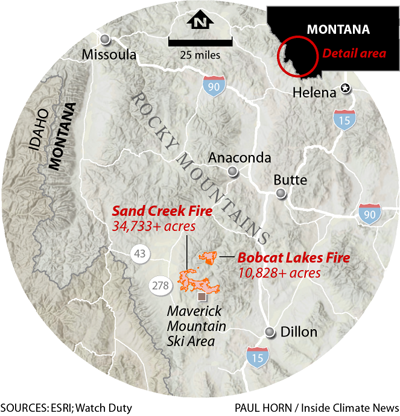
First, a shout-out Ms. Leuschen-Lonergan and reporter Mosabber Hossain for this story in Inside Climate News about what’s happening on two Montana wildfires.
Mariah Leuschen-Lonergan, fire communications lead for the U.S. Forest Service’s Northern Rockies Fire & Aviation Management program, said some sections of the Sand Creek and Bobcat Lakes fires are burning in steep, densely timbered terrain that is difficult for firefighters to safely enter and leave.
Intentionally burning vegetation between the fires “removes the fuel before the main fire gets there, so when the fire edge reaches the burned-out area, there’s nothing left to carry it forward,” Leuschen-Lonergan said in an email response to Inside Climate News.
She said the approach gives crews a safer place to work and can help protect private property in the path of the fire.
Firefighters consider safety and threatened property or infrastructure when deciding whether to use a firing operation, Leuschen-Lonergan said.
Terrain, vegetation, current fire behavior and weather also influence where and when the operations are conducted.
“Firing is one tool among several for building and securing control lines,” she said.
Fire officials have not specified how much of the reported 45,561 acres burned by both fires resulted from strategic firing operations.
Fire officials said they are working on a very rough estimate and will share it as soon as possible.They confirmed that acres burned during firing operations are included in the reported total acreage of each fire.
On the Sand Creek Fire, crews have been using a combination of direct and indirect control lines. Along the western side, firefighters were preparing the Steel-Fox Road as a control line and using hand firing operations to burn pockets of heavy fuels and bring that fire toward established control lines, according to the latest incident update.
Large amounts of dead and downed timber in the southwest portion of the blaze has challenged firefighters. Fire officials said the probability of holding a control line there was very low, prompting crews to scout locations to dig control lines away from the active fire edge, where firefighters could work more safely.
Leuschen-Lonergan said fire managers, in deciding when to intentionally burn downed limbs and vegetation, examine temperature, humidity, wind speed and direction and the moisture level of available fuels, including grass, needles, twigs, branches and brush, as well as heavier logs on the ground.
An incident meteorologist assigned to the fire provides forecasts for the specific location. Fire behavior analysts, operations personnel and the meteorologist evaluate the conditions before a firing operation is approved and carried out.
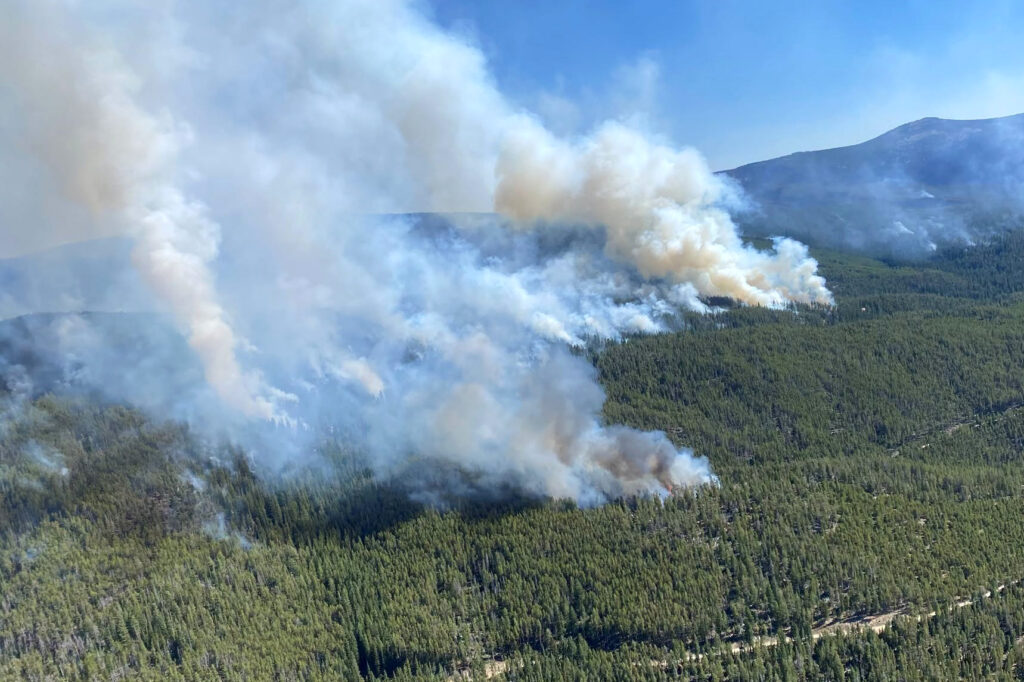
Smoke rises from the Sand Creek Fire as crews work to establish control lines on Sept. 1. Credit: Northern Rockies Complex Incident Management Team
“No two fires, or even two spots on the same fire, are identical,” Leuschen-Lonergan said.
Crews conduct firing operations when conditions allow vegetation to burn at an intensity they can manage. Wind direction and speed are monitored during the operation to reduce the possibility that the fire will move toward homes or increase in intensity.
If conditions are not suitable, the operation does not proceed.
Rain can also affect the operations. If fuels become too wet to burn effectively, crews may postpone the work until conditions change.
Leuschen-Lonergan said the challenges are not limited to firing operations.
“It’s not firing operations specifically that are getting harder, it’s fire operations in general, and there are many elements involved in those challenges,” she said.
“Fire seasons seem to be running longer. Fuel loads and standing dead trees are heavier in many areas, which makes direct attack, usually our safest option, harder to use.”
She said those conditions can result in greater reliance on suppression methods that keep firefighters farther away from the wildfire.
“We lean on indirect tactics like firing operations more often,” she said.
Development in wooded areas is another factor, Leuschen-Lonergan said, reducing the number of locations where firefighters can safely engage a fire.
Remember when DOGE tried to get rid of probationaries, which was problematic because the FS had hired so many people (Chief Moore said 5400) many of them on authorities that had two year probationary periods? And many of whom (as we heard complaints at the time) were not in field oriented positions? Without an apparent plan of what positions were most important to fill?
But then a court case said “you can’t do that” and so the FS in this Admin had to use voluntary authorities. So let’s circle back to something Chief Moore said last fall:
And you know us once we get going, we are very successful. We actually hired about 5,400 people, you know, we didn’t have a governor in there, you know. We it didn’t it didn’t just stop, you know. So 5,400 people.
And so when you talk about what the Forest Service was behind, it was never $700 million, what was mentioned. It was about $500 million. But here’s the thing. Our plan, we had 10 years to spend that money. More like eight years to spend that money. On the average, we lost about 2,000 employees a year through attrition. So, we know that at worst, we could reach that 5,000 employees over two and a half, three years. And that’s what we were looking at doing, but we needed to hire a lot of people to do that additional work that we’re being asked to do. And so, that’s why we hired the additional 5,000 people.
What occurred to me recently is that..if the FS first discovered the deficit in 2024 (based on this September 17th all-employee call) then the extra hiring must have been done prior to that. Let’s say 2022-2023.
Based on..the concept that the extra people (hired with soft money) would be balanced out by those who were retiring.. so in 2026, the FS would have ended up by losing the same number of folks. And because of the court case against the DOGE going after probationaries, those are people who went voluntarily. It seems as if we put those pieces together, and realize that this is 2026, the FS would have lost that number anyway, even if the previous Admin had continued with their plans.
Were those folks who left different folks than would have “naturally” retired? I’m not sure we know. In fact if the models of losing 2K people a year to retirement were correct, programs like VERA may have caused the FS to lose more than the 5300 or whatever it ended up being.
But the next time you hear or read, “the Forest Service lost 20% of its workforce due to DOGE” or whatever, you will know that the real story, as usual, is likely a great deal more complicated.
Here’s the link. By the way, I meant “old” in the headline in the sense of “experienced” and “wise.”
***************************
Many of today’s appointments will be familiar names. Nearly all have been selected from the Forest Service’s existing senior executive cadre, with one exception joining us from USDA’s Natural Resources Conservation Service. With these decisions, we have now placed the remaining members of our senior executive team. Any career SES positions that remain vacant on the new organizational chart will be actively recruited, internally and externally.
These assignments are another important step in putting our new organizational model to work. We have strong leaders across the Forest Service, and these assignments put their experience and expertise where they can make the greatest difference for our forests, our employees and the communities we serve.
These leaders show true commitment to not only the new organizational structure but also to the legacy and importance of the history of the Forest Service, as well to every employee and discipline contributing to the success of our mission.
They know this agency, they understand the challenges facing our forests and communities, and they recognize the importance of working closely with states, partners and tribes. There is a lot of important work ahead, and I am excited about what we can accomplish together.
The following leaders have been reassigned (names in italics represent current position and any title changes):
Jaelith Hall-Rivera, chief of staff
Beattra Wilson, deputy chief of staff
Katie O’Connor, deputy chief of Strategy Management
Mark Lichtenstein, deputy chief of Strategic Planning, Budget, and Accountability
Andria Weeks, deputy chief of Finance and Administration
Jennifer McGuire, associate chief of Finance and Audit
Erica Nieto, director of Human Resources
Lisa Northrop, director of Business Services Center
John Rothlisberger, director of Field Operations Support Center
Valerie Hipkins, acting director of Research and Development
Richard Barhydt, deputy director of Research and Development
Linda Heath, deputy director of Research and Development
Lisa Ramirez, director of Job Corps
Karen Woodrich, director of Cooperative Forestry
Ellen Shultzabarger, deputy chief of Field Operations East
Jacqueline “Jacque” Buchanan, state director of Oregon
Troy Heithecker, state director of Colorado
Kristin Bail, state director of New Mexico
Gordon Blum, state director of Lake States
Michelle Samuel-Foo, state director of Ozark/Gulf Coast
Phil Hardy sent the below in as a comment, so I thought I’d post. From my observation, (some) people mischaracterize the motives and views of others. That can happen from both sides.. the change agents can characterize the skeptics as “turf defenders”, while the people who don’t want (this set of) change say that the changers “want to suppress everything” and “are in it to make money from FS contracts” or whatever. Whatever energy we spend decrying others’ motives (other than politicians for whom that is BAU) is energy we could have spent trying to understand their concerns and address them.
Maybe we all don’t disagree about all this as much as we are told by others (whose business model derives from outrage) we do? Maybe we should just talk to each other directly, and especially, listen. Maybe, as Tim said on The Hotshot Wakeup podcast Friday, we could all work together on improving conditions for wildland firefighters.
In that spirit, here’s what Phil has to say:
********************************
I guess I need to clarify myself for everyone here. I’ve waited long enough. And I apologize for the wait.
I am absolutely for managed fire and recognize the value of prescribed fire. However, I think it’s lunacy to conduct those sorts of things between May and October. And we can argue over the exact timing because the weather is different every year.
I don’t think enough people even want to have a discussion of the fact that what we really are talking about is fire in the WUI. That needs full suppression. Federal fires that bleed into private property and state timberlands need full suppression.
Let’s use the Angeles NF as an example. I would describe this essentially as an urban forest. There are probably 10 million people who live around it within 10 or 15 miles maybe 20. I scarcely think there is a purpose or place for managed fire or prescribed fire here. Something’s gonna get on fire there anyhow anyway.
I’m also flabbergasted by continued references to two things: First, “let’s do things how the natives used to do it.” In 1900 90 million people lived in the United States. Now there are 340 million people living in the United States. There’s no possible way we can do things the way the Indians used to do it unless we are talking about doing it in Alaska or in a large enough designated wilderness areas. And let’s forget about all of the health issues that go along with letting something that big burn. Let those burn, fine.
The second thing is people are still constantly bringing up is the 10 AM rule. I don’t know a single policy person who isn’t some kind of crockpot who keeps using this term and believes it. It’s a ridiculous comment and a ridiculous idea that people propagate to raise money for their NGO’s.
I can’t believe it still gets used! I’ve been doing this for almost 20 years and I’ve never had a conversation with anyone about the 10 AM rule other than to say, “that’s ridiculous. No one talks about that anymore.”
Oh! I have a third, “clear cuts”. I haven’t bothered to do enough research here, but I seem to believe that the last clear cut on Federal land occurred in 1971 but I’m sure there’s somebody on here who can enlighten me about that. But online people still talk about it all the time on federal lands. Where are they getting these talking points?
If I wasn’t clear enough, and Steve Ellis did mention this (Parenthetical remark, Steve was my BLM state director in Idaho in 2010) and I like Steve. However, I think too much has changed since he retired.
I have spoken in the last week to 10 current and past federal fire chiefs on all different national forests. All of them say, it has changed completely. They all spoke of former line managers who had almost coequal fire knowledge as the fire chiefs. Experienced fire knowledge, and they were great forest sups or District Rangers. Not anymore, by and large.
My main thesis is, whatever we’re doing is not working well because we just burned down half of Spokane. We’ve lost large parts of two cities in two years. So everything is fine?
I get it, change is hard and scary. But all I think about are my children (and hopefully grandchildren) living in Boise who are breathing absolutely toxic air every summer and have been all their lives. And those toxins are even worse now because of all kinds of things like electric car batteries.
***************
A few of my own thoughts:
As to Phil’s “clearcut” comment, I attempted to get a definition going in this post in 2025 “Clearcuts, Openings, Definitions and Some Reasons For” and “Let’s Define Clearcut and Reduce Unnecessary Disagreement.” The latter starts with “What if.. we agreed on a definition of clearcutting?” Still, as Matthew Koehler pointed out in his comment, the FS does do some clearcutting still. I don’t know how prevalent it is.. nor the fuels/silvicultural rationale. Perhaps the totals are in some FS database somewhere? This might be a good question for readers to address from their local unit perspective.
And as to the prescribed fire close to town idea, I’ve seen it work in Northern Arizona and Colorado, but the vegetation, fuel characteristics, weather patterns and all that are different. Part of that is probably the NEPA process and public involvement in the decision. Plus prescribed fire tends to be used by local experts which increases trust over time, while WFU based on a team of out-of-towners.. maybe not so much.
Firefighters monitor a 2018 prescribed burn on the Gus Pearson Natural Area north of Flagstaff.
Quote from Andrew Sánchez Meador:
If you were to manufacture or engineer a species of tree that is well suited for that, ponderosa pine would probably be at the top of the list of the thing that you created. It’s well suited for the future climate. What it is not well suited for is the current density and the way wildfires behave, and insects and disease behave.
Yes, this fits into the “I think we already knew that” category, but it’s great to hear someone officially in the research community say it. Here’s a link to more information on the Fort Valley Experimental Forest. From Arizona Public Radio:
******************
A new study from Northern Arizona University shows thinning and regular prescribed burns can help ponderosa pine forests survive both drought and wildfire. The work took place at a thirty-year-old research site on the Fort Valley Experimental Forest north of Flagstaff. KNAU’s Melissa Sevigny spoke with ecologist Andrew Sánchez Meador about the findings.
Okay, so this experimental area has places that have been thinned, places that have been thinned and routinely burned, and then some places that have been left alone.
Yeah. And in this study, the initial thinning was followed by repeated burning every four years. In fact, we’re going to burn it this fall. That repeated burning, that frequent fire interval, is key to the function of this ecosystem.
What did you find out?
We actually found that both young and old trees responded to the thinning and grew really fast. That’s not a surprise with young trees. When you open up and make resources available, young trees can tend to thrive and jump on that. But what we found was trees 500 years old had dramatic increases in growth rates, suggesting that if we treat, both young and old trees can increase their vigor, they can be more resilient to drought, insect and disease, and what we also found was that if we introduce fire into this system, we don’t increase the mortality in that.
So the trees in the treated area are more likely to be resilient to the drought?
Yes. And to increased fire or being exposed to fire. Which is an equally important thing. Because you see a lot of messaging now advocating for putting fire back into these systems. People are scared of fire, rightfully so. But what we do know is, putting fire back into the system, seems to have only positive benefits in a frequent fire, naturally functioning system.
How do you hope the information from this study will help inform forest management in this region?
First and foremost, as we work to translate this science, I hope it makes the public feel better about seeing reduction in forest density. These forests we all live in here in Arizona, they are the only forests we’ve ever seen, so when we come here and someone tells us that these forests are unhealthy and too dense, that’s hard for us to understand. But these type of studies repeatedly show these forests are degraded and if we open them up we can increase vigor and resilience and make them healthy…And I think the other piece of this is that we know a lot about this. I often get the question about: we’re experiencing increasing severity of fire, and frequency of fire. The burn year is getting longer and longer and longer. What we can do to counteract it? Well, we know that thinning followed by the reintroduction of prescribed burning, that can counteract it. It took us 150 years to get into this mess, it’s going to take us a long time to get out of it, but we know that thinning and burning is a way out of it, we just need to be able to do it at a landscape scale in order to get ahead of these wildfires that we’re experiencing.
We’re on two decades of drought and we know that our ponderosa pines are struggling. After doing this research are you feeling more optimistic about the future of ponderosas, or are you still worried?
That’s a great question. Because I often say that if I look forward to the future climate… We know that we’re getting warmer, and the availability of precipitation is becoming less for plants and trees. If you were to manufacture or engineer a species of tree that is well suited for that, ponderosa pine would probably be at the top of the list of the thing that you created. It’s well suited for the future climate. What it is not well suited for is the current density and the way wildfires behave, and insects and disease behave. I’m very optimistic that if we can do more restoration at the landscape scale, if we can create more continuous parts of the landscape that are restored, we’re setting our ponderosa pines forest up to have the best chance they can have.
It’s starting to feel like fall here. The monsoons have started. And if you look at Inciweb, you easily find wildfires with estimated containment dates at the end of October. You might read stories like this, (and the same story has turned up in many outlets) creatively eliding the 10AM policy with the stated goals of full suppression or aggressive initial attack. It is true that some of us want the 10AM policy back, but exactly what does that mean? Does the “10AM policy” mean the same thing to everyone? And what is actually happening this fire year with the full suppression and aggressive initial attack approach? Since I can’t keep up with the terminology changes, and I think the term “beneficial fire” unhelpfully elides prescribed and WFU, I’ll just use WFU for now to mean what some people call Managed Fire (all wildfires are managed) or Wildfire for Resource Benefits or whatever.
Let’s take a look at one of today’s current wildfires (as of Aug. 27), the Upper Smith Fire on the Idaho Panhandle Forest:
The Northern Idaho Blue Team assumed command of the fire on August 12, 2026, at 6:00 am. A full suppression strategy will continue to be implemented utilizing direct and indirect tactics to protect critical values at-risk and minimize firefighter risk exposure.
Yesterday it was 30% contained and had 96 people on it, with an estimated containment date of 10/31/2026.
-Monitor and patrol H-2, north and downslope, through the avalanche chute and east along Smith Creek, using ground and aerial resources.
-Patrol DP-17 to above H-5 into burn scar. Patrol line from DP-17 to sling 2, sling 1, into Smith Creek. Patrol spot fires east of sling 2.
-Aerial resources will continue to check fire spread as it moves across the Parker Ridge fire scar.
-Continue to fine tune structure protection and prep the Westside Road for possible firing operation.
-Scout west into Smith Creek and look for opportunities for point protection on critical values.
-Patrol and monitor around associated values at risk from increased fire activity.
-assess ability to contain new starts within the TFR.
-continue to monitor and patrol for new starts and holdovers.
-Support the suppression of new fires within the TFR.
What are the conditions?
The fire is burning in mature mixed conifer with moderate to high loadings of 1000-hr fuels and deep duff layers. Fuels in Long Canyon Fire 2022 and Parker 2015 burn scars include snags, dead and downed woody debris, and conifer regeneration. Fuels in the Long Canyon Fire 2022 burn scar include a slash/blowdown fuel model and pockets of shrubs. Fuel moisture in 1000-hr fuels is 12-14%.
I’m not a wildfire person, but it sounds like a sensible approach. Note that they are monitoring and doing point protection within the overall strategy of full suppression.
****************
Maybe the real issue is “when and how much WFU, and who decides?” This was a bad fire year, so maybe this wasn’t the year? Or maybe in some windowless cubicle farm in the bowels of Interior, some group is dreaming up a better way to go about it and build more public support. I
If I listen to some of the voices on the “not ever” side, I hear concerns about the way decisions are made to engage in WFU. Maybe implicit in that is the difference in public engagement and environmental analysis between major vegetation manipulation categories. For older folks, this is another incarnation of the old tension “should there ever be NEPA for wildfire management?”; “when is wildfire an emergency, and when not?”?
If we look at this handy table (last years below)
We find that the Forest Service FY 2025 Oct 1, 2024 to Sept 30, 2025, did 867,764 acres of WFU, actually twice as much as 2024. So it looks like the FS did over twice as much WFU in 2025 as 2024 (868k vs. 362K). From the outside, then, assuming these numbers are as close to correct as the FS and DOI have, it looks like WFU was increased during the first year of the Trump Admin by over 2x. Granted that the Admin did not start till January, and maybe lots of WFU happened between 10/01/2024 and January.
**************
When I hear Frank Carroll talking about his concerns, I hear the idea that “if it’s intentional and it’s supposed to be good, why don’t we measure its goodness (and decide on what that is) and fund it through non-emergency funds?” It’s hard to disagree with that formulation, or is it?
Then there’s the question of “if you need a CE to harvest 70 acres (and this CE was litigated!), why you don’t need any NEPA to intentionally burn potentially hundreds of acres.” Well, you do if it’s prescribed, but not if it’s WFU. This seems like a bit of a NEPA gap, and maybe folks should pick a lane as to whether it’s intentional or not. Everyone who follow TSW knows that I am not a fan of Forest Plans and the current planning rule. But WFU pre-decisions have been made in forest plans and amendments, so it does seem like a particularly useful thing to do in Plans.
To circle back to Roadless, one problem I have with the rescission idea is that land allocations should be made in forest plans. This one of those concepts that may sound good in theory, but in practice, forest planning is lengthy and often held up by litigation, and potentially too expensive and unwieldy for that to actually work in practice. Just think of all those assessments where FS employees calculated NRV and all that.. only to find that a couple hundred thousand acres is not in the condition they assessed and it’s already out of date. Still, given all that, I’ve argued for a long time that the FS should cease revisions until fire management amendments are up to speed.
At some point, we would understand the desired future conditions of some landscape, and then could assess whether any specific WFU was successful at moving toward those conditions.
But backing way up to the Three Horizons Framework, perhaps WFU as currently constituted with the inherent fuzziness on emergency applicability for NEPA and funding, is simply the equivalent of an H2 technology, as Google AI tells me:
H2 Capture: Governments often use H2 technology simply to extend the life of an outdated H1 system rather than transforming it.
Anyway, I hold both ideas at the same time- we put too much emphasis and effort on forest planning for what we get and let’s not put more on a potentially sinking ship. And if you’re going to have plans, that’s the best place for pre-WFU planning.
First of all, for context, a big shout-out to the California Assembly for this (from Jennifer Pahlka):
Last November, I wrote about an experiment in the California Assembly designed to change that. Speaker Robert Rivas launched a pilot called Outcomes Reviews: a structured process by which a legislator and their staff publicly commit to reviewing a law they championed, spend months meeting with the people the law actually affects and researching the outcomes, and then announce what they learned and what they’re going to do about it. Earlier this week, his office announced the results of the pilot year. Fifteen Assemblymembers reviewed fourteen laws, covering housing, energy, health care, foster care, wildfire recovery, and more. According to the Speaker’s office, the program will continue next session, with more members and more reviews, on its way to becoming a permanent part of how Assembly policy teams work.
Just like the Assemblyfolk in California, can you imagine the US Congress doing the same? I’d put NFMA on the top of my list for review.. But there’s no reason the Executive Branch, or even partners, or universities or someone out there could do a review with recommendations. That’s basically what Idaho and Colorado did with their Roadless Rules.
When it comes to Roadless, NWFP, Travel Management and Wildfire Use, basically some people have not been happy with the way things are working, and want to review and fix things. The NWFP, not reviewed and improved (although efforts were made last Admin) but with certain critiques apparently off-limits. The Roadless Rule. The Travel Management Rule. The Planning Rule. Wildfire Use.
Yet, how are some of these efforts covered in some media elements? As “all or nothing.”
Even though there’s an Alternative 3 for Roadless.
Even though folks like the American Motorcycle Association American Motorcycle Association that include those ideas (thank you to The Wilderness Society for sending this!):
As the Forest Service considers how best to move forward, it is important that any change to these regulations should preserve current access and ideally improve and streamline TMP-related decisions. However, a full repeal of the 2005 rule risks creating agency and user confusion and additional fragmentation of these areas. This process, although not perfect, was the result of close collaboration among recreation and conservation groups with Forest Service officials. Future decisions, while guided by national policies, should be made at the local level with these same stakeholders involved in the process.
There are many interest groups out there engaging on Travel Management (and likely Roadless) with “fix but don’t throw out”, with their own lists of experiences or issues that they would prefer to be changed.
Now, why would the Admin propose rescinding if they really plan to do something in the middle?
Here’s why I would hypothesize, not being privy to their deliberations:
a) The old English “you might as well be hanged for a sheep as a lamb.” Any tweaking will cause hyperbolic outrage, so why not go for the full thing at the beginning? Those of us who worked on the State rules have been through the media/NGO full-court press already, and maybe those groups can recycle their talking points from the State Petitions Rule and the State rules.
b) There will be high-quality and extensive litigation, so moving from a proposal to a final and considering public comments always looks good. Sure 99% of the comments are likely to be form letters generated by clicking on a “do you want your forests destroyed” button, but still.
c) As my old boss Fred Norbury used to say “we don’t need to negotiate with ourselves.” I looked this up on Linked in and found “why we do it.”
Lack of confidence: You don’t fully believe your position is legitimate, so you soften it before anyone even pushes back.
People-pleasing: You want to be liked (or at least not disliked), and you’ve convinced yourself that a more aggressive position will make you the villain.
Conflict aversion: You believe that holding firm will make things worse, so you try to smooth the road before you’ve even hit a bump.
Past baggage: A difficult history with someone leads you to presume the worst, so you preemptively adjust to avoid what you’re convinced is inevitable.
Deal fatigue: You’ve been working on this for months, and you just want it done. Any deal sounds better than no deal, so you start making mental price cuts before the first offer is on the table.
d) They get points from user groups for being influenced by them to change toward the reasonable from the disruptive.