Thanks to Nick Smith for his newsletter, today I found two and maybe three and will try to put them “in conversation”. I wonder whether partisan forces are intentionally fanning the flames of “bad Trump Admin wildfire policies” and it’s really a tempest in a teapot, or a fire in a firepit, or whatever the wildfire equivalent is. If you just take a gander at Inciweb, you see all kinds of tactics being used. Many acres of fuels are being burned for wildland fighter safety reasons. What is different is that there is no intentional WFU at this point (supposedly, we shall see when the annual report comes out).
It seems like maybe people are mixing “full suppression strategies” with “not using indirect tactics”, which as we’ve discussed before, the latter is not happening. And as a resident to the north of the Aspen Acres fire, the talking point “trying to put out all wildfires is a bad thing” doesn’t really resonate with me.
Also, if the problem with not using WFU in a bad fire year is that not enough fuel will be reduced, won’t plenty of fuel be reduced just from regular wildfires with regular tactics? It looks like it’s possible, based on the acres in Inciweb.
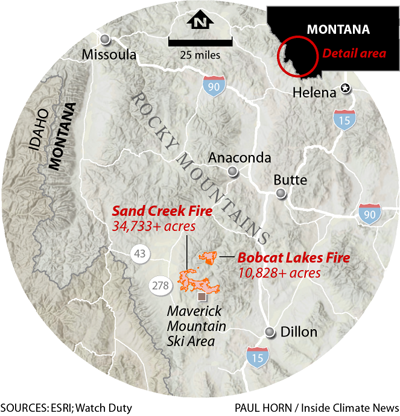
First, a shout-out Ms. Leuschen-Lonergan and reporter Mosabber Hossain for this story in Inside Climate News about what’s happening on two Montana wildfires.
Mariah Leuschen-Lonergan, fire communications lead for the U.S. Forest Service’s Northern Rockies Fire & Aviation Management program, said some sections of the Sand Creek and Bobcat Lakes fires are burning in steep, densely timbered terrain that is difficult for firefighters to safely enter and leave.
Intentionally burning vegetation between the fires “removes the fuel before the main fire gets there, so when the fire edge reaches the burned-out area, there’s nothing left to carry it forward,” Leuschen-Lonergan said in an email response to Inside Climate News.
She said the approach gives crews a safer place to work and can help protect private property in the path of the fire.
Firefighters consider safety and threatened property or infrastructure when deciding whether to use a firing operation, Leuschen-Lonergan said.
Terrain, vegetation, current fire behavior and weather also influence where and when the operations are conducted.
“Firing is one tool among several for building and securing control lines,” she said.
Fire officials have not specified how much of the reported 45,561 acres burned by both fires resulted from strategic firing operations.
Fire officials said they are working on a very rough estimate and will share it as soon as possible.They confirmed that acres burned during firing operations are included in the reported total acreage of each fire.
On the Sand Creek Fire, crews have been using a combination of direct and indirect control lines. Along the western side, firefighters were preparing the Steel-Fox Road as a control line and using hand firing operations to burn pockets of heavy fuels and bring that fire toward established control lines, according to the latest incident update.
Large amounts of dead and downed timber in the southwest portion of the blaze has challenged firefighters. Fire officials said the probability of holding a control line there was very low, prompting crews to scout locations to dig control lines away from the active fire edge, where firefighters could work more safely.
Leuschen-Lonergan said fire managers, in deciding when to intentionally burn downed limbs and vegetation, examine temperature, humidity, wind speed and direction and the moisture level of available fuels, including grass, needles, twigs, branches and brush, as well as heavier logs on the ground.
An incident meteorologist assigned to the fire provides forecasts for the specific location. Fire behavior analysts, operations personnel and the meteorologist evaluate the conditions before a firing operation is approved and carried out.
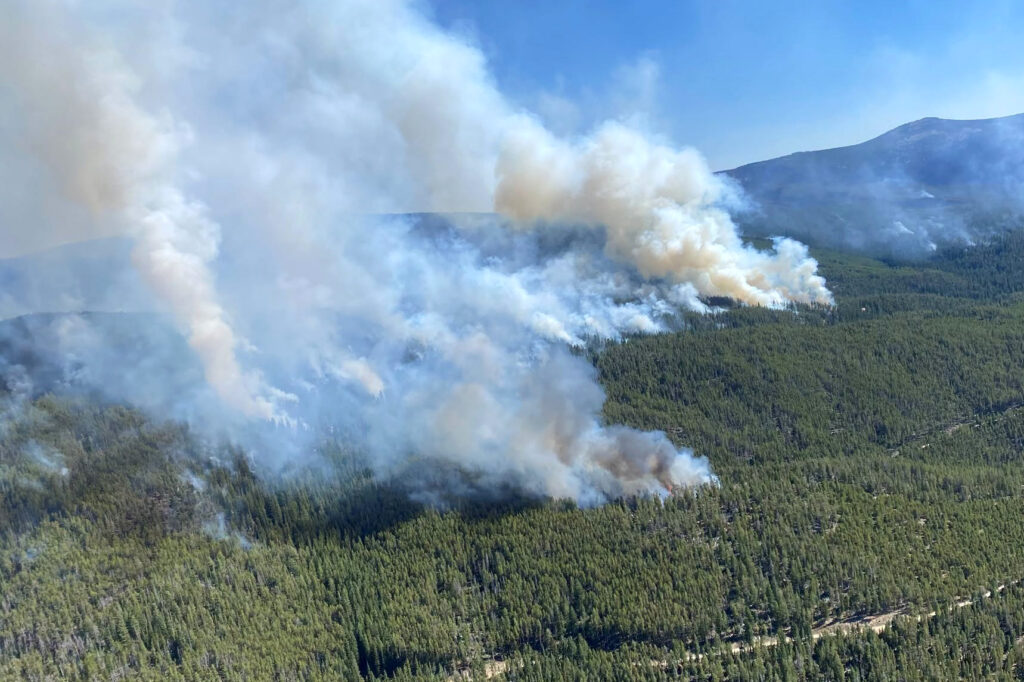
Smoke rises from the Sand Creek Fire as crews work to establish control lines on Sept. 1. Credit: Northern Rockies Complex Incident Management Team
“No two fires, or even two spots on the same fire, are identical,” Leuschen-Lonergan said.
Crews conduct firing operations when conditions allow vegetation to burn at an intensity they can manage. Wind direction and speed are monitored during the operation to reduce the possibility that the fire will move toward homes or increase in intensity.
If conditions are not suitable, the operation does not proceed.
Rain can also affect the operations. If fuels become too wet to burn effectively, crews may postpone the work until conditions change.
Leuschen-Lonergan said the challenges are not limited to firing operations.
“It’s not firing operations specifically that are getting harder, it’s fire operations in general, and there are many elements involved in those challenges,” she said.
“Fire seasons seem to be running longer. Fuel loads and standing dead trees are heavier in many areas, which makes direct attack, usually our safest option, harder to use.”
She said those conditions can result in greater reliance on suppression methods that keep firefighters farther away from the wildfire.
“We lean on indirect tactics like firing operations more often,” she said.
Development in wooded areas is another factor, Leuschen-Lonergan said, reducing the number of locations where firefighters can safely engage a fire.
3 thoughts on “How Folks are Really Fighting Wildfires This Season: Inside Climate News Story”
Firefighters lives are continuing to be put in jeopardy while Environmental Organizations funded by Vanguard, Fidelity and the Rockefeller Foundation file suits padding the pockets of Attorneys, keeping FS from treating acreage. I hope people consider this when investigating and donating.
.
The Leuschen-Lonergan quote about direct attack getting harder is the one with a payroll attached to it. Prepping something like the Steel-Fox Road as a control line is dozer and hand-crew work, and leaning on indirect tactics more often means more of that work, for longer, farther from where anybody lives. We run a job board for traveling trades workers and we see the same shape on the industrial side – once a job moves out of easy reach you stop hiring locally and start paying to bring people in and keep them there, and the hands who will be gone that long are the scarce part. Our crawl of live postings tracks what dozer operators and line crews are being advertised at if the money side of a longer season is useful to anyone here. No opinion from me on tactics or policy, just the part that shows up on a check.
“U.S. firefighting personnel are being overrun by wildfires at the highest rate in two decades, leading to six deaths and dozens of injuries this year, federal data showed, a grim count during a record-setting fire season in the United States.
There have been 12 entrapments so far in 2026, according to the Wildland Fire Lessons Learned Center, a federal agency, already more than the full-year average of nine in the last 20 years, and the highest year-to-date number since 2006.
Seven active and retired firefighters told Reuters they were also concerned firefighters were taking unusual risks because of an all-out approach to stopping fires mandated by the Trump administration. They also questioned the impact of U.S. Forest Service staffing cuts as part of broader federal downsizing.”
Firefighters lives are continuing to be put in jeopardy while Environmental Organizations funded by Vanguard, Fidelity and the Rockefeller Foundation file suits padding the pockets of Attorneys, keeping FS from treating acreage. I hope people consider this when investigating and donating.
.
The Leuschen-Lonergan quote about direct attack getting harder is the one with a payroll attached to it. Prepping something like the Steel-Fox Road as a control line is dozer and hand-crew work, and leaning on indirect tactics more often means more of that work, for longer, farther from where anybody lives. We run a job board for traveling trades workers and we see the same shape on the industrial side – once a job moves out of easy reach you stop hiring locally and start paying to bring people in and keep them there, and the hands who will be gone that long are the scarce part. Our crawl of live postings tracks what dozer operators and line crews are being advertised at if the money side of a longer season is useful to anyone here. No opinion from me on tactics or policy, just the part that shows up on a check.
Here’s another take on “how folks are really fighting wildfires this season:” https://www.reuters.com/business/environment/record-us-wildfire-season-firefighter-entrapments-hit-20-year-high-2026-08-13/
“U.S. firefighting personnel are being overrun by wildfires at the highest rate in two decades, leading to six deaths and dozens of injuries this year, federal data showed, a grim count during a record-setting fire season in the United States.
There have been 12 entrapments so far in 2026, according to the Wildland Fire Lessons Learned Center, a federal agency, already more than the full-year average of nine in the last 20 years, and the highest year-to-date number since 2006.
Seven active and retired firefighters told Reuters they were also concerned firefighters were taking unusual risks because of an all-out approach to stopping fires mandated by the Trump administration. They also questioned the impact of U.S. Forest Service staffing cuts as part of broader federal downsizing.”
(And these figures are from a month ago.)