Politicians vs science

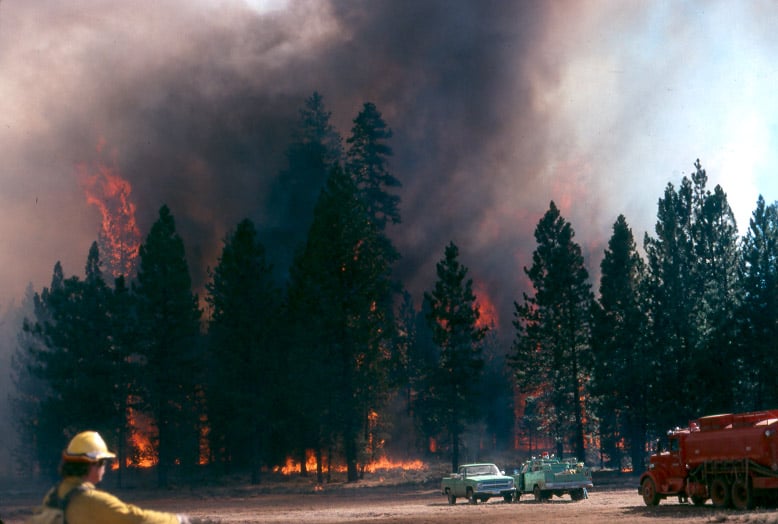
Ideology was on display at a grandstanding event on the Lolo Peak Fire.

Secretary Sonny Perdue, Interior Secretary Ryan Zinke, Congressman Greg Gianforte and Senator Steve Daines got a briefing from the fire management team, and then held a short press conference.

Senator Daines repeated a refrain that Montana Republicans have been saying for years: That lawsuits from extreme environmental groups are preventing the U.S. Forest Service from carrying out logging and thinning projects that would remove trees and prevent wildfires… “It is the lawyers who are – funding for these extreme environmental groups — who are having a tremendous impact, devastating impact on allowing us to move forward here on some common sense timber projects,” Daines said.

Both Perdue and Congressman Greg Gianforte pointed to a 5,000 acre logging project called the Stonewall that was approved by the Helena Lewis and Clark National Forest outside Lincoln in 2016. That was then put on hold in January by a judge responding to a lawsuit from the Alliance for the Wild Rockies and Native Ecosystems Council. That area is now burning as part of the Park Creek fire sparked by lightning this summer.

But, after listening to audio of the press conference this afternoon, the dean of the Forestry School at the University of Montana, Tom DeLuca, cautioned against expecting too much from a timber sale or wildfire  fuel management projects…  On a windy, hot day, a fire will carry right through that understory or in those crowns regardless of whether it’s been thinned or not. It does change the behavior…  There are also studies that try to quantify how much more severe wildfires are in recent years due to climate change. DeLuca says it’s clear that human-caused climate change from burning fossil fuels is making fire seasons longer and more intense.

Sen. Daines says, “We go through warmer cycles, cooler cycles, droughts, excessive precipitation. We are in a warm cycle right now, we are in drought conditions here in Montana consequently we’re having a severe fire season.”

(Climate scientist Steve) Running says.., “”What I heard is the kind of evasive response, ‘yeah weather’s always changing and we’ve had dry seasons and fire seasons before,’ and so the implication that there’s nothing really new and this is just part of natural cycles. Of course in the climate change research community we’ve well documented in dozens and dozens of peer reviews papers that the fire season’s getting longer and overall we’re burning more acres than in the past and that we’re on a trend of longer fire seasons and bigger fires,” Running says…  It’s always the case that if you pick any one year out you can say there’s been other years like this, but when we study climate, we’re studying decades, multi-decadal trends, and we clearly document multi-decadal trends of longer, warmer summers and more, bigger fires.”

At least Perdue agreed, “There obviously is climate change …”
Forest “Christmas tree” bill out of House committee

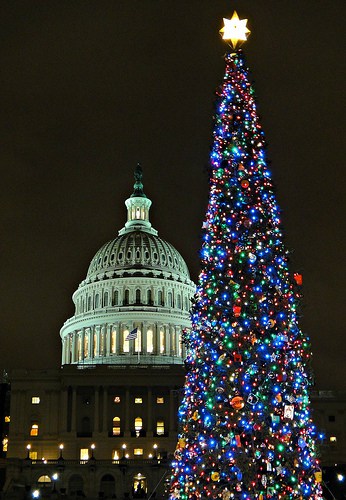
No, not that Christmas tree (they are searching the Kootenai National Forest for that one).


This one.  This is the Westerman bill that the House hung all the hopes of active forest management on:  “the Resilient Federal Forests Act of 2017.”  Similar legislation in 2015 passed the House, but died in the Senate.

“To expedite under the National Environmental Policy Act of 1969 and improve forest management activities on National Forest System Lands, on public lands under the jurisdiction of the Bureau of Land Management, and on tribal lands to return resilience to overgrown, fire-prone forest lands and other purposes.”

Just about everything that has been suggested before (and stopped by Obamacrats) is in there to make it easier and attractive to do things.  Categorical exclusions, expedited salvage, expedited project ESA consultation and reduced/eliminated forest plan consultation, litigation restrictions, county payments, less road decommissioning, elimination of eastern OR/WA old growth harvest restrictions, elimination of Northwest Forest Plan survey and manage requirements, O & C land management changes, wildfire disaster funding.


The beginning of state management of national forests

A group of Western senators, including Sens. Jim Risch and Mike Crapo, both R-Idaho, have introduced a bill to allow states to implement their own conservation plans to protect sage grouse and their habitats, in lieu of federal management.

Congress would be allowing states to override the decisions by the Forest Service and BLM to amend their plans to protect sage grouse, which would amount to letting states take over planning for national forests to the extent that it can be tied to sage grouse in any way.

Post-Election Thoughts About Our Forests?

With a new Republican President and a Republican-controlled Congress, how will this affect the Forest Service and the BLM?

crown-fire-panorama-web

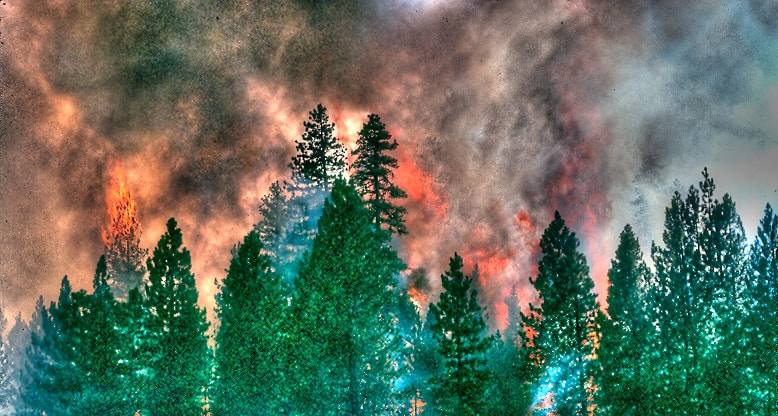
Regarding the picture: I did some processing with a High Dynamic Range (HDR) program to get this artsy view. It is interesting that it enhanced the flames better than in the original scan, from a Kodachrome slide. I shot this while filling in on an engine, on the Lassen NF, back in 1988.

“Patriot” attack on public lands (and its users and employees)

Some members of Congress are trying to shine a spotlight on the threat to public land from armed militias.  They point out the direct threats, but also link them to the attempts to transfer federal lands to states:

“Anti-government extremists didn’t always direct their ire at public-lands agencies. That changed, in part, because a group of Western congressmen, state legislators and county sheriffs built their careers by advocating the transfer of millions of acres of federal land to states or counties, even though no state or county had ever owned the land in question or could afford to manage it now.”

They cite, in particular, a letter from 32 former employees of federal land management agencies (including three former Forest Service chiefs), which lists ten threats to public lands from anti-government extremism.


Politicizing science – the view from the front lines

A survey from the Union of Concerned Scientists included employees of CDC, FDA, FWS and NOAA.

A significant number of scientists (46 to 73 percent of respondents across agencies) reported that political interests at their agencies were given too much weight in their agencies.  Many scientists told us that scientific decisions were being swayed by politics or that political influence inhibited their ability to carry out agency missions.

The Fish and Wildlife Service was at the 73% end of the scale where one employee said,

“It is my perception that upper-level managers are influenced by fear of Congress dismantling the Endangered Species Act and/or otherwise interfering with the mission of the Service.”

One would expect that this would eventually lead to litigation about not following the law (followed by Congress complaining about the plaintiffs and the courts).

Interesting that another question in the survey indicates that Congress is as guilty as advocacy groups are for slowing the ESA process down.  While the Department of the Interior is credited with investing in scientific integrity, the Agriculture Department is singled out for not doing so.

Career Ladders for Temps?!?! Maybe Soon!

More interesting news for “disposable” employees!

campbell_fire1-webhttp://nffe.org/ht/display/ArticleDetails/i/105694

NFFE-Backed Temporary Employment Reform Legislation Approved by Senate Committee

There may come a time when temporary employees actually have a career ladder!

“Thousands of wildland firefighters and other dedicated seasonal workers have been stuck for too long in dead-end jobs, not because of a lack of merit on their parts, but because of flawed regulations that do not recognize their years of service,” said Mark Davis, Vice President of the National Federation of Federal Employees (NFFE) and past President of the NFFE Forest Service Council.  “Many others leave and take their years of experience with them because of blocked career paths. After years of work, I’m optimistic that we are about to fix that.”

Of course, this is most directed towards firefighters, as so many timber temps have been jettisoned or have found “other employment”. Most temps would say that there is plenty of work to do, outside of their 1039 appointments but, that issue is not being addressed. The higher-ups choose to continue to embrace the 1039 appointments, thinking that policy is “good enough for Government work”. There really is nothing stopping the Forest Service from changing their policies on 1039 appointments. Truthfully, I’d like to see the temporary appointments scaled back to 800 hours, essentially forcing the Forest Service and other Agencies to hire more 13/13 permanent positions. Yep, make it too costly and “inconvenient” for them to continue using temps to do work that is needed, each and every year. It’s up to OPM to impose more rules, to stop the abuse of the temporary hiring authority.

Sleeping With the Enemy?

high-intensity-burn-web

Timber industry people who don’t trust forest collaboration believe that those of us who participate in collaboratives are sleeping with the enemy. Environmentalists who would rather sue than participate in collaboratives think that environmentalists who collaborate with us are sleeping with the enemy. So it’s unanimous. We’re sleeping with our enemies. I don’t care what our critics think. Collaborative groups, ours included, are solving political problems that should never have become political problems, and those problems are the reason why our forests are dying and burning before our very eyes. So if you really want to know what collaboration is all about, it’s about protecting forests from the ravages of nature, not just for our benefit, but also for the benefit of future generations.

Duane Vaagen, Chief Executive Officer
Vaagen Brothers Lumber Company, Colville, Washington

http://www.evergreenmagazine.com/forest-collaboration-in-northeast-washington-part-1-duane-vaagen/

Larry’s note: Sent to me from a reader, this points out the, maybe, necessary mistrust at this part of the collaborative journey. We need all sides to embrace full transparency, so that the public at-large can more accurately form a better-educated opinion of the compromises that might work, for those site-specific conditions. I do think that the tables are turning, in favor of more active management and stewardship. I do think this summer’s fire season might convince a few more people, too.

Congress supports unloading national forests

From a New York Times op-ed by the president of the Trust for Public Land:

Last week, the United States Senate voted 51 to 49 to support an amendment to a nonbinding budget resolution to sell or give away all federal lands other than the national parks and monuments.

This was bad enough. But it followed a 228-to-119 vote in the House of Representatives approving another nonbinding resolution that said “the federal estate is far too large” and voiced support for reducing it and “giving states and localities more control over the resources within their boundaries.” Doing so, the resolution added, “will lead to increased resource production and allow states and localities to take advantage of the benefits of increased economic activity.”

The measures, supported only by the Republicans who control both houses, were symbolic. But they laid down a marker that America’s public lands, long held in trust by the government for its people, may soon be up for grabs.

Is this purely symbolic, or does it mean a Republican president in 2017 would get a bill to do this, and would sign it?  Should maybe the Republican presidential candidates be asked what they would do?

The Forest Service: Fighting climate change since 1974

(In memory of the Keystone Pipeline)

As you know, the Senate recently voted to acknowledge that climate change is real.  In this story,  one senator called it ‘a step forward’ for Republicans.  What is most remarkable is that they must have been marching backwards since a much wiser Congress passed the Forest and Rangeland Renewable Resources Planning Act in 1974.  That law, recognizing “the necessity for a long term perspective in planning and undertaking related national renewable resource programs administered by the Forest Service,” required that the Secretary of Agriculture prepare a periodic renewable resource assessment that must include “an analysis of the rural and urban forestry opportunities to mitigate the buildup of atmospheric carbon dioxide and reduce the risk of global climate change.”  (Draw your own conclusions – here.)