One Experimental Forest- Super-Sized : OSU and Elliott State Forest

Thanks to Peter Williams for this one, reported in Nature.

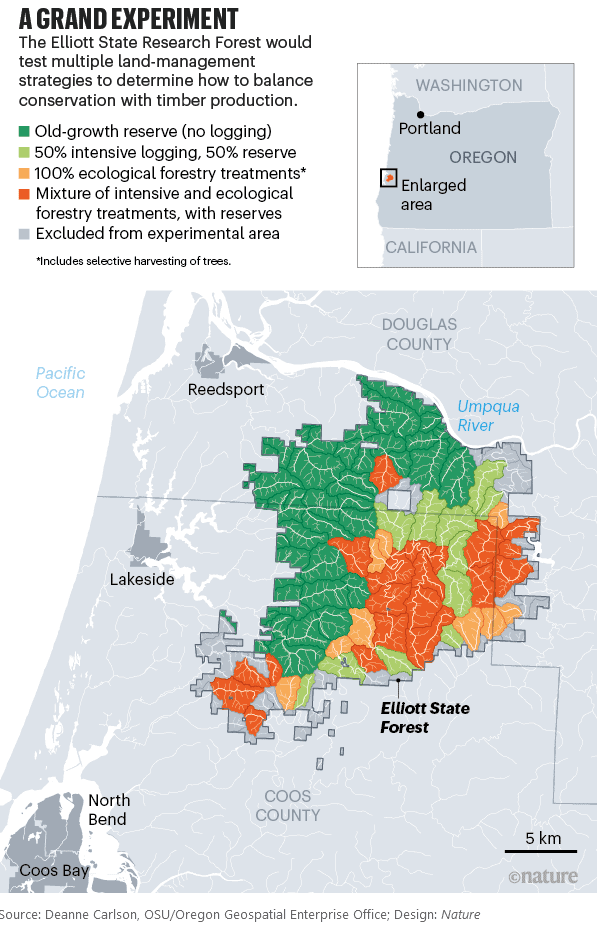
If the project — proposed by DeLuca and other researchers at OSU — launches successfully, the newly created Elliott State Research Forest in southwestern Oregon would occupy a roughly 33,000-hectare parcel of land. This would be divided into more than 40 sections, in which scientists would test several forest-management strategies, some including extensive logging. The advisory committee for the project, which comprises environmentalists, hunters, loggers and members of local Indigenous tribes, approved the latest research proposal on 22 April.

Controversially, the study would allow logging in a new research forest, in an attempt to answer a grand question: in a world where wood remains a necessary resource, but biodiversity is declining, what’s the best way to balance timber production with conservation?

Well, it will answer that question at least for areas similar to Elliot State Forest, anyway, or at least illuminate trade-offs. Is it controversial to allow logging in a new (or old) research forest? Most of them, at least on Forest Service land, were established to do precisely that. Here’s a link and map of all Forest Service Experimental Forests and Ranges. At least two of them, H. J. Andrews in Oregon (16K acres) and Hubbard Brook in New Hampshire are also Long Term Ecological Research units and get infusions of funding from NSF.

It’s also interesting that some environmental groups are on the advisory committee, while others think clearcutting shouldn’t occur at all, and others don’t trust OSU. The advisory committee would conceivably review plans for specific sites, though, so mistakes like the 16 acre old growth one shouldn’t occur in the future.

Questions:

“As currently designed, the project would leave more than 40% of the forest — a section of old growth that has been regenerating naturally since the area last burnt, a century and a half ago — untouched by logging.”

Is 150 years old considered “old growth” in that area? Or are there pockets of old-growth in the burned area that will be untreated?

But the Elliott research forest would be larger than most of its predecessors, and advocates say that it would provide scientists with the first opportunity to test ecological forestry at such a large scale.

I’m curious about the larger ones.. the H.J. Andrews is “only” 16,000.. I wonder where those larger ones are? I also wonder what are the kinds of specific questions for which you need more than 10,000 acres of designed experiment to answer.

Totally off the subject side note: I ran across this while looking at the (excellent) H.J. Andrews website. I found it a bit disconcerting.

CONSERVATION ETHICS
Natural resource management can be seen as a set of practices, which reflect certain ideas about the world. Ideally management practices will be consistent with our best scientific ideas about the workings of both biophysical and social systems, but management practices also and inevitably manifest our ideas about what is good, what is right, and what is valuable. For example, we manage riparian zones in certain ways because we understand certain relationships between riparian zones and streams and rivers; but also because we believe certain management practices will achieve important goals, or protect important values, related to streams and rivers. In this way, management fuses science and ethics.

At the Andrews Forest, we consider ethics an inherent part of our work. We seek not only to understand how ideas work in socio-ecological systems, but also to explicitly consider how they ought to work, particularly at the interface of science and management. Formal methods of critical thinking, or argument analysis, are used to understand and evaluate both the science and ethics of management decisions, predicated on the belief that decisions made through such a process of sound and rigorous reasoning will be more systematic, more transparent, and ultimately more reasonable than they might otherwise be.

I didn’t learn much about ethics in my science education, except research ethics. I grant you that my education was a long time ago.  Still, I found it pretty fascinating that the scientists are “explicitly considering how social systems (well, at least socio-ecological systems) “ought to” work. Because it sounds like “we reason more reasonably than people who make management decisions” or “we are more attuned to ethics than they are.” I’m not sure that there’s relevant social science research behind either claim.
North Versus Hanson

Experts Frustrated by Stalled Efforts to Counter Megafires

“Use every damn tool you’ve got,” he said. “If we could have beavers on crack out there I’d be donating to that process — anything that will speed up the pace and scale of this thing.”

Dr. Malcolm North

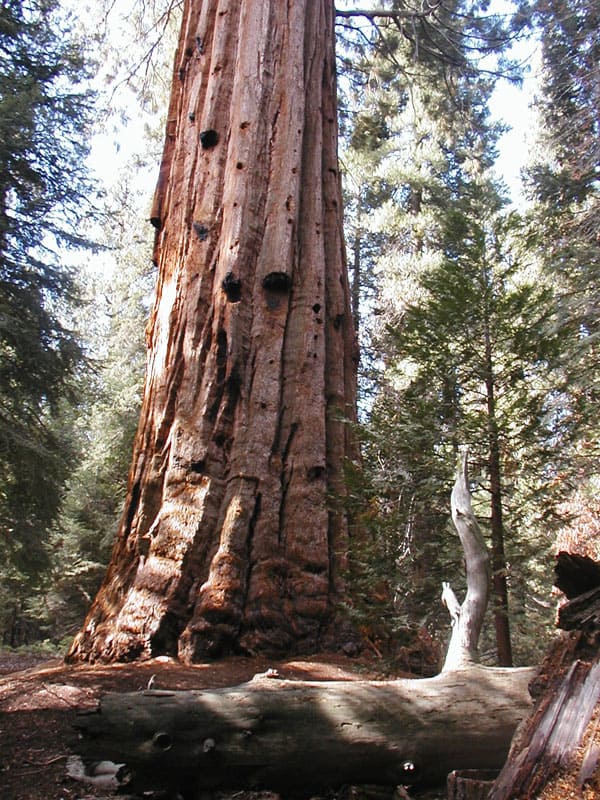
Hundreds of Giant Sequoias Considered Dead From Wildfires

It appears that rumors of ‘natural and beneficial’ wildfires in the southern Sierra Nevada have been ‘greatly exaggerated’. Even the Alder Creek grove, which was recently bought by Save the Redwoods, was decimated. Of course, this eventuality has been long-predicted.

https://www.latimes.com/environment/story/2020-11-16/sierra-nevada-giant-sequoias-killed-castle-fire

Patterns and Drivers of Recent Tree Mortality in Diverse Conifer Forests of the Klamath Mountains, California

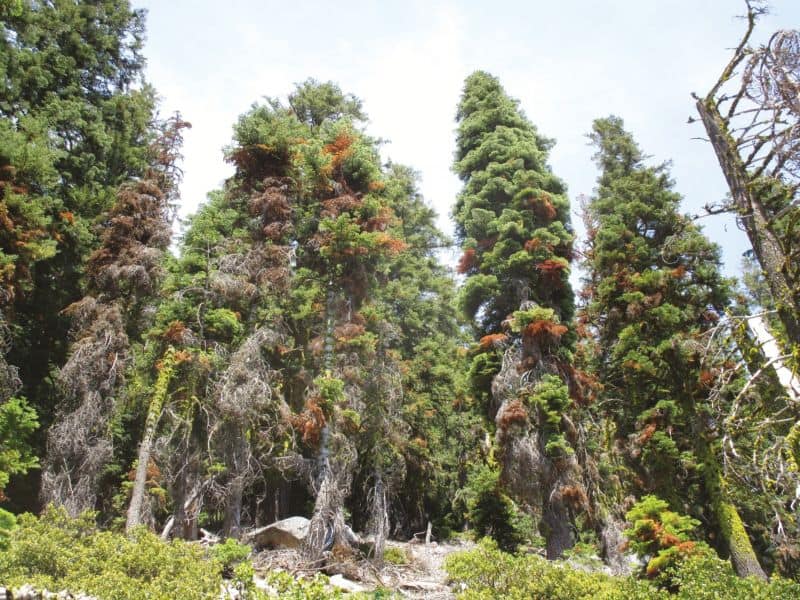
A typical Shasta red fir (Abies magnifica var. shastensis) stand within the study area with substantial damage from dwarf mistletoe (Arceuthobium spp.), Cytospora, and fir engraver (Scolytus ventralis).

Thanks to the Society of American Foresters for posting a western round-up of papers in Forest Science and Journal of Forestry. I thought that this one was particularly interesting from several standpoints.Here’sa link.

1. Just because we leave trees alone doesn’t mean they will continue to do carbon storage. Maybe this works in the rain forests, but not so much where the cycle is “trees get established, get dense without fire, water can’t support so many trees and/or trees grow old, get bugs and diseases and die”.

2. It’s really hard or impossible to tease out how much of this mortality is due to changes in climate, past fire suppression, changes in bug and diseases, age of trees and so on, because through time they are all correlated. Back in the day when we wanted to tease out interactions, we would design experiments to do that. We could plant trees every 20 years, run fires through at different intervals, and wait 100 years (or 250) for our answer, except the climate would be changing all that time. So perhaps it’s time to simply say “we won’t know for the foreseeable future- if ever, but if it is climate we should do x, and if it’s age, we should do y, and if it’s fire suppression we should do z. Are x, y and z all that different? How sure are we that they will “work”? How much will they cost? What if we don’t do anything?”

3. From a pragmatic point of view, we need to consider a concept I’ll call “cats out of the baggery”.. one being climate change, and the other being non-native species. Even if we stopped climate change today, and kept all new non-native pests and pathogens from entering the country, managers would still have to deal with existing effects. Or not, in the case of this study, because it’s a Wilderness.

4. Philosophical question: the authors state.

Since this disease complex was first described in 1984, several management recommendations were made to increase the health and vigor of Shasta red fir stands, including selective removal of severely infested trees, and clearcutting and regenerating in heavily infested stands (Kliejunas and Wenz 1982). As of 2010, these silvicultural treatments were not yet prescribed and forest health continued to decline at this site (Angwin 2010), and in 2015, many of the severely infested stands burned in a wildfire (personal communication, Keli McElroy, USFS). Fire may be the best management strategy for slowing the spread of the disease complex, particularly in wilderness regions where silvicultural treatments are not feasible.

I think since it’s in Wilderness, management would mean simply mean no intervention, except maybe WFU?

5. It makes me wonder how much of what we think is conditioned by the most-studied forest areas. Note below how the Klamaths are different from other studied areas.
(CWD is climatic water deficit).

Several authors attribute recent die-off events to initial abiotic stress that predisposes trees to other agents of mortality, such as pests and pathogens. The region-wide dieback of piñon pine (Pinus edulis Engelm.) in the southwestern United States, for example, was attributed to the 2000–2003 drought accompanied by unusually high temperatures, which predisposed trees to attack by a secondary bark beetle species, Ips confusus LeConte (Breshears et al. 2005). Similarly, Millar et al. (2007) found that limber pine mortality in the Sierra Nevada was linked to increased temperature and decreased precipitation, followed by dwarf mistletoe, and finally by mountain pine beetle. We do not see surmounting evidence that recent tree mortality in our study area is linked to unusually high summer temperatures, as the rising temperature trend we observe is driven by minimum temperatures and is most pronounced in winter months (Figure S4, Figure 3). Our study is consistent with literature suggesting that fir engraver outbreaks are associated with increased evapotranspiration (Wright and Berryman 1978, Berryman and Ferrell 1988); however, similar to Rapacciuolo et al. 2014, we did not see an increase in CWD. This distinguishes our study from many other tree mortality studies in the Sierra Nevada, for example, where die-offs have been attributed to large increases in CWD in recent years (Millar et al. 2012, Mcintyre et al. 2015). Finally, we used a ten-year window (2004–2014) for calculating recent changes in climate parameters, but it is possible that a few years of extreme drought within this period could have accelerated mortality, as has been shown in other systems (Breshears et al. 2005). For example, the 2011–2014 regional drought almost certainly created physiological challenges for Shasta red fir trees that exacerbated drought stress from dwarf mistletoe, and increased susceptibility to fir engraver infestation, but further investigation is needed to tease apart the abiotic vs. biotic causal agents of mortality.

Changes in the historical disturbance regime of these forest types, particularly the effects of fire exclusion, may be partially responsible for the elevated levels of recent mortality in high density and/or more mature stands throughout our study area. Similar to other parts of California, forests in the Klamath region have notable signs of fire exclusion, including in-filling of small, shade-tolerant trees (typically white fir), and dense accumulations of litter and duff around older trees. Historically, this region is characterized by a mixed-severity fire regime, with a high frequency of fires prior to the twentieth century producing mostly low and moderate fire effects in most conifer vegetation types (Skinner et al. 2006). In the upper montane zone (where we observed the highest mortality), the estimated fire return interval based on studies done in nearby forests ranges from about 15 to 41 years (Taylor and Halpern 1991, Taylor 2000) According to Forest Service records, our study area has not burned in the past 100 years (Safford et al. 2011), and based on the aforementioned estimates, we determine that the upper montane zone in our study area has missed somewhere between two and six fire cycles. Our finding of higher mortality among smaller diameter trees is consistent with a growing body of literature suggesting that increased stand density and competition from fire exclusion are major contributing factors to the increasing mortality trend in western coniferous forests (Guarin and Taylor 2005, Maloney 2011, Millar et al. 2012). Furthermore, high stand density has been shown to amplify drought stress (Gleason et al. 2017) and increase the spread of pests and pathogens. While some of the mortality observed in this study is undoubtedly related to self-thinning in high density stands, the usually high numbers of recently dead and dying Shasta red fir trees (28%) coupled with the high levels of pathogens and forest insects is more indicative of a die-off event versus a slower change in community composition. In this case, the die-off was almost certainly precipitated by at least a decade of damage from dwarf mistletoe and Cytospora infestation.