New (revived) weapon to attack the “deep state” (aka federal employees)

Image: CrowD Games

Maybe the less that’s known about this the better, since it could be intimidating, but it’s unlikely to be used for two years any way, and even when the Republicans had the power to use it before they couldn’t, but I think it’s relevant to discussions we sometimes have about the “political” nature of federal agency decisions.  This would be that on steroids.  I’ve excerpted much of this Washington Post article:

GOP revives rule allowing lawmakers to target federal agencies, staffers

The rules package House Republicans approved late Monday (January 9) includes a provision allowing lawmakers to reduce or eliminate federal agency programs and to slash the salaries of individual federal employees.

Called the Holman Rule, the measure was proposed in 1876 but was sparingly used until it was reinstated by Republicans in 2017 and then dropped by Democrats two years later. In theory, it could apply to any federal worker or agency — but for now the move is seen as mostly symbolic, as the Democratic Senate could block Republicans from using the provision.

The rule is named for a House member who proposed it nearly 150 years ago as an exception to the general practice of keeping policy decisions separate from spending decisions

One attempt … in 2018, would have reduced to $1 the pay of a federal employee in charge of an office that had been the subject of whistleblower complaints; opponents called the move an attempt to punish without due process one individual who was involved in a wide-ranging dispute.

Even if an attempt to use the rule is ultimately blocked, though, “It’s the potential use that makes it so concerning,” said Max Stier, president and CEO of the nonpartisan Partnership for Public Service. “If you’re a federal employee, this now becomes a risk that you have to think ‘I may get myself in hot water or have my salary dropped to zero or my job could get axed’” when making a professional decision.

“Symbols can cause harm. We need a workforce that is committed to the public good and feels safe to make that choice. That’s what’s at risk here,” he said.

Republicans have embraced the Holman Rule as part of the party’s aggressive stance toward the federal government, including President Donald Trump’s attempts to create new job classifications that would make it easier to fire government workers and his decision to move federal agencies like the Bureau of Land Management out of D.C.

During the House floor debate, Rep. Kat Cammack (R-Fla.), an ally of House Speaker Kevin McCarthy (R-Calif.), blasted federal officials as “unelected bureaucrats, the true, real swamp creatures here in D.C.,” saying they had “run roughshod over the American people without consequence.”

Democrats and union leaders, though, denounced the rule’s revival as an opening for the GOP to attack federal agencies and the people working in them for political reasons. Democrats warned that Republicans could abuse the power to lessen federal workers’ salaries or fire them outright — particularly at a time when the government is investigating former president Donald Trump.

Republican backers on Monday, though, said that reinstating the rule would provide an important check on the federal government.Rep. Chip Roy (R-Tex.) — a member of the conservative House Freedom Caucus — said the Holman Rule would “restore the people’s House” in the face of administrative action.

“I think it’s another intimidation tool for civil servants who are simply doing their job,” said Rep. Gerald E. Connolly (D-Va.) in an interview. “It is designed to provide a chill effect on the ability of civil servants to do their jobs and carry out enforcement regulations and compliance with the law.”

“The whole point of it is to use it recklessly. There’s no way to use it responsibly,” said the public policy director of the American Federation of Government Employees, Jacqueline Simon. “It goes around everything that protects the civil service from political corruption — not just federal employees but entire agencies.”


“Proforestation” It Aint What It Claims To Be

‘Proforestation’ separates people from forests

AKA: Ignorance and Arrogance Still Reign Supreme at the Sierra Club.

I picked this up from Nick Smith’s Newsletter (sign up here)
Emphasis added by myself as follows:
1)  Brown Text for items NOT SUPPORTED by science with long term and geographically extensive validation.                                                                                                                                                        2) Bold Green Text for items SUPPORTED by science with long term and geographically extensive validation.
3) >>>Bracketed Italics for my added thoughts based on 59 years of experience and review of a vast range of literature going back to way before the internet.<<<

“Proforestation” is a relatively new term in the environmental community. The Sierra Club defines it as: “extending protections so as to allow areas of previously-logged forest to mature, removing vast amounts of atmospheric carbon and recovering their ecological and carbon storage potential.”          >>>Apparently, after 130 years of existence, the Sierra Club still doesn’t know much about plant physiology, the carbon cycle or the increased risk of calamitous wild fire spread caused by the close proximity of stems and competition driven mortality in unmanged stands (i.e. the science of plant physiology regarding competition, limited resources and fire spread physics). Nor have they thought out the real risk of permanent destruction of the desired ecosystems nor the resulting impact on climate change.<<<

Not only must we preserve untouched forests, proponents argue, but we must also walk away from previously-managed forests too. People should be entirely separate from forest ecology and succession. >>>More abject ignorance and arrogant woke policy based only on vacuous wishful thinking.<<<

Except humans have managed forests for millennia. In North America, Indigenous communities managed forests and sustained its resources for at least 8,000 years prior to European settlement. It is true people have not always managed forests sustainably. Forest practices of the late 19th century are a good example.                                                                                                                                                 >>>Yes, and the political solution pushed on us by the Sierra Club and other faux conservationists beginning with false assumptions about the Northern Spotted Owl was to throw out the continuously improving science (i.e. Continuous Process Improvement [CPI]).  The concept of using the science to create sustainable practices and laws that regulated the bad practices driven by greed and arrogance wasn’t even considered seriously.  As always, the politicians listened to the well heeled squeaky voters.  Now, their arrogant ignorance has given us National Ashtrays, destruction of soils, and an ever increasing probability that great acreages of forest ecosystems will be lost to the generations that follow who will also have to cope with the exacerbated climate change.  So here we are, in 30+/- years the Faux Conservationists have made things worse than the greedy timber barons ever could have.  And the willfully blind can’t seem to see what they have done. Talk about arrogance.<<<

Forest management provides tools to correct past mistakes and restore ecosystems. But Proforestation even seems to reject forest restoration that helps return a forest to a healthy state, including controlling invasive species, maintaining tree diversity, returning forest composition and structure to a more natural state.

Proforestation is not just a philosophical exercise. The goal is to ban active forest management on public lands. It has real policy implications for the future management (or non-management) of forests and how we deal with wildfires, climate change and other disturbances.

We’ve written before about how this concept applies to so-called “carbon reserves.” Now, powerful and well-funded anti-forestry groups are pressuring the Biden Administration to set-aside national forests and other federally-owned lands under the guise of “protecting mature and old-growth” trees.

In its recent white paper on Proforestation (read more here), the Society of American Foresters writes that “preservation can be appropriate for unique protected areas, but it has not been demonstrated as a solution for carbon storage or climate change across all forested landscapes.”

Proforestation doesn’t work when forests convert from carbon sinks into carbon sources. A United Nations report pointed out that at least 10 World Heritage sites – the places with the highest formal environmental protections on the planet – are net sources of carbon pollution. This includes the iconic Yosemite National Park.

The Intergovernmental Panel on Climate Change (IPCC) recognizes active forest management will yield the highest carbon benefits over the long term because of its ability to mitigate carbon emitting disturbance events and store carbon in harvested wood products. Beyond carbon, forest management ensures forests continue to provide assets like clean water, wildlife habitat, recreation, and economic activity.
>>>(i.e. TRUE SUSTAINABILITY)<<<

Forest management offers strategies to manage forests for carbon sequestration and long-term storage.Proforestation rejects active stewardship that can not only help cool the planet, but help meet the needs of people, wildlife and ecosystems. You can expect to see this debate intensify in 2023.

Biden DOJ Defends Bernhardt Decision on King Cove: What Makes Something a “Political” Decision?

Interior Secretary Deb Haaland, left, is honored at an assembly at the King Cove School. (Marc Lester / ADN)

Saturday I posted about a controversy between Tribal people and a ski area on federal lands.  I’d like to place that story in conversation with another story, the King Cove controversy.  We don’t hear much about it, because it’s about a Fish and Wildlife Service (US DOI) administered area, and we usually talk about the FS and BLM.  But it has many familiar issues.  Native Alaskans in the village want a road to access a hospital.  Some national ENGO’s don’t want the road.

So we often talk about “political” decisions and decisions being “corrupted”.  I’d like to delve into this further.  As a person who has worked on numerous controversial EISs and rulemakings, I think it’s safe to say that there are a number of reasonable options that could be chosen.  What makes something “political”? Obviously there are numerous levels of internal and well as external politics. I think to agency people it might mean “a decision that I don’t agree with that favors interests I don’t like.” But then I think perhaps it’s about politics in the sense of “rewarding your friends and/or punishing your enemies,”   perhaps beyond what is a reasonable approach toward your stated aims.  For example, I think if the Admin’s stated goal is decarbonization, then shutting down US production on federal lands seems like more punishing oil and gas companies, or assuaging NRDC or ??, more than a rational policy call.  Others may disagree.  I would call that a political decision in that sense.  Do you agree or disagree or do you have a different definition?

So let’s look at the King Cove cases, which looks like Native Alaskans who need the road vs. (some) national ENGO’s.  The Admin appears to be picking a side by defending the decision (pro-road). Is this political? Was Sally Jewell’s decision not to political (assuaging ENGO supporters)?  Was Bernhardt’s political? Are they all political?

An interesting aspect of this case is that  he same argument (the federal property rights trump other considerations) seems to be made by these groups for Native people as for any local people.

Does this sound familiar?From an Anchorage Daily News story on Secretary Haaland’s visit.

Others complained to Haaland that outsiders can access Izembek to hunt and fish, and that much of the opposition to the road comes from conservation groups based on Alaska’s road system or in the Lower 48.

“Those folks live there,” said Skoey Vergen, chief executive of Aleut Corp., the Native corporation for the King Cove region. “These folks live here.”

Those dissenting groups were not present Wednesday in King Cove. But they’re still examining last month’s court ruling approving the Trump-era land exchange, and an appeal is an option, said David Raskin, president of Friends of Alaska Wildlife Refuges.

“This refuge is not owned by the people of King Cove. It is a great, valued possession of the people of the United States,” Raskin said in a phone interview Thursday. “And to have a small community like that reap horrible damage on one of the jewels of the refuge system would be a travesty, and a terrible blow to the American people.”

It appears that 11 miles of the road between King Cove and Cold Bay have not been built and that is what this decision is about. People from King Cove want a road to the hospital in Cold Bay.

Would we say that if the road goes through it is politics, or if the road doesn’t go, through it’s politics.  Do we feel more sympathy for the native Alaskans, or for far away people with environmental concerns.  If the Biden Admin were to give in to them, would that be undue political influence.

What groups, might we ask, are concerned about this road (desired by local Native Alaskans) to the extent that they are litigating it? Well, plaintiffs include The Wilderness Society; Defenders of Wildlife; National Audubon Society; Wilderness Watch; Center for Biological Diversity; National Wildlife Refuge Association; Alaska Wilderness League; and Sierra Club (collectively “Plaintiffs”). Many of these are powerful friends of the Obama/Biden Administrations.  Perhaps why Sally Jewell made her decision (political influence?).

And how did our friends at the New York Times cover the Jimmy Carter angle?  “The legal battle over the gravel route could gut an environmental law that the 39th president called one of his highest achievements.”

They are arguing the precedent of course, not the actual road.

***********************

Another interesting angle is how political decisions get validated or invalidated by the courts.

I got hopelessly confused over the legal questions involved.  At first it sounded a little like that Sec. Jewell made a decision from an EIS, and Sec. Bernhart couldn’t make a different decision off the same EIS by weighing things differently.  Then the judges became frustrated at having their time potentially wasted because conceivably Sec. Haaland could make a new decision (with a new EIS?) .

But then there’s this explanation in the Anchorage Daily News article.

Trump’s administration was good to King Cove. After a federal judge invalidated a land exchange aimed at authorizing the road, Trump’s Interior Department redid the plan and tried it again. A different judge rejected it a second time, in 2020. But last month, a federal appeals panel reversed that decision and said the land exchange could proceed,..

In the NYT article:

The exchange was authorized by Congress during the Obama administration, but was rejected by Sally Jewell, then the interior secretary, after a review found it would cause irreversible damage to the refuge and its wildlife.

If Congress asks the Admin to do something, it can just decide not to?  Hopefully someone knowledgeable can explain.

Judge Kim McLane Wardlaw, a Clinton appointee, disagreed with her two colleagues, writing in a dissenting opinion that Bernhardt never explained the reasoning for this policy shift from Jewell and that she would have found that the land swap violated the Administrative Procedure Act and other federal laws.

DOJ argues in its brief that Bernhardt’s explanation placing public welfare over other concerns “sufficiently explained the change in policy,” in compliance with the Administrative Procedure Act, and that no other documentation was needed.

I thought that it was interesting that of three judges two thought (and DOJ thinks) that it was adequately explained, and one thought not.  That’s why to us observers, it sometimes seems like when we go to court the decisions are more or less random.  If I were redesigning the system, the judge would have to explain what they thought would be an adequate explanation. Otherwise it’s like “bring me a rock”; decisions can’t be improved without constructive feedback.

***********************************

Here’s one from E&E News, part of a long interesting article from 08/08/2022, if you are interested in more background.


DePartisanizing Issues: Biomass Utilization and Fuel Treatments


It’s been interesting to watch the mechanics of how an issue becomes partisanized.. or departisanized. Two cheery notes on this wherein what used to be considered that bad R people had are now the same ideas that good D people from states like California and Colorado have.

At a alumni gathering a few years ago at Yale, Gina  McCarthy gave what amounted to a rousing very partisan political speech (personally that’s not why I show up for reunions, but that’s a different topic) that included the concept of biomass being bad for climate as if it were something everyone knows the “right answer” to.

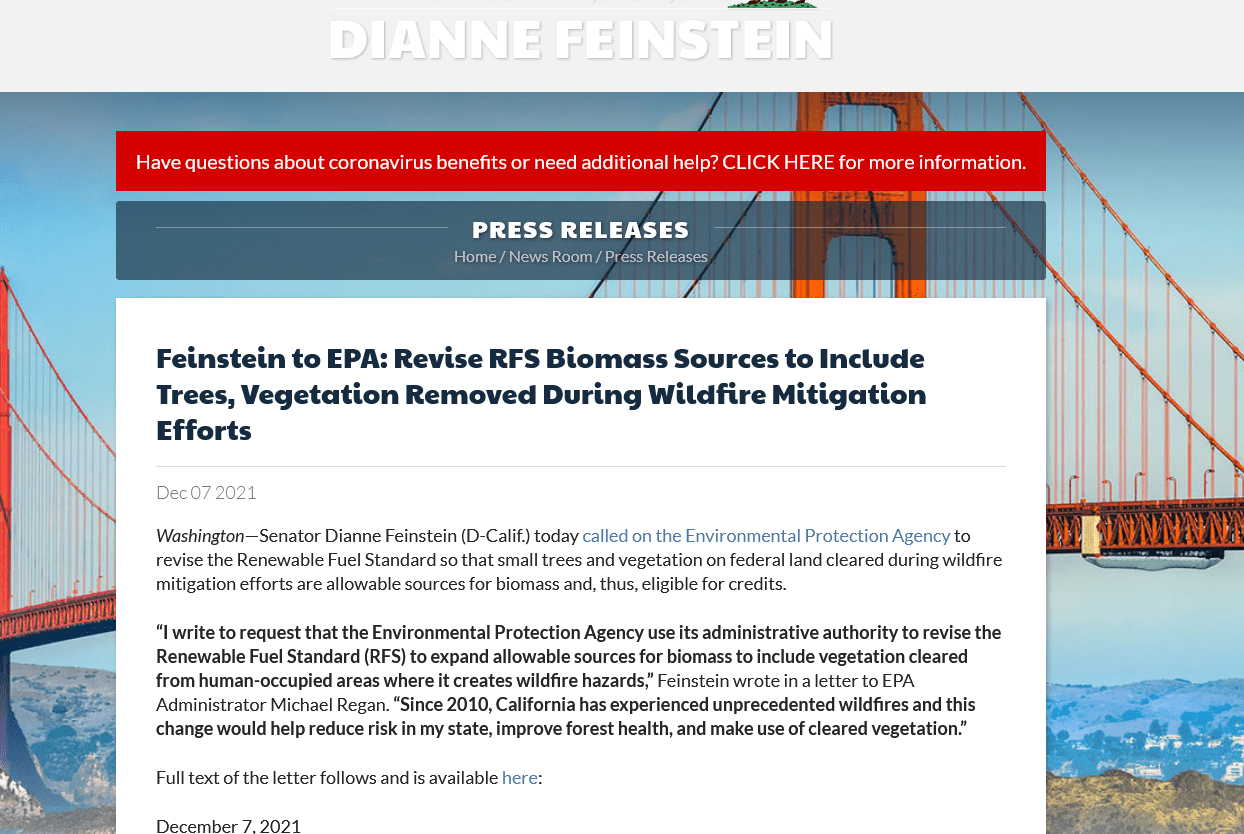
Fast forward a few years and here’s Senator Feinstein saying what we’ve always said here- it depends.. Don’t look at our problems through an “east coastal” lens.

“I write to request that the Environmental Protection Agency use its administrative authority to revise the Renewable Fuel Standard (RFS) to expand allowable sources for biomass to include vegetation cleared from human-occupied areas where it creates wildfire hazards,” Feinstein wrote in a letter to EPA Administrator Michael Regan. “Since 2010, California has experienced unprecedented wildfires and this change would help reduce risk in my state, improve forest health, and make use of cleared vegetation.”

Here’s what her letter said:

As you may know, Section 201 of the Energy Independence and Security Act of 2007 (EISA) allows biomass from federal land to be sourced “from the immediate vicinity of buildings and other areas regularly occupied by people, or of public infrastructure, at risk from wildfire.” In 2010, the EPA published implementation guidelines for that category in its final rule, “Regulation of Fuels and Fuel Additives: Changes to the Renewable Fuel Standard Program.” Unfortunately, the implementation of this law did not account for areas with wildfire hazard potential and excluded most of the Western United States where catastrophic wildfires are increasing common. (See attached map, “2020 U.S. Forest Service Wildfire Hazard Potential,” which underscores the risk in the West.)

As this year’s fuel quantities become finalized, I urge the EPA, in conjunction with federal land management agencies, to expand the criteria for which qualifying biomass could be sourced and, thus, eligible for credits under the cellulosic category in the RFS. This determination should be made in accordance with the latest science, and to recognize the exacerbating threat that climate change poses to catastrophic wildfire in the American West.

This one from the formerly “fuel treatments don’t work” Los Angeles Times.. (this is from a political reporter, not an environmental reporter, so..)

Democrats are proposing a potentially seismic shift in how the nation battles wildfires by dramatically increasing funding for efforts that aim to prevent blazes, rather than focusing on the tools to put them out.
Under the social safety-net and climate bill passed by the House and now being negotiated in the Senate, Democrats would funnel $27 billion into the nation’s forests, including a sizable $14 billion over a decade for clearing vegetation and other dry debris that can fuel a fire.

What this article seems to overlook is that there is a substantial chunk of change in the bipartisan Infrastructure bill, and that the BBB $ come with restrictions that may make them less useful than they could be.

Still, the $27 billion would represent the largest investment the federal government has made in its forests, according to Sen. Michael Bennet (D-Colo.), who introduced a similar forestry bill this year. Funding for the preventative hazardous fuels reduction — to be spread over a decade — is more than double what Congress spent on such efforts annually between 2011 and 2020, according to the nonpartisan Congressional Research Service.

Traditionally, the federal government has focused its wildfire spending on suppression at the expense of prevention. The Interior Department and Forest Service are even allowed to unilaterally move money from any of its programs, including fire prevention, to fund more urgent suppression efforts.

“When you combine the effects of climate change with the profound negligence of the federal government in terms of managing its national forests, these places are profound dangers to our communities and to our economy,” Bennet said.

“Profound negligence of the federal government in terms of managing its national forests”.. sounds almost like an R Congressperson from the Sierra, or dare I say, the Western Slope.

Practice of Science Friday: How Local Politicians May or May Not Influence Number of Projects and Level of Analysis

In the  comments from yesterday, Forrest Fleischmann mentioned this study, and I think it’s worth looking at the study a bit more.

What Forrest said in the comments was:

By contrast, local people living near federal lands in the US have very substantial political rights to express their opinions and participate in decision-making both through formalized processes (e.g. through NEPA and NFMA and associated public comment processes) and a wide variety of informal political processes at multiple levels (e.g. our recent research suggests that local politics has a fairly direct influence on agency decision-making beyond notice and comment procedures – https://academic.oup.com/jpart/advance-article-abstract/doi/10.1093/jopart/muab037/6364117). And local people in the US often exert leadership over decision making on forest lands because unlike in India, in the US individuals, tribes, and local governments own forest land, and also have various opportunities to exert leadership over the management of public land.


First, I’ll say that local decisions are not what I was originally talking about. I’m thinking more of national rules like Roadless or Planning. From the discussions in DC around the 2012 Planning Rule, I think local officials didn’t have much of a bite at the apple (although it was too complex for most to follow, probably). Bur originally I was speaking of things like Monument declarations and legislation (such as the potential Reconciliation bill or Wilderness bills) that do not take public comments and do not have EIS’s. These larger scale decisions (like not funding fuel treatments outside WUI) or keeping OHV’s out of newly Monumented areas, may have little local involvement (a trip by the Secretary of the Interior?). Projects can only occur within those larger decisions which seem to be made elsewhere. Like Washington D.C. for example, where issues tend to get scrunched into a partisan framing and often lack local or even regional context.  George Hoberg at University of British Columbia tracked that back to the intentional nationalizing of issues by major ENGO’s around the time of the spotted owl intentionally to counter what was seen to be “pro-timber localism”.

Still, given that the study looks at more local kinds of decisions, let’s look at the abstract:

Research on political control over government bureaucracy has primarily focused on direct exercises of power such as appointments, funding, agency design, and procedural rules. In this analysis, we extend this literature to consider politicians who leverage their institutional standing to influence the decisions of local field officials over whom they have no explicit authority. Using the case of the US Forest Service (USFS), we investigate whether field-level decisions are associated with the political preferences of individual congressional representatives. Our sample encompasses 7,681 resource extraction actions initiated and analyzed by 107 USFS field offices between 2005 and 2018. Using hierarchical Bayesian regression, we show that under periods of economic growth and stability, field offices situated in the districts of congressional representatives who oppose environmental regulation initiate more extractive actions (timber harvest, oil and gas drilling, grazing) and conduct less rigorous environmental reviews than field offices in the districts of representatives who favor environmental regulation. By extending existing theories about interactions between politicians and bureaucrats to consider informal means of influence, this work speaks to (1) the role of local political interests in shaping agency-wide policy outcomes and (2) the importance of considering informal and implicit means of influence that operate in concert with explicit control mechanisms to shape bureaucratic behavior.

I think that this study may suffer from a current trend I’ve noticed in many other studies. The ability to use large datasets leads to conclusions that seem based on correlation without delving into any mechanisms for why the correlation might occur, nor testing different hypotheses about those proposed mechanisms. There’s also the question for such datasets, why is a given scale chosen? Some have argued that academic journals like worldwide conclusions best. Yet mechanisms may be different at different scales, as well as correlations. My old example is an economic one. If you close a mill in Forks, Washington, then that economy is impacted, but the economy of the State is not. So the answer you get depends on the scale you pick.

But let’s take it from the other end. Why do FS workers initiate “extractive” actions (are cattle and sheep really “extractive”?)

Oil and gas leasing and permitting is run by BLM and is leased by them based on a complicated process that we have discussed here, or you can read about on their website. Given that, we’d have to go back to BLM and see whether oil and gas leasing decisions are affected by local representatives. They can be, but that works both ways, to not lease or to lease; and which restrictions go where. This is something that would require further analysis to make a conclusion in my mind, because the BLM and FS can be quite different.

Many grazing leases are in the interior west. The interior west is full of Republicans. Ergo, Republicans want to extract and that’s the reason there are grazing leases. I would say not. Historically, the Interior West (not coastal here, I think that would require further analysis) has been an area with grazing (due to lack of water for food crops) and mining, including, as our minerals friends would say “fluid minerals.” Therefore, there are grazing leases, oil and gas leasing decisions, and mining decisions to be had. For some reasons, which only historians and political scientists can tell us, many local officials are Republicans (perhaps that’s what the authors meant by the coyly worded “congressional representatives who oppose environmental regulation.”) But there are not more grazing leases because there are Republicans.

Timber harvest is a different kettle of fish.  As we can see here at TSW, the dynamics are very different in coastal states than in the Interior west. They’re probably even different in different parts of, say, California. It’s also super confusing as so many projects with timber harvest have a variety of purpose and needs, and the existence of mills and so on. If we just look at the handy Headwaters chart for states and volume of timber produced, we see that two heavily Democratic states have the highest volumes (328K cut California, 402K Oregon). It’s actually pretty interesting to take your State where you might know the Congressfolk involved and look at the forest volume sold. Of course, if we looked at the number of projects with a timber component, it might be different. let’s take fuels treatment projects with a timber component.  For example, there were many bucks (and their own CE) associated with getting fuel treatment done around Lake Tahoe. Did all those bucks come due to Congressman McClintock? I think not.  Indeed,  the number of fuel treatment projects in each Congressional District is likely to be associated with how much money that unit gets passed down to them via the DC-Regional-Forest-District budgeting process.

As to “rigor of analysis” I’d say that all O&G  decisions are likely to get litigated, so they’d all be pretty rigorous. Most grazing decisions are not (where I worked) so that would be a function of the local unit’s NEPA culture. As to vegetation treatments, it might be that the presence of environmental groups who might litigate and local officials of the “support environmental regulation” persuasion are correlated due to the presence of people in the community with those views. But would the FS “depth” of analysis be related to the likelihood of being litigated, or the presence of local officials of a given philosophical persuasion? I don’t know but it could be teased out via experimental design. Or I guess we could ask the people currently working how they decide.

My point is that correlation is not causation. To understand causation, we’d have to talk about specific mechanisms for “informal and implicit” means of influencing decisions. It seems like this is an increasingly common way to do research- take big data, on as large a scale as possible, and correlate. We’ll look at more of these studies in the future.

Budd Falen: Standing Up for Rural Constituents

Salon

Karen Budd Falen was the Deputy Solicitor for Parks and Wildlife in the Department of Interior for three years, and she left with the rest of the Trump administration, capping off a notable career in opposing public lands.  She appears to come by that view honestly, being raised on a Wyoming ranch and representing ranchers as an attorney (including the Bundys).  She reflects in this short piece on her legacy of changing the Endangered Species Act regulations and National Environmental a Policy Act regulations to promote more “local control” (as well as with the Land and Water Conservation Fund).

I take issue with her arguments in both cases that the laws the regulations implement (ESA and NEPA) were intended to allow social and economic considerations to play the role she has provided for them.  These statutes are both clearly aimed at the “natural environment,” and not local “custom and culture.”  Remarkably, she appears to admit that, “the listing of a species should be based only on science,” but then she has made it harder to do that with various changes in the ESA implementing regulations (which go beyond those she describes here in relation to critical habitat).

My fundamental disagreement with her and those she represents concerns this statement (and I suspect it may be a reason for differing opinions on this blog):

In my view, local elected officials should have more sway on issues directly affecting them than someone from midtown New York who has never faced the realities of making a living from the land.

The major gloss-over here is that endangered wildlife and federal lands don’t belong more to local people and their elected officials.  Her view that local interests should have more influence is not supported by either of these laws, and it is not the view held by most of the people that these resources do belong to.  Should the Biden administration not reverse these regulations, courts will have another opportunity to slap down the misinformation from her, and organizations she has worked for like the Mountain States Legal Foundation, that has led to ideas like “county supremacy” limiting how national forests are managed.

(Here is a little background from just before Trump decided she could not get confirmed as BLM Director.)

“Tracking Biden’s environmental actions”

The Washington Post has put together a “scorecard” for “environmental actions” to be taken by the Biden Administration to reverse over 200 Trump policies in seven categories, sorted by how hard they would be to overturn.  Those marked by dark orange are already “overturned,” those in lighter orange are “targeted,” and the rest “not yet targeted.”  Overall, 8 have been overturned, 60 have been targeted, and 139 are not yet targeted.  Here’s the categories and total amounts.

Air pollution and greenhouse gases (64)

Chemical safety (14)

Drilling and extraction (61)

Infrastructure and permitting (26)

Transparency (2)

Water pollution (13)

Wildlife (27)

Public land management may be affected by actions in several of these categories, but “Drilling and extraction” includes logging, so I’ve copied some of that list above.  Among the priority actions (overturned or targeted) include Utah national monuments, timber harvesting on BLM lands, the protest process for federal timber sales, the Tongass roadless rule, and fracking rules.  Also, in the “wildlife” category, ESA critical habitat designation, spotted owl critical habitat and Endangered Species Act consultation have been targeted.   Not yet targeted include many things we have discussed on this blog, such as:  the Eastside Screens old growth plan amendment, the executive order encouraging logging on federal lands, sage grouse protection, Twin Metals mine leases near Boundary Waters, the Tonto NF copper mine, Forest Service NEPA regulations, and CEQ NEPA regulations.  It’s also interesting to note the number of these that are “under litigation,” which may also provide leverage to undo Trump actions.

I hope this is something they will continue to update with successes and failures and new targetings.

Team-building for Congress and Other Unlikely Proposals to Promote Unity

President Biden again stressed unity and civility in his Inaugural Address. Last week I wrote an op-ed, published in the Colorado Springs Gazette with some helpful, if potentially unpopular, suggestions. Here’s a link.

I think our country needs to take a deep breath now that this election is over. I don’t think the problem is really the existence of people who disagree with each other-we always have- but rather the way we disagree, and how politicians and the current media business models tend to inflame those disagreements. If we frame the problem this way, the goal would be simply to calm the seas of civic life.

President-elect Joe Biden wants to promote unity. Based on my experience in DC, both as a career federal employee, and assignments In Congress and at the White House, I’ve got a few suggestions.

First, Congress clearly needs the mother of all team-building sessions. As a veteran of many, I’d suggest AOC and Lauren Boebert be assigned to the same small group. No one will be assigned their office until they’ve worked in a small group composed of Members from both parties and have signed on to five agreed upon proposals.

Second, have you ever noticed that proposed federal regulations have public comment periods, and yet legislative proposals don’t? If they did, everyone would be able to weigh in, not just interest groups of various kinds.

Each interest group wants something that’s best for them, not necessarily for the public. They could start with the list of all the proposals developed in the above team- building.

Third would be no Twitter accounts for elected officials. If the past four years have shown us anything, it’s that Tweeting instead of press releases is anathema to thoughtful public discourse. I actually went on Senator Cory Gardner’s once and felt like I needed a cleansing ritual afterwards. People were simply nasty. Why intentionally provide a safe space for hate? I’d make a rule that like career feds, elected officials can’t have their own Twitter accounts.

Fourth would be no money seeking for elected officials. I volunteered to work on now-Governor Jared Polis’ campaign via the website, but I never heard back except with emails asking for donations. Perhaps because I was on that list, I also received emails from an account in his name after he was elected, asking for more donations. Not a good look for public officials, in my opinion.

When people take their oaths of office, I think they should also suspend all donation seeking or other activities related to campaigning or future campaigns. They would only be able to campaign for themselves and only starting, say, four months before the election. That way we would know for sure they were working on what we were paying them to work on (governing, not stumping).

Fifth, we need a bipartisan Internal Peace Commission led by retired legislators and others with input from academic and practicing conflict resolution folks. We’re always talking about “using the best science” in policy. What policy could be more important than making our mutual public life better? Good policies flow from good people, quality and open discussions, and working in good faith.

It’s a simple idea. We know what’s broken. Let’s take a deep breath, reset our mistrust and hate levels to zero and get at it.

Other suggestions?

A Unification Approach to Bears Ears: Let’s Swear Off Political Sharp Sticks in the Eye

Conservation Lands Foundation board member and former Interior Secretary at a meeting in Durango, Colorado. Photo by Steve Lewis, Durango Herald.
Lisa Friedman of the New York Times wrote an interesting article about the top things the new administration could do for the environment.

Most of her nine are about climate change. Of most interest to us, is perhaps one she calls “Restore Wildlife Areas”

According to her, Mr. Biden has pledged to take “immediate steps to reverse the Trump assault on America’s national treasures” including major cuts in 2017 to Bears Ears and Grand Staircase-Escalante National Monuments as well as opening parts of the Arctic National Wildlife Refuge to oil exploration. He has said on the first day of his administration that he will sign an executive order to conserve 30 percent of US lands and waters by 2030.”

We’ll be continuing to discuss the details of a 30 x 30 goal.

One concept I’ve never heard political writers talk about is what I would call the “sharp stick in the eye” factor, which I think deserves more exploration. Bears Ears was monumentized following the loss of an election. We have heard from the same people that it’s bad for Supreme Court nominees to be picked too close to an election, but the same folks argue that it was fine to Monumentize an area where many elected officials are of the opposing party after an election. It seems to me that these positions are inconsistent, and I’ve found that inconsistent and or illogical positions are often guideposts to decisions that are ultimately political (in the sense of pleasing someone at the expense of others). Anyway, to me that was an intentional sharp stick in the eye. It will be interesting to see if we agree on the SSE (sharp stick) factor. I’d give Bears Ears an 8 on a 1-10 scale.

I don’t think the “uniting” approach would be to “immediately reverse” what the Trump Administration did. That would be just another sharp stick in the eye.. haven’t we had enough of those? What about sitting down again with folks in the area and concerned groups looking at a variety of alternatives without the drama of the Nationally Significant Focus by Some Groups as a Symbol. Certainly the only choice is not “these 2016 lines with these 2016 restrictions”. As Chris Wood said about the 2001 Roadless Rule, “it wasn’t written on stone tablets.”

Despite the fears, we didn’t see any oil and gas nor additional uranium development. Maybe, as we have seen, increasing recreation in the area would be bad for the environment, or people come whether or not it’s a Monument, or people overuse trails and spread Covid to locals. Seems like the last four years have had changes that could be considered in such a discussion.

Mark Squillace, a professor at the University of Colorado Law School, tells the story of when he accompanied Interior Secretary Bruce Babbit to affected communities to discuss Grand Staircase-Escalante national Monument. The way his story goes, talking person to person with Babbit may have actually changed minds, or at least reduced the atmosphere of antipathy. (Of course, that’s Mark’s side of the story, but we don’t have another one, so I’ll go with it.)

Here’s my unifying approach based on that:
1. Send the Secretary out there (presence is a great symbol) as part of a public comment period
2. Determine to listen respectfully to the other sides, including elected officials from the other party (!). As the President-elect said, they are not your enemy.
3. Do a deal with the goal of stability.. “can everyone live with this?”

Actually, it sounds a lot like plain old collaboration. It’s also what states have to do regularly, which is why I like former western governors and DNR directors for Interior Secretaries.
It’s interesting to think about why it is that when the stakes are higher than at the State level, it seems like collaboration takes a back seat and “winner takes all” takes over. But internationally, we’d reject that approach in supporting peace processes. Perhaps national politics are some kind of anomaly. Not in a good way.

I ran across this article from only five years ago from the Durango Herald on Babbitt’s then-current activities:

The pushback from the energy production industry is a major obstacle, but Babbitt said he has long held the belief that the two, preservation and industry, can co-exist.

“How many of you know, that there is gas production at the Canyon of the Ancients?” Babbitt asked the crowd of about 30 members and non-members. “The opponent says you’re taking things off the slate of use and production, that the land is just being set aside for weak environmentalists. But (oil and gas) can be managed with minimal impact. It is possible to make them work together.

And one reason the BLM is taking such good care of that place is because they’re looking over their shoulder,” he said. “That’s the model for the entire West, and it began right here in Durango.”

I think by “they” in the last sentence Babbitt meant local people given the context. Also Babbitt talks about BLM’s National Conservation Lands which sounds like it could be an alternative to monumentizing, especially when an Administration starts with enough time for such a process.

Setting the Table for Unity: An Extravagantly Immodest Proposal

Today (perhaps) is the last day we don’t know what color of Administration we’ll have. So I’ll propose something that either party could adopt. I’m going to focus on the idea of uniting and getting better policy. Here are my assumptions: 1) a diversity of ideas to select from promotes better policy 2) wide swings don’t help anyone (the Freudenthal (D former Governor of Wyoming) view) 3) you can favor your friends without punishing your enemies (this is something that perhaps can’t be measured, but can be sensed). We discussed pretty much the same topic in August here, along with the Freudenthal quote. We’ve also talked about the role that the Western Governors could play in terms of Living With Fire.

It seems odd to me that as a citizen, I can weigh in on, as an individual, a 500 acre fuels reduction project. But I can’t weigh in on the priorities of an administration. Citizens can via interest groups, but when was the last time you observed an interest group taking a poll of its members before it determined a policy (let alone a political party!). I always say a political party is a bit like the old church expression “pray pay and obey” without the “pray.”

What if the new administration scoped its priorities? Even though this is an immodest proposal, I’m just talking our own little world of FS and BLM, and private forest issues not, say, immigration or health care or climate change.

Of course, that is a naive idea. We don’t have much of a choice on priorities.. we had a dichotomous choice for Prez and that decision leads directly to whatever they and their allies want done. Even if we voted for a party, most of us have no ability to influence their agenda.. it’s take it or leave it. And we don’t even know for sure what the elected will do, as the people running take more extreme positions to attract votes in the primaries and then moderate to try to win the general election- and some proposals are chiefly symbolic- not feasible or legal. Even the folks who voted for them have no control over what they ultimately do. I get that.. but we don’t have any input (as opposed to control, a relatively tiny ask IMHO) either. Unless we agree with favored interest groups. And so it goes. And so the labels on the chairs outside the Secretary of Interior’s office are changed back and forth from industry to environmental groups, when most of us would want to arrive at some agreement and move on to the next issue. And most of us don’t serve on the boards of companies and NGO’s that exert their influence on administrations.

I’m thinking of some kind of advisory committee, which would be tasked with reviewing, helping select and developing options, with the help of agency folks and others in an open process. This does happen in rule-making, (think ANPR) but the solution to every problem is not rulemaking (nor undoing the previous administrations’ rules). And solutions can be micro and macro or a combination. But if we focus on rulemaking, we’ve already privileged some points of view and skill sets and left out others. This advisory committee could also review how changes are working and recommend course corrections. One of the problems we have is that Party A will start something and Party B will throw it out instead of trying to fix it. Some (most) problems are way too complex for the first tweaks to work perfectly. And an advisory committee could outlive the reigns of Party A or Party B and be a unifying and centering force.

But how to select people to not just replicate partisan warfare? This is where the new administration could decide to “set the table for unity.” When Colorado took up working on a state Roadless Rule, different parts of the government picked members of the task force (members also covered a range of interests).

We can imagine some ratio of appointed by party in power, appointed by party not in power, and of most interest, those unique individuals that are agreed upon by both parties. These folks tend to have talent and experience in bringing people together, and are pretty much the folks who do the heavy lifting on arriving at agreements. We can also imagine variations like “what if the environmental folks picked the oil and gas person?” or “what if the oil and gas people picked an environmental group representative?” We could also throw in some folks designated by the Western Governors since most federal land is located in the west.

At the end of the day, it’s still fine for decisions to be made by an Administration’s circle of friends. But I think with this approach, the Administration would be much more knowledgeable about other paths and practical and political trade-offs.

I’d be interested in any examples you all have of: getting direct public input on priorities, long-term valued advisory group, and other ways of setting the table for unity. We also have a substantial scientific literature on successful collaboration that might be applied to such an effort.