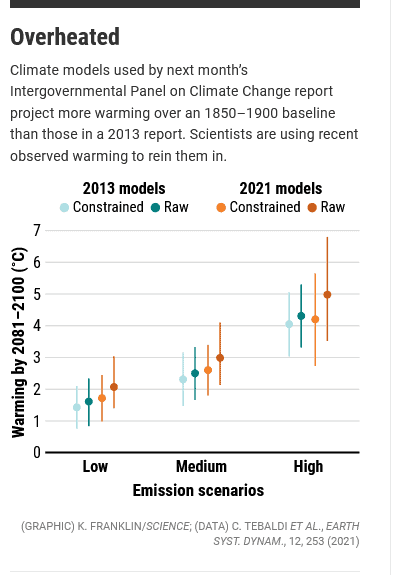
This is an interesting article in Science Magazine leading up to the upcoming IPCC report. This one looks at some of the reasons and the “poorly understoods” that are causing models to run hot.
The models were also out of step with records of past climate. For example, scientists used the new model from NCAR to simulate the coldest point of the most recent ice age, 20,000 years ago. Extensive paleoclimate records suggest Earth cooled nearly 6°C compared with preindustrial times, but the model, fed with low ice age CO2 levels, had temperatures plummeting by nearly twice that much, suggesting it was far too sensitive to the ups and downs of CO2. “That is clearly outside the range of what the geological data indicate,” says Jessica Tierney, a paleoclimatologist at the University of Arizona and a co-author of the work, which appeared in Geophysical Research Letters. “It’s totally out there.”
To find out why, modelers probed the guts of the simulations, focusing on their representation of clouds, long the wild card of climate change. The models can’t simulate clouds directly, so they rely on known physics and observations to estimate cloud properties and behavior. In previous models ice crystals made up more of the low clouds in the midlatitudes of the southern Pacific Ocean and elsewhere than satellite observations seemed to justify. Ice crystals reflect less sunlight than water droplets, so as these clouds heated and the ice melted, they became more reflective and caused cooling. The new models start with more realistic clouds containing more supercooled water, which allows other dynamics driven by warming—the penetration of dry air from above and a subduing of turbulence—to thin the clouds.
But that fix has allowed scientists to spy another bias previously countered by the faulty cooling trend. In both the old and new climate models, the patchy cumulus clouds that form in the tropics thin out in response to warming, allowing in more heat than satellite observations suggest, according to a study by Timothy Myers, a cloud scientist at Lawrence Livermore National Laboratory. “Even though one feature of the climate is now more realistic, another that’s persistently biased has been revealed,” Myers says.
But this part brought back a memory from the 70’s…
So the IPCC team will probably use reality—the actual warming of the world over the past few decades—to constrain the CMIP projections. Several papers have shown how doing so can reduce the uncertainty of the model projections by half, and lower their most extreme projections. For 2100, in a worst-case scenario, that would reduce a raw 5°C of projected warming over preindustrial levels to 4.2°C.
Our silviculture professor at Yale, Dave Smith, had a skeptical view of forest vegetation models. We were also, as graduate students, learning FORTRAN as a programming language (history, this was actually a graduate level course!). Dave told us something like “when trees grow too tall, they just put in a card that says “if the modeled tree height value is greater than 90, tree height equals 90″”. I don’t know if that was actually true about the JABOWA model, but this climate modeling intervention sounds a bit like the same thing.
The modelers hope to do better next time around. Lamarque says they may test new simulations against recent paleoclimates, not just historical warming, while building them. He also suggests that the development process could benefit from more time, with updates every decade or so rather than the current report interval of every 7 years. And it could be helpful to divide the modeling process in two, with one track focused on scientific experimentation—when a large range of climate sensitivities is helpful—and the other on providing a best estimate to policymakers. “It’s not easy to reconcile these two approaches under a single entity,” Lamarque says.
A cadre of researchers dedicated to the task of translating the models into useful projections could also help, says Angeline Pendergrass, a climate scientist at Cornell University who helped develop one technique for weighting the model results by their accuracy and independence. “It’s an actual job to go between the basic science and the tools I’m messing around with,” she says.
For now, policymakers and other researchers need to avoid putting too much stock in the unconstrained extreme warming the latest models predict, says Claudia Tebaldi, a climate scientist at Pacific Northwest National Laboratory and one of the leaders of CMIP’s climate projections. Getting that message out will be a challenge. “These issues don’t translate very well in practice,” she says. “It’s going to be hard for people looking to make some projection of a water basin in the West to make sense of it.”
Maybe people who manage resources like water just acknowledge “we don’t know, but things could be somewhat, very, or terribly much worse in a variety of ways due to climate change and a variety of other factors that may interact” and then see how the responses would play out, and what would be key decision points. It seems like that’s actually what they are doing, at least, as I recall Denver Water, ten or more years ago. Here are some examples.