I thought that this was an interesting study.. sort of a combination of observation and modeling, plus economics. My favorite piece was..
Treatments were especially effective at reducing high-severity fire — those that kill more than 75% of the tree canopy — lowering burned area by 20% to 35%.
Tall living trees are good IMHO.
****************
Every dollar spent on forest fuel treatments saves about $3.75 in wildfire damages, according to a new study, led by researchers at the University of California, Davis, of nearly 300 fires in the western United States. The study estimated that the treatments, such as forest thinning and prescribed burns, prevented $2.8 billion in losses, reduced wildfire spread and fire severity.
The researchers analyzed the nearly 300 wildfires that intersected USDA Forest Service fuel reduction treatments in 11 states between 2017 and 2023. The study is the first to evaluate the economic value of Forest Service fuel treatments across the West at a large-scale using data from wildfires that encountered fuel treatments rather than relying on wildfire simulation models. It was published today in Science.
“Fuel treatments and forest management are critically underfunded public goods,” said lead author Frederik Strabo, a postdoctoral scholar with the UC Davis Department of Agricultural and Resource Economics. “Our results suggest that when fewer resources are available to agencies like the Forest Service, more of the economic burden of wildfires falls on the public.”
The researchers measured wildfire damages including structure losses, carbon emissions and the health impacts of exposure to fine particulate matter. As climate change has intensified wildfires in recent decades, those damages are estimated to total $185 billion to $540 billion a year.
Preventing wildfire spread
Researchers compared how fires behaved when they spread into treated areas vs. untreated forests, accounting for predictable patterns of fire spread using fire-simulation modeling, while controlling for weather conditions and suppression efforts.
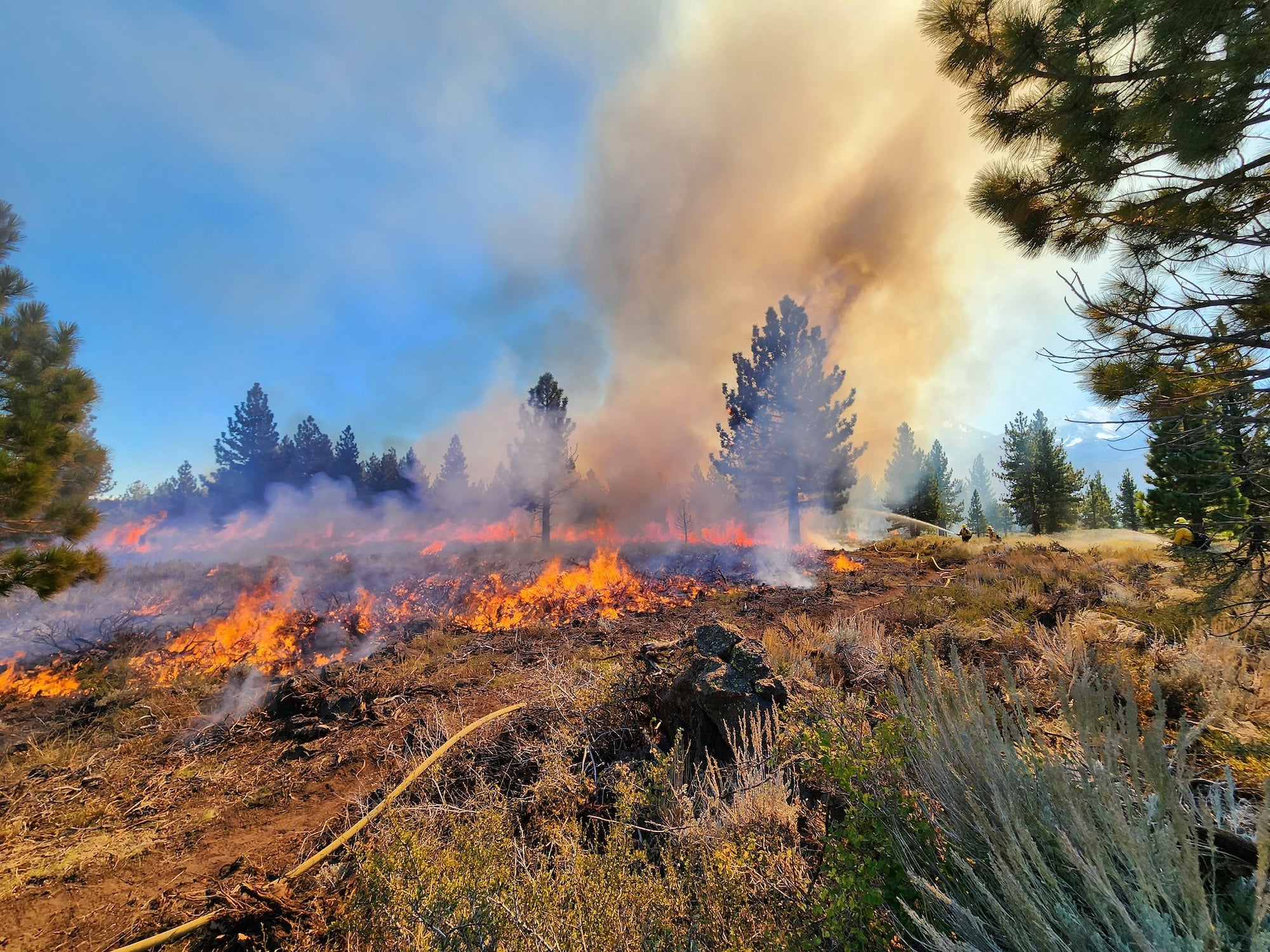
Fires were more than 13 percentage points less likely to continue spreading after reaching a treatment area. Treatments were especially effective at reducing high-severity fire — those that kill more than 75% of the tree canopy — lowering burned area by 20% to 35%.
Prescribed burning was significantly more effective than mechanical thinning alone at limiting wildfire spread. Treatment size also mattered: landscape-scale treatments larger than 2,400 acres were the most effective at reducing wildfire spread.
Investments pay off
Across the fires studied, fuel treatments reduced total burned area by 36%, or about 152,000 acres, relative to a scenario without treatments. They also prevented the loss of more than 4,000 buildings, avoided the release of 2.7 million tons of CO2, reduced 25,757 tons of fine particle pollution and prevented an estimated 59 premature deaths.
Together, these avoided damages totaled about $2.8 billion, including:
- $895 million from avoided structure loss
- $503 million from reduced CO2 emissions
- $1.39 billion from avoided health impacts and productivity losses linked to smoke pollution
Strabo said the findings underscore the importance of investing more in preventive forest management.
“Wildfire policy has historically focused on suppression, but our results suggest greater investment in prevention could substantially reduce wildfire damages,” said Strabo. “That will become even more important as the climate continues to change and forests face more large wildfires and other disturbances.”
The research was supported by the Giannini Foundation for Agricultural Economics and the USDA Forest Service.
Other authors include Matthew N. Reimer with UC Davis and Calvin Bryan with the Department of Economics at Washington and Lee University.
See also
https://www.rff.org/publications/working-papers/the-economics-of-forest-fuel-removals-on-federal-lands/
Why CalDavis and not USFS DOING the research?
Thanks, Ann!
Compare the conclusion “bundling small amounts of sawtimber harvest with treatments is capable of dramatically expanding treatable area.”
To: “Tall living trees are good IMHO.” (Sharon) And they resist burning so shouldn’t be a focus of fuel reduction.
Jon, sometimes you need to thin some tall living trees to make conditions more likely that other tall living trees will survive. Some of these tall living trees to be removed are commercial, depending on their size and proximity to places who want to buy them be they sawmills, bioenergy, firewood, house logs or whatever. Maybe that’s not the case in Montana, but it is in more arid regions.
“sometimes you need to thin some tall living trees to make conditions more likely that other tall living trees will survive.”
My point has been that the burden should be on the agency to justify a treatment based on the ecological needs of the site (AKA “forest health?”), not based on revenue or helping pay for the treatment. And that I am skeptical of the value of killing large trees to reduce the risk of other large trees dying from an event that may never occur (research?).
I am less skeptical about a situation where abnormal and expected persistent drought requires fewer large trees to protect the whole stand. But I would still ask for evidence of that need for a particular stand (and it should involve climate change considerations).