If you listened to The Hotshot Wakeup Fennessey interview, Fennessey talked about the shortage of what he called “middle managers”:
I’m trying to approach this thing kind of from a balanced perspective. And I’m told at our first IMT meeting that, no, you know what, Chief? No, there are contract resources available. And the limiting factors is this middle management. Like middle management? Now middle management means something different depending on I know it does in the structural world and it does. I say, well, what do you mean middle management? Well, you know, there’s folks at the task force leader level and they’re describing this, that we, the government, have a gap there. And that, you know, these are the folks that go out with some of the contract crews or whatever to make sure that, you know, they’re complying or that there’s safeties in whatever it may be. And there’s a bunch of resources available, but we don’t have the ability To put middle managers on it. Some of it because we train them and then very quickly they get moved up to strike team leader or some other thing.
I’m like, well, whoa, that’s news to me. So there are hundreds, perhaps thousands of contractors that could be doing this work, but they’re not doing it because we are the limiting factor. You know, fast forward to Washington. Before we got to Washington, again, Chief Fisher and I Meeting with the Army Colonel out of Pentagon, he comes to visit NIFC and myself and Russ Long from the force. Russ is managing that program. Amazing. Russ Long is an amazing individual, great firefighter. Anyways, he introduces folks and they’re getting near the end of their 30-day mission. And he says something to the effect that, you know, If things were to keep on, we probably could come up with another battalion. And I think a battalion is 240. I don’t know. It’s a lot of people. But it doesn’t sound like you guys have the ability. Basically, you talk about middle managers to manage that. And I think we saw weather on the horizon.
So it wasn’t like, but it’s twice now that I’m hearing, wait a minute, there’s a limitation here that I was unaware of. And, you know, I’ve looked at Sarah (Fisher, of the Forest Service) and she’s looked at me and said, we got to do something about this. I don’t know that it’s, publicly tolerable to be able to say that there are resources available, but we, the government, do not have the qualified people in place to take care of it. Now, I say that, I take a big risk in saying that because, again, I’m somewhat the new guy.
THE STORY OF TWO FIRES: HOW AMERICA LEARNED TO IMPORT WILDFIRE CAPACITY—AT WHAT PRICE?
We have become remarkably adept at delivering the workforce—and the funding—after the crisis begins. RSR gives us the opportunity to build the solution before the fire comes.
So what are we waiting for?
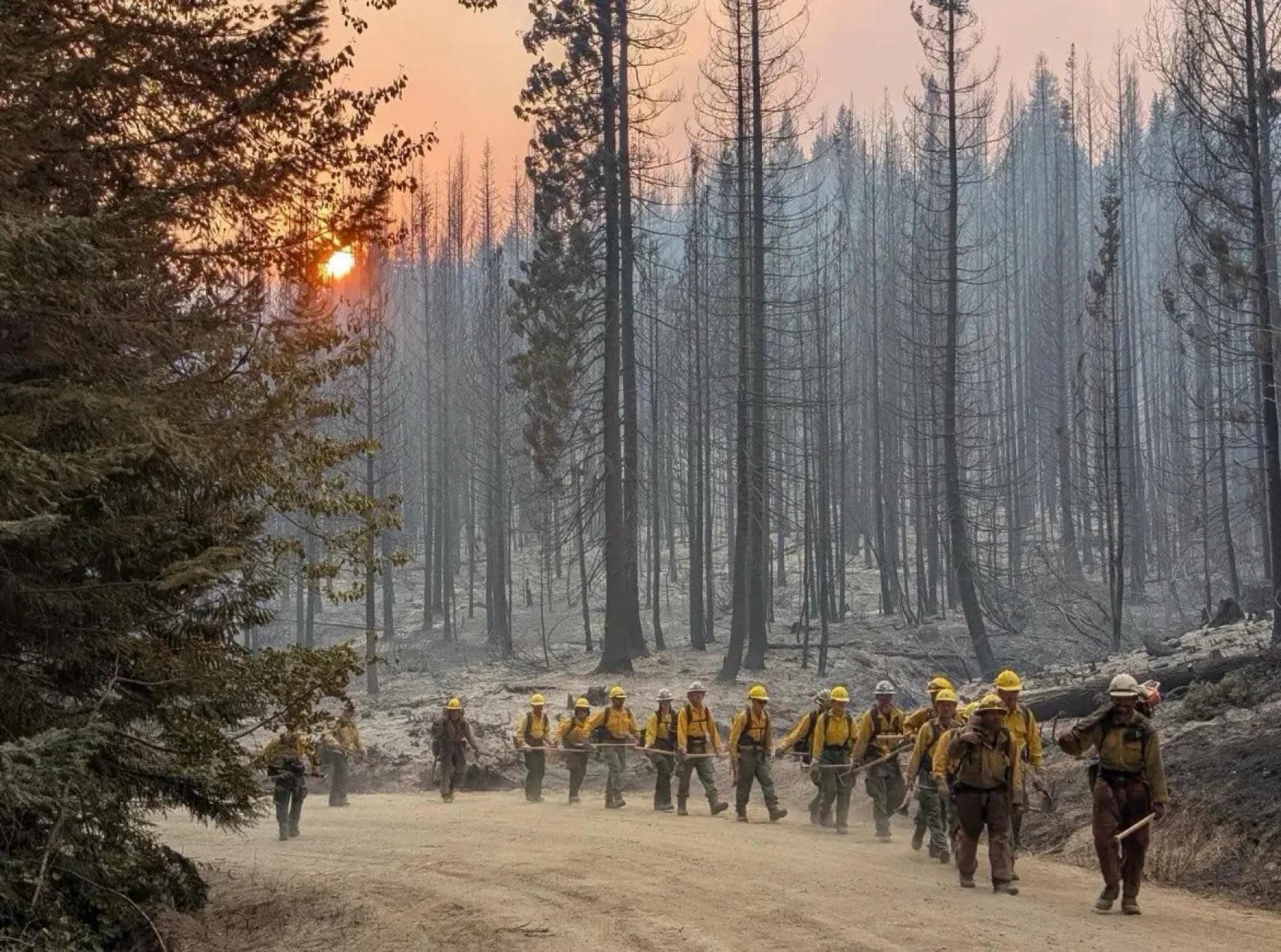
THE STORY OF TWO FIRES: HOW AMERICA LEARNED TO IMPORT WILDFIRE CAPACITY—AT WHAT PRICE?
We have become remarkably adept at delivering the workforce—and the funding—after the crisis begins. RSR gives us the opportunity to build the solution before the fire comes.
So what are we waiting for?
If anyone wants to understand America’s wildfire workforce equation in crisis, look at two fires burning this summer in Washington and Oregon.
Lightning started Washington’s Little Giant Fire July 15 in the Okanogan-Wenatchee National Forest. By September 17, it had grown to 172,814 acres, one of the largest fires of Washington’s tempestuous 2026 season. Little Giant required an extraordinary mobilization: the National Interagency Fire Center deployed approximately 250 active-duty soldiers from Joint Base Lewis-McChord to support wildfire suppression, with the soldiers moving to Little Giant on August 20.
And Little Giant was only part of the problem. Oregon’s Rowe Creek Complex ultimately reached 373,927 acres. Put the two together and the scale comes into focus: two states, two enormous incidents, 546,741 acres within their fire footprints, and thousands of people mobilized—crews, engines, aircraft, heavy equipment, incident management teams and military personnel. Some are coming from farther and farther away.
Moving the Shortage
This summer the United States requested wildfire assistance from Australia and New Zealand. The first contingent brought 74 fire-management specialists, including a 15-person Incident Management Team. A second wave brought another 240 specialists, for a total of 314 assigned across the Northwest and Great Basin.
These are not bargain-basement firefighters brought in because America can find cheaper labor overseas. They are experienced professionals, and they are coming because America needs their qualifications. Mutual aid is fundamental to wildfire response: a quiet region helps a busy one, states help one another, and America’s international partners help us—as we help them.
That system saves lives. The question is why, year after year, we have to call for reinforcements as though adequate fireline staffing can be delivered on demand.
There is a significant difference between mutual aid providing surge capacity during an extraordinary emergency and a system becoming dependent upon moving scarce qualifications around the country—and eventually around the world—to fill predictable gaps. We have become remarkably adept at moving the shortage. Perhaps it is time we became equally serious about fixing it.
The Real Shortage
Because the shortage isn’t simply firefighters. America does not merely have a firefighter shortage. We have a qualification and command deficit.
Anyone who has spent a career in wildland fire understands the distinction. We can hire seasonal firefighters, buy engines, contract aircraft and deploy sophisticated technology. But none of it substitutes for qualified people who can lead firefighters, supervise equipment, manage divisions, run operations and command complex incidents.
Those people cannot be manufactured during an emergency. A beginning firefighter does not become a crew boss overnight, and a crew boss does not suddenly become a division supervisor, operations chief or incident commander. The profession is built upon qualifications, field experience, mentorship and judgment accumulated over years. When that pipeline becomes too thin, crews cannot deploy without qualified supervision, equipment may lack people qualified to lead it, and technology cannot substitute for command.
A fire engine without a qualified leader is a parked fire engine. In the middle of a wildfire emergency, it might as well be in the boneyard.
Qualifications Travel. Local Knowledge Does Not
There is another part of this equation those who fight wildfire understand instinctively: qualifications travel; local knowledge does not. A firefighter arriving from another state may be superbly qualified. An Australian incident manager may bring decades of experience. But neither arrives carrying intimate knowledge of a Washington drainage network or an Oregon backroad system—the prevailing winds, communications dead zones, escape routes, water sources or peculiarities of a particular piece of Western terrain.
That is not an argument against mutual aid, but a strong case for maintaining a deeper regional bench in the American West.
And that brings us back to Oregon. While America spends astronomical sums delivering wildfire capacity after fires begin, a project designed to build that capacity before the next fire has spent nearly eight years trying to cross the funding finish line.
Build the Bench
The Rogue Siskiyou Regional Wildfire Training Center—RSR—is not simply an Oregon project. It is potentially part of the larger answer to a Western workforce crisis.
RSR has organized as a nonprofit, secured a 31.5-acre former lumber-mill site near Gold Beach, completed environmental and planning work, acquired equipment and generated millions in regional support. At full capacity, it is designed to train approximately 1,600 people annually, building a professional pipeline from entry-level training through crew leadership, supervision, operations, management and ultimately command.
And those people do not belong to Gold Beach. They become part of a much larger Western wildfire workforce. They can fight fire in Oregon, reinforce Washington or deploy elsewhere as national mobilization requires. The point is not to eliminate movement between states; it is to build a deeper reservoir of qualified Western personnel from which the mutual-aid system can draw.
By incorporating hazardous-fuels reduction, forest restoration and other off-season land-management work, RSR offers more than seasonal training. It offers year-round workforce development, accumulated experience and professional advancement—the things required to produce tomorrow’s supervisors, operations leaders and commanders.
And then We Come to the Money
Here is where America’s wildfire workforce equation becomes very difficult to explain.
Rowe Creek ultimately burned 373,927 acres, with its last reported estimated suppression cost reaching approximately $120.7 million—or about $323 per acre.
Then there is Little Giant. As of September 17, the fire had reached 172,814 acres, with estimated suppression costs of approximately $162.7 million—about $941 per acre.
Two fires. 546,741 acres. Approximately $283.4 million spent fighting them.
Now put another number beside that: $37 million.
That is the current estimated capital cost of building the entire RSR facility—a permanent investment with the capacity to train approximately 1,500 wildfire professionals every year, from entry-level firefighters through crew leadership, supervision, operations, management and command.
In other words, the estimated suppression cost of these two fires alone is more than seven and a half times the projected cost of building RSR.
Nobody is suggesting that a training center would have prevented Little Giant or Rowe Creek, or that $37 million invested in training infrastructure would make catastrophic wildfire—or the enormous expense of fighting it—disappear. That isn’t the comparison. The comparison is between what America is willing to spend reactively once fires become major incidents, and what we struggle to invest proactively in permanent capacity before the fire comes, as it inevitably will.
We will spend hundreds of millions fighting major fires, move firefighters across the continent, activate the military, fly highly qualified wildfire specialists across the Pacific, and sustain enormous incident organizations for weeks or months. And then we struggle to assemble $37 million for permanent infrastructure capable of building the very workforce and leadership capacity we are scrambling to find.
There is something fundamentally backwards about that equation.
Where is the Capacity, Continuity and Will to Put Out the Fire?
The West does not need new ways to put more fire on the land, more symposiums explaining that wildfire is a problem, or repeated reminders that the workforce is strained. The people running these fires already know. What they need is capacity, continuity and experience—and the institutional will to build and sustain them. Above all, they need command: command that will “first put out the fire.”
RSR is not an alternative to America’s mutual-aid system. Quite the opposite. Build RSR so mutual aid can remain what it was intended to be: surge capacity—not a recurring answer to predictable workforce and qualification shortages.
Because we are already paying for the shortage—in aircraft hours and engine miles, mobilization and demobilization, military deployments, and personnel moved thousands of miles from one incident to another. We pay for it when experienced wildfire professionals must be flown across an ocean because our own system needs their qualifications. Above all, we pay when there simply aren’t enough experienced people available where and when they are needed.
We are living inside the hole created by yesterday’s failures.
Little Giant and Rowe Creek reveal the same underlying problem: the people fighting these fires need a deeper bench behind them. The national mobilization system is telling us what it needs, and the fires are telling us what it costs when that capacity falls short. Meanwhile, in southern Oregon, a project specifically designed to build that capacity is waiting—strengthening the national system while putting trained personnel and rapid-response capacity closer to the communities that need them.
The Choice: Fish or Cut Bait
At what point does delay become prevarication—a choice without accountability for the staggering consequences to the beautiful landscapes of Chelan County, Washington, now laid waste at enormous cost to taxpayers?
Failure to fund RSR is not the absence of a decision. It is a decision to continue paying for the shortage instead of building the capacity to fix it.
Government has developed an insanely expensive habit of using our taxpayer dollars without limit once disaster arrives, while becoming skittish about investing a fraction of that amount to build readiness before the fire comes.
That equation has to change, before there is nothing left to burn.
Build the workforce. Build the leadership. Build the command capacity.
If we are serious about wildfire readiness, build RSR. Now.
The National Wildfire Alliance has formalized a partnership with the Rogue Siskiyou Regional Wildfire Training Center to support and advance RSR as a regional wildfire workforce and command-capacity resource.
The National Wildfire Alliance is a nonprofit public-interest organization working to improve wildfire policy, forest stewardship, suppression effectiveness, public accountability and regional firefighting capacity. NWA brings together wildfire professionals, researchers, landowners and public advocates to advance practical solutions that protect forests, communities and the people who defend them.
Dana Tibbitts is an author and investigative journalist specializing in wildfire risk, evacuation safety, and government accountability. She is co-founder with her husband of the Tahoe East Shore Alliance and serves on the Board of the National Wildfire Alliance. Dana is also co-author of Harnessing the Sky.
Sources
National Interagency Fire Center, “National Fire News,” August 26 and August 31, 2026. National Preparedness Level 5; national incident and personnel statistics.
National Interagency Fire Center, “Military Support,” updated August 31, 2026. Active-duty U.S. Army support from Joint Base Lewis-McChord and deployment to the Little Giant Fire.
Central Oregon Fire Information, “Rowe Creek Complex / August 15, 2026.” Official acreage 373,784; 1,318 personnel; 89% containment.
Oregon State Fire Marshal, “Oregon State Fire Marshal resources demobilize from Rowe Creek Complex as containment reaches 89 percent,” August 18, 2026.
National Interagency Fire Center, “International Support — 2026 Australia and New Zealand mobilization.” 74-person first contingent, including a 15-person Incident Management Team; 240-person second wave; Northwest and Great Basin assignments.
Washington State Standard / Oregon Public Broadcasting, “Cost to battle 20 wildfires in Washington has topped $200M,” August 19, 2026. Washington DNR data showing $207 million in firefighting costs for 20 fires in roughly one month.
RSR project materials supplied by the author: site, project history, training-capacity model and current estimated $37 million capital cost.
PNW Roads, https://pnwroads.com/incident.php?id=15890