New Wild Turkey Federation Agreement with USFS

Apologies if someone posted about this already…. Link is here.

Amidst the increasing threat of wildfires, the USDA Forest Service has taken a proactive stance by implementing the comprehensive 10-year Wildfire Crisis Strategy designed to confront the crisis in areas posing the most immediate threats to communities. The NWTF, with a longstanding history of partnering with the Forest Service on stewardship projects nationwide, recognizes the urgency of addressing western landscape issues and fully supports the Wildfire Crisis Strategy.

The Participating Agreement enables the NWTF to enhance its support for this critical initiative by providing funding for new positions dedicated to supporting the implementation of the Master Stewardship Agreement. Funding for this agreement comes entirely from federal dollars authorized in the Bipartisan Infrastructure Law and the Inflation Reduction Act. This includes covering expenses such as personnel costs, including travel, and supporting essential meetings like Partner Coordination Meetings and Industry Coordination Meetings to foster effective communication and collaboration among stakeholders.

Currently, the NWTF has two key staff positions dedicated to implementing the Master Stewardship Agreement under the Wildfire Crisis Strategy, a Wildfire Crisis Manager and a Regional Wildfire Crisis Coordinator.


Homes Lost to Wildfire: It’s the Grass

CNN story:

Over the last three decades, the number of US homes destroyed by wildfire has more than doubled as fires burn bigger and badder, a recent study found. Most of those homes were burned not by forest fires, but by fires racing through grass and shrubs.

The West is most at risk, the study found, where more than two-thirds of the homes burned over the last 30 years were located. Of those, nearly 80% were burned in grass and shrub fires.

Old Growth: How Much is Enough? — 4 Responses

Back in November,  I posted “Old Growth: How Much is Enough?” with a link to the Dovetail Partners report of the same title. (Only 2 comments on TSW.)

Now Dovetail has posted 4 “guest responses” to the report. The group explains:

In November 2023, Dovetail Partners released a report titled, “Old growth forests: How much is enough?”. In the report, we explored the different definitions of “old growth” applied globally and in regions of North America and Europe, including their scientific basis. The report considered why we need old growth forests, and conversely, why we do not, and included a discussion of old growth forest protection and management. We concluded with a discussion how much old growth is ‘enough’, how we can create more, and how our understanding of the relationship between people and forests is evolving.

We asked the following individuals to respond to the report, “Old growth forests: How much is enough?”, and compiled their feedback into one document.

Marcella Windmuller-Campione
Marcella is an Associate Professor with the Department of Forest Resources at the University of Minnesota.

Dr. Alexander Evans, Forest Stewards Guild
As an Executive Director, Zander focuses on building partnerships, promoting sound policy, and supporting on-the-ground implementation of ecological forestry. He has a PhD from the Yale School of Forestry and Environmental Studies and worked as a cartographer and spatial analyst with the US Geological Survey.

Dave Atkins
Dave is a Family Forest Owner and President of the Montana Forest Owners Association; he is one of the authors of the Mass Timber Report.

Joseph Vaughn, CF
Joseph is a Key Account Manager at NCX and has a deep rooted passion for sustainable forest management.

Outdoor Life Magazine Looks at MOG

Nick Smith has this in his Healthy Forests, Healthy Communities email today. Interesting that it’s from Outdoor Life, which says it “has been the go-to publication of America’s diehard hunters, shooters, and anglers since 1898. Our stories are written by hunters, for hunters. We value experience in the field, at the range, and on the water above all else. Our mission is to deliver stories about success in the field, cutting-edge gear, and adventures in far-off wildernesses and close-to-home woodlots. We inspire America’s outdoorsmen and women to chase the critters they’re passionate about and fight for the wild places they love.”

Here’s Why No One Can Agree on How to Manage America’s Old Growth Forests

The Biden administration’s plan to climate-proof old growth and mature forests generates mixed opinions from the conservation community

PNW Forest Plan Revision Update and LSR Trends

The USFS press release today: “The initial comment period for the USDA Forest Service’s Northwest Forest Plan concluded Feb. 2. The Forest Service had been accepting comments on a Notice of Intent that the Agency will prepare an Environmental Impact Statement to evaluate the effects of proposed amendments to the Northwest Forest Plan.” Info here.

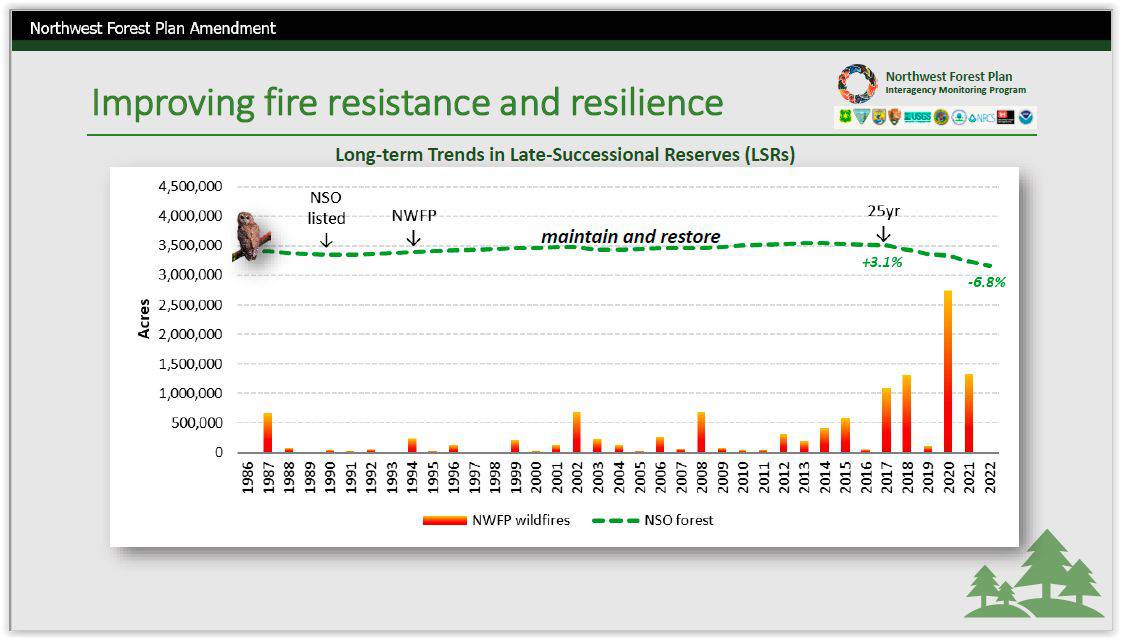
There’s an interesting Powerpoint presentation here, “Information Winter Webinar, January 2024.” Lots of stats and trends. This slide, for example, on LSR trends. Steady until recent wildfires.

This is compelling evidence that simply setting aside older forests with little or no active management is a losing proposition.


Forest Service warns of budget cuts ahead of a risky wildfire season

From The Conversation: “Forest Service warns of budget cuts ahead of a risky wildfire season – what that means for safety.” By a pair of professors from Colorado State University. Excerpt:

Staffing is still a concern

Doing this work requires staff, and the Forest Service’s challenges in recruiting and retaining qualified firefighters may hinder its ability to accomplish all of its objectives.

In 2023, over 18,000 people were employed as federal wildland firefighters. While the Forest Service and Department of the Interior have not specified precise staffing targets, Moore has mentioned that “some crews have roughly half the staff they need.”

A recent Government Accountability Office report found that low wages and poor work-life balance, among other challenges, were barriers commonly cited by federal firefighting employees. The government boosted firefighters’ pay in 2021, but that increase is set to expire unless Congress votes to make it permanent. So far, firefighters have kept the same level of pay each time Congress pushed back acting on the 2024 budget, but it’s a precarious position.

The agency has started many initiatives to recruit and retain permanent employees, but it is too early to assess the results. A recent study involving one of us, Jude Bayham, found that highly qualified firefighters were more likely to remain with the agency after active seasons, during which they earn more money.

Where Will We Put All the Powerline Corridors?

This article may be of interest from Smokey Wire folks….

Explore this gift article from The New York Times. You can read it for free without a subscription.

The Planet Needs Solar Power. Can We Build It Without Harming Nature?

Today’s decisions about how and where to set up new energy projects will reverberate for generations.

https://www.nytimes.com/interactive/2024/02/11/climate/climate-change-wildlife-solar.html?unlocked_article_code=1.U00.n-mx.vSGlqqnyJPuL&smid=em-share

Some perspective: I live about 250 yards from a Bonneville Power Administration power line corridor that runs from The Dalles, Oregon, to Troutdale, known as Big Eddy–Troutdale No. 1. The corridor cuts across the Mt. Hood National Forest and a bit of private land for about 43 miles (measured via Google Earth Pro). Most of corridor was cleared of timber when it was built in the 1950s; these days, BPA crews regularly cut seedlings and shrubs and/or use herbicides on the brush before it grows tall enough to interfere with the lines. At roughly 375 feet wide, this section of the corridor is essentially a clearcut that covers about three square miles.

This article reports that, according to a National Renewable Energy Laboratory 100% clean electricity study, 91,000 miles of new high voltage interregional transmission lines are needed by 2035 to carry “affordable, reliable clean energy.”

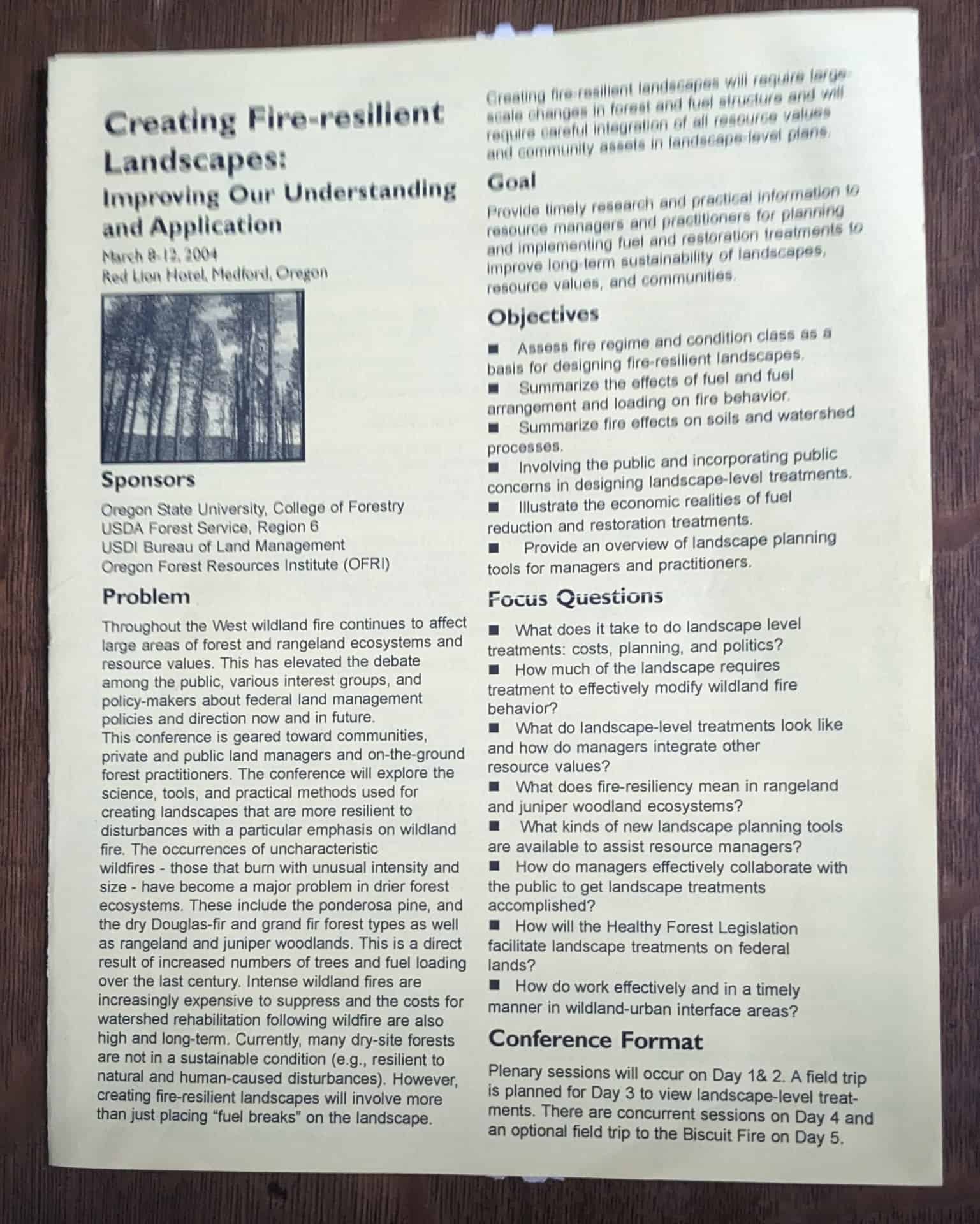
Creating Fire-resilient Landscapes 2004

Rainy day, so I’m cleaning out my office — I do so every decade or so. Found a flier for a 2004 conference in Medord, OR, sponsored by OSU’s College of Forestry: “Creating Fire-resilient Landscapes: Improving Our Understanding and Application.” A decade later, we’re still working on it….

James Burchfield: A view from inside forest collaborative groups

Thanks to Nick Smith of Healthy Forests, Healthy Communities for including this item from The Missoulian in today’s email list….

GUEST VIEW
James Burchfield: A view from inside forest collaborative groups

I applaud the Missoulian for publishing various views on forest management and the role of citizen-driven forest collaborative groups in decisions regarding public lands.

With the wide-ranging disruptions of climate change, forward looking, science-based management of our forests will be critical in sustaining social and environmental health. Yet too often characterizations of collaborative groups by Missoulian contributors miss the mark, erroneously claiming that these voluntary associations are captured by profit-driven representatives of timber industry to advance exploitation of forests at the expense of other values.

For the past 13 years, I have been a participant in the Lolo Restoration Committee and the Southwest Crown of the Continent Collaborative. I have found them to be steadfastly independent, thoughtful, and focused on outcomes that will benefit forests for the long term. Each of these groups has a written charter that identifies principles of inclusion, diverse representation, deliberation, and fairness.

In each, federal or state land management agency representatives are encouraged to join our meetings but are enjoined from voting on the group’s recommendations, which are typically generated through consensus. These and other collaborative groups convene their own meetings, design their own agendas, and are beholden to no one other than themselves.

The power of these groups is their creativity, as the collision of different points of view and respectful deliberation leads to original ideas and approaches to highly complex, contextually dependent problems within the forest. There has never been an occasion where timber industry has possessed singular influence.

Collaborative groups contain people expressing powerful conservation ideals as well as advocates for environmental protection. A large proportion of participants are retired natural resource management professionals with ample experience in wildlife management, recreation, wilderness management, and public lands administration.

In fact, on multiple occasions the two groups with which I have been involved have struggled to sustain representation from timber industry, since the demands on industry staff can be extreme.

Put simply, the assertion that collaborative groups are captured by timber industry is false.

Sadly, there are individuals and organizations that prefer complaining about collaborative groups rather than joining a group and doing the difficult work of examining potential forest management decisions or resource protection measures.

Along with my fellow collaborative group participants, I have tried to encourage diverse voices to join groups so we can listen to their ideas and incorporate their views. I believe that those who criticize collaborative groups have legitimate concerns and have an honest desire, like the members of collaborative groups, to protect forests so they can provide the remarkable environmental services on which we all depend.

I hope these critics have a change of heart, join a group, and use their influence to help shape better decisions.

The energy behind collaborative groups emerges from a strong American tradition that allows voices with local knowledge to reflect and consider how public issues within their everyday lives might be addressed. This does not mean that these local voices will carry the day, but only that they be heard. There may be larger scale interests or other critical factors that lead to decisions that may not adhere to local demands. Every collaborative group recognizes that their recommendations are simply one set of suggestions across the spectrum of public engagement.

In the case of national forests, the responsible officials rightly make the final decisions on these forests. The significant contributions made by collaborative groups are the original, often well-grounded thoughts and observations that can lead to better plans and actions.

In a world where we feel like we are often victims of forces beyond our control, collaborative groups offer a refreshing opportunity to work together for the common good.
Northwest Forest Plan Amendment Comment Period Correction & Upcoming Webinars

FYI… USFS PR today….

A correction has been issued to extend the comment period to February 2, 2024, for the USDA Forest Service published Notice of Intent (NOI) to prepare an Environmental Impact Statement on the proposal to amend the 17 land management plans of the Northwest Forest Plan (NWFP) that provides direction for the management of those national forests and grasslands.   The Federal Register notice with the correction can be found here.

The Notice of Intent identifies changed conditions that are driving the need to amend the plan. The Forest Service is focusing on five key areas:  wildfire resilience, climate change adaptation, tribal inclusion, sustainable communities, and conservation of old growth ecosystems and related biodiversity. Amending or otherwise strengthening the effectiveness of the Northwest Forest Plan can incorporate the latest science and help forests adapt to social, economic, cultural, and ecological changes. The Forest Service intends to preserve the elements of the plan that are working well.

Upcoming webinars have been planned to share more information about the Northwest Forest Plan and the Notice of Intent.  Please join us this month for one of our Informational Winter Webinars scheduled for you to learn more about the Northwest Forest Plan, the current amendment effort and how to provide comments to the Forest Service.  All webinars will provide the same presentation but offer a choice of different days and times to accommodate schedules. There will be limited time for questions and unofficial feedback.  We anticipate principally being able to respond to basic questions about the commenting process.  Feedback shared at these webinars will not be considered official comments for purposes of standing to file objections. Formal comments must be submitted electronically via our comment page by February 2, 2024. While we strongly prefer submission to our comment page, hard copy letters may be also be submitted to the following address: Regional Forester, Region 6, U.S. Forest Service, Attn: Northwest Forest Plan Comments, 1220 SW 3rd Ave., Portland, OR, 97204.

An additional official comment period will also follow the draft Environmental Impact Statement, currently estimated to be available by summer of 2024.

Note: Because the NWFP is a landscape-scale plan covering 24 million acres, the amendment and webinars will not be addressing things such recreation, hunting, grazing or permits or other forest-specific uses.   Select the webinar that works best for you to register for the access link.

January Informational Winter Webinars:

February’s Virtual Open House will provide an additional opportunity to learn about the Northwest Forest Plan Amendment and offer more time for questions of a panel of agency staff working on the amendment.

February Virtual Open House: Thurs, Feb 8, 5-7pm, Join Feb 8 Open House


Continue to stay updated on the progress and additional information about the Northwest Forest Plan Amendment: https://www.fs.usda.gov/goto/r6/nwfp

The Northwest Forest Plan covers 24.5 million acres of federally managed lands in western Oregon and Washington, and northwestern California. It was established in 1994 to address threats to threatened and endangered species while also contributing to social and economic sustainability in the region. After nearly 30 years, the Northwest Forest Plan needs to be updated to accommodate changed ecological and social conditions.