Timber Wars Peace Breaking Out in John Day, Oregon: New York Times Op-ed

Thanks to Bob Sproul for finding this New York Times story about Susan Jane Brown and efforts to reach consensus around logging on the Malheur National Forest by Nichols Kristof. Since it’s so relevant, I’m posting the entire piece. I do like the idea that our humble forest work could “offer lessons for a divided country.” It’s also interesting that this is posted as an opinion, while other pieces, which seem similar to me (interviews with people supplemented by statistics), are counted as news stories. The comments are also interesting; I see some from three hours ago, but it says they are now closed. Susan Jane Brown, member of our own TSW community, plays a prominent (and dare I say heroic) role in the story.

April 10, 2021
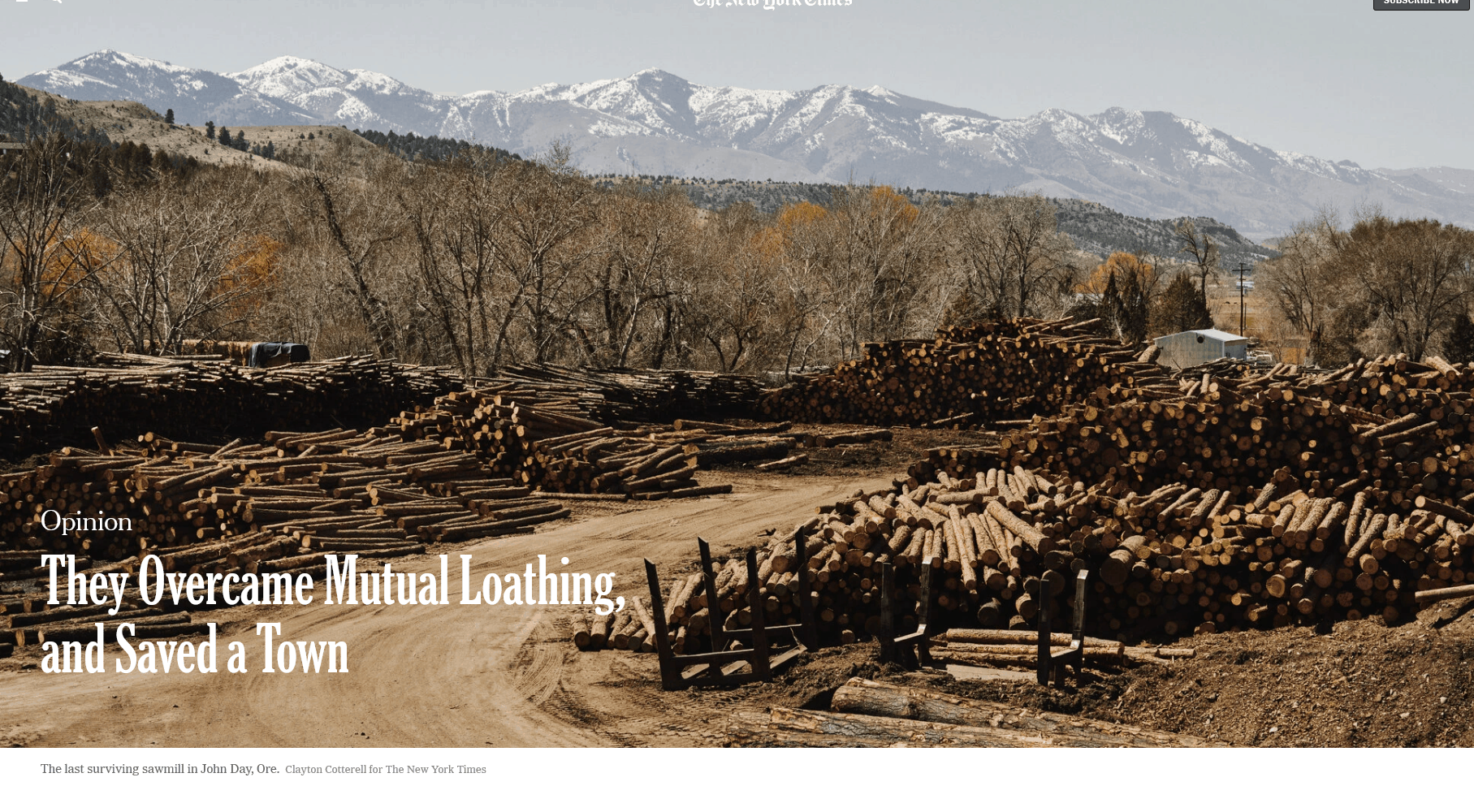
JOHN DAY, Ore. — One of the most venomous battles in our polarized nation is the one that has unfolded between loggers and environmentalists in timber towns like this one in the snow-capped Blue Mountains of Eastern Oregon.

Yet, astonishingly, peace has broken out here. Loggers and tree-huggers who once loathed and feared each other have learned to hold their noses and cooperate — and this may have saved the town. It may also offer lessons for a divided country.

The timber industry, by far the biggest employer in John Day, survives here only because environmentalists led by Susan Jane Brown, a Portland lawyer, fought to save these workers’ jobs by keeping chain saws active. John Shelk, who owns the town’s sawmill, and might be expected to eat environmental lawyers for breakfast, says simply, “Susan Jane is my hero.”

This collaboration between environmentalists and loggers is often grumpy, incomplete and precarious, but it’s also inspiring. It offers America a model of a process to sit down with antagonists, seek common ground, register progress (punctuated with eye rolls and moans) and knit this country back together.

The timber peace process began in 2003 at a bitter meeting over forest policy. Loggers were furious at Brown for having halted logging in local national forests by suing to protect species like woodpeckers and redband trout and by tying the U.S. Forest Service in procedural knots — but they were also desperate to save their livelihoods. A delegation of burly woodsmen approached Brown, who is 5-foot-2, and invited her to go out into the forest with them.

“My life flashed before my eyes,” Brown told me. But she took a deep breath, overcame her fears and eventually spent three days with the loggers (she brought a very large friend as a bodyguard), visiting forests and arguing about whether trees should be cut.

“It was very tense,” she remembered. But while the two sides didn’t agree, each was surprised to find the other not entirely diabolical.

“We thought, ‘Well, we haven’t killed each other, so maybe we should keep talking and let’s see what happens,’” she said. In 2006 they formalized the dialogue by naming it Blue Mountains Forest Partners.

The word “partners,” though, was mostly aspirational. The timber industry was collapsing, with a 90 percent plunge in the harvest from national forests in Oregon between the 1980s and the 2000s. Workers were losing well-paying jobs and in some places the human toll was catastrophic. I wrote recently about an Oregon friend of mine, Mike Stepp, whose life disintegrated into homelessness and early death when he couldn’t follow his dad into a good sawmill or factory job. Brown says that back when she started to talk with the loggers she didn’t really think of the human cost.

“My attitude was, ‘You deserved it,’” she said. “‘You cut down all the old growth.’”

John Day reciprocated the hostility. The area was already deeply conservative — it had voted overwhelmingly to withdraw from the United Nations — and the closure of two of its three sawmills left people fearful and furious.

Then, with almost no new logs coming in, Shelk announced that he would have to close the last sawmill, just as he had already closed his two other sawmills in Eastern Oregon. The entire town was teetering.

Yet this was also a crisis for environmentalists. In their meetings with the foresters, Brown and her colleagues had gradually been persuaded that some logging was necessary to make the forests healthy again.

That’s because nearby forests were dangerously overgrown. For thousands of years, fires had burned the forests every decade or so, clearing out the underbrush but not harming large trees. Decades of fire suppression had ended that natural balance, leaving the forests full of tinder just when climate change was also making them drier and hotter.

“This is not natural,” Pam Hardy, who works with Brown at the Western Environmental Law Center, told me as we walked through a national forest full of saplings and brush west of John Day. If a fire broke out in a place like this, she explained, there was so much fuel that the fire would burn hot and incinerate everything — destroying forests, rather than keeping them healthy.

The best hope to revive the forests, Hardy and Brown concluded, was to hire loggers to clear out small trees — and that meant there had to be a sawmill to take the logs. “I need the mill,” Brown explained.

So the environmentalists and loggers joined forces. With the help of Senator Ron Wyden, an Oregon Democrat, they won a 10-year stewardship contract to subsidize forest thinning and restoration of the traditional landscape, and this saved the mill and kept the town alive.

“Without her, we wouldn’t be,” said Mark Webb, a county commissioner. “It’s as simple as that.”

Yet this kind of cooperation is brutally difficult. Small logs are less profitable for the sawmill than large ones, and many people on all sides see those participating in the dialogue as sellouts.

Webb, who has a Ph.D in philosophy but was drawn to rural spaces, joined the forestry collaborative, as the process is called, but instead of being rewarded for saving the mill, he was defeated in his re-election bid. Hardy was nudged out of another environmental organization for her openness to logging to reduce fire danger. And Shelk, the owner of the mill and an active member of the collaborative, says, “I’m kind of an outcast in the timber industry.”

There are other forest collaboratives around Oregon that are also trying to sustain dialogue between loggers and environmentalists, with varying degrees of success and frustration. In John Day, the group is tussling over how much salvage logging to allow after forest fires, and how many roads should be allowed in the national forests. But members are making progress, and Brown has built a weekend home in John Day.

What advice do they offer for bridging hostilities and creating a peace process? A starting point is finding people from each side who are equipped with humility and empathy. Then when disputes arise, both sides need to agree to defer to science — and if the science doesn’t exist, then to conduct experiments to gather evidence. They say it doesn’t hurt if after meetings everyone relaxes over dinner together.

“It helps to have alcohol, and it helps to have food,” Brown said.

I normally cover people who are exchanging insults, occasionally gunfire. So there’s something exhilarating about being in Brown’s home in John Day, with loggers and environmental lawyers arguing amiably around a dinner table, antagonists who have also become friends.

They roll their eyes in fond exasperation at things the others say, and across town, because of them, the sawmill is still spitting out boards and keeping John Day humming. Maybe there’s something the rest of the country can learn from this handful of sellouts who saved a town.
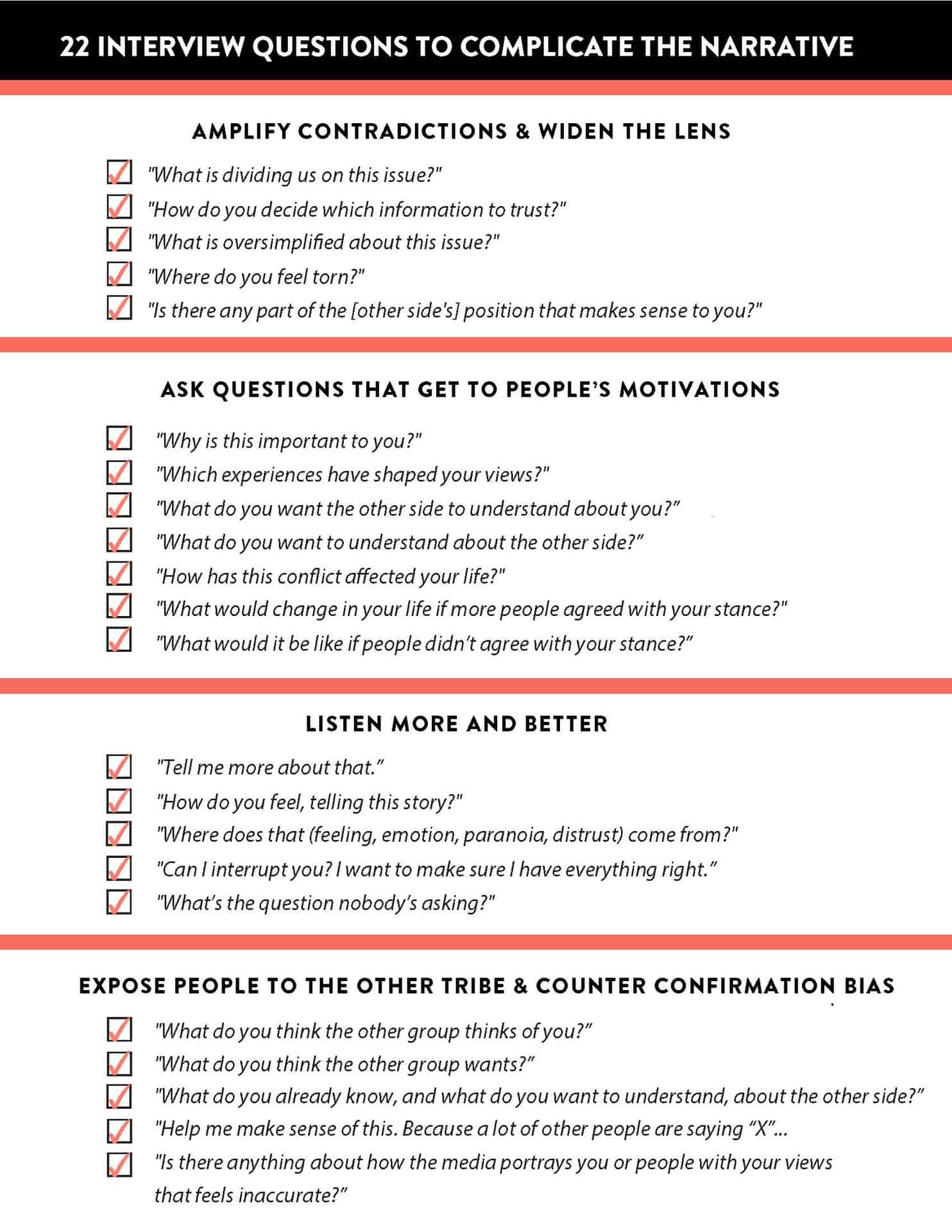
EPA Files Objection on BLM Decision?

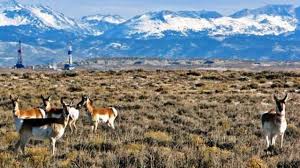
Pronghorn seen here graze near natural gas operations in the Upper Green River Basin of Wyoming. Credit: Jeff Burrell, Wyoming Conservation Society
I ran across this story today in Wyofile. It brought back memories of disagreements about BLM’s air quality models as discussed by lawyers and judges during FS/BLM litigation. According to this story, EPA objected to a BLM decision. Isn’t there some kind of interagency disagreement resolution method other than objecting? I’m not sure I’ve seen that within the federal government, is this something new? Can we expect to see it in FS decisions?

The Bureau of Land Management improperly used an “alternative approach” to predicting air pollution from a 5,000-well oilfield, the U.S. Environmental Protection Agency said as it joined a chorus of critics blasting approval of the Delaware-sized development near Douglas.

The federal environmental watchdog filed its objection to the agency’s decision along with 13 stakeholders that either objected to or protested against the final study.

If BLM ignored Audubon on grouse, it did provide the EPA with its reasoning for allowing more air pollution. EPA engaged the land and minerals agency from the start of the analysis providing a “detailed explanation” of why the BLM should use EPA methodologies in predicting whether air pollution will violate federal standards.

BLM first said EPA, which sets National Ambient Air Quality Standards, employed an inaccurate approach to gauge impact. EPA’s estimates are based on “impacts for stationary sources that remain in a given location for multiple years,” BLM contended. Instead, drill rigs and such usually don’t operate in a single location permanently.

EPA countered, saying that while a rig might move, it could, essentially, continue working all year. BLM’s “alternative approach” to predicting air pollution “did not align with EPA’s methods,” EPA wrote. That departure from standards makes it impossible to compare model results to the air standards, EPA said.

Operators sided with the land and minerals agency, which said it, the BLM, lacked authority “to require application of the air quality mitigation measures.”

BLM had the final word. It “may rely,” on Wyoming’s DEQ “to ensure permitted activities do not exceed or violate any state or federal air quality standards under the Clean Air Act,” the agency said.

Wyoming’s DEQ, would be the agency that would patrol for any violations, BLM said. That state agency, BLM said, “is subject to oversight by the EPA.”

What We Can Learn from a Conflict Resolution Expert

Professor Carrie Menkel-Meadow of UC Irvine Law School

While we remain immersed in what some folks call “environmental” conflicts, there are other folks who are experts in the world of conflict resolution. Perhaps we can learn from them. One of these is Carrie Menkel-Meadow, a law prof at UC Irvine. Here are some excerpts from her 2010 paper “When Litigation Is Not the Only Way: Consensus Building and Mediation As Public Interest Lawyering“.

While Hampshire concludes that agreement on the substantive good is not possible in our modern, diverse, and pluralistic world/ he is optimistic that there might be one human universal: “fairness in procedure is an invariable value, a constant in human nature …. [T]here is everywhere a well-recognized need for procedures for conflict resolution, which can replace brute force and domination and tyranny.” Hampshire refers to several forms of conflict resolution, including both well-known forms such as adjudication, arbitration, and ”judging,,, as well as broader political processes such as deliberating, examining, discussing policy choices, diplomatic negotiations, and “hearing.” … When properly expanded from “hear the other side” to “hear all sides,” Hampshire provides a foundational principle from which to measure whether justice and the public interest are served in all political and legal decision making. Where Hampshire sees justice in the recognition that all conflict is inevitable and must be humanely tended to, those in the conflict resolution movement see the conflict resolution processes employed as at least one important measure of justice.

She goes on to say that there are seldom only two sides in public conflicts.

Environmental issues involve developers, local communities, who themselves may be split between pro-development employment seekers and environmental conservationists, a wide variety of disagreeing public interest groups, and federal, state, and local agencies. … Consider how often in litigation the “real parties in interest” include others besides those formally named as plaintiff or defendant in any given case. To the extent that multiple parties have claims, needs, interests and “rights” in a legal action, the concept of “hearing both sides” may be falsely reductionist in assuming that all parties can align themselves on one or the other side of the “v.” and that any resolution favoring one side over the other will solve the problem, conclude the litigation, or end the conflict

The environmental arena is an especially productive domain for these processes. Former Secretary of the Interior, Bruce Babbitt, frustrated by the legislative grid-lock on some forms of environmental regulation and wildlife protection, championed a process he denominated “quasi-legislative dispute resolution. Habitat Conservation Planning empowers the stakeholders in a particular region to engage in trades and negotiations and to set standards for preservation of species not protected by the binary approach of current legislation. Environmental problems over natural resource use cannot be solved in dichotomous terms and not with the time-consuming processes of litigation or legislation. ”New governmental processes, involve all the stakeholders and to manage a variety of targeted, and in some cases, unique, creative solutions to problems. Such solutions may themselves be contingent and revisited with an agreed-upon process as scientific conditions or facts change.

Sounds like structured adaptive management. (my bold)

Size Matters (?):

Consensus outcomes are more likely to focus on the future, as well as the past. They are supposed to be based on underlying interests and needs, rather than arguments and positions. As the popular parlance goes, they are intended to “expand the pie,” or look for additional resources or new ideas, rather than to divide a presumed limited sum of resources available to the parties. In more technical terms, different processes are more likely to produce “pareto optimal” solutions than the assumed compromises of negotiation or “split the baby” compromise verdicts or arbitration awards. In processes where all the “real parties in interest, participate, there will be more than two sides to each issue and very likely there will be more than one issue to be resolved. Expanding, rather than narrowing, issues will increase the likelihood of reaching good agreements, because as game theory and other quantitative theories propose, more solutions are possible when more “trades” are possible. Although it may seem counterintuitive to conventional legal reasoners, the more disagreement about what is important, the better. Oppositional or complementary “trades” allow each side to satisfy their most important needs by meeting the most important needs of other parties. With more complementary, rather than conflicting, desires, we can find more ways to share things, an elaboration of the Homans theory of complementary needs.

This makes much sense, and I can see how that might go back to why collaborative processes fit better with multi-activity large projects. However, following this along, it seems like forest plans would be even better for achieving agreement, but that doesn’t seem to be the way it works. Or is it?

Other ideas?

Here’s a link to the Bruce Babbitt paper she cites. But I couldn’t seem to get it for free. Also this one looks interesting. “Bruce Babbitt’s use of … A Mid-term Report Card” by Tom Melling. Maybe someone with access to a law library could help?

Media, Divides and Talking Across Them: Some Polling and Some History

Both of these sources (Limerick’s history post and the webinar) talk about people in the middle.

The Colorado Media Project had an interesting webinar on “Reclaiming the Public Square: Trust, Media and Democracy in Post-Election Colorado.” I think it’s worth watching to get the views of (some) media folks on problems and solutions. The presentation by Stephen Hawkins runs from 5:06 to 18:00 and was my first introduction to More in Common

More in Common works on both short and longer term initiatives to address the underlying drivers of fracturing and polarization, and build more united, resilient and inclusive societies.

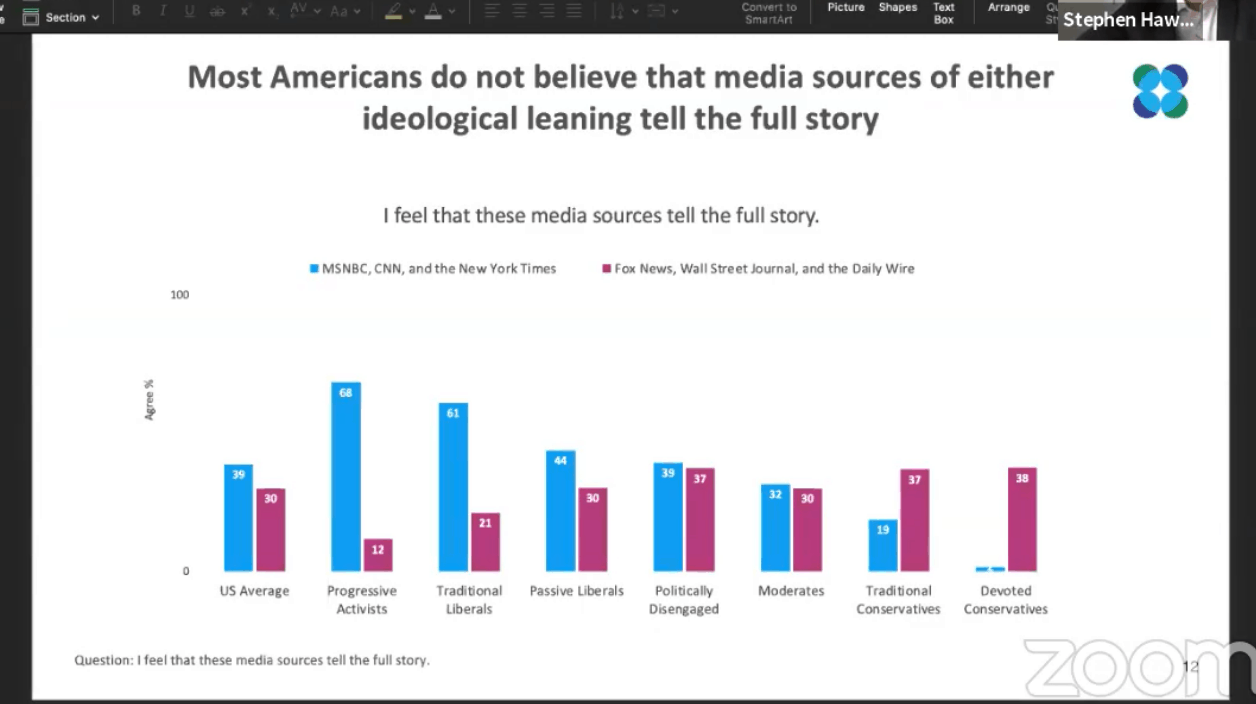
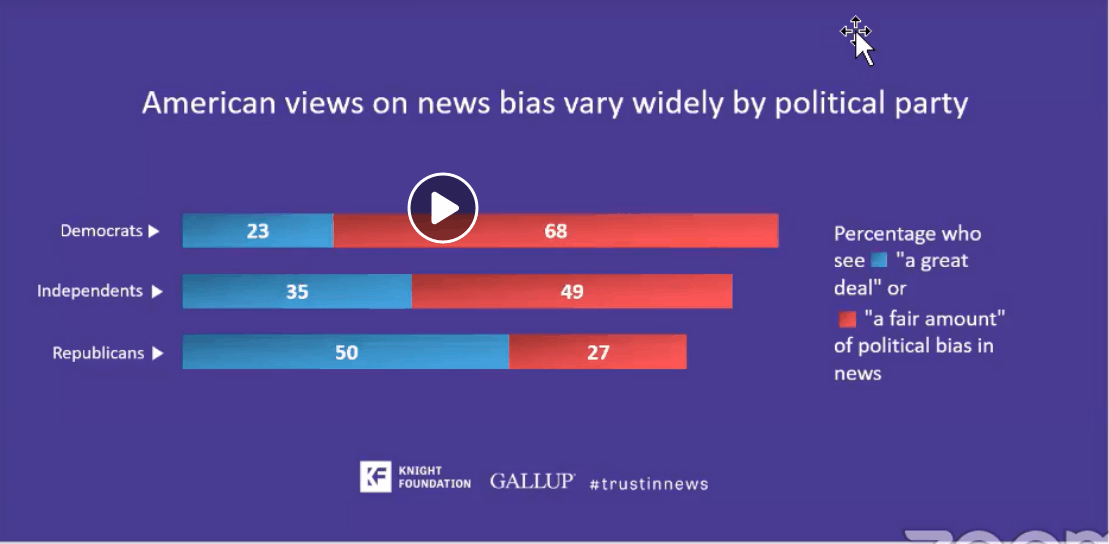
More in Common divides Americans politically into eight “Tribes” (see the chart above). Following that is a presentation about some Gallup polling that put people into three political categories (Ds, Is and R’s)(see chart above). It would be interesting to take some forest-related questions and see what different narratives might result from dividing folks who answer into three or eight categories. My guess is that eight would yield more understanding of peoples’ points of view. You don’t have to be a sociologist of science to think that how you structure the study (what groups you choose, exactly what questions you ask) can affect the answers you obtain.

Patty Limerick had an interesting idea in her “Not My First Rodeo” post History’s Essential Workers about the role of interpreters in Western history.

A Familiar Story from the Past, A Fresh Approach for the Present
As Meriwether Lewis and William Clark traveled from St. Louis to the Pacific Ocean, the terrain they crossed presented an almost unfathomable variety of landforms. And yet the diversity of the languages they encountered proved far more difficult to comprehend.

At every stage of the trip, the expedition encountered a group that spoke a different language. On a few occasions, this required Clark and Lewis to engage in an early nineteenth century experimentation with what would later be called “the telephone game,” a chain of interpreters lined up to pass on a single message. In one episode when clear communication was of great importance, Lewis spoke in English to a French soldier from the expedition. The soldier then spoke in French to the expedition’s official interpreter, Toussaint Charbonneau. Charbonneau then spoke in Hidatsa to Sacagawea, who spoke in Shoshone to a leader of that tribe. And then the process reversed: Shoshone to Hidatsa to French to English.

Here’s an idea that we suspect no one else has proposed: this would be a good time to adopt his chain of translation and put it to use to our world today.

There is no mistaking our national dilemma: people who are firmly committed to one political position are unable to communicate with people who are firmly committed to an opposite political position.

Lewis and Clark offer us a promising technique.

A far-left progressive Democrat would speak to a centrist Democrat. The moderate Democrat would speak to a centrist Republican. The centrist Republican would speak to a far-right Republican, who could then offer his response to the centrist Republican, and that response would then move back along the chain.

After a few messages have traveled back and forth through the chain, the time would be right for a designated interpreter to step in. Asking everyone to pause, the interpreter could ask everyone a few debriefing questions: “What did you just hear? Was it what you expected to hear? Where do you agree and disagree? Were there parts that you simply did not understand and that need more explanation? Do you need to keep using this chain of indirection, or are you ready now to talk with each other?”

Limerick has an interesting idea but in our forest world, I’m not sure our views fall into neat political categories whether three, four as in Limerick, or eight. Thoughts?

How Does a Decision-maker Know What’s “Right”? Guest Post by Jim Furnish

Thanks to Jim Furnish’s for his take on “what makes a land management decision right?” (Others are welcome to submit posts on this topic).

This poses THE trenchant question when working one’s way through a controversy. The very existence of controversy indicates opposition, unease, and concern about the status quo or new proposal. The science and art of finding the most elegant solution is the responsibility of decision-makers, but “right” decisions can prove elusive. Good leaders excel here; poor ones flounder. Difficulty increases because outcomes often remain unknown for some time, meaning that knowing what’s right at decision time may be impossible. I’ll share what worked for me, acknowledging that one has to tailor their decision-making methods to their own skills and character.
Before proceeding, let me address what I consider to be an oft-stated but errant myth: “good decisions leave all parties of a conflict equally upset.” In my experience, this became almost dogma as I heard many decision-makers explain their rationale for a course of action, thinking that the right decision necessarily lay in a brokered middle ground that left both sides angered and neither whole. I find this notion confounding. A right decision should incorporate as much common ground as possible, leaving both sides feeling they achieved important aims; “win-win”, to echo a trite saying.

Realistically, this is often not possible. Which leads to another common brokering concept: what can all sides “live with”? This suggests optimality. It has a positive feel, but this hints at settling for some least offensive solution. It also reflects a social construct, neglecting an all-important priority — does the decision do right by the land?
I consider the land ethic issue to be the essential element of right decisions for natural resource managers. This may not factor in decisions for a banker or insurance manager, but must be a priority if one is managing land. In my view, this was the essence of my national forest business. Here I give some deference (not much) to private land managers for whom economics and profits play a more prominent role, but for public lands I think a bias for environmental considerations exists, or should.

Why? Public lands must be managed to benefit the citizenry, and this basic stewardship responsibility underpins all decisions. Commercial transactions commonly involve forest products, ski areas, grazing, and concessions among others, and private entities naturally focus on their bottom line. I never considered it my responsibility to assure the financial health of a business contractor. But if my decision did not focus primarily on the environmental effects of commercial entities doing business on public land – in my role as steward – who would see to it? I think “citizen owners” of public land have every right to expect and demand this of public land managers.

How to apply this in trying to reach a right decision? Context matters. As an example, consider ATV use, a heated issue since ATVs burst on the recreation scene about the 1980s. Most agencies found themselves caught flat-footed as ATV users exploited a cheap, fast, and nimble ride to essentially replace 4WD vehicles. New trails laced forest and alpine, and solitude disappeared. How does one find the right balance between exclusion and permission? Do users have an inherent right to go virtually anywhere outside Wilderness areas?

I begin with the adage “just because you can doesn’t mean you should”. The FS took an important, long overdue step about 2005 by requiring that ATVs stay on designated routes, to be determined by comprehensive travel plans. A major issue was whether illegally created ATV trails could or should become a designated route. The FS left that door open to be determined locally. The battle was on. Enviros pushed for minimal routes and large scale exclusion zones. ATVers wanted almost every existing track to become a designated route. I slide toward the enviro end in seeking the right balance on that spectrum.

I try to simplify an arguably complex issue by asserting that ATV use is capable of significant soil and water damage, wildlife impacts, noise, and loss of solitude. ATV use is legitimate but needs restrictions as per Nixon’s Executive Order 11644. Accordingly, ATV use is permissible after negative effects are minimized and/or mitigated. Environmental issues as well as effects on other users must be accounted for. This means that ATV users should get the short(er) end of the stick. All things considered, this is not unfair and it’s “right” in my book.
I think historic context is crucial in working through other conflicts like logging and grazing. Timber industry had it their way for decades until the spotted owl solution in the Pacific Northwest came down heavily in favor of wildlife habitat and fish protections. The agencies doled out pain unequally; again, right in my view. Similarly, ranchers historically received preferential treatment and federal grazing has been supported at well below market value for decades. This context should tilt “right decisions” toward an environmental bias to help restore balance, especially when necessary to restore degraded environments.

Ultimately, I tried to weigh all factors in reaching a just outcome, but this didn’t mean I tried to make everything equal. Strive to help all sides to an issue achieve their aims, but it’s often necessary to take from one side to give to another in reaching a right decision.

Peter Williams on The Challenges of “Getting It Right” in Land Management Decisions

Christmas readings often involve seeking peace (e.g., lions lying down with lambs, and other non-biological ideas). We tend not to use that kind of language so much in resolving or managing environmental conflicts. Still, I can think of no one better to start off 2020 than with a thoughtful (as usual!) piece by Peter Williams on “getting it right.” Here it is:

Recently, The Smokey Wire has had several really interesting posts or comments that raise the question of what we mean by “getting it right” when it comes to Forest planning and other land management decisions including project plans. Tim Coleman and Russ Vaagen, among others, talked about the Colville National Forest. They provide a perfect example of how different people can see “right” differently. I had good experiences working with both of them about a decade ago on various local USFS planning efforts, so I appreciate their insights regarding the County Commissioners, local industry, USFS, and local residents [LINK].

Sharon challenged a few of us to think about this question of getting it right, with Tony Erba offering the first take a few weeks ago [LINK]. The question we were asked was about “getting it right” when it comes to land management decisions and what role can USFS and stakeholders play in that. I’m going to offer two main thoughts: (1) it’s worth taking a step back to consider the question and (2) what we mean by the “it” in “getting it right” is also worth careful consideration.

The question about “getting it right” seems to go to the idea of a “right” answer, as opposed to a “good” answer, and this affects our search pattern, meaning it affects what we look for. From a decision-making perspective, if we search for a right answer, we often think in terms of a single best answer being the ultimate right one. For this reason, my first thought is to take a step back, to reframe the question.

Let me offer an example, overstating it to make a point. Folks searching for a right answer may disagree about what is the right answer, but they all agree there is one and they can find it. Often, they even begin their search already knowing what they mean by a right answer, at least in some significant ways often based on their technical training or beliefs about how the world works. Their search pattern is defined by agreement that there is a right answer and, more powerfully, by their disagreements regarding whether and when they have found the answer itself. These disagreements tend to be or become counterproductive if not destructive because if you aren’t right, you must be wrong.

In contrast, consider what searching for a “good” answer can mean. Instead of looking for the single right answer, a search for a good answer looks for a broader set of plausible, viable answers. Also, consider that looking for a good answer as a group or as a community often allows room for constructive disagreement because it begins with developing some shared understanding of what different folks might mean by “good” with regards to addressing or resolving the local, immediate issue.

This constructive disagreement, handled well, can enlarge the edges of the envelope within which is that set of good answers. And, within that set, more folks can see more of their interests, which is a really different result that you get from the right-wrong frame.

So, my first point is that searching for a right answer and searching for a good answer are different in truly meaningful ways. If you want to explore this idea, read “The Unbounded Mind” by Mitroff and Linstone (1993). Yes, one could quibble about the words or argue that I’m just setting up a conceptual stalking horse, but I hope the point is still useful for discussion.

My second point is that whether a land management decision is right sometimes depends on whether you look at it in the near-term, as opposed to from a longer-term perspective, as well as whether you look at it from a technical perspective, a legal perspective, or a community perspective.

A different way of looking at the idea of “rightness”—somewhat similar to the idea of looking for a good answer—might be that a land management decision is right when it is appropriate given what is known about the issue, the resources available to address the issue, and the willingness to live with the decision.

There’s an interesting literature about “appropriateness-based decision making” as opposed to “traditional rational planning.” The former tends to focus on trying to understand the situation, including how the group or participants see themselves and what they see as an appropriate process. Traditional rational planning, in contrast, tends to define rightness in terms of consequences understood through technical lenses, like the ubiquitous “Effects Analyses” so familiar as part of a NEPA process. For a really readable look at this, check out March’s “A Primer on Decision Making” (1994).

As an aside, an effects analysis would still occur as part of a NEPA process framed by “appropriateness,” but it would look different because more attention to the situation, community, and process would happen up front, up-stream of what we might call the formal NEPA process. The main take-away I would offer here is that what most of us would call the traditional NEPA process is not the only way to comply with the NEPA Act and CEQ regulations, but that’s a whole different discussion, one that Jon Haber might have particularly useful insights to add.

Coming back to this question of “rightness” for a land management decision, I’m going to suggest that a particularly useful way to think about this is to focus on what happens the day AFTER the decision. Let’s assume we’re thinking about rightness as more like a set of good options (point #1) that are appropriate for the circumstances and participants (point #2). What’s right might come down to whether, once the decision is made, the participants share a general willingness to live with the decision and whether many will actually support implementation, perhaps helping make it happen or helping assess whether desired outcomes occur and undesired ones do not.

The reason I suggest this approach is it seems more likely to avoid the trap that Tony Erba alluded to, where, after a bunch of meetings that seem to be going in a worthy direction, folks retreat to their starting positions and the USFS—or whoever—is left holding the proverbial bag. That’s no good for anyone who cares about public lands or collaborative conservation.

Tony Erba on The Challenges of “Getting it Right” in Land Management Decisions

This is a guest post from Tony Erba, in our series “What is “getting it right” in land management decisions, and how can stakeholders and the FS facilitate that?” I’ve asked a couple of people for guest posts, but anyone, anonymous or  not, is welcome to submit one.  I wonder whether others have similar experiences of the FS doing its best and things falling apart. Do you have insight into the causes? What could the FS or stakeholders have done differently? On a broader level, is the idea that the FS can somehow make peace among long-term mistrusting factions if they just “did it right” an unreasonable expectation? If it is, what should the FS do?  I’d have a tendency to put my forest at the bottom of the revision list and start a “possibly building trust” effort with small projects.  What would you do?

My one personal experience that addresses your questions was with the southern Utah plan revision effort. We had developed topical working groups around five particular topics:  timber, grazing, dispersed recreation, roadless areas, and I cannot remember the fifth one.  I was the planning team representative for the roadless group (each topical working group had a broad spectrum of perspectives, selected by our 3rd party facilitator and collaboration sponsor so each group was balanced). I felt the roadless group did an effective job of asking questions over five meetings (about a month apart) about the history of roadless areas, the current policy (2001 Roadless Rule), and the wilderness evaluation process described under the 1982 planning rule. Much confusion existed (as you can imagine) and I put in a lot of hours to bring information to the group so we all could have a common information base to work with.

The conversations were robust and it appeared that the group was making progress to find a middle ground that all could live with (i.e., a “right” answer).  But, at the end, when each member of the group was asked if they could support a “middle ground” approach on how the soon-to-be revised plan would treat roadless areas (as well as recommend any wilderness areas), I was stunned to hear each person fall back into their “camp” and advocate for their position as it was at the beginning of the group’s engagement. Five meetings of discovery ended with the FS holding the bag in making a decision on what to do rather than leveraging the group’s knowledge and learning that was gained through the group’s meetings.

The other groups fared a bit better, but not much. I think we tried to overcome decades of mistrust (especially with the environmental history and conscience of Utah) with an open and transparent collaborative process, thinking that if we did it “right”, others would recognize that effort and contribute meaningfully to move beyond the conflict. Perhaps that was too idealistic on our part, but we were committed to expand the public conversation beyond what was required for an EIS’s public involvement requirements under NEPA. In doing so, we unearthed deeper levels of mistrust and skepticism, resulting in an outcome really no different than if we had done just the minimum. However, I do think we did move the needle a bit with bringing people together who normally do not seek each other and had them learn a little about the other person. In the end, our failure hopefully resulted in a success in another place in Utah at a later time, but since I moved to DC in 2004 for my EMC job, I did not witness whether this success actually occurred.


Lawsuit drives proposed changes in elk feeding permit


The State of Wyoming has been feeding elk during the winter at several locations on the Bridger-Teton National Forest for decades.  Environmental plaintiffs challenged a 2016 decision to authorize the continued use of the Alkali Creek Feedground, and the court remanded the decision because of NEPA violations, as described here.

Rather than appealing or spending years studying the feedground’s impacts to address the judge’s concerns, the Forest Service and Wyoming wildlife managers came up with a plan that will allow emergency elk feeding on a smaller area for five years and then end the operation by 2024 (with a possible extension). That plan is now being “scoped” and is open for public comment.  The scoping letter is attached to this article.

This is an example of how litigation may lead to a better decision (after the appropriate public review process).  It appears to have made the State take a closer look at whether it really needed this feedground.  However, plaintiffs don’t appear to have been involved in the new proposal yet.  It’s also interesting that the original decision was based on an EIS/ROD, which the court found to be inadequate, but this is being proposed as a categorical exclusion (so maybe the Forest has an idea that they are not going to be challenged on it?).

Midwest timber wars revisited

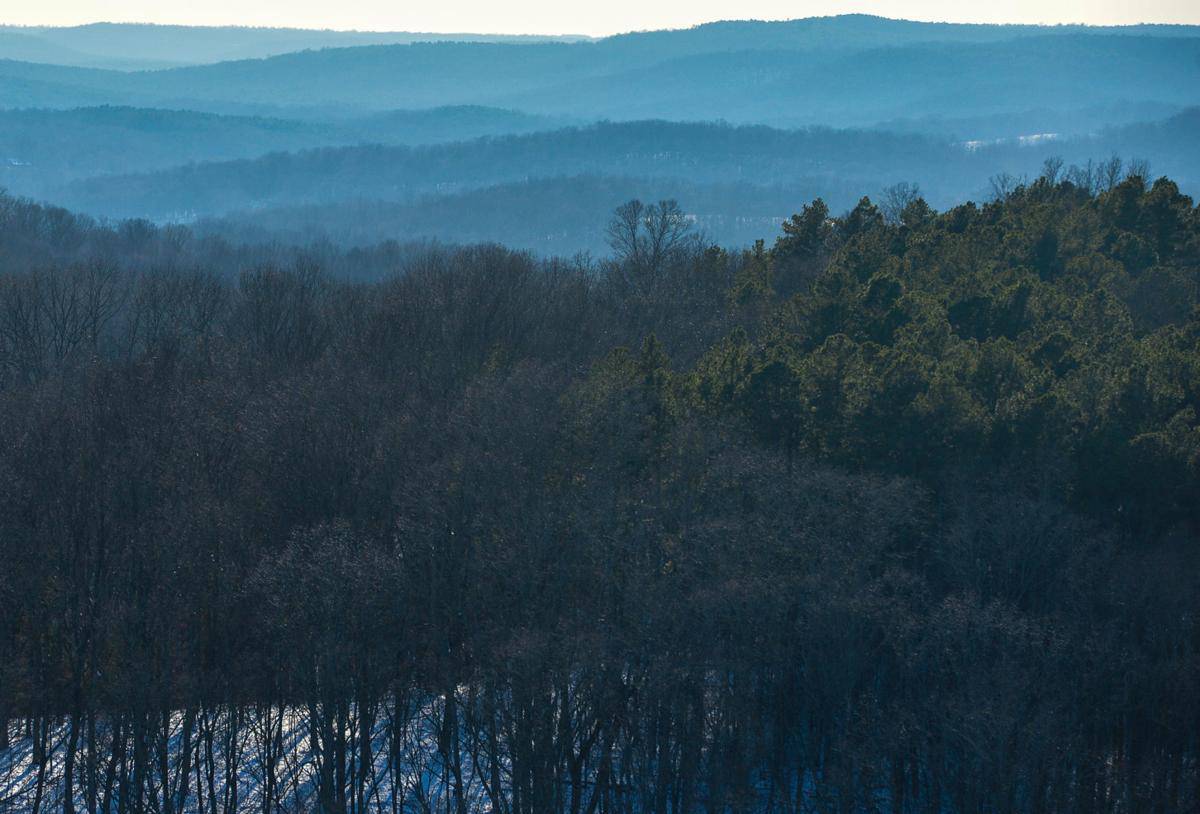
For the first time in nearly three decades, the Shawnee National Forest in Illinois has proposed a commercial timber harvest of mostly native oaks and hickories. And environmental activists whose high-profile fight against logging in the 1990s led to a 17-year moratorium are once again raising alarms.

Lisa Helmig, acting forest supervisor with the Shawnee National Forest, said the plan is rooted in the best available science about how to maintain the keystone oak ecosystem that is native to the Shawnee foothills.  “The oak ecosystem has been in place here in the central hardwood region for 5,000 years,” she said. But Helmig said the ecosystem is at risk due to a lack of natural or man-made disturbances, such as fire, storms and, yes, even logging. Without these disturbances, non-native, shade-tolerant sugar maple and beech trees sprout up and fill in the forest’s midstory, she said.

The activists have filed an objection, based largely on their past experience with timber harvest on the Forest.

The trees that have grown up to replace the harvested oaks and hickories are mostly 28-year-old stands of “undesirable” beeches and maples.  “When you think about how many oaks were here, it’s heart-wrenching,” Wallace said “Had they not cut the oaks, we’d have oaks here,” Stearns added. In addition to the Farview site, in their letter they write that we also returned to the North End Ecological Restoration project logged in Pope County in the late 1990s. “Little to no oak and hickory have been visibly restored.” They cited other examples, as well.

This is the root of their concern: What the Shawnee National Forest’s leadership claims is happening isn’t.

Asked about their concerns, Helmig said that her “gut reaction” is that the Forest Service likely didn’t follow through with what should be a multiphase treatment. Helmig said she’s confident that the Forest Service is committed to seeing (this) project through… “We have a wonderful silviculturist on staff now,” Helmig said. “He’s been here five years and is absolutely fantastic.”

Hopefully we can assume that there has been a science-based determination that ecological integrity requires regenerating some young oaks and hickories.  But implementation unfortunately still boils down to “trust us,” and “we’re different now.”   (But then the Forest evicted the media from the objection meeting, wrongly according to the Washington Office.)