Certainly that’s over half. Which of course does not obviate other restrictions, like Wilderness, Roadless, etc. In fact, it only applies to EAs and EIS’s that meet other designation and plan requirements. But I can see why a press release would not go in to those details. So that explains it- the origin of what might be considered cascading misunderstandings.
Our friends at Center for Western Priorities were quick to jump on this in their newsletter this AM…
The Trump administration has removed protections for over half of the National Forest System via the issuance of an emergency order related to wildfire risk. The order covers more than 110 million acres of forest land and will fast-track timber production by removing National Environmental Policy Act regulations in the name of wildfire mitigation.
Guess what the link goes to? Not the AP story, the WaPo story. And so the cascade continues.
Today I’d like to focus on the Washington Post story that covers the very same Emergency Situation Determination that we covered here Friday. Now remember what the ESD does-
1. One action alternative or no action is analyzed in an EA or EIS.
2. No objection process
3. Thanks to Rich J., a special injunctive relief section, which is part of the bill known as Bipartisan Infrastructure Law and IIJA.
As for “special injunctive relief standards,” section 40807(e) states:
(e) JUDICIAL REVIEW OF EMERGENCY ACTIONS.—A court shall not enjoin an authorized emergency action under this section if the court determines that the plaintiff is unable to demonstrate that the claim of the plaintiff is likely to succeed on the merits.
This section reduces the four part test for injunctive relief used in the 9th Circuit (and perhaps others) to just one element – plaintiffs’ likelihood of success on the merits. Masochistic readers desiring more injunction background info can go here:
Since the WaPo story, thanks to Nick Smith, I found this AP story by reporter Matt Daly which is very good IMHO.
Anyway, let’s go to the claims made in the WaPo piece (notably filed under “climate”). Let’s start with the headline.
Trump administration orders half of national forests open for logging
An emergency order removes protections covering more than half the land managed by the U.S. Forest Service as the president aims to boost timber production.
Note that this is purportedly a news story, not an op-ed.
The Trump administration has removed environmental protections covering more than half of the land managed by the U.S. Forest Service.
I was curious about this and went to the FS website with acres of IRAs and Wilderness and other special areas. This is definitely a rabbit hole not of general interest, so I put that adventure at the end of the post.
Now if a person knew that there were a variety of environmental laws and regulations, one might be skeptical of the above idea. I can think of the Bush or Trump 1 folks thinking “hey we didn’t know it was that easy! Pesky old statutes and regs!”
Forest management can help prevent wildfires by thinning the amount of fuel available for blazes to feed upon. But forestry experts often suggest the removal of undergrowth that doesn’t yield timber, and they warned during similar efforts in Trump’s first term that you can’t log your way out of fire danger, The Washington Post reported. Removing large, fire-resistant trees also gives way to young trees that are more susceptible to fires.
I don’t think anyone ever said that we could “log our way out of fire danger”; what people said is that under some conditions, mechanical thinning is a useful fuel reduction tool. In some cases, there is a market for the thinned material.
Rollins’s memo, which does not make a reference to climate change, instructed Forest Service field leadership to fast-track timber production by removing National Environmental Policy Act regulations, making it easier to obtain permits and reducing “contracting burdens.”
Um…if it were that simple…
Here’s another one:
Under President Joe Biden, national forests received new protections after logging projects were banned in select areas to protectcarbon-rich trees, most of which were more than 100 years old, from being cut down. Scientists say those trees play an essential role in fighting climate change, provide habitats for wildlife and are more likely to survive wildfires.
“We think this will allow us to respond effectively and strategically to the biggest threats that face old growth,” former Agriculture Secretary Tom Vilsack told The Post at the time, pointing to wildfire, disease and pests as examples. “At the end of the day, it will protect not just the forests, but also the culture and heritage connected to the forests.”
But, as we know, just as “protections” weren’t “removed” by the Secretarial Memo, neither were “protections” put in place by the Biden Administration. Forests didn’t actually receive new “protections” because the national plan amendment was never finalized. And even folks like Andy Kerr thought it wouldn’t do much anyway at the end of the day.
People I know send me this stuff and they are honestly worried. I tried to help the WaPo audience by putting a comment with a link to Friday’s post here.
As for me, the Trump Admin is doing some things I like and some things I don’t like. And with years of experience, I am pretty humble about how things will turn out. But there are enough really problematic things they are doing, like the RIFs and the purchasing card restrictions, that I don’t think the WaPo-needs to unnecessarily scare and anger people by .. well.. making stuff up. But I don’t think the reporter intentionally did that.. as I’ve said before, we have a systemic situation in which traditional outlets can’t afford specialized reporting (nor apparently fact-checking); E&E news does, but we can’t afford it; and other outlets are funded by folks with particular biases and axes to grind.
So another shout-out to reporter Matt Daly and AP for breaking that mold in this case!
*************
Down the Acreage Rabbit Hole
At least on my computer, you can click on this FS table and make it larger. I added the 44, 919 for designated areas to 58,518 IRA acres – 6015 for IRAs included in designated areas. I got .5066 or .51 of total acres that are in special areas including Wilderness, and Roadless that are seemingly off limits to commercial logging. Without going down the associated rabbit hole of acres suitable for timber production in forest plans, which is also a restriction on timber harvesting for timber purposes. It strikes me that a Sec memo that changes number of alternatives, objections and injunctions, won’t influence forests to go outside of suitable lands without a plan amendment.
So how could the Emergency Situation Determination affect greater than 50% of the acres? Maybe I calculated wrong or this FS table is wrong or outdated? Does someone have a current table like this?
The emergency designation covers 176,000 square miles (455,000 square kilometers) of terrain primarily in the West but also in the South, around the Great Lakes and in New England. Combined, it is an area larger than California and amounts to 59% of Forest Service lands.
By the authority vested in me as President by the Constitution and the laws of the United States of America, including section 232 of the Trade Expansion Act of 1962, as amended (19 U.S.C. 1862) (Trade Expansion Act), it is hereby ordered:
Section 1. Policy. The wood products industry, composed of timber, lumber, and their derivative products (such as paper products, furniture, and cabinetry) is a critical manufacturing industry essential to the national security, economic strength, and industrial resilience of the United States. This industry plays a vital role in key downstream civilian industries, including construction.
The United States faces significant vulnerabilities in the wood supply chain from imported timber, lumber, and their derivative products being dumped onto the United States market.
“Dumping”- that reminds me of the perennial Softwood Lumber Dispute.. and terms like “countervailing duties” and so on.
The United States has ample timber resources. The current United States softwood lumber industry has the practical production capacity to supply 95 percent of the United States’ 2024 softwood consumption. Yet, since 2016 the United States has been a net importer of lumber.
Wood products are a key input used by both the civilian construction industry and the military. Each year, the United States military spends over 10 billion dollars on construction. The military also invests in innovative building material technology, including processes to create innovative wood products such as cross-laminated timber. The procurement of these building materials depends on a strong domestic lumber industry and a manufacturing base capable of meeting both military-specific and wider civilian needs.
It is the policy of the United States to ensure reliable, secure, and resilient domestic supply chains of timber, lumber, and their derivative products. Unfair subsidies and foreign government support for foreign timber, lumber, and their derivative products necessitate action under section 232 of the Trade Expansion Act to determine whether imports of these products threaten to impair national security.
I’m not a fan of the “threats to national security” framing; we’ve had great relationships and made money from Canadian lumber duties, kept forest economists employed on both sides of the border, as well as folks at the WTO, for some years now. Plus there was the joint US-Canada funding (from the 2006 agreement) that went to our friends at the US Endowment for Forest and Communities, who are still doing useful things with the funding.
In fact, Pete Madden, their CEO posted an opinion piece about problems with the South Carolina timber industry and possible solutions.
Christopher Gaston, a forestry and economics associate professor at the University of British Columbia, said high tariffs were already challenging big forestry players to operate in the province.
Large forestry companies like Canfor make their money selling large amounts of lumber to U.S. buyers for a slim profit margin, according to Gaston.
He said raising tariff pressure will likely encourage them to move their business out of B.C.
“I can’t imagine any British Columbia company will be able to ship lumber for any kind of a profit; it would be at a loss,” he said. “The big mills will close down.”
Still, Gaston said there may be a silver lining. B.C.’s forest industry is already shifting into the hands of smaller and Indigenous-owned companies, which are better equipped to manage the province’s volatile forest supply.
Tariffs will up the pressure on smaller companies to create wood products from their harvest, instead of solely shipping raw lumber, Gaston said. That would mean building lumber processing infrastructure and facilities in Canada to add value to raw lumber.
“There’s a lot of pain associated with that,” he said. “We can’t just go from being a commodity producer to being more value-added oriented overnight, but ultimately, I think it’s the right thing for Canada to do in the long run.”
In the comments on the article, someone pointed to the San Group, which has its TM “from harvest to home.”
San Group developing 100% Canadian-made value added, low carbon based, environmentally friendly, renewable wood products – from Harvest to Home™
Sounds like the BC folks have a great deal in common with our own communities’ needs. Perhaps we should work with Canada to help both our industries having difficulties?
If I were really worried about threats to national security from imports of lumber, I’d also look at packaging and dangerous invasive diseases and insects. That issue seems to have been more or less ignored with greater concern about climate change.
Sec. 2. Investigation. (a) The Secretary of Commerce shall initiate an investigation under section 232 of the Trade Expansion Act to determine the effects on the national security of imports of timber, lumber, and their derivative products.
(b) In conducting the investigation described in subsection (a) of this section, the Secretary of Commerce shall assess the factors set forth in 19 U.S.C. 1862(d), labeled “Domestic production for national defense; impact of foreign competition on economic welfare of domestic industries,” as well as other relevant factors, including:
(i) the current and projected demand for timber and lumber in the United States;
(ii) the extent to which domestic production of timber and lumber can meet domestic demand;
(iii) the role of foreign supply chains, particularly of major exporters, in meeting United States timber and lumber demand;
(iv) the impact of foreign government subsidies and predatory trade practices on United States timber, lumber, and derivative product industry competitiveness;
(v) the feasibility of increasing domestic timber and lumber capacity to reduce imports; and
(vi) the impact of current trade policies on domestic timber, lumber, and derivative product production, and whether additional measures, including tariffs or quotas, are necessary to protect national security.
Sec. 3. Required Actions. (a) The Secretary of Commerce shall consult with the Secretary of Defense and the heads of other relevant executive departments and agencies as determined by the Secretary of Commerce to evaluate the national security risks associated with imports of timber, lumber, and their derivative products.
(b) No later than 270 days after the date of this order, the Secretary of Commerce shall submit a report to the President that includes:
(i) findings on whether imports of timber, lumber, and their derivative products threaten national security;
(ii) recommendations on actions to mitigate such threats, including potential tariffs, export controls, or incentives to increase domestic production; and
(iii) policy recommendations for strengthening the United States timber and lumber supply chain through strategic investments and permitting reforms.
This sounds like a great program for work for forest economists. Except that they don’t work for DOC nor the military, so hopefully they will be still employed (and not the victims of cuts) when the DOC starts asking for their help.
I’m not sure that Canadian imports “threaten national security.” Perhaps the military needs wood to function, at least to build buildings. But they also need clothing, and are imports of clothing a national security issue? And how many new buildings does the military need? It seems like a stretch, but maybe the evaluation will agree with me. At the same time, folks need housing and we build it with wood, so increasing wood prices runs against the needs of people for housing.
However, I think it would be a terrific addition to transparency if the policy recommendations were vetted by the public and other experts. Certainly there are many folks with experience of past permitting reform efforts that might be valuable; also younger people now working in the field.
Sec. 4. Definitions. As used in this order:
(a) The term “timber” refers to wood that has not been processed.
(b) The term “lumber” refers to wood that has been processed, including wood that has been milled and cut into boards or planks.
Sec. 5. General Provisions. (a) Nothing in this order shall be construed to impair or otherwise affect:
(i) the authority granted by law to an executive department or agency, or the head thereof; or
(ii) the functions of the Director of the Office of Management and Budget relating to budgetary, administrative, or legislative proposals.
(b) This order shall be implemented consistent with applicable law and subject to the availability of appropriations.
(c) This order is not intended to, and does not, create any right or benefit, substantive or procedural, enforceable at law or in equity by any party against the United States, its departments, agencies, or entities, its officers, employees, or agents, or any other person.
If you’re curious about Russia, note the degree that imports declined -apparently due to its invasion of the Ukraine in 2022. At least, according to FAS. The link AFRC has is to 2022 data on wood products more generally, so it would take a forest economist to figure out how to make them comparable.
Anyway, the paper industry, as represented by AF&PA, is not on board with tariffs (not the EO per se) according to this statement:
WASHINGTON – The American Forest & Paper Association (AF&PA) President and CEO Heidi Brock issued the following statement regarding President Donald Trump’s announcement of 25% tariffs on all products from Canada and Mexico and related retaliatory measures:
“While we recognize the Administration’s goals of securing our borders, AF&PA remains concerned that today’s new North American tariffs have potential to seriously disrupt our industry’s complex, cross-border supply chains. These manufacturing processes have been built and refined with the customer in mind around existing mill infrastructure for decades.
“Pulp and paper mills are strategically located across the United States to efficiently and sustainably create essential products for everyday use. From turning wood chips into pulp, pulp into base stock, and then transforming that raw material into a product that is then packaged for distribution, our industry’s manufacturing process involves many stages that can each happen at different facilities on both sides of the border.”
“Additionally, certain raw material inputs must be sourced from Canada due to specific fiber quality demands and transportation efficiencies.
“The U.S. forest products industry employs more than 925,000 people, largely in rural communities across the country. We rely on Canada and Mexico as key trading partners and strongly encourage them to continue addressing concerns raised by the U.S. government.
Here’s what the National Association of Home Builders called on Congress to do, and among other things..
Responsibly boost the domestic supply of lumber and call on the Trump administration to negotiate a long-term softwood lumber agreement with Canada that will end lumber tariffs, help stabilize this volatile market and give builders greater price stability.
“I hereby order the heads of all executive departments and agencies to deliver emergency price relief, consistent with applicable law, to the American people and increase the prosperity of the American worker. This shall include pursuing appropriate actions to: lower the cost of housing and expand housing supply;
I was trying to find the other Timber Executive Order and ran across this by Snopes.
It’s supposed to be a fact check. Snopes claims
We are the internet’s go-to source for discerning what is true and what is total nonsense. Before you scroll further, a few tips on how to “snopes”:
So what did they say about the Executive Order?
The order allows federal agencies to bypass environmental protection laws in an effort to increase production but doesn’t call for clear-cutting.
It doesn’t take a Ph.D. in government to know that Admins can’t bypass statutes just by issuing EOs. There is the whole “separation of powers” thing, that we learned about in high school.
What’s True
Trump signed an executive order allowing federal permitting agencies to ignore environmental protection laws in an effort to increase domestic timber and lumber production. The executive order also calls for expanding domestic logging production on federal lands.
What’s False
The executive order does not directly call for 280 million acres of national forests and other protected public lands to be clear-cut.
Briefly stated, the Gell-Mann Amnesia effect is as follows. You open the newspaper to an article on some subject you know well. In Murray’s case, physics. In mine, show business. You read the article and see the journalist has absolutely no understanding of either the facts or the issues. Often, the article is so wrong it actually presents the story backward—reversing cause and effect. I call these the “wet streets cause rain” stories. Paper’s full of them.
In any case, you read with exasperation or amusement the multiple errors in a story, and then turn the page to national or international affairs, and read as if the rest of the newspaper was somehow more accurate about Palestine than the baloney you just read. You turn the page, and forget what you know.
That is the Gell-Mann Amnesia effect. I’d point out it does not operate in other arenas of life. In ordinary life, if somebody consistently exaggerates or lies to you, you soon discount everything they say. In court, there is the legal doctrine of falsus in uno, falsus in omnibus, which means untruthful in one part, untruthful in all. But when it comes to the media, we believe against evidence that it is probably worth our time to read other parts of the paper. When, in fact, it almost certainly isn’t. The only possible explanation for our behavior is amnesia.
(Note, previously I thought there was one EO but there are two timber EO, will discuss the second one in the next post. Sorry about that.)
But rare indeed is the government doing anything “immediately”.
I’m posting it in its entirety below along with my thoughts and questions.
By the authority vested in me as President by the Constitution and the laws of the United States of America, it is hereby ordered:
Section 1. Purpose. The production of timber, lumber, paper, bioenergy, and other wood products (timber production) is critical to our Nation’s well-being. Timber production is essential for crucial human activities like construction and energy production. Furthermore, as recent disasters demonstrate, forest management and wildfire risk reduction projects can save American lives and communities.
The United States has an abundance of timber resources that are more than adequate to meet our domestic timber production needs, but heavy-handed Federal policies have prevented full utilization of these resources and made us reliant on foreign producers. Our inability to fully exploit our domestic timber supply has impeded the creation of jobs and prosperity, contributed to wildfire disasters, degraded fish and wildlife habitats, increased the cost of construction and energy, and threatened our economic security. These onerous Federal policies have forced our Nation to rely upon imported lumber, thus exporting jobs and prosperity and compromising our self-reliance. It is vital that we reverse these policies and increase domestic timber production to protect our national and economic security.
So while the case is made more generally for producing our own timber, the EO focuses only on federal forests. As we’ve discussed here, the problem tends to be that people can’t run businesses effectively and mills are closing or have closed in many places, and supply is one of many issues. I suppose another intervention would be to increase tariffs, but that would raise prices and make life more difficult for people who use wood, which is pretty much everyone, either directly or indirectly.
Sec. 2. Directives to the Secretary of the Interior and the Secretary of Agriculture.
(a) Within 30 days of the date of this order, the Secretary of the Interior and the Secretary of Agriculture, through the Director of the Bureau of Land Management (BLM) and the Chief of the United States Forest Service (USFS), respectively, shall each issue new or updated guidance regarding tools to facilitate increased timber production and sound forest management, reduce time to deliver timber, and decrease timber supply uncertainty, such as the Good Neighbor Authority described in 16 U.S.C. 2113a, stewardship contracting pursuant to 16 U.S.C. 6591c, and agreements or contracts with Indian tribes under the Tribal Forest Protection Act as contemplated by 25 U.S.C. 3115a. The Secretary of the Interior and the Secretary of Agriculture shall also each submit to the Director of the Office of Management and Budget any legislative proposals that would expand authorities to improve timber production and sound forest management.
As we have seen via the Keystone Agreements, much timber work has been farmed out to NGOs, which may or may not have been stopped. The first thing I’d do is figure out which mills really need the supply and focus workers in those areas. And stop firing people related to that work(although this may already have happened, as with the Black Hills folks). Also analyze where people needed to do projects are missing from the workforce, including folks needed for project NEPA including specialists. For example, last fall, I was thinking of working for ACES and was told a certain forest needed NEPA help and couldn’t find anyone. I also heard that between timber sale contracts, stewardship agreements, and so on, it seemed difficult for folks to enter the needed info into various databases. There were thought to be a few timber assistants near retirement that actually understood all the complexities. Maybe that could be streamlined. Other ideas?
(b) Within 60 days of the date of this order, the Secretary of the Interior, through the Director of the United States Fish and Wildlife Service (FWS), and the Secretary of Commerce, through the Assistant Administrator for Fisheries, shall complete a strategy on USFS and BLM forest management projects under section 7 of the Endangered Species Act (ESA) (16 U.S.C. 1536) to improve the speed of approving forestry projects. The Secretary of the Interior, through the Director of the FWS, shall also examine any applicable existing authorities that would permit executive departments and agencies (agencies) to delegate consultation requirements under section 7 of the ESA to other agencies and, if necessary, provide a legislative proposal to ensure consultation is streamlined.
Others may remember various efforts to streamline consultation but I’m sure they all depend on having employees do it. I’d get a bunch of FWS, NOAA Fisheries and FS folks working in the consultation space to make recommendations.
(c) Within 90 days of the date of this order, the Secretary of the Interior and the Secretary of Agriculture shall together submit to the President, through the Assistant to the President for Economic Policy, a plan that sets a target for the annual amount of timber per year to be offered for sale over the next 4 years from Federal lands managed by the BLM and the USFS, measured in millions of board feet.
Setting targets is good for accountability; and yet, puts the agency between a rock and a hard place if legal challenges are not taken into account.
(d) Within 120 days of the date of this order, the Secretary of the Interior, through the Directors of the FWS and the BLM, and the Secretary of Agriculture, through the Chief of the USFS, shall complete the Whitebark Pine Rangewide Programmatic Consultation under section 7 of the ESA.
Maybe folks can help me with this one- I don’t often see whitebark growing in stands with traditional timber trees, usually the sites are too high and cold. Maybe this is a regional issue somewhere?
(e) Within 180 days of the date of this order, the Secretary of the Interior and the Secretary of Agriculture shall consider and, if appropriate and consistent with applicable law, adopt categorical exclusions administratively established by other agencies to comply with the National Environmental Policy Act and reduce unnecessarily lengthy processes and associated costs related to administrative approvals for timber production, forest management, and wildfire risk reduction treatments.
I’m not sure that any other agencies have CEs associated with those things, but OK. And I don’t exactly know what “unnecessary lengthy processes” are.. I suppose folks not using existing CE’s? If you go back in the NEPA literature, you’d find things like “had to wait for archaeologist, they were too busy to get to this project” or “got new ranger who wanted to start over” and other internal issues. Even I as a planning director, spent time encouraging people who didn’t work directly for me to prioritize NEPA work (in my case on the Southern Rockies Lynx Amendment).
Contractors, Enterprise units, States via GNA and so on.. even the recent EADM effort we covered here had many suggestions for improving processes. Plus, does BLM have the same issues?
I think the least favorite suggestion was centralized and dedicated project planning teams. Like my old boss Fred Norbury said “we run NEPA like a cobbler shop, and it should be more like a Nike factory.” Culturally, that was a non-starter.
(f) Within 280 days of the date of this order, the Secretary of the Interior shall consider and, if appropriate and consistent with applicable law, establish a new categorical exclusion for timber thinning and re-establish a categorical exclusion for timber salvage activities.
Sec. 3. Streamlined Permitting. All relevant agencies shall eliminate, to the maximum extent permissible by law, all undue delays within their respective permitting processes related to timber production. Additionally, all relevant agencies shall take all necessary and appropriate steps consistent with applicable law to suspend, revise, or rescind all existing regulations, orders, guidance documents, policies, settlements, consent orders, and other agency actions that impose an undue burden on timber production.
If I were the FS, I’d also look at when regulations, etc. made it more difficult to dispose of woody material with no timber value. In fact, I’d take this part of the EO and ask “what holds up timber production AND what holds up fuels reduction without valuable timber?” I think a case could be made that since the EO mentions bioenergy, that it takes a broader look at removing materials of different and possibly negative value.
Sec. 4. Endangered Species Committee. (a) Agencies are directed to use, to the maximum extent permissible under applicable law, the ESA regulations on consultations in emergencies to facilitate the Nation’s timber production. The Secretary of the Interior, as Chairman of the Endangered Species Committee, shall ensure a prompt and efficient review of all submissions to such committee, to include identification of any legal deficiencies, in order to ensure the timely consideration of exemption applications and, where possible, to resolve such applications before the deadlines set by the ESA.
(b) Federal members of the Endangered Species Committee, or their designees, shall coordinate to develop and submit a report to the President, through the Assistant to the President for Economic Policy, that identifies obstacles to domestic timber production infrastructure specifically deriving from implementation of the ESA and recommends procedural, regulatory, and interagency improvements.
(c) The Secretary of the Interior shall ensure that the Director of the FWS, or the Director’s authorized representative, is available to consult promptly with agencies and to take other appropriate action concerning the applicability of the ESA’s emergency regulations. The Secretary of Commerce shall ensure that the Assistant Administrator for Fisheries, or the Assistant Administrator’s authorized representative, is available for such consultation and to take such other action as may assist in applying the ESA’s emergency regulations.
I’m not an expert on ESA, but it might be a good thing again, using timber as an example, to look at “procedural, regulatory, and interagency improvements” including employee and contractor capacity and budget.
Sec. 5. General Provisions. (a) Nothing in this order shall be construed to impair or otherwise affect:
(i) the authority granted by law to an executive department or agency, or the head thereof; or
(ii) the functions of the Director of the Office of Management and Budget relating to budgetary, administrative, or legislative proposals.
(b) This order shall be implemented consistent with applicable law and subject to the availability of appropriations.
(c) This order is not intended to, and does not, create any right or benefit, substantive or procedural, enforceable at law or in equity by any party against the United States, its departments, agencies, or entities, its officers, employees, or agents, or any other person.
Note 5b.
A reader wrote in and had these excellent questions about the EO.
Would this actually expedite projects, both on the FS side and consultation?
Who knows? It depends on what they analyze and recommend, and the factors of employees and funding.
Is that delegation of consultation mentioned in sec 2b a real thing, and what would that look like?
I think it’s been done before in certain situations, but others know more than I do about this.
How big of a deal is the deadline for WBP consultation?
I would guess that if the agencies had good reasons and seemed to be doing their best, at least in the minds of the Secretaries as briefed, it would be OK.
Does 2a mean a handbook revision (which I thought were already under revision but have been delayed several years)?
I’d think “guidance” in that sense could mean a variety of things.. including, say, a letter from the Chief.
Other questions? More background and context? I’d look at the EO as an opportunity to look at the range of providing services- contracts, enterprise, GNA, grants and figure out how best to streamline and still ensure that the work is planned, done, monitored and the contract administered, and documented in a transparent way by qualified people.
Last week we talked about the resurgence of coolness of reforestation. Could it be.. that at least in areas away from the mental baggage of the timber wars’ “timber industry are bad guys” worldview, that forest products might be cool again? Not only cool in the trendy sense, but cool in the climate mitigation sense.
We identify the interventions and work to scale transformative change in the global energy system to cut greenhouse gas (GHG) emissions by at least 50% by 2030.
Now if you were to hear about forest products being climate solutions from, say, AFRC, as in another AFRC podcast, this one with Dr. Nate Anderson, one of my favorite Rocky Mountain Station researchers, you might think “those folks are biased.”
********
Why is Dr. Anderson one of my faves? He’s into the nitty-gritty of pursuing the Holy Grail of Dry Forests- finding practical uses for small diameter material from fuel treatment thinnings. There have been entrepreneurs, scientists and many, many, others working on this for at least 40 years, and they need research support to make these uses economically viable. You’ve got to give them credit, these folks are not deterred by many years of difficulties, trials and failures, and keep on keepin’ on, as they say.
**************
But it’s hard to say that RMI is biased. Looking more broadly, trees die for many reasons and finding something to do with them, other than burning them (and adding to PM2.5 pollution), and at the same time, storing the carbon, seems like a good idea. And we love our Canadian sisters and brothers, but jobs here for our folks, and the taxes they pay, are good also, and conceivably building material could be cheaper without the tariffs in our longstanding and renegotiated Canadian Lumber Agreements. Although I don’t know if Mass Timber is included in the agreement (that’s the kind of stuff forest economists know.)
Report
From Wildfire to Wealth
Growing resilient forest economies in Colorado’s wildfire-prone communities
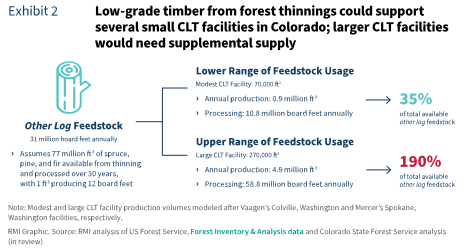
Colorado is facing more frequent wildfires, a shortage of affordable housing, and limited high-quality job opportunities in rural areas. Businesses that process small-diameter trees (9 inches or less) from wildfire mitigation efforts into mass timber, a class of high performance wood building products, could help tackle these issues while also reducing carbon emissions from the construction sector, which is the state’s third-largest source of pollution.
Challenges to developing a mass timber industry in Colorado include supply uncertainties from federally managed forests and a limited logging and milling infrastructure. However, growing demand for sustainable building materials and updated building codes present significant opportunities for businesses and communities if these obstacles can be addressed.
The study recommends a phased strategy for wood product businesses:
Rightsize Now (2–3 years): Increase log supply to existing mills and launch small-scale operations producing nail-laminated timber, dowel-laminated timber, and cross-laminated timber. This approach can quickly boost wood product output, strengthen local businesses, and prepare for future growth.
Plan for Scale (5–10 years): As timber supply expands, scale up to high-volume production of cross-laminated timber, glue-laminated timber, wood fiber insulation, and other advanced products using automated techniques, unlocking new business opportunities and adding value to forest residues.
We would like to express our sincere gratitude to the Gates Family Foundation, Mighty Arrow Foundation, National Forest Foundation, and the United States Forest Service for their generous support. Their contributions have been instrumental in our efforts to efficiently and accurately gather the relevant information for this report. We also acknowledge and appreciate the valuable collaboration of the Colorado Mass Timber Coalition for their tireless work in advancing this initiative.
One difference I noticed on my recent trip to the field was the way of looking at the world. Not surprisingly, technology has changed a great deal in 45 or so years. Folks take tablets to the field, and not paper maps. The view is from a satellite, not from the road, looking down, not looking up. A satellite gives a very different view than even aerial photos (remember them?). Like any way of observing, it’s an additional way to look at the world. There’s a layer for almost everything, that can be toggled on or off, or made more or less opaque.
Which reminds me of (some of) the media. Sometimes, these outfits act like they have an opaque “good guy, bad guy” layer. If a “good guy” does something questionable, it’s not worth looking at. If a “bad guy” does something good, it’s also not worth looking at. Many colleagues have told me that they had interviews with reporters and the story or their comments were never used, and later the story would come out without voices that questioned a certain narrative. They effectively couldn’t be seen through the GGBG (good guy bad guy) overlay. Now, no one will be surprised, if you have been following “media on the media” stories to learn that folks like the WaPo, NYT, AP, Propublica, and various public broadcasting outfits seem to populate their GGBG overlay with partisan political views (generally D’s good, R’s bad).
It seems like in this article Propublica and OPB knows who the bad guys are. It can’t be the Biden Admin.. so it must be the BLM (employees)! In this case, it seems to be that commercial logging is also bad. Did they not interview, or include the take of say, folks at AFRC? If we want to really understand what’s happening, seems to me that we would be well served to toggle off the good guy-bad guy layer.
The BLM also has tried to avoid detailed environmental reviews as it moves to log in new areas, saying it sufficiently considered impacts in 2016. Over and over, conservation groups have sued to demand full reviews, which can be required by federal law. Over and over, courts have decided against the bureau, in most cases directing it to redo its analysis before logging can continue. The BLM lost at least three such lawsuits between 2019 and 2022, with judges ruling that it failed to take a “hard look” at impacts or calling its decisions “arbitrary and capricious.”
Are the desired “detailed environmental reviews” EIS’s? How many lawsuits did the BLM win?
The BLM is moving forward with timber sales in dozens of forests like this across the West, auctioning off their trees to companies that will turn them into plywood, two-by-fours and paper products. Under Biden, the agency is on track to log some 47,000 acres of public lands, nearly the same amount as during President Donald Trump’s first term in office. This includes even some mature and old-growth forests that Biden’s executive order was supposed to protect.
I’d ask, “how do you define mature (was it in the EO?), and exactly what projects are cutting old-growth forests?”
OPB and ProPublica compared the agency’s forest database for Oregon to its timber records and found that in the past two years, the BLM oversaw logging in more than 10,000 acres of forest it labeled as at least 80 years old — the age at which the BLM and Forest Service consider western Oregon’s conifers to be “mature.” The average number of acres of older forest logged annually since the president’s executive order is already higher than in any two-year span since at least 2013.
This whole convo, as it’s been since the Executive Order has been about mature and old-growth in some folks’ minds.
Trees greater than 40 inches in diameter or older than about 175 years are, in most cases, protected under the BLM’s 2016 management plan for Oregon’s Coast Range. But if logging does go forward here, the intact forests these trees now anchor will be transformed, says Reeder, the retired BLM surveyor. The older trees themselves, more exposed in the landscape, could be more vulnerable to windstorms. The soil around them could dry out.
Or they could do better with less competition. Might be good to hear from someone other than one person.
Environmental groups in Oregon can’t challenge every BLM logging project. “We just don’t have the capacity,” said attorney Nick Cady of Cascadia Wildlands, one of three groups that filed a joint lawsuit to stop the plan for Blue and Gold. This one stands out, he said, because of the apparent age of the forest.
It seems like the below piece may have been intended to engender some “last-minute-ism on the part of the Biden Admin, those don’t usually work, except for Monuments.
The BLM still reports to Biden until Trump takes office again in January, and it’s unclear what changes, if any, the new administration will make. Outgoing presidents often use this lame-duck period to take additional action on the environment and to protect public lands. In a statement, White House spokesperson Angelo Fernández Hernández wrote that the “Biden-Harris Administration has made unprecedented progress toward the climate-smart management and conservation of our nation’s forests.” He did not specifically answer questions about why Biden’s actions didn’t slow the BLM’s cutting of old forests — or about any further protections the administration is planning now.
But here the FS is good and BLM bad..
Unlike the BLM, the U.S. Forest Service, the biggest federal forestland manager in Oregon and the country, responded to Biden’s order by proposing to update management plans for all national forests with new regulations for protecting old growth. These plans outline how a forest will be managed — like logging parameters, species protections, restoration projects and road maintenance. The updates will include a prohibition on cutting old growth solely for commercial reasons.
But as Andy Kerr says, the FS already rationalizes the projects it does now for non-commercial reasons, so there’s that. What he asked people to say in comments:
The final record of decision should:
1. End the cutting of old-growth trees in all national forests and forest types and end the cutting of any trees in old-growth stands in moist forest types.
2. End any commercial exchange of old-growth trees. Even in the rare circumstances where an old-growth tree is cut (e.g. public safety), that tree should not be sent to the mill.
Cutting down old-growth trees to save them from potential threats is a false solution. They are worth more standing.
Mature forests and trees–future old growth–must be protected from the threat of commercial logging in order to recover old growth that has been lost to past mismanagement. They must be protected to aid in the fight against worsening climate change and biodiversity loss. And they must be protected to ensure that our children are able to experience and enjoy old growth.
Failure to protect our oldest trees and forests undermines the objectives of this amendment, contravenes the direction of EO 14072, and ignores 500,000+ public comments the agency previously received.
OK, then, I guess, Biden Admin good, FS and BLM employees (?) bad.
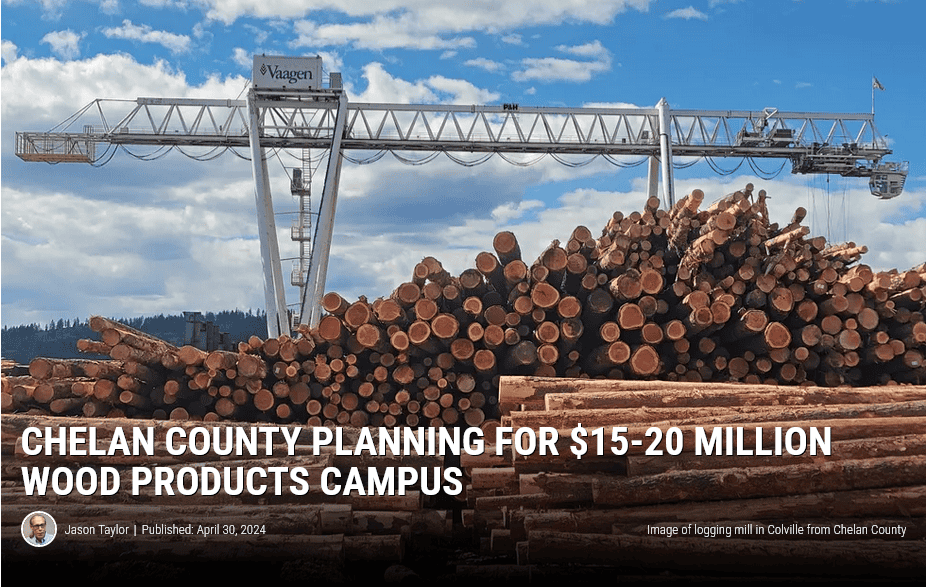
Chelan County is moving ahead with plans for a wood products campus, which would use timber thinned from the county’s forest land to make a variety of wood products.
County commissioners and staff recently toured sawmills and biomass plants in the region to gather ideas for the future facility.
Chelan County Natural Resources Director Mike Kaputa says they’ll look to develop a hybrid type of plant, based on what they saw.
“I wouldn’t say that we saw any one facility that we thought was perfect for Chelan County, but some combination of those things we think is going to be perfect for Chelan County,” said Kaputa. “So, we have a lot of ideas, and we have a lot of partners that are working with us on this, so we’re going to be looking into this very seriously over the next few months.”
Among the stops the commissioners and staff made were in Colville and Wallowa, Ore.
In Colville, they toured Vaagan Brothers Lumber, a company started in the 1950s and today is a leader in the west in sustainable forestry.
In Wallowa, they toured the Heartwood Biomass facility. Heartwood takes wood that is underutilized by the traditional logging industry and turns it into various wood-based products.
Kaputa says they’ll be working to figure out what products can be derived from the Chelan County forest and what type of facility needs to be built.
“We’re going to be talking about, given the work that’s going to occur on the national forest here over the next five to 10 years, what are the best product lines that we think could come from that, and then what kind of infrastructure do we think we could bring here to support that,” Kaputa said.
He said the county has spent two years coming up with several assessments of the wood supply and the different product lines that could come from that wood supply in the forests of Chelan County.
Kaputa said some type of facility will be in place to serve as a wood products campus in two years. He said the price tag would be between $15-$20 million to build the facility and/or convert existing buildings into one of more plants.
He said funding could come through several sources, including county economic development sales tax collections as well as state partners and the forest service itself.
The county has a good neighbor authority agreement to with the forest service to go into the Okanogan Wenatchee National Forest and conduct the work to thin the forest.
The process of thinning the forest of excess timber and using the wood to produce useful products – lumber for building purposes, firewood, poles, wood chips, etc. – would help achieve the goal making the forest healthier and protecting it from wildfires.
Kaputa said the forest land in Chelan County needs held because the decline of the forest in the county is well documented and the need for treatment is well known and well documented.
“Chelan County is the highest risk community in the state for potential wildfire damage,” said Kaputa.
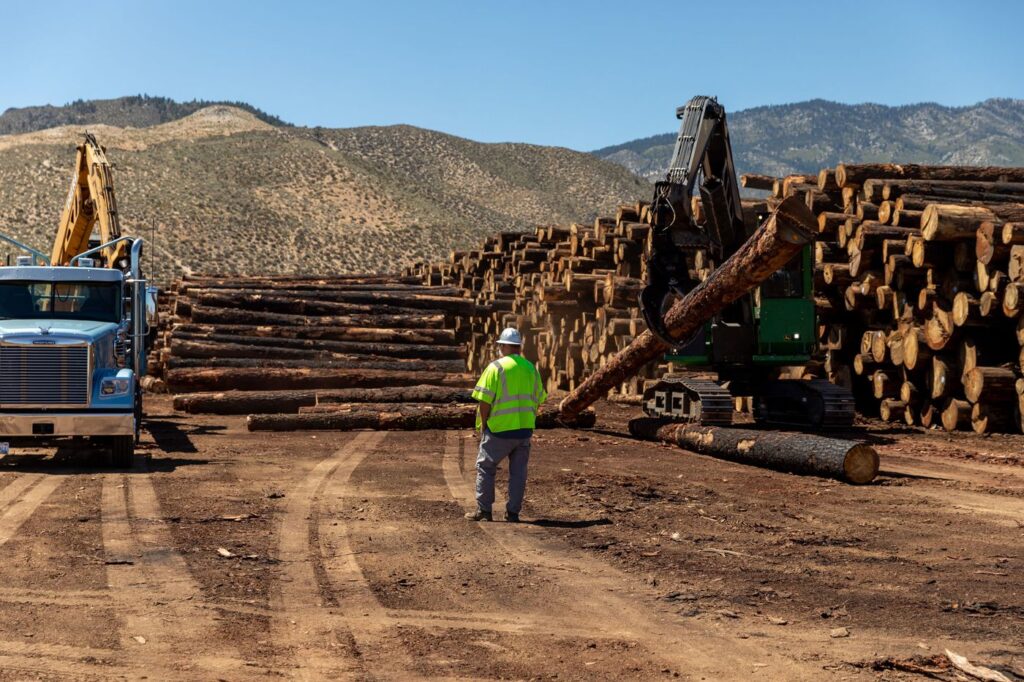
New Tahoe Forest Products Sawmill (courtesy of Bloomberg)
There were many interesting things to explore with the hearing on the Westerman Bill yesterday. As we saw in previous posts, it’s a compendium of many different ideas we can explore in greater depth. What I thought was one theme in Chris French’s testimony was what we might call another Wood Wide Web (broader than the mycological one discussed here a few weeks ago), this one of people, workers and organizations making useful products of wood.
Certainly mycorrhizal fungi help trees. But also people help trees, at least around here, by thinning them and protecting them from fires, planting them and so on. And trees provide us with useful products, often more environmentally friendly than those produced from minerals of various kinds. So, in fact, we as humans have some mutualism going on here with trees. And within that mutualism, we have a complex interrelationship of businesses and workers (from sawmills to CLT to paneling to furniture to horse bedding to sawdust to biochar to bioenergy) that depend on each other. And people who depend on the products they produce, plus employment, plus taxes. So indeed people have their own Wood Wide Web, and while Chris didn’t talk about it in those words, he made the point that this Web is important to forests surviving and thriving into the future, come climate change, wildfires and a variety of other stressors. Or at least that’s how I heard it. We are, indeed, all in this together.
********************************************
Housing is a crisis in many places in the US. And the US is allowing large numbers of migrants in (at least 2.5 million according to NPR) (not judging, just observing). It seems logical that we would need even more housing. Housing tends to be built using wood for various reasons, including cost. We have lots of extra wood from fuel treatment and restoration projects, but it tends to be small. Will new materials like CLT help us build our way out of the housing crisis? Certainly if we look at the Wood Utilization grants of USDA, there is much effort (and funding) going toward Mass Timber, CLT and other efforts. Maybe the future is small, local mills, with local employees scattered through the landscape. Which is kind of what we had, previously, except in the past they focused on larger dimension lumber.
I’m not a fan of top-down industrial policy, but if the wildfire folks can have a Cohesive Strategy, I don’t see why, given the massive amounts of biomass to be otherwise burned, we can’t have a Coherent (and what the heck, let’s throw in Cohesive also) Strategy.
Current Dimensions Used (from AFRC)
I was curious about the size of material being used by current timber industry (including CLT mills). I know there are university and Forest Service experts out there, so hopefully they will add information here or you all can add good contacts.
AFRC generously provided me with their perspective on dimensions:
Log utilization is an ongoing point of contention between the federal agencies and AFRC. The Forest Service in Region 6 generally classifies minimum specifications for sawtimber as an 8-foot log with a small-end diameter of 5-6 inches for most conifer species. The only exception is ponderosa pine where they use a 16-foot log. AFRC has been advocating that the Forest Service use a 16-foot log for all conifer species for several years since most all of our members assert that 8-foot logs with 5-6 inch diameters do not get processed as saw material, but rather end up as pulp or chip material. Most of our members whose mills are designed to utilize small logs are capable of sawing or peeling down to 5-6 inches, but some minor variations exist. However, when delivered as an 8-foot piece, the economics of doing so becomes marginal—hence our advocacy to change that length.
The CLT facilities that I’m familiar with (Freres in Lyons and DR Johnson in Riddle) do not actually process raw logs—instead they secure veneer that has previously been peeled or boards that have previously been cut at other mills and then manufacture them into larger products by gluing them together. Generally speaking though, the products that are delivered to CLT facilities can be cut/peeled from small, medium, or large logs.
From loggers to end users – all of whom are currently involved in a complex exchange of material and value. Fiddling with a part may cause a series of consequences throughout the web. And 16 foot logs with 5-6 inch diameters are pretty small. With, no doubt, transportation costs being a big thing. Again, the web. Again, the need for a Double C (cohesive and coherent) strategy.
Academic Horsepower and Successful Industry-Chicken or Egg?
If your state has a prominent forest industry, generally (but not always) universities hire experts to help them, and conceivably the rest of us who use wood or want to get rid of biomass. But if your state doesn’t, then they probably don’t have experts. Which could be a problem if you want to support new industries, in that there are no/few experts to help entrepreneurs.
As I was writing the above on transportation costs, I received an announcement of a webinar by Drs. McConnell and Tanger who seem to be forest economics/wood utilization/operations experts.
Wood-using sawmills prioritize availability of raw materials, their accessibility, and associated transportation costs as the main drivers of new mill constructions and financial viability of existing mill operations. One of the major hurdles faced by the forest sector is hauling costs. Hauling costs have commonly been cited as comprising 35 to 45% of the delivered cost of round wood. Join us to learn how road network repairs could benefit both the forest sector and the broader Mississippi economy.
California’s Wildfire and Forest Resilience Task Force Market Development Program
I don’t know how many economics and utilization professors California has (I know there’s some in Extension) but they have a market development program that’s interesting. They have five pilot programs:
to establish reliable access to forest biomass through a variety of feedstock aggregation mechanisms and organizational innovations. The pilots will develop plans to improve feedstock supply chain logistics within each target region through the deployment of a special district with the authority and resources to aggregate biomass and facilitate long-term feedstock contracts. Each pilot will assess market conditions, evaluate infrastructure needs, and work to enhance economic opportunities for biomass businesses in their project regions. The pilots are distributed across 17 counties in the Central Sierra, Lake Tahoe Basin, Northeast California, North Coast and Marin County.
Their rationale is:
Diverting forest residues for productive use can help increase the pace and scale of forest restoration efforts in California, reducing vulnerability to wildfire, supporting rural economic development, and promoting carbon storage. The Wildfire and Forest Resilience Action Plan identifies the development of, and access to, markets for these residues as a key barrier to conducting necessary treatment activities across priority landscapes in the state. The development of such a market for residues has been hampered by the lack of any centralized broker capable of entering into long-term feedstock supply contracts.
Washoe Sawmill Opens
I posted about this last year, The Tahoe Fund, Tahoe Forest Products LLC, and the Washoe Development Corporation worked together to build a new mill. Here’s a link to a Bloomberg story. Region 5 has a good story about it opening, with some interviews and a historical perspective. Shout out to writer Andrew Avitt!
“The truth is, the forest, it needs our help,” said Serrell Smokey, Tribal chairman for the Washoe Tribe of Nevada & California, at the Tahoe Forest Products sawmill opening Dec. 18, 2023, “Our people have intervened in these areas since the beginning of time, because otherwise, if we don’t take care of it, it will take care of itself.”
********
There is a mutually beneficial relationship here – land management agencies need to treat landscapes and the timber industry needs timber. There used to be an old saying of “trees paying their way out of the woods.” That meant the value of the timber would help offset the cost of treating an area. While that’s not the reality on the eastern side of the Sierras, having a mill infrastructure in proximity drastically improves the economics of the type of work that’s needed to restore landscapes in the West.
When timber business makes assessments about when and where to take on a contract, they look at a number of factors — fuel and labor costs, and market prices for timber. But there is one factor that tends to be the most prohibitive — distance.
The further a log has to travel to arrive at the nearest mill increases fuel and labor costs and decreases a business’s profit. Depending on all the variables, the breakeven distance is about 50-80 miles from forest to mill.
Before the opening of Tahoe Forest Products mill in Carson City, the closest mill was in Quincy, California. That’s more than 100 miles from many of the areas that need work on the Humboldt-Toiyabe National Forest.
“Since the mill has opened the conversation has definitely changed,” said Monti, “Now contractors are calling and saying, ‘hey, I heard this new mill went in. I’m really interested in doing work on this side of the mountain.’… We have not had that option for the last several decades.”
Note the transportation costs, and the shimmering of the beginning of a new working-wood-wide-web. I always wonder why California seems to be different from Oregon in its appreciation of the Web- maybe the Timber Wars are still resonating.
If you watched the Forest Service budget hearing, a few of the Senators brought up Mass Timber and CLT (cross-laminated timber). The National Museum of Forest Service History had an excellent explanation (with photos) in their newsletter. They are also having an auction until April 15, I’ve bid on a couple of places to stay and there’s other good stuff as well. The below and attached newsletter is reprinted with the permission of the National Museum. I thought this was a great article, so shout-out to the Museum and to Tom Chung! I just excerpted the introduction below, and the article itself is here.
By Tom S. Chung, FAIA, Principal, Leers Weinzapfel Associates
Many of us may have heard of the term “Mass Timber” but are not sure of what it is, although I would say that many, if not all, of us know what a “wood building” is and have been inside one from log cabins to solid heavy timber office buildings to curved wood structured churches. A Mass Timber building is in one sense, simply a wood building that uses large pieces of wood instead of smaller pieces of wood like lumber (2x4s and 2x6s) that we see being used for single family houses and multifamily housing 5 stories tall or less, all over the country for the past sixty plus years.
Mass Timber as the name implies is made of heavier (or larger) pieces of wood and its earliest examples are the solid heavy timber buildings that were built with old growth trees that made possible large cross sections of columns and beams often greater than 1’ x 1’ and more from a single tree trunk just debarked and cut to size.
But Mass Timber today is a highly engineered product that is assembled into even larger building elements with just lumber (2x4s and 2x6s) or even smaller laminations. Unlike
solid heavy timber that relies much on the characteristics of a single tree and a large safety factor since no two trees are the same, mass timber today is much more predictable and precisely engineered to meet the necessary loads with material efficiency. It is also fabricated in a factory in a highly automated way using digital technologies and equipment and assembled on site quickly and quietly, instead of being constructed piece by piece on site with lots of construction time and material waste.
While most civilizations began building with wood, as it was plentiful and easy to shape with simple tools, our modern society and its need to build bigger and taller buildings over the late 19th and 20th centuries in urban centers, coinciding with the results of industrial revolution which began a century earlier resulted in wood being displaced as the main building material by steel and concrete.
Though wood remained throughout the past century as a building material for smaller structures such as single family homes and small multi-family housing, the emergence of mass timber today makes possible the use of wood as a building material previously reserved for steel and concrete, allowing us to build these larger, taller and more complex buildings now in wood, with a renewable building material with less carbon emissions that helps address the building industry’s responsibility towards climate change.
In addition to being a solution to build more responsibly with less carbon footprint, mass timber buildings, unlike light-frame wood construction often expose the wood since it doesn’t need to be covered up by painted white drywall. This allows for the inherent biophilic attributes of wood to be experienced; visually appealing color and grain, the warmth to touch, the fresh pine scented smell with the humidity and moisture regulating properties of mass timber provides a full tactile experience that enrich the daily routines of those who live and work in these buildings.
Products
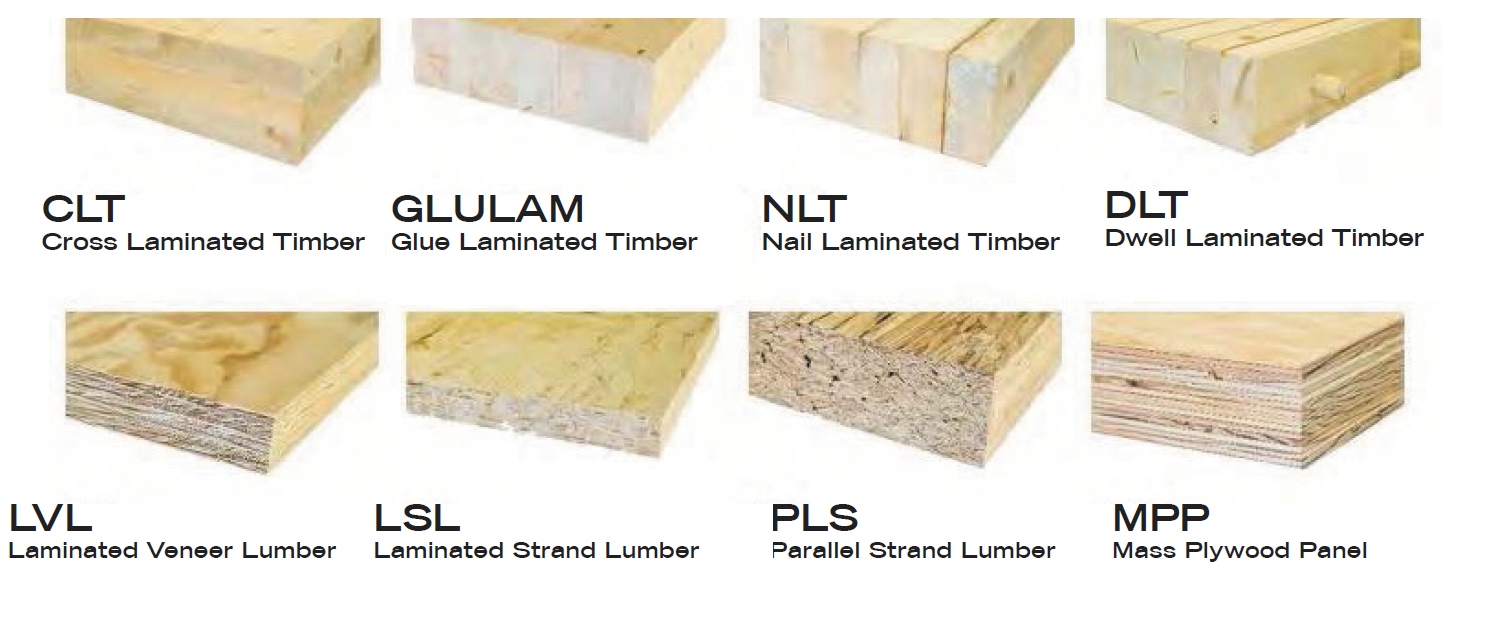
Among the commercially available products in the mass timber category are Cross-laminated Timber (CLT), Naillaminated Timber (NLT), Dowell-Laminated Timber (DLT), Mass Plywood Panel (MPP), Glue Laminated Timber (GLT) and glulams, Laminated Veneer Lumber (LVL), Laminated Strand Lumber (LSL) and Parallel Strand Lumber (PSL). They range in costs, appearance
and applications.
Nail-Laminated Timber or NLT are simply lumber (2xs) nailed together in a one way span between beams to make solid floors and usually require a layer of plywood on top for lateral stability. They are simple to build, do not require expensive factories and are on the less expensive end of mass timber product costs. But since there are nails, they cannot be cut with CNC machines
and are more limiting structurally and architecturally in general. Dowell-laminated Timber or DLT can be seen as an evolution of NLT in that the steel nails were replaced by hardwood dowels so that it could be CNC cut and made in a highly automated factory like other mass timber products. It appears similar to NLT and also spans one-way between beams but also with increased
structural and architectural possibilities at a higher cost.
Glulams, similar to NLT as mass timber products have been around for over eighty years. They have been used mostly as beams and columns (linear elements) and can be seen in many old churches and gymnasiums as large curved or arching elements. But they can also laid flat on their sides and with successive pieces become floor assemblies, similar to NLT or DLT.
In this configuration as floor panels, they are called “GLT.”
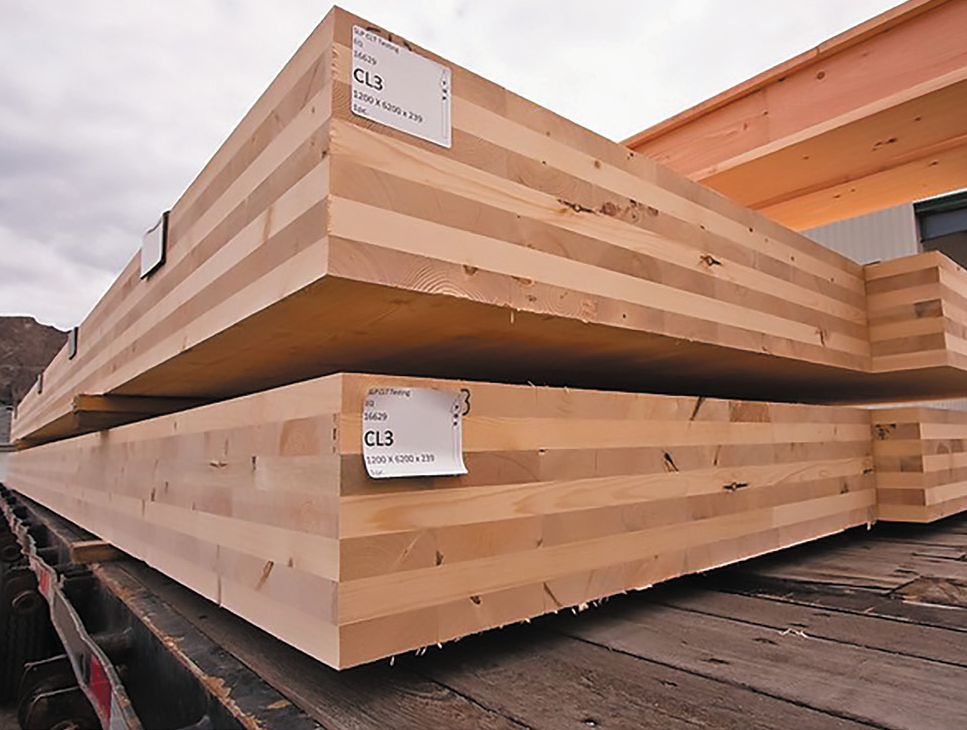
Seen often in combination with glulam beams and columns are Cross-laminated Timber or CLT panels It is the most well known and most talked about mass timber product today given its versatility. It was first commercially developed in Europe with factories in Austria, Germany and Switzerland about 25 years ago, then to Canada and now gaining traction in the US over the past 5-7 years. CLT arranges lumber laid flat, with each successive layer in a perpendicular direction such that unlike NLT, DLT or GLT the grain of the wood is oriented in perpendicular directions rather than a single direction. This allows for a greater dimensional stability and a two-way span capability and possibility of being point-supported with just a column and without beams. However, most CLT floor panels are still used as primarily one-way systems in conjunction with beams and columns given the simpler engineering involved and greater spans and column spacing that it enables. But the two-way structural capacity of CLT panels also makes it ideal not only as floor or roof (horizontal) panels but also as wall (vertical) panels. Many buildings utilize CLT in this way as load bearing walls and even as building cores for egress stairs, elevators and mechanical, designed to also take on lateral loads such as wind and seismic loads.
As versatile as CLT but very different in appearance is Mass Plywood Panel or MPP. MPP are simply layers of plywood (usually 4’x8’ and ~1” thick) laminated on top of each other to make thick, wide and longer panels of 8’ x 40’ or greater and from 4” to over 1’ thick, similar to CLT, NLT and DLT. Like CLT, MPP can span in two directions, be point supported with just columns and are dimensionally more stable. It can also be used as floors or walls and take on lateral loads. But unlike CLT in which each layer is made of 2x boards which can be seen, it’s made of plywood and one can see the whole or partial pieces of the 4’x8’ plywood in its appearance.
Although CLT precedes MPP, as plywood preceded CLT and as they both can span in two directions as they have the grain of wood oriented in perpendicular directions, CLT is sometimes referred to as “plywood on steroids.” Similarly, as CLT, like DLT and MPP are made in a highly automated factories with multi-million dollar investments in the production equipment-such as presses, CNC machines, glueing, dowelling, sorting and finger jointing machines with butterfly tables and vaccum lifts-all with associated costs. NLT has been referred to as “poor man’s CLT” given its relatively low cost and low production factors.
Laminated Veneer Lumber (LVL), Laminated Strand Lumber (LSL) and Parallel Strand Lumber (PSL) are veneer or strand-based products with much higher glue to fiber ratio and mainly used for their additional strength properties as compared to lumber, often as columns or beams in conjunction with light frame wood construction where stronger members are needed. Though they can be exposed to view, they are often hidden behind drywall just like light frame wood construction. Though they are technically in the mass timber category, they are less associated with mass timber as they are not used for large floor or wall panels or columns or beams that support them as described earlier with with CLT, NLT, DLT, MPP, GLT and glulams.