Wildfire Tech, Building Trust and Anon.R.One’s Experience With Some New Technologies

Not a wildfire technology mentioned in the post.
It seems to me that we (well not TSW-ites exactly, but Those Currently in Power have an opportunity to build (via the USWFS in cooperation with USDA) an open, transparent system for coordinating and on-the-ground validation, plus ensuring interoperability, of the many new wildfire technologies. Megabucks are to be made here, and much marketing hullabaloo exists, and NGOs, universities and foundations are trying to guide and help out. It looks like a money-sucking cluster from here, but what do I know?

To build trust, we (they) could explicitly find out and acknowledge the fears of people going into this.. from privacy, to claims of AI decisions response and legal accountability, to the voices of on-the-ground firepeople going unheard while folks like Lockheed Martin, Raytheon, NASA and NOAA and so on dehumanize and deculturize our relationship in communities with wildfire. Those are just fears I can conceive of, I’m sure there are others out there. My own experience, with genetically engineered plants, was that people developed them without considering fears and then tried to overcome fears at the end of the process by talking more. When they could easily have been designed with those factors in mind, leading to quicker implementation (and better relationships). It also has to do with silos- what seems to be a great solution in one silo is not so great considering the whole picture.

As Anon.R.One stated in his comments:

There’s an impression that these groups are here to tell the people on the ground what they need and why their product solves some unknown problem, as opposed to listening to existing issues.

Conceivably a system of coordination of efforts could be designed with a USG review process involving a team of users. We already know how to do this.. think FIA.
I bolded a few of A’s sentences.

Here are more of Anon.R.One’s comments:

I think I’ll broadly agree with Rand’s key findings here. Certainly no disagreement with the funding emphasis on suppression and gravitation toward headline-grabbing ideas. My subsequent complain will mostly focus on suppression as well. As an end user, the hype surrounding new products, applications, and technologies is highly frustrating.

The past few years there has been a steady push to develop ‘real-time’ ignition detection of wildfires using satellites and AI. We finally got to test this product last field season. It was non-functional in mountainous timber (both false positives and numerous known fires not being located), maybe it does better in open grasslands or shrubs. Yes, the product is still being developed, however advocates declared how simple and easy it would be pull off. Conversely, it appears that newer AI-linked camera systems have been pretty effective at detection, or at least helpful. We don’t need 6 tools that all sort of do 60% of one job, just one that does 95+ will suffice.

This past season crews also got to work with a ‘smart tank’ (I tried finding an online example, but couldn’t). The smart tank is essentially a porta-tank/folda-tank with a pump that is dropped off by a helicopter intended to be used remotely away from a water source on a large incident. Sounds like a decent enough idea. But it is also intended to be filled by a helicopter. So in practice the tank gets dropped off and the helicopter returns to fill it up with a bucket, possibly flying past the area of heat, then dumps a load of water into the tank whereby much of the water sloshes out as water dropping from a 100 feet up will do. Ultimately this leaves the tank never more than half full and turns into a waste of resources. Just have the helicopter do trailing drops… or save $40k+ a day and send it away and let the crews mop up.

Often the problem (long running issue at that) for suppression is moving large quantities of water uphill. It seems the water needed to extinguish a fire are often underestimated, thus energy demands are underestimated. Another recurring issue is the one-size-fits-all approach. Just because something works in on locale, doesn’t mean it can be easily applied across the country. The success of internet/cell connectivity dependent technologies is also highly location dependent and often this seems to not be realized by technology developer types.

MTDC has created custom products for us that have very limited national appeal or scalability. This has been a great resource and should continue to be funded. A change that I would welcome would be the adoption of the Canadian Quick Connect hose fittings but this certainly isn’t headline grabbing or riling up investors.

My point here is that it seems innovator/investor groups often underestimate the true needs and are in a hurry to get something out the door to secure a contract and make that money. There’s an impression that these groups are here to tell the people on the ground what they need and why their product solves some unknown problem, as opposed to listening to existing issues.

Probably the biggest ‘innovation’ on the suppression side over the last five to 10 years has been the adoption of existing military technology for detection and reconnaissance. Fire managers saw products from overseas operations and realized it would be pretty useful in suppression and pushed for access. This resulted in better detection capabilities, real-time reconnaissance, and perimeter mapping.

Likely the second biggest change has been with the UAS program. Again fire managers recognized the technology existed and they thought it could be helpful. Managers went to drone manufactures asking the manufactures to create or modify drones to accomplish specific tasks.

While it has more limited uses, the California National Guard FireGuard program is pretty neat to follow.

Point being, ask fire managers what they need, not what the politicians and venture capitalists think managers need.

Here’s a link to a story on FireGuard

I’d only add philanthropists, NGO’s, and researchers to that list.

There have to be models out there for user-directed technology development in terms of prioritizing, reviewing, independent field testing and so on. other than FIA.

National Post-Fire Recovery Environmental Assessment: Comments Open on NOI

Slater Fire Road Risk Reduction and Safety Project: Rogue River-Siskiyou
Here’s the press release:

The U.S. Department of Agriculture’s Forest Service today announced plans to prepare a national environmental assessment to expedite post-fire recovery work on national forests and grasslands. The Notice of Intent is now open for public comment in the Federal Register.

Because severe wildfires are larger, more complex, and burning longer, recovery efforts have become more challenging and expensive. Burned landscapes are susceptible to hazards like erosion and flooding, which threaten lives, damage property, contaminate drinking water and destroy communities. This new approach aims to streamline work to reduce these post-fire hazards by planting trees, repairing infrastructure, safeguarding water quality and performing other critical stabilization work.

“Restoring forests after a wildfire is not something we can delay, especially when public safety is at stake,” said Forest Service Chief Tom Schultz. “Post-fire recovery actions need to be immediate and comprehensive to protect the future of our forests and the people who depend on them.” 

This action aligns with President Trump’s Executive Orders on Unleashing Prosperity Through Deregulation, Immediate Expansion of American Timber Production, and Empowering Commonsense Wildfire Prevention and Response. This action also aligns with USDA’s interim rule, which improves how its agencies implement the National Environmental Policy Act.

“This effort is about resilience,” added Chief Schultz. “We’re not just recovering from a fire. We’re building landscapes that can withstand the next one.” 

Public comments are open until January 26, 2026. More information and progress updates are available online at https://www.fs.usda.gov/managing-land/disaster-recovery/post-fire-recovery.

***********

It sounds like a Programmatic EA, to which project documents could be tiered. Other TSW folks may remember other programmatics, I recall a Western Spruce Budworm and maybe a Seed Orchard Insecticide. It sounds like the FS thinks “much of the analysis in these documents is repetitive and could be done once, with local folks adding the site-specific requirements and concerns later in each project document. In addition to being an info-roundup for later decisions, there might be some kind of extra legal force attached to a programmatic? Perhaps our legal friends can fill us in.

I tend to think “the permitting problem is not NEPA, it’s litigation on NEPA, because analyses can be endlessly poked at, and so litigation-proofing leads to extra, potentially unnecessary, work and expanded uncertain timelines.” When something is not controversial to people or groups with lawyers, teams do the work, take comments, review and get the decision out. Of all the activities mentioned here, I think the previously most litigated have been salvage and hazard trees. I also wonder whether an advantage of a national approach is to work out some kind of national consistency in approach with regulatory agencies. Even if those projects continue to be litigated, the FS will still have saved time by tiering from the programmatic.

Here’s what NASA says about programmatics (interestingly for the Mars Sample Return Flight Elements- who knew they did NEPA for that?):

Programmatic National Environmental Policy Act (NEPA) documents are typically used to assess the environmental impacts of proposed policies, plans, programs, or projects for which subsequent actions will be implemented based on the programmatic analyses. Program-wide NEPA compliance allows for greater efficiency in preparing NEPA compliance documentation for individual projects by reducing repetitive analysis. The programmatic document provides the foundation for subsequent specific actions that “tier” from the programmatic document. Tiering allows reference to broad analyses in the programmatic document, thereby streamlining the subsequent NEPA analyses in an efficient manner as a good steward of federal funding.

Most of the programmatics I know have been EIS’s but I don’t see a reason it couldn’t be an EA. Ilooked around and the BLM has a Statewide Wildland-Urban Interface Fuels Treatments Programmatic EA for the State of California.

For NEPA nerdly types, there’s a discussion of programmatics in this “Final Guidance for the Effective Use of Programmatic NEPA Reviews”. The discussion is interesting but the guidance may not be current based on the current judicial and executive branch NEPA shuffling. Anyway…

The Forest Service develops post-fire recovery projects and routinely conducts individual environmental reviews for these projects. A national review of Forest Service post-fire recovery analyses under the National Environmental Policy Act shows that, regardless of location, these projects occur in a relatively similar manner and have similar environmental effects across the agency (timing, impacts, and methods of implementation), with the most noticeable differences being site specific design criteria or mitigation measures. As such, the Forest Service is preparing an environmental assessment to analyze the effects of general post-fire recovery actions on National Forest System lands in the continental United States to help facilitate subsequent site specific analysis if needed. The agency recognizes the need for:
• Appropriate standardization of project design and implementation, while providing flexibility to address local conditions;
• More rapid, efficient, and effective response by local managers to quickly changing post-fire conditions; and
• Strategic use of limited resources (for example, staff and budget).

There generally is a need to address burned areas in an expedited manner to accelerate post-fire recovery to restore safer, healthier forests in a timely manner at a
landscape scale. The purpose of proposing this action is to analyze actions that are common to post recovery to facilitate more efficient site specific analysis that allows the agency to more timely:
• Mitigate hazards to infrastructure;
• Reduce combustible materials, such as trees damaged by fire, and woody debris;
• Harvest fire-killed and damaged trees before they lose their economic value; and
• Establish restored forest conditions after a fire.
**********

Grim Wallace-Wells Op-ed in NY Times: Which City Burns Next?

There was an interesting essay in the New York Times by David Wallace-Wells, probably due to the anniversary of the Los Angeles fires of 2025.

One year ago this week, the Santa Ana winds roared over the Santa Monica Mountains at over 60 miles per hour, gusting up to 100 in some spots in what some people called, loosely, once-in-a-century fire conditions. What followed was a new kind of fire disaster, for which even the fire-wise communities of the American West seem deeply unprepared.

One moral of this story: Last January’s catastrophic fire disaster did not have to be a catastrophe at all, only a close call.

Another moral comes from the wisdom repeated to me by firefighters, policymakers and researchers over the past year: that there is more to fire risk than ignitions and fire response, that what can burn will eventually burn, and in a landscape baked by warming in which human structures have been erected in open defiance of known risk, some of those fires will prove catastrophic. “California is built to burn,” the fire historian Stephen Pyne once told me. “It is built to burn explosively.”

As I was writing this, I received notice of fire weather and ongoing fires in my area from Watch Duty. I don’t think that that’s actually true. I don’t think Downtown Denver will burn because we happen to be in a “landscape baked by warming in which human structures have been erected “in open defiance” of “known risk.” I’m not sure what the florid writing style adds or detracts from the points he is trying to make. Because you could argue that about any place in the western US, even the Great Plains. In my area, we are building housing and expanding into grass areas- it makes housing more affordable. Maybe we should all live in tower blocks in Connecticut?

But the Los Angeles fires mark a new phase, and seem to affirm a new consensus among a certain cohort of fire experts, that we have fundamentally misunderstood the nature of the problem and mismanaged fire risk as a result.

We’ve seen a lot of “new phases”, Marshall Fire, Paradise and so on.. count me skeptical. There have been many “new wildfire paradigms” proclaimed over the years.

Watching from afar, we still reflexively call these disasters “wildfires,” perhaps imagining that they ignite in some distant forest. But there may be little truly “wild” about such fires beyond the ferocity of the burn. Increasingly, disaster strikes almost entirely within an urban envelope, drawing on homes and landscaping for fuel rather than trees and wild brush. These are not forest fires encroaching on human settlement but rather human settlements burning like only forests used to. And stopping them will require something much harder, and more unpopular, than clearing out distant forests of dead wood.

As a native Southern Californian, this framing fascinates me. But how about this.. fire spreading in suburban areas is a problem. Ignitions can come from outside or inside the relatively urbanized area. In some cases, (in Calif, for example) they can build up quite a head of steam before they get to the suburban boundary (if there is even such a thing, perhaps it’s really more diffuse). Of course, “disaster” strikes within an urban(ized) envelope, because it wouldn’t be a disaster if there weren’t people there. And where did “clearing out distant forests of dead wood” come from?

The climate scientist Daniel Swain has called the phenomenon the return of the “urban firestorm,” a throwback to horrors from centuries past, when cities such as Chicago and San Francisco could burn for miles and days on end. By the middle of the 20th century, that kind of urban fire had come to look like an extinct beast.

Actually I found this kind of funny.. changes in climate (in urban areas? where the vegetation seems to be the same kind planted 50 years ago?) cause us to return to the past. We stopped urban fires via improving construction and suppression practices.
***

Probably, the list features your most vivid impressions of our new age of wildfire. But in 2023, a group of researchers reviewed some of the decade’s most nightmarish fires in the Proceedings of the National Academy of Sciences, or PNAS, and declared that “wild-land-urban fire disasters aren’t actually a wildfire problem.” The ignitions weren’t wild, the predominant fuel wasn’t wild, the surrounding landscape wasn’t really wild land and wild-land firefighting wasn’t able to change the outcome, either.

Not to disagree with “a group of researchers” but when fires start on wild (or wild-ish) land and develop a head of steam before heading into urban areas.. in the case of the Palisades Fire, this occurred in Topanga State Park… which is wild-ish and were they wildland firefighters? I think this might be a definitional nightmare.. think of the Marshall Fire with the firepit and the electric lines..

In our grassy open areas “wildlands”, we put out wildfires before they get to houses. But maybe grass fires aren’t “wild”? Were the folks told to leave the Bachman fire wildland or not? Maybe all this is saying is that urban and adjacent wildish (grazing or shrublands) lands are all intermixed and have to be considered on the ever-popular “landscape scale.”

The problem is often defined almost entirely in terms of forest management, as it was in a 2022 Wildfire Crisis Strategy document prepared by the Department of Agriculture. But federal land increasingly contributes little to disasters in urban and semi-urban settings, said David Calkin, the lead author of the PNAS paper and a pioneering fire-risk scientist who recently left the U.S. Forest Service lamenting its direction under President Trump.

“We know the wild lands need fire,” he said. But we also need to stop pretending that these disasters are wild-land fires. They aren’t. “It’s a different beast,” Calkin said. Instead, we should start thinking about the risks of those disasters primarily in terms of community design: how homes are built, with what materials and in what configuration. Instead of thinning fuels in the wild land, as we’ve struggled to do now for decades, perhaps we need to thin the fuel of the community itself.

I think we’ve been saying and doing this for years, think CWPP’s and so on. Plus there is an extensive social science literature on community mitigation and prescribed fire.

Ideally, it would involve redrawing property lines and reconstructing houses with fire-hardened materials and fire-smart principles; a much more aggressive program of landscape management and more small-scale prescribed burning; eliminating or at least limiting flammable vegetation; retraining urban firefighting forces to prepare for the new threats; establishing some permanent firebreaks; and perhaps rerouting roads and homes away from natural wind patterns. If we could do all that, we could find our way to a much more comfortable relationship to California fire, probably, even with climatic changes that seem to increase those risks almost year by year.

“The astonishing thing is not that Los Angeles burns but that so much of its development has enhanced rather than blunted the threat from fire,” Pyne, the fire historian, reflected last January. The city was built with exposed wood and shake-shingle roofing, he pointed out, making homes “maximally primed to burn”; demand for public forests and parks meant, for all their pleasures and beauty, fire risks were mostly preserved within the design of the city itself; suburbs invariably pressed up against brush landscapes, which generate new fuel basically every time it rains.

You might hope that a disaster like the fires last January would prompt a reckoning with the way those communities were designed, with property lines perhaps redrawn to better resist future fires. But the interest in rebuilding quickly is too great, from homeowners and investors alike, such that the state has been forced to waive certain building codes to accelerate progress in Palisades, Malibu and Altadena — which have only just barely begun to rebuild.

Fire response remains a problem, too: Urban firefighting forces are unaccustomed to fires burning through dozens of homes at once, and wild-land firefighters who may be called in to help are unaccustomed to fires burning through urban environments. And there are problems of fire oversight. An after-action report prepared by the L.A. Fire Department was watered down, downplaying, for instance, failures in leadership. The original author of the report and the department’s battalion chief, Kenneth Cook, called these edits “highly unprofessional.”

At the state and national level, there’s been inconsistent guidance and erratic implementation concerning fuel reduction in parks and national forests, such that even those places with plans to thin the landscape of brush and other fuels aren’t always effective in doing so. A wildfire management plan prepared by California State Parks just before the fires a year ago called for allowing fires to burn through large parts of Topanga State Park, where the Palisades fire began, so long as they didn’t threaten homes and other “fire exclusion zones.” The plan also outlined several “avoidance areas” where firefighting was meant to be restricted. In the months before the fires, several projects were designed to thin fuel in parts of the Palisades that burned, including one project completed less than 36 hours before the initial fire began.

Officials highlighted homes where better landscaping may have saved the structures from the recent fires. Homeowners pointed to examples of others where action hadn’t been taken and they still survived. The two sides argued over studies showing that home hardening was more effective against fire than vegetation management was, and homeowners asked why fire risk should require tugging hedges out of the ground but not replacing wooden porches or door frames.

Perhaps some of this sounds reasonable, or perhaps it sounds like fire-safety NIMBYism. But the problems are much larger than Brentwood, with hardly any community in the state seeming to meet the challenge of urban fire at the appropriate scale — which is growing. Above the problem of homeowner resistance you can stack local officials, who are rarely comfortable challenging the preferences of their constituents and the aesthetic sensibilities of the California dream, embodied by non-native and often quite combustible vegetation. Above that, you can stack local planning and zoning, which has often produced communities like the Pacific Palisades where streets can serve as wind tunnels carrying embers from home to home so efficiently that even an initial burst, Calkin said, could ignite as many as a hundred homes almost simultaneously.

I wish people would talk more about mechanisms. Sure, these are urban fires. But if they are urban fires, how does climate change enter in? Is urban vegetation drier than it used to be? we see a great deal of sprinklers and non-native water-loving species in landscaping. Why are urban fires more widespread and problematic than they used to be? Yes, there are more houses where there weren’t before in the Marshall Fire, with notably dry periods and high winds. But the Palisades and Altadena have been around longer than I have, with notably dry periods and high winds.

The comments on this piece were also interesting. Many people suggested not using wood for housing, but others pointed out that wood is best for earthquakes. Some of the commenters articulated their concerns and different views of different kinds of vegetation removal compared to changes in exterior materials.

After I read a story like this, it reminds me how rare these disasters continue to be.. which means that most ignitions in urban and WUI mixes are not getting out of control. Just like the one put out while I was writing this. And all the folks around the West working with their communities on home-hardening, mitigation and evacuations projects. It would be interesting for a reporter to go back and see what changes have been made in the Boulder County area after the Marshall Fire. Anyway, I found this a bit of a grim opinion essay.. and again, it never seems like these folks juxtapose “things getting worse” with “technology making vast improvements” as we noted yesterday.

Rand Report on Accelerating Wildfire Innovation: LA Times Op-ed


Thanks again to Nick Smith for this link! Apparently the folks at Rand have figured out something I wrote about a long time ago…I’d only add that I’ve seen companies jockeying for federal and state funding for their technology- and without some centralized review process funding could fall victim to “good folks in my district” pork-diffusion.  Personally, I have more warm fuzzy feelings about DOE than military and intelligence models. Because.. well.. transparency and accountability lead to trust. From the LA Times op-ed.

Yes it’s true.. big government fund channels and philanthropic funding channels have entered what has traditionally been more or less “our” wildfire space.  We (and our science and tech) are likely to become minnows to their sharks, accept these new entrants with some kind of grace, and yet maintain our very important land and boots on the ground-related seat at the table.  I hope there are folks at the new USWFS thinking about all this. My worry would be that all the excellent on-the-ground research done by Forest Service R&D would get subsumed into the NASA/NOAA and associated contractor funding ecosystem.. more Lockheed Martin and less Missoula Tech Center.

These tools can’t eliminate wildfire, nor should they, because fire is a part of healthy ecosystems. But they can reduce wildfire’s destructive potential. They can lead to fewer evacuations, fewer neighborhoods lost, fewer lives turned upside down.

So why aren’t they widely deployed?

The United States lacks a coherent system for advancing and scaling wildfire technology innovation. Diverse actors — including federal and state fire and land management agencies, local fire districts, tribal governments, utilities, insurers, research institutions and private companies — operate under different authorities, budgets, procurement rules and data systems. Innovators who want to help don’t always know where to go. Philanthropies fund pilot programs, not adoption at scale. Fire agencies struggle to test or purchase new and unproven technologies.

And yet we have examples of what effective innovation can look like. Within the U.S. military the Defense Innovation Unit identifies promising commercial technologies and helps the services field them within a year or two. At the federal Department of Energy the Advanced Research Projects Agency-Energy identifies high-risk, high-reward technologies related to power generation, transmission and storage. In‑Q‑Tel, a nonprofit created by the Central Intelligence Agency, uses a venture capital model to invest in commercial technologies needed by intelligence and national security agencies.

None of these organizations invented every technology they advanced. Their success came from creating connective tissue. In a recent study, colleagues and I looked at how the models that led to those successes could help strengthen the wildfire technology innovation pipeline.

Wildfire needs its own version of a federal coordination entity dedicated to connecting innovators, funders, researchers, fire agencies, utilities and communities. As a neutral coordinator, such an entity could scan emerging technologies for broad situational awareness; establish shared standards to support interoperability; assist with testing and adoption to strengthen buy-in by end users; help innovators and state and local agencies navigate procurement challenges; and provide targeted funding to accelerate deployment. It also could ensure that innovators and investors look beyond headline-grabbing fire-suppression tools and instead toward mitigation and prevention technologies that can save lives and money in the long run.

Land management, controlled burns, updated building codes and community planning all remain essential. Technology can make those efforts more effective. It can give firefighters better information and residents more warning. It can help communities to avoid disaster or, failing that, to recover faster.

Some states, utilities and federal agencies already are pushing innovation. For example the California Department of Forestry and Fire Protection, known as CAL Fire, created a new Office of Wildfire Technology Research and Development. Colorado created a center of excellence to bring innovation to aerial firefighting.

But without national coordination, progress remains uneven. Communities with fewer resources risk falling further behind.

The anniversary of the L.A. wildfires is a reminder of what is at stake. Americans have transformed public risk systems before — in national security, earthquake preparedness, hurricane forecasting and aviation safety — through coordination and smart investment. Wildfire should be next.

Patrick S. Roberts is a senior political scientist at Rand and an author of the recent report “Accelerating Technological Innovation Across the U.S. Wildfire Management System.”

Here are the report’s key findings and recommendations:

Key Findings

  • The wildfire management cycle spans prevention, preparedness, response and suppression, and recovery, but most attention and resources go toward suppression.
  • The wildfire technology innovation system is polycentric and complex. Authority is distributed among federal, state, local, tribal, territorial, private, and nonprofit actors.
  • The innovation system consists of innovators, accelerators, and users of technologies, but few accelerators provide funding, share information, and provide opportunities for pilot testing. The lack of accelerators limits innovations from being developed and adopted at scale.
  • The innovation system’s strengths are its many innovators, multiple paths for funding and innovation, and its committed individual champions.
  • Its weaknesses are the silos that limit coordination, fragmented and primarily small-scale budgets for new technologies that do not support larger or long-term projects at scale, and markets and incentives that skew toward suppression technologies. These three limitations, in turn, create a variety of challenges faced by innovators and users of technologies.
  • The system’s fragmentation impedes coordination, and its constrained resources — especially for investments in things other than suppression technologies — make it difficult to invest in large-scale technological advances where the market is uncertain or long term.
  • Innovation agencies from other sectors provide lessons for addressing the fragmentation and resource constraints of the wildfire technology innovation system.
  • The research literature offers three governance models for innovation networks: a shared-governance consortium model, a lead-organization model, and a coordinator or network administrative organization (NAO).

Recommendations

  • Create a wildfire innovation NAO to coordinate innovators, accelerators, and users and accelerate the transition of promising technologies from early development to adoption and scale across the full wildfire management cycle.
  • Ensure that the NAO has a stakeholder board, a federal funding anchor, and the ability to receive philanthropic funds.
  • Have the NAO conduct the following activities: Span boundaries, build communities of interest, scan technology horizons, provide nonfinancial technology transition support, make or attract reputable investors to inspire others, directly fund research and development, provide funding via problem-focused prizes, and balance the investment portfolio to ensure that mitigation and preparedness technologies receive support.


BLM Will Reanalyze Nevada Transmission Line- Conservation Advocates Happy

It’s important to point out when we agree with others.. I have to give our friends at CBD credit for consistency in looking at threats to species. When groups like Audubon or Sierra arm-wave and “but climate change will kill all the birds!” not addressing alternatives, be it siting or alternative forms of energy production. You don’t have to be a solar and wind “hater” to wonder, at this point, whether we can decarbonize with smaller footprints and closer to existing transmission lines.


Federal Government Announces New Analysis of Nevada Transmission Line

RENO, Nev.— Conservation advocates recorded a major win today as the Bureau of Land Management announced it would begin a new environmental analysis for the proposed Greenlink North transmission project across central Nevada.

Greenlink North is a proposed 235-mile transmission line that would cut across the heart of sagebrush country along Highway 50, known as the “Loneliest Road in America.” Government scientists have found that the transmission line would cause severe harm to the imperiled greater sage grouse. Local communities are concerned that it would harm their economies and way of life.

“This is vindication for the people and communities fighting back against the destruction of central Nevada by Greenlink North,” said Patrick Donnelly, Great Basin director at the Center for Biological Diversity. “We’ve been saying for years that this transmission line would ruin some of the best sage-grouse habitat in the state. Now the BLM has found that its own environmental analysis didn’t account for such harms.”

Today’s BLM announcement is in response to an administrative appeal launched by conservationists and sportsmen’s groups last summer. Lander County also submitted a protest. The Bureau agreed with the groups that its original environmental impact statement was deficient.

In particular, the Bureau failed to analyze how proposed waivers and exemptions to land use plans intended to protect greater sage grouse would avoid harm to the birds. The transmission line would run within 4 miles of dozens of sage grouse mating grounds, called leks, which conflicts with measures to protect the birds.

The agency’s supplemental environmental analysis will be open for 30 days of public comment, starting in February. The Bureau anticipates issuing a record of decision in May.

“I’m thrilled that the Bureau of Land Management is hitting the pause button on this destructive project and that people will be given another chance to weigh in,” said Donnelly. “People from all walks of life in Nevada, from all corners of the state, are concerned that Greenlink North will blast a hole through the heart of the Silver State. We have to ensure that those voices are heard, and we’ll never give up the fight to save central Nevada and the Loneliest Road.”

Chief Schultz’s Interview With Nick Smith on AFRC Podcast: Some Items of Interest

USDA Forest Service Chief Tom Schultz visits Fire Station in Downieville on the Tahoe National Forest, May 6, 2025, to discuss the direction and then future needs for fire personnel.
(USDA Forest Service photo by Preston Keres)

Nick Smith interviewed Chief Schultz on December 17th on the AFRC Podcast.  It’s worth listening to in its entirety, although a bit timber-numbers-heavy toward the end as you might expect, given the audience.  I’ll highlight some non-timber interesting things.

I had Otter AI do a transcript.  I only chose Otter because it was free and I’ve edited it where I think it was wrong.. but I certainly didn’t catch them all.. I think the transcript at Apple Podcasts was better but could only copy a section at a time.

On his way of approaching his job:

And, you know, I’ve always tried to take the approach seek, first to understand, then to be understood. I think that’s from Covey’s 5th Habit  (of Highly Effective People- SF) So I don’t have all the answers by any means. I’ve got some experiences. I’ve learned from a lot of people at different levels. And you know, I try to learn from everybody. And then, you know, one of the people that really shaped me was Governor Butch Otter in Idaho. And no matter who he talked to, he gave them his full attention. And then we’ve all been in those situations where somebody is, you know, looking above us, looking over our shoulders as they’re talking to us, not giving us their attention, but  he’s someone that really taught me, no matter who it is, I don’t care what your lot in life is, what your job is, we all have something to offer. And if you’re going to take the time to talk to somebody, give them your full attention. And that’s what I try to do.

On FS employees:

I’ve worked in the military, I’ve worked in state government, I’ve worked in the private sector, and the passion and commitment that I see in people for what they do is above what I’ve seen elsewhere. What I hear people regularly say, it’s not just what they say, it’s what they do, but their passion for their jobs. Many people say this is the best job in my life. This is, you know, when so many people want to like, you know, I hear a lot of kids say this that, you know, I’m going to have a job that I love for the rest of my life. And many people, I think, struggle to find that a lot of people do work as a way to support themselves. It’s not necessarily what they want to do in life, but so many people do it.

He thinks that the FS doesn’t need new authorities, but needs to review the degree of prescriptiveness of the directives to ensure the folks on the ground have appropriate levels of discretion.

Yeah, so when I think about this type of question about what we can and can’t do, the Forest Service has so many authorities as you well know we’ve gotten more and more authorities, whether it was the Farm Bill in 2018 the Farm Bill 2014 before that, we have so many authorities, so in many cases, I don’t think we need a lot of authorities, new authorities, to get work done. What we’re doing, though, is we’re looking at all of the authorities we have. We’re looking at all of the regulations, the directives. I’ll put this in perspective for you, Nick, we have something called the Forest Service Handbook and the Forest Service Manual. And in that there are directives. There are roughly 1000 directives that have been issued by the Washington Office, and another 2000 supplemental directives that have been issued by various regions across the country. I did not have knowledge of that before coming to the Forest Service. And these directives are very prescriptive, and they do not afford much discretion, so we’re going to go through additional rulemaking processes to make it sure that these directives are either removed in many cases, or that the language has changed as guidelines into afford discretion and decision making to the men and the women on the ground and other professionals. There’s a great book I love. It’s called “the Speed of Trust”. Stephen Covey’s son wrote the book, and it’s a real simple book. But if you want to find a low trust environment and organization to work with, typically, the more rules and regulations organizations you have that implies the low trust organization. Low trust organizations have very high costs. They tend to be very inefficient in getting things done. High cost or high trust organizations tend to have very little written. Those environments tend to be high trust, they tend to be low cost, and they tend to move much quicker. And so when you see the Forest Service, you think about the statutes, the regulations, the directions, you layer all that on top of it, the perceived discretion of many field operating people in the Forest Service is that they don’t have much discretion.”

FWIW, The Speed of Trust is one of my faves as well.

Defined “Active Management” as he means it(10:23)

And to me, active management, just so we’re clear, is a multitude of things. Active management, it’s grazing. It’s ensuring we have reduction of fine fuels. It’s about reforestation. On the Forest Service, this last year, we planted 285,000 acres. It’s the most acres we’ve planted in the last 25 years. It’s about thinning forests. It’s about fuels reduction. It’s about timber sales, all of that. When I talk about active management, it’s after a fire, it’s going in and salvaging the dead material, and then it’s going post- fire recovery, all of that’s active management. It’s not just one thing. Active management is not just commercial timber sales. It’s a key part of it, but it’s a total supply chain. If you think about it, we’ve got to be growing seedlings.  We’ve got to be planting. We’ve got to be preparing the soil. We got to be thinning those forests- pre-commercial thinning. We’ve got to get fire on the landscape. We’ve got to have commercial timber sales. We’ve got to. after we have fires, we have to salvage the dead and dying material. All of those things are part of the active management strategy. More than that, we do we are going to improve the health of the forest long term, so that when we walk out there, we don’t just see 1000s, if not millions, of acres that are dying in the forest.

Of course, back in Big Timber days we also had forest health/wildfire problems, including MPB in Central Oregon and Western Spruce Budworm outbreaks.  We also knew then that in some cases, appropriate management at the appropriate scale could reduce impacts. I don’t think that the Chief intended a “silver bullet” kind of meaning to active management.

Discussion of Shared Stewardship With States and Tribes and Cooperative Federalism.(23:57) .  The transcript would be too long and I don’t think I could summarize and do it justice (and AI can’t either).

*************

Your thoughts?


Transfer of the Forest Service to Interior? Evergreen, Mike Lee, and Andy Kerr

Evergreen had a piece today by Jim Petersen called “the Death of the Forest Service.” Apparently,

Here’s the backstory as we know it

A draft copy (RYA25627 4 KV) of Senator Lee’s proposed legislation arrived in our inbox on January 3.
The original reportedly circulated on October 9, but it wasn’t shared with us at that time.

We don’t know who is sharing it now, but it appears to have come from someone within the Senate Legislative Counsel.

The five-page draft—which appears to be a work in progress—is titled:

Reorganization of the Forest Service Under the Department of the Interior

That title is misleading.


This is not a reorganization

There is nothing in the draft that suggests a reorganization.

The proposed legislation would simply transfer the U.S. Forest Service—and the nation’s 193 million-acre federal forest estate—from the Department of Agriculture to the Department of the Interior.

That’s not reform.

It’s a jurisdictional shift with serious consequences.

Reorganization of the Forest Service Under the Department of the Interior

Why this keeps coming up

Senator Lee is among several U.S. Senators on both sides of the aisle who—for very different political reasons—want to eliminate the Forest Service.

  • “Progressive” Democrats favor letting “nature” take its course in federally owned forests, no matter the consequences.
  • Republican budget hawks see consolidation as a way to cut federal spending.

Both arguments miss the reality on the ground.

********************

As usual, I think it’s more complicated than that.  As we’ve discussed before, Interior has a long history of wanting to acquire the FS.  I think Democratic-funded and leaning organizations like Megafire Action have other motivations, not sure what they are.  Usually, increasing efficiency is not a specific D goal, but who knows? And/or their desired NGO appointees would have more direct control?  Anyway, I am wary of impugning motives to anyone on any side.

The Hotshot Wakeup also had (admittedly hearsay) that there was a bipartisan push of some kind to move the FS and put its wildland fire folks in the USWFS, but it was held up by a particular person of influence.

I personally am not a fan of moving.  I think at least we need to see the USWFS past its growing pains, and how it settles in, as well as the coordination efforts with fire folks in the FS.  And reinvigorating ideas of Service-First could take both agencies a long way. Nevertheless,  with all due respect to Jim Petersen, I don’t think moving would be “Death.”

*************

On to Andy Kerr, who sees the FS through the old “timber wars” lens and wrote a post approving the “death” of the Forest Service:

A Departmental Transfer Proposal


Senator Mike Lee (R-UT), chair of the Senate Committee on Energy and Natural Resources, is proposing that the Forest Service be transferred from the US Department of Agriculture to the US Department of the Interior. This is the same Senator Lee who recently proposed selling off public lands.

See Public Lands Blog post: “While It Has Never Been Worse . . .”

While Senator Lee has no redeeming social value and his intent is as nefarious as it is disingenuous, the public lands conservation community should not reject a departmental transfer proposal out of hand just because it comes from someone with unclean hands.

Gifford Pinchot was the first chief of the Forest Service, the nation’s first trained forester, a socialist, and a friend of President Theodore Roosevelt. At the agency’s founding in 1905, the Agriculture Department was friendlier to Pinchot than the Interior Department, which was notoriously corrupt (for example, see Looters of the Public Domain; Embracing a Complete Exposure of the Fraudulent Systems of Acquiring Titles to the Public Lands of the United States [1908]). The result is that for more than a century, the National Forest System has been overseen by an agency that is at best a side hustle for the Department of Agriculture.

Agriculture secretaries are chosen because of their interest in soybeans and livestock, not spruces and larches. The Forest Service traditionally had great independence from the departmental mothership. Until relatively recently, the outgoing chief and the associate chief and deputy chiefs chose the new chief among themselves. All that was missing was white smoke rising from the chimney of the Agriculture Building on the National Mall. Now, the position of chief is fully politicized (as that person serves at the will of the president).

A politicized Forest Service can be better for public lands conservation than a supposedly independent bureaucracy, as that independence leans toward making stumps. The challenge to the public lands conservation community is electing presidents who will impose the enviros’ conservation will on the bureaucracy.


Any other recent write-ups on this idea?

Forest Service Claims 92% of Fuels Reduction Goal Despite Earlier Predictions

If one state could do this…. why not the Feds?

A Boise State Radio piece I picked up from Nick Smith’s newsletter was headlined:

Local Western officials raise concerns about federal fire policy; agencies push back

About 160 officials from 11 Western states recently signed a letter that criticized declining wildfire preparedness efforts and what it described as “reckless and potentially illegal cuts to federal public land management agencies and hazardous fuels reduction efforts.”

I would guess, from the areas that the signers represented, that these officials belong to a certain political party.  Of course if the headline were Western D. Officials Question R Policy it would be not exactly news.

“I want to see them all have teeth and push back and be aggressive about protecting these resources, because we can’t undo a fire,” said Jenn Kaaoush – a Superior, Colorado town councilmember whose home narrowly survived the catastrophic 2021 Marshall Fire.

Of course, that was not a federal fire and the Facilitated Learning Analysis pointed out mostly local response issues.

Anyway, remember the Grassroots Wildland Firefighters’ report, which we covered here?  We had questions about why some Regions were doing so well and others not. Grassroots were able to access data that I don’t think were publicly available.

Then media (and politicians) spin it.  The WaPo did get a quote from a professor at CSU, which seemed reasonable.

The figures could be skewed because of a lag in recordkeeping, given the shutdown and the busy time of year, said Camille Stevens-Rumann, an associate professor of forest and rangeland stewardship at Colorado State University.

“It probably wouldn’t change the trend,” she added. “But it might change the hard numbers.”

The Boise State Public Radio included a response from the FS (10th paragraph)

But the Forest Service told the Mountain West News Bureau that full reporting was delayed by the government shutdown, meaning that the analysis was based on “incomplete data.” The agency said it ultimately got to 92% of its annual goal.

“The Forest Service delivered nearly twice the level of hazardous fuel reduction critics had claimed, successfully treating more than 3.3 million acres,” the agency wrote in an email.

This seems pretty important. Hopefully the same outlets that ran the original story will run this one.

Now, back to my wishes for 2026.. if the Forest Service had a weekly update on a publicly available website, we could have looked at the data ourselves and not needed Boise State Radio to inquire to the Press Office.  It seems to me that Int and the FS should agree on definitions (through some mechanism working with the States and the public) for different treatments and accomplishments, as well as numbers of employees in different series, kinds of work, and temporary or other status. Then we all could use those numbers and write our own stories and ask our own questions.  I’ve spoken before (many times) about the Peoples’ Database.  It’s my wish for 2026, that we could get it going, at least for fuel treatment and wildfire accomplishments. Think of all those brilliant coders out there and all the technology we now have! If we could just agree on some definitions and reporting, it seems doable. But maybe not. What do you think?


Predictions/Wishes For the New Year: What Are Yours?

Welcome back to Forest Service and other employed folks! We’ve missed you!

Don Amador sent me a list of his “predictions” for the New Year.  This sounds like fun so I thought I’d highlight a few, add my own, and  give you all a chance to add yours.  I have a few more, which I’ll put in separate posts, and you can submit a guest post as well.

Here are three of my favorites of his predictions/wishes..

 DOGE effort helps refocus Forest Service leadership to redirect fiscal and other resources out to local units to empower District Rangers and Forest Supervisors to increase the pace and scale of on-the-ground projects that benefit natural, cultural, and recreation programs.

I think this is happening anyway, although it’s more about leadership intent than DOGE.  Also we all know this is not easy to do.  This next one is more novel.

 Forest Service Chief, Tom Shultz, creates a new “Trail Czar” position in the agency to promote the designation of roads, trails, and areas for OHV and other outdoor recreation activities.   That new Czar will spend a lot of time in the field meeting with National Forests that already have a high quality trail recreation program and, most importantly, those Forests that do not to encourage them to get on the trail recreation train.

While Don says “OHV and other recreation activities”,  I might say all recreation activities, including OHV.

National and regional motorized and non-motorized outdoor recreation groups will continue to collaborate and find common ground on a growing number of access challenges realizing there is strength in numbers.  Those collaborative efforts take on even more importance as they address  new problems and find solutions.

This is a real dream.. how can they (motorized and non) work together better?  What’s preventing them from doing that now? Any guest posts on this topic or other predictions/wishes would be appreciated.


Mountain Pine Beetle Expanding in Ponderosa in Colorado’s Front Range-Governor Creates Task Force

It’s very difficult to read the small print under the above map. I will try to get a better version from the FS.  The basic point is that all of our ponderosas could die (or at least the old ones).

I’ve noticed some MPB in PP in my own hood.  What can you do? The article doesn’t focus on it, but here’s what Colorado State Forest Service says (and it’s probably true for other states).

Check and remove trees in the fall.

Large outbreaks of mountain pine beetles are difficult to control. One of the best ways to mitigate the effects of beetle outbreaks is to manage for overall forest health and resiliency. Thinning overly dense stands of trees to reduce competition and promote tree age and species diversity is the most successful forest management strategy to increase tree vigor.

******************

This is from the news story:

The map, produced by the U.S. Forest Service, shows how experts predict the beetles will spread through the forests unless a major weather event, like flooding or an extended extreme freeze, slows their expansion.

I understand the “extreme freeze” idea, but where I live on the Front Range, low precip, sandy soil, it’s hard to see what flooding would do. Maybe someone can explain? It also seems as if Colorado has a “lots of dead trees lying around is not a good thing” vibe compared to more timber-historic states.

****************************

Here’s a story from Phys.org, that appears to have been originally in the Denver Post.

Here’s the CoPo story.

Pine beetle infestations are quickly spreading across large areas of Colorado’s ponderosa pine forests, evident from aerial surveys conducted by the U.S. Forest Service over the last year.

The USFS surveys found beetle infestations in mountainous and foothill regions from Larimer County to El Paso County have been on the rise over the last year, suggesting large areas of forests near major Colorado metro areas could look a lot different within the next five to 10 years.

To combat the pine beetle problem, Gov. Jared Polis created a Ponderosa Mountain Pine Beetle Task Force in a Dec. 15 executive order.

“Colorado has long been a leader in forest health and fire mitigation efforts, and this is no exception,” Polis said. “As the latest outbreak of pine beetles begins to take shape along the densely populated Front Range, we are taking an aggressive approach to boost tools and partnerships to help protect our communities, forests and key water sources, and equipping homeowners with the resources they need to better protect their homes.”

The governor will also submit a supplemental request to the state legislature, recommending actions aimed at reducing wildfire risk, supporting landowners and saving them money on risk mitigation investments, and strengthening Colorado’s long-term response to the pine beetle outbreak.

The Polis administration plans to appoint members of the task force by Feb. 1.

Beetle-caused mortality to forests can create public safety hazards, alter fire behavior and make fire suppression more challenging for firefighters, the USFS said.

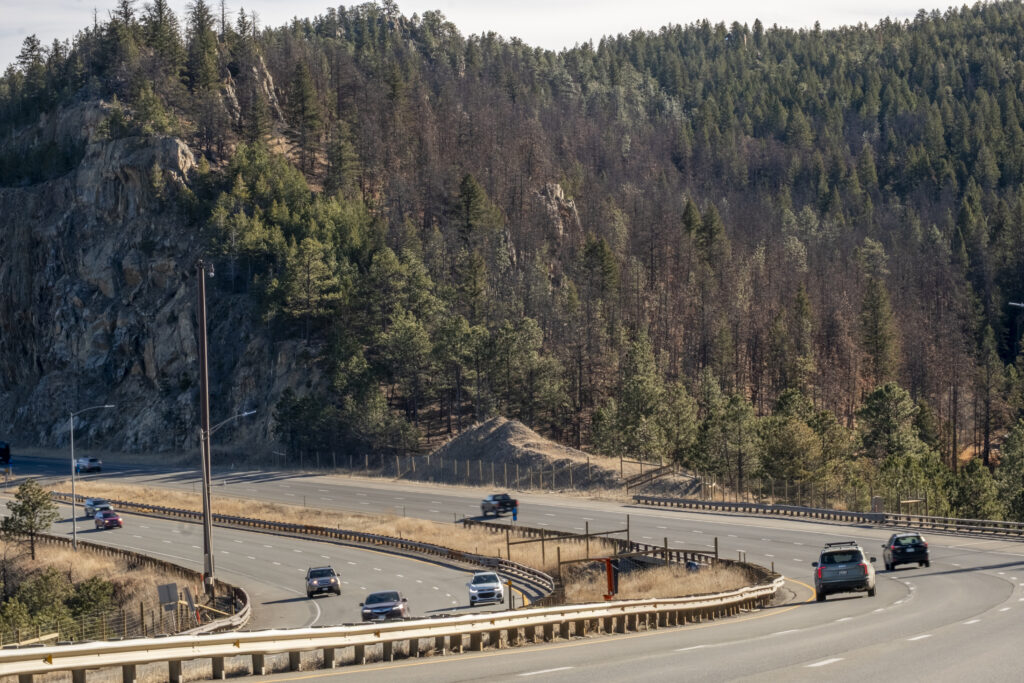
Pockets of beetle-killed trees are already visible along the major Front Range highways like U.S. Highway 285 and Interstate 70.

Pine beetles have killed approximately 20 acres of ponderosa pine on the above mountainside next to Interstate 70 and Soda Creek Road in Jefferson County, just east of Floyd Hill, as seen Monday, Dec. 22, 2025. (Jonathan Ingraham/Denver Gazette).

According to the USFS, warming climates and drought have created optimal environmental conditions for the beetles to spread into neighboring trees.

Very low temperatures are necessary to diminish the beetles’ progress. The state has recently been experiencing prolonged dry conditions, which weaken the trees’ defenses.

“A very high level of tree mortality, especially among ponderosa pines, is likely to continue for the next decade,” the USFS said.

The Colorado State Forest Service has an online map of Colorado showing where pine beetle infestations have been prevalent and expanding from 2022-2024.

The interactive map shows ponderosa pine forests in portions of Larimer, Gilpin, Clear Creek, Boulder, Jefferson, Park and Douglas counties are experiencing elevated levels of infestation from mountain pine beetles.

In addition, lodgepole pine forests in Park and Gunnison counties that evaded prior bark beetle outbreaks are experiencing elevated mortality of trees as populations of mountain pine beetles expand.

Lastly, ponderosa pine forests on the Uncompahgre Plateau in western Colorado have also been affected by increased pine beetle activity.

A forecast map from the USFS shows that beetles could kill nearly all of the ponderosa pines along the Front Range.

The map shows how foresters predict the beetles’ spread through the forests; however, unless a major weather event like flooding or an extended freeze cycle happens to slow the expansion, the beetles will continue to find new trees and spread across the forested regions.

The mountain pine beetle is native to Colorado and ranks first in destructiveness among the tree-killing bark beetles that are native to the West, according to the U.S Department of the Interior.

Bark beetles infest pine trees by laying eggs under the bark. When the eggs hatch, the larvae mine the area beneath the bark and eventually cut off the tree’s supply of nutrients. The beetles also carry a fungus that causes dehydration and inhibits a tree’s natural defenses against beetle attacks.

From the late 1990s through 2013, mountain pine beetles affected 3.4 million acres of forests in Colorado, predominantly attacking lodgepole pines, according to the Colorado State Forest Service. The beetles killed up to 80-90% of trees in some lodgepole pine forests in Summit, Grand, Eagle and Routt counties during the epidemic.

Pine beetles attacked ponderosa pine forests along the Front Range in the early 2010s, but heavy rains and flooding, like the 2013 floods, stopped their spread.

“This is not a time to panic, it’s a time to ramp up and take action to reduce the impacts of this outbreak and ensure we never allow our forests to become this vulnerable ever again,” Matthew McCombs, state forester and director of the Colorado State Forest Service, said in a news release.

The Colorado State Forest Service said residents should look for these telltale signs and symptoms of mountain pine beetle infestation:

  • Popcorn-shaped masses of resin, called pitch tubes, on the trunk that may be brown, pink or white.

  • Boring dust in bark crevices and on the ground immediately adjacent to the tree’s base.

  • Woodpecker damage, where the birds have stripped portions of the bark in search of larvae, leaving accumulations of bark at the base of the tree.

  • Presence of live mountain pine beetles (eggs, larvae, pupae and/or adults)

  • Exit holes on the bark’s surface where adult beetles have emerged.

  • Foliage turning yellowish to reddish throughout the entire tree crown, which usually occurs eight to 10 months after a successful attack.