It’s very difficult to read the small print under the above map. I will try to get a better version from the FS. The basic point is that all of our ponderosas could die (or at least the old ones).
I’ve noticed some MPB in PP in my own hood. What can you do? The article doesn’t focus on it, but here’s what Colorado State Forest Service says (and it’s probably true for other states).
Large outbreaks of mountain pine beetles are difficult to control. One of the best ways to mitigate the effects of beetle outbreaks is to manage for overall forest health and resiliency. Thinning overly dense stands of trees to reduce competition and promote tree age and species diversity is the most successful forest management strategy to increase tree vigor.
******************
This is from the news story:
The map, produced by the U.S. Forest Service, shows how experts predict the beetles will spread through the forests unless a major weather event, like flooding or an extended extreme freeze, slows their expansion.
I understand the “extreme freeze” idea, but where I live on the Front Range, low precip, sandy soil, it’s hard to see what flooding would do. Maybe someone can explain? It also seems as if Colorado has a “lots of dead trees lying around is not a good thing” vibe compared to more timber-historic states.
Pine beetle infestations are quickly spreading across large areas of Colorado’s ponderosa pine forests, evident from aerial surveys conducted by the U.S. Forest Service over the last year.
The USFS surveys found beetle infestations in mountainous and foothill regions from Larimer County to El Paso County have been on the rise over the last year, suggesting large areas of forests near major Colorado metro areas could look a lot different within the next five to 10 years.
“Colorado has long been a leader in forest health and fire mitigation efforts, and this is no exception,” Polis said. “As the latest outbreak of pine beetles begins to take shape along the densely populated Front Range, we are taking an aggressive approach to boost tools and partnerships to help protect our communities, forests and key water sources, and equipping homeowners with the resources they need to better protect their homes.”
The governor will also submit a supplemental request to the state legislature, recommending actions aimed at reducing wildfire risk, supporting landowners and saving them money on risk mitigation investments, and strengthening Colorado’s long-term response to the pine beetle outbreak.
The Polis administration plans to appoint members of the task force by Feb. 1.
Beetle-caused mortality to forests can create public safety hazards, alter fire behavior and make fire suppression more challenging for firefighters, the USFS said.
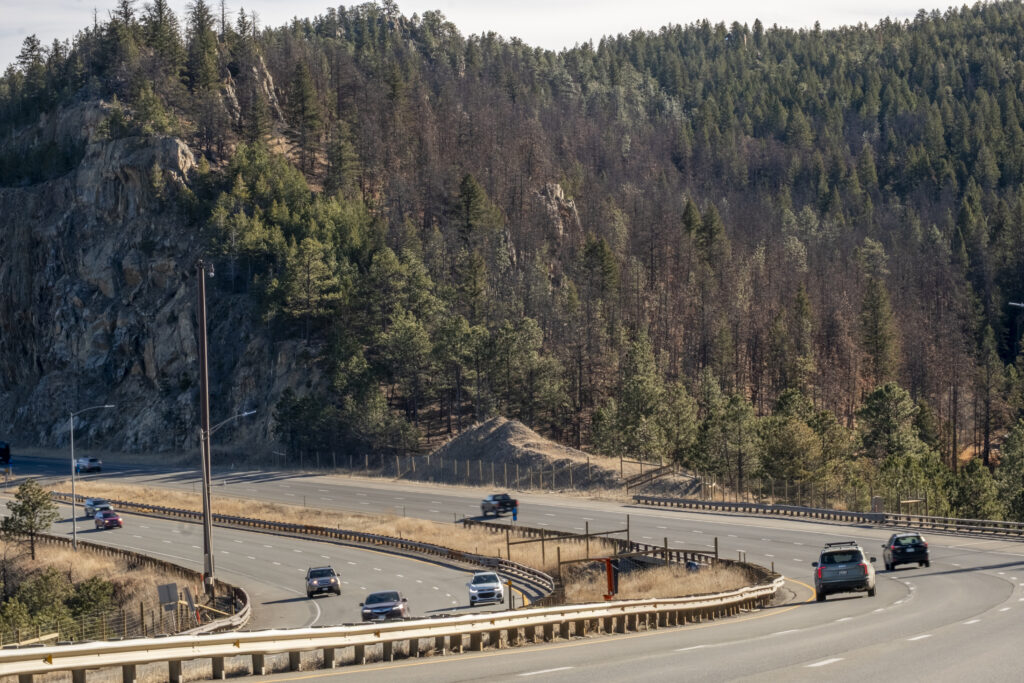
Pockets of beetle-killed trees are already visible along the major Front Range highways like U.S. Highway 285 and Interstate 70.
Pine beetles have killed approximately 20 acres of ponderosa pine on the above mountainside next to Interstate 70 and Soda Creek Road in Jefferson County, just east of Floyd Hill, as seen Monday, Dec. 22, 2025. (Jonathan Ingraham/Denver Gazette).
According to the USFS, warming climates and drought have created optimal environmental conditions for the beetles to spread into neighboring trees.
Very low temperatures are necessary to diminish the beetles’ progress. The state has recently been experiencing prolonged dry conditions, which weaken the trees’ defenses.
“A very high level of tree mortality, especially among ponderosa pines, is likely to continue for the next decade,” the USFS said.
The Colorado State Forest Service has an online map of Colorado showing where pine beetle infestations have been prevalent and expanding from 2022-2024.
The interactive map shows ponderosa pine forests in portions of Larimer, Gilpin, Clear Creek, Boulder, Jefferson, Park and Douglas counties are experiencing elevated levels of infestation from mountain pine beetles.
In addition, lodgepole pine forests in Park and Gunnison counties that evaded prior bark beetle outbreaks are experiencing elevated mortality of trees as populations of mountain pine beetles expand.
Lastly, ponderosa pine forests on the Uncompahgre Plateau in western Colorado have also been affected by increased pine beetle activity.
A forecast map from the USFS shows that beetles could kill nearly all of the ponderosa pines along the Front Range.
The map shows how foresters predict the beetles’ spread through the forests; however, unless a major weather event like flooding or an extended freeze cycle happens to slow the expansion, the beetles will continue to find new trees and spread across the forested regions.
The mountain pine beetle is native to Colorado and ranks first in destructiveness among the tree-killing bark beetles that are native to the West, according to the U.S Department of the Interior.
Bark beetles infest pine trees by laying eggs under the bark. When the eggs hatch, the larvae mine the area beneath the bark and eventually cut off the tree’s supply of nutrients. The beetles also carry a fungus that causes dehydration and inhibits a tree’s natural defenses against beetle attacks.
From the late 1990s through 2013, mountain pine beetles affected 3.4 million acres of forests in Colorado, predominantly attacking lodgepole pines, according to the Colorado State Forest Service. The beetles killed up to 80-90% of trees in some lodgepole pine forests in Summit, Grand, Eagle and Routt counties during the epidemic.
Pine beetles attacked ponderosa pine forests along the Front Range in the early 2010s, but heavy rains and flooding, like the 2013 floods, stopped their spread.
“This is not a time to panic, it’s a time to ramp up and take action to reduce the impacts of this outbreak and ensure we never allow our forests to become this vulnerable ever again,” Matthew McCombs, state forester and director of the Colorado State Forest Service, said in a news release.
The Colorado State Forest Service said residents should look for these telltale signs and symptoms of mountain pine beetle infestation:
Popcorn-shaped masses of resin, called pitch tubes, on the trunk that may be brown, pink or white.
Boring dust in bark crevices and on the ground immediately adjacent to the tree’s base.
Woodpecker damage, where the birds have stripped portions of the bark in search of larvae, leaving accumulations of bark at the base of the tree.
Presence of live mountain pine beetles (eggs, larvae, pupae and/or adults)
Exit holes on the bark’s surface where adult beetles have emerged.
Foliage turning yellowish to reddish throughout the entire tree crown, which usually occurs eight to 10 months after a successful attack.
16 thoughts on “Mountain Pine Beetle Expanding in Ponderosa in Colorado’s Front Range-Governor Creates Task Force”
Exactly. Why ponderosa pine is being replanted after wildfires remains a mystery. Domestic livestock eat the aspen shoots just like any ungulate does and because moral hazard favors the extractive industries self-reliance is a forgotten ethos. Including a Wood-Mizer LX50SUPER Portable Sawmill With GO Trailer remanding most lands in the public domain to the Indigenous cultures from whom they were seized can’t happen soon enough.
Seems important to me that all lumber mills stay operational in order to accept the inevitable trees coming their way. Perhaps the governor could help them with expenses and maintenance in the meantime?
It’s logistically really hard to log beetle killed trees. Trees in the same stand die at different rates, often over several years. Beetles carry spores of blue stain fungus. Within short order the wood is turned blue. Although structurally sound, the blue wood isn’t desired by purchasers. Even if it were, the wood doesn’t last as long on the stump as fire killed trees. It is also ineffective to try to increase resilience during an outbreak. It takes years for green trees to increase resin production in response to thinning. Ramping up the ability to deal with millions of tons of mostly economically worthless wood would be great (biomass?).
How easy we’ve forgotten the Colorado’s Route Divide Blowdown in October 1997. Adequate response was too little and too late. Half the blowdone was in a Wilderness where nothing was done and the other half had 4 years of NEPA planning before any salvage logging would begin. This event was the beginning of the US/Canada pine beetle devastation.
The local Foresters and Research Entomologists predicted this could happen.
Curious how you know it’s mountain pine beetle? It is my understanding MPB are less likely to focus on ponderosa than western pine beetle, and the MPB scientific name is misleading. The stories you linked to kept calling them pine beetles, without specifying species. The beetle outbreak in the southern Sierra that killed millions of ponderosa was dominated by western pine beetle.
Only in really cold places do temps affect beetle populations. Where it’s routinely not cold enough, beetle populations are kept in check by tree defense, which is primarily resin production. Climate change reduces resin production by increasing probability of drought and by increasing transportation due to higher temps. When beetle populations reach an outbreak, even healthy trees and stands are unable to resist mass attack. Landscape resilience to outbreaks can be increased through tree density reduction at the landscape scale, but there is only so much forest health resilience can do on sites where climate change has shifted temps and precipitation beyond the conditions the species is adapted.
A. please go back and reread the quotes, they (CSFS) specifically call out MPB.
CSFS has an excellent story map for their 2024 forest health highlights. https://storymaps.arcgis.com/stories/c5cfa14f7c394f5faf42bf0ae63e2749
“Mountain pine beetle is having a comeback
Mountain pine beetle infests all native pine species in Colorado, except for piñon pines.
This native bark beetle affected approximately 80% of the pine forests in Colorado from 1996-2014. Although not every tree was affected in every acre of pine forest, many of the largest, most susceptible ponderosa and lodgepole pines were depleted during this outbreak. Some areas of the state were largely unaffected, leaving these relic trees susceptible to attack in years of below-average precipitation and warm weather. Mountain pine beetle persists in weakened trees, particularly from drought in recent years. ”
Additionally, more than 180 acres of limber pine were infested by the mountain pine beetle in 2024 in the Mosquito Range, in Chaffee and Park counties. This area has been affected for three years running, with many green trees in the vicinity to infest, posing significant risk in the coming year.
Mountain pine beetle-caused mortality was noted within the Front Range corridor. Jefferson, Clear Creek, and Gilpin counties are seeing an uptick in activity. Landowners should be on the lookout for infested trees and take action before beetles escape infested trees. ”
I’m not sure that “climate change has shifted temps and precipitation beyond the conditions the species is adapted.” Problem is fire suppression, density and climate all interact and have trended in the same direction over the last 100 years. Also tree age and vigor is a thing..so with LPP if you have a stand over 100 years, you are looking at what we used to call “beetle bait.”
What the Black Hills did in terms of thinning seemed to work to protect trees, whereas when we in Central Oregon in the 80’s thinned around our selected trees to increase vitality, the increased vitality seemed to say “great food here” to BBs. So I bet it’s fairly complicated and perhaps location/tree species/BB species specific.
One other wrinkle climate change has added is that warmer temperatures in spring and fall have increased the percentage of mountain pine beetles going through two reproductive cycles in a year, thus allowing for increased growth in their populations when conditions are favorable. MPBs are then able to spread faster and overwhelm healthy trees just with their sheer numbers.
The best way to manage beetle outbreaks is with fire. Fire where trees have been killed, and fire where trees haven’t been killed. Learn how to conduct your own low-intensity fire. Prescribed fire or Cultural Fire. Burn needles on the ground where they lay. Do not rake and pile them. Burn where they lay. Fire near the base of pines triggers a stress release in the tree that can make the tree somewhat undesirable to beetles, depending on the tree type.
Everyone can learn to use good fire. And in fact, everyone should.
Joseph, the interaction between BBs and PF is complex. There is a substantial literature across tree species, insect species, tree densities, geography, season of burning, and so on. I’m hoping to locate an entomologist to summarize for us. Sometimes, stress chemicals attract BBs. Do you have a citation for your claim “fire triggers a stress release that makes the tree somewhat undesirable to beetles?”
Bug kill is everywhere mostly because they suck their own water sources so the Arkansas isn’t running in Kansas and the Colorado is at risk of federal intervention. Another Black Forest Fire is not impossible. $20 says the SFNF Laguna Fire will recharge aquifers on that side of the Jemez.
Just what we need, everyone using fire! Nationally owned neighboring lands have carte blanche to immolate thousands of acres of private property under the veil of the discretionary function exception of the Federal Tort Claims Act. Now, Joseph, you are encouraging everyone to learn to use “good” fire, like it is a dog?
Let me tell you, fire is fire. A physical/chemical force that kills humans and other living things.
How about the science and art of silviculture practiced by a professional forester to manage for resilience before a bark beetle infestation occurs, instead of your pyromania home brew?
Active beetle outbreaks usually include dead trees, dying trees and drought-stressed trees. The risk of a crown fire in such conditions is considerable, depending on how severe the ongoing beetle outbreak is. Adding fire to a current beetle outbreak adds additional impacts to the survival of individual trees. We do know that one of those impacts is cambium-kill. That makes trees weaker and easier for bark beetles to attack. I’ve seen stands that survived a wildfire, with ample green canopy, only to die (en masse) 8 months later. The Biscuit Fire was an excellent example of that phenomenon.
It’s not just Colorado. Ponderosa pine sucks billions of gallons from aquifer recharges, needles absorb heat and accelerate snow melt while aspen leaves reflect sunlight in the summer months and hold snowpacks in winter. Insects like the mountain pine beetle and spruce bud worm can help promote drought- and fire-tolerant species like aspen. Nevertheless, the march to replant ponderosa pine after wildfire seems paramount on the Santa Fe National Forest.
A study released in October, 2024 by Northern Arizona University’s Ecological Restoration Institute revealed that animal grazing and wildfire management have contributed to the decline of aspen trees in the area.

Exactly. Why ponderosa pine is being replanted after wildfires remains a mystery. Domestic livestock eat the aspen shoots just like any ungulate does and because moral hazard favors the extractive industries self-reliance is a forgotten ethos. Including a Wood-Mizer LX50SUPER Portable Sawmill With GO Trailer remanding most lands in the public domain to the Indigenous cultures from whom they were seized can’t happen soon enough.
Seems important to me that all lumber mills stay operational in order to accept the inevitable trees coming their way. Perhaps the governor could help them with expenses and maintenance in the meantime?
It’s logistically really hard to log beetle killed trees. Trees in the same stand die at different rates, often over several years. Beetles carry spores of blue stain fungus. Within short order the wood is turned blue. Although structurally sound, the blue wood isn’t desired by purchasers. Even if it were, the wood doesn’t last as long on the stump as fire killed trees. It is also ineffective to try to increase resilience during an outbreak. It takes years for green trees to increase resin production in response to thinning. Ramping up the ability to deal with millions of tons of mostly economically worthless wood would be great (biomass?).
How easy we’ve forgotten the Colorado’s Route Divide Blowdown in October 1997. Adequate response was too little and too late. Half the blowdone was in a Wilderness where nothing was done and the other half had 4 years of NEPA planning before any salvage logging would begin. This event was the beginning of the US/Canada pine beetle devastation.
The local Foresters and Research Entomologists predicted this could happen.
No markets (mills), no management! Simple fact.
Curious how you know it’s mountain pine beetle? It is my understanding MPB are less likely to focus on ponderosa than western pine beetle, and the MPB scientific name is misleading. The stories you linked to kept calling them pine beetles, without specifying species. The beetle outbreak in the southern Sierra that killed millions of ponderosa was dominated by western pine beetle.
Only in really cold places do temps affect beetle populations. Where it’s routinely not cold enough, beetle populations are kept in check by tree defense, which is primarily resin production. Climate change reduces resin production by increasing probability of drought and by increasing transportation due to higher temps. When beetle populations reach an outbreak, even healthy trees and stands are unable to resist mass attack. Landscape resilience to outbreaks can be increased through tree density reduction at the landscape scale, but there is only so much forest health resilience can do on sites where climate change has shifted temps and precipitation beyond the conditions the species is adapted.
A. please go back and reread the quotes, they (CSFS) specifically call out MPB.
CSFS has an excellent story map for their 2024 forest health highlights.
https://storymaps.arcgis.com/stories/c5cfa14f7c394f5faf42bf0ae63e2749
“Mountain pine beetle is having a comeback
Mountain pine beetle infests all native pine species in Colorado, except for piñon pines.
This native bark beetle affected approximately 80% of the pine forests in Colorado from 1996-2014. Although not every tree was affected in every acre of pine forest, many of the largest, most susceptible ponderosa and lodgepole pines were depleted during this outbreak. Some areas of the state were largely unaffected, leaving these relic trees susceptible to attack in years of below-average precipitation and warm weather. Mountain pine beetle persists in weakened trees, particularly from drought in recent years. ”
Additionally, more than 180 acres of limber pine were infested by the mountain pine beetle in 2024 in the Mosquito Range, in Chaffee and Park counties. This area has been affected for three years running, with many green trees in the vicinity to infest, posing significant risk in the coming year.
Mountain pine beetle-caused mortality was noted within the Front Range corridor. Jefferson, Clear Creek, and Gilpin counties are seeing an uptick in activity. Landowners should be on the lookout for infested trees and take action before beetles escape infested trees. ”
I’m not sure that “climate change has shifted temps and precipitation beyond the conditions the species is adapted.” Problem is fire suppression, density and climate all interact and have trended in the same direction over the last 100 years. Also tree age and vigor is a thing..so with LPP if you have a stand over 100 years, you are looking at what we used to call “beetle bait.”
What the Black Hills did in terms of thinning seemed to work to protect trees, whereas when we in Central Oregon in the 80’s thinned around our selected trees to increase vitality, the increased vitality seemed to say “great food here” to BBs. So I bet it’s fairly complicated and perhaps location/tree species/BB species specific.
One other wrinkle climate change has added is that warmer temperatures in spring and fall have increased the percentage of mountain pine beetles going through two reproductive cycles in a year, thus allowing for increased growth in their populations when conditions are favorable. MPBs are then able to spread faster and overwhelm healthy trees just with their sheer numbers.
The best way to manage beetle outbreaks is with fire. Fire where trees have been killed, and fire where trees haven’t been killed. Learn how to conduct your own low-intensity fire. Prescribed fire or Cultural Fire. Burn needles on the ground where they lay. Do not rake and pile them. Burn where they lay. Fire near the base of pines triggers a stress release in the tree that can make the tree somewhat undesirable to beetles, depending on the tree type.
Everyone can learn to use good fire. And in fact, everyone should.
Joseph, the interaction between BBs and PF is complex. There is a substantial literature across tree species, insect species, tree densities, geography, season of burning, and so on. I’m hoping to locate an entomologist to summarize for us. Sometimes, stress chemicals attract BBs. Do you have a citation for your claim “fire triggers a stress release that makes the tree somewhat undesirable to beetles?”
Bug kill is everywhere mostly because they suck their own water sources so the Arkansas isn’t running in Kansas and the Colorado is at risk of federal intervention. Another Black Forest Fire is not impossible. $20 says the SFNF Laguna Fire will recharge aquifers on that side of the Jemez.
Just what we need, everyone using fire! Nationally owned neighboring lands have carte blanche to immolate thousands of acres of private property under the veil of the discretionary function exception of the Federal Tort Claims Act. Now, Joseph, you are encouraging everyone to learn to use “good” fire, like it is a dog?
Let me tell you, fire is fire. A physical/chemical force that kills humans and other living things.
How about the science and art of silviculture practiced by a professional forester to manage for resilience before a bark beetle infestation occurs, instead of your pyromania home brew?
Active beetle outbreaks usually include dead trees, dying trees and drought-stressed trees. The risk of a crown fire in such conditions is considerable, depending on how severe the ongoing beetle outbreak is. Adding fire to a current beetle outbreak adds additional impacts to the survival of individual trees. We do know that one of those impacts is cambium-kill. That makes trees weaker and easier for bark beetles to attack. I’ve seen stands that survived a wildfire, with ample green canopy, only to die (en masse) 8 months later. The Biscuit Fire was an excellent example of that phenomenon.
It’s not just Colorado. Ponderosa pine sucks billions of gallons from aquifer recharges, needles absorb heat and accelerate snow melt while aspen leaves reflect sunlight in the summer months and hold snowpacks in winter. Insects like the mountain pine beetle and spruce bud worm can help promote drought- and fire-tolerant species like aspen. Nevertheless, the march to replant ponderosa pine after wildfire seems paramount on the Santa Fe National Forest.
A study released in October, 2024 by Northern Arizona University’s Ecological Restoration Institute revealed that animal grazing and wildfire management have contributed to the decline of aspen trees in the area.
Larry, I think why folks don’t plant aspen back is because aspen regenerate by themselves after a fire, whereas in the absence of a seed source and bare mineral soil, ponderosas may have have trouble getting reestablished.
https://www.nationalforests.org/assets/pdfs/WAA-Brief3_aspen-fire_2015final.pdf
https://www.fs.usda.gov/nrs/pubs/jrnl/2024/nrs_2024_stoddard_001.pdf