Vaden Testifies on Reorganization at Senate Hearing Wednesday

I’m taking a slight break from posting about Transformation to note that there is a Senate hearing tomorrow on this. I wish there were another entity who would take it upon themselves to organize a history of FS reorganization and improvement efforts, before those with memories become inaccessible (mediumship isn’t a popular data collection tool at Schools of Public Administration).

I noted before that during the National Performance Review reorg, the plans had to be approved by Congress as noted here:

for the Department’s programs the

Does anyone have a record of the final bill as passed (or was a bill passed)?

Back to the present. In a recent E&E News story on the subject of the Wednesday Senate Hearing on the reorganization:

Stephen Vaden, who was sworn in July 7 and will lead the reorganization effort, should expect sharp questions Wednesday from the Senate Agriculture, Nutrition and Forestry Committee, which hastily called the hearing after the USDA announced the plan without first informing lawmakers.
Chair John Boozman (R-Ark.) said he was “disappointed” that lawmakers were kept in the dark, saying he questioned just how effective the reorganization would be. Ranking member Amy Klobuchar (D-Minn.) called the move “half-baked.”

********

The question of working with Congress ahead of time on agency reorganizations came up at Vaden’s nomination hearing in April.
At the time, Boozman, the Agriculture chair, asked Vaden whether he anticipated further reorganizations, “and if so, will you commit to working with and communicating with Congress as any such actions are contemplated?”
Vaden answered, “When it comes to the actions of the department, we need to be communicating with you on a regular basis whether it’s about reorganizations, policy matters or anything else, because ultimately all the department does is carry out the will of Congress.”

OK then. It appears that interest groups of all stripes and degrees of disagreement with each other are coming out of the woodwork to say no to the current Reorganization plan (dropped on the FS by USDA parties unknown to me, at least).

The E&E news story had interesting background about Vaden’s prior legal skirmishes with Congress over reorganization. Apparently moving entire agencies like NIFA and ERA didn’t invoke the need for Congressional approval?

At the time, Vaden vigorously defended the relocations against criticism that the department had bypassed Congress — a theme that’s likely to be repeated this week.
In that 2019 case, Vaden pushed back on the notion that the USDA can’t relocate offices without the approval of congressional appropriators, although that requirement is boilerplate language in annual appropriation bills.
Vaden sparred with the USDA Inspector General’s Office on the point after the OIG found that the relocation went astray of the requirement. Since federal agencies have the authority to relocate offices, he said — a point the OIG didn’t dispute — a
requirement to obtain one committee or one congressional chamber’s approval is unconstitutional.
Regulations specific to the USDA also outline procedures around realignments and reorganizations, although Vaden said they didn’t apply to the ERS and NIFA relocations.
Among other provisions, the USDA policy says reorganizations must take into account “maximum attraction and retention of employees,” as well as economy and efficiency of operations.

Why did USDA put this out knowing that so many would be against it? So Congress will settle for the usual three regions ultimately (Vaden is an attorney by profession so is this some kind of opening negotiating posture? Is there an Interior mole at USDA who wants the FS to lose its attachment to USDA?

Please put your ideas in the comments. No generic comments, please

Deputy Secretary Vaden photo courtesy of E&E News.
(Trump Admin people are stupid/evil).

Transformation (2007) Reorganization I. Intro , Organizational Design Criteria and Roles and Responsibilities

Many of you know that I’ve been trying to build a history of previous Forest Service reorganization efforts.

Anonymous has said that there was an effort last year during the budget crisis.  I would be interested in seeing any documents that describe what they came up with.  I’d prefer to not have to FOIA them.

Neverthless, the most recent serious effort with (some) available documents was in 2007 (the last previous one I remember was the National Performance Review under the Clinton Administration in 1993).  It seems to me that the work the Transformation Team did was very good work, from where I was sitting at the time as a Regional Planning Director.  They teased out the “support to the field” from the other tasks that RO staff were involved in.  It seemed to me that they got quite far along in design, but I don’t think much ultimately happened.  Our Engineering staff in the RO took it to heart and did reorganize, as I recall.   Our national planning group, on the other hand, had more of a “fill out the forms and wait it out” approach.  WO Minerals folks took the opportunity to move to the Denver Metro area (but maybe that was due to something else?).  Folks talk about “organizational antibodies that resist change” and perhaps those antibodies ultimately did the effort in.  Or maybe it was Congressfolk who wanted no movement of bodies away from their then-locations.  Someone out there knows what happened…

I couldn’t find any documentation for the effort.  It wasn’t even clear whom I would ask at the Forest Service.. historian? Archivist?  I got some phone numbers and emails but no one returned the messages.

Meanwhile, I pestered all the folks I remember working on it to write about their experiences and thoughts for TSW, but none would.. I am still interested if anyone out there worked on it.   Fortunately Kathy Kurtz, one of the team until I recruited her to Region 2, still had some of the records in boxes in her attic- so I collected and scanned them.

It’s only one document from one point in time, but has a great deal of useful info about what they were thinking then IMHO.  It’s too long for one post, so it will be a series.  I’ll focus on the diagrams and tables but the document as I scanned it is here  This particular document is from July 19, 2007, though the Transformation process was ongoing for some period of time. 

One of the important changes since that time is the concept of “when do employees have to be in the office, and which positions can be virtual, and whether there is a consistent policy about it.”  Covid caused an office-less ness with pros and cons.. what should the policy be?

*******


Senate Approps News

NAFSR sent out the below summary last week. Looks like some of the “ideas many of us think are bad” about R&D and S&PF are off the table.

******************

Public Lands

  • The bill rejects President Trump’s efforts to shortchange America’s cherished landscapes and ensures that funding for operations of the National Park System, the National Wildlife Refuge System, National Conservation Lands, and the National Forest System is fully protected at enacted levels.
  • The bill provides the funding necessary to maintain personnel at prior year levels and requires the necessary staffing levels to be able to provide visitor services, Tribal consultation, ensure public safety, and carry out the science necessary to respond to growing natural threats and increased visitation.

National Park Service

  • The bill provides $3.27 billion for the National Park Service, including $2.87 billion for the operation of the National Park System, which is equal to the enacted level and is $145 million above the level in House Republicans’ bill and $875 million higher than the level requested by President Trump.
  • The bill provides the resources to sustain fiscal year 2024 staffing levels—rejecting staffing cuts made since January—and to support a full complement of seasonal staff during fiscal year 2026.
  • The bill also provides $168 million for the Historic Preservation Fund and protects all 433 national park units from being sold off or otherwise eliminated from the National Park System.

Forest Service

  • The bill provides $6.17 billion for the Forest Service, excluding additional funding for the Wildfire Suppression Operations Reserve.
  • Of this amount, $3.7 billion is provided for the Forest Service’s non-wildland fire management responsibilities and provides sufficient funds to sustain appropriate staffing levels.
  • The bill rejects the steep $1.4 billion cuts to the Forest Service’s non-fire budget proposed by President Trump.
  • The bill provides funding for the Forest Service to improve forest restoration and fire risk reduction efforts on federal lands and through cross-boundary partnerships.
  • It also provides $175 million for hazardous fuels reduction projects, $31 million for the Collaborative Forest Landscape Restoration Program, and $6 million for the Legacy Roads and Trails program to prioritize fish passage improvements and repurposing unnecessary roads as trails.
  • The bill continues funding for state grant programs and federal and cooperative research that were proposed for termination in President Trump’s budget request, including an increase of $8 million for State and Volunteer Fire Assistance Grants, and a total of $8 million for Joint Fire Science research.

Land and Water Conservation Fund (LWCF)

  • The bill allocates $900 million for federal land acquisition and financial assistance to states provided through the LWCF under the Great American Outdoors Act.
  • This program is critical for improving recreational access to our federal lands, protecting iconic landscapes, delivering grants to states and local governments to create and protect urban parks and open spaces, and providing farmers and ranchers with easements to allow them to continue to steward their private lands in the face of development pressures.

Payment in Lieu of Taxes (PILT)

  • The bill fully funds payments to counties through the PILT program, which are estimated at a total of $550 million.

Protects Full Funding for Wildland Firefighting and Supporting Federal Wildland Firefighters

  • The bill provides funding for the permanent pay fix and job series for federal wildland firefighters to prevent a devastating pay cut for the firefighting workforce.
  • The pay fix was enacted as part of the fiscal year 2025 continuing resolution and began as a temporary bonus for Forest Service and Department of the Interior firefighters provided in the Infrastructure and Investment in Jobs Act.
  • The bill bars consolidation of federal wildland firefighting into one agency in fiscal year 2026 and specifically provides funding to continue wildland firefighting using the longstanding practice of funding both the U.S. Forest Service and the Department of the Interior to allow Congress to consider legislative proposals for such a major change.

Wildfire Suppression

  • The bill fully funds essential wildfire preparedness and suppression efforts by providing $4.25 billion for wildfire suppression, of which $2.85 billion is for the Wildfire Suppression Operations Reserve Fund.
  • The Reserve Fund provides the Forest Service and the Department of the Interior an assured amount of funding to be used when major fire activity requires expenditures exceeding regular base suppression operations funding. This funding level—in addition to carryover balances—will meet projected needs for fiscal year 2026 wildfires.

***************

Here is a link to Faith Campbell’s take (focusing on invasive species)..below are some parts that interested me.

The Senate bill provides a total of $8.6 billion for the Forest Service. This includes $308,497,000 for the Research and Development program. This is an increase of $8.5 million above funding for the current year. The Senate bill specifically supports retaining the five regional offices and experimental forests. Remember, the Trump Administration had proposed to eliminate the Research program – other than Forest Inventory and Analysis. The Committee’s report link specifies that the USFS should prioritize projects requested by or benefitting the agency’s mission, not requests by external entities. The benefit to the agency and public should be stated before a project is initiated.  The report specifies funding for several issues, including/

*************

There is also $19.6 million to support Congressionally-directed components of Forest Resource Information and Analysis – which is apparently separate from the FIA program.

?? Perhaps someone here understands that.

**********

Reminder: the House Appropriations bill provides $301,706,000 for the research account – almost $7 million less than the Senate. The House’ allocation for the Forest Inventory and Analysis (FIA) program is $34 million. Thus, there is a $9 million difference in funding levels – a significant challenge to reconcile. How will funding for the already-underfunded invasive species programs fare?

Other groups, no doubt, have their own summaries.. please put any you run across in the comments.

The West is Primed for a Megafire: So Let’s Be Careful Out There

I happened to be reading this piece on Heatmap Daily “The West is Primed for a Megafire” .. which has some interesting points.

Oregon’s Cram Fire was a warning — the Pacific Northwest is ready to ignite.

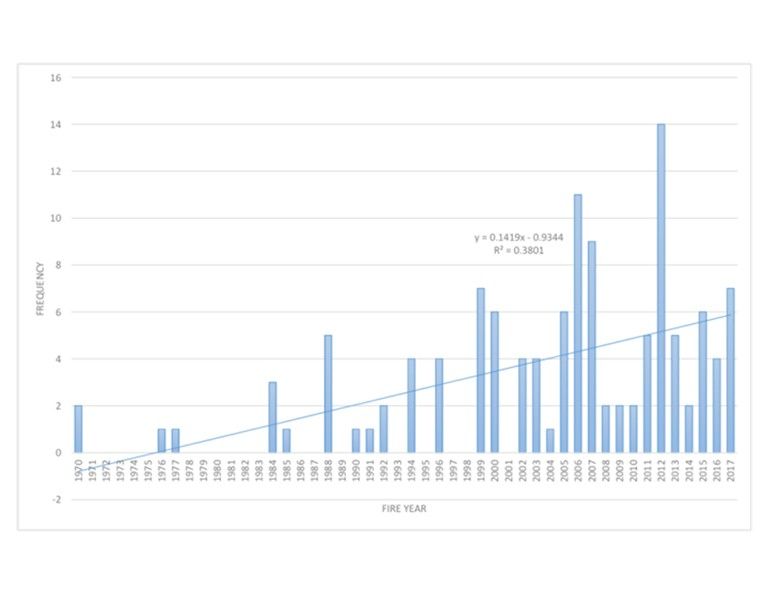
What struct me was NASA’s statement that there hadn’t been megafires before 1970 (defined as fires over 100K acres).

Sure enough, though, NASA basically said that..

Periodic wildfires are a naturally occurring part of the Western ecosystem, and not all are attributable to climate change. But before 1995, the U.S. averaged fewer than one megafire per year; between 2005 and 2014, that average jumped to 9.8 such fires per year. Before 1970, there had been no documented megafires at all.

That was the last link, to NASA:

Those fires are also burning more acres of land. The average annual amount of acres burned has been steadily increasing since 1950. The number of megafires—fires that burn more than 100,000 acres (156 square miles)—has increased in the past two decades. In fact, no documented megafires occurred before 1970.

The recent increase in fire frequency and size is likely related to a few reasons, including the rise of global temperatures since the start of the new millennia. Seventeen of the 18 warmest years on record have occurred since 2001.

Global temperatures can affect local fire conditions. Amber Soja, a wildfire expert at NASA’s Langley Research Center, said fire-weather conditions—high temperatures, low relative humidity, high wind speed, and low precipitation—can increase dryness and make vegetation in the west easier to burn. “Those fire conditions all fall under weather and climate,” Soja said. “The weather will change as Earth warms, and we’re seeing that happen.”

Two odd things about this.. their history seems to only include NASA instruments (otherwise why 1970)? And global temperatures are not felt by local vegetation, local temperatures are. Global temperatures are averages.. so therefore some would be higher and some lower than the average.

More fires is partially due to more humans doing more things, or not doing maintenance of things, as the story says..

The NIFC’s higher confidence in its temperature and precipitation outlooks, in turn, “leads to a belief that the ratio of human to natural ignitions will remain high and at or above 2024 levels.” (An exploding transformer appears to have been the ignition source for the Cram Fire; approximately 88% of wildfires in the United States have human-caused origins, including arson.)

So this same story could have been “conditions are dry in Oregon, be careful!”

Another thing is how hard it is to predict lightning..

The National Interagency Fire Center has “low confidence … regarding the number of lightning ignitions” for the end of summer in the Northwest, in large part due to the incredible difficulty of forecasting convective storms. Additionally, the current neutral phase of the El Niño-Southern Oscillation means there is a “wide range of potential lightning activity” that adds extra uncertainty to any predictions.

As usual, the “more acres burned” doesn’t seem to take into account our friend Managed Fire which has definitely increased; in fact in 2023 I posted “Surprising Flat Line: 20 Years of Unwanted Wildfire Acres (Total Acres with WFU Subtracted).

If I were going to  make  suggestion for organizational improvement, I’d say there should be a Board of Wildfire Context that reviews any public communications by agencies on wildfire to ensure accuracy and context.

Secretary’s Memo a Big Fat Surprise to FS?

One thing about being old is that you’ve seen a great many initiatives come and go.. and hopefully we learn from some of those experiences.

However, the Secretary’s memo (covered yesterday) with no ROs.. was way out of the normal range of “things to do.”  Three regions has been around for awhile, most notably during the Transformation effort (developed by FS employees).

The only thing I could figure was that it was a bargaining chip with Congress so they would settle for three.  As far as I can tell from my look at the National Performance Review (I was comparing USDA ideas from then to the memo) at the time USDA thought that Congress would have to agree to such reorganization plans.

Aside: I read in the NPR documents about a combo of agencies in USDA, later I was part of a completely different combo of agencies (CSRS and ES, then CSREES and now NIFA) so I don’t really understand where Congress fits in all this.

Anyway, come to find out through the Rumor Mill that the FS wasn’t involved at all in these ideas and heard about the memo at the same time as the public.  To which I would say that makes total sense with “no RO’s” being so far outside the bounds of the previously considered. Plus there seemed to be a lack of clarity, as I pointed out, between what Stations do (administer research) and what Labs do (research). If I were the Admin, I’d find the author(s) of this memo and banish them forthwith, for giving the impression that the whole front office of USDA is clueless.  Or maybe this is a trick by a DOI mole at USDA to make the FS want to leave and join INT? Just kidding, I think.

****************

In the comments, I’d appreciate if there were no presumed intentions here, nor generalized diatribes against the current Admin.  I’d like TSW to be a place that even Admin folks can be without generalized diatribes and especially thinking we know anyone’s intentions (hospitality for everyone).

Because any Admin has disagreements within, as well as disagreements with Congressfolk, and Congressfolk of one party disagree with each other as well.  So it may be some kind of random process by which certain people’s ideas meet with success on certain issues.

This Admin has some good and some bad ideas, as well as some totally out to lunch ideas.  Hopefully if they are reading this, we can help them distinguish the really, really bad ones before the ideas get ripped apart by their own Congressfolk (as well as the standard “everything they do is bad” groups).

Secretary’s Reorganization Memorandum


Thanks to Anonymous for this!  Here’s the link.

Here’s my take:

Generally it sounds like the Sec is not interested in letting the FS go to INT. In fact, USDA consolidation looks like wrapping USDA arms around all operations FS.

1) it doesn’t sound like RIF (or “large-scale RIF”).

Over the last four years, USDA’s workforce grew by approximately 8% and employees’ salaries increased by 14.5%. Many of these salaries were funded by temporary funding. As part of this reorganization, USDA is not conducting a large-scale workforce reduction. To make certain USDA can afford its workforce, this reorganization is another step of the Department’s process of reducing its workforce. Much of this reduction was through voluntary retirements and the Deferred Retirement Program (DRP), a completely voluntary tool. As of today, 15,364 individuals voluntarily elected deferred resignation.

***

USDA has and will continue to fully leverage voluntary programs such as the Deferred Resignation Program (DRP), Voluntary Early Retirement Authority (VERA) and Voluntary Separation Incentive Payments (VSIPs). The Department will also leverage directed and voluntary reassignments to ensure the workforce is aligned with mission priorities. Focused and limited Reductions in Force will be implemented only if needed and only after approval by USDA’s Deputy Secretary.

2. Five hubs

The five hub locations and current Federal locality rates are:
I) Raleigh, North Carolina (22.24%)
2) Kansas City, Missouri (18.97%)
3) Indianapolis, Indiana (18.15%)
4) Fort Collins, Colorado (30.52%)
5) Salt Lake City, Utah (17.06%)
In addition to these five hubs, USDA will maintain two additional core administrative support locations: Albuquerque, New Mexico and Minneapolis, Minnesota. These two locations have substantial concentrations of human resources staff that support the delivery of critical public safety functions. USDA will continue to maintain critical service centers and laboratories including agency service centers in St. Louis, Missouri; Lincoln, Nebraska; and Missoula, Montana.

3. Eliminating Management Layers

The Forest Service will phase out the nine Regional Offices over the next year and implementation activities will take into consideration the ongoing fire season. The Forest Service will maintain a reduced state office in Juneau, Alaska and an eastern service center in Athens, Georgia. The current stand-alone Research Stations will be consolidated into a single location in Fort Collins, Colorado. The Forest Service will retain the Fire Sciences Lab and Forest Products Lab – the former, vital for protection from forest fires and the latter, critical for assessing market development opportunities for timber and other forest products and related industries.

This is a bit confusing to me… how many RO’s will be left? Do they have to be at the hubs?  Since this is about management, will labs continue (Fire Science and Forest Products Lab are not Stations in terms of management).  I would think labs would stay labs (all labs, Olympia WA to Auburn AL).  Most puzzling. Also the One Big Research Station will be in the highest cost area of the five?

4. Principle 4: Consolidate Support Functions
To reduce duplication and provide consistency across USDA, support functions will be consolidated. Mission area and agency resources will be realigned to the consolidated functions.

This is SOP for organizations but would require the rest of USDA to know more about the FS..and the FS folks transferred to learn more about USDA.  Maybe ASC will work better?

Consolidate human resources functions in the Office of the Assistant Secretary for Administration (ASA). Although human resources will be consolidated, agencies will still have focused hiring support including a dedicated team for wildland firefighting hiring.
• Consolidate contracting functions in the ASA. Although contracting resources will be consolidated, dedicated teams for commodity procurement and wildland firefighting incident support will continue to exist. The Department will transfer contracting for common goods and services to the General Services Administration during FY 2026.

Given the past, I’d guess that closures  (at least) would have a great deal of Congressional interest, so we’ll see what happens.