I happened to be reading this piece on Heatmap Daily “The West is Primed for a Megafire” .. which has some interesting points.
Oregon’s Cram Fire was a warning — the Pacific Northwest is ready to ignite.
What struct me was NASA’s statement that there hadn’t been megafires before 1970 (defined as fires over 100K acres).
Sure enough, though, NASA basically said that..
Periodic wildfires are a naturally occurring part of the Western ecosystem, and not all are attributable to climate change. But before 1995, the U.S. averaged fewer than one megafire per year; between 2005 and 2014, that average jumped to 9.8 such fires per year. Before 1970, there had been no documented megafires at all.
That was the last link, to NASA:
Those fires are also burning more acres of land. The average annual amount of acres burned has been steadily increasing since 1950. The number of megafires—fires that burn more than 100,000 acres (156 square miles)—has increased in the past two decades. In fact, no documented megafires occurred before 1970.
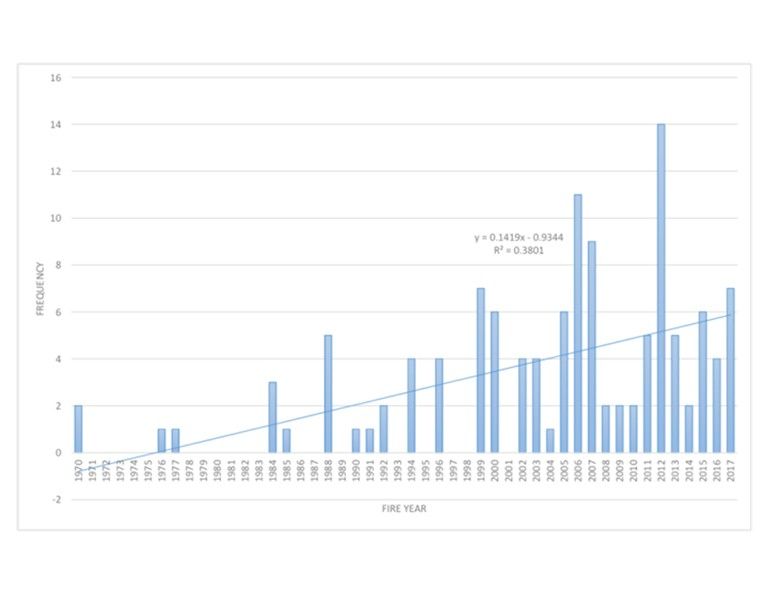
The recent increase in fire frequency and size is likely related to a few reasons, including the rise of global temperatures since the start of the new millennia. Seventeen of the 18 warmest years on record have occurred since 2001.
Global temperatures can affect local fire conditions. Amber Soja, a wildfire expert at NASA’s Langley Research Center, said fire-weather conditions—high temperatures, low relative humidity, high wind speed, and low precipitation—can increase dryness and make vegetation in the west easier to burn. “Those fire conditions all fall under weather and climate,” Soja said. “The weather will change as Earth warms, and we’re seeing that happen.”
Two odd things about this.. their history seems to only include NASA instruments (otherwise why 1970)? And global temperatures are not felt by local vegetation, local temperatures are. Global temperatures are averages.. so therefore some would be higher and some lower than the average.
More fires is partially due to more humans doing more things, or not doing maintenance of things, as the story says..
The NIFC’s higher confidence in its temperature and precipitation outlooks, in turn, “leads to a belief that the ratio of human to natural ignitions will remain high and at or above 2024 levels.” (An exploding transformer appears to have been the ignition source for the Cram Fire; approximately 88% of wildfires in the United States have human-caused origins, including arson.)
So this same story could have been “conditions are dry in Oregon, be careful!”
Another thing is how hard it is to predict lightning..
The National Interagency Fire Center has “low confidence … regarding the number of lightning ignitions” for the end of summer in the Northwest, in large part due to the incredible difficulty of forecasting convective storms. Additionally, the current neutral phase of the El Niño-Southern Oscillation means there is a “wide range of potential lightning activity” that adds extra uncertainty to any predictions.
As usual, the “more acres burned” doesn’t seem to take into account our friend Managed Fire which has definitely increased; in fact in 2023 I posted “Surprising Flat Line: 20 Years of Unwanted Wildfire Acres (Total Acres with WFU Subtracted).
If I were going to make suggestion for organizational improvement, I’d say there should be a Board of Wildfire Context that reviews any public communications by agencies on wildfire to ensure accuracy and context.
No megafires in the western U.S. before 1970? What has NASA been smoking? Has this young agency not heard of the Big Blowup of 1910 that burned 3 million acres?
The ebb and flow of the Earth’s burning is mediated by glacial periods. Lots of ice = fewer acres burned (ice doesn’t burn). During the last inter-glacial (Eemian period), 5-8% of the Earth’s vegetated land burned annually, about the same as during the recent pre-industrial Holocene (5-7%).
During the modern human era, i.e., since the birth of agriculture, about 4% of the Earth’s vegetated land burns annually. Turns out that paving and tilling the Earth are the best fire reduction tactics we humans have come up with — nothing else moves the global needle measurably.
The conceit that federal fire policy and firefighters make any difference in acreage burned is an artifact of human hubris.
So long as there is photosynthesis, there will be rapid oxidation. Build and live accordingly.
You know what turns me off from paying attention to anything, or anyone that has something to say? When a so called, expert can’t even get the preliminary statement true! And NASA, great purveyor of the climate change hypothesis, should know better! Stick to rockets folks; well, ask Elon about how to make rockets, I reckon.
Oregon – 1902, Yacolt fire, 238,000 ac, 65 dead
1933, Tillamook burn, 350,000 ac, 1939, Tillamook burn, 190,000 ac,
1945, Tillamook burn, 180,000 ac – most likely started by Japanese incendiary balloon.
Also, as Andy pointed out, the Big Blowup burned over a million acres, if I remember correctly. So…… to quote a forester philosopher friend of mine – horse manure!👍
To be fair, the “megafires” you referenced in your comment all occurred prior to 1950. The dataset NASA used for this paper was limited to fires that occurred between 1950 to 2017. This appears to be an example of poor word choice, rather than poor data analysis or interpretation.
Then the correct thing to have said would have been “since 1950 when the records we used started.” It doesn’t seem that difficult to be accurate.
I dont disagree that it was a poorly written sentence, but if folks read the paper, it also as not as misleading as it is being made out to be.
Oh, “cherry picking”, another preferred method of skewing results! 👍
The ‘MF acres’ must be kept separate from the ‘Safety Card acres’, for obvious transparent reasons.