Trump Admin is Planning to Try to Rescind Roadless Rule: Deja Vu All Over Again

Sigh. Here we go again.  We could have a contest for most over-the-top statement on an email.. and I think the Western Environmental Law Center would win hands down.  I didn’t even know that WELC was all that metaphysical.

Trump to unleash Hell on crown jewels of undisturbed public lands by rescinding Roadless Rule

Sorry, as a certified Roadless Geek and veteran of Colorado Roadless, I think this effort follows the Generational Law of Bureaucracy.. which is:

Wait until everyone’s retired who knows about how to do something (preferably over five years)… and then start the same process all over again.

This seems like a mostly symbolic waste of government time to me.. kind of like the Trump Admin equivalent of the MOG work.

Here’s the announcement, it’s pretty straightforward.

Here is there argument for why it is needed.. to help with wildfire.

Here’s what I’d do instead.. 1. stop doing plan revisions. 2. Get plan amendments done with prescribed fire, managed fire, PODs and evacuation routes.  If it turns out that a critical area is in a Roadless Area,  the problem is not cutting trees (we went through this in Colorado, the argument was that you could do fuel reduction treatments because.. (this was the ENGO argument for not needing tweaks to the 2001 Rule)

Fuel treatments other than PF (not restricted in RR) would be infrequent, remove “generally” small diameter material and might fit the “uncharacteristic.. range of variability” verbiage.  Here’s the exact wording:

(b) Notwithstanding the prohibition in paragraph (a) of this section, timber may be cut, sold, or removed in inventoried roadless areas if the Responsible Official determines that one of the following circumstances exists. The cutting, sale, or removal of timber in these areas is expected to be infrequent.

(1) The cutting, sale, or removal of generally small diameter timber is needed for one of the following purposes and will maintain or improve one or more of the roadless area characteristics as defined in § 294.11.

(i) To improve threatened, endangered, proposed, or sensitive species habitat; or

(ii) To maintain or restore the characteristics of ecosystem composition and structure, such as to reduce the risk of uncharacteristic wildfire effects, within the range of variability that would be expected to occur under natural disturbance regimes of the current climatic period;

So if you follow that (and I don’t know if there’s case law in which a fuels treatment project didn’t meet the criteria), the only problem is temp roads.  And sometimes that can be a problem, because there are (some, few?) places that material may need to be removed for fuels reasons and can’t be burned onsite because of the forest conditions.  We also ran into problems with powerlines and dams in roadless areas. Powerlines obviously need maintenance, and equipment was allowed to get to dams based on “imminent” threat.. how immanent is “immanent.”

The point of what we did in Colorado was to locate the specific 2001 Problem Children and deal with them.  As part of deal-making, acres that had roadless characteristics but had not been included in the original mapping (low-tech compared to now) were added.  If I were in the Admin, I’d ask the Governors (except for Alaska, Idaho and Colorado) to identify any Problem Children and work changes to the reg from those.  This has the added advantage of dealing with real world issues so that it doesn’t end up being just another sucker of employee time with the result ending up in a courtroom, being decided by someone who decided if the right words are on paper.  This is not to diss my legal friends, but I think there is a better way.

In my meanderings, I  wondered:

Why is Colorado Roadless Rule litigation not on the FS webpage? 

Nor apparently the actual rule itself, but you can find it here.

Finally, just a note to folks unfamiliar with the 2001 Rule.. there are roads in roadless areas (original mapping issues) and there are pre-existing rights, and there is grazing and recreation (in fact part of a ski area was in a Roadless Area), so it’s not accurate to equate Roadless with “pristine” or “undisturbed.” There are powerlines and pipelines and OHV trails…

The Amenity Migrant/Second Home/Short Term Rental Housing Conundrum: Solutions?


I’ve said before that I don’t think “selling federal lands” is going anywhere.  Nevertheless, the topic has drawn attention to the plight of some western communities (specifically) with regard to affordable housing.  Chelsea Pennick’s recent post on her All Things Public Substack is a case in point. It’s worth reading in its entirety, and I’ll just excerpt a few paragraphs:

If you’ve read the Senate ENR’s bill text or my summary, you know that the purported motivation for selling off public lands is to enable housing development or provide infrastructure needed to create more housing.

Housing and housing affordability are challenges in Idaho, as in most western States. Idaho ranks among the top 5 states in the country with the largest affordability gap, where middle-income earners can afford the fewer than 12 percent of the houses on the market. Most analysts agree that more houses need to be built to reduce the affordability gap. But where and how these houses are built, and for whom, matter.

Danya Rumore, founder and co-director of the Gateway and Natural Amenity Region Initiative at Utah State University, explained why in a piece in High Country News last year:

In scenic places like Vail, Colorado or Bozeman, Montana, often referred to as “gateway” communities, Rumore said that increasing the housing supply doesn’t necessarily result in affordability. “If you build more housing and your community is a very popular place to visit, then often that housing gets consumed by short-term rentals” or second homes, she explained. Unless new projects are “very carefully protected for the local workforce,” Rumore fears they won’t make a dent in the housing crisis.

Looking to federal lands to help ease the housing crisis brings its own set of complications. First, most federal lands are located far from urban or town centers. And in much of the West, these lands tend to be mountainous and not suitable for development. Second, even in cases where they are located closer to cities or towns, they likely do not have access to basic infrastructure like water and sewer, the cost of which is placed on local governments and tax payers. Such development would also expand the wildland urban interface, increasing the resources necessary to mitigate and/or respond to wildfire threats.

The high cost of developing such parcels increases the likelihood that they will be sold to wealthy purchasers that can afford to foot the bill for such infrastructure, leading some to call these legislative proposals “McMansion Subsidy Acts”.

And lest you argue that attracting wealthy landowners might benefit rural economies, research across the West on amenity migration has shown that the increased demand for community services like fire suppression, safety, road maintenance, etc. associated with new residential development often surpass any increase in property tax receipts, placing greater burdens on the tax base while reducing federal payments to public lands counties.

I am curious as to why if that is the case, why communities don’t appropriately charge new residential development? Also why would more development reduce federal payments (which federal payments exactly?).   So amenity migration has downsides currently.

Then if more homes are built, amenity migrants and others buy them for short-term rentals.  Either way, it could happen that  local people and workers are priced out of housing.  Of course, this happens in other areas when housing costs increase as well.  So amenity migrants, second home owners, and short-term rentals have cumulative impacts.  But  it’s not just the US nor even the western US, as we have seen in the recent tourism protests in Europe. According to the Guardian:

For the most part, protesters are calling for a total overhaul of a model of tourism that, they argue, drives up housing costs, harms the environment and creates low-paid, unstable jobs – while concentrating profits in the hands of a few.

When I read Justin Farrell’s book Billionaire Wilderness, I wondered why workers put up with the bad housing conditions, long dangerous snowy drives,  and didn’t just leave for other areas. Especially folks who had immigrated from another country in the first place. Then, I guess the community would be forced to do something about housing or raise workers’ pay or both.  It would be interesting to round up what communities have done to deal with this, especially successful interventions.

Let’s Talk More About: the Proposed Wildfire Agency and Related Topics and Concerns

This is what Microsoft AI thinks a wildland firefighter in full gear at a desk (working on NEPA docs, naturally) looks like.


Mike Edrington wondered what we are thinking about the Wildfire Agency EO and the President’s budget and why we haven’t had more discussion. I know I’m not a Fire Person so haven’t wanted to wade in too much, but on the other hand I have been listening to different fire people and others’ views, questions and fears. So I’m going to touch on some random thoughts I’ve had about the situation and please add your own.

There seem to be many moving parts, the EO, the President’s Budget and a Senate bill.

1. What we think we know about the “coordination” of wildfire work in the EO as opposed to “reorganization” efforts seems to be that it is more Service-First-y than reorganization. So I think there are a bunch of people over the summer working to figure out how to fix coordination problems. There have been news stories that have not been accurate about that.. Marc Heller of E&E  News caught the nuance in the new EO, so shout-out to him.

2. Everyone (but me) seems to be fan of joining forces via a Wildfire Intelligence Center. I am dubious of placing shark agencies in the pool with minnow agencies like FS R&D- the ones who are doing a great deal of useful work. Plus there’s the NOAA- NASA- military contractor axis. Plus zeroing out FS R&D in the President’s budget.. it could be a rare case of partisan alignment, but not necessarily in the interests of people currently doing the heavy lifting in the wildfire R&D space nor those benefitting from their work.

3. I don’t this we know where the linkage with land management agencies would be in any proposed reorganization. Some have said that prescribed fire and mechanical treatment would go with the new agency. As I’ve said before, I think this would be problematic as trust is key to successful prescribed fire programs and many local folks are getting involved in prescribed fire. Plus I don’t think any new agency really wants to do NEPA, plus the Interior Solicitors probably don’t want to have the FS PF and MT workload. Plus many projects I look at tend to be combos of activities that would fall in and out of fuel-ish purpose and needs. Finally, I don’t think the work of doing NEPA and the organizational culture of wildfire suppression are necessarily compatible. See the AI image above.

4. Suppose you left everything else with the land management agency, and just took prescribed fire and gave it to the Wildfire Agency. A District finishes a NEPA doc and is ready to go. Perhaps it takes a ticket and gets in a virtual line to get a PF crew.. but by the time their number comes up conditions are not good. It just doesn’t seem very realistic.

5. I’ve suggested that a possible linkage would be “if a fire needs full fledged suppression stat, then call in the new agency”, but someone said that that’s kind of the way it works now.

6. Keeping PF and MT in the land management agencies would lead to two sets of people who work with fire and have fire knowledge. I don’t see this as a problem, perhaps it’s a strength? If the Fire Agency gets overwhelmed, it would be able to tap into those folks, and maybe other state and community folks working in PF if appropriately certified.

7. I find any ideas about fire decisions being changed from what they are now and put under Interior to be of concern. What do we know about Interior compared to Ag? It seems to me that they can be comparatively partisan. But don’t take my word for it.. Here’s the Wyoming D Governor Dave Freudenthal of Wyoming as noted in 2010 for the BLM in a letter to Secretary Salazar:

Unfortunately, Washington, D.C. seems to go from pillar to post to placate what is perceived as a key constituency. I only half-heartedly joke with those in industry that, during the prior administration, their names were chiseled above the chairs outside the office of the Assistant Secretary for Lands and Minerals. With the changes announced yesterday, I fear that we are merely swapping the names above those same chairs to environmental interests, giving them a stranglehold on an already cumbersome process.

My experience is that there is something about USDA that tends to buffer partisan political drama. Think of Jim Hubbard compared to Tracy Stone-Manning. My argument for either party would be “fix the broken parts, but do you want to risk politicizing wildfire response?” Or maybe I’ve just made an argument for moving BLM to USDA? After all, there’s lots of grazing on BLM, and who does research on cows, diseases, nutrition and so on?

8. Well-meaning folks like those at MegaFire Action probably look at the situation and logically say “these agencies are similar so let’s put them in the same department.” Of course factions in Interior would like to acquire more land, budget and power. But centralizing power further, in an overtly politicized agency, may have negative consequences. Not to put too fine a point on it, and welcoming new philanthropic, technology and other entities into this space, many of these new folks are Coastals of one coast or another with associated views, which can diverge from interior kinds of views. And where is fire country, generally?

9. Certainly wildfire decisions have some political overtones (remember air tankers to Long Island during the Clinton Admin?), yet I think trust in government institutions, and their working well for everyone is something that both parties can agree on. So I would hope that these more touchy-feely cultural and trust considerations make their way into the dialogue.

10.  Remember Service-First? I think that that’s more the way to go.  See this GAO report from (sigh) 2000:

The colocation of the Forest Service and the Bureau of Land Management (BLM) units provides the best opportunity for the agencies to jointly serve the public, effect operational efficiencies, and improve land management. The Service First Initiative is designed to improve the operations of these two agencies by combining resources and providing “one-stop shopping” services for the public. Since the initiative has been in operation, the number of shared projects between BLM and the Forest Service has increased from 15 in fiscal year 1996 to 272 in mid-fiscal year 2000. Many of the projects involve shared personnel, shared equipment, and joint training projects. Although there have been some successes in achieving efficient government operations, there are many legal and regulatory barriers that prevent the full integration of the agencies’ resources. The full integration of the agencies’ operations depends on resolution of these barriers.

Where would we be today if it hadn’t gotten derailed? Maybe  hiring would have been centralized with the most effective agency. We can imagine all kinds of possibilities.. harmonizing regulations that apply to both agencies, like FOIA. We actually did one joint review of the San Juan Public Lands Center with FS and BLM, and had a joint LMP/RMP going for awhile.  Perhaps coordinate assessments and measurements? So many possibilities broader than Fire.

11. I haven’t heard this discussed much, but I recall that sometimes Fire people could do things that the rest of us couldn’t do because it was an “interagency” decision by NIFC. So perhaps in reality NIFC could act more as “one fire agency” in other key areas without reorganization (I’m really out of my depth here.)

If I had a single critique of the FS and government agencies that I’ve known, it would be the lack of consistent approaches to improvement through time. One Admin will think of something (e.g. Service First) employees will assiduously work on it and then it is slowly attacked and removed by organizational antibodies to change. And politicals tend to be interested in pleasing constituents (can’t argue with that) so improvement efforts tend to fall by the wayside. I think we can do better.

Land Sales, the Shifting Language in the Senate Bill, and the TWS Map

This is what TWS thinks
“Map and analysis by The Wilderness Society using source data from BLM, USFS, USGS, NPS, and SENR reconciliation bill text as of June 16th 2025.”Check out your own area and compare with bill text. You can see the communities on my area on the map and compare them to the green (“potentially for sale”).

I was hoping not to write about this, at least until the language in the bill was settled, but there is so much lack of clarity around it right now, I thought I’d take a stab at it. I am generally against selling federal land (trades are better IMHO), and at least BLM has the authority to dispose of land anyway under FLPMA, but the House didn’t pass the sales section, so to me, it passing both houses still seems unlikely.

Let’s look past the more apocalyptic framings and start from a rational wonkish basis.

What is the problem as stated by proponents? Are there alternative ways to solve the problem?

Some towns and cities are surrounded by federal land and are growing in population.  So the federal land could be used potentially for housing, especially for building lower cost housing.  Now I’m sure that there is a think-tank somewhere that has analyzed leasing versus selling.  I suppose leasing would run into ongoing administrative costs, plus maybe legal liability?  But if you can permit a resort or a camp, why not housing?

Like I said about the Public Lands Rule, if you plan to change laws or rules to do things the agencies can already do, it would be helpful to have a rationale.  Sadly, political actors don’t seem to need rationales.  Maybe in a backroom somewhere a Senate legislative staff person is asking these questions and getting answers, but we aren’t (similar to the Public Lands Rule, again).

But what happens when this occurs (they already have tools to do this) is that people lose trust in that actually being the rationale and wonder if it’s really something else.  It could be that Senator Lee simply has a bug in his bonnet about federal lands due to the long history of his state and this is the current bug-effluence? Or is there something deeper.. millions of acres will be sold for other purposes and somehow when the other purposes are revealed there won’t be litigation?

Anyway, if they were policy folks and not pols, there would be problem framing and various options with pros and cons to solve the identified problem.

So here we are.  I think the Wilderness Society maps and numbers are questionable based on a need for housing because… I’m not sure the acres are crosswalked with proximity to communities which seems to be a requirement. Check out your own area. I can safely say there are no communities in proximity to many of the acres shown green in the area I know best.

Here’s the current language:

the extent to which the development of the tract of Bureau of Land Management land or National Forest System
” land would address local housing needs including housing supply and affordability)  or any associated infrastructure to support
local housing needs.”

and priorities:

(A) are nominated by States or units of  local governments;
(B) are adjacent to existing developed  areas;
(C) have access to existing infrastructure;
(D) are suitable for residential housing

Here’s what I like about it:

1. If sales are going to happen, which they do,  have an open process to nominate parcels (not smoke-filled rooms), everyone gets a chance

It’s a bit of a social justice issue for me. For example, it appeared that powerful political figures (Senator Harry Reid) may have existed in Nevada who designed not only sales but exactly where the money would go and got it passed in Congress (and why did money from the sales go to Lake Tahoe, which doesn’t seem close to Las Vegas?).  Is that fair to communities without powerful politicians?

2. Local governments and States do the nominating (no extra work for feds)

What I don’t like about it:

1.Targets (why?) (the agencies have enough to do, with fewer employees and smaller budgets)

2.Understanding why selling is better than leasing or permitting, or why this bill is needed instead of other ways of tweaking existing authorities.

***************************

There’s an interesting article in the Cowboy State Daily about the validity of the Wilderness Society map (caution, I think the checkerboard idea is gone from the current text, linked above, at least I searched on the word and couldn’t find it).

For example, the map shows nearly all of the Bridger-Teton National Forest could potentially be sold, as well as a huge chunk of the Bighorn Mountain Range in northern Wyoming.

In my experience, there are many acres in both areas that do not fit the bill’s requirement of “addressing local housing needs.” I think it would be much more difficult to map.  First you’d have to identify communities by some density or other cut-off (maybe the existence of a post office?). Then figure out if they have an affordability problem.  Then say take some amount say 50 acres? for each of these, if there happened to be NFS or BLM land “adjacent to developed areas.” We’d have to figure out how to define “developed areas” and maybe “adjacent” although that seems pretty clear. That’s how I’d do it, anyway.

Many groups have come out against what’s in the bill, or the general idea, including hunting groups, I think based on the generic idea of sales.  Hopefully people aren’t hunting “adjacent to existing developed areas.” I went down a side trail on this and found that 500 feet from homes is a general shooting rule. But across the country these distances vary greatly.

So it appears that a) the House rejected this. 2) The Senate is still working on language, 3) TWS posted a map which doesn’t IMHO address the language in any substantive way, 4) people react strongly to the map.

Like I said, I am not a fan of the current bill for my wonk-ish reasons. But I also think there’s something weird about how people believe.. maps.. perhaps more than words. I also get the “camel’s nose under the tent” view. But given that, could we still go back to “what is the problem?” and “what are potential solutions?”

Federal Lands Litigation – update through June 18, 2025


FOREST SERVICE

On May 20, the Beaverhead-Deerlodge National Forest withdrew its decision for the Greenhorn Project, following a lawsuit filed on April 3 by the Alliance for the Wild Rockies, Council on Wildlife and Fish and Native Ecosystems Council.

  • Tonto NF land exchange

Supreme Court petition review in Apache Stronghold v. United States (Supreme Court)

On May 27, the Supreme Court turned down the petition by Apache Stronghold to review the Resolution Copper land exchange at Oak Flat on the Tonto National Forest.  The reasoning was not provided, but Justice Gorsuch released a dissenting opinion, which is linked to this article.

Temporary stay granted in San Carlos Apache Tribe v. U. S. Forest Service (D. Arizona)

On June 9, the district court denied motions for preliminary injunctions as “premature” in two consolidated cases also involving the Oak Flat land exchange.  However, the court issued an order enjoining the exchange until 60 days after release of a final EIS and decision because the Forest Service had agreed to it.  The Forest Service has now released the FEIS.

This article includes a link to the statute “authorizing and directing” the land exchange, which includes provisions regarding the EIS.   Here is the San Carlos court’s description of the issue:

“In 2014, Congress passed the National Defense Authorization Act for Fiscal Year 2015 (“NDAA”). Section 3003 of the NDAA, known as the Southeast Arizona Land Exchange and Conservation Act (“SALECA”), authorizes the exchange of 2,422 acres of federal land in the Tonto National Forest for land held by a private company, Resolution Copper.

Congress supplemented the ordinary NEPA requirements for such statements and required that the [FEIS] for the land transfer also assess the effects of the mining on cultural and archaeological resources in the area and identify measures to minimize potential adverse impacts on those resources. The [FEIS] was then to form the basis for all decisions under Federal law related to the proposed mine, such as the granting of any permits, rights-of-way, and construction approvals.” Id. (cleaned up). “The statute commands that the land transfer take place `[n]ot later than 60 days after’ the publication of the [FEIS]. Nowhere in § 3003 does Congress confer on the Government discretion to halt the transfer.”

On May 23, Southern California Edison (SCE) agreed to pay the United States $82.5 million – the largest-ever wildfire cost recovery settlement by the United States in the Central District of California – to resolve claims on behalf of the Forest Service to recoup costs and damages associated with the 2020 Bobcat Fire in the Angeles National Forest.  It caused years of closure of more than 100 miles of trails and numerous campgrounds, and had a detrimental impact on wildlife and habitat, including to the federally endangered yellow-legged frog, and cultural and heritage resources.  The United States alleged that the Bobcat Fire ignited when trees that were not properly maintained by SCE and its tree maintenance contractor came into contact with power lines, causing the blaze to ignite.

Decision withdrawn in Alliance for the Wild Rockies v. U. S. Forest Service (D. Utah)

On June 9, the Forest Supervisor of the Manti-La Sal National Forest withdrew the approval of the Restoration and Fuels Reduction Prescribed Fires Project, following litigation filed on February 18 (described here).  The article includes a link to the withdrawal letter, which confirms the scope of the project.

BLM

Reconsideration in Southern Utah Wilderness Alliance v. U. S. Department of the Interior (D. Utah)

On May 19, the district court reversed its February 4 decision to dismiss this case involving 145 oil and gas leases covering more than 200,000 acres of public lands in Utah.  The court decided that these were in fact final agency actions that are ripe for judicial review because some drilling permits had been issued.

Court decision in Tohono O’Odham Nation v. U. S. Department of the Interior (9th Cir.)

On May 27, the appeals court reversed the district court dismissal of the case, finding that plaintiffs presented enough evidence to support a claim that the agency violated the National Historic Preservation Act by giving SunZia Transmission permission to begin construction of the 515-mile project, including crossing about 180 miles of land managed by the Bureau of Land Management. The BLM issued two limited notices to proceed (LNTPs, which are final agency actions) to Pattern Energy to build the transmission line before satisfying its obligations to consult with plaintiffs.  The case was remanded to the district court to address the merits.  The article includes a link to the opinion.  Much of the construction has been completed, according to this article.

New lawsuit:  Friends of Nevada Wilderness v. U. S. Bureau of Land Management (D. Nevada)

On May 28, Friends of Nevada Wilderness and Basin and Range Watch filed a complaint arguing decisions by Bureau of Land Management, the U.S. Fish and Wildlife Service and the National Park Service authorizing portions of a power line violated NEPA and ESA.  Greenlink West is a 472-mile-long overhead power line, with a series of connected substations, slated to span between Las Vegas and Yerington and come online in 2027.  The article includes a link to the complaint.

Court order in Orutsararmuit Native Council v. U. S. Army Corps of Engineers (D. Alaska)

On June 10, the district court issued an order for the federal government to provide additional analysis of the risks of a catastrophic dam failure at the Donlin gold mine in western Alaska.  This was in response to the court’s earlier finding that the EIS was inadequate.  However, the court did not vacate the permits already granted.  The article includes a link to the order and the prior decision.

Court decision in Center for Biological Diversity v. U. S. Bureau of Land Management (9th Cir.)

On June 13th, the circuit court mostly upheld the federal approvals for ConocoPhillips’ Willow Project in Alaska.  The court upheld compliance with NEPA, ESA and the Reserves Act governing the National Petroleum Reserve, but found the BLM violated the APA because “it never explained in the [record of decision] how its chosen alternative complied with full field development.”  This issue was viewed as “procedural” so it did not warrant vacating the approval of the project while the issue was being addressed.

ENDANGERED SPECIES

New lawsuit:  Center for Biological Diversity v. U. S. Fish and Wildlife Service (D. Arizona)

On May 28, the CBD filed a lawsuit claiming the agency missed its legal deadline to finalize Endangered Species Act protections for the Railroad Valley toad.  The FWS had found the species may be warranted for listing in January, 2024.  It is found in one wetland in Nevada’s Great Basin, and is threatened by oil and gas and mineral developments on nearby BLM lands.  The BLM (and others) also filed water rights protests with the Nevada State Engineer, objecting that the proposed use of water for a proposed lithium production project would harm the spring habitats that the Railroad Valley toad lives in.  The article includes a link to the complaint.

New lawsuit:  Desert Tortoise Council v. Burgum (D. Arizona)

On June 4, Desert Tortoise Council, Tucson Herpetological Society, Western Watersheds Project, and WildEarth Guardians challenged the U.S. Fish and Wildlife Service in federal court for (again) denying Endangered Species Act protections for the Sonoran desert tortoise in 2022.  Sonoran desert tortoises are found in desert scrub habitats in Arizona and Mexico, east and south of the Colorado River, and threats to the species include livestock grazing.  Issues involve the use of best available science.  The news release includes a link to the complaint.

Today, arguments are being heard in the Montana federal district court in three related lawsuits challenging the 2024 decision denying petitions to restore federal Endangered Species Act protections for wolves in the northern Rockies.  The news release provides background on the cases and related links.

OTHER

Emergency appeal in U.S. Doge Service v. Center for Responsibility and Ethics in Washington (Supreme Court)

On May 21, the Trump Administration asked the Supreme Court to block lower court orders requiring Elon Musk’s Department of Government Efficiency to turn over records related to its operations to CREW.  Its requests included a list of the employees and positions for which DOGE had recommended termination.  In March, a district judge found that DOGE’s role is likely more than just advisory, and therefore is not exempt the Freedom of Information Act’s requirements to provide documents.  The blog post includes links to court filings.

New lawsuit:  Kāpa‘a Conservation Council for Hawaii v. Trump (D. Hawaii)

On May 22, the Council and the Center for Biological Diversity sued the Trump Administration over its April 17 proclamation opening the Pacific Islands Heritage Marine National Monument to commercial fishing.  The proclamation would rescind protections put in place by President Obama in 2014.  Plaintiffs challenge the proclamation as a violation of the Antiquities Act (which provides authority for the President to establish national monuments), and violations of other laws, including NEPA and ESA.  The article includes a link to the complaint.  Here is some further discussion of recent policy developments and likely future national monument litigation.

New lawsuit:  Urban Sustainability Directors Network v. U. S. Department of Agriculture (D. D.C.)

On June 5, three federal grant recipients sought to overturn “the U.S. Department of Agriculture’s policy, pattern, and practice of unlawfully terminating hundreds of grants issued to nonprofit organizations, farmers, ranchers, universities, cities, and states.”  These specifically include the Forest Service’s Urban and Community Forestry Assistance program.  Plaintiffs argue “these actions violate Plaintiffs’ constitutionally protected right to due process, as well as USDA’s own regulations.” They also allegedly violate the APA and, “for certain awards, violates the U.S. Constitution’s Separation of Powers provision and is ultra vires because these terminations exceed executive authority and usurp legislative authority.”

New lawsuit:  Lac du Flambeau Band of Lake Superior Chippewa Indians v. Wisconsin Department of Natural Resources (State of Wisconsin circuit court)

On June 6, a Wisconsin county court denied a northern Wisconsin tribe’s request to temporarily halt state approval of a mining company’s plans to drill for copper and gold on the Chequamegon-Nicolet National Forest based in improper permitting procedures.  The Forest Service had already approved its permit.  The article includes a link to the opinion.


Words Matter, Grizzly Reintroduction Views and Other FS R&D Work: June Research Digest

Today I received the June Research Digest from Forest Service R&D. You can read it here and sign up for it to come to your inbox.

This is part of the “FS R&D does indeed produce useful research” push back to the verbiage in the President’s budget.  Also, I believe FS R&D has open access for all authored publications so that everything it does is available to the public.

******************

Given our discussion yesterday about the definition of clearcutting, the below piece seems timely on different entities define forest measurements differently. See the paper below with the heading “In Forestry Words Matter.” The paper comes to the conclusion that when people add things up based on different definitions, it leads to numbers that can’t really be interpreted. Which, if studies are used in policy, means that policy is based on potentially bogus numbers. So like Sean said in the comments, using the same definitions is important for scientists, but becomes a bit more murky at the science/policy interface.  If you want to use science in policy, and scientists tell us consistent definitions are important, shouldn’t consistent definitions also help policy by way of using the science that has consistent definitions? It’s a conundrum.

Here’s an excerpt from that paper:

Primary forest
Many international forest reporting efforts include the area of primary forests as a reporting category (e.g., FAO FRA, Sustainable Development Goal [SDG] 15 (Goal 15: Life on land n.d.), the UN Forum on Forests Global Forest Goals [GFGs] (FAO and CPF, 2022)). Yet the concept of primary forests is highly value-based and emphasizes the so-called “natural” state of forests in the absence of post-settlement human alteration. The FAO defines primary forest as “Naturally regenerating forest of native tree species, where there are no clearly visible indications of human activities and the ecological processes are not significantly disturbed” and that it “[i]ncludes forests where Indigenous Peoples and local communities engage in traditional forest stewardship and management/use activities that meet the definition” (FAO, 2023c). While the FAO definition is generally adopted by reporting countries, its lack of measurable thresholds makes objective and repeatable primary forest reporting challenging, undermining the ability to obtain globally coherent estimates (Bernier et al., 2017; Morales-Hidalgo et al., 2015).
Historically, the US quantified primary forest area for FAO reporting as the aggregate of: (1) areas designated under the “Roadless Area Conservation Rule” (66 Federal Register 3244, January 12, 2001) (i.e., Roadless Areas on USDA Forest Service lands which are subject to limitations on road construction and timber harvesting (Riddle and Vann, 2020)); (2) reserved forest (i.e., forest land where timber extraction is prohibited); (3) 80 percent of the state of Alaska’s unreserved natural forest; and (4) Land Trust forest (i.e., forest land managed and owned by major organizations entrusted to preserve and conserve it). This coarsely delineated forest land where primary forests may occur but was not based on measurable physical attributes that indicate “primary-ness” (e.g., native species assemblages; lack of specific visual indications of human activity).</blockquote

I looked at the grizzly one also, here’s an excerpt:

Our stakeholder groupings are simplistic but still highlight the need to move beyond assumptions about how people with particular identities will feel about reintroducing grizzly bears or other large carnivore recovery projects (Heneghan & Morse, 2018; Hughes & Nielsen, 2019; Nesbitt et al., 2023). Such assumptions can drive further polarization between stakeholder groups and turn constructive conflicts into pathological ones that result in gridlocks (Harrison & Loring, 2020; Madden & McQuinn, 2014). To successfully balance agencies’ legal mandates of grizzly bear recovery and other responsibilities to the public, it will be crucial to facilitate open and honest conversations; build trust, tolerance, and understanding between stakeholder groups; and share knowledge in ways that create space for diverse perspectives to be heard, deliberated, and addressed (Consorte-McCrea et al., 2022; Hiroyasu et al., 2019; Hughes & Nielsen, 2019; Lafon et al., 2004; Lorimer et al., 2015; Nesbitt et al., 2023).

Their identification of a pragmatic view

Here, the pragmatic viewpoint (Factor 2) was more concerned with the actual capacity of agencies to manage such an endeavor and its overall practicality, especially in the face of many other conservation and management priorities, such as trail maintenance or the recovery of threatened species still extant in the ecosystem (#32, +5; #3, +2; Table 3). At the same time, this perspective did not necessarily indicate strong feelings of support or opposition to the restoration of bears itself.

Reminds me of some of the current discussions around wolf reintroduction here in Colorado.

Anyway, here’s the rest… thank you, FS R&D folks!

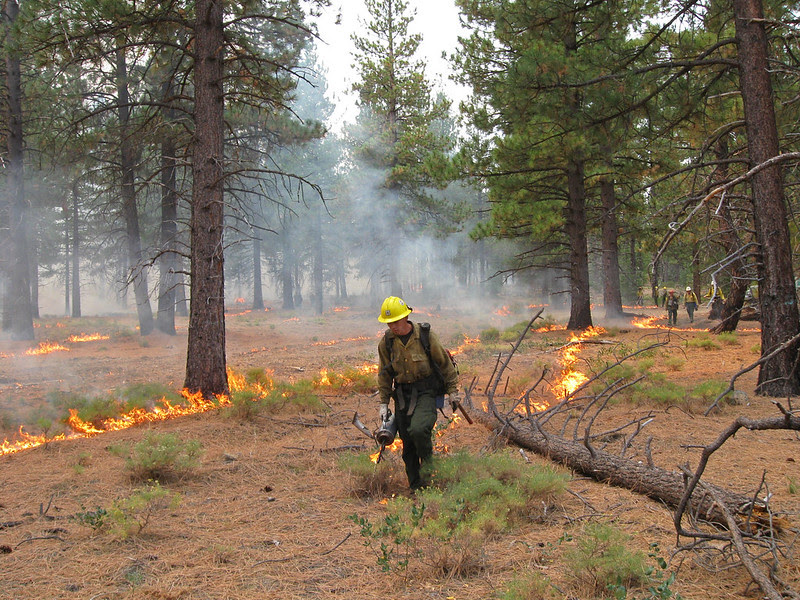
An image showing a person with a drip torch lighting a prescribed burn in a thinned dry conifer forest.


Mechanical Treatments Best in the West;
Prescribed Fire Best in the East

Forest treatments work, confirm agency scientists running a study of forest types across the nation , especially when repeated and adapted to changing goals and conditions. Over the past two decades, researchers tested how prescribed fire and mechanical treatments promote fire-adapted species, reduce fire hazard, and improve understory diversity in Montana, California, North Carolina, and Ohio forests. While all treatments benefited each site, western forests responded better to mechanical treatments, and eastern forests responded better to prescribed fires. The researchers note their ongoing project — unparalleled in both duration and scope — keeps up with the times, showing managers how best practices may evolve with changing forests.

In Forestry, Words Matter

Many groups around the world monitor forests, but not all report their findings in the same terms. Case in point: the minimum threshold for “forest land” used by scientists in the United States is 0.1 hectares smaller than the threshold used by the United Nations. Over large landscapes, this difference adds up — and complicates forest reporting. Agency scientists emphasize the need for transparency in reporting and conversation among those making forest-related decisions.

Southern Waterways May See More Pollution,
But Forests Can Help

Levels of nitrogen may increase by over 300 percent and levels of sediment by over 200 percent in a southern waterway over the next 50 years, say agency scientists, though preserving or expanding upstream forest cover may mitigate the issue. When modeling water quality scenarios at sites in Georgia and Alabama’s Middle Chattahoochee watershed, scientists saw higher pollutant levels downstream of highly developed lands and lower levels downstream of thriving forests. Study authors note that — without efforts to preserve and expand forests — land development likely will continue to reduce forest cover in the area. Additionally, they note rural communities in particular may lack the tools to manage this pollution.

Grizzly Bears: Oh My!

By analyzing arguments on grizzly bear reintroduction in the North Cascades, agency scientists found common ground among differing opinions. While reintroducing carnivores like grizzlies often helps restore biodiversity, many people fear the animals may threaten lives, livestock, and recreation. Though the opinions of study participants varied, people in different camps often shared similar, pragmatic concerns. Additionally, seemingly straightforward opinions had nuances often overlooked in heated debate. Study authors stressed that identifying and validating various concerns helps managers build trust and develop reintroduction plans that work.

A grizzly bear and her cub in the Flathead River System, Montana. USDA Forest Service/Northern Region
Use the bioTIME 2.0 database to monitor long-term biodiversity trends.

Answer your risk- and exposure-related questions about forest and fuels management using the Fireshed Registry dashboard.

Ensure your techniques for assessing in-service wood products are up to date with the third edition of the Wood and Timber Condition Assessment Manual.

Track wildlife through your yard with Lights, Camera, Tracks, the newest article from the Natural Inquirer program meant for learners of all ages.

The cover of the lights, camera, tracks monograph
This email was sent by: USDA Forest Service Research and Development
201 14th St SW Washington, DC, 20227, USA

Update Profile

Clearcuts, Openings, Definitions and Some Reasons for

Now that’s a clearcut ! Illustration for Climate Forest Campaign’s writeup on the Timber EO. forest in the Oregon Coast Range. Photo credit: David Herasimtschuk

Our definition clearing up effort does not seem to be successful, so I’ll try to clarify that there seem to be four choices. 1. Clearcut (standard) the definition fuzzy as it is, in the handbook and the dictionary definitions. 2. Clearcut (L) Looks like one, so any seed tree or shelterwood after overstory removal. 3. Clearcut (O) Any opening.  4. Clearcut (P) used in polemics, could mean anything writer wants.

Some Habitat Requires Openings  (1993 to today)

I had a vague memory that our social scientist friends used to study what people think about clearcutting.   I looked around and found a study on Google Scholar study from 1993

In the 1993 monitoring report for the White Mountain National Forest, forest supervisor Rick Cables wrote that “there is a wide and increasing interest in the concepts of ecosystem management, a principle which we believe is well addressed in the existing plan although subject to change as our monitoring efforts continue. The growing question, though, is the ‘place’ of the Forest in the wider landscape” (Cables, 1993, p. xi). One of the Forest’s goals in response to this issue of ‘place’ is to conduct all management activities with full recognition of the effect on Forest appearance. The foundation of this sensitivity to scenic value is “realizing the importance to society of a natural (appearing) landscape distinct from the man-made environments otherwise dominant in the East (USA).” As a result, project plans are frequently adjusted. “This is especially true for those areas that have experienced residential development since completion of the original (forest plan) inventory. Awareness of the concern over clearcutting has led to reduced clearcut acreage or identification of alternative prescriptions for many projects” (Kokx, 1993, pp. 52–53).
Irrespective of its effect on harvesting volume, Rick Cables observes that “with respect to clearcutting, the problem boils down to this: Of the 339 inland animal species in New England, 257 of them have a primary or secondary dependence on a forested habitat. Of these 257 species 90% (233) of them have a primary or secondary dependence on forest vegetation in the regeneration (0–10 years old) or young (from 10 up to 69 years for some species) age classes. Clearcutting is the vegetative management practice that produces these various age classes of the Forest. It is difficult to provide enough of this habitat when the means of doing so is one that so many people find objectionable — clearcutting” (Cables, 1993, p. v).
Looking back, Rick’s argument was that openings are needed for certain wildlife species. I would say that seedtree and shelterwood also produce those age classes. And here we are having the same discussion about openings pretty much 30 years later.  I think we made a detour to “openings are OK if they fit NRV” but as it turns out, the same groups that were against cutting trees before that detour, are still against cutting trees!
How Many, How Spatially Distributed, Under What Conditions?
How many openings should there be, distributed how, with what characteristics? Should humans make openings directly, or guide wildfire in making openings?
I think the idea of NRV was (perhaps descended from coarse-filter/ fine-filter thinking) that if you had the distribution of ecological characteristics as sometime in the past, then you would be providing habitat for critters as in the past.  I remember when these ideas first came to the WO.. we’ll cut trees to “restore”, who could be against that?  It turns out the same people.
 Some Groups Don’t Want Human-Initiated (or for Salvage, post Natural- Initiated Disturbance, Human- Assisted)  Openings
And we still have folks like WEG and other members of the Climate Forest Campaign who think no cutting (or just commercial?) should occur in stands over 80 years old. It seems like some people and groups are either “anti-opening” or “anti-opening if it involves commercial wood products.” Or perhaps it’s OK to have openings in under 80 years old stands, just recycle the same sites as they grow in.  However, this runs against thinking like “the process of stand development is important”. as per this work by Swanson et al. (note that Beschta and DellaSalla are coauthors)
Early-successional forest ecosystems that develop after stand-replacing or partial disturbances are diverse in species, processes, and structure. Post-disturbance ecosystems are also often rich in biological legacies, including surviving organisms and organically derived structures, such as woody debris. These legacies and postdisturbance plant communities provide resources that attract and sustain high species diversity, including numerous early-successional obligates, such as certain woodpeckers and arthropods. Early succession is the only period when tree canopies do not dominate the forest site, and so this stage can be characterized by high productivity of plant species (including herbs and shrubs), complex food webs, large nutrient fluxes, and high structural and spatial complexity. Different disturbances contrast markedly in terms of biological legacies, and this will influence the resultant physical and biological conditions, thus affecting successional pathways. Management activities, such as postdisturbance logging and dense tree planting, can reduce the richness within and the duration of early-successional ecosystems. Where maintenance of biodiversity is an objective, the importance and value of these natural early-successional ecosystems are underappreciated.
So early-successional communities are important for biodiversity, but only if you don’t log post-disturbance, and don’t plant trees “too” densely.
It doesn’t appear to me that there is any scientific answer to the correct amount of openings and what they should or should not contain.  I guess I could understand the idea of only allowing “natural” disturbances.  Except that we’re told by many of the same groups that today’s disturbances are caused by climate change and are therefore unnatural.
It’s very confusing.  Plus we can’t go back in time in terms of population, past practices and so on.
I do think the idea that openings are created by others in a mixed landscape, and therefore the FS should consider that, does have some merit. However if people want to observe early-successional wildlife and conditions, they can’t do that on private land.  Plus private landowners tend to have different management objectives and practices, and may not want to encourage biodiversity the same way the FS does. Then there are species that prefer wildfire.. which leads to openings.  Fire is more likely to be managed on federal lands than on private.
Sometimes Clearcutting is Used For Any Cutting by Interest Groups (P)
I should also note that some groups seem to use the term clearcutting for any cutting at all, including what we might imagine to be commercial and non-commercial thinning. From the Climate Forests Campaign on the Expansion of American Timber Production Executive Order:
Clearcutting our public lands for private profit will destroy mature and old-growth forests, pollute our air and water, and in bypassing the Endangered Species Act, actively drive vulnerable wildlife to extinction.”
Of course, they argue that thinning is also bad..
Removing large trees and reducing overstory canopy opens the forest to more sunlight, hot, dry winds and higher temperatures, which can encourage growth of flammable shrubs and increase wildfire risk.
The problem I have with this is that the FS really does clearcut (S) and if we want to understand why, we need to focus on those prescriptions in those units.
Conditions That Lead Landowners to Clearcut (S) in Minnesota
I thought that this 2020 JFor paper by Windmiller-Campione et al. of landowner changes over time in Minnesota was fairly interesting.  Similar studies would be of interest in the West, perhaps they exist and I haven’t found them.  The FS does not always tell us clearly in NEPA documents why clearcutting (S) was chosen.
In the Minnesota study, National Forests, industry and small landowners were surveyed. One gets the impression of clearcutting being used when a species is having trouble with native or invasive insects or diseases. It’s interesting that clearcutting went up from 2008 to 2017 for dealing with a couple of these problems.
*************

Wildfire Executive Order of June 12, 2025: What Are Your Thoughts?

Generally, I think that wildfire has done pretty well at not getting partisanized.  I do think that any future partisanization that occurs will just obfuscate the policy and organizational choices..in the fog of saber-rattling, fear-mongering and other political theatrics. So let’s help them not go there.

Anyway, here’s the link to the EO.

Section 1. Purpose. The devastation of the January 2025 Los Angeles wildfires shocked the American people and highlighted the catastrophic consequences when State and local governments are unable to quickly respond to such disasters. In too many cases, including in California, a slow and inadequate response to wildfires is a direct result of reckless mismanagement and lack of preparedness. Wildfires threaten every region, yet many local government entities continue to disregard commonsense preventative measures. Firefighters across the country are forced to rely on outdated technology and face challenges in quickly responding to wildfires because of unnecessary regulation and bureaucracy. The Federal Government can empower State and local leaders by streamlining Federal wildfire capabilities to improve their effectiveness and promoting commonsense, technology-enabled local strategies for land management and wildfire response and mitigation.

Some have thought that this is dissing local fire people.  To me it’s just partisan blather. Certainly the Feds reducing unnecessary regulations and bureaucracy and streamlining Federal wildfire capabilities would be helpful, as would giving them more funding.

Sec. 2.  Streamlining Federal Wildland Fire Governance.  Within 90 days of the date of this order, the Secretary of the Interior and the Secretary of Agriculture shall, to the maximum degree practicable and consistent with applicable law, consolidate their wildland fire programs to achieve the most efficient and effective use of wildland fire offices, coordinating bodies, programs, budgets, procurement processes, and research and, as necessary, recommend additional measures to advance this objective.

Senator Merkley reads this as:

“Instead of focusing on preparing for fire season and directing all energy to actively respond to wildland fires on the ground—like the Rowena Fire in Oregon—President Trump is telling the agencies responsible for keeping us safe to instead make it their top priority to move ahead with a hasty, poorly planned reorganization of their agencies. Congress has not authorized or provided funding for this consolidation and telling the agencies to do this in 90 days, at the height of summer fires, is literally playing with fire that will only burn our communities.”

I would, instead, interpret the EO as a tabletop exercise by people not directly involved in firefighting. I don’t see calling people off the fireline to work on procurement processes.

In fact, rumor has it that the current effort is more like Service First and less like “move to Interior.”

I liked Marc Heller’s take..”The executive order calls for consolidating efforts, without directly telling officials to shift wildfire management to a new agency,” and “Trump’s watered-down wildfire order skirts fight with Congress.” Because the EO does say “consistent with applicable law.”

But maybe Merkley read something different?:” The Trump Administration is once again acting with a blatant disregard for the law and constitutional separation of powers. ”

Sec. 3.  Encouraging Local Wildfire Preparedness and Response.  (a)  Within 90 days of the date of this order, the Secretary of the Interior and the Secretary of Agriculture, in consultation with the Secretary of Homeland Security, shall:
(i)   expand and strengthen the use of partnerships, agreements, compacts, and mutual aid capabilities that empower Federal, State, local, tribal, and community-driven land management that reduces wildfire risk and improves wildfire response, including on public lands; and
(ii)  develop and expand the use of other measures to incentivize responsible land management and wildfire prevention, mitigation, and response measures at the State and local levels.
(b)  Within 180 days of the date of this order, the Secretary of the Interior and the Secretary of Agriculture, in consultation with the Secretary of Commerce and the heads of executive departments and agencies (agencies) represented at the National Interagency Fire Center, shall:
(i)   develop a comprehensive technology roadmap, in consultation with the Director of the Office of Science and Technology Policy (OSTP), to increase wildfire firefighting capabilities at the State and local levels, including through artificial intelligence, data sharing, innovative modeling and mapping capabilities, and technology to identify wildland fire ignitions and weather forecasts to inform response and evacuation; and
(ii)  promote the use of a risk-informed approach, as consistent with Executive Order 14239 of March 18, 2025 (Achieving Efficiency Through State and Local Preparedness), to develop new policies that remove barriers to preventing and responding to wildfires, including through year-round response readiness, better forest health, and activities outlined in Executive Order 14225 of March 1, 2025 (Immediate Expansion of American Timber Production).

Those all seem useful.

Sec. 4.  Strengthening Wildfire Mitigation.  Within 90 days of the date of this order:
(a)  The Administrator of the Environmental Protection Agency shall consider modifying or rescinding, as consistent with applicable law, Federal rules or policies that impede the use of appropriate, preventative prescribed fires.
(b)  The Secretary of Agriculture and the Administrator of the Environmental Protection Agency, in consultation with the Secretary of the Interior, shall consider modifying or rescinding, as consistent with applicable law, Federal rules or policies hindering the appropriate use of fire retardant to fight wildfires.
(c)  The Secretary of Agriculture, in consultation with the Secretary of the Interior, shall consider promoting, assisting, and facilitating, as consistent with applicable law, innovative uses of woody biomass and forest products to reduce fuel loads in areas at risk of wildfires.
(d)  The Secretary of the Interior, the Secretary of Agriculture, the Secretary of Energy, and the Federal Energy Regulatory Commission shall consider initiating rulemaking proceedings to establish, as consistent with applicable law, best practices to reduce the risk of wildfire ignition from the bulk-power system without increasing costs for electric-power end users, including through methods such as vegetation management, the removal of forest-hazardous fuels along transmission lines, improved engineering approaches, and safer operational practices.
(e)  The Attorney General, in consultation with the Secretary of Agriculture and the Secretary of the Interior, shall review pending and proposed wildfire-related litigation involving electrical utility companies to ensure the Department’s positions and proposed resolutions in such matters advance the wildfire prevention and mitigation efforts identified in this order.

I see something like (hey EPA let’s relook at PM2.5 and fire retardant); I don’t find it particularly surprising.  Innovative uses of biomass.. sigh.  If only more words would help.. I like the idea of departments working together,  so I like getting Interior, Ag, Energy and FERC on the same page.   It also seems to make sense that we would pay attention to lawsuits and what they have to tell us.

Sec. 5.  Modernizing Wildfire Prevention and Response. 
(a)  Within 120 days of the date of this order, the Secretary of Defense, in consultation with the Director of OSTP, the Assistant to the President for National Security Affairs, and the heads of relevant agencies, shall, as appropriate, identify, declassify, and make publicly available historical satellite datasets that will advance wildfire prevention and response and improve wildfire prediction and evaluation models.
(b)  Within 180 days of the date of this order, the Secretary of the Interior and the Secretary of Agriculture, in consultation with the Secretary of Commerce and the heads of agencies represented at the National Interagency Fire Center, shall:
(i)   Identify rules that impede wildfire prevention, detection, or response and consider eliminating or revising those rules, as consistent with applicable law.  This consideration and any resulting rulemaking proceedings shall be reflected in the Fall 2025 Unified Regulatory Agenda.
(ii)  Develop performance metrics for wildfire response, including metrics related to average response times, annual fuels treatments, safety and cost effectiveness, and other subjects, as appropriate for inclusion in strategic and annual performance plans.
(c)  Within 210 days of the date of this order, the Secretary of Defense shall evaluate and, as appropriate and consistent with applicable law, prioritize the sale of excess aircraft and aircraft parts to support wildfire mitigation and response.

Speaking of Holy Grails (biomass), performance metrics for annual fuels treatments.. yup.   I didn’t know that there was an issue with historical satellite datasets.


So that’s basically it.  Hey you all, work together better. And fix those problems we identified even the ones we’ve been working on for decades. Plus get some consistent performance measures going.

Let’s Define “Clearcut”and Reduce Unnecessary Disagreement

A variable retention site with 23% retention illustrates the impact of aggregate size on the amount of forest influence. Sites with smaller aggregates have higher levels of calculated forest influence. However smaller aggregates are more edge-affected and susceptible to windthrow and regeneration burn impact. Figure produced by Robyn Scott. I think it’s from this paper.

What if.. we agreed on a definition of clearcutting?  It seems like originally it meant a practice used in even-aged regeneration of forests used (and still used in the SE) by timber industry.  The impression was big openings, removal of all trees, burning broadcast or piles and replanting. During the 80’s I remember an economist from Oregon State on a field trip to Weyco’s Klamath Tree Farm, telling us that we needed to move from “pick and pluck” or Keen classification to clearcutting because it was more efficient. Yes, that was apparently the best available science at the time.

Then as I recall, (and others remember more) it was important to retain wildlife trees and snags.  Then there was an effort to make clearcuts smaller. Then there was the suggestion of “Big Messy Clearcuts”. Well, I couldn’t find those words when I searched in Duck Duck Go, but I do remember them.  Some Region 6 retiree should probably write a history of silvicultural terminology and practices through time.

I did find something when I searched Google Scholar.  It was from a 1991 (35 ish years ago) Focus on Forestry, put out by OSU.

Franklin sees New Forestry as an alternative “to the stark choice between tree farms and total preservation”a way for real multiple-use management to occur on the same parcel of forest at the same time. “It’s a way we can integrate, not allocate, the resource among interest groups,” he says.
However, New Forestry has drawn fire from both the timber industry and environmentalist groups. Industry managers point to a host of problems associated with leaving green trees and snags fire hazard, logger safety, difficulties in regeneration, high costs, and plain ugliness”these places look like messy clearcuts,” says one critic.

Environmentalists, for their part, are suspicious of any scheme that asks them to modify a fundamental tenet: preservation of intact forests. There’s no guarantee, they say, that New Forestry will really do the job of protecting the ecosystem over the long haul.

So now folks are talking about variable retention harvesting, which apparently allows openings (clumps and openings?).   We know that some species require openings to regenerate.  No openings means true fir success, which can compete with ponderosa and die off from bugs leaving material for a wildfire, which indeed makes openings.

I was surprised when I read that the BLM was proposing (according to Oregon Wild):

a massive logging proposal that would clearcut thousands of acres of public forest, including mature and old-growth trees.”

This was surprising to me, as in my definition, it wasn’t clearcutting.  So I asked Victoria Wingell (the author) what she meant by clearcutting. I appreciate her response, as many folks do not respond to my emails.

The 42 Divide Draft EA indicates that as many as 1,040 acres would receive Variable Retention Harvest (VRH). Although BLM does not call this clearcutting, from a practical standpoint it is the equivalent, leaving behind a very small number or percentage of trees in a given stand. The 42 Divide Draft EA also indicates BLM could authorize as much as 3,919 acres of commercial thinning with up to 25% gap creation (mini-clearcuts). 25% of 3,919 is nearly 980 acres. 1,040 acres of VRH plus 980 acres of gaps is over 2,000 acres.

In other documents, BLM has acknowledged that VRH and “group selection openings” (gaps) are the equivalent of clearcutting from a watershed analysis. For example, see the Last Chance EA , pp. 86-87, found here:

I’m not sure about her math, if 1040 acres receive VRH, conceivably it’s not all openings.  So a person  could claim  if a “very small number” is left, it’s the “equivalent” of clearcutting. And if gaps are “mini-clearcuts” then how much of a gap is a mini-clearcut?
If we were going to develop a shared definition of clearcutting, it seems to me it should have some characteristics, like:
1. The trees were alive before being cut down (is cutting a dead stand of lodgepole with some dead leave trees really a “clearcut”?)
2.  The size of openings
3. The spatial relationship of openings
Let’s imagine a a 1 acre opening.  It seems to me the impact would be different if another 1 acre opening were 20 feet away versus two miles. That’s what the literature on variable retention shows. So for me, you can’t add openings across space and by doing so call it a clearcut.
It’s perfectly fine to say “we don’t want openings larger than….”.  Or “over this 1000 acre block, we only want 50 openings less than 1 acre.”
I think using the term “clearcut” without defining it by some kind of mutual agreement leads to unnecessary disagreement and confusion.
In my view, we have enough necessary disagreements (and apparently have had the same ones since the 80s’s) without having unnecessary ones!
*******************
For those who want to philosophize, I also found this quote that seems, in retrospect, somewhat sanguine about the power of research to resolve disputes. I’ve always found it curious that forest science has always been so resistant to the sociology of science work directed at understanding when more science helps or doesn’t.  From Focus on Forestry Winter 1991.
Crucial to resolving the disagreements surrounding New Forestry and the other contentious issues posed by natural-resource management today is good science leading to new knowledge, says Dean George Brown. “We are fully equipped to be the center for that science. We have hundreds of studies going on, looking at everything from the biological processes of forest soils, to manipulating the vegetation to get better growth from seedlings, to finding more-efficient ways to use the wood we have. “This kind of effort is what it’s going to take.”

Human Beings Expunged From USDA Research Websites, Including the Forest Service, But Not Interior (USGS)- Why?

USGS website “staff profiles”.


Dear USDA,

What happened to you? Agricultural research has always been fundamentally networked with farmers and their needs.  But for some reason, at least with Forest Service R&D and ARS, there seems to have been an intentional effort to make it difficult for citizens to contact researchers.

IMHO we need to foster relationships between the public and scientists, not put barriers up to those relationships.

Why are you doing worse at this than Interior (USGS)? What’s going on?

Signed,

One Very Grumpy Retired Employee

******************************

Well, I had the idea of posting a useful researcher and research project each day until the budget discussion has led to not zeroing out R&D.  But sadly, I found that I couldn’t do this… because I associate great research with specific researchers.. and guess what? Instead of making NFS human beings more accessible, the FS has made R&D human beings less accessible. It doesn’t seem to be the FS’s fault though, because it happened to ARS as well (the other intramural research agency at USDA).

I suspect, but can’t prove that this effort started in the previous Admin (remember the disappearance of the employee directory?) and appears to have been driven by some non-partisanal force that we don’t yet understand.

Here’s how I used to look for researchers (and research)- the information was organized.

This is the site as captured by the Wayback Machine June 24, 2024.

When you go to the people link, you got this alphabetized list.

And if you selected a person, say Nate Anderson, you would get an extremely useful set of tabs. I picked Nate because he’s  on the first page of names, and he’s working on biomass as well as other things which are Congressional and Admin priorities.  Note that with this page, interested members of the public could contact him.  Also note that you can still use the Wayback Machine to locate scientists the old way.


This all seems very useful, at least to me.

But what does the homepage for RMRS look like now?

The people appear to be gone, and contact forms for the Station are supposed to substitute.. which I think would actually make more work for folks to route the questions. The same thing we noticed with NFS last year.

I tried to figure out if this was a USDA-wide thing by looking at ARS. I noticed that ARS also doesn’t have their data on people anymore, and did a Wayback to April 2024.


So it seems like it’s a USDA thing..not a Forest Service thing.  Then I checked USGS, and they do have their people listed. So it appears to be only USDA? It would be sad if the agency that is the home of the Land Grant model, liking education, research, and extension, somehow decided it was important to build walls between people and the peoples’ researchers.