Randy Moore, pictured at the upper right, with OHV riders. Photo courtesy of Don Amador.
From the Lake County News. Please feel free to link to other tributes to Randy in the comments below.
This tribute is published in response to the recent announcement that Forest Service Chief Randy Moore is retiring from the agency.
I had the privilege to meet Randy Moore shortly after his appointment in 2007 to serve as the Pacific Southwestern Regional forester. After shaking his hand and looking him in the eye, I knew he possessed the character, commitment and leadership skills needed to guide the agency through the difficult challenges it faced.
That first meeting at the Region 5 HQ in Vallejo, CA was with a core team of OHV leadership and our partners at the CA State Park Off-Highway Motor Vehicle Division. The discussions were centered on our shared commitment to ecologically-balanced motorized recreation on Forest Service System lands.
After the initial welcomes, Randy opened the meeting by sharing his background and his willingness to meet with OHV and other key stakeholders but that attendees should be aware of what I called Randy’s Rule” and that was, “If you come to my office with a problem, you also need to come with a solution.”
During the course of his tenure as the Regional Forester (2007-2021), the “Trail Community” deeply valued their relationship with Randy and his management team. And, that his door was always open to the recreation community providing your meeting focused on solution-based discussions.
I also appreciated his shared passion for field trips on an ATV or Dirt-Bike where Randy could review some of the important recreation and trail management challenges facing the agency along with solutions being implemented to address those concerns.
Randy should be commended for the collaborative manner that his office and staff conducted themselves during the 2018-2020 intense wildfire seasons to build agency and partnership capacity to address post wildfire recovery efforts of both motorized and non-motorized recreation facilities and areas damaged by wildfires.
I believe that Randy had the right stuff or blend of field level experience, character, administrative and political acumen, and people skills to succeed both as the R5 Regional Forester and Chief of the Forest Service.
I want to thank him for his 45 year career with the Forest Service and for “Caring for the Land and People” along with his strong commitment to working with agency partners in support of managed recreation and resource management of public lands.
I wish him all the best in the next chapter of his life.
Don Amador has been in the trail advocacy and recreation management profession for 35 years. He is president of Quiet Warrior Racing LLC, past president/CEO and current board member of the Post Wildfire OHV Recovery Alliance, and a co-founder and core-team member on FireScape Mendocino, a forest health collaborative that is part of the National Fire Learning Network. Amador served as an AD Driver for the Forest Service North Zone Fire Cache during the 2022, 2023 and 2024 fire seasons. A northwest California native, Amador writes from his home in Cottonwood, California.
I’m looking for reputable numbers of Forest Service employee numbers over the last 50 years. Are we bloated, are we on the decline?
The next post will go further into the past, but for now, let’s talk about the recent past.
We are very fortunate here to have an actual HR person answer some of our questions, so a special thank you to that person! Also, these numbers may not agree with other numbers you read. Part of that is the timing of them being pulled, and since many op-eds and other publications don’t include that information, nor give the source of the numbers, it is hard to compare. ISo I don’t know but this is the best I could get, from a very recent data check.
It seems that there are many more news stories about the Park Service and Forest Service than other agencies, but that might be just due to my news sources. It does look like the Forest Service hired many permanents in the last few years. Many of these were on various kinds of authorities (non-competitive?) that require a 2-year probationary period. So.. given that overall 20% (I hope you check my math) of the permanent workforce was hired in the last two years, and that they were hired under authorities with-two year probationary periods (instead of one year for those hired under other authorities), then it would explain why firing probationary workers would have had a disproportional impact on the FS. If, as our HR source says, 2200 probationary employees were actually terminated at this point (see below), that would still leave the perms above the average of 2018-2022 (added 5860, lost 2200). But is it fair to count the converted 13/13s ( around 1400) as a real “addition?”
We could still subtract the 13/13 conversions from the 5860 and get 4460 new not converted. If 2200 positions were lost, the FS would still have 2260 more perms than previously. Again, please check my logic and math.
Given the conversions, perhaps the only way to answer Anonymous’s question would be to compare hours worked by all perms + temps, over time.
Who Gets a Probationary Period and How Long?
HR Notes: Let me qualify this first by saying I am not an expert on this issue, but here is my understanding of it. Any new hire to the Federal Service is subject to a 1-year probationary period. However, certain excepted hiring authorities, such as Direct Hire Authority (DHA), Veterans authorities, Schedule A, and others are subject to a 2-year period (called something else) but essentially a 2-year probationary period. A lot of the recent hiring (last couple of years) was using DHA, Sch. A, and Veteran authorities. Any SES selectee is subject to a 1_year probationary period (I think the FS had about a dozen). Finally, anyone hired into a supervisory position for the first time is subject to a probationary period. There are other nuances to all this, but this is the general, basic guidance.
What are the current numbers of terminated employees?
Off the top of my head, there were over 5,000 employees (both fire and non-fire) who were identified as probationary. Fire was mostly exempted from being DOGEed, so about 3,500 non-fire were ultimately identified to be terminated, but this number dropped significantly as further review of cases were made. Last I heard, there were maybe closer to 2,200 or thereabouts who were actually terminated. Now, there are efforts to try and hire some back, plus court rulings may ultimately bring some back, at least for a short time. This may all change again depending on who might apply for and be accepted for Voluntary Early Retirement (VERA). It will likely change yet again if/when a potential RIF plan is submitted (first iteration of Plan due to the Department very soon…March 13) and then implemented.
I hope someone will send me a copy of the RIF plan.
“Here are the actual Onboard numbers for the last 7 years, 2018 – 2024, plus 2025 year to date:
All (perm + Temp) Perm (incl. Fire) Perm Fire Temp (all fire+non-fire)
2018 35,210 27,730 7,280 7,300
2019 35,740 27,420 7,680 8,190
2020 36,920 28,930 8,670 7,830
2021 35,985 28,720 8,550 7,070
2022 35,990 29,700 8,970 6,070
2023 38,180 32,780 9,710 5,200
2024 38,820 35,650 10,400 3,050
2025 ytd 35,220 34,630 10,090 460″
HR Notes: the low temp number for 2025 reflects the time of year when count is made plus the effects of the hiring freezes put into effect by Chief Moore (mid 2024) and USDA (2025). Temp numbers have been trending down as the agency began moving toward more Permanent Seasonal Emplotyee (PSE) 13/13 positions in lieu of temp 1039 appointments. This started within the fire organization back in 2018 or earlier but accelerated in the last couple of years. Over 1,400 non-fire positions that were formerly temporary 1039 appointments were advertised and filled in 2024 as PSE positions. The percent of permanent fire positions relative to the total workforce was 26.25% in 2018, and was 29.2% in 2024.
So it appears that the trend to make seasonals permanent and hire many new perms (past Admin) was on a collision course with the this Admin’s idea of firing probationary employees (except for fire positions).
The temp number is low for a few reasons. This ytd number is where we stand from Oct. 1 thru early February. Typically, not many temps are hired for this timeframe. Some beat the freeze, so to speak, by having an offer letter, accepting the offer, and having a report date by February 8. All others in the pipeline were caught in the freeze. Some of these, if they were for fire positions, are now unfrozen based on an approved exception, and are back on track (within a week or two) of their originally planned onboard dates. A second exception recently approved released for advertisement a number of fire positions. I believe most of the fire jobs in the temp world are usually onboarded between PP 8 and 11, and thus are potentially still on track, assuming we get viable candidates.
My next question (you all can check my math): And to interpret the perms including fire.. it stayed about the same.. gradual increase, from 2018 to 2021. Then in 2022, 1000 were added with 420 of those fire.
In 2023, 3080 were added of which 740 were fire.
in 2024, 2780 were added of which 690 were fire.
So in two years, 23 and 24, the FS added 5860 permanent positions, of which 1430 were in fire? If we take, say, 28,500 (the average of 2018-2022), that would be about a 20% increase in perms in two years?
HR Notes: Yes, the agency did some major non-fire hiring over the last couple of years. Foresters, Forestry Tech (timber), Partnership Coordinators, Recreation 401s, archaeologists, lands and special use administrators, Engineers, and probably a few other categories, all had national collective hiring processes/events that brought in new employees. The agency did so well at this that they overshot what the budget could cover, hence the partial freeze that Chief Moore put into effect back in April 2024.
Note the “overshot” part- how could that happen? See next post going further into the past.
Again, everyone feel free to check my math and logic.
Schultz has been a topic of interest to this blog, naturally, and it will be interesting to see what others think of Jim’s insights and perspective. Here is the text and most photos to his article, but without direct links to related Evergreen essays:
Tom Schultz: Big Picture Thinker
Money doesn’t grow on trees…
Our mission is public education as it relates to all things forestry – so your contributions matter. Your support means we can continue to bring you the quality of content you have come to expect from Evergreen. If you appreciate our work, let us know – subscribe, donate, or leave us a tip!
On February 27, Tom Schultz was named the twenty-first Chief of the Forest Service. Many of my friends know Tom from his 14 years with the Montana Department of Natural Resources and Conservation and his years as Director of the Idaho Department of Lands and, more recently, Vice President of Resources and Government Affairs for the Idaho Forest Group.
I know him best from his IFG years. We visited at several conferences in Boise. He is a big picture thinker who brings exceptional leadership skills to the Forest Service at a time when both are desperately needed. He possesses what Vice President George Herbert Walker Bush called “that vision thing” when a Time Magazine writer asked him if there would be an over-arching theme in his 1988 run for the White House.
Schultz is only the third Forest Service Chief to be hired outside the ranks of the agency’s executive chain. The first was Jack Ward Thomas, an elk biologist in eastern Oregon before President Clinton picked him to lead the development of the controversial Northwest Forest Plan. He worked so impressed Clinton that he talked him into accepting the Chief’s post. The second was Mike Dombeck, a fisheries biologist, who was working for the Bureau of Land Management when President Clinton named him Chief in 1997, after Thomas resigned.
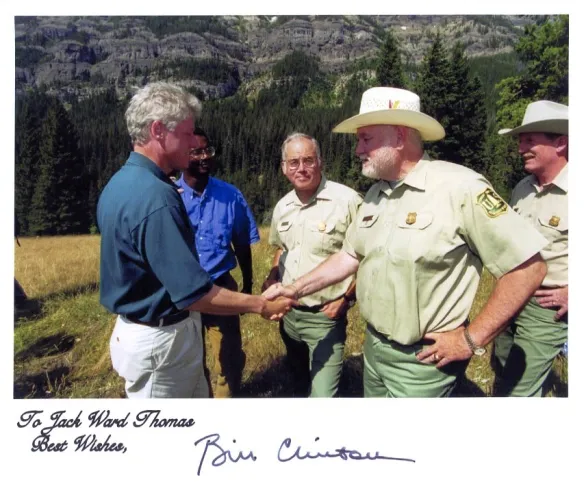
That’s Jack shaking hands with President Clinton. The President was so impressed with Jack’s work on the Northwest Forest Plan that he asked him to consider accepting the Chief’s post. Jack’s late wife urged him to accept despite her own illness.
Jack and I got to know one another well during the years I was living in Bigfork, Montana. He had quit the Forest Service and accepted a Boone and Crocket-funded chair in the W.A. Franke College of Forestry and Conservation at the University of Montana. I wanted to know why he quit. His answers led to many heated conversations at his home in Corvallis, Montana, but we remained friends. We had planned one last get together before cancer killed him. I still have the message he left on my cell phone a few days before he died.
Apart from his excellent book, Journals of a Forest Service Chief, Thomas has more than 600 articles to his credit: chapters in other books, essays and articles on everything from elk biology to land use planning. He was a strong advocate for zoning national forests based on eco-types. We have many of his writings in our library, along with dozens of books that trace the history of the U.S. Forest Service.
Of these books, the most comprehensive is Harold Steen’s book The U.S. Forest Service: A History. Steen held a PhD in History and was the Executive Director of the Forest History Society during its rise to prominence after Steen moved it to Durham, North Carolina in 1984.
The Forest Service also published several books of its own that chronicle its progress following its founding in 1905. Among them, 100 Years of Federal Forestry, aka Agriculture Information Bulletin No. 402, a picture book assembled by Forest Service retiree, William Bergoffen in 1976.
My personal favorites were written by Forest Service Chiefs who had lived their stories. These include Bill Greeley’s 1951 book, Forest and Men. Although he was Chief from 1920 to 1928, his book opens on the fire lines in western Montana and northern Idaho during the Great 1910 Fire, still the largest forest fire in our nation’s history.
Bill Greeley, Third Chief of The U.S. Forest Service
This is the Greeley profile written by the World Forestry Center
GREELEY-WILLIAM-B..pdf
60 KB
Greeley was then the District Ranger for District No. 1 which included federal forests in western Montana, northern Idaho and northeast Washington. Among his post-fire responsibilities was the identification and burial of the 78 men who died in the three million acre conflagration.
The tragedy haunted Greeley for the rest of his life and had much to do with his significant behind-the-scenes role in ratification of the Weeks Act in 1911 and the Clarke-McNary Act in 1926. Clarke-McNary put the Forest Service in the firefighting business alongside a series of privately-funded cooperatives assembled by the Weyerhaeuser Timber Company following the 1902 Yacolt Burn. The fire leveled 239,000 acres of virgin timber in northwest Oregon and southwest Washington. Thirty-eight people were killed.
Greeley also wrote a lesser known book in 1953 titled Forest Policy, a three part compendium based on his years at the helm of the West Coast Lumbermen’s Association. He left the Forest Service to join the deeply-troubled association in 1928. He had concluded that WCLA was in dire need of a major course correction that would align it with Forest Service reforestation and conservation interests.
Gifford Pinchot’s Breaking New Ground also well worth reading. It was published by his estate in 1947, the year following his death. The Forest History Society published Jack’s Journals in 2004.
Both men were held captive by political events of their time. With Pinchot it was wildfire and his belief that regulation was the only way to control the harvesting excesses of private forestland owners. With Jack it was the northern spotted owl and wildlife habitat conservation.
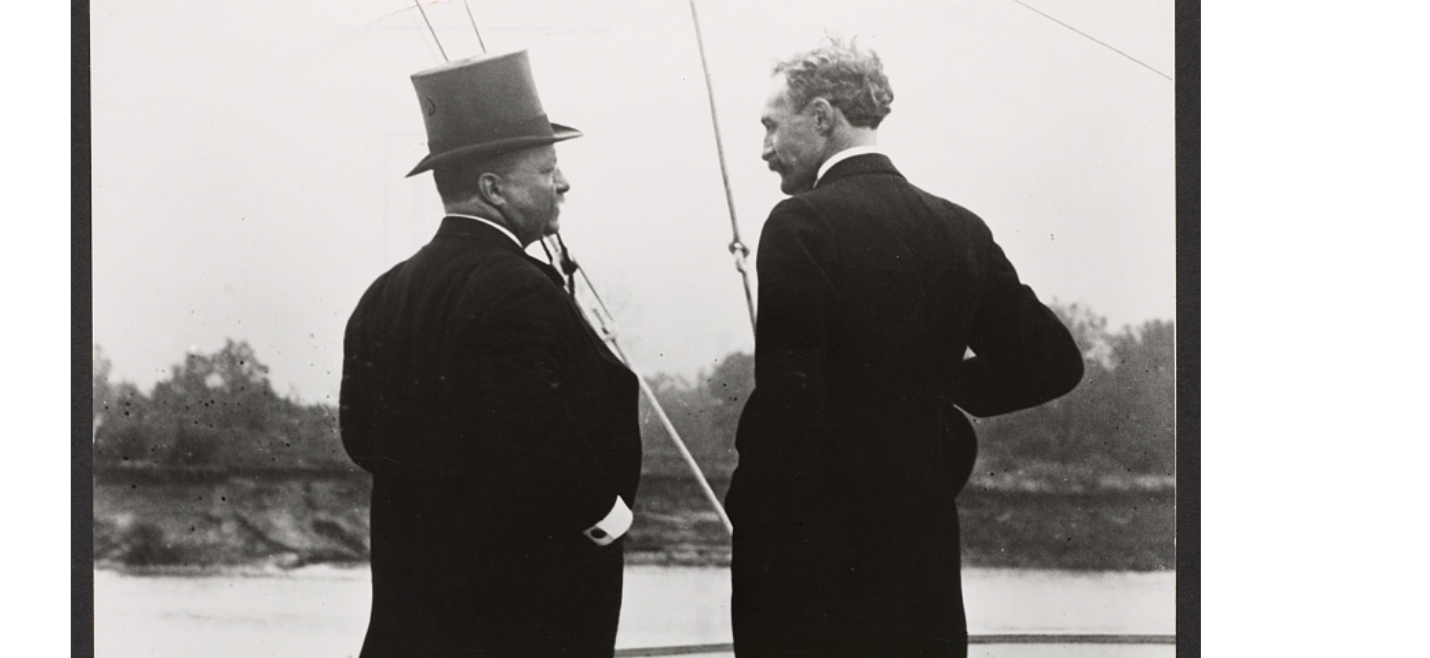
Forest Service Chief, Gifford Pinchot [right] with President Theodore Roosevelt on an Inland Waterways Commission tour of the Mississippi River in 1907.
President Theodore Roosevelt named Pinchot the first Chief of the Forest Service at its founding on February 1, 1905. They had been friends and confidants since Roosevelt’s years as New York Governor. On that same day, Roosevelt signed the Transfer Act, moving 63 million acres of designated Forest Reserves from the scandal ridden Department of the Interior to the newly formed Forest Service. About 500 employees answered to Pinchot.
Those 63 million acres were in Forest Reserves designated by Presidents Benjamin Harrison and Grover Cleveland – most of them in the West.
Tom Schultz’s Forest Service includes 154 national forests, about 30,000 mostly demoralized employees and 193 million acres. About 180,400,000 of these acres are located in 84 National Forests in the West and about half – some 93 million acres– are dying, dead or burnt to a crisp.
I have been flooded with questions from worried westerners who want to know what Schultz thinks or how he might tackle the mess he faces. My guess is that he will first hire a Washington Office staff he trusts, then he will turn his attention to the regulatory impacts of the Supreme Court’s Chevron Deference ruling. More on this in a moment.
We are fortunate to already know a few things about Schultz’s 30,000-foot view of the Forest Service and its tattered relationships with states, counties, and stakeholder collaborative groups because he joined three other big picture thinkers who were asked to pen their thoughts in an essay that appeared in 193 Million Acres: Toward a Healthier and More Resilient U.S. Forest Service, a 2018 book published by the Society of American Foresters.
Their essay was titled Cooperative Federalism, Serving the Public Interest: A Policy Analysis of How the States Can Engage Local Stakeholders and Federal Land Managers to Improve the Management of the National Forests.
Cooperative Federalism
An essay co-authored by Forest Service Chief, Tom Schultz
Schultz Cooperative Federalism – FINAL.docx
135 KB
Schultz’s co-authors were Holly Fretwell, then a research economist with the Property and Environment Center [PERC] in Bozeman, Montana, Dennis Becker, then Director of the Policy Analysis Group within the University of Idaho’s College of Natural Resources, now Dean of the College of Natural Resources and Kelly Williams, a natural resources lawyer and Adjunct Professor at the S.J. Quinney College of Law at the University of Utah.
The essay is long, but it will tell you what Schultz and his big picture colleagues saw when the looked at the struggling Forest Service eight years ago and asked themselves what could be done to help the agency get back on its feet again.
It seems inconceivable to think that Schulz ever thought the task of rescuing the Forest Service would fall to him – but he is now at the helm of a shell-shocked agency that is in real danger of tumbling off the crumbling cliff it has occupied since the federal government added the Northern Spotted Owl to its list of threatened species in June 1990.
There is no point in rehashing the history of how the world’s most admired natural resource management agency became one of the most reviled.
Far more important are the tasks that Chief Schultz faces now and in the near future….Here is a brief summary:
Terminate the Forest Service’s Overreaching “Managed Fire for Ecosystem Benefit” Policy
This is one of the most controversial, perplexing, and misled practices the agency has embraced in its 120-year history.
The concept of “managed fire” as a standalone approach is misleading – as it neglects the crucial need for regular thinning and prescribed burns under the right conditions – to restore balance to our overstocked public lands.
New Mexico’s 2022 Calf Canyon/Hermits Peak Fire is a prime example. It started as a prescribed burn on long-neglected land, despite conditions being too windy and too dry—directly contradicting the Forest Service’s own guidelines for a “managed burn.”
The fire quickly escaped its handlers. Some 341,400 acres and several hundred homes were burned.
Taxpayers have thus far paid more than one billion dollars in damage claims. This recurring scenario across the West continues to leave devastation in its wake.
How much more destruction must occur before the Forest Service’s reckless “managed fire” practices are abolished?
Chief Schultz can do it in a heartbeat with his own executive order aimed at forest-to-community health – a holistic, mutually inclusive approach to management, stewardship, ecosystem stabilization, and conservation.
Decades of scientific studies support the necessity of periodic thinning and prescribed burning in overstocked forests. When evidence-based science is applied, there is no safer or more cost effective way to reduce the risks associated with insect and disease infestations – and inevitable wildfire.
Just ask our First Nations citizens—they successfully managed the land long before science recognized the wisdom of Indigenous knowledge.
States, tribes, and private landowners regularly thin and burn to reduce biomass, manage debris, improve soil health, promote a healthy forest ecosystem, improve tree propagation, and mitigate insect and disease infestations. The Forest Service once did the same, but after the spotted owl was listed in 1990, it abandoned these practices. Too often now, the Endangered Species Act is used as an excuse for inaction.
Recasting the Wrecking Ball: Reforming the Equal Access to Justice Act
The EAJA was created to help ordinary citizens stand up to the government overreach, but elite environmental groups have hijacked it into a weapon for their own agendas.
Well-funded organizations, backed by wealthy donors, file endless lawsuits – to block responsible forest management.
They claim to be committed to justice, but they exploit a law meant for the underprivileged, forcing taxpayers to pay for their legal battles.
They claim to fight for conservation, yet their legal obstruction to thinning and prescribed burns has led to more devastating wildfires, insect infestations, and diseased forests.
The EAJA must be reformed to ensure our forests are managed with science – not endless litigation that hurts communities, damages our forests, and squanders public funds.
Reform will take time – but until it is done – all of the current Administration’s forestry-related executive orders will be challenged by serial litigators. This is an ongoing cycle, regardless of the administration – because they risk nothing.
While Congress is unlikely to exempt federal lands from the EAJA, it could replace litigation over forest plans with binding, baseball-style arbitration.
In this process, serial litigators and stakeholder collaboratives would each present their case, and arbitration judges would determine which proposal best aligns with the goals and objectives of the disputed forest plan.
Some experienced advisors suggest that the Equal Access to Justice Act could be improved through executive orders that reverse specific changes made during the Clinton Administration.
These modifications, introduced long after Congress originally passed the Act during the Reagan years, expanded its misuse – allowing well-funded groups to exploit taxpayer dollars for endless litigation.
Restoring the EAJA to its original intent through executive action could help curb these abuses and ensure the law serves those it was meant to protect, rather than elite litigators and obstructionist organizations.
Return to Evidence-Based Forest Service Culture
A profound cultural shift is underway within the Forest Service, driven by a sharp decline in the quality of forest science education at U.S. universities.
This decline stems from universities prioritizing federal research funding tied to political agendas, leading to an education system that promotes selective science rather than comprehensive, evidence-based forestry practices.
Decentralize the Forest Service’s Organizational Structure
Decision-making about our public lands must shift away from Washington and Regional Offices and return to District Ranger Offices. Local staff—who understand the land, have community trust, and can foster collaboration—are best equipped to make informed decisions.
However, given shifts in education and experience, some Ranger Districts may need support. Recent Forest Service retirees and qualified mentors can help by completing essential NEPA documents, including Environmental Impact Statements, Environmental Assessments, and Categorical Exclusions.
Jack Ward Thomas likened NEPA’s regulatory process to a ‘Gordian Knot,’ suggesting it was nearly impossible to navigate without facing lawsuits – lawsuits often used as a delay tactic to stall timber salvage after wildfires.
However, successfully navigating NEPA without litigation is possible. A retired Forest Service expert on our Evergreen Foundation Board has done so multiple times.
With intention and a commitment to collaboration, we can reduce the risk of catastrophic wildfire, disease, and insect infestations while maintaining environmental balance and strengthening the connection between forests and communities.
Align Forest Service Regulations with New CEQ Standards Under the Supreme Court’s Chevron Deference Decision
In Loper Bright Enterprises v Raimondo [Gina Raimondo was the Biden Administration’s Secretary of Commerce from 2021 to 2025] the Supreme Court ruled in favor of Loper Bright, a New Jersey Fishing Company that sued the National Marine Fisheries Service.
Chevron Deference was established in 1984 by the Supreme Court in Chevron U.S.A., Inc. v. Natural Resources Defense Council, Inc. Justices ruled for NDRC, requiring lower courts to defer to the agency’s interpretation of a statute if the statute was ambiguous. Justices assumed that the agencies were experts in their subject matter areas and that Congress intended for the agencies to fill in gaps in statutes.
By a 6-2 margin the Roberts-led Supreme Court overruled Chevron Deference, citing the 1946 Administrative Procedures Act. APA spells out the process that federal administrative agencies must use to propose or establish administrative laws or regulations. It also grants federal courts oversight over all agency actions.
The upshot of the Loper Bright Enterprises v Raimondo ruling is that CEQ – the Council of Environmental Quality – must now revisit and revise decades of federal regulatory overreach involving federally-owned natural resources.
To wit: Jack Thomas’ Gordian Knot.
Once CEQ finishes its work, it will be Chief Schultz’s job to lead the same effort within the Forest Service. My guess is that he is up to his eyeballs in this process.
CEQ’s draft regulations are expected to be released soon. A 30-day comment period will follow, then a 45-day timeframe for implementation. It will be Chief Schultz’s responsibility to bring Forest Service regulations into alignment with new CEQ standards.
What we have here is a significant opportunity to loosen the “Gordian Knot” by adding much needed efficiency to the National Environmental Policy Act,
NEPA has become a tangled mess after 40 years of improper court rulings and excessive agency regulations. However, the Supreme Court’s decision in Loper Bright Enterprises v. Raimondo has undone much of this bureaucratic overreach, providing an opportunity to restore clarity and proper implementation of the law.
The Supreme Court has shredded the litigation-based business model that opportunists and obstructionists have relied on to push a false narrative about public land management.
They only make money if the public believes that conservation and management are mutually exclusive – that any form of active management is harmful – and that humans cannot play a responsible role in maintaining balanced ecosystems.
Chief Schultz is going to need his own chorus – composed of conservationists, forest scientists, stakeholder collaborative groups – everyone who enjoys the environmental and economic benefits that flow from well managed forests…
Clean air, clean water, abundant fish, bird and wildlife habitat and the very long list of year-round outdoor recreation activities that can only be found in healthy, thriving forests.
As I’ve said before but it bears repeating…
It’s time to saddle up and ride hard. We have a long way to go and a short time to get there.
The Northwest Forest Plan lays out how to manage millions of acres across Washington, Oregon and Northern California. But the scientists behind the plan say it hasn’t been very successful. It cost thousands of timber industry jobs and failed to protect vulnerable species. Now that the government is reconsidering it, the scientists reflect on what was considered the best option 31 years ago.
For TSW readers, I think the important part is his observation below.
This wildfire bill may spark some concern about returning to the 10 AM rule… but it’s a response standard, not a suppression standard.
I’ll just excerpt what he has to say about that (there are other interesting things about the bill).
First, this Bill sets a 30-minute response time for new wildfires, but what that actually means is defined as the following:
RESPONSE TIME- The term “response time”, with respect to a wildland fire incident, means the period of time between ignition of the wildland fire and evaluation for purposes of suppression of that wildland fire, on the ground or in an aircraft.
To me, this sounds like a traditional size-up. They are asking to have eyes on the fire within 30 minutes by air or ground and have some sort of evaluation done for how to suppress the fire. Pretty straightforward. This bill would set a 30-minute standard for that action to take place.
It continues by saying this could be accomplished by any Federal, State, or local public safety officer or a public safety volunteer. If the fire is on federal land, it would be whoever has jurisdiction, including the Forest Service, Bureau of Land Management, USFWS, Bureau of Indian Affairs, National Park Service, or the Fire Administration under FEMA.
Furthering clarification on how this would work:
Not later than 90 days after the date of enactment of this Act, the Secretary concerned shall establish a standard for the response time to any wildland fire incident occurring on Federal land administered by the Secretary concerned.
Goal- To the extent practicable, the response time established by the Secretary concerned for a wildland fire incident shall-
be not more than 30 minutes, and
include the deployment of fire suppression assets in a response time of not more than 3 hours.
The critical part here is “to the extent practical,” as these standards would be challenging to meet in places like Alaska, where fires can take hours to get to, and time-consuming refueling might be necessary due to the vast and expansive landscape.
The bill also calls for the wildfire agencies to essentially take an audit of available ground and aviation resources and determine if they are sufficient to meet the standards.
It asks the Agencies for “a description of the composition of the aviation and ground wildland firefighting fleet as of the date on which the report is submitted; and an estimation of the size of that fleet required to provide a response time of not more than 30 minutes for wildland fires occurring in the United States, including the deployment of fire suppression assets in a response time of not more than 3 hours.”
I assume they will say it will take a large amount of wildland firefighting and aviation resources to accomplish this.
Just a gentle reminder.. TSW is not the place for generic statements about politics, nor to attack other people on this site nor elsewhere. I have been tightening up, so if you don’t see your comment posted, that’s the reason. There are plenty of other places full of generic comments you can visit,
*******************
I’m still looking for any documents related to the Transformation effort. The Museum and the Forest History Society don’t have any. I sent an email to the Forest Service historian and haven’t heard back. It just seems like something that cost so much time and effort should have some documentation available. Otherwise, we’re going to have to depend on my memory… and that would be bad. Guest posts about your own experiences with Transformation would be welcome. Why? Because folks are talking about reducing non-Forest and District personnel and that’s exactly much of what went on with Transformation.
*******************
Anonymous asked this question:
I’m looking for reputable numbers of Forest Service employee numbers over the last 50 years. Are we bloated, are we on the decline?
There are a few moving parts to this question. I’ll review the 2019 NAFSR study in the next post, and look at the overall numbers in the third of these three posts.
1. Has the work itself grown, decreased or otherwise changed over time?
If you were in Region 6 during the big timber days of the 80’s, there was a great deal more timber work going on, with associated work and expertise (for example, the Ochoco had a full time transportation planner in the Engineering shop).
Like reforestation, this decreased over time. At the same time, recreation work increased, as did fire work, and probably lands and special uses. Different kinds of work goes with different series of employees and different ways of getting it done (contracts, grants, agreements, concessionaires and so on.)
2. What is the role of federal employees? Even in the 80’s, the FS used contractors for timber sales. We also used contractors for tree climbing and reforestation. You need fewer employees to contract work than to do it force account, but you still need employees for the paperwork and quality control (CORs and inspectors). During some contracting effort in the past, we used to talk about work that was “inherently governmental.” I wonder if that has changed over time,as I don’t hear much about that anymore.
In the last few years, work has been done via grants and Good Neighbor Agreements and so on. You need G&A people to get the grants out, and it’s unclear in some situations if the grantee monitors themselves or not (based on my read of the agreements). There are also many concessionaires doing recreation work including campgrounds and trailheads.
Depending on that, conceivably programs like American Forests’ work in reforestation or NWTF’s and other efforts on fuel reduction projects would require fewer FS permanent employees. Or any of the Keystone Agreements. But maybe just different kinds.. more G&A employees and fewer natural resource folks.
3. Has the composition of the workforce (in terms of series) changed based on different needs?
NAFSR (Forest Service retirees) did a terrific Workforce Capacity study that looked at this. We’ll dive into that in the next post.
4. How have the numbers of field vs. non-field changed over time (for the purposes of this discussion, field =District and SO)?
It’s not clear that this information is available, in the Budget Explanatory Notes, I think in the Notes the FS counts everything not WO as the field.
4. What is the role of permanents vs. temporary employees? We saw last year that some temps were converted to perms. The temps were told not to come back for 2025, but then the converted ones were probationary and let go.
This reminds me of the “toilets not being cleaned” news stories associated with recent cuts in permanent employees. This certainly varies by Forest, but where I am, most of the campgrounds are run by concessionaires. Last fall, I overheard temps working on cleaning toilets at a visitor center talk about not knowing if they had a job next year. On another Forest I ran across what might have been permanents in uniform cleaning a campground’s toilets. According to this story from last fall and the freeze on hiring temporaries:
The Forest Service recently converted 1,300 seasonal positions into permanent jobs, including 105 in the Rocky Mountain Region and 15 in the White River National Forest.
That Colorado Sun story is also interesting as it focuses on interviewing volunteer organizations on how they will be picking up the slack.
The Rocky Mountain Elk Foundation recently joined with partners to distribute $3.7 million for 33 projects in Colorado, including elk research, fencing projects and habitat improvements in the Arapaho, Gunnison, San Isabel, San Juan and White River national forests.
Blake Henning, the chief conservation officer for the foundation, does not expect the Forest Service hiring freeze to impact these projects.
“Most of the work we provide funding to the Forest Service for, a lot of it is done by their fire crews,” Henning said. “Those people are going to help continue the projects we have granted money to. Talking with our partners in the Forest Service, my sense is that a lot of these temporary folks are related to recreational programs like trail maintenance and campgrounds.”
It sounds from the quote as if RMEF received funding from the FS to hire FS fire crews. That’s somewhat confusing. Also were temporary fire folks caught in the previous temporary freeze?
5. What about the big chunks of money? As I’ve said before, it’s hard for an organization to spend so much funding suddenly. If they give out lots of grants, they need more G&A folk, contracts, contracting folks. If they hire more people to do the work, or even the contracting or G&A, what happens when the funding goes back to normal (or less). The only solution, it seems to me, is for Congress to not give agencies huge boluses of funding. Look at what happened with the EPA. Certainly the Forest Service did better with the groups it selected, but it’s not really clear whether the Forest Service had any choices that would have been possible to implement without hiring some people, either in G&A or to do the work, or to coordinate with the grantees plus G&A folks.
One thing I wonder about is whether other agencies have the same proportional cuts as the Forest Service. I’m not hearing about them, but I’m not following them closely, either. Anyway, here’s the story. It’s interesting that the story is based on two agency employees and “others familiar with the Trump administration’s thinking.”
The Forest Service plans to shed as many as 7,000 additional employees in the coming months through force reductions and early retirements, with a heavy toll on research that supports healthier forests, according to two agency employees and others familiar with the Trump administration’s thinking.
The mass departures — more than double the number terminated in the recent firings of probationary employees, if realized — would affect a wide range of missions as the administration looks to shift the agency’s decision-making away from Washington and toward local offices. The Forest Service had around 30,000 total employees prior to this year’s reductions.
With a large organizational chart of managers compared with other departments, one Forest Service employee told POLITICO’s E&E News on Wednesday, “We are sheep headed to slaughter when it comes to our innocence compared to other agencies.”
I’m not exactly sure what that means. “With a large organizational chart” sounds like the FS might be chosen because they appear to be full of fat and tasty for cost-cutting exercises. Not sure what innocence has to do with it.
And wouldn’t the correct comparison be “compared to other agencies that manage large chunks of federal land”. And I could think of only one.
A reader pointed out: USFS has 35,000 employees for 193 million surface acres. BLM has 10,000 employees for 245 million surface acres and 700 million mineral acres. It was 10,000 employees 20 years ago. Perhaps the FS has more rangers and employees per square mile than the BLM? But having fewer and consolidating would run against being more present in local communities; those same communities the FS needs to build trust with for successful wildfire prevention, management and community resilience.
Employees who shared details about the plans aren’t authorized to speak publicly and requested that their names be withheld.
The projections are part of the Forest Service’s personnel-cutting plans due for submission to the White House by March 13, a deadline other agencies face as well.
They reflect twin objectives of making the forest agency smaller and realigning policies to be more in tune with the new administration.
Even in the current atmosphere of workforce reductions, the envisioned cuts were jarring to outside groups and individuals who work in forest policy.
“I don’t know how they do anything with cuts like this,” said Susan Jane Brown, principal at Silvix Resources, a nonprofit environmental law firm in Oregon.
Hopefully we can get a copy of the document at some point.
They also come as the Department of Agriculture faces a court order to temporarily reinstate probationary employees terminated February.
Details emerged as the new Forest Service chief, Tom Schultz, prepared for his first employee wide call Thursday, after stepping into the job at the beginning of the week.
Schultz is a former timber executive in Idaho with a background in public land management there and in Montana.
The call was rescheduled.
Other priorities shared with E&E News include cutting forest restoration tied to climate change
But all restoration and fuels treatments were “tied to” climate change, if only through a few sentences here and there.
and reducing or eliminating urban and community forestry that supports tree-planting in public spaces throughout the country.
I think the UCF program has several complexities associated with it. 1. It gives urban people an opportunity to support the FS budget (quite significant, given proportions of urban vs. rural people), 2. It can be used to reward communities that an Admin wants to reward (as one Clinton-era Undersec was heard to say “the UCF authorities are so broad you could drive a truck through them.”), and 3) it raises the question “what is the federal government’s role in communities? Certainly cities could pay for their own trees, or native plant programs or sidewalks, or rural communities could pay for wildfire mitigation and fire department support. Then we might talk about “why not block grants to the States?” and tell them it’s generally to support a laundry list of programs, which would save much administration at the federal level.
In addition to research — which touches on everything from pests and diseases to climate change — initiatives such as international programs to keep out invasive species could see sharp reductions. But fire science and forest inventory and analysis would be spared the heaviest hits, according to the people familiar with the plans.
Fire-related positions would not be exempt, although the definition of fire-related jobs is broad, an employee who’s seen the plans told E&E News.
The Forest Service and the USDA, which oversees the agency, didn’t immediately return a message seeking to verify the information.
The agency would also seek to increase timber harvesting, an existing goal being ramped up by the Trump administration.
Reductions of the level officials envision would put the total cuts at the Forest Service this year in the range of 10,000, although estimates have fluctuated as the agency
reverses some terminations.
The staff reductions set the stage for spending cuts across several Forest Service mission areas in the next fiscal year that begins in October.
Internal communications viewed by E&E News outline as much as a $316 million cut from forest and rangeland research — which is most of its annual budget — and $40
million from urban and community forestry, which is virtually its entire budget.
My understanding is that Congress decides these line items in the budget. The Administration gets to decide what to spend it on, within the broad outlines of Congress. Also, this would be a really bad idea. In my experience with both the FS and USDA R&D, in-house research tends to be more relevant and pragmatic to users, which is exactly what we should want. That’s not to diss university research, (after all that was my gig at the agency that is now NIFA) but entire disciplines like forest economics or genetics can be lost at universities, so they don’t apply for grants, so the work doesn’t get done.
Research has been a “sacred cow” at the agency, Brown said, suggesting the idea of cutting it won’t have much support. “We’ll see how all that happens.”
Plus anytime the idea is raised to close up local Research (or other) facilities, elected officials become involved.
And while the administration is promising bigger timber harvests to meet an executive order President Donald Trump signed last weekend, “you’re sure not going to do that
without people and infrastructure,” Brown said.
Significant losses in personnel could jeopardize Forest Service work on clean water, wildfire mitigation and other missions, said Ellen Montgomery, public lands campaign
director for Environment America.
“Our forests filter drinking water for millions of Americans, shelter hundreds of species of wildlife and provide spaces for Americans to ski, climb, hunt, fish, hike and camp,”
Montgomery said. “The Forest Service research and development arm provides invaluable research and resources, while other staff do significant fire mitigation to protect communities from future wildfires.”
Side note: while Environment America seems to think that fire mitigation is protective, according to our friends at the Center for Western Priorities, “scientists say” thinning doesn’t work.
Scientists say that increased timber production is not a solution to wildfires. Climate change and drought are what make wildfires bigger and more destructive, and forest thinning can actually increase wildfire intensity by reducing shade from the forest canopy and changing the forest’s microclimate.
“They’re not hiding the ball,” said Blaine Miller-McFeeley, a senior legislative representative at Earthjustice. “It’s just about trying to cut as much [of] our forests as possible to line the pockets of timber industry executives.”
Anyway…
Force reductions would fall more heavily in the Washington headquarters and the Forest Service’s nine regional offices around the country, employees said. That pursuit could have broader support, as organizations that work with the Forest Service complain that it’s too top-heavy.
I wonder who these organizations were?
Past proposals to eliminate regional offices haven’t gone far, but Brown said there may be some merit to reorganizing them. She said she wouldn’t be surprised if the administration seeks to consolidate regional offices. Among officials’ goals, they said, is to put more decision-making authority in the hands of local offices that have a better handle on community priorities. Putting more decision-making authority in the hands of forest supervisors and other local officials would build on efforts already underway. Those include “good neighbor” agreements that the Forest Service uses to work with non-federal partners to thin forests and do other restoration work in places where national forests abut state and
Timber industry groups have long applauded the collaborative approach, although they’ve also watched nervously as sweeping staff reductions threaten to undermine the administration’s goal of stepping up forest management.
Cuts to community and urban forestry would not be new ideas to the Trump administration, as it sought a similar move during Trump’s first term. Doing so would allow the Forest Service to concentrate more fully on wildfire in the West, the first administration said.
The National Association of State Foresters and other groups have urged continued funding for urban and community forests, saying they cover at least 138 million acres nationwide. The Inflation Reduction Act steered $250 million to state forestry agencies for the program, although some of that funding appears uncertain in the new administration.
The Admin can try to zero this stuff out, but traditionally the States lobby for it and get it. To me, if the Admin wants to minimize the amount spent on the “programs that Congress wants funded and will anyway” while maintaining transparency and accountability around those federal funds, that’s a very different question and requires a different approach.
By the authority vested in me as President by the Constitution and the laws of the United States of America, including section 232 of the Trade Expansion Act of 1962, as amended (19 U.S.C. 1862) (Trade Expansion Act), it is hereby ordered:
Section 1. Policy. The wood products industry, composed of timber, lumber, and their derivative products (such as paper products, furniture, and cabinetry) is a critical manufacturing industry essential to the national security, economic strength, and industrial resilience of the United States. This industry plays a vital role in key downstream civilian industries, including construction.
The United States faces significant vulnerabilities in the wood supply chain from imported timber, lumber, and their derivative products being dumped onto the United States market.
“Dumping”- that reminds me of the perennial Softwood Lumber Dispute.. and terms like “countervailing duties” and so on.
The United States has ample timber resources. The current United States softwood lumber industry has the practical production capacity to supply 95 percent of the United States’ 2024 softwood consumption. Yet, since 2016 the United States has been a net importer of lumber.
Wood products are a key input used by both the civilian construction industry and the military. Each year, the United States military spends over 10 billion dollars on construction. The military also invests in innovative building material technology, including processes to create innovative wood products such as cross-laminated timber. The procurement of these building materials depends on a strong domestic lumber industry and a manufacturing base capable of meeting both military-specific and wider civilian needs.
It is the policy of the United States to ensure reliable, secure, and resilient domestic supply chains of timber, lumber, and their derivative products. Unfair subsidies and foreign government support for foreign timber, lumber, and their derivative products necessitate action under section 232 of the Trade Expansion Act to determine whether imports of these products threaten to impair national security.
I’m not a fan of the “threats to national security” framing; we’ve had great relationships and made money from Canadian lumber duties, kept forest economists employed on both sides of the border, as well as folks at the WTO, for some years now. Plus there was the joint US-Canada funding (from the 2006 agreement) that went to our friends at the US Endowment for Forest and Communities, who are still doing useful things with the funding.
In fact, Pete Madden, their CEO posted an opinion piece about problems with the South Carolina timber industry and possible solutions.
Christopher Gaston, a forestry and economics associate professor at the University of British Columbia, said high tariffs were already challenging big forestry players to operate in the province.
Large forestry companies like Canfor make their money selling large amounts of lumber to U.S. buyers for a slim profit margin, according to Gaston.
He said raising tariff pressure will likely encourage them to move their business out of B.C.
“I can’t imagine any British Columbia company will be able to ship lumber for any kind of a profit; it would be at a loss,” he said. “The big mills will close down.”
Still, Gaston said there may be a silver lining. B.C.’s forest industry is already shifting into the hands of smaller and Indigenous-owned companies, which are better equipped to manage the province’s volatile forest supply.
Tariffs will up the pressure on smaller companies to create wood products from their harvest, instead of solely shipping raw lumber, Gaston said. That would mean building lumber processing infrastructure and facilities in Canada to add value to raw lumber.
“There’s a lot of pain associated with that,” he said. “We can’t just go from being a commodity producer to being more value-added oriented overnight, but ultimately, I think it’s the right thing for Canada to do in the long run.”
In the comments on the article, someone pointed to the San Group, which has its TM “from harvest to home.”
San Group developing 100% Canadian-made value added, low carbon based, environmentally friendly, renewable wood products – from Harvest to Home™
Sounds like the BC folks have a great deal in common with our own communities’ needs. Perhaps we should work with Canada to help both our industries having difficulties?
If I were really worried about threats to national security from imports of lumber, I’d also look at packaging and dangerous invasive diseases and insects. That issue seems to have been more or less ignored with greater concern about climate change.
Sec. 2. Investigation. (a) The Secretary of Commerce shall initiate an investigation under section 232 of the Trade Expansion Act to determine the effects on the national security of imports of timber, lumber, and their derivative products.
(b) In conducting the investigation described in subsection (a) of this section, the Secretary of Commerce shall assess the factors set forth in 19 U.S.C. 1862(d), labeled “Domestic production for national defense; impact of foreign competition on economic welfare of domestic industries,” as well as other relevant factors, including:
(i) the current and projected demand for timber and lumber in the United States;
(ii) the extent to which domestic production of timber and lumber can meet domestic demand;
(iii) the role of foreign supply chains, particularly of major exporters, in meeting United States timber and lumber demand;
(iv) the impact of foreign government subsidies and predatory trade practices on United States timber, lumber, and derivative product industry competitiveness;
(v) the feasibility of increasing domestic timber and lumber capacity to reduce imports; and
(vi) the impact of current trade policies on domestic timber, lumber, and derivative product production, and whether additional measures, including tariffs or quotas, are necessary to protect national security.
Sec. 3. Required Actions. (a) The Secretary of Commerce shall consult with the Secretary of Defense and the heads of other relevant executive departments and agencies as determined by the Secretary of Commerce to evaluate the national security risks associated with imports of timber, lumber, and their derivative products.
(b) No later than 270 days after the date of this order, the Secretary of Commerce shall submit a report to the President that includes:
(i) findings on whether imports of timber, lumber, and their derivative products threaten national security;
(ii) recommendations on actions to mitigate such threats, including potential tariffs, export controls, or incentives to increase domestic production; and
(iii) policy recommendations for strengthening the United States timber and lumber supply chain through strategic investments and permitting reforms.
This sounds like a great program for work for forest economists. Except that they don’t work for DOC nor the military, so hopefully they will be still employed (and not the victims of cuts) when the DOC starts asking for their help.
I’m not sure that Canadian imports “threaten national security.” Perhaps the military needs wood to function, at least to build buildings. But they also need clothing, and are imports of clothing a national security issue? And how many new buildings does the military need? It seems like a stretch, but maybe the evaluation will agree with me. At the same time, folks need housing and we build it with wood, so increasing wood prices runs against the needs of people for housing.
However, I think it would be a terrific addition to transparency if the policy recommendations were vetted by the public and other experts. Certainly there are many folks with experience of past permitting reform efforts that might be valuable; also younger people now working in the field.
Sec. 4. Definitions. As used in this order:
(a) The term “timber” refers to wood that has not been processed.
(b) The term “lumber” refers to wood that has been processed, including wood that has been milled and cut into boards or planks.
Sec. 5. General Provisions. (a) Nothing in this order shall be construed to impair or otherwise affect:
(i) the authority granted by law to an executive department or agency, or the head thereof; or
(ii) the functions of the Director of the Office of Management and Budget relating to budgetary, administrative, or legislative proposals.
(b) This order shall be implemented consistent with applicable law and subject to the availability of appropriations.
(c) This order is not intended to, and does not, create any right or benefit, substantive or procedural, enforceable at law or in equity by any party against the United States, its departments, agencies, or entities, its officers, employees, or agents, or any other person.
If you’re curious about Russia, note the degree that imports declined -apparently due to its invasion of the Ukraine in 2022. At least, according to FAS. The link AFRC has is to 2022 data on wood products more generally, so it would take a forest economist to figure out how to make them comparable.
Anyway, the paper industry, as represented by AF&PA, is not on board with tariffs (not the EO per se) according to this statement:
WASHINGTON – The American Forest & Paper Association (AF&PA) President and CEO Heidi Brock issued the following statement regarding President Donald Trump’s announcement of 25% tariffs on all products from Canada and Mexico and related retaliatory measures:
“While we recognize the Administration’s goals of securing our borders, AF&PA remains concerned that today’s new North American tariffs have potential to seriously disrupt our industry’s complex, cross-border supply chains. These manufacturing processes have been built and refined with the customer in mind around existing mill infrastructure for decades.
“Pulp and paper mills are strategically located across the United States to efficiently and sustainably create essential products for everyday use. From turning wood chips into pulp, pulp into base stock, and then transforming that raw material into a product that is then packaged for distribution, our industry’s manufacturing process involves many stages that can each happen at different facilities on both sides of the border.”
“Additionally, certain raw material inputs must be sourced from Canada due to specific fiber quality demands and transportation efficiencies.
“The U.S. forest products industry employs more than 925,000 people, largely in rural communities across the country. We rely on Canada and Mexico as key trading partners and strongly encourage them to continue addressing concerns raised by the U.S. government.
Here’s what the National Association of Home Builders called on Congress to do, and among other things..
Responsibly boost the domestic supply of lumber and call on the Trump administration to negotiate a long-term softwood lumber agreement with Canada that will end lumber tariffs, help stabilize this volatile market and give builders greater price stability.
“I hereby order the heads of all executive departments and agencies to deliver emergency price relief, consistent with applicable law, to the American people and increase the prosperity of the American worker. This shall include pursuing appropriate actions to: lower the cost of housing and expand housing supply;
Here’s the E&E News story.. maybe time for the Trump Admin with its newly confirmed Secretaries to take a step back and approach the need to downsize using the same pathways used by the Clinton Administration, which didn’t arouse the same degree of controversy.
*****************
Thousands of fired workers at the Department of Agriculture must get their jobs back for at least the next month and a half, the chair of a federal civil service board ruled Wednesday.
The ruling said the recent dismissals of more than 5,600 probationary employees may have violated federal laws and procedures for carrying out layoffs.
The decision is a blow to the Trump administration’s effort to drastically and quickly shrink the federal bureaucracy. Though it applies only to the USDA, it could lay the groundwork for further rulings reinstating tens of thousands of other probationary workers whom the Trump administration has fired en masse across the government.
But it’s far from a final resolution of the legality of the mass terminations. The administration may have further options to place the reinstated workers on administrative leave or fire them again as part of a formal “reduction in force.”
The ruling blocks the USDA from implementing the firings for 45 days while the merit systems board continues to review the issue. During that time, fired workers must “be placed in the positions that they held prior to the probationary terminations,” Harris wrote.
The merit systems board is a three-member independent agency in the executive branch that adjudicates federal employees’ complaints over terminations or suspensions.Meanwhile, President Donald Trump is separately trying to fire Harris herself. She is fighting in court to keep her job because a federal law limits the president’s ability to remove her from her position.
Trump’s effort to reduce the workforce across the federal government has targeted probationary workers — typically workers who have been in their positions only for a year or two and lack full civil-service protections.
Harris took particular aim at the USDA’s decision to use form letters, apparently crafted by the Office of Personnel Management, that told the employees that “based on your performance … you have not demonstrated that your further employment at the agency would be in the public interest.”
Harris’ ruling came in response to a petition filed by Special Counsel Hampton Dellinger, who serves as a watchdog for the federal workforce. He argued to the board that USDA’s claims of performance issues appeared dubious.Trump has also tried to fire Dellinger. Like Harris, he is protected by federal law from being arbitrarily fired and is fighting in court to hold onto his job.
Dellinger welcomed the stay Wednesday and telegraphed that he is exploring the possibility of seeking similar short-term protection for thousands of other probationary workers beyond USDA.
“I am calling on all federal agencies to voluntarily and immediately rescind any unlawful terminations of probationary employees,” Dellinger said in a statement.
“My agency will continue to investigate and take appropriate action on prohibited personnel practices including improper terminations of probationary employees. Voluntarily rescinding these hasty and apparently unlawful personnel actions is the right thing to do and avoids the unnecessary wasting of taxpayer dollars,” he added.
I’m grateful to serve as your next Chief of the Forest Service. First, thank you to Chief Moore for his leadership. He spent his life in service, dedicating a 45-year career to the benefit of the American people. I recognize that I am the first Chief who did not come from or previously work within the agency, but I hope you will see that as I do—as a strength. I have over 25 years of land management experience and I’m a lifelong user of public lands. I grew up roaming the woods of Virginia, not coming home until the streetlights flickered on. My grandfather, an avid birder and Scout leader, influenced my appreciation of the outdoors, as did my father-in-law, who was an avid sportsman, hunting and fishing in Gallatin County, Montana.
Working for state agencies in Montana and Idaho has given me a perspective on the role of the states in managing public trust lands and how that differs from goals and objectives in managing federal lands. My tenure at Idaho Forest Group gave me a deep understanding of markets and the role that raw material availability, quality and price play in being able to support a profitable forest products industry. The logging contractors and truck drivers are critical infrastructure and without them our ability to manage the forest and suppress wildfires can be impaired to a point that management is not feasible. All this gives me a balanced perspective as Chief.
Studying forestry at the University of Montana gave me an academic’s view of the forest management, including wildlife management, watershed management and silviculture. A class in environmental politics at the University of Wyoming, co-taught by Dr. Gregg Cawley and former U.S. Department of the Interior Secretary James Watt helped shape the way I think about public lands today. Cawley, ever the one to look the part of a lost soul from the 60s, looked exactly as you’d picture an environmentalist. He and Watt had different views about public lands and conservation and their respectful dialogue and classroom engagement taught me to think critically about land management issues and the role that values, science and politics plays in what we do.
Leadership Philosophy
I believe humans have two ears and one mouth for a reason, meaning we’re supposed to listen more than we talk and that we should learn from one another. I will come into a meeting with a direction but not all the answers. I want healthy, respectful dissent, but once a decision is made, I believe we must follow through together and hold ourselves accountable. That’s how I’ll present myself as your Chief.
The Forest Service is a decentralized agency, and I want to manage it as such. You are part of this agency’s strengths, which I see as a tripod of people, culture and tradition. I support decisions made locally when aligned with our overall strategies and goals. As Herbert Kaufman noted in his seminal work, “The Forest Ranger,” “It is the man or woman on the ground that is ultimately doing the work and making decisions.” I am committed to this agency, the American people and to supporting all of you, and I ask you to share that commitment. It’s not about me; it’s about us and the American public.
I want to refocus our efforts on safety, active forest management, fire management and recreation. As a field-based organization, safety must always be at the forefront of our minds. Years of fire suppression and declining timber harvest have left us with significant fuel buildup. I want us to do more to create resilient forests through active forest management, including timber sales, fuels reduction through mechanical thinning and prescribed fires, as well as fighting fires safely and protecting resource values.
Our public lands offer some of the best recreational opportunities in the world, and many are on Forest Service lands. I want to increase those opportunities to benefit urban and rural communities, yet we must balance public access with the potential for impacts on adjacent landowners.
The Forest Service carries a fiduciary responsibility to the American public. We must steward tax dollars wisely, so I’ll examine how to best optimize our workforce and our expenditures. We’ll focus on fundamentals—blocking and tackling. In the Forest Service, our motto gets at the core of our mission: “Caring for the land and serving people.” This requires us to be stewards of the public’s land and resources.
There was a time when preservation versus management was the source of significant debate. I believe that time has passed. Land managers, sportsmen and conservationists are allied now. Our largest partners are conservation and sportsmen organizations. Communities across the country depend on national forests and grasslands, and I will work tirelessly to support and protect those communities by partnering to actively manage public lands for multiple uses.
I believe strongly that we are in service to the public. Service is part of who I am, and it runs in my family. I have volunteered with several organizations, including the National Forest Foundation, Boy Scouts of America, Knights of Columbus, and several university advisory boards. My wife co-founded the nonprofit Laryngeal Cleft Network and was a dyslexia tutor. We’ve been married 30 years and have three kids, one in the Peace Corps and two in college. I believe we have to give back and that opportunities to serve are all around us. I know you believe in service, too, or you would not have chosen your career.
You’ve heard of the golden rule. I believe in what is known as the platinum rule: Treat others as they want to be treated. To do that, you have to get to know people and build trust. One way to do that is by soliciting feedback from those who use our public lands, from tribes, states, recreationists, industry, sportsmen, ranchers and the mining community.
I want to hear from you. I want to hear your motivations and ideas. Why did you want to work for the Forest Service? What brings you to work every day? I want you to identify problems and I want you to bring me solutions. We can’t be defined by what we’ve done in the past—we must chart a new path forward to ensure the productivity and health of our National Forest System. I pledge to work with you to protect people and communities and ensure our national forests and grasslands are healthy and productive.