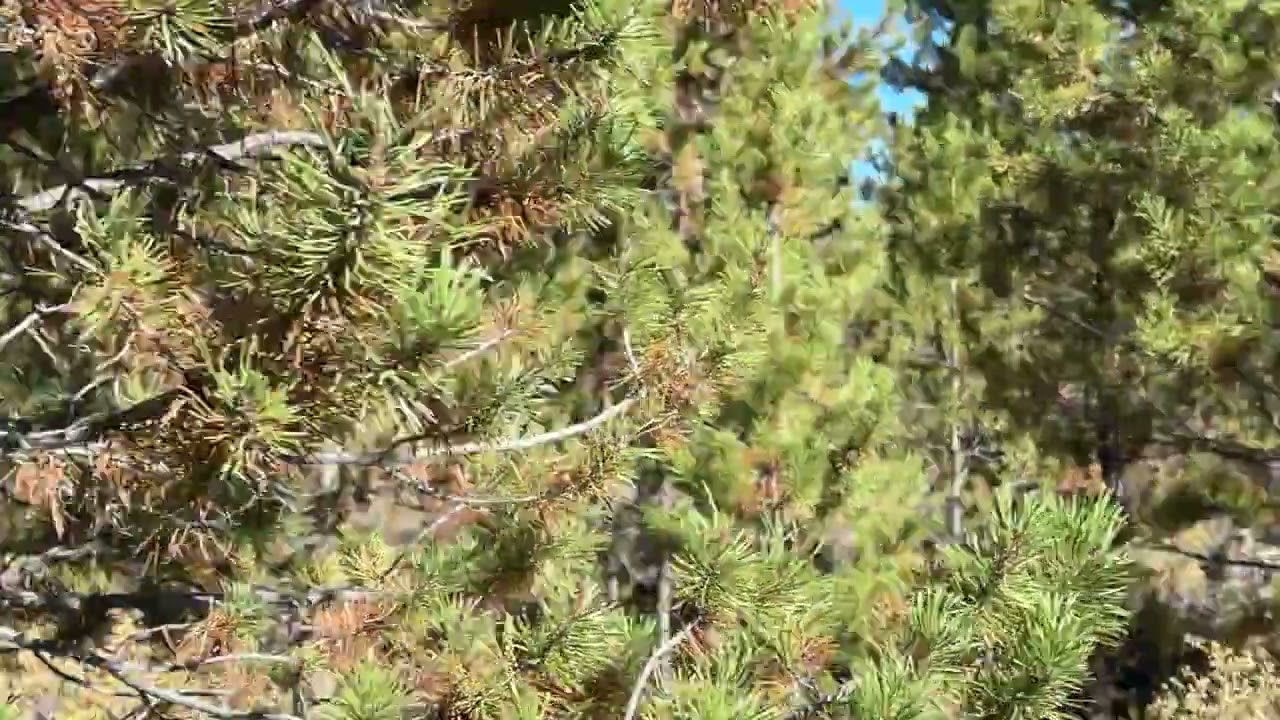
The Fremont-Winema sent me some photos of the Bear Wallow project and this video.
Although this is generally Jon Haber territory, after the previous post about the various stories on the Shared Stewardship Agreements and my critique of the coverage, I noticed (thanks, Nick Smith!) this reporting by Zach Urness of the Salem Stateman Journal (Oregon), which is an example of trying to understand folks from both sides. So shout out to Zach, and we can support him by contacting him and letting him know we appreciate his work.
A federal judge vacated approvals for three major logging projects in Oregon and ruled that the U.S. Forest Service could not use a so-called “logging loophole” to approve large-scale timber projects in a decision filed Jan. 13.
U.S. District Court Judge Michael McShane said the Forest Service unlawfully used what’s known as a categorical exclusion to approve three timber projects totaling 29,000 acres in Fremont-Winema National Forest.
The case stems from 2021, when the Forest Service sought to use the exclusion, known as a CE-6, to bypass more stringent environmental laws and approve a project they said was aimed at improving forest health and mitigating wildfires.
Conservation groups have increasingly said the Forest Service was using CE-6, under the guise of wildfire prevention, to avoid more detailed study of logging projects that would normally require going through a National Environmental Policy Act (NEPA) process.
McShane ruled that the Forest Service could not rely on the CE-6 going forward for timber projects across all national forests. He vacated the approval of the Baby Bear, Bear Wallow and South Warner projects.
“This ruling delivers a tremendous victory for forests and communities across the country,” said Erin Hogan-Freemole, attorney for WildEarth Guardians, one of the members of the lawsuit. “The Forest Service can no longer disregard environmental impacts simply because Trump ordered the agency to ramp up logging on the public’s forests. The court’s decision … (closes) this loophole that has allowed the Forest Service to authorize industrial-scale logging under the guise of restoration at great cost to our forests and all who depend on them.”
The lawsuit was brought by conservation groups Oregon Wild, WildEarth Guardians and Go Alliance, who challenged the use of CE-6 to approve the projects’ commercial thinning, and asked the court to block the rule’s application to commercial logging moving forward.
Timber groups said they were disappointed by the ruling, noting that the projects were previously upheld in local and appeals court and that their primary focus was reducing the risk of wildfire.
Hello Sharon,
Yes, this case took a long time from when it was first filed until this decision on Tuesday. That included a trip up to the Ninth Circuit and back to the district court on remand. The AFRC press release you link to does not appear to acknowledge that remand. On remand, Judge McShane finally reached the merits of plaintiffs’ claim:
When the Forest Service promulgated CE-6, did it provide findings that supported a “no significant impacts” determination for commercial logging of unlimited acreage?
Judge McShane examined the record and determined the agency had not done so, and thus invalidated this particular CE’s use, including for the three logging projects on the Fremont-Winema National Forest.
Regarding the Trump Administration’s role here, during the most recent round of briefing the Forest Service argued it needed CE-6 to implement Executive Order 14225 (Immediate Expansion of American Timber Production). That EO, of course, directed the Forest Service to identify any and all ways “to fully exploit our domestic timber supply” by avoiding NEPA and ESA “burdens.”
As to “what verbiage” our groups would be seeking regarding logging projects of this scale, it’s important to recognize that a brief scoping notice and a brief CE decision memo do not provide the same consideration and disclosure of impacts and project features as an environmental assessment or environmental impact statement. In addition, commercial logging inherently has greater impacts on environmental values like habitat and soils than non-commercial treatments, which involve less heavy equipment, less use of roads, and generally lighter-touch prescriptions. So we feel full NEPA analysis through an EA or EIS is warranted for commercial logging projects of this scale due to their potential for significant impacts.
Last, Judge McShane’s ruling does not affect any existing contracts related to these projects: “Existing contracts regarding the sale of commercially thinned timber from the Projects are not affected by this Order.” We only know of a few small GNA contracts related to these projects.
John
This just sounds like one of those situations when the bosses say, “Just do it and we’ll see what happens.”
The court decision is not unexpected.
Thanks for giving your thoughts, John! I greatly appreciate hearing your side.
A “categorical exclusion” category is based on an administrative record compiled by a federal agency. This record documents numerous project decisions that the agency has found not to have a significant effect on the environment. Based on those past project decisions, the agency creates a category by describing the parameters for the category. As long as a future proposed project is consistent with the category’s parameters, the project is categorically excluded from preparing an EA or EIS because the agency has demonstrated from past decisions that no significant effects are expected from the proposed project.
This demonstrates agency learning of whether certain actions have a significant effect on the environment. Why shouldn’t an agency be allowed to apply its learning to future decisions?
The agency is allowed to apply its learning to future decisions. In this case, the record did not show they had done that.
My point exactly (though, expressed indirectly). If the pushback was the use of CE-6, then the FS could have (should have?) relied on the administrative record establishing the category as justification to propose the timber actions…UNLESS those proposed actions were clearly out of bounds of the administrative record, which means the category was inappropriately used as claimed by the plaintiffs. This FS approach was foreseeable years ago…it was only a matter of time before the FS was legally held accountable for this approach to approve “active management” actions.
Yes, but I’m not sure when the Category was established nor what process was used. I only entered the NEPA scene in 2001 and worked on the LTH and HFI CEs. Maybe someone has more history on this?
Hence the inherent weakness of using CE-6 for large acreage “active management” decisions (i.e., whether an administrative record even exists for establishing Category 6). This particular category’s weakness has been known (and discussed) since the “increase the pace and scale” ambitions of the WO and Department. I know that the planning/NEPA voices (me being one) protested against the wanton disregard of CE norms at that time. This aggressive decision-making strategy was all in the interest to get decisions approved quickly to address the “active management” ambitions of getting more acres treated. This strategy’s risks pointed to this outcome.
I agree, our WO NEPA advice would have been “let’s not push it.” Some of the most conservative voices I heard against using CEs came from the timber industry, who didn’t want experimentation. If, in fact, it was an entirely “from above” pressure to use this CE, we might expect it to have been used elsewhere than the F-W.
And of course, since scoping started in September 2021 and the decision was in 2022..those were during the Biden Admin? So the “increase the pace and scale” was their idea, or they were promoting it?
My guess is the line officer was promoting “increase pace and scale”, which was a platform developed in the 2010s. The slogan lent an urgency to the described problem of too much fuel on the ground and not enough acres treated/volume removed to address that problem.
The forest where this categorical exclusion was used may have been the unlucky one to be legally challenged. The F-W likely took cues from other forests using the same approach without being challenged.
I think the Fremont-Winema was an outlier, pushing the envelop farther than other forests. The South Warner Project alone involved 16,000 acres of commercial logging (with a CE!)
That’s true AND I think they did a great job at explaining what they want to do and why. Shouldn’t be too hard to convert to an EA or use smaller CEs while waiting for FOFA. Lots of potential strategies to consider. https://www.fs.usda.gov/r06/fremont-winema/projects/archive/60368
On some projects, Congress has mandated only the no action and action alternative (can’t remember off the top of my head), and I don’t know if this fits.
And the result of taking this risk and pushing the envelope is losing the categorical exclusion entirely, even for timber stand and wildlife improvement activities that would not have significant impacts.
Sharon, I believe this CE 6 category was established with the other “original” CE categories around 1990 or so. It was in place when I started with the FS in 1992 on the Bly RD of the Fremont. I also think Dave may be right in that the Timber Stand Improvement part of the CE category may have been intended for young plantation thinning, but certainly not for widespread thinning (or even wildlife habitat improvement activities) across many thousands of acres, including mature and old forest as some of the Bear Wallow project area includes. Similar to this court decision, in 2008 some may remember the FS lost and was enjoined from using a Fuels CE category that had a cap of only 1,000 acres. This category is still shown in the FS NEPA Handbook Chapter 30 CE section as CE “(10) (Reserved)” with the court ruling history and “the category is not to be used”.
In my view, these projects were clearly a calculated stretch by the Fremont and a bad faith effort to abuse this CE, likely stemming from external and internal FS pressure to take “risks” to “increase pace and scale” of fuels reduction treatment that were supposed to be ramped up under the FS “Wildfire Crisis Strategy” and associated Biden Admin funding included in the Infrastructure Act and another Act whose name I cannot recall.
From the original intent and context of CE project categories promulgated under CEQ regs, CEs were clearly meant for small acreage and minor projects that “individually OR CUMULATIVELY do not have significant effect on the human environment” (as still stated in the March 2023 FS NEPA Handbook, Chapter 30 on CEs). To apply any CE category, there also must be a determination that it will not lead or contribute to significant cumulative impacts to the extraordinary circumstances resources. I think it would be tenuous and difficult to conclude that implementing multiple thinning projects of tens of thousands of acres including in mature/old forest, such as with these 3 Fremont NF CE projects at issue, that this would not have at least potential for significant cumulative impacts, and thus trigger need for a more in depth EA analysis. I think this is also supported by the fact that the acreage caps for the original vegetation management CE categories were in the range of only 70 to 250 acres, where caps were included. It is odd that the FS did not include an explicit acreage cap for CE 6 at the time like they did for some others, but perhaps they could not imagine a Forest in the future would try using it for tens of thousands of acres of commercial thinning. In this case (and some others), it appears the Fremont interpreted an absence of an explicit acreage cap as carte blanche for widespread commercial thinning that traditionally and still usually is analyzed with an EA.
Also worth pointing out that the more recent veg management CEs the FS has gained or added (the 2 legislative HFRA CEs and the new Restoration CE #25 that the FS developed) have acreage caps of 3,000 and 2,800 acres, respectively. (As of early 2025, there was direction to Forests to contact the WO before using this Restoration CE 25. Maybe to make sure the proposed treatments were all legitimate ecological restoration and to reduce potential litigation and loss of the CE category??). The Restoration CE includes among other activities, prescribed burning, vegetation thinning, and timber harvest, the types of treatment the Fremont was proposing for this project.
It seems telling to me that these HFRA and Restoration CEs, with ostensibly the same purpose of the 3 Fremont CE projects, have maximum acreage caps of only a few thousand acres, yet the Fremont tried shoe horning thinning across up to 29,000 acres under the CE 6 category.
I looked at the Bear Wallow project scoping letter and DM, and the project description in both was sorely lacking detail, sort of to the point that it was more of a condition-based management project (e.g. up to 10,000 acres of thin from below treatment may occur across a 17,000 acre project area with no trees >21″ dbh to be cut) rather than site-specific. Another problem for application of a CE (or an EA). Also, one project element prescribed that “All lodgepole pine and white fir will be removed within 30 feet of mature ponderosa pine 9” dbh or greater”. This would likely create very open forest canopy conditions and remove larger fir trees potentially up to 21″ that are of much more value to wildlife than the favored little 9″ dbh ponderosa pine. In my view, just one example of the questionable project purpose/objective statement that this project would be beneficial for “wildlife” and ecological restoration, and not do more harm to wildlife species of concern and habitat that need larger trees and some higher canopy cover. There was a cap on cut trees of 21″ dbh, so obviously there are mature and old forests/trees present in the landscape, not represented by the video clip. This is also evident through a Google Earth tour of the project area. Clearly from the video Sharon included from the Fremont of driving through a regenerating lodgepole plantation (with bitterbrush understory), some judicious thinning could be applied and beneficial, but it is not clear from the lack of project information provided in the scoping letter or DM (or the archived project webpage on the F-W Forest website – no specialist reports posted) what the current conditions in the project area or potential treatment units are or what the impacts might be. Normally, this points to the need for an EA analysis, which has been the FS standard for projects of this scope.
Sharon, I believe this CE 6 category was established with the other “original” CE categories around 1990 or so. It was in place when I started with the FS in 1992 on the Bly RD of the Fremont. I also think Dave may be right in that the Timber Stand Improvement part of the CE category may have been intended for young plantation thinning, but certainly not for widespread thinning (or even wildlife habitat improvement activities) across many thousands of acres, including mature and old forest as some of the Bear Wallow project area includes. Similar to this court decision, in 2008 some may remember the FS lost and was enjoined from using a Fuels CE category that had a cap of only 1,000 acres. This category is still shown in the FS NEPA Handbook Chapter 30 CE section as CE “(10) (Reserved)” with the court ruling history and “the category is not to be used”.
In my view, these projects were clearly a calculated stretch by the Fremont and a bad faith effort to abuse this CE, likely stemming from external and internal FS pressure to take “risks” to “increase pace and scale” of fuels reduction treatment that were supposed to be ramped up under the FS “Wildfire Crisis Strategy” and associated Biden Admin funding included in the Infrastructure Act and another Act whose name I cannot recall.
From the original intent and context of CE project categories promulgated under CEQ regs, CEs were clearly meant for small acreage and minor projects that “individually OR CUMULATIVELY do not have significant effect on the human environment” (as still stated in the March 2023 FS NEPA Handbook, Chapter 30 on CEs). To apply any CE category, there also must be a determination that it will not lead or contribute to significant cumulative impacts to the extraordinary circumstances resources. I think it would be tenuous and difficult to conclude that implementing multiple thinning projects of tens of thousands of acres including in mature/old forest, such as with these 3 Fremont NF CE projects at issue, that this would not have at least potential for significant cumulative impacts, and thus trigger need for a more in depth EA analysis. I think this is also supported by the fact that the acreage caps for the original vegetation management CE categories were in the range of only 70 to 250 acres, where caps were included. It is odd that the FS did not include an explicit acreage cap for CE 6 at the time like they did for some others, but perhaps they could not imagine a Forest in the future would try using it for tens of thousands of acres of commercial thinning. In this case (and some others), it appears the Fremont interpreted an absence of an explicit acreage cap as carte blanche for widespread commercial thinning that traditionally and still usually is analyzed with an EA.
Also worth pointing out that the more recent veg management CEs the FS has gained or added (the 2 legislative HFRA CEs and the new Restoration CE #25 that the FS developed) have acreage caps of 3,000 and 2,800 acres, respectively. (As of early 2025, there was direction to Forests to contact the WO before using this Restoration CE 25. Maybe to make sure the proposed treatments were all legitimate ecological restoration and to reduce potential litigation and loss of the CE category??). The Restoration CE includes among other activities, prescribed burning, vegetation thinning, and timber harvest, the types of treatment the Fremont was proposing for this project.
It seems telling to me that these HFRA and Restoration CEs, with ostensibly the same purpose of the 3 Fremont CE projects, have maximum acreage caps of only a few thousand acres, yet the Fremont tried shoe horning thinning across up to 29,000 acres under the CE 6 category.
I looked at the Bear Wallow project scoping letter and DM, and the project description in both was sorely lacking detail, sort of to the point that it was more of a condition-based management project (e.g. up to 10,000 acres of thin from below treatment may occur across a 17,000 acre project area with no trees >21″ dbh to be cut) rather than site-specific. Another problem for application of a CE (or an EA). Also, one project element prescribed that “All lodgepole pine and white fir will be removed within 30 feet of mature ponderosa pine 9” dbh or greater”. This would likely create very open forest canopy conditions and remove larger fir trees potentially up to 21″ that are of much more value to wildlife than the favored little 9″ dbh ponderosa pine. In my view, just one example of the questionable project purpose/objective statement that this project would be beneficial for “wildlife” and ecological restoration, and not do more harm to wildlife species of concern and habitat that need larger trees and some higher canopy cover. There was a cap on cut trees of 21″ dbh, so obviously there are mature and old forests/trees present in the landscape, not represented by the video clip. This is also evident through a Google Earth tour of the project area. Clearly from the video Sharon included from the Fremont of driving through a regenerating lodgepole plantation (with bitterbrush understory), some judicious thinning could be applied and beneficial, but it is not clear from the lack of project information provided in the scoping letter or DM (or the archived project webpage on the F-W Forest website – no specialist reports posted) what the current conditions in the project area or potential treatment units are or what the impacts might be. Normally, this points to the need for an EA analysis, which has been the FS standard for projects of this scope.
Here is the wording for category 6
(6) Timber stand and/or wildlife habitat improvement activities that do not include the use of herbicides or do not require more than 1 mile of low standard road construction. Examples include, but are not limited to:
(i) Girdling trees to create snags;
(ii) Thinning or brush control to improve growth or to reduce fire hazard including the opening of an existing road to a dense timber stand;
(iii) Prescribed burning to control understory hardwoods in stands of southern pine; and
(iv) Prescribed burning to reduce natural fuel build-up and improve plant vigor.
For this category to cover all sorts of timber harvesting over thousands of acres, one has to assume that any timber harvesting is “wildlife habitat improvement” or “timber stand improvement”. In my mind, timber stand improvement is primarily pre-commercial thinning. There is also no acre limit for category 6. So, I am to understand that the Forest Service looked at all timber sale activity, regardless of acres, as long as there was not more than one mile of road construction (no limit on reconstruction or temporary road construction) and came to the conclusion that it was all good, no significant effect here, nothing to see.
I’m thinking this was a poorly worded category intended for actual timber stand improvement activities which the Forest Service took advantage of to cover all sorts of timber harvesting. It appears that the Judge probably agreed with that. As far as public involvement, using a CE versus an EA, eliminates the comment period on the draft EA and the possibility to object on the decision.
I haven’t read the whole opinion yet, but this looks like the crux of it:
“The Forest Service explained CE-6 was based on “[e]xperience in applying agency NEPA
procedures and project monitoring,” concluding exempted activities had “little potential for soil
movement, loss of soil productivity, water and air degradation or impact on sensitive resource
values.” SAR 9–10.
However, Defendants do not identify the evidence to which the Forest Service applied its
expertise. While the agency materials to which Defendants direct the Court refer generally to
agency findings, they do not describe the subject of the findings or how the findings relate to the actions to be excluded under CE-6. They instead provide only conclusory statements that merely recite the definition of a CE.”
“Because the record before the Court does not show the Forest Service considered the impact of thinning at any scale, commercial or otherwise, the Court cannot conclude the Forest Service engaged in a “reasoned decision” regarding environmental impacts of the actions authorized by CE-6.”
This looks like another of those cases where the Forest Service just didn’t show its work. Maybe they didn’t do the work. Maybe if they did, the evidence would show that past commercial thinning projects (of unlimited acreage) may have had significant effects requiring an EA or EIS. Based on the record the Forest Service provided, the court couldn’t tell.
This was the point of my earlier comment, Jon. The FS could have relied on the Category 6’s administrative record to justify the proposed timber actions. My guess is that such a reliance would have been a fool’s errand since the administrative record likely does not demonstrate agency experience that such timber actions of this acreage do not significantly affect the environment. Hence, the agency’s reliance on only the category’s wording as well as platitudes to “monitoring” (as the court notes).
I am surprised, given this weakness of defense, why the agency chose to push forward with the court case.
Well, just like I said above, someone way up the ladder wanted to try to shove this idea through the courts. I think it is someone using the Project 2025 ideas, to bypass existing rules, laws and policies. Of course, they were ordered to try this path, and this is the logical conclusion of underestimating the opposition. Even worse is that the Forest Service is wasting time that the Administration doesn’t have much of left.
“We can do this the easy way, or we can do this the hard way.” Well, we will see what happens, won’t we? The easy way didn’t work, as expected.
Jonas, I don’t see how seeing this as a story of “Bad Administration /Project 2025”. As I wrote to Tony, the dates don’t match. The decisions to scope a CE and decide a CE are And of course, since scoping started in September 2021 and the decision was in 2022..those were during the Biden Admin? Plus as far as I can tell Project 2025 was published in 2023, so I don’t think the FS folks on the Fre-Wi were in contact with the Heritage Foundation before its publication.
The district court did not exactly “rule differently” than the prior cases. It did rule differently on the statute of limitations question because of an intervening Supreme Court case that contradicted the district court conclusion in this case. It did not rule differently on the merits because it had not ruled on the merits the first time.
Nick Smith/AFRC: “The suggestion that these treatments are somehow illegitimate because some of the removed material is commercial misses the point entirely,”
I think he missed the point of the court’s decision entirely. There was no discussion of the term “commercial.” It used the term “commercial logging” interchangeably with “commercial thinning,” indicating it didn’t see a distinction between the effects of one versus the other. Cutting down large trees has the effects of logging (that large trees can also be sold is irrelevant).