
I was reflecting on the AP story from earlier this week, and it occurred to me that sometimes issues are raised like “full suppression is a problem”, or even “private aviation is a problem” by national media, when it appears that in some cases, states don’t seem to have the same ideological battles. Why is that?
Remember this from the AP story?
But critics say the administration is trying to fix something that isn’t broken: The four agencies the firefighters were drawn from — the Bureau of Land Management, Fish and Wildlife Service, Bureau of Indian Affairs and National Park Service — have a record of extinguishing 98% of the fires they handle.
Just think if that same concept were applied at the state land local level. LA would be off the hook for improving their wildfire readiness, because after all, the LA Fires were ultimately extinguished! States seem to be more pragmatic and perhaps less ideological. Plus there’s the whole “laboratory of democracy” thing, compared to nationally we need to pick one option for the country. Let’s look at a couple of tweets from CAL FIRE. for example.

Keeping fires small. BAU for the State and highly ideologically questionable for the Feds.
And the importance of air resources…

Of course, it’s not clear if these are contract or CAL FIRE owned aircraft. It seems to me, though, that if you want to make the case that contract air resources is a potentially grafty way to go, then you would have to go much further back in history than the current Admin.
The current wildfire partnerships with States, for me, raises the question “why is it so worrisome if Feds work with States better on fuels management (i.e., forest vegetation) when they already work in an integrated way on wildfire?” As Cissel said in his post yesterday, even in Oregon wildfire has more impact on vegetation than any other activity. States also have responsibility for regulating under the Clean Air Act, with which both prescribed and wildfire have a nexus. We even have stable Roadless Rules done with State/Federal cooperation. If we look at state management of endangered species that also seems to evoke state-o-phobia in some.
But as PERC says:
“under the proposed rule the states are provided a path to managing those areas that exceed local recovery objectives, while the grizzly remains federally listed.”
Why wouldn’t we trust states with forests and wildlife when we obviously do with air and wildfire?
And Governor Polis, in Colorado (another D-led state) vouches for cattle and goats in their role in fuel reduction.

Here are people in states agreeing on (some) things. And yet, when federal lands enter the picture, there are massive abstract ideological battles. Remember “Cattle-free by 93?”
Let’s go back to California
The California Department of Forestry and Fire Protection, also known as CAL FIRE, ran its own field test involving five autonomous drones that worked together to deploy between 500 and 1,000 gallons of foam combined for suppressing fires on July 15, according to the TV station KPMH. The demonstration was organized with the help of the nonprofit FireWERX and the California-based company Seneca, which is making the drones commercially available starting in 2026.
*************
CAL FIRE has not signed up any firefighting drones just yet, but it represents another large potential customer. The California fire agency already operates the world’s largest aerial firefighting fleet with more than 70 crewed fixed-wing aircraft and helicopters, along with using AI-powered camera networks and supporting development of the FireSat constellation designed to spot wildfires from space even faster.
At this rate of innovation, it won’t be long before initial attack becomes more reliable and with less or no risk to firefighters. The conversation may change then to “where and when, and under what conditions, should fire be prescribed?”
The question remains, though, why and where is state-o-phobia a thing?
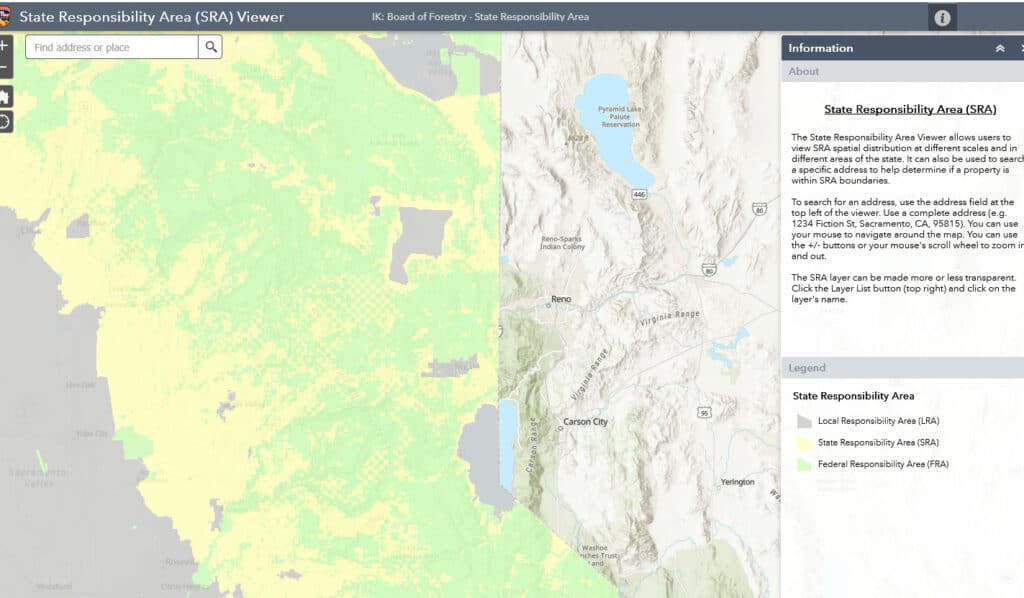
One confounding factor here is the nature of the lands protected by state firefighting entities versus those protected by federal agencies. Federal responsibility areas include virtually no private lands, residences, etc. State responsibility areas do. On its face, it makes sense that there would be a stronger emphasis on keeping fires small and protecting private property within state responsibility areas.
As an example, see this map for California. FRA = federal responsibility area, SRA = state responsibility area, LRA = local responsibility area
https://gis.data.cnra.ca.gov/datasets/CALFIRE-Forestry::california-state-responsibility-areas-1/explore
Of course, the lands also have differing legal bases for management, which naturally comes through in fire management policies and how people feel about those policies.
Some amount of the “state-o-phobia” is related to the fact that state employees are accustomed to working in a paradigm that makes sense for the character and legal purpose of the lands they normally manage, but doesn’t necessarily make sense when applied on federal lands with different character and legal purposes. This is not theoretical: I have seen plenty of examples of GNA forest management projects on National Forest lands where the outcomes did not really meet the FS objectives. Instead, they looked more like the management that occurs on state lands, designed to meet a different set of objectives. How big of a problem this is certainly is a matter of perception.
To me, it makes sense to be skeptical that states can quickly take on large programs of work on federal lands and consistently meet the management objectives for those lands. However, it also makes sense that states could build that capacity over time. So, I say, let’s give it time and ramp it up.
One last thought… remember way back in the Biden days when the federal money fire hose turned on, pointed at the Forest Service, to be spent ASAP? Without time to build capacity (and it does take time, always!), that money basically just added a bunch of entropy and destabilized the agency. Dumping a huge amount of work on states without taking the time to build the capacity looks to me like a close parallel.
I’m not sure that it’s as straightforward as all that. For example, this map looks very checkerboard-y in spots. And it’s hard to find parts of California that don’t have some infrastructure and/or residences that aren’t within 1 days run of a wind-driven wildfire. (the checkerboard may not show unless you click on the photo).
“This is not theoretical: I have seen plenty of examples of GNA forest management projects on National Forest lands where the outcomes did not really meet the FS objectives. Instead, they looked more like the management that occurs on state lands, designed to meet a different set of objectives. How big of a problem this is certainly is a matter of perception.”
Process question… were the documents, prescriptions and forest plan adherence reviewed by FS employees? Or were the docs correct but the implementation off? Could you be more specific about the differences from FS projects?
Maybe to simply the question – how much fire on non-federal lands is considered “desirable,” compared to federal lands.
Sean pretty much covered my thoughts on this post. One more point is that “cattle free by ’93” was a very different agenda than using cattle/goats/sheep to meet a particular management objective for a specific area. I would argue that grazing was a factor for the reduction of low intensity/severity fires in fire adapted forests thus leading to higher density forests more prone to high intensity/severity fires.
I get that, but folks wanted cows off federal lands, and some still do, which would obviously lead to higher levels of grass fuel (although wildfire wasn’t as much of an issue then). At least that’s the case in my neighborhood, I drive by ungrazed (tall thick grasses) and grazed (short grasses) on my way to town.
Cattle make sense to create firebreaks in grass-dominated WUI. However, I have had ranchers ask me why we were not promoting cattle grazing in the Sierra for fuels reduction purposes. My response is that cattle are grazers, not browsers. Our biggest issue in the Sierra are shrubs and tree regen, not grasses/forbs. Grasses are flashy fuels that often don’t burn intensely enough to kill mature fire adapted trees if other surface and ladder fuels have been dealt with. If we put enough cattle out there to have a meaningful effect on woody fuels, the effect on the ecosystem would be undesirable. Goats seem to be the one livestock choice that has a meaningful effect on live brush and regen, but the animals need to be purged before being moved to reduce invasive species, there needs to be fence and water, and it needs to be ensured that we are not feeding cougars. Goats also eat everything, so it’s not as selective as I’d like to see but works great in the WUI where Rx fire is more difficult.
When possible, Rx fire is a better choice to manage fuels as it mimics a natural process and doesn’t rely on a nonnative species the system is not adapted to, and cows are terrible for riparian areas.
Just to be clear, I stated that wildfire has been the biggest source of loss of old forests in the Oregon Cascades on lands managed under the NWFP, i.e., federal lands, a statement I stand by. I did not state or imply that this applies to other lands or locations in Oregon.