Wildfire burns 11,000 acres of carbon-offset forest

Saw this article linked in today’s TreeFrog daily new email:

Northern California Wildfire Burns in Carbon Offset Project

Excerpt:

A Northern California wildfire is burning in a vast swath of land where trees are protected in exchange for so-called carbon credits.

The Shelly Fire, which ignited July 3 in Siskiyou County, has spread across thousands of acres of land owned by the Portland-based Ecotrust Forest Management, or EFM. The investment firm protects the trees on its land, rather than clear-cut logging them as some neighboring landowners do. Storing carbon on the land in the form of trees allows the company to sell carbon credits intended to offset the harmful climate effects of other activities.

Carbon credits are often sold to companies or individuals who want to make up for other polluting activities. Some companies bill themselves as carbon-neutral because they say the carbon offsets they buy into account for their pollution.

The Shelly Fire has burned across about 11,000 acres of EFM’s 18,000-acre carbon storage project in Siskiyou County. This raises questions about the viability of carbon storage projects in areas prone to high-severity fire.

Much of EFM’s carbon offset plot hadn’t burned for 70 years or more before the Shelly Fire, and as a result was covered with extremely overstocked, unhealthy forests — conditions that can result in high-severity fire that decimates trees.

My comment: This one case does not mean that all carbon offset projects are unlikely to have important benefits. However, it does offer an arguement to those who suggest that we ought to create “strategic forest reserves” to store C02 and protect biodiversity, such as in this paper, which we discussed here and elsewhere.
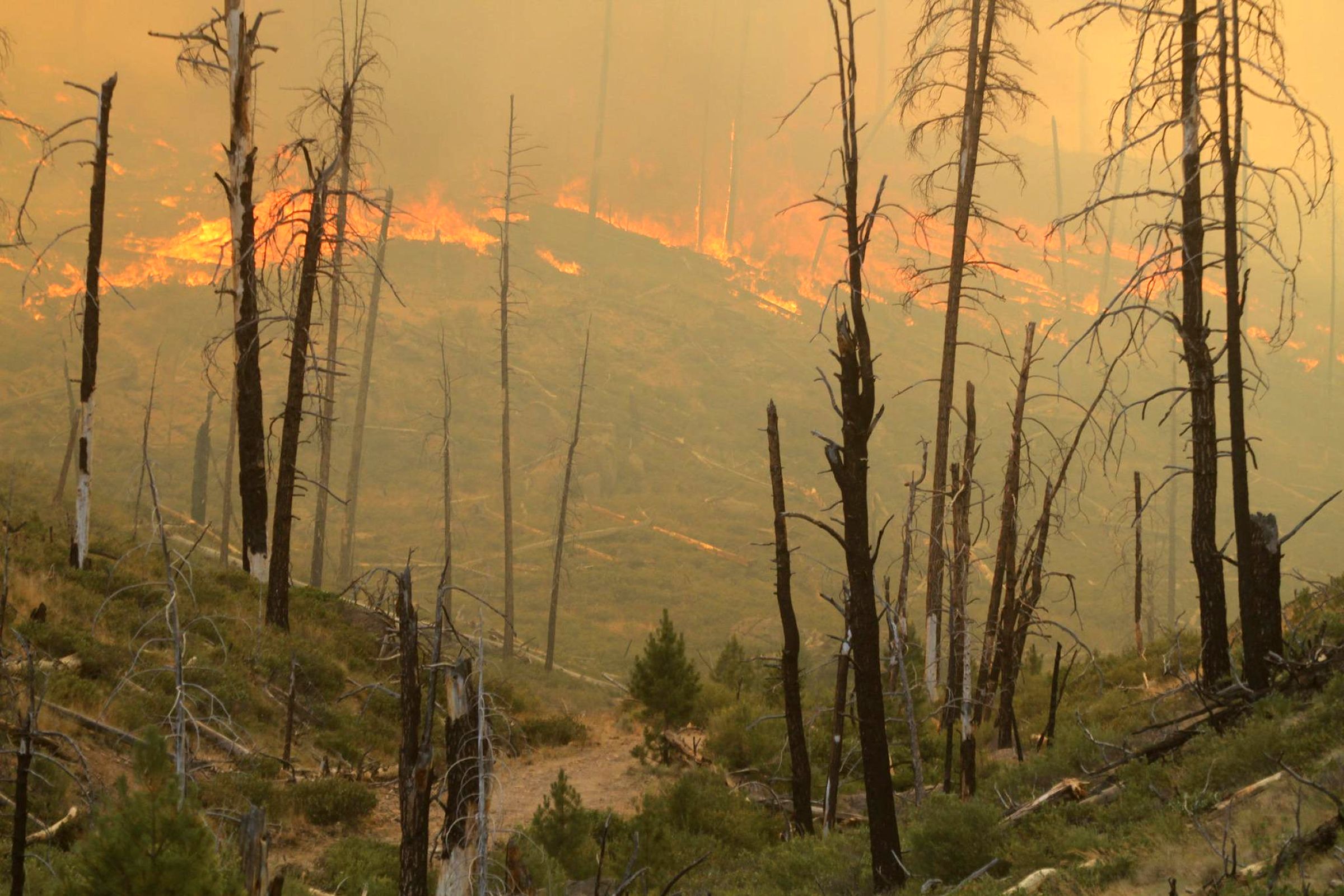
 

Falls Fire 2024 Burning in 2007 Fire Scar

Part of the ~111,000-acre Falls Fire on the Malheur National Forest in eastern Oregon is burning in the 2007 Bear Canyon Fire scar. I’m posting this photo by Mike McMillan/USFS only to show what a 17-year-old fire scar looks like, and that the dead down/standing and live fuels (saplings and brush) can burn with fairly high intensity.  Click on the photo for a larger view. More at InciWeb.

CASPO Benefits From Rx Fire

Yet another interesting link from Nick Smith…. This is from Audubon. This has been said many times here on TSW: Yes, Rx fire burns up accumulated fuels, but you can’t have an Rx fire with high fuel loads — see below. Trigger warning <grin>: mentions managed wildfire.

Fire Is a Major Threat to California Spotted Owls—but Could it Also Help Save Them?

The U.S. Fish and Wildlife Service could soon give the subspecies protection under the Endangered Species Act, and is calling for more beneficial fire to help the birds rebound.

Excerpt:

Wildfire is nothing new in California. In recent years, though, the blazes have taken on increased severity and reshaped the landscape. As more of their home turf transforms, California Spotted Owls—dark-eyed, mottled-brown raptors living in the state’s central and southern forests—have been feeling that heat: Destructive megafires burned more of their habitat in 2020 and 2021 alone than in the previous 35 years. Experts say these growing disasters represent the most urgent threat to the birds.

Recognizing this mounting menace—along with other, intertwined hazards such as climate change and drought—the U.S. Fish and Wildlife Service (FWS) last year announced plans to give the birds Endangered Species Act protections.

Yet the California Spotted Owl’s best hope, counterintuitively, may also lie in fire. Research increasingly suggests that lower-severity burning—which burns up accumulated fuels but can leave many larger trees intact—not only inoculates many drier forests against destructive megafires, but also creates the mosaic of habitat types that the birds gravitate toward. “It really depends on how it burns,” says Gavin Jones, a U.S. Forest Service wildlife ecologist. “In general, these owls like fire.”

….

The USFWS listing decision “recommends more thinning of the owl’s forests. Though critics contend thinning sometimes offers timber companies a pretext for cutting big trees, research shows that clearing dense brush and selectively logging, when combined with intentional fire, can create the patchwork structure that benefits owls while also reducing fire severity.” [emphasis mine]

GAO Report on USFS Rx Fire Program

Article about a new GAO report (thanks to Michael Archer for the link to the article).

FOREST SERVICE: Fully Following Leading Practices for Agency Reforms Would Strengthen Prescribed Fire Program

Why GAO Did This Study
Wildfire severity has increased across the U.S., causing loss of life and property and damage to ecosystems. To mitigate wildfire risk and improve forest health, the Forest Service uses prescribed fire to reduce fuels. The agency reports that less than 1 percent of prescribed fires escape control and become wildfires, but escapes can have significant effects.

GAO was asked to review the Forest Service’s efforts to improve its prescribed fire program following two escapes in New Mexico in 2022. This report addresses, among other things, (1) steps the agency has taken to reform its prescribed fire program and (2) the extent to which it has followed selected leading practices for effective agency reforms. GAO reviewed relevant Forest Service documents; interviewed officials from agency headquarters, regional offices, and national forests; interviewed stakeholders and Tribes; and conducted in-person site visits and interviews in Idaho and New Mexico.

What GAO Recommends
GAO is making four recommendations to the Forest Service related to its prescribed fire efforts: (1) develop outcome-oriented goals and performance measures; (2) develop and implement a strategic workforce plan; (3) develop an implementation plan for its reform efforts; and (4) assess the appropriate level of resources to maintain day-to-day management of reform efforts. The Forest Service generally agreed with the report and recommendations, and plans to develop and implement a corrective action plan to address the findings.

From Appendix 1:

From 2012 through 2021, the Forest Service conducted around 50,000 prescribed fire projects, 43 of which resulted in an escape declaration (0.09 percent). These escapes occurred throughout eight of the Forest Service’s nine regions and varied in size, impacts, and characteristics (see table 3). Specifically, our review of Forest Service documents found:

• The area burned outside of the planned project boundary ranged from less than an acre to approximately 20,000 acres, with the median escape being 68 acres.
• Of the 43 escapes, 24 (56 percent) remained within Forest Service lands and 19 (44 percent) spread onto non-Forest Service lands.1
• Damage was reported for 30 of the 43 escapes (70 percent).2 The type of damage varied, with 24 escapes reporting damage to natural resources (e.g., trees and other vegetation), seven escapes reporting damage to improvements (e.g., fences, signs, roads), and six escapes reporting damage to structures (e.g., houses, outbuildings).
• Complexity of the escaped prescribed fires varied, with 29 of the escapes (67 percent) occurring from projects rated as moderate complexity in the prescribed fire plan, 12 escapes (28 percent) from projects rated as low complexity, and two escapes (5 percent) from projects rated as high-complexity.
• Twenty-seven of the escapes (63 percent) were from a broadcast burn, whereas 16 of the escapes (37 percent) were pile burns.
• Drought conditions were present for 18 of the escapes (42 percent).3


Chevron Decision and NW Forest Plan

From The Oregonian today….

How a Supreme Court decision could reignite Oregon’s biggest environmental battles

Excerpts:

Since the Pacific Northwest’s “timber wars” of the 1990s, the federal Northwest Forest Plan has managed conservation and logging interests in regional forests.

The plan was formulated by a team of scientists from several fields, tailoring their rules to mandates from Congress. The Forest Service announced earlier this year that it was looking to update those rules to meet the growing challenges of wildfire and climate change.

But Oregon environmental advocates say those rules, among many others issued by federal regulatory agencies, could now come under threat. The Supreme Court late last month overturned what’s known as the Chevron decision, a longstanding precedent that lower federal courts should defer to agencies — staffed by experts — on “reasonable” rule changes to enforce legislation.

The ruling effectively means federal regulators will have a harder time defending those rule changes in court. It could also make existing rules easier to challenge.

…

Daniel Rohlf, a professor of wildlife law at Lewis & Clark Law School, said the reversal of Chevron could be compounded by another lesser-noticed ruling last month — Corner Post Inc. v. Board of Governors of the Federal Reserve System.

He said that previously, there was a six-year statute of limitations for challenging federal regulation, beginning when the regulation was implemented. But now, the six-year clock starts when the regulation begins to affect the entity mounting the challenge.

Rohlf said this means old rules could be opened up for litigation. And he expects future challenges could throw a wrench in an already overworked legal system.

“It’s sort of a full employment act for administrative law practitioners,” he said.

Forest Service launches ambitious effort to restore Dude Fire Scar

Nick Smith had an article about t his in his Wildfire News of the Day email today, but the link at the Payson Roundup doesn’t work.  This is all I see:

“The US Forest Service will remove overgrown brush and saplings on 7,600 acres burned by the Dude Fire in 1990 in an attempt to restore the natural, fire-resistant Ponderosa Pine forest that once grew there. The devastation from the Dude Fire can still be seen in Rim Country.”

FWIW, the USFS has this page about the project and a June 12 update here.


WUI Building Codes and Effects of Wood Products Industry

This isn’t a forest-planning story, but interesting. From the Softwood Lumber Board (SLB). Mentions the American Wood Council (AWC). It makes sense to reduce the use of wood in decks and siding, but using non-renewable products has an environmental impact. OTOH, there are wood products treated to be “fire-resistant, such as this one.


June 2024

SLB Study Reveals Importance of WUI Code Work in Defending Market Share

Up to 150 MM BF of siding and 770 MM BF of decking from the repair and remodeling market are at risk from Wildland-Urban Interface code changes and adoption, according to an SLB-funded study by Forest Economic Advisors. The study quantifies the importance of the AWC and the SLB’s codes and standards work defending the use of lumber in regions with wildfire hazard.


“The FEA study is timely and relevant given recent major wildfire losses and significantly increased WUI code activity as a result,” says Phil Line, Vice President of Codes & Regulations at the AWC. “The study findings that lumber siding and decking are at risk aligns with WUI code requirements that regulate exterior building materials to reduce the spread of fire.”


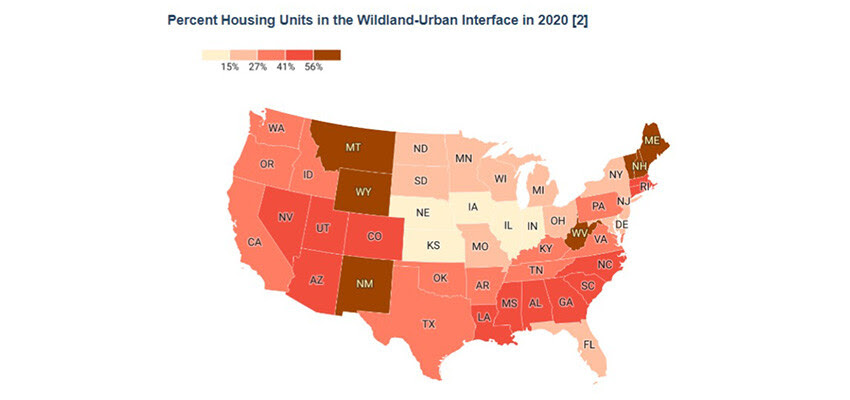
Wildfires have been on a steady increase in recent years. Between 2005 and 2022, more than 100,000 structures were lost to fires in areas where structures and development meet undeveloped wildland or vegetative fuels. More jurisdictions are considering implementing building codes to mandate wildfire-resistant construction in these areas.


FEA’s analysis shows that while the use of lumber and structural panels is not affected by WUI codes when used structurally in roofs, walls, and floor systems, lumber volumes in the repair and remodeling market, especially decks and siding, are at risk. While the higher end of the estimates is not likely to be lost over the short to medium term, the potential volumes represent between 7% and 17% of total consumption for siding and 4% and 14% for decking.


The AWC is active in the development process for WUI codes including ICC 605, the new standard for residential construction in regions with wildfire hazard. The AWC is also using full-scale fire tests of hardened wood-frame buildings to demonstrate the viability of fire-resistant wood construction versus noncombustible materials alone.

Science Review Shows Fuel Treatments Reduce Future Wildfire Severity

This is not news to most foresters, but it’s good to have such a review from three parties, including TNC. Will the review help courts make decisions in cases where enviro groups claim that thinning, etc., do more harm than good? The debate, as ever, centers on whether taking any tree considered mature or old-growth. (Thanks once again to Nick Smith for the link.)

Comprehensive Science Review Shows Fuel Treatments Reduce Future Wildfire Severity

Researchers from the USDA Forest Service Rocky Mountain Research Station, The Nature Conservancy and the University of Montana examined 30 years of fuel treatment effects on wildfire severity.

Excerpt:

Researchers found overwhelming evidence that in seasonally dry mixed conifer forests in the western U.S., reducing surface and ladder fuels and tree density through thinning, coupled with prescribed burning or pile burning, could reduce future wildfire severity by more than 60% relative to untreated areas. The study results were recently published in Forest Ecology and Management. You can download this Science You Can Use in 5 minutes for an overview of the research methods, key findings, management considerations and links to related publications.

Threats to Mature and Old-Growth Timber: The Numbers

Nick Smith had a link to an article about this USFS/BLM report, “Mature and Old-Growth Forests: Analysis of Threats on Lands Managed by the Forest Service and Bureau of Land Management. From the executive summary (emphasis mine):

The initial threat analysis found that mature and old-growth forests have high exposure to a variety of threats—climate and disturbance projections show this exposure will likely increase. Currently, wildfire, exacerbated by climate change and fire exclusion, is the leading threat to mature and old-growth forests, followed by insects and disease in the West, while more varied disturbances threaten older forests in Alaska and in eastern regions. The analysis also found that two-thirds of mature forests and just over half of old-growth forests are vulnerable to these threats. Tree cutting (any removal of trees) is currently a relatively minor threat despite having been a major disturbance historically, as from 1950 to 1990 these practices were the primary reason for loss of old-growth forests.

Since 2000:

  • Wildfires were associated with a net decrease of 2.6 million acres of mature forest, and 700,000 acres of old-growth forest.
  • Insects and disease corresponded with a net decline of 1.9 million acres of mature forest and 182,000 acres of old-growth forest.
  • Tree cutting that resulted in 24 percent-or-more basal area loss by the Forest Service and BLM was associated with a net decrease of 214,000 acres of mature forest and 9,000 acres of old-growth forest.
  • Where no severe forest disturbances have occurred, mature forests had a net increase of 2.21 million acres and old-growth forests by 1.20 million acres.
  • Combined, there has been a 2.51-million-acre net decline of mature forests, with about a tenth of this becoming old growth (a 0.28 million acre net increase in old growth).

Projections over the next 50 years show growth of young and mature forests may result in an increase of older forests, despite increased disturbances. However, gains lessen with each passing decade and the expanding wildland-urban interface complicates mitigation of threats. Projections of increasing mature and old-growth forests are tempered by the reality that American forests are entering uncharted territory with climate change. Climate change has already increased threat levels and is altering where, and what types of, mature and older forest can persist.