Coincidentally I ran across this piece about improving government by Francis Fukuyama this morning. It’s written as a letter to Elon Musk.
There is another type of deregulation that needs to occur, however, if the government is to be made more efficient. People blame the bureaucracy for over-regulating the private sector, but the bureaucracy itself is over-regulated. Americans have never trusted the government, and over the decades have piled up a mountain of rules that bureaucrats must follow. An example of this are the Federal Acquisition Regulations (FAR), which contains hundreds of pages of rules that government procurement officers must follow before they can acquire anything from an F-35 fighter to office furniture. Hiring new employees is also extremely difficult; my students often have to wait months before getting a job interview for an open position in the federal government. There are, moreover, a lot of DEI requirements that don’t necessarily reward merit, rules that I’m sure a Trump administration would be happy to torch.
Many conservatives believe that government bureaucrats have too much discretionary authority and use it to enact a liberal agenda, thereby eluding democratic control. This does occur in some instances. But the real truth is rather the opposite: bureaucrats spend way too much of their time complying with hundreds of rules mandated by Congress, rather than using their independent judgment to make decisions that lead to good results for citizens. They need to be liberated from these constraints, and have their performance judged by the outcomes they achieve rather than how risk-averse they are. This is, of course, how Silicon Valley and the private sector operate.
Perhaps that is the reason that when the Forest Service needed to do the Wildfire Strategy, it decided to build capacity in the private sector (specifically the NGO sector) because it believed that the FAR and hiring were too big a barrier to… getting the work desired by Congress done. But like anything, that raises its own set of issues. Today we’re going to look at timber sale contracts.
Again, I am not against the NWTF and other NGOs; I think they do great work, and I hope we remain friends. But I think we need to ask questions about how best- financially and quality of work-wise- for the USG to achieve its goals. Below is a request for proposals for a contract to do harvest inspection, that is, a contract to inspect a contract, competed out by an NGO which got its $ via a non-competed grant.
So we used to hire people to do the work. Now we give grants (without apparent competition) to large organization compete or hire people to do the work. Now I am sure that the FS is still inspecting the inspectors and has ultimate authority, but we have to wonder about the trade-offs of doing it this way. Hire a temporary inspection helper directly, vs. send the money via NWTF to a contractor.. G&A folks send $ to and track NWTF, NWTF does a competition, (skills desired seems outside of FS control), awards and manages contract.. seems like unnecessary layers of paperwork to me. Which is the more likely approach from the standpoint of the person who does the work? Would they rather have a federal job?
Notice how sending the bucks via grant obviates those pesky FARs, and USAJOBs and screening and timing hassles (and experience and education requirements?) and also took some percentage off the top. The FS thought the tradeoff was worth it, and maybe the FS still does.
But I think it points to something broken in the federal system itself. It’s not that I don’t trust the ENGO’s involved, but why should people less trusting not wonder whether it could turn into the same kind of cronyism that all those rules were intended to regulate against?
Here are the other stories I’ve heard on the timber sales topic:
A contracting firm made up of old FS folks seems to be getting much of the work (not clear if it’s doing the work or inspecting).
FS sale administrators being told that they can’t visit the worksite without an NGO rep being available.
Anyway, here’s an RFP for a timber sale inspection assistant.
Statement of Work:
Selected contractor will provide the following:
Conduct an on-site inspection and sale administration support to NWTF approximately one to two times per week during active operations (or as feasible, needed and requested by NWTF). Inspection findings, operations progress and any observed concerns per the contract will be documented in the agreed-to format and shared with NWTF (as well as with USFS and Purchaser) via email.
o Provide contract specifications compliance assistance and site review to NWTF and purchaser.
o Spot-check unit boundary compliance.
o Spot-check timber utilization including occasional load checks (However USFS and NWTF will facilitate all timber scaling and accounting).
o Spot-check slash treatments.
o Spot-check leave tree damage.
o Equipment inspections.
o Report observed petroleum spills.
o Ensure CO Best Management Practices for Water Quality are followed.
o Spot-check erosion control measures (Appendix G).
o Spot-check to assist in communication only of observed system and temporary road conditions (however USFS will facilitate all new temporary road construction and closure, detailed reviews of T-specification compliance, official road signage, official roads inspections for maintenance and closure and communication to Purchaser).
o Provide communication assistance between NWTF, USFS and Purchaser/Harvester for routine field related concerns (However it is likely that additional regular communication between these partners will also be necessary for adequate contract service).
o Provide inspections support to NWTF through these systems, however official correspondence will be between NWTF, USFS and Purchaser.
o Track actual completed acres via Avenza/GPS and provide updates to NWTF monthly or upon completion of units.
• Conduct sale administration support to NWTF and USFS as authorized in the Delegation of Authority (Exhibit D) as needed and requested by NWTF during inspections.
o Review and approve all landings and skid trails through inspection form. Map all approved landing locations. Purchaser will be required to maintain adequately spaced (i.e., 100 feet, except
where converging at landings and where otherwise constrained by terrain) skid trails. Selected contractor has the discretion to blanket-approve skid trail locations by description to gain overall
operational efficiency, if the Purchaser consistently adheres the following objectives:
▪ Logs will be skidded with leading end free of ground to reduce ground disturbance.
▪ Skid trails shall not be less than 100 feet apart, except where converging near landing
locations or where otherwise dictated by terrain.
▪ Skidding operations may only occur when soils are dry, soil moisture is below the plastic limit (water content at which soil starts to transform from kneadable-plastic to rigid or
brittle) or when soils are protected by at least one (1) foot of packed snow or two (2) inches of frozen soil.
▪ Re-use existing skid trails, wherever practicable.
▪ Damage to advance regeneration and residual live trees is minimized.
o Stream crossing locations for all skid trails require site-specific approval from the harvest inspector.
o Mark damaged trees for removal as needed.
• Coordinate inspection and administration support work with USFS and NWTF to ensure efficient and valuable inspection and administration support services.
• Provide other regular communication including unit progress to NWTF, USFS, Purchaser or partners as needed and requested by NWTF.
Thanks to everyone who responded to the previous question! Especially those currently working.
Since our last post on this, we have found out about the election. But looking over what people have written, it’s interesting how much is within the purview of the Forest Service itself to improve and fix. And like we used to do in NEPA in the WO, we can take good ideas, and argue for them in a way that appeals to the new Admin’s interests and goals. As with other years, we can generate our own TSW Transition Recommendations.
So let’s dig deeper into the discussion.
Here’s my first cut at Things We Agree On (and if we don’t, let me know)
1. More funding for LE
2. More funding for access and encroachment issues.
3. Data systems should be built to answer the questions line officers and specialists face on a regular basis that could help them make decisions, define trade-offs, and communicate such to the public. This includes funding and accomplishments of grantees.
4. Making sure that appropriate orientation is given new employees.
***************************
Then we have the organizational stuff. Both FS and BLM have experiences with this.. for example, reducing or eliminating the RO in Region 9 (was anyone here involved? How did it go? Why did they go back? And then the story of the BLM removing a layer during Reinvention and restoring it. Then there was an effort (I don’t think it was called Reformation, but the names all run together) when I worked in the R-2 RO where the engineers carefully outlined the different kinds of tasks they had (budget formulation, quality control, and expertise) and reoriented and downsized their staff. Probably many other staffs in other Regions did this as well. So there’s a great deal of knowledge out there. But what has changed since then? The budget, work at home, more new employees and so on.
Jim Furnish: “I also favor getting rid of Regional Offices (but leave a small cadre there to deal with States, interagency stuff). The computer era can deal with budget formulation/distribution. Yes, get more people back at the RD level.
As everyone knows, I am not a political animal. So I don’t know if the idea of a Regional Forester gives the FS more political heft than a group of Supes. And that may vary by state. Maybe have a State Director instead of an RF, like the BLM? And if there is interagency stuff, wouldn’t the State have to pull from forest people to do the work, which defeats the purpose of getting more work to the ground. I know that there’s a workload for Interagency Stuff Bigger Than One Forest (say, a lynx amendment). Which perhaps leads us to Greg’s suggestion:
Thorough analysis of all permanent positions as to what they are really contributing.
Or getting some idea of what the work actually is. I think this is particularly important today, as with agreements like the Keystone Agreements, there is potential for grantees to be doing certain kinds of jobs previously thought to be federal. It seems like this would help the FS be conscious of which work to farm out and which work to keep.
Then we have some really big picture thoughts from Jim Zornes:
Remove NFS from the WO and make it its own entity. Take all the other Deputy Areas (Business Ops, CIO, Planning, Lands and Special Uses, S & PF, Research and HR) and put them together with the BLM! Reorganize that mess to remove repetitive functions between the two Agencies, making one service area for everything but NPS. NFS would be extractive resources; mining, timber, wildlife, range and recreation. I may have missed something – sorry. Close all Regional Offices and supercharge the Supervisors Offices with those RO staff areas in SO’s that would make sense for that old Region. Those SO’s would become the only other management center between the BLM/FS and RD’s.
That organization would remove at least 1/3, if not 1/2 of the employees, saving $ and streamlining work on the ground. Fire would be in NFS, but not stovepiped as it is now. More boots on the ground – cross trained in resource management and fire/fuels. LE & I would not be under the NFS.
I’ve probably told the story that when we in Region 2 had trouble getting our folks paid through ABQ, our Regional Forester (Rick Cables) talked about contracting with BLM at their Denver Center for HR). On the other hand, as I’ve also said, for some HR topics (employee relations), human to human relations are critical
I’m not with Jim on planning (although an analysis and maybe modernizing NFMA might be good), and lands and special uses actually need more attention. Pulling S&PF out of the FS would tend to break down their natural alliances with NIFA-Extension and NRCS (although someone might want to look at all three for gaps and overlaps). R&D would be folded into USGS which I think would be bad for the linkage to real-world problems with FS folks.
I would be wary of getting too much with the BLM due to their political bent. However, it might be helpful to go back and look at past successes to streamline position sharing, budget exchanges, harmonizing shared regulations (to help the public understand better) and dual delegation. On interspersed lands, visitors can’t tell whose ownership they’re on and how different the rules might be, nor even to whom they should direct questions and complaints. I remember we had two Public Lands Centers at one time in Region 2 (and we conducted a joint administrative review with the BLM on the San Juan Public Lands Center) and there the public liked it, as well as many employees.
There is another election coming up. TSW has been around for the 2012. 2016, 2020, and now 2024 Presidential elections. So now is a good time to ask the question “what would you do if you were appointed to be undersecretary?” What issues would you focus on?
What initiatives that you think are important might appeal more to R’s or D’s? This is the time, before the election results are in, to think outside the box, that is.. way outside the box if possible. And no partisan vitriol today, thank you.
It’s only fair that I give my own.
1. I am concerned that forest policy wonks, (NGO’s and the foundations who support NGOs) focus on the big picture, including getting more money, and the nuts and bolts of doing things, spending the money, and what is accomplished with what degree of difficulty, gets overlooked. So I would go back to the basics. I would host some kind of conversation with FS employees (focused on the District level, but with input from other levels) on what are the main barriers to their work, and their ideas for fixing them, large and small. And of course, going ahead and streamlining the path for folks to try new things. I was part of the Pilot effort in the 1980’s (on the Ochoco) for administrative helpful changes and was able to get the FS paying by check established as a practice. It sounds a bit silly nowadays, but it meant something to us then. And there was the spirit that we could actually identify new, better ways of operating and be supported in making change, which was great for morale.
2. What would it take for the Forest Service to be able to be visible and helpful to the public? As I’ve said, humility and invisibility is a value, but people are doing great work out there and should be, say, appropriately visible. Many forests are doing this, or trying to. What are the obstacles? What few things might make a big difference? Where do human beings matter most? Where should federal employees (not contractors or grantees) matter most?
Planning:
3. Put plan revisions on hold until each “wildfire forest” has a wildfire (including PODs, conditions for WFU, prescribed fire and maintenance, reducing ignitions) amendment and EIS with public involvement and comment.
4. Set up FACA committee (and employee and stakeholder and retiree workgroups) to answer the questions “what values come from forest planning in the 21st century, and can those values be achieved more directly?” with an eye to potentially revising NFMA with bipartisan support.
****************
Hopefully those ideas will spark something in you. Like I said, there are only certain times we can dream big, and today is one of those before we find out what new Admins want to do and whom they pick for political jobs.
Chelsea, in a recent comment, linked to a post by Don Moynihan letter signed by some academic folks in public administration. Again, I think Schedule F is a bad idea, and I agree with these academics that there are areas of broad bipartisan agreement. I also think that any real reform needs to be reality-based. Which would be terribly difficult to generalize, because agencies and subagencies and missions are so different.
The letter the academics wrote said
Government workers will not take justified risks or innovate if they feel they are being judged on the basis of political loyalty rather than results.
I’m only speaking of the Forest Service here:
There are many reasons that government workers don’t take justified risks or innovate. We used to talk about how new ideas are dissolved by anti-novelty antibodies (actually there is a much better way of saying this, but I can’t remember). And of course, say with IMTs and managed fire, “justified” risk is in the eye of the beholder.
When I worked in WO NEPA, we had a list of policies we wanted to push in either variety of Admin. Admins, when interested, can actually overcome natural organizational inertia, so there’s that. For example, the 2001 Roadless Rule. I happened to be at a Chief and Staff meeting with Chief Thomas and we in RPA presented the idea that we could adopt a roadless policy. But organizational inertia prevailed – “but what about Alaska?” end of discussion. But with Admin interest and pressure..
Then we have to address “political loyalty” and try to determine whether, or how it is different from “policy alignment.” I think it’s a key question, since folks with different policy orientations can be in different parties. Meanwhile folks are Ramspecked in from Congressional staffs who clearly had some kind of partisan affiliation. So, is it OK to pick people due to policy alignment for SES jobs? It seems like it would be, or at least that’s what people already do.
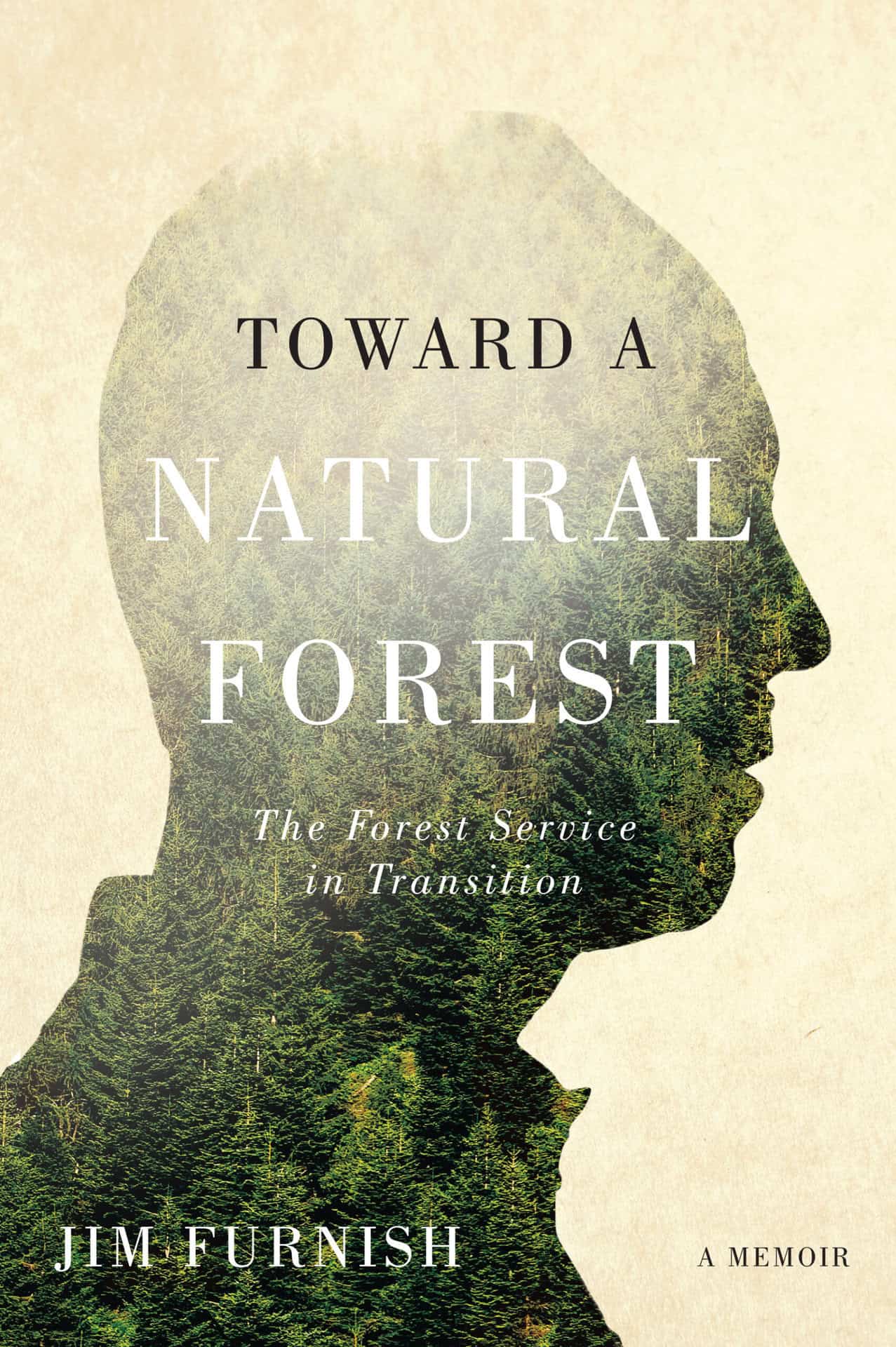
Jim Furnish was kind enough to let us sample from his book on his own history of how he went from Forest Supervisor to Deputy Chief. In this part of his story, politicals sensed his alignment and put him in an SES position, from which he was able to do many innovative things in alignment with the Admin’s goals. Also note the intensive coaching for the SES application.
Anyway, let’s let Jim tell his story:
*******************
Chapter 8: Opportunity Knocks
Washington, DC, Part II, 1999–2002
Capitol Politics
Chris Wood was Forest Service Chief Michael Dombeck’s policy advisor. Wood had followed Dombeck to the Forest Service from the Bureau of Land Management, where Dombeck had served, though never confirmed by the Senate, as acting director for four years. Dombeck, a fisheries biologist, had risen rapidly through the ranks of the Forest Service before detouring to the BLM, assured by then-Chief Dale Robertson that he had a “get home free” card. Now he was home again.
No Forest Service chief had ever employed a policy advisor before. It was hard to discern Wood’s role exactly, but not difficult to know that he was important. I first met Wood when he came to a Forest Service leadership meeting in Oregon in about 1996. Numerous stories about his influence with Dombeck preceded his arrival. It seemed Wood served as the chief’s gatekeeper. If you wanted to talk with the chief, you had to talk to Wood first.
This alarmed anyone who’d learned how to work the ropes in an agency with a very tight chain-of-command tradition. The chief’s office had historically kept a very open door to field officers, especially forest supervisors. Basic respect made stopping by to say hello to the chief de rigueur when in town. Now, anecdotes dribbled through the rumor pipeline about Wood’s unwelcome intervention in the affairs of the chief’s office. People longed to see this arrogant badass in the flesh.
When Wood came to Oregon, I found I liked him from the get-go. He was bright, energetic, optimistic, and smiled a lot, a high-minded go-getter with a real passion for issues. Youngish, he didn’t iron his shirts. He kept no pretenses, and he radiated confidence and power.
I suspect he sensed that many agency people viewed him with a wary eye, so I approached him warmly at coffee break, quickly discovering we shared a love of fishing. Then the questions started popping. He wanted to know all about the Siuslaw—what were our hot issues, what did I see as needing to happen to move Dombeck’s agenda forward? I had a vague awareness Wood used such questions to gauge my land ethic. I eagerly shared our work on thinning, road closures, and watershed restoration. Based on what I’d seen of Dombeck’s agenda, I thought my ideas about managing national forests were similar to the chief’s.
Wood enthusiastically encouraged me to keep up the good work. He mentioned that Chief Dombeck believed we were in a time of flux, and the chief wanted to find change agents. Wood said he planned to talk with Dombeck about the Siuslaw’s road closures, fisheries restoration, and thinning of plantations to promote old growth. Wood wanted me to stay in touch and keep him abreast of any new developments. This was the badass people feared? I saw nothing to fear.
To respond to Wood’s curiosity, I sent him a copy of “Torrents of Change,” a half-hour video produced by the Forest Service Employees for Environmental Ethics following the big flood of 1996. The video began by relating how the storm had affected the forests and rivers. It described how we on the Siuslaw had storm proofed our roads with water bars and how well our preventive measures had worked to absorb the punch of the storm. I also sent Wood a speech I’d just given at a Siuslaw forestwide celebration of human diversity. The talk included my thoughts on Forest Service obligations to tribes, since virtually all our western national forests had once been Native American ancestral homelands. Wood sent a note back saying that he really liked what he saw and would share it with the chief.
Wood must have sensed that I operated on a different wavelength than most other forest supervisors. On his next trip West, he confided to me that Dombeck had concerns about the willingness of agency leaders to break away from past traditions and dogma to assert bold change.
I agreed with Dombeck’s assessment. I had a certain dread and uncertainty about the future, but a keen sense that inaction was deadly. I felt compelled to break out of the mire and do something.
As we charged ahead with our programs on the Siuslaw, I mentioned to Wood how much I appreciated the newfound support I had received from the environmental community. He could appreciate that because it was so rare. Also, a fresh energy and enthusiasm was evident within the Siuslaw organization as we pursued our new mission. Yet, I explained, many of my peers had little use for or interest in the Siuslaw’s resurgent agenda.
I remember that Wood said something like, “We need this kind of stuff back in DC.”
On Wood’s next trip, he came right out and asked if I’d consider coming back to work in the chief’s office. “As what, for instance?” I replied. I loved my work in Oregon. Besides, I’d already spent a two-and-a-half-year tour in DC. I was not eager to return. In fact, going back to DC had not occurred to me since I arrived in Oregon.
“Well, the associate chief and deputy chief for national forests are both open.”
I let this cannonball bang in my brain for a moment. No forest supervisor had ever made that kind of jump.
I found Wood’s suggestion extraordinary. The associate and deputy positions were, respectively, the number-two and number-three positions in the agency. Both fell under the category of Senior Executive Service (SES) appointments, which normally involved an arduous evaluation just to get qualified, then usually six months of “charm school” training. I had done neither. Furthermore, plum positions like a deputy chief’s post always went to people already in the queue for SES positions, like regional foresters or associate deputy chiefs. This was how the old Forest Service did things.
Undeterred, Wood said the chief didn’t put much stock in all that. Dombeck just wanted to get people in these jobs who would move the Forest Service ahead. Wood said they had ways to cut through all the bureaucracy—evidenced by Dombeck’s recent appointment of Francis Pandolfi, an executive from the Times-Mirror Corporation and a complete outsider, to an SES job through open competition. Dombeck wanted people with new ideas, big ideas.
I asked if Dombeck was serious. Wood said yes, but he could guarantee nothing, since both positions would be filled through open competition. Dombeck wanted someone like me, but he couldn’t hand me the job. I understood.
I told Wood I needed time to consider his request.
I knew something about the recent rapid changes at the top. Almost immediately after Dombeck became chief, he’d fired several top SES leaders, including the former deputy chief, Gray Reynolds. Reynolds had issued a bitter rejoinder that had hit the inbox of almost all employees, saying his firing was unwarranted, unwelcome, and an offense to Forest Service tradition. Dombeck had replaced Reynolds with Bob Joslin, southern regional forester from Atlanta, but Joslin retired after only a year and a half amid rumors that he couldn’t handle the environmental politics of the Clinton administration.
Gloria Manning stepped in behind Joslin as the acting deputy chief.
There was turmoil elsewhere. Phil Janik had replaced Dave Unger, the recently retired associate chief. Dombeck chose to split Janik’s duties to create a second associate chief position. The person filling this new job would supervise the deputy chief of the national forest system.
Substantive questions needed answers before I could even think about being that person.
Could any forest supervisor succeed in such an environment, especially a supervisor from the Siuslaw, which was a small forest relative to many others? I would not be regarded as a particularly powerful or credible forest supervisor. I anticipated strong resistance and pushback because of an agency culture that respected power. If Dombeck selected me, largely unknown, as either associate or deputy chief, I would leapfrog about four or five rungs on the organizational ladder. How would this affect agency leaders’ trust in the chief? Bypassing all the more likely candidates would send a strong signal that he doubted them. This would echo in their doubts about him.
Could I succeed? Regardless of how positive Dombeck was about my accomplishments, he didn’t really know me, and I didn’t know him. My biggest concern was not my ideology, but my capacity to develop and build followership. Would regional foresters and national program directors willingly roll up their sleeves with me to get things done? A long career in the Forest Service had convinced me that a failure in either of these important jobs would be costly to both the chief and the agency.
I harbored doubts. Such a move carried steep risks. If Dombeck selected a nontraditional person like me, it would be difficult for me to bring others along, and I could easily become isolated. Yet I also sensed that Dombeck intended to pursue an ambitious agenda, and he wanted and needed like-minded people to help him. The possibility of helping shift the trajectory of the Forest Service held a tantalizing appeal.
I had long talks with my wife, Judy. Surprisingly, she supported my going after the job. She knew the inherent uncertainty that I’d get either job. Yet she’d enjoyed living in the DC area. We both knew a promotion would bring a big jump in pay, too.
Until now, Chris Wood had done all the talking with me. I told Wood that I thought it was time for me and Mike Dombeck to speak directly. Could Dombeck call me personally? Days went by, and then weeks. I began to wonder whether all my speculation was for naught.
Then, as often happens, about the time my anxiety began to burn away, Dombeck called.
We had a good talk. I shared my concerns and asked the chief his thoughts. He said he admired my accomplishments on the Siuslaw. He thought I had what he and the Forest Service needed to move the agency forward. He mentioned the scarcity of big ideas, much less big accomplishments, in crafting a twenty-first-century agenda. He and Jim Lyons, the under secretary of agriculture, both wanted people on the leadership team who would forge change.
We discussed the SES hiring process. He said he had hired others without SES experience via open competition. It was a tricky deal, though, and I needed to quickly get acquainted with Tom Leeper, who was the Forest Service’s SES expert. Dombeck asked me to tell Leeper, “The chief wants you to shepherd me through the application process.”
It was now summer 1998. Wood had mentioned that Sally Collins, Deschutes National Forest supervisor in Bend, Oregon, was also in the running. Collins and I tended to think alike, and we got along well. She and I discussed the merits of going after these jobs, and we both thought it was a big gamble. Collins told me her daughter was entering her senior high school year in Bend, and a move at this time seemed imprudent for the family. I countered that it would take many months before a decision was made, and she could bargain to delay her starting date until after graduation the following June. After much soul-searching, Collins decided not to go after either job.
I called Tom Leeper. He stood ready to help, but he warned of the arduous process before me. To receive a favorable review by the Office of Personnel Management, I would need to put together a sterling application. He said he would coach me along the way. I did ask if being a GS-14 would be held against me, since almost all those who qualified for SES selections came from the higher-level GS-15 pool. He said that would not be a problem.
The process required that candidates develop narratives demonstrating their competence in five evaluation factors: leading people, leading change, building coalitions, being results-driven, and having business acumen. Applications had to be approved by a panel of three government reviewers. If rejected, the application could be revised and submitted again, but only once.
I dove in and spent many evenings preparing my application until I felt it represented my best effort. I ran it by Tom Leeper, who said, “Looks OK.” So I submitted it. Weeks went by before Leeper called to tell me I hadn’t made it. The panel found four out of my five elements “deficient,” and the fifth just marginal. Leeper said I had another shot, but I had to pass the second time or it would be a dead end.
I begged for some insight on what I had done wrong and how to fix it. Leeper said they really looked for a “certain style” of writing (what I privately described to myself as elite bureaucrat or self-aggrandizing). Could he provide some examples? No, but he’d work with me when I sent him the next write-up. This he did: he said the application was still not there.
Desperate now, I asked if he could rewrite a few paragraphs to illustrate what he meant by a certain style. Then I submitted another heavily edited round for the Leeper test. Leeper remained nervous about my application, and I even more so.
I then invoked the Dombeck imperative. To “shepherd me” through this process, I told Leeper that he needed to give me more hands-on help. I told him that Dombeck wanted me to be a candidate available for selection. If I didn’t get through the SES gate, we’d all look bad. I asked him to work with me line by line, editing it strongly to make sure it passed the SES panel review. I was grateful when he helped me prepare my last-chance version for reconsideration.
I later discovered a couple of interesting things. Francis Pandolfi confided to me that he applied for his SES job with just one handwritten paragraph for each of the five evaluation elements. Seeing this, Leeper had delicately advised Pandolfi that this wouldn’t do, since SES applications were serious business, and Pandolfi had a lot of work to do before he could submit his work. Pandolfi said he told Leeper, “No, Tom, you’ve got a lot of work to do.” Pandolfi got the job after Leeper polished those few paragraphs to a luster that passed the SES board.
I talked with another SES person who served on review panels. He said the Office of Personnel Management took a very dim view of GS-14 candidates (like me), deeming them unworthy of consideration, since SES candidates were usually from the higher-level GS-15 pool. He indicated that GS-14s were routinely rejected without serious consideration.
Do these anecdotes indicate a double standard, or was I simply naïve? Even though I think Leeper should have been more helpful from the beginning, my application squeaked through the second time, and I became an applicant in good standing for both high-level jobs. As associate chief, I would report directly to Dombeck, and my responsibilities would include national forests and the agency’s research branch. As deputy chief, I would report to the associate chief, and I would manage all national forest issues, supervising nine regional foresters, ten national program directors, and a staff of about fifteen, with an overall budget of about two billion dollars. I knew I would be thrilled, and fully challenged, if offered either one.
This is the second of two posts reflecting on generalized critiques of “the Forest Service.” Yes, things seem to be unusually messed up right now, but looking more broadly…
Bob said:
The Forest Service is lost and struggling. The NLT, RFs, and Rangers have developed an unhealthy contempt for the mission. I think it blossomed in the pandemic. It manifests as arrogance and a complete lack of focus on the public.
and Zeke (maybe) said:
They’ve lost their esprit de corps and sense of purpose, and their reason for being has gone away
It’s certainly true that cutting trees, in some Regions and on some Forests, led to hiring of many kinds of specialists (including me, back in the day). Funding from KV and BD led to work and experience with burning piles and planting. We general employees were available for wildfires, and it all worked together, as a kind of general system in some areas. Even then, though, there were regional differences. For example, the Fremont (Region 6) had a very different approach to timber than its next-door neighbor, the Modoc, in Region 5.
On some forests, though, grazing was the big thing, and in others, recreation. It seems to me a natural fact that what you work in seems important to you, and there’s the overall old statement “caring for the land and serving people”. We all seemed to see it that way, whether we worked in wildlife or reforestation or hydrology or engineering or recreation, and I assume folks still do.
Check out your neighborhood Forest SOPA for ongoing projects to see what they are actually spending time on, along with the standard operations of recreation, road maintenance, signs, trails permits, encroachment, and so on. Or check out the White River SOPA or the Inyo or the Chattahoochee-Oconee as.. there are plenty of other things going on besides vegetation management – special uses, recreation, minerals, and watershed rehab projects. Even new (motorized!) trails as in the Lake Tahoe Basin.
Project work will include constructing three new trailheads, paved parking and restrooms at Pine Drop, Brockway Summit and Elks Point; constructing new e-bike trails, new motorcycle trails, and new non-motorized trails; designating new routes open to e-bikes and new routes open to motorcycles; upgrading road and trail crossings for aquatic organism passage; installing wayfinding and interpretive signs; developing and upgrading existing trailheads, parking areas, and access points; and updating the Motor Vehicle Use Maps.
***********************
But behind that is both an philosophical question “what is “the Forest Service”?” as well as a social science question “what do individuals think of when you think of “the Forest Service?”.
Again, I’d like to place this discussion in context of other institutions. One that comes to mind is the Roman Catholic Church- having been an institution for 2000 years or so- through a variety of different Zeitgeists in different countries through time. Let’s ask the same questions “What is the Catholic Church?” Is it the local parish, is it the Vatican curia, is it the people who did the Crusades, or people today or..? It’s all of those things. If we were to ask individuals, though, it might depend on how closely they had encountered individuals. Like, “I think the bishop is a jerk but my priest is great” or vice versa. It’s about the people and the experiences for those closer to the action. But there are also observations from afar.
Or try State Parks and Wildlife. Some people look at our in Colorado as “those people – all they care about it hunting.” In my case, it’s about my local guy AB, who always answers emails and writes a column in our local paper about wildlife concerns. I’ve had a conflicted relationship in the past with certain politicals in the organization’s previous (DOW) incarnation, but if you asked me today, my warm fuzzies about the organization are about AB and my liking of a certain wildlife area that they manage. But I would like if State Park passes worked at wildlife areas. So, like the Forest Service, (and the RC church) I’ve got generic warm fuzzies but also ideas for improvement. Both things are true. It’s not a loyalty test or an us vs. them. When people get frustrated with various aspects of the RC church, I tend to sigh and say “it’s an institution, composed of flawed people, many of whom are trying to do their best.”
We can, and should, work on improving institutions but as long as people run them, it’s best if we don’t get too upset when they behave suboptimally. Is the organization working? Is there a church to go to? Do I get answers to my wildlife questions? Are campgrounds and trailheads open? Does a university teach students? It’s pretty clear where the rubber meets the road in most organizations and where the focus of energy and funding should be.
************************
I probably contact different Forests, Regions and the WO as much as anyone. Shoot, Dave Mertz and I have been trying to get the info on how much funding has been obligated to the Keystone Agreements and Community Navigators.. a simple spreadsheet would do- for almost a year. FS public affairs asked me to ask the Department; the Department won’t acknowledge my requests let alone answer them. Either to the form I submitted or directly to the person putatively in charge of the FS section. So I too am frustrated.
But I also find forests and districts where I really couldn’t tell the difference between the old FS and the new FS in terms of responsiveness. So there’s that. And some are actually better because they have more technology to better answer questions.
***********************
Anyway, I think broad generalizations don’t help. I do think talking about our specific concerns, and getting them in the open would help. Like what could the Forest Service do to increase transparency and accountability, and give people better customer service experiences? We could start by learning from units that already do those things well. Remember that old management slogan “catch people doing something right?”
Lately on TSW there have been a great many critiques of the current Forest Service situation. We’ll go into specific critiques in another post. But some of the critiques are fairly broad-brush, like this one Frank Carroll quoted from Zeke Lunder (I don’t have independent confirmation that Zeke said it):
“We should…not pretend … the Forest Service is a functional agency because it’s not They can’t meet our expectations of them getting anything done because they can’t . They lost so much they’re really not a functional agency. They can’t do anything at scale, and they haven’t been able to since they stopped cutting big trees …. They were really good at cutting big trees …, but since then they no longer have a function. They’ve lost their esprit de corps and sense of purpose, and their reason for being has gone away …. So, they still have to manage the land with active management …what does that leave us? Well, using fire is active forest management. So, they’re using fire.”
Well, you see, I don’t believe that that’s true. And I’ll talk about that in the next post. But here I want to talk about the fact that the Forest Service as an agency is responding to the currents of the time. And I think that this is a very important conversation to have, and hopefully we can continue sharing our stories and understanding different points of view.
Lao Tzu: “A strong wind may topple the sturdy oak, but the willowbends and lets the wind pass through.”
Let’s talk about this point in time. It has many folks of the Baby Boomer generation retiring, and new people being hired. It includes post-Covid work at home (although pressure to allow that started a decade ago), so that people may not have the informal connections and training via storytelling around the field lunch of the past. ROs and SOs in some areas are (expensive) ghost towns. In some ways, work at home broke both the traditional social organization and relationship building, and the visitor response, as in some of the examples we have seen in the comments. My friends in other fields have observed different work ethics and cultures in some of the younger generations. Their salaries don’t go as far as they did, especially in terms of housing.
So there are many challenges, which the BLM has also faced (it would be interesting to do surveys and compare, social scientists out there?). Then there was a vast infusion of funding, the likes of which had never been seen, as well as changes in the budget structure. Many of us outsiders still don’t understand how that works, or how that change may have affected appropriate ranger district autonomy.
Then there has been a tremendous increase in employees being hired from outside the agency, including from the military, USFWS, Congressional staffs, and so on. That idea is a very old one in management, even from my day. The idea is that you don’t really have to understand the work or the land or the people, you are interchangeable from McDonalds to Tesla to the CIA to the Forest Service, if you are a good leader. This used to be true of Senior Executives and political appointees, but has now reached the District Ranger level.
So… the Forest Service today confronts many challenges that are different from what we retirees remember, which have nothing at all to do with “big trees.” And I am going to ask for some grace for them, in addition to specific critiques and ideas for improvement.
I’m going to tell a story about another institution, the Yale School of Forestry (when I attended), later Forestry and Environmental Studies, and today the Yale School of the Environment. Two years ago, I attended an alumni gathering. Dean Indy Burke spoke, and I happened to be sitting next to a group of what I’ll call “uppity” alums. They were mostly from New England. They were younger than I (well, most people still out and about are, so there’s that).
It turns out that these alumni weren’t happy about the name change. I had been on some Zooms about it, and it appeared to me that if YFES didn’t change their name, circling shark administrators from other units would see YFES as a minnow and yes, start a completely new school. It seems to be feature of the Zeitgeist that more different administrative units are needed to coordinate the workers, in this case, professors.
Back to the Forest Service. I was told by a reliable source that 43% of the Forest Service works in direct provision of services on the Ranger District. It would be interesting to know what it was in the past. So.. there are forces in both academia and government (and probably other institutions) that have led to of more what we might call overhead. I myself worked in overhead pretty much my whole career (various kinds of support to the field), so I am not dissing the idea. It’s just that it seems to have an almost cancer-like tendency to grow and spread if not consciously contained.
So Dean Burke was being a willow, standing her ground and bending, which was necessary to maintain the institution and keep it from the circling sharks. Now, we are not privy to the conversations between Randy Moore and the Secretary. let alone the Secretary or Randy’s conversations with CEQ or other White House-favored entities. So I think it is difficult or impossible to judge FS leadership on its willowhood.
A few other observations from Indy’s presentation. She pointed out that Yale profs had an important role in recent legislation, I think it was the IRA. I think we were supposed to think that this was a good thing, but I did not. They also were proud of funding NPR to reach recreational fisherfolk to talk about the dangers of climate change with examples of how fishing will be impacted. My uppity neighbors noted “the people they are trying to reach don’t listen to NPR.”
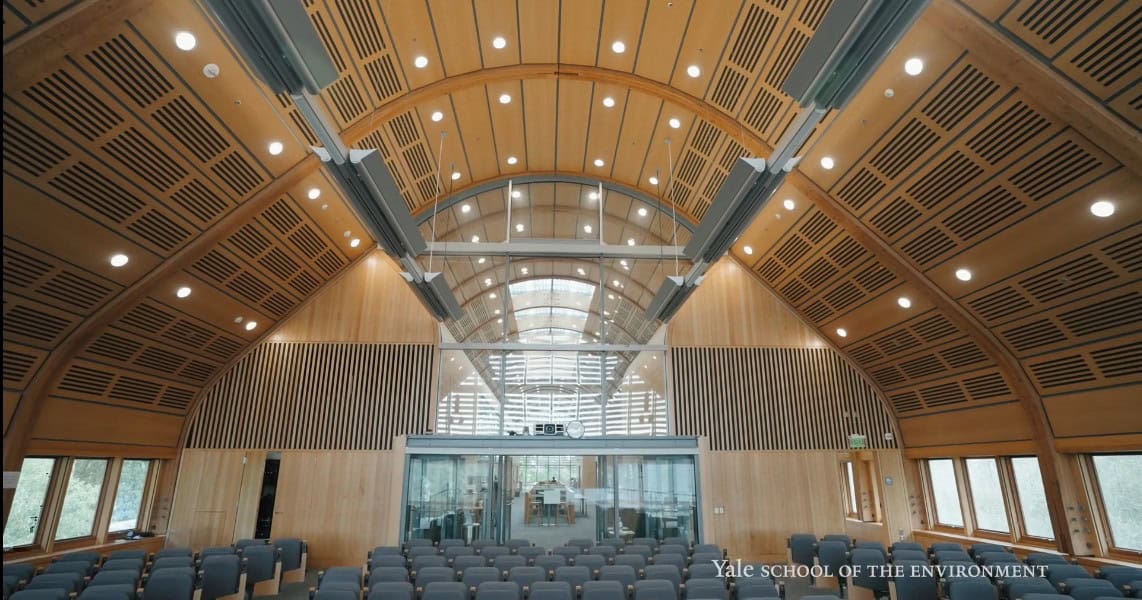
Dean Burke also replied to a question about the name change something along the lines of ” forestry sounded too “extractive.” This exchange occurred in Kroon Hall which proudly touts wood from the Yale Forest. The hall is in the photo above.
Our uppity alum suggested “maybe this is an opportunity to educate them that extraction is not a bad thing”. But no, of course, not, because that is not really the issue. It’s about that there the need for institutions to align with the ideas of the time and avoid sharks.
Is it a little bit silly to decry extraction in a wooden building? Of course. We might call it hypocritical (in general, I think we should rename ourselves Homo hypocritus). We might say that the non-extractive emperor has no clothes (of course, since clothing is manufactured using natural resources). But it doesn’t matter. If you work in an institution, especially if you are a leader, you have to be a willow not an oak for the institution to survive. And institutions still do good things.. teach students, or maintain campgrounds, or do prescribed fires.
And we don’t have much insight into the strength and direction of the winds that blow the Forest Service, nor is there much of a chance we will find out.
Which is not to say that we cannot attempt to understand, or critique what we see. I just wanted to set this context.
All, I am going to write a formal letter to the Forest Service Chief asking to have the employee directory put back online.
Ideas for text, or willingness to sign, please let me know in comments or email me.
As Lesa noted in her comment, “I will need to find an employee and have the employee look it up,” not having it means that we have to do detective work to figure it out, including bothering other employees. For members of the public who need to contact employees, we are not going to simply go away and forget about it because it’s too difficult. So perhaps the FS was not aware of this unintended consequence.
And, as Andy noted, other agencies in USDA have such directories.
Anon posted this in a comment, which I think is important:
We need leadership as much as people on the ground, so focusing on RO or WO positions seems like the wrong tree to bark up. To me it’s about the programs, and how far the agency has strayed from its core mission. How many communications positions are out there? WEPO? Partnership positions? Fleet managers? A lot more than we need, IMHO.
It would be great if, every once in a while, bureaucracies would do a review of how their current programs are staffed, and ask whether it is optimal for today’s needs. Certainly, most programs have outside supporters who would raise a fuss. But maybe some don’t. It would be interesting to hear from both perhaps a national FACA committee and employees, again, with a reconciliation process (and maybe minority reports, remember Roger Sedjo’s comments in the Appendix to the Committee of Scientists (and one law prof)). With that document, put it out for review with some biz schools and public admin schools for technical insights. Adapt and then put it out for public comment. Sure that could easily take longer than one Admin, but we can’t just ignore the efficacy of government and waste funding with gaps and overlaps.. or decades of accretions of fundamentally useless bureaucracies…because it’s “too hard.”
While I was looking for a link , I ran across this from the introduction.
Dreams and Practicality
The current Committee of Scientists was urged by the Secretary’s office to step back and define a land- and resource-management planning framework that would last a generation, in some sense to dream a little. Our dreams have been inspired by the actions of dedicated and resourceful on-the-ground employees of the Forest Service. While some have understandably become disillusioned and defensive after years of conflict and impasse, others have risen to the challenge, experimented, and are successfully pursuing new approaches to planning and management.
The lessons of their efforts provide a glimmer of hope and a foundation of experience upon which the Committee could construct an innovative, dynamic, yet pragmatic approach to planning. All the while, the Committee has tempered its dreams with the realization that the Forest Service does not need another impossible mission; our dreams should not translate to Forest Service nightmares.
I think the last sentence holds true for our NWFP FAC friends.
*********
But back to Anon’s comments..
I don’t know what WEPO is. I do have a story to tell. I’m hoping that others, both retirees and current employees, will share their stories of management improvement schemes and how well they worked.
In the mid-90s, I used to work in RPA in the Yates Building, in 4NW. I worked on the ill-fated 1995 RPA Program as the coordinator with R&D.
They were building the Holocaust Museum next door at the time. (There were also rats evacuating the building that became the cafeteria for the Museum, so our wildlife friends in the basement had unusual challenges.) I argued that the Museum should have done a psychological impact report for the neighbors. Can you imagine at every staff meeting (in the Director’s office) looking out over the building, knowing the material housed there, and what it represents about the capacity of humankind? As their website says:
Along the north brick walls, a different perspective reveals a roofline profile of camp guard towers, a procession of sentry boxes. Above the western entrance, a limestone mantle holds a solitary window containing 16 solid “panes,” framed by clear glass, reversing the normal order and obscuring the ability to look in or out.
*********
Anyway, at the time, there was a special section in the center of the building for copying and printing. There was chatting while we were waiting in line. Since Recreation was on the same floor, one of the folks was a rec special uses person. Now at the time, the RF in Region 9 had the idea that he could shrink the RO (these ideas and implementation come and go). So.. the forests in Region 9 who did have technical questions.. called the expert in the WO. Rec special uses is not something you can just guess at, and it’s usually a tiny piece of a rec person’s job, so doesn’t make sense for them to become expert. As she said “I shouldn’t be the phone pal of everyone in Region 9.”
Point being, to agree with Anonymous, cutting positions can have unintended consequences to quality (in this case with legal ramifications) or to other units.
Another story from the same time period is that we shared one printer with Wildlife and Fish. When I was picking up copies, I ran across a letter that one of their employees was sending to wildlife NGOs stating that an RO combining a Wildlife director position with something else would have bad impacts on.. wildlife programs. I was later told he wanted the job for himself, but the story illustrates that the discussion of some positions can be porous between the agency and outside groups. And of course, there is symbolism, in some cases- “we respect you by having this position.”
Another story is more recent, from the 2010’s perhaps, when I worked in the Region 2 Regional Office. There was an effort to Reimagine, Reform, Reinvigorate or whatever (I get all these efforts mixed up, and tried to stay away from them as much as possible). Most of the staff areas, including planning, gave it more or less lip service. But our Region 2 engineers actually thought the whole thing through, analyzed it carefully, and changed their organization in a reasonable and thoughtful way. They got rewarded by… well, they didn’t actually get rewarded, as far as I know. Staffs who used the “this is likely to blow over” methodology came out ahead by a) not spending time on it and b) not changing.
I’d be really interested in hearing peoples’ experiences about other management improvement efforts and how they worked for the better or didn’t.
I asked Microsoft Designer for “humans gossiping wearing Forest Service uniforms”
Let’s hope the AI in wildfire models works better…is that Smokey, without his signature hat, in the back listening to gossip?
******************************
This post is in the interest of being a public service to all folks working or volunteering in groups. Also our chance to tell our stories. Due to the whims of the Algorithm Gods, I just found this 2018 article from the Harvard Business Review.
In the Forest Service during my time period (1979-2012), we definitely had training about how to talk to people directly, rather than going behind their back (specifically to their supervisors). We were supposed to go to the person first, so that if we went to their supervisor, the supervisor was supposed to ask “have you spoken to that person first? What did they say?” and the discussion would go on from there to work towards a solution.
In my career, as you can imagine (!), I had a great many complaints filtered via my boss without the complainant coming to me first. Now, I don’t blame an Undersecretary for not going to me first, he was working through channels. When I was a young FS sapling, trying hard to learn the culture, I noticed that “going through channels” was something I was supposed to do (and did gladly) but other people did not. I would point out this asymmetry from time to time without getting a good answer, so I accepted it as the way things are.
I remember my first surprise about this was my first job, second location, the Ochoco SO. My boss, a terrific guy, was giving my performance review and said “the administrative folks said you were something.” Today, I can’t remember what the concern was. I do remember saying “you never asked me to give input on them, is this something that’s standard?” I was one of the first women professionals and maybe there was some kind of problem, which I couldn’t fix unless they told me specifically. At the time, there were pockets of tension between some (women) administrative folks and (some) women professionals. Women (and men) are not always kind to each other.
I also remember also being highly irritated that this wonderful person whom I had worked with, and whom I supported for a job, had his chances kiboshed by someone in the RO who had never worked with him. This also happened to me when I tried to get a job nearer to where my husband lived.. my Forest Super called over and was told “they heard bad things about her.” I called this (my tiny part of Region 6’s) “Management by Gossip.”
Fast forward thirty years, and I’m on review panels for jobs in R2. More than once I was really frustrated after carefully reading all their applications and calling around, to find that all it took was one bad word from a highly regarded person and that was it.
Now I understand part of why that is. Hiring people is critical, if you get the wrong one they can 1) make your life miserable 2) make everyone else’s life miserable, and 3) make extra work for you and your employees. I have a friend in the medical university world who has PTSD from dealing with one colleague. So it’s very important, removing people is hard, and being risk-averse is not a bad thing. Especially when other people might be trying to get rid of problem employees and giving them glowing reviews. No, not easy at all.
I also know why many people don’t want to give feedback. At one time, I was working in 4NW of the Auditor’s Building in RPA. We shared with the Wildlife and Fish people a huge space of small cubicles. One wildlife and fish person spoke very loudly while she was on the phone. I did speak to other folks to make sure that I wasn’t the only one, and found myself the only person willing to tell her. So I think the fact that “hearing bad things” is an employment criterion and being unwilling to give feedback because it might irritate a person who might then say bad things about you. In my case we didn’t inhabit the same potential promotion space, so it was fairly safe for me. At the same time, future promotion space is not entirely predictable, so there’s that.
In my last job, only 12 years ago, I had an employee who wanted to lateral to a Deputy Forest Supe on a Forest. The Forest Supe, she and I were all together on this. I went to my boss at the time and said “let’s make this happen.” My boss looked at me and said “I’ve heard from the WO that she has a blog so we can’t support her.” I felt like, but didn’t say, “you clueless wretch!” I did say “you accepted that and didn’t ask me or her if it was true? It’s me who has the blog.” Coming after me was one thing, but coming after innocent employees- based on gossip..? That was the day I decided to retire.
Why is gossip sometimes helpful? Why is “talk to the person before you talk to someone else” so difficult? Please share your own stories, or explanations or clarifications in the comments. About the Forest Service or any other organization.
Considering how satisfying it is to be right, how tempted we are to avoid giving direct feedback and having difficult conversations, and how often we seek confirmation for what we already believe, it can be hard to break the habit of engaging in gossip — as the instigator or the recipient. Nevertheless, there are several strategies to help you and your team stop engaging in something so wrong that feels so right:
1) Name it, then pivot. First, call gossip “gossip” to stop it in its tracks. If you are engaging in “informal and evaluative talk in an organization, usually among no more than a few individuals, about another member of that organization who is not present,” — especially if the aim is to confirm your experience rather than get constructive solutions — then you are participating in gossip. If you call someone on it, most people will step back at hearing a colleague say, “This sounds like gossip. Is that what you intended?” Second, pivot the conversation by asking, “How can I help you get a better outcome?” Only engage in coaching, brainstorming, and problem-solving conversations — not in problem-confirming ones.
2) Ask yourself or others why you need someone else’s confirmation about a behavior that you’re noticing in a third person. If it’s to justify your feelings, to confirm that you’re right, or to gain support for your point of view, don’t bring someone else into the conversation. If it’s to understand how you might be contributing to the dynamic or problem, to brainstorm helpful solutions, or to go on record to make a formal complaint for further investigation, then go for it.
3) Let people know that you have a policy of “if you have a problem with me, please tell me first.” Adopt the “tell them first” policy with your colleagues, and, when someone approaches you with gossip about someone else, ask “Have you already told her?” to remind them of this policy.
4) Create a feedback-rich environment around you. The more you normalize feedback — both positive and negative, and both giving and receiving — the less likely people will be to look for alternative means to express their frustrations and concerns. Rather than “saving” feedback for annual performance reviews, make discussions about what someone did well, and what he or she could do differently, a part of every supervision meeting or project debrief. And make sure to give people positive feedback when they offer particularly useful feedback — even if it’s hard to hear.
Gossip, even by any other name, is still a destructive communication strategy that negatively impacts individuals, teams and the whole organization. By stopping it in its tracks, choosing healthier and more helpful methods of communicating what’s not working, and engaging in collaborative problem-solving, relationships and organizations can flourish.
One of the things we elders like to do is support the younger folks in our professions. I’d like to give a shout-out to The Hotshot Wakeup (THW). I am a regular follower and subscriber. I encourage you to support him and subscribe, if only for a month or two, as you can afford.
FS Chief Moore Calls Out Hypocrisy With Cost Of Living Increases. Says The Feds Are Not Doing Enough. FS Has A $740M Budget Hole.
During which he talks about rent increases for federal housing, rebates for some federal housing, and differences in salaries or geographic differentials (not clear which) between BLM and FS employees in the same building in North Dakota. It sounds like the problem(s) might be with OPM, but I’m sure it’s complex; if anyone can explain the details (or if the FS has something written about it), please share. Also what agency sets rents, and do they rationalize somewhere why a 100% increase is a good number?
I’m sure some folks in the FS have written a clear description of the problem(s) and possible solutions. It sounds as if the Secretary can’t influence OPM, but if they are the problem, surely someone can. I think we all would like to help if we could figure out exactly how and whom to try to influence. THW also included a clip from a recording by the Chief during which he sounds pretty frustrated.
Please, if you have access to clear(er) information, share it either below or via email.
Also THW mentioned something like “the FS owes more in leases than they are legally funded for”, I’d like to hear more details about that.
He also said something like the FS is something like 740 mill in the hole. Again, more details would be helpful.
The FS is probably in the middle of figuring out how to deal with it and doing the best they can. I hope after the worst is over, though, there is a publicly accessible lessons learned.
Finally, I would still like to see an explanation of the “new” budget structure and how it is different from the previous version, if someone has seen one or would be willing to write one.