Reorganizing the Federal Government and Why Does Wyden Care So Much About BLM/FS?

here. Norman’s comment reminded me of this piece I read about FS and BLM coordination/reorganization, that describes how Senator Wyden is against “senseless reorganization”. Since I personally think it makes a lot of sense (as opposed to senseless), I was curious as to why he cared.. since the last time this was proposed that I remember from Oregon (Interchange, Reagan Administration), it seemed to me like it was Republican ranchers who opposed it at that time. Do any Oregonians have any ideas for why Wyden has these ideas?

Here’s the story from Wildfire Today.

Oregon Senator Ron Wyden was more vocal than most and expressed his displeasure with the proposal. When the Senate Energy and Natural Resources Committee voted on Rep. Zinke’s confirmation as Secretary of the Interior on January 31, Senator Wyden abstained, citing the movement of the FS as a problem. Rep. Zinke was approved in the committee on a vote of 16-6-1 (yes-no-abstain).

A source we talked with on Capitol Hill who asked to remain anonymous told us that after the committee vote Senator Wyden extracted a pledge from Rep. Zinke that if confirmed as Secretary, he would not pursue reorganizing the FS. With that promise, on March 1 the Senator voted for the confirmation in the full Senate.

Just after that vote, the Senator issued a statement, saying in part:

After several discussions, I received an assurance that as secretary of the Interior, Rep. Zinke will focus on doing his job, which includes protecting our special places and managing the forests already within the Interior Department’s control, instead of engaging in senseless reorganization of bureaucracies.
Our Capitol Hill source said now that Secretary Zinke is on the job, he still can’t completely let go of the desire to move the FS.

In fact, when the Secretary spoke before the Public Lands Council on March 28, he talked about a “joint command” of the FS according to E&E news:

“I may not get the Forest Service, but we’re going to work with the Forest Service and figure out how to not be so stove-piped,” the Interior chief said. Zinke indicated that he and Agriculture secretary nominee Sonny Perdue had discussed a “joint command” model like the ones used by the Pentagon to manage personnel across the military services.
Secretary Zinke may be thinking that this arrangement would not violate his promise to Senator Wyden. However, the Senator expressly mentioned he did not want to see “senseless reorganization of bureaucracies”.

Secretary of Agriculture Nominee Perdue Hearing- DIY Journalism

This seemed like a good summary from Faith Campbell at The Center for Invasive Species Prevention.

Here’s one of my favorites quotes:

The hearing was friendly – except to the President’s proposed budget, which calls for a 21 percent cut in USDA’s discretionary spending. Ranking Minority Member Debbie Stabenow (D-MI) said the budget makes it clear that “rural America is an afterthought.” But Chair Pat Roberts (R-KS) and others noted that “the President proposes and Congress disposes,” with a nod down the table to Sen. John Hoeven (R-ND), who chairs the Senate Appropriations Committee’s agriculture subcommittee. Sens. Thad Cochran (R-MS), Mitch McConnell (R-KY), and Patrick Leahy (D-VT) — each with considerable seniority — serve on the same subcommittee.

I’m around many younger people nowadays who are really worried about the President’s budget. After spending a number of years watching this “President proposing and Congress disposing,” I am not as worried. Of course, I’m worried about their being worried…

And as for the Forest Service:

Only the U.S. Forest Service received more than passing attention. Its management of national forests was criticized. Several senators noted the crisis in funding fire-fighting. Forests, Gov. Perdue said, provide “opportunities clothed in challenges,” e.g., to implement best management practices and be better neighbors. Sen. Steve Daines (R-MT) urged him to restore active management of forests, as well as to limit litigation by “extremist groups.” Perdue sympathized.

Here’s the link to this article.

Any other interesting quotes or summaries from other sources?

Lyle Laverty on “If I Were Chief of the Forest Service”

Thanks to the Rocky Mountaineers, our Region 2 retirement group, for this link to an Evergreen interview with Lyle Laverty.  I have been out of the loop on potential Secretaries, Undersecretaries and Chiefs and perhaps others can share what they’ve heard…

Interesting that Lyle has worked in both DOI and USDA.  I notice that Evergreen said that he and Michael Rains were candidates. I have worked with both of these folks, and they are both very good.  I wonder who else is on the list?

Any folks can contribute a post on “if I were Chief” to this blog, we are not limited to folks identified by the new administration.  Just email me at [email protected]. Y ou all can pick any of Lyle’s statements to discuss..because we have folks outside the agency here, we can kick it off with:


“There is great value in tenure. Land and resources are complex. As an agency, we need to encourage folks to become established members of communities. We need them to understand the complexity of the resources they are stewarding. Tenure translates into learning and accountability. With constant changes, the individual never sees the full outcome of the decisions they make or the work they perform, they never understand the community, or develop the relationships necessary to achieve outcomes. Perhaps a bonus system for tenure could change the active movement. The current alignment of the agency’s human capital does not encourage learning or the formation of the strong community ties that were for decades an integral part of the Forest Service’s great success.”


Women in Fire- Still Plugging Away After 40 Years


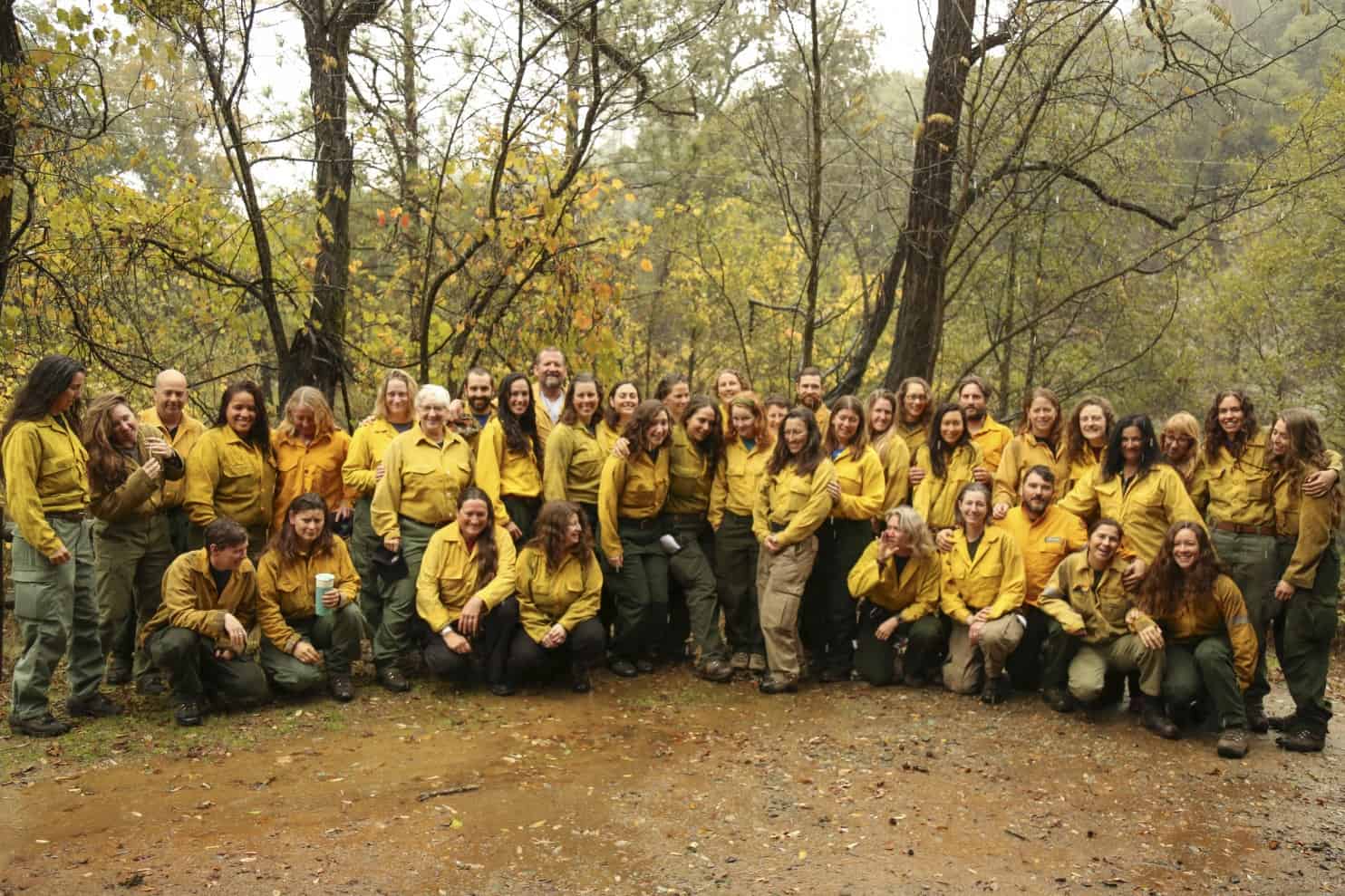
Despite the rain, participants in the first female wildfire training program gather outside to take a group photo at a Whiskeytown training camp on Oct. 27. (Tauhid Chappell/The Washington Post)

Interesting article here in the Washington Post about women in fire..with video.

“ I know a lot of women who have left fire because they did not feel supported or felt there was no room for them to grow,” Sauerbrey said. “It’s sad for me to see women who have that desire who don’t continue because of the culture. It’s hard to describe the passion people have for this job. There’s no other job I’d rather be in.”

WTREX, or Women-in-Fire Training Exchange, electrified female firefighters when it was announced. Ninety people from the United States and abroad applied for the 10-day training, and fewer than half were accepted for lack of space.

In firefighting, every bit of training is essential. It’s the path to the certifications needed to move up in rank and pay. In fire crews throughout the country, where two women are often the maximum, they are often overlooked by the men who lead them. Many are so intimidated, they don’t ask questions because guys sometimes mock them, so they don’t advance.

“This is a safe space,” said Lenya Quinn-Davidson, a University of California Cooperative Extension adviser who planned the event. “There are no wrong questions. Women feel more comfortable in this environment.”

Thanks to TNC Fire Learning Network and the supporters of women in fire..

As to the numbers, while I was still working I noticed the numbers of women going down and mentioned this to our Civil Rights folks.  The math is that if you are going for Diverse People ethnic/racially and Veterans, the proportions of women interested in fire in those groups are not 1:1  (nor are they 1:1 among non-diverse people). I feel great empathy for people who are hiring with the goal of implementing all of these divergent hiring goals(all of which I support) in the workforce at the same time. Here’s to those facing those hiring challenges and to the women and Employee Relations folks who have to deal with people continuing to do the wrong thing…decade after decade.

Post-Election Thoughts About Our Forests?

With a new Republican President and a Republican-controlled Congress, how will this affect the Forest Service and the BLM?

crown-fire-panorama-web

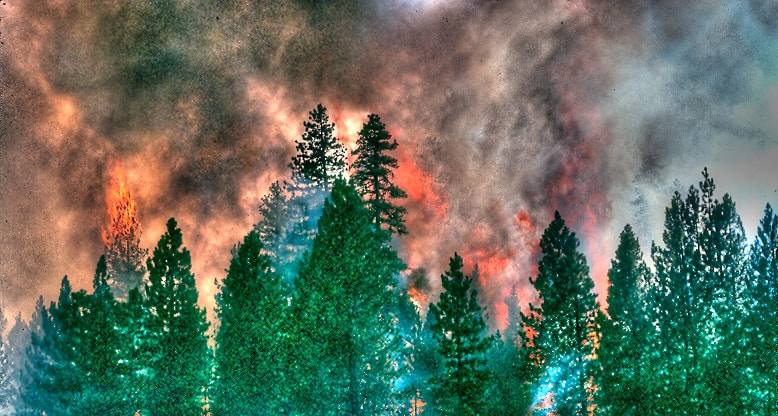
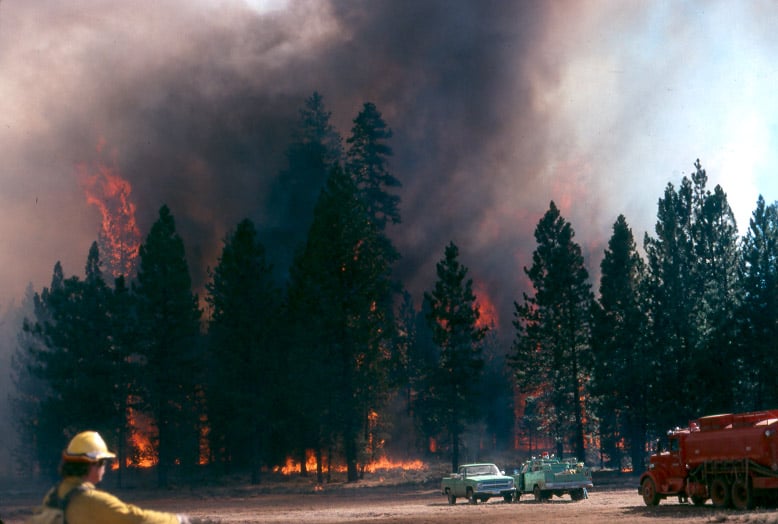
Regarding the picture: I did some processing with a High Dynamic Range (HDR) program to get this artsy view. It is interesting that it enhanced the flames better than in the original scan, from a Kodachrome slide. I shot this while filling in on an engine, on the Lassen NF, back in 1988.

The Forest Service and A Box of Frogs: Seven Years Later

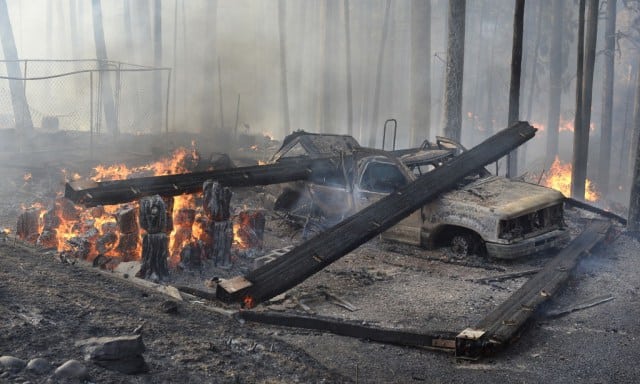
A burned truck and smoldering ruins is all that is left of a garage near a house that burned on Cedar Drive in Oakhurst,  Calif., Sunday, Sept. 14, 2014, as two raging wildfires in the state forced hundreds of people to evacuate their homes. The California Department of Forestry and Fire Protection said flames damaged or destroyed at least 21 structures. (AP Photo/The Fresno Bee, Mark Crosse)
A burned truck and smoldering ruins is all that is left of a garage near a house that burned on Cedar Drive in Oakhurst, Calif., Sunday, Sept. 14, 2014, as two raging wildfires in the state forced hundreds of people to evacuate their homes. The California Department of Forestry and Fire Protection said flames damaged or destroyed at least 21 structures. (AP Photo/The Fresno Bee, Mark Crosse)

Thanks to the reader who found this and thanks to Ron Roizen for posting on his blog! I think it’s great fodder for discussion on a sleepy late August day. Interesting that it was originally posted in 2008.. so a question might be “do you think some of these things were true or are true?” “how much have things changed since 2008?”.

Here’s an excerpt:

More realistically though, it has become nearly impossible to dismiss from service the incompetent, the lazy, the inordinately prejudiced, the foolish, the deranged… Unless they commit the most vile of bureaucratic sins: insubordination. To disagree or question any directive – no matter how senseless it may seem – is a cardinal violation of internal politics and will get you canned (or more likely re-assigned) in a week.

Their method tends to reward those who are lazy but compliant, to promote people who are incompetent but who object the least to performing nebulous tasks. Those who remain become entrenched Lemmings. When they retire or leave the FS (for any reason), they seldom find work in the private sector – unless the employer desperately needs a FS interpreter to fix government contracts – because they have no viable skill in the actual economy.

REASON 4: JOB SECURITY MOTIVATION

Forest Service employees do not spend sleepless nights worrying about the condition of the National Forests or the welfare of American citizens. They do not drive to work dreaming of ways to improve land management or cut costs.

What Sharon experienced: Yes, it can be difficult or impossible to remove those people. But people have stood up for their other employees and actually done it, at some risk to their own well-being and reputation, which can be pretty much a thankless job. I can’t argue with those who weigh the costs and benefits and give up.

And I would like to give a great big shout out to the Forest Service employee relations folks.. when I have had employees who needed a push, or more (!), and when people were trying to remove me, and did things that were not according to law and regulations, those folks had my back. Just sayin’, they are pretty much the backbone of the Forest Service, in my opinion.

I do think that sometimes employees who didn’t make waves were promoted, and then accused of “not having a vision” or the even more vague “not being leaders.” There were good ways of questioning and bad ways, and they were all in the eye of whichever beholder happens to be talking about you. It’s kind of like “Management by Innuendo” (I coined this term after one employee of mine who was great, had a bad rep in the Regional Office (because the regional guy had heard something bad once) so people listened to that and not to me, his supervisor and he couldn’t get promoted.

BUT Forest Service employees DO spend sleepless nights worrying about the condition of the National Forests or the welfare of American citizens. They DO drive to work dreaming of ways to improve land management or cut costs.” I’d say most of the employees I worked with did.

Career Ladders for Temps?!?! Maybe Soon!

More interesting news for “disposable” employees!

campbell_fire1-webhttp://nffe.org/ht/display/ArticleDetails/i/105694

NFFE-Backed Temporary Employment Reform Legislation Approved by Senate Committee

There may come a time when temporary employees actually have a career ladder!

“Thousands of wildland firefighters and other dedicated seasonal workers have been stuck for too long in dead-end jobs, not because of a lack of merit on their parts, but because of flawed regulations that do not recognize their years of service,” said Mark Davis, Vice President of the National Federation of Federal Employees (NFFE) and past President of the NFFE Forest Service Council.  “Many others leave and take their years of experience with them because of blocked career paths. After years of work, I’m optimistic that we are about to fix that.”

Of course, this is most directed towards firefighters, as so many timber temps have been jettisoned or have found “other employment”. Most temps would say that there is plenty of work to do, outside of their 1039 appointments but, that issue is not being addressed. The higher-ups choose to continue to embrace the 1039 appointments, thinking that policy is “good enough for Government work”. There really is nothing stopping the Forest Service from changing their policies on 1039 appointments. Truthfully, I’d like to see the temporary appointments scaled back to 800 hours, essentially forcing the Forest Service and other Agencies to hire more 13/13 permanent positions. Yep, make it too costly and “inconvenient” for them to continue using temps to do work that is needed, each and every year. It’s up to OPM to impose more rules, to stop the abuse of the temporary hiring authority.

Book Review: “Toward a Natural Forest: The Forest Service in Transition” by Jim Furnish

toward a natural forest

Many thanks to Teri Cleland for her contribution!

Review by Teri Cleeland, who retired from the US Forest Service in 2013 after a nearly 30 year career with assignments in Arizona, Washington DC, and Florida.

After seven years working as a seasonal archeologist for the Forest Service and Park Service, I finally landed a permanent job in 1989 on the Kaibab National Forest in northern Arizona. The job only came about because of a consent decree the Forest Service had signed to settle a lawsuit based on careless destruction of significant southwestern cultural sites during logging operations. “Save the Jemez” brought together a coalition of Tribes, environmental groups, even the State of New Mexico, against the Forest Service. The Agency bowed to legal pressure and instituted reforms that were a boon to my career and began a sustained period of protection and interpretation of many archeological and historic sites, as well as improved relations with Tribal governments. I got a ground floor view of the beginning of change in the Forest Service, change that has come fitfully through the years and continues today.

So it was fascinating to read Jim Furnish’s memoir about his career in the Forest Service, “Toward a Natural Forest” (Oregon State University Press, 2015). Furnish started as a company man in the “timber is king” era of the 1960s and slowly evolved a new land ethic, ending his career at the pinnacle of the agency as an iconoclast—and outcast—for his unconventional ideas and style, pushing for the embrace of ecosystem management.

This is a personal account that traces Furnish’s career and how certain experiences through the years changed his view on Forest Service management practices and his own land ethic. Only 200 pages long, it is well-written and engaging, short on details but with an unflinching viewpoint. It focuses primarily on timber issues, which keeps the book at a manageable length; although I found myself wishing he had included more about other issues such as recreation and tribal relations.

Anyone who worked for the agency (or against the agency) in the 1980s, 1990s and early 2000s will be interested to read Furnish’s accounts of some of the great controversies of the times. I found myself reflecting on my own perspective as a field staff officer hearing the buzz about how politicized the agency had become. I wanted to find out how Washington ticked, and so became an idealistic newbie in the Washington Office, where I briefly worked with Furnish on the Recreation Fee Demonstration program. From the fights over unrealistic timber targets to the Spotted Owl controversy and Chief Dombeck’s race to institute a Planning Rule and Roadless Rule in the waning years of the Clinton administration, Furnish provides his unique perspective.

The book also includes frank acknowledgement of Furnish’s own shortcomings and a fascinating account of how he vaulted from the supervisor of a relatively small national forest (the Suislaw) to the Deputy Chief for the National Forest System. Many names in the book will be familiar Forest Service followers. Furnish heaps praise on some and scorn on others, but never gets too personal. And he doesn’t spare himself from scrutiny.

Of his first ranger job on the Tensleep District on the Bighorn National Forest, Furnish said “. . . I came to sense I hadn’t made the grade as a district ranger, certainly not in the eyes of many of my peers, nor, to a degree, in my own eyes.” Later, as acting Forest Supervisor on the Suislaw National Forest, a clash of viewpoints on logging brought many personnel changes. “When presented with opportunities to bring careers to an end, I seized each chance. I had been ruthless in ways I thought myself incapable of.” That statement might have come back to haunt Furnish when the end of his own career came with the Bush administration: “I clearly had no legitimacy . . . I was marginalized, irrelevant. . . . Though the treatment was not unexpected, the rapidity with which it happened surprised me.” For Furnish, the end came not with a bang but a whimper, eased out with little fanfare.

But he continued to advocate for change in the Forest Service, and felt “sweet vindication” when a court ruling in 2012 supported his Roadless Area Conservation Rule. And he approves the latest Planning Rule as an improvement on the 2001 version he helped craft. Although the Forest Service has left many of the old timber battles behind, according to Furnish, it has a long way to go toward both restoring trust in the agency and restoring the National Forests. I think Furnish might be underestimating how far the agency has advanced a restoration ethic in the 13 years since he left the agency. But there is no doubt in his assessment that bold leadership is needed to achieve the goal of restoring and sustaining our nation’s forests.

With an excellent forward by historian Char Miller, I recommend this book as a contribution toward understanding a tumultuous period of land management in the United States with unique insights into the Forest Service organization and some of its key players.
Do we need national ‘forests?’

Things seem a little quiet out there, so here is my response to Sharon’s asking what I  think about “disappearing districts” on June 12.  The problem I see with the approach of consolidating districts (and national forests) is that is an ad hoc and opportunistic response, and I haven’t seen much of an effort at long-term strategic planning for what the current and future agency should look like.

I think there are some good arguments for maintaining a local ‘face’ of the Forest Service responsible for implementing policies and programs.  I think that could be done with many staff specialists located elsewhere and in different places.  Something close to a “one person ranger district” might make sense again.

On the other hand, what purpose do national forest administrative units serve?  There is a need for someone at a higher level and with a broader view to develop policies and programs.  But is there really a need for a hundred-and-how-many different sets of policies?  There is a historic and legislative basis for national forest boundaries, but I think that the decentralization of authority that has been tied to that works hard against the need to reduce government costs (as well as creating artificial cross-jurisdictional management problems).


I think that the Clinton Administration had the right idea that the Forest Service can’t afford four layers of bureaucracy.  What would happen if we eliminated national forest supervisor offices?  Or if that’s too many districts for a regional office to handle, a more reasonable alternative might be to reorganize based on states or multi-state units (like the BLM, which would make it easier to eventually merge with the BLM).  This might even improve working relationships with the states.