Disappearing Districts: A hundred years of lumping and leaving!

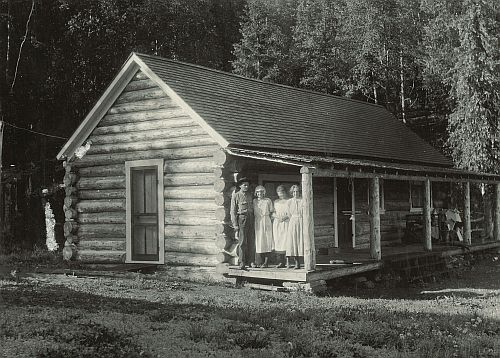
Alpine Guard Station History: In the 1920's, the Gunnison County area was home to one of the largest sheep grazing industries in the nation and over 1,000,000 sheep were shipped out of Montrose annually. The Alpine Guard Station was built so the Forest Service Ranger could oversee operations associated with permitting and sheep grazing. In this 3 room cabin, the Forest Ranger and his family spent each summer while he “rode the range.”
Alpine Guard Station History:
In the 1920’s, the Gunnison County area was home to one of the largest sheep grazing industries in the nation and over 1,000,000 sheep were shipped out of Montrose annually. The Alpine Guard Station was built so the Forest Service Ranger could oversee operations associated with permitting and sheep grazing. In this 3 room cabin, the Forest Ranger and his family spent each summer while he “rode the range.”

While linking to the Rocky Mountain Mountaineers website (for the previous post on the OPM data breach), I ran across this history piece by Tom Thompson.

Here’s an excerpt:

“From 1960 to 1980, another 26 districts were eliminated. Regional Forester Craig Rupp was not pleased with the direction this was going and in January, 1983 he wrote to the Forest Supervisors and stated emphatically that he was
“unwilling to agree to any further combinations at this point in time and for the foreseeable future.”
The essence of his position was laid out in this one paragraph:

The Ranger District remains the front line of the Forest Service contacts. The District
personnel provide the very large majority of visible perception of ‘what the Forest
Service is’ to the public. They have the day-to-day contact with the largest amount of the
public and the best opportunity to: manage the resources, manage use of resources,
manage activities, prevent destruction, decide local issues on local grounds, act as
agents of the public, prevent mistakes rather than being reactive, and represent the
Forest Service and its goals and objectives to the public.

He believed the arguments to combine districts that dealt with budget savings were short-sighted
and the organizational loss of presence and availability to the public were just not worth it. He said he would
“rather see you return to one person Ranger districts with zoning of all technical and professional assistance, than combine Ranger Districts and lose Ranger contacts.”

What do you all think?

Merry Packers of Yesteryear

A good friend who worked in the Forest Service before the 1964 Wilderness Act asked me if I had heard of a Merry Packer. I had not heard of them. He then described this motorized contraption that ferried equipment up trails in remote areas. The full picture is here.

My friend Tom commented about their use:

“Look!”
I looked. It was hard not to. We had just broke camp and started down the trail when the morning fog boiling up out of the canyon burst a hole a couple of miles away across the gorge, and in that hole, perfectly framed in corpuscular rays, sparkled a waterfall. It was quite a sight… and possibly my last!
 
Landers stumbled on a raised root in the trail just as he pointed with his right hand at the waterfall. His left hand on the throttle squeezed involuntarily as he struggled for balance. The little engine revved, kicking the mechanical mule in the ass just as we came out of a switchback. We came WAY out. I was up front, leaning back on the handles, supposedly steering, hopping and tiptoeing over rocks and roots, my feet on the ground only now and then.
 
We were having way too much fun again with this thing, and, way out here in the Douglas fir forests of the Wind River District above the Columbia River Gorge, no one was looking….and we were getting paid, too! Without having to carry gear, we moved fast, almost effortlessly, and we cleared a lot of trail……until Landers spotted that waterfall. I was lifted in the air about two feet before going over the edge, followed by all of our stuff – chainsaws, axes, sleeping bags, raingear, food, canteens and mosquito nets. Only a sleeping bag landed on me as I tumbled. Thank God that machine missed me. Landers fell on his face in the trail, laughing.
 
 The adults in the Forest Service had declared us the Trail Crew, showed us how to start this thing, then sent us into the wilds. Its called a Merry Packer. They’re like those deer carriers, but motorized. Are they still around?”

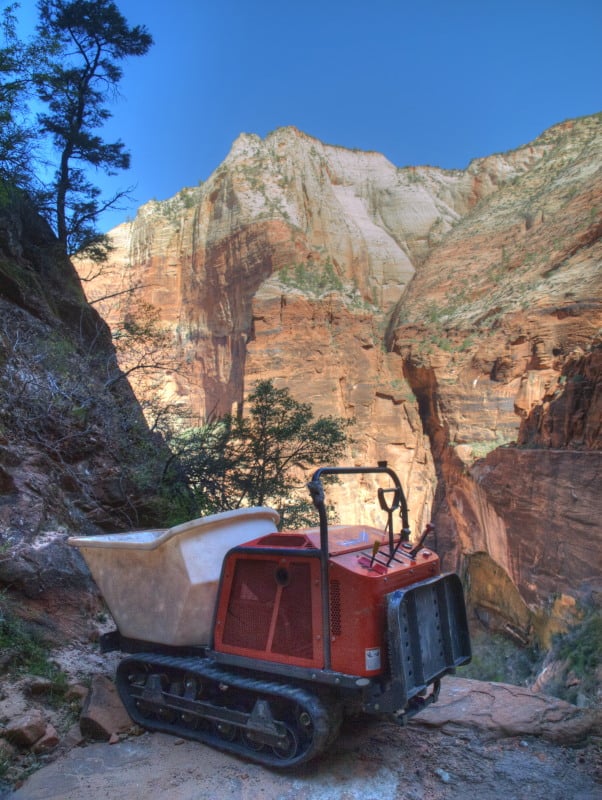
I hadn’t seen one in all my years in the Forest Service. I’m sure they were used a lot, in trail construction, before the restrictions on “motorized use”. On a recent trip to Zion, I saw, maybe, its replacement, in this more modern world. I’m sure that they had to fly this machine up to this strategic spot on the East Rim Trail.

P9034648_tonemapped-web


Forest Service New Digs in D.C.

Thanks to the Rocky Mountaineers retirees association for this one.

Sharon’s take: I spent many glorious years in the Yates building and it is a beautiful building. In fact, I worked on 4SW when the Holocaust Museum was being built…it warms the cockles of my heart that they strengthened that wall.

Here’s a song for my many friends in the Yates Building (and yes if anyone’s still in Rosslyn) (to the tune of “As Time Goes By”)

Commuting in a tube,
A cube is still a cube,
On that you can rely,
Your space will always tend to shrink
As years go by

Throwback Thursday Hits NCFP!

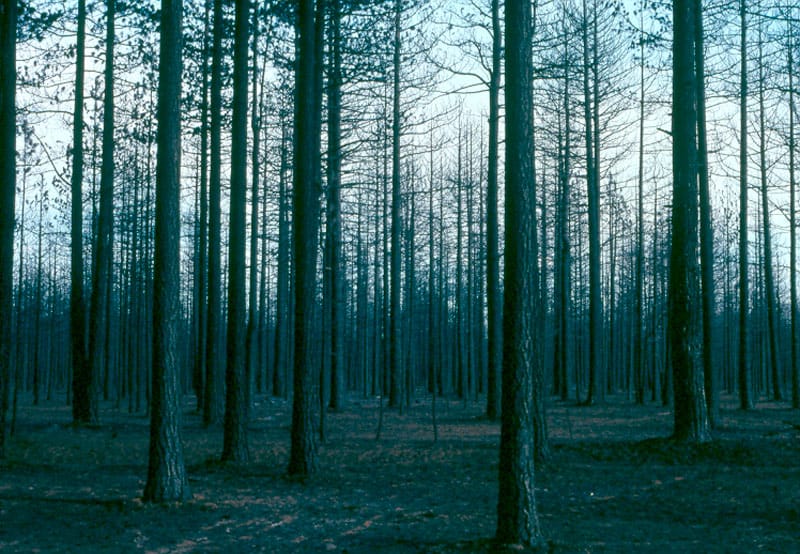
After the “Siege of 1987”, and 43 wildfires on the Hat Creek Ranger District, in three days, the Lost Fire burned up this forest up on the Hat Creek Rim. Even without terrain effects, this fire raged through the forest incinerating everything in its path. There is an eerie beauty in this picture, reminiscent of an Ansel Adams monochrome image.

high-intensity-burn-web

Today, those forests are growing back, after a big reforestation program, and it appears, a subsequent thinning. Here is a Google Maps view of that area today.

https://www.google.com/maps/@40.8027893,-121.4002792,862m/data=!3m1!1e3?hl=en

Already this summer, there has been 3 large wildfires on this Ranger District. It is mostly a dry “eastside pine” forest, requiring trees to be thinned and crowns separated. It appears that the Forest Service is finally seeing that early thinning is key to restoring forests. In the past, it always appeared that they were “gambling” on waiting for the trees to get bigger (and more profitable), before managing their plantations.

Time for a Change: Firefighter Fairness

Here is the letter sent to all FS employees:

Subject: Time for a Change

Hello my forest service coworkers. Please give me five minutes of your day. I know that this email is going to make me an unpopular employee by speaking out. My apologies to my forest supervisor for the phone calls you will most assuredly receive. My intent is not to embarrass you or infuriate you.

My name is Scott Mayner. I have been an employee of the USFS for 20 years. I have been a forestry technician my entire career and I have been heavily involved in timber and fire for two decades.

Recently I applied for a job as a supervisory fire engine operator. It was advertised as a primary fire position. That designation comes with an age restriction requiring the applicant to be no more than 36 years old unless sufficient time has been served in a primary or secondary fire position which can be subtracted from your current age to qualify you as less than 37.

This clause apparently has no provision for time dedicated to fire training, fire details, or prescribed fire or wildfire suppression work on your own unit/forest.

Despite the fact that I have served for many cumulative years in fire related duties and am highly qualified for many positions in our ICS system, I was deemed too old to qualify. I am 38 years old and only a short 14 months ago, I would have been considered for this position. My time working in fire related duties isn’t being considered at all. My years of training, years of service, and level of qualifications mean nothing.

It actually has little to do with a person’s age however. If I was 45 and had been a fire tech for 10 years, I could qualify. It is all because of the firefighter retirement system.

This system is completely screwed up however. A forestry technician who is arduous fire fighter qualified, assists with every prescribed burn, every wildfire, attends numerous trainings, attains numerous qualifications, and travels on details will never be considered for fire fighter retirement benefits. The fire tech from the same district who does no more fire related work than the forestry tech gets a 20 year retirement with additional financial benefits!

I feel this is wrong. Any employee who dedicates 20 years assisting this nation with fire suppression should be given consideration for fire fighter retirement, regardless of whether they are a forestry tech, recreation tech, wildlife tech, or professional series.

Some of you are reading this and saying, oh this is just “sour grapes” and that is fine if you believe that. But any system we have that discounts experience and discriminates based on age, regardless of the reason, is a system that has no place in our agency.

I may not be the most qualified person for the job, and if I am not then so be it, I can accept being beaten by a higher qualified person, that is the nature of competitive placement and the nature of life. What I cannot accept is not being considered because our agency will not allow anyone over 36 to apply for a job who isn’t already in a fire position. Regardless of the reasoning, it is wrong.

I know you fire fighter retirement designers and personnel managers will be saying that I don’t understand the intent of the 20 year retirement, mandatory retirement age, etc. Well I do, and I believe it to be a system that is heavily flawed. It favors younger, less experienced employees over those who have dedicated many more years and have much more experience. We are doing away with experience on the fireline and discriminating against the older employees with such requirements. The Forest Service should be ashamed of themselves.

I understand the taboo of sending a message All FS. Yet I have hit block after block by people above me who don’t care, aren’t interested, or have a fear of breaking a rule. I have said nothing in this message that is offensive, rude, or out of line. I am merely speaking about part of our agency that I feel is wrong. I expect that I am not the only victim of this discriminatory practice and I feel that this agency needs to change the rules regarding fire fighter positions and fire fighter retirement. I have heard the lousy excuse “rules are rules” way more than I can stand. The rules are stupid, discriminatory, disregard experience, and need to be immediately changed. Rangers, Forest Supervisors, Regional Foresters, Chief….this is wrong, let’s fix it.

Thank you,

Scott Mayner
USDA Forest Service

My take:This would be a good example of somethings that either 1) has good reasons for existing, not yet explained clearly or 2) no one feels that they can change it (do not know how fixing it could be done) Just a clear explanation of why this is the way it is would be helpful. With any decision, especially personnel, some win and some lose.

Here is my take on the way this works:

I think being clear about what you are doing and why makes some people unhappy with the choice. These are real people who can and do fight back in various direct and indirect ways.

Being unclear makes everyone unhappy and powerless because it looks bad and there is no apparent reason and no perceived way to fix- plus no one cares enough to give you a reason. Yet, no one decision maker can be accountable.. it happens in the HR ether somewhere.

And from the ether, sometimes you get a pellet and sometimes you get a shock.