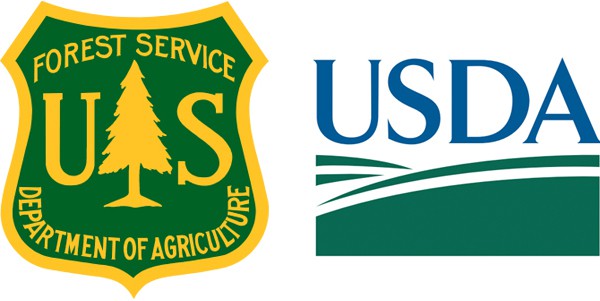
Why Is USDA Stripping the Forest Service of its Pine Tree Logo? Char Miller on the Shield Silliness

forest-service-usda-logos

Yes, I’m on vacation, but Char sent this commentary to me and it is too good to wait. Char hit this one out of the park, IMHO. (yes there is spring-like weather in Colorado again).

Retiree networks echo Andy Stahl’s info that a letter from the Secretary is coming…

Below is an excerpt, but as usual with Char, the whole thing is definitely worth a read.

Goodbye, Pine Tree. Hello, Bland.

Just how insipid becomes clear when reading the department’s description of its so-called signature model:

The USDA symbol is a graphic representation of the land — the foundation of all agriculture — and the Department’s initials. The symbol’s colors — dark green and dark blue — represent the essential elements of earth, air, and water. Together these elements comprise the symbol.

Now cast your eyes over the USDA logo itself — what exactly does it evoke? Where? Who? Looking more closely at this generic landscape, can you spot anything missing? If you worked for the largest agency within USDA — the Forest Service — you might well be puzzled that nothing is growing in this stylized field of green and blue. You might also crack up at the cutting remark of one agency retiree, who lambasted the USDA symbol as “the ultimate example of permanent deforestation.”

Not laughing is the upper echelon of the USDA hierarchy; after more than two years of planning, they’re taking this aggressive rebranding quite seriously. Asserting that hitherto the “USDA symbol is the official and sole identity mark for the Department and all agency programs,” Secretary Tom Vilsack and his staff have rolled out the dead-handed language of federal bureaucratese to justify their actions: “The USDA symbol will give consistent identity to the Department, increase public recognition of the value and wide range of USDA’s products and services, and bring economy of scale to the production of visual information materials.”

Given that the USDA oversees the homogenization of milk, is it any wonder that it wants to standardize it tens of thousands of employees spread out over more than 20 agencies? To make their uniforms uniform, to insist that all signage, vehicles, news releases, websites, social-media platforms, letterheads, envelops, business cards, powerpoint presentations, certificates of merit — right down to the smallest “event name cards,” and table-tent cards — conform to and are consistent with the rigorous set of departmental graphic standards.

To insure compliance, the department also has created an oversight office, whose head bears the august title of Director of Brand, Events, Exhibits, and Editorial Review Division (BEEERD). Amid the fiscal turmoil of sequestration, Secretary Vilsack & Co. appears strangely worried about appearances.

The department might instead want to think about the budget, the astonishing costs associated with repainting the Forest Service’s vast fleet alone (not to say those vehicles that carry food inspectors, researchers, librarians, natural resource scientists, and a host of others on their daily rounds). They might also calculate the lesser but still substantial price tag for reprinting stationary, reissuing IDs, and redesigning logos, uniforms, and, yes, badges.


Best and Worst Federal Bosses

A decision last year to extend health benefits to temporary firefighters but not to all temporary workers proved frustrating to many employees. “It just makes no sense to limit it to firefighters,” Davis said. The Forest Service hires thousands of employees who work a few months out of the year maintaining trails, clearing brush, running recreational programs and maintaining facility grounds.

http://www.federaltimes.com/article/20130331/PERSONNEL03/303310007/Feds-rank-worst-bosses-best-bosses?odyssey=tab|topnews|text|FRONTPAGE

Calaveras Bigtrees


www.facebook.com/LarryHarrellFotoware


The USDA Homogenization Project

Floggings-Will-Continue-New-Logo

No, we are not talking dairy here..but new Department Direction ( would you think they might have other things to do, given sequestration?)

USDA symbol is the official and sole identity mark for the Department and all agency programs. Agency logos are being phased out and replaced with a standardized signature model to be adopted by all USDA agencies …

USDAlogo-1 the pdf (Bob, you might not want to read this…it’s very bureaucratic)

Turns out that a retiree says that this was tried to the Park Service a while back then rescinded due to uproar by employees and retirees.

Here are the two possibilities- 1) Don’t know how this will affect employees. Insensitivity.
2) Don’t care how this will affect employees. Intentional Irritation (with some end in mind?).

If I were a Machiavellian thinker, I would think all this was an elaborate plot by the Obama Administration to pry our achy and arthritic retiree fingers from the attachment of the stodgy to the FS being in USDA, when it would make sense and save the taxpayer beaucoup bucks to move the FS to Interior. If so, it’s working, because many retirees I’ve spoken with now see this transfer in a favorable light.

But one of my favorite things is to see the language of retirees released from the bureaucratic mush of official written statements.

From Tom Hamilton (formerly Associate Deputy Chief for R&D)
“The USDA symbol is the ultimate example of permanent deforestation.”

USFS budget cuts likely to affect fire, forest management- Missoulian Story

Thanks to Rob Chaney for delving into this mystery..

Here is the link and below is an excerpt.

On the forest management side, Vilsack’s letter predicted the closure of up to 670 campgrounds and other recreation sites and the “reduction” of 35 Forest Service law enforcement officers. It didn’t explain if those reductions meant people would be fired, furloughed or not hired.

Timber harvests would be cut about 15 percent in 2013, from 2.8 billion board feet to 2.379 billion. The agency also would “restore 390 fewer stream miles, 2,700 acres of lake habitat and improve 260,000 fewer acres of wildlife habitat.”

That sounds like the kind of work performed by Collaborative Forest Landscape Restoration Projects such as Montana’s Southwest Crown Collaborative. But Pyramid Mountain Lumber resource manager Gordy Sanders said he’d not heard of any change in the many CFLRP projects the Seeley Lake mill was involved in.

“We look forward to the Forest Service performing in developing projects, doing the NEPA (National Environmental Policy Act) work and doing the project just like always,” Sanders said. “We fully expect them to produce. They’re incredibly important piece of the overall supply for all these family-owned mills.”

Vilsack’s letter gave no indication of what this might do to Forest Service or other Agriculture Department workers.

By comparison, WildfireToday.com blogger Bill Gabbert posted a copy of a Feb. 22 letter from Department of Interior Secretary Ken Salazar to Department of Interior employees stating “thousands of permanent employees will be furloughed … for periods of time up to 22 work days.”

The letter also stated “Many of our seasonal employees will be furloughed, have delayed starts, or face shortened employment periods. In some cases, we will not have the financial resources to hire seasonal employees at all.”

Salazar’s letter also warned of deep cuts to the department’s youth hiring this year. Montana Conservation Corps Director Jono McKinny said he was still waiting for details at a crucial time of the year.

“We have hired our crew leaders for the year, and we’re training them now,” McKinny said. “We will have 250 young people serving in AmeriCorps this summer, and another 240 serving in our summer youth programs. This is when we start negotiating projects, in March and April. If those projects aren’t there, we’re going to need to scale back dramatically. Those projects are two-thirds of our budget.”

Sharon’s take: At the risk of sounding like a broken record, there are two sets of highly paid folks (Interior and Agriculture) sitting in a cascading set of meetings, planning on dealing with sequestration on closely related work (e.g., fire crews) in potentially uncoordinated ways. One is more open, the other less so. It just doesn’t make any sense.

FS Budget & Sequestration 101

chickenlittle

To (sort of) understand the sequestration and its effects on the Forest Service, here’s a crash course in the Forest Service’s budget.

FS spending is divided into the following budget accounts (FY2013):

National Forest System ($1.63 billion): This money is used primarily to pay salaries & benefits for the 40,000 folks who do day-to-day national forest management.

Fire ($2.5 billion): About half is spent on having an infrastructure reading to fight fires and the other half on actually fighting the fires, with very large fires accounting for most of these costs. These proportions can vary greatly from one year to another.

Research ($0.3 billion): Studying how things tick.

Capital Improvement ($0.45 billion): Fixing built stuff.

State and Private Forestry ($0.26 billion): Cutting & burning worthless wood.

Permanent Appropriations ($0.65 billion): Payments to states (e.g., Secure Rural Schools) is the big ticket. Also where most of your recreation fee dollars are spent. A potpourri of other spending tidbits is lumped in here, too, e.g., salvage sale money laundering.

Land Acquisition ($0.08 billion): House R’s don’t want to buy any more federal land, so we don’t anymore.

Trust Funds ($0.08 billion): Green groups don’t want to cut any trees, so we don’t anymore, which has pretty much zeroed out K-V and other trust funds.

Take these numbers and subtract 5% and that gives you the FY2013 spending amount if the sequestration dollars stay sequestered to the end of the fiscal year. On a month-to-month basis, however, actual spending will reflect a 10% cut because federal agencies have been spending at the regular, un-sequestered rate since the beginning of the fiscal year (10/1/12). We’re halfway through the fiscal year, so agencies have to double their cuts to stay within the caps.

How the FS distributes the cuts WITHIN these budget accounts is anyone’s guess.

Mystery Solved: Forest Service Sequestration Silence

Thanks to the Daily Courier from Prescott, Arizona for solving the mystery.

Here is the link and below is an excerpt.

It doesn’t sound like USDA is in the mainstream of other land management agencies in terms of communicating to the public. What’s up with that, and that tight control over information? Another argument for sending the Forest Service to Interior.. read the article for the details of what the Interior agencies are doing.

The Daily Courier was unable to assess the local impacts of Vilsack’s letter because – unlike other federal agencies the Courier contacted – Vilsack is not allowing employees outside of Washington to discuss sequester issues.

The Courier was directed to a D.C. spokesperson for the USDA who didn’t have answers to questions Wednesday about whether the Prescott National Forest is able to continue hiring seasonal employees, or even how many seasonals the forest planned to hire. The spokesperson, USDA Deputy Press Secretary Stephanie Chan, did send Vilsack’s letter.

Happy 70th Birthday, Morten Lauridsen!

lauridsen

Mr. Lauridsen may be the only internationally recognized composer who worked on a hotshot crew and as a fire lookout for the Forest Service.

A native of the Pacific Northwest, Lauridsen worked as a Forest Service firefighter and lookout (on an isolated tower near Mt. St. Helens) before traveling south to study composition at the University of Southern California with Ingolf Dahl, Halsey Stevens, Robert Linn, and Harold Owen [4] He began teaching at USC in 1967 and has been on their faculty ever since. (Wikipedia here)

I believe I read somewhere that his father was also a Forest Service employee.

Referring to Lauridsen’s sacred music, the musicologist and conductor Nick Strimple said he was “the only American composer in history who can be called a mystic, (whose) probing, serene work contains an elusive and indefinable ingredient which leaves the impression that all the questions have been answered ..

And from this article in the Salt Lake Tribune:

It was in the process of making the documentary, which premiered in 2012, that Stillwater discovered the roots of Lauridsen’s inspiration: solitude, being in nature, silence. “It is out of that deep, peaceful beauty of nature where he lives part of his life, that this gorgeous music is heard inside of his being and then comes out,” the filmmaker said.

“I believe that anyone who has some relationship to nature, and the beauty of nature, the silence of nature — who has some relationship to music more in the classical style — will discover a new musical friend, companion and treasure in meeting Lauridsen’s music. It’s a wonderful discovery to make for somebody who doesn’t know anything about him.”


Here
is a video of Lauridsen talking about his hotshot and fire lookout experience.

Sometimes I think I can hear the Pacific Northwest, wet dripping from Douglas fir, gray skies, in his music.. my favorites are available on Youtube:

O Magnum Mysterium
Lux Aeterna
Dirait-on

And Soneto de la Noche, set to the beautiful Neruda poem that you can find translated here.

One Person’s “Red Tape” Is Another Person’s Following Legitimate Legal Processes: And That’s OK

For many years, I carpooled in DC with a person who worked a lot in fire. We had more than our share of conversations about air tankers…this was about 10-20 years ago. It seems like there’s always something going on with them. A good business to get into for young people who want to follow the same issue for a long time.

Anyway, I thought it was interesting that Senator Udall was complaining about Forest Service “red tape” in this article, when the delay seems to have been caused by appeals of contracting procedures. But there is an emergency clause, that Udall seems to be thinking should be invoked. I like the idea of agencies being able to cut through “red tape” of all kinds; but perhaps different mechanisms could be invoked for different kinds of “red tape” or procedural processes..

Here
is a post by Bob Berwyn and below is an excerpt:

Udall, who serves on the U.S. Senate Energy and Natural Resources Committee, is urgin private contractors to respect the U.S. Forest Service’s upcoming decision to award contracts to several U.S. companies to supply next-generation air tankers.

More information on the air tanker contract issue is online at Wildfire Today and Fire Aviation, where a recent post indicates the Forest Service expects to finalize contracts in the next couple of months.

Protests and challenges of past contract awards have already delayed the Forest Service’s acquisition of seven next-generation air tankers. Additional protests could leave Colorado and the West without adequate tanker resources for the 2013 wildfire season, Udall said.

Federal contracting rules allow private companies not awarded government contracts to protest contracting decisions without penalty. Previous protests by unsuccessful bidders have already delayed the delivery of the next-generation air tankers by at least eight months. Federal agencies, however, are allowed to override a protest in cases where there are urgent and compelling circumstances.

“Air tankers are critical firefighting resources that can save lives and prevent small blazes from becoming catastrophic wildfires,” Udall said. “When I met with Northern Colorado firefighting and emergency-management officials this week, they all agreed that we need to ensure that Colorado and the Forest Service have the resources they need to fight fires now. If contractors continue to challenge agency decisions, I will urge the Forest Service to use its emergency authorities to override the challenges and finalize the tanker contracts as soon as possible. Colorado cannot wait.”

Forest Service Maps To Be Sell Digital Maps

I think this is a good idea, but someone ought to watch the contract for intellectual property issues..

Here’s the link and below is an excerpt..

The U.S. Forest Service wants to contract with online retailers so it can sell digital and digitally-enhanced versions of its national forest maps and atlases along with forest map-based mobile apps, according to solicitation documents posted Thursday.

The Forest Service produces numerous hardcopy maps that it sells to about 250,000 tourists and hikers each year, the request for proposals said, but its sale of digital maps through its own websites has been more limited.

The agency hopes to remedy that by selling maps through a vendor such as iTunes or Google’s e-Bookstore, which could digitally enhance the agency’s base maps to make them more interactive and user friendly.

The Forest Service plans to offer 18 digital visitor maps of national forests in California, Arizona and New Mexico to start along with about six full digital atlases, the agency said.

The price per map may vary, the agency said, because it is required by law to at least break even on any map-selling ventures.

More on the AVUE Saga- OR Why Does the USDA Approach Seem, Well, Worse?

59570.strip

Great piece by Stephanie Ogburn in High Country News here (Thanks to Matthew for finding it).

Yet the switch comes with its own set of costly hassles — and questions about the value of government outsourcing meant to save money. While the Forest Service won’t comment on the decision to switch to eRecruit, a service offered by an Australian company NGA.net, or on its dealings with Avue, employees within the agency currently aren’t able to access any data from Avue, including thousands of job descriptions it needs to populate the new system. (Known as position descriptions, or PDs, these are key for matching applicants with jobs.) And not only are are Forest Service employees unable to access old data. If they have downloaded copies of position descriptions from Avue, they aren’t allowed to use those either. An agency memo lays it out:

“In no event … can you use a PD (position description) from the Avue system, in whole or in part, to create a new or modified PD in the new eRecruit system.” The Forest Service is also in ongoing negotiations with Avue about accessing that old data, but won’t comment on that either.

Linda Rix, CEO of Avue Digital Services, says the focus on the missing position descriptions misses the point, though. She says eRecruit isn’t able to do many of the complex tasks that Avue did, and that is partly why the transition has been difficult. “What eRecruit is doing for the Forest Service is about 40 percent of what we were doing for the Forest Service.”

And despite the difficulties of using Avue, its complexity had a purpose, she adds. When the Forest Service contracted with Avue, says Rix, it was at pains to implement a system where “you can definitely show that you are not practicing discriminatory hiring.” Avue’s system does this, she says, because it “auto-calculates” matches based on specific job and legal criteria like the Fair Labor Standards Act, matching people — regardless of race or gender — based on the position needs and their own skill set. The new system, says Rix, lacks these capabilities.

Forest Service employees might argue that the auto-calculation was precisely what they wanted to get rid of. Avue’s automated application screening process, according to a 2011 GAO report, “frequently result(ed) in situations where highly qualified candidates were wrongly eliminated from consideration or unqualified candidates were listed along with qualified candidates.” Employees, particularly those in the wildfire program, complained about these baseless disqualifications as well as the overall difficulty of the application process.

Admittedly, it’s not easy to be a giant federal agency, with thousands of applications for seasonal openings needing to be evaluated every year. Yet, by 2013, one would hope that the U.S. Forest Service would have figured it out. The Bureau of Land Management, NOAA and a number of other agencies use jobs giant Monster.com, but instead of joining that system, the Forest Service’s jump to eRecruit is part of the U.S. Department of Agriculture’s overall shift to a comprehensive human resources management program called “OneUSA,” which aims to provide a simpler way for the whole Agriculture Department to hire qualified candidates.

Sharon’s questions: What is the USDA thinking? And why can’t they tell Forest Service folks why they need to buy solutions that appear to be second-rate compared to other agencies? And if you tick off all the diverse candidates due to your application process, how does that help you meet your goals? Is there some research that shows that diverse people are more likely to put up with bureaucratic bizarreness? Not to speak of all the dedicated employees who are simply trying to hire qualified people and you are torturing… I had a boss once who wanted to outsource the administrative part of our region to the BLM, which was located right down the road from our Regional Office. He seems wiser, in retrospect, on that issue, as time goes on.