Fortunately a knowledgeable TSW reader was kind enough to fill me in on some key details related to the positions, the series, and the way SES positions are filled. The latter is extremely byzantine, even for the federal government. Stay tuned for more details. This post is only about the 340 series and its history.
To begin, people have questioned why there is no education requirement. It used to be, in the Old Days, that “line” positions such as District Rangers, Forest Supervisors, and Deputy and Regional Foresters were advertised in the 460 (forester) series. I remember when I worked in Region 5, for example, in the 80’s, that we were required to do Consent Decree Action Plans (the Consent Decree had to do with the FS being required by the courts to hire more women) or some such thing. I wrote a proposal to allow administrative folks (mostly women at the time) to get line positions. I also thought we could work with the universities to provide a “natural resources 101” field class for them. I remember the Regional Office shutting me down with “you’ll raise their (administrative people’s) expectations.” Fast forward to today, and I am told that most line positions are advertised in the 340 Program Management series.
Anyway, point being that for awhile line positions were advertised in a variety of series, say 401 biology, 460 forestry, but maybe also 807 Landscape Architecture, 810 Civil Engineering and so on. Some units even sent out pre-notices for interest, so they would know what combo of series to advertise in. Then, for whatever reasons, folks started hiring district rangers from other places, like congressional offices, and Veterans who might not degrees in the fields traditionally hired by the Forest Service. For example, in Region 2, Andrea Delgado was hired in from USDA to the Deputy Regional Forester slot (which I think is a line position) with a degree in international relations. Anyway, the point was to open up managerial positions to the broadest range of applicants.
One of the points of developing SES was that you could swap executives around among departments and agencies, because managing any organization is kind of the same thing. Perhaps this view was inherited from Corporate World.. if you’re a good executive at Chik-Fil-A you would be equally good at SpaceX. The USG corollary would be if you lead a bunch of scientists at NIH, you would be good at leading, say, the Rural Development staff at USDA.
Perhaps the same thinking informs the use of 340, and perhaps its lack of an education requirement. Managing is managing and you can learn by doing, I guess. I don’t suppose business schools and schools of public administration feel the same way, but that’s their battle. One little subagency (the FS) is way down the food chain from OPM.
One thing I noticed about the BLM State Director position announcement was this paragraph.
Effective January 1, 2010, OPM must authorize any employment offers we make to current or former (within the last 5 years) political Schedule A, Schedule C, or Non-career SES employees in the executive branch. If you are currently, or have been within the last 5 years, a political Schedule A, Schedule C, or Non-career SES employee in the executive branch, you must disclose that to the Human Resources Office.
Career Reserved positions — must be filled by career SES officials to preserve impartiality.
General positions — can be filled by either career or non-career SES appointees.
Non-career SES appointments are limited by law:
no more than 10% of SES positions governmentwide may be non-career,
and generally no more than 25% within a single agency
That was all a bit confusing.
Meanwhile, it turns out that seemingly political people are also making their way into GS-15 positions. I am told that this is common, but it seemed fairly unusual to me. The only examples I knew of moving from a political position in the Admin to a GS position was Doug MacCleery who worked in the staff then known as Timber. I was mildly surprised when a Deputy Regional Forester position in Region 2 (not sure exactly which deputy position with which responsibilities) was given to a person whose background was seemingly not particularly related to the work of the Region.
Delgado most recently served as the Government Affairs Director at the United Farm Workers Foundation, where she developed and implemented legislative and administrative strategies aimed at improving living and working conditions for agricultural workers across the country. Previously, Delgado held roles of Legislative Director for the Healthy Communities Program and Senior Legislative Representative at Earthjustice. She also spent time as a policy fellow with the National Latino Coalition on Climate Change. Delgado received her Bachelor of Arts in International Relations from the State University of New York (SUNY) at Geneseo.
*******************
So I think that there are three axes of politicalness within the big P political landscape.
1. One is by the kind of appointment. Schedule A or C, or non-career SES.
2. One is by the background. Has that person a track record in FS affiliated work, whether from the ENGO side, the industry side, or state government?
3. One is by perceived alignment with the Administration. Certainly Admins want Chiefs, for example, aligned with their priorities. The WO scuttlebutt during the Clinton Admin was that that was the first Admin that had considered the (perceived) political views of GS-15s. I don’t know if that’s the case.
We can usually tell the Politicalness of the hire if they leave when a different color of Admin comes in. But let’s take the example of Doug Vilsack, who moved from a legislative affairs position in the State of Colorado to BLM State Director.
Vilsack, a Colorado College graduate and lawyer whose father, Tom Vilsack, served as the Department of Agriculture secretary in the Obama and Biden administrations after two terms as governor of Iowa, joined the BLM after serving three years as the assistant director at the Colorado Department of Natural Resources, where he also headed up the department’s legislative affairs.
So when a new Admin comes in, they tend to look at the current folks and shuffle ones who are obviously politically affiliated to less desirable positions.
He told employees Wednesday he had been reassigned to a new role at the agency’s National Operations Center at the Denver Federal Center in Lakewood, the same complex that houses the BLM’s state office.
I think reassignments are possible when folks are SES. When I (in a career position) was moved to another position against my will, I filed a grievance and got my job back. Or at least that’s how I think it works.
**********
But.. many career folks left, who were retirement eligible and say they left because of the Trump Admin, including people here at TSW. So there’s a bit of a slippery slope there. Again, I think there are three vectors of Politicalness, type of appointment, background, and perceived alignment with the Admin.
Then there’s the Little P political landscape.. pleasing your boss, hiring your buddies or your employees’ buddies, or not hiring folks for gossipy reasons and so on. But pleasing your boss, small p can blend into big P if your boss is trying to please their boss who is more or less big P.
Anyway, some people were worried that the new FS State Directors would be “political”- I think they meant in the Big P sense. I tend to think that the Chief won’t pick someone with a track record of vociferous opposition to the current Admin, whether career or not.
I thought I’d add some context for the State Director positions.
First, for those of you who wonder what SES is, it stands for the Senior Executive Service. The idea apparently was at one time that federal executives could be trained up and then form a cadre that could be moved around where needs are.
At the present, regional foresters, station directors, various associate and deputy chiefs, and directors of staffs (WO level groups within NFS, ST&P, and R&D) are SES (at least when I retired). Becoming SES involves being selected, going for training, and then being eligible for SES positions. People come into the FS, or are in the FS and not SES (like Chief Thomas) and people are around to help them qualify by writing their application appropriately. So there is the in-house path and the external path. Hopefully SES folks reading this can add. In our Region, at least, all the other positions were not SES and topped out at GS-15.
I asked Grok for the history of SES and here’s what it said..
The SES remains the backbone of federal executive leadership, intended to bridge political appointees and the permanent civil service while enabling better management of large programs and agencies. It has faced ongoing debates about recruitment, diversity, mobility, pay incentives, and political responsiveness versus neutrality. For official details, OPM’s SES overview and history page is the primary source.
What I like about this advertisement is that it’s really clear that the person should know about the work:
Demonstrated experience and accomplishments in developing strategies and making decisions on controversial natural resource management issues where the interests of valued partners may conflict with or not align with Agency authorities or needs. This includes the full range of natural resource management programs of a multiple-use land management agency, and diverse partners such as Tribes, States, other Federal agencies, local governments, non-governmental organizations, and members of the public.
You can compare the advertisement to this one I found for a BLM State Director. Leadership competencies include political savvy (reading the writeups on those might be entertaining! These are Mandatory Technical Qualifications.. I don’t know what the year was but it sounds like maybe Biden or Obama Admins.
MTQs are designed to assess an applicants experience relevant to the specific position requirements. Each MTQ narrative response must 1.) not exceed two pages per narrative statement; 2.) include specific examples of your experience, education, and/or accomplishments; and 3.) address specific challenges, contexts, actions, and results.
Knowledge of and ability to implement the laws, regulations, Executive Orders, Secretarial Orders, etc., governing public land/natural and cultural resources management.
Knowledge of public land/natural and cultural resource program development, policy formulation, program and budget accomplishment, as well as how top-level government procedures and decision making are handled.
Knowledge of and ability to apply the best available science, promoting adaptation and restoration efforts to reduce the impacts of climate change and other threats on public lands, and addressing the disproportionate and cumulative harm from air pollution, water pollution, and toxic sites on communities of color, low-income families, and rural and indigenous communities.
Ability to present, discuss, and defend major program objectives before Congress; national and international organizations; scientific and professional organizations; Federal, State, Tribal, and local governments; interagency groups; private industry; special interest groups; and public meetings which often involve dealing with highly controversial and sensitive issues.
***************
It explains the CCAR model
Challenge-Context-Action-Result(s) (CCAR) Model.
CCAR Model is outline below. When addressing the ECQs and MTQs, you are strongly recommended to utilize the CCAR Model. Each ECQ or MTQ statement should include more than one example of relevant experience.
Challenge: Describe a specific problem or goal.
Context: Talk about the individuals and groups you worked with, and/or the environment in which you worked, to tackle a particular challenge (e.g., clients, co-workers, members of Congress, shrinking budget, low morale).
Action: Discuss the specific actions you took to address a challenge.
Result: Give specific examples of the results of your actions. These accomplishments demonstrate the quality and effectiveness of your leadership skills.
Apologies for the bad screenshotting, here is the link. I’d go for the one in Placerville, but am sadly lacking in executive skills. My thoughts on this will be in a later post.
Maybe we missed it earlier, but the applications close on 5/20 so get yours in there!
I thought that this was an interesting study.. sort of a combination of observation and modeling, plus economics. My favorite piece was..
Treatments were especially effective at reducing high-severity fire — those that kill more than 75% of the tree canopy — lowering burned area by 20% to 35%.
Tall living trees are good IMHO.
****************
Every dollar spent on forest fuel treatments saves about $3.75 in wildfire damages, according to a new study, led by researchers at the University of California, Davis, of nearly 300 fires in the western United States. The study estimated that the treatments, such as forest thinning and prescribed burns, prevented $2.8 billion in losses, reduced wildfire spread and fire severity.
The researchers analyzed the nearly 300 wildfires that intersected USDA Forest Service fuel reduction treatments in 11 states between 2017 and 2023. The study is the first to evaluate the economic value of Forest Service fuel treatments across the West at a large-scale using data from wildfires that encountered fuel treatments rather than relying on wildfire simulation models. It was published today in Science.
“Fuel treatments and forest management are critically underfunded public goods,” said lead author Frederik Strabo, a postdoctoral scholar with the UC Davis Department of Agricultural and Resource Economics. “Our results suggest that when fewer resources are available to agencies like the Forest Service, more of the economic burden of wildfires falls on the public.”
The researchers measured wildfire damages including structure losses, carbon emissions and the health impacts of exposure to fine particulate matter. As climate change has intensified wildfires in recent decades, those damages are estimated to total $185 billion to $540 billion a year.
Preventing wildfire spread
Researchers compared how fires behaved when they spread into treated areas vs. untreated forests, accounting for predictable patterns of fire spread using fire-simulation modeling, while controlling for weather conditions and suppression efforts.
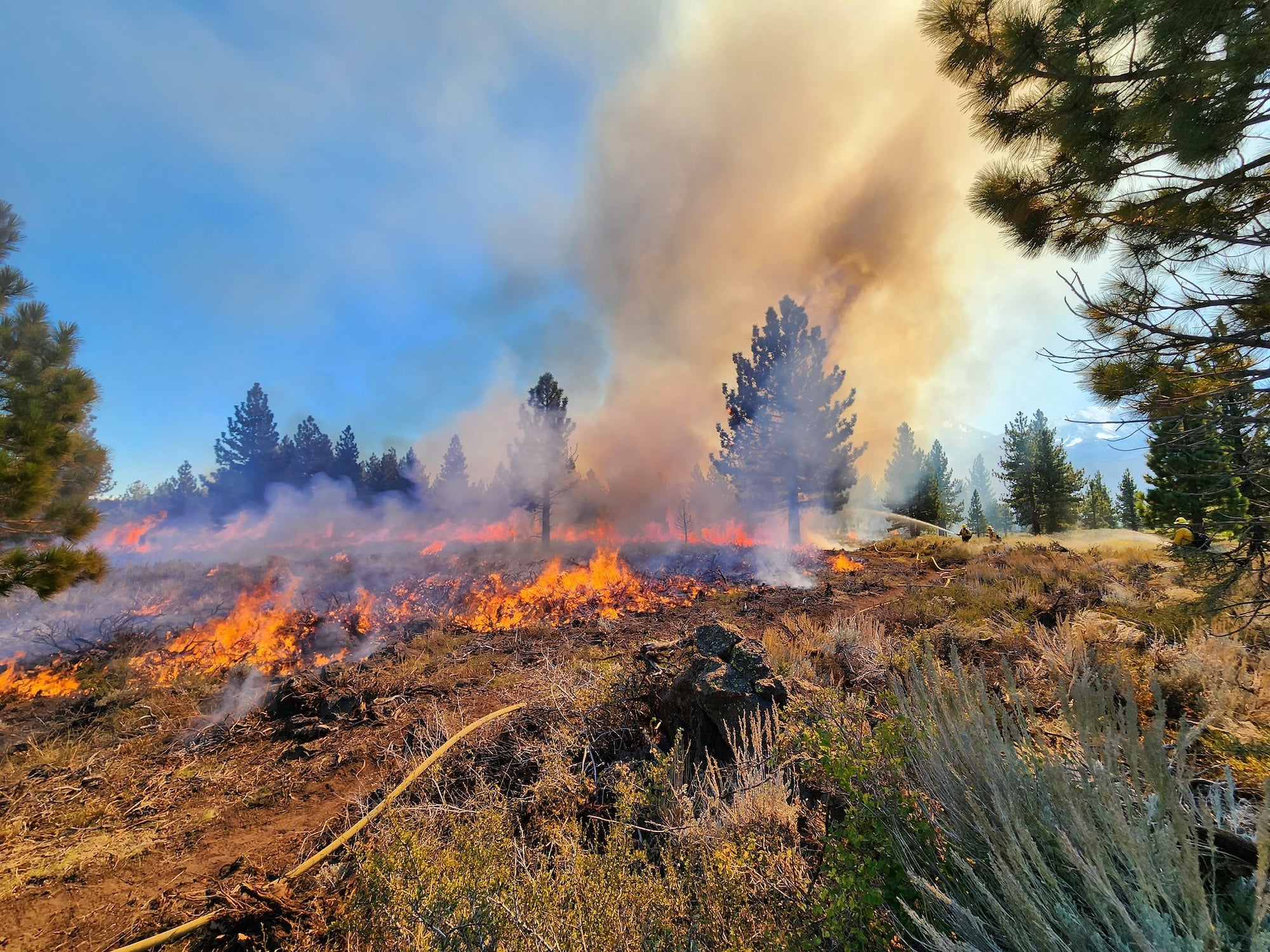
“Prescribed burn near Sherwin Creek Campground, Mammoth Lakes, Inyo National Forest. Taken October 4, 2023. (USDA Forest Service photo by Oliver Litchfield)
Fires were more than 13 percentage points less likely to continue spreading after reaching a treatment area. Treatments were especially effective at reducing high-severity fire — those that kill more than 75% of the tree canopy — lowering burned area by 20% to 35%.
Prescribed burning was significantly more effective than mechanical thinning alone at limiting wildfire spread. Treatment size also mattered: landscape-scale treatments larger than 2,400 acres were the most effective at reducing wildfire spread.
Investments pay off
Across the fires studied, fuel treatments reduced total burned area by 36%, or about 152,000 acres, relative to a scenario without treatments. They also prevented the loss of more than 4,000 buildings, avoided the release of 2.7 million tons of CO2, reduced 25,757 tons of fine particle pollution and prevented an estimated 59 premature deaths.
Together, these avoided damages totaled about $2.8 billion, including:
$895 million from avoided structure loss
$503 million from reduced CO2 emissions
$1.39 billion from avoided health impacts and productivity losses linked to smoke pollution
Strabo said the findings underscore the importance of investing more in preventive forest management.
“Wildfire policy has historically focused on suppression, but our results suggest greater investment in prevention could substantially reduce wildfire damages,” said Strabo. “That will become even more important as the climate continues to change and forests face more large wildfires and other disturbances.”
The research was supported by the Giannini Foundation for Agricultural Economics and the USDA Forest Service.
Other authors include Matthew N. Reimer with UC Davis and Calvin Bryan with the Department of Economics at Washington and Lee University.
The government should treat this situation as deeply threatening to the habitability of the West. But as heat and drought battered the region this spring, the federal government, utterly dismissive of climate change, was shredding an astonishing number of forest-related conservation efforts. At the end of March, the Trump administration introduced a reckless plan to restructure the Forest Service, gutting much of the scientific research into how we might mitigate the effects of climate change on public forests. The threatened (or in some cases, abandoned) studies looked at climate-related insect and tree disease and wildfire behavior essential to public safety.
Again, watch for elision, in this case restructuring (not necessarily affecting research programs) vs. zeroing it out (which would obviously have a substantial impact on all kinds of research). Plus, think about this, neither D nor R states are doing anything too differently about something “deeply threatening to the habitability of the west” which, to me, would draw into question whether they agree with Mr. Ferguson. And yes, states have responsibilities both in wildfire, in forest health, and in reforestation. You’d think an organization like the Western Governors might be interested in a situation “deeply threatening to the habitability of the West.” But hey, I know, it’s only an op-ed.
Efforts to make prescribed burns more effective in the face of climate change have also been slashed.
What does this even mean? I’d think targets of prescribed fire projects (reducing fuels, not killing lots of big trees, not escaping) are somewhat invariant to the predictions of climate models. Maybe not?
*****************
Given the ponderosa’s striking reputation for resilience, it’s possible that in a century or two some of these lost forests might make a comeback. But that depends on whether we humans can muster some resilience of our own. It will mean keeping alive our commitment to find more sustainable ways of living: increasing solar and wind power, retrofitting commercial buildings to make them more energy efficient and transitioning to electric vehicles.
Hmm. It seems like this individual has overlooked some other alternatives to dealing more directly with the issue, e.g. mechanical treatment, prescribed fire, and planting trees.
“It’s awful, all our cars are breaking down!”
“Why don’t you increase the number of mechanics available?
“the only solution is to move everyone closer to where they want to go”
Another way I look at these stories is “I don’t know what’s going to happen, but I (Sharon) also know you don’t know what’s going to happen either, so why are you spouting off with such (unreasonable) assurance?
On my way to a volunteer gig this morning I stopped to take the above photo. I thought it would be interesting if people could send in their own photos of ponderosa regeneration from around the West.
To do this, or to load other photos in comments, here is the process I use to put a photo in a comment. It is very kludgy and maybe a more technologically adept TSW reader can suggest another approach.
Get a free account on WordPress.com
In your account, start a fake post. You will see a tab for “add media” somewhere (I use the classic editor of WordPress but you should see something like that even with the other version.)
Add your photo or photos.
You should have tabs that say “visual” and “code.”
Go to the code tab.
Copy the weird writing (it’s called html) and put it in your comment.
Voila, your photo should show up!
Please let me know if you have trouble with this approach, and certainly if there’s an easier way.
The New York Times has an op-ed today, “A Water Doom Loop Is Coming.” It’s by Gary Ferguson, author of “The Twilight Forest: An Elegy for Ponderosa in a Changing West.” As a subscriber, I’m allowed to “gift” access to the essay. Here’s the link.
First 2 paragraphs:
In much of the Southwest, the ponderosa pine is the one and only truly big tree, thriving in dry heat and poor soils. The painter Georgia O’Keeffe captured the beauty of a stately ponderosa north of Taos, N.M., in one of her most stunning works, “The Lawrence Tree.” The creators of the television show “Yellowstone” were so taken with ponderosa forests that they did much of their filming within one far from Yellowstone in western Montana.
But after about 26 years of exceptionally high heat and drought, hundreds of million of these trees in lands stretching from New Mexico and Colorado to the southern Sierra Nevada of California have died. And in many places, something even more startling is happening: The trees aren’t coming back.
trash pile surrounded by barbed wire to keep bears out sits at an illegal cannabis site in the Shasta-Trinity National Forest on Nov. 12, 2025. Photo by Fred Greaves for CalMatters
Check out Rachel Becker’s Cal Matters piece on the ongoing illegal grow saga. We’ve covered this topic before, but nothing seems to change much.
For over a decade, Wengert and her colleagues have warned that illegal cannabis grows like this one dangerously pollute California’s public lands and pristine watersheds, with lasting consequences for ecosystems, water and wildlife.
Now, they’re sounding another alarm — that inadequate federal funding, disjointed communication, dangerous conditions and agencies stretched thin at both the state and federal levels are leaving thousands of grow sites — and their trash, pesticides, fertilizers and more — to foul California’s forests.
Dozens of fertilizer bags wept blue fluid onto the forest floor. Irrigation tubes snaked across the craters of empty plant holes. The cold stillness felt temporary — as if the growers would return at any moment to prop up the crumpled tents, replant their crop and fling more beer cans and dirty underwear into the woods.
Wengert has tallied nearly 7,000 abandoned sites like this one on California’s public lands. It’s almost certainly an underestimate, she said. Her team knows of only 587 that have been at least partly cleaned up.
No government agency can provide a comprehensive count; several referred CalMatters back to Wengert’s nonprofit for an unofficial tally.
Most of the sites Wengert’s team identified are in national forests, where “limited funding and a shortage of personnel trained to safely identify and remove hazardous materials” are driving a backlog in cleanups, a U.S. Forest Service spokesperson told CalMatters via an unsigned email.
The federal government, the spokesperson said, has dedicated no funding for the forest service to clean them up. And it’s leaving a mess in California.
And probably in other states as well.
The federal government owns nearly half of the more than 100 million acres in California. But it’s California’s agencies and lawmakers taking the lead on tackling the environmental harms of illegal grows — even as the problem sprawls across state, federal and privately managed lands.
The California Department of Fish and Wildlife’s policy is to clean up all grows spotted on its 1.1 million acres of wildlife areas, ecological reserves, and other properties, officials say.
Staff assist with cleanups on federal lands “when asked,” said cannabis program director Amelia Wright — typically on California’s dime. But, she said, “That’s not our mandate.”
Fees and taxes on California’s legalized cannabis market fuel state efforts — supporting the California Department of Fish and Wildlife’s cannabis program and funding tens of millions of dollars in grants for rehabilitating places damaged by cultivation. These grants can cover cleanups and sustainable cultivation projects, or even related efforts such as fish conservation.
The department has helped remove almost 350,000 pounds of trash and more than 920 pesticide containers from grows on public lands over nearly a decade.
But former Assemblymember Jim Wood, a North Coast Democrat, said that as he prepared to leave office in 2024, progress on cleanups was still too slow.
“It doesn’t reflect what I see is the urgency to watersheds, and the water and the people that are served by them,” he said.
In 2024, lawmakers passed Wood’s bill directing the Fish and Wildlife Department to conduct a study to inform a statewide cleanup strategy for cannabis grows. The law requires the department to provide regular reports to the Legislature about illegal cultivation and restoration efforts on lands both public and private.
To Wright, that’s a path forward, however prospective it may be.
“It just feels like such redemption right now for many of us,” Wright said. “It’s a one-of-a-kind program. So we didn’t have a playbook — we’re still creating it.”
But the study, which Wengert’s organization is conducting on the state’s behalf, isn’t due until next year. Meanwhile, the bloom of illicit pot grows on private land has been demanding California’s attention, a growing problem since voters legalized cannabis in 2016.
“It’s like whack a mole. They pop up in a new location, and then we have to go there — but the impacts are occurring across the landscape,” said Scott Bauer, an environmental program manager with the Department of Fish and Wildlife’s cannabis office.
The California Department of Justice told CalMatters it recently identified a “substantial increase of illicit cannabis cultivations on or adjacent to public lands.” Of the 605 sites where a multiagency state and federal task force ripped out illicit cannabis plants, roughly 9% were on public lands — up from an average of 3% to 4%.
“Everybody thought with legalization that a lot of these problems would go away,” said Wood, the former Assembly member.
***********************
A federal void
In 2018, a federal audit lambasted the U.S. Forest Service for failing to clean up — or even document — trespass grows in national forests.
The agency was finding and eradicating cannabis grows in national forests effectively. But its failure to consistently clean them up, the audit said, put “the public, wildlife, and environment at risk of contamination” and could allow growers to return more easily.
Little has changed. From 2020 through 2024, when Gabriel worked for the agency, a spokesperson said the Forest Service “prioritized reclaiming sites over investigating active grows.”
But the agency said it still has received too little funding and has too few personnel trained to work with often hazardous materials. And the backlog persists. How big it is, the Forest Service wouldn’t say. After declining an interview request and taking two months to reply to emailed inquiries, a spokesperson said CalMatters must submit a public records request.
The Forest Service now is shifting the responsibility for cleanups to individual forests. That, too, contributes to the backlog, the spokesperson said.
U.S. Rep. Jared Huffman, a California Democrat and ranking member of the House Natural Resources Committee, said he has tried repeatedly to direct more funding to cleaning up trespass grows on federal lands, but with little success in Congress.
“We have tried just about everything,” Huffman said. “It’s clearly not enough.”
Now, under the Trump administration, the Forest Service is even more understaffed. A spokesperson said while law enforcement staffing “has remained steady,” roughly 5,000 non-fire employees “have either offboarded or are in the process of doing so” through “multiple voluntary separation programs.”
Having worked with some of those chemicals in the past, I don’t think handling them is an “other duty as assigned.” It sounds like it needs a dedicated and specially trained workforce, perhaps with hazard pay incentives?
I’ll get back to what I’d intended to talk about last week… understanding mechanisms.. but since we were on the topic of reforestation, I thought it would be helpful if we could discuss this piece sent in by Anonymous. It’s from the outlet Mother Jones, who apparently recently combined with the Center for Investigative Reporting, with donors including the MacArthur Foundation and the New Venture Fund ( a D. affiliated dark money group). The reason I am pointing out the funding is it’s really not clear why a reforestation project would have attracted this kind of attention- other than some underlying political point. Which might be this one..
And finally, what would come of the Trump administration setting two key parts of its coalition—Big Agriculture, which embraces glyphosate, and the Make America Healthy Again crowd, which loathes it—on a collision course?
MAHA folks could also wonder why so much herbicide is sprayed in California on private land, which would be the erstwhile business of the State to regulate. Last I heard, California isn’t exactly a MAGA state.
Anyway, I have three major criticisms with the piece. the first is that they elide private and Forest Service activities (intentionally apparently); the second is that they express concerns about issues that are dealt with in the EA, without arguing that the restrictions in the EA are inadequate (which would be fine but more detailed). In fact, it sounds like maybe the reporter didn’t read the EA, let alone Appendix B where the restrictions are located. Finally we get the old saw (so to speak) “In short, a key rationale for spraying a disputed chemical in natural settings boils down to executives and regulators treating forests, including our national forests, as tree farms.” Like so may talking points, you can keep saying it, and certainly we can disagree about practices, but it’s not really true.
The title is We Are Bombarding America’s Forests with Roundup
With the tagline.. Scientists are wary of glyphosate. MAHA loathes it. And our yearlong investigation shows California is spraying it everywhere.
The story starts out personally, with the reporter driving by and observing the difference between natural recovery and private timberlands:
The towering trees were gone, but new saplings abounded—cedars, pines, firs, and more—scattered randomly amid the greenery, already a foot or two high. No such verdant revival is visible on the private timberland before me. No bees, no flowers—it’s a virtual dead zone where the only life consists of row upon row of manually planted, tightly packed conifer saplings, all less than a foot tall.
This is because, unbeknownst to most people, logging companies and the US Forest Service have been spraying massive amounts of herbicide in clear-cut and fire-ravaged forests of California—and throughout the nation. And not just any herbicide, but glyphosate, a potent and problematic weed killer best known by the brand name Roundup.
**************
Actually, I don’t think “logging companies” do spraying.. private forest owners, including corporate ones, do. But then private agriculturists and private gardeners do also.
My first hint of all this was a single word in a letter the Forest Service sent to me and my neighbors about a year and a half ago. Lassen, it said, was to be part of an ambitious new wildfire recovery project. This was welcome, as the fires had burned perilously close to our properties. Workers would remove selected trees, cull undergrowth, and set prescribed fires, as Native Americans have done for millennia to keep forests healthy and reduce the risk of megafires. The agency also would plant new trees where few had survived.
Then I came to the word “herbicides.” The Forest Service would, starting in spring 2026, spray glyphosate on some 10,000 acres of public land in Lassen to wipe out leafy plants and shrubs that might compete with replanted conifers, whose needles allow them to tolerate the chemical.
1.2.4 Need to Eradicate and Control Invasive Plant Species
Currently, there are 17 known and 1 suspected invasive plant species within the Project area. The SNFPA directs the Forest Service to manage invasive plants and prioritize the following objectives: (1) prevent new introductions of invasive species; (2) conduct early treatment of new infestations; and (3) contain or control established infestations.
The Lassen NF treats plants primarily with manual methods. Manual methods often require multiple visits annually and reduce the potential for seeds to spread, but they do not control the infestations that remain. Wildfires increase the spread of invasive plants. There is a need for additional methods of treatment, including herbicide treatment, to contain, control, and eradicate known priority infestations and to prevent establishment of new infestations of invasive plants.
So that was interesting. Then there’s the reforestation part.
So it sounds like the EA says 2700 acres not 10K. I wonder where the reporter found the other 7300.. maybe for invasive species? I guess there isn’t a ceiling for invasive species, but that’s not the reporter’s argument (which seems to be against glyphosate for reforestation).
It’s also not just glyphosate, which is also interesting, but the article singles out glyphosate. Note: I am glyphosate agnostic- to figure out what applications I would support depends on the needs and the alternatives, plus a great deal of reading.
“In the late 1990s, widespread spraying on US crops genetically engineered to withstand it helped propel the organics movement.” “Propelling” is carrying a lot of weight here. Wikipedia seems to think that in the US, the organic movement it started in the 1930s and 40s. Those of us who attended Berkeley in the 70’s remember the Berkeley Coop. Organic folks have never liked herbicides in general so why call out Roundup?
The Forest Service and private loggers say they use glyphosate because it helps commercially attractive conifers like pine and Douglas fir rebound faster after fires and timber harvests. It does so by killing deciduous trees, native shrubs, flowering plants, and anything else that might compete for water, nutrients, and sunlight. In short, a key rationale for spraying a disputed chemical in natural settings boils down to executives and regulators treating forests, including our national forests, as tree farms.
Again, in my primitive brain, loggers.. er.. log. They take woody material out of the woods. Private timber companies as well as any other private landowner spray. Plus in the EA there’s this..
When using herbicide, plantation-conifer seedlings and desired woody vegetation (e.g., black oak, alder, willow) will be avoided or shielded when spraying nearby.
Note how they think of non-commercial species as “desired woody vegetation.” Which doesn’t seem very tree-farmy to me.
And in their own words..
This seems like another NRV problem.. if the FS wanted the “Whatever Without Intervention” as a Desired Future Condition.. that would have been a different regulation (not the 2012 Planning Rule). They want to get trees back, which I think is good for carbon sequestration, wildlife, recreation, etc., plus historically there were ..trees.
To learn more about how widely glyphosate was being used and the risks of using it in places where people camp, forage, hike, hunt, and swim, I began by requesting all California spraying reports going back to 1990. My colleague Melissa Lewis and I analyzed more than 5 million records, and what we found was eye opening: Forest spraying, which practically nobody knows about, is happening at record levels. The amount applied annually in state forests—266,000 pounds of pure glyphosate in 2023, the latest year for which data was available—is nearly five times what it was two decades ago. And though far more glyphosate is sprayed on state croplands overall, forest uses have become the herbicide’s fastest-growing market in California.
I suppose illegal marijuana grows may use glyphosate as well, not sure that they would be in the records the reporters looked at. I tried to look online but most of the stories were about carbofuran and other pesticides. Maybe others know more?
Others, upset about the proposed spraying, wrote to the agency to register their opposition. They knew of the health concerns—studies suggesting glyphosate might contribute to ailments ranging from non-Hodgkin lymphoma to brain inflammation and metabolic and liver problems in children. There’s a growing body of evidence, too, suggesting it disrupts the gut microbiome, with implications for chronic disease. (Bayer disputes these findings and says glyphosate safety is “supported by one of the most extensive bodies of research.”)
Again, I’m a glyphosate agnostic, but they do sell it at the Home Depot in Susanville and Redding, so there is a danger of getting exposed elsewhere than on a conifer plantation. Those interested may check out the details of the rules for administering herbicides in Appendix B of the EA.
As my reporting proceeded, the questions kept piling up: Is glyphosate as safe for humans as Bayer insists? Does it really help forests bounce back after fires or, conversely, might it leave them more susceptible? And finally, what would come of the Trump administration setting two key parts of its coalition—Big Agriculture, which embraces glyphosate, and the Make America Healthy Again crowd, which loathes it—on a collision course?
Those tensions have been there since the beginning of the Trump Admin, and I don’t think the Lassen’s 2700 acres of reforestation has much to do with it. Then there are many paragraphs about Monsanto.
The Forest Service’s 2011 risk assessment, which broadly depicts glyphosate as posing no significant threat to people and the environment, references Williams’ 2000 article 27 times—more than any other peer-reviewed paper, often to refute studies that raised health concerns. In fact, five of the seven most-cited journal articles in the report were either directly orchestrated by Monsanto or written by authors with financial ties to the company.
The only potential human risk acknowledged in the Forest Service’s assessment has to do with people unknowingly ingesting glyphosate after foraging for mushrooms and plants in recently sprayed areas. That’s a problem not just for foragers like me, but for anyone who has ever eaten a chanterelle, morel, or porcini mushroom, none of which can be farmed. Stores and restaurants purchase them from permitted commercial foragers who collect them in wild places, including the Lassen National Forest.
Yet in the EA, they put up signs to keep people out.
Signs will be posted at public access points to treatment areas at the time of herbicide application and remain in place for two weeks after application. Posted signs will include the herbicides being used, application dates, reentry periods, and a contact name and phone number. When the herbicide label specifies a reentry period or restricted entry interval, signs will also include warnings and the required timeframe during which entry is prohibited.
Again, this is a bit of a theme.. what seems concerning at one level, by some, may not be as concerning when you dive deeper.
“Here is a maddening irony: We now have solid science and decades of hard-won experience managing western wildfires, yet the issue of fire policy is becoming as polarized as the spotted-owl timber wars of the 1980s and ‘90s. Ideology is crowding out evidence at precisely the moment when getting this right matters most. So, let’s try something radical — a fact-based look at what peer-reviewed research actually tells us about controlling wildfire.”