Does Anyone Know More About…DOEnergy Plan to Build Data Centers on Federal Land?

I started a post with this…

I get a daily newsletter from an outfit called Heatmap News.  It had this interesting article yesterday

The Department of Energy is moving ahead with plans to allow companies to build AI data centers and new power plants on federal land — and it has put together a list of more than a dozen sites nationwide that could receive the industrial-scale facilities, according to an internal memo obtained by Heatmap News.

The memo lists sites in Texas, Illinois, New Jersey, Colorado, and other locations. The government could even allow new power plants — including nuclear reactors and carbon-capture operations — to be built on the same sites to generate enough electricity to power the data centers, the memo says.

Trump officials hope to start construction on the new data centers by the end of this year and switch them on by the end of 2027, according to the memo.

The agency will request formal feedback from artificial intelligence companies and developers about how best to proceed with its proposal as soon as Thursday, according to an individual who wasn’t authorized to speak about the matter publicly …

There’s more to the story, but Heatmap News costs $99 a year, so if anyone else subscribes, please post the rest.

**********************

UPDATE:  Thanks to the alert TSW reader who sent an E&E News, the DOE was going to use its own land.  Which interestingly didn’t come up on my previous internet search for “federal land in New Jersey.” So it goes. Here’s a link to the Request for Information itself.  If you live near any of the proposed sites, you can look at the appendix of the document for maps and photos of what they are thinking about and what considerations they are incorporating. Back to the E&E story..

In a request for information, DOE said it had identified 16 sites overseen by the department that potentially could host AI infrastructure. It said it was seeking input from companies and the public on how to potentially develop the sites and back public-private partnerships to meet surging electricity demand in the coming years.

According to the RFI text, “DOE sites offer potential advantages such as access to or the potential to build power infrastructure, secure locations and opportunities for technological collaboration with DOE research facilities.”
The 16 sites are not the only sites under consideration and no decisions have been made about “changes to land use” at the locations, the RFI says. It included detailed maps for potential data centers and indicated the Trump administration was eyeing long-term ground leases or easements for construction.

“The global race for AI dominance is the next Manhattan project, and with President Trump’s leadership and the innovation of our national labs, the United States can and will win,” Energy Secretary Chris Wright said in a statement. Wright, who has repeatedly called for boosting AI capacity, is visiting the National Renewable Energy Laboratory in Colorado today and plans to reveal more information there.

The department said it is looking to enable construction of AI infrastructure by the end of 2025 and start operations at data center sites by the end of 2027.
The DOE sites identified for development are Idaho National Laboratory; the Paducah Gaseous Diffusion Plant; Portsmouth Gaseous Diffusion Plant; Argonne National Laboratory; Brookhaven National Laboratory; Fermi National Accelerator Laboratory; National Energy Technology Laboratory; National Renewable Energy Laboratory; Oak Ridge National Laboratory; Pacific Northwest National Laboratory; Princeton Plasma Physics Laboratory; Los Alamos National Laboratory; Sandia National Laboratories; Savannah River Site; Pantex Plant; and the Kansas City National Security Campus.

The plan aims to address one of the largest challenges facing the energy sector: how to find enough electricity to support a technology boom and ensure the United States stays competitive with China in developing AI technologies. According to Lawrence Berkeley National Laboratory, data centers could consume roughly 12 percent of U.S. electricity by 2028.

***********

The new RFI doesn’t outline in detail which power sources might fuel data centers on federal land but said new infrastructure could “accelerate deployment of key technologies like nuclear, geothermal, and energy storage.” DOE said it was looking to “fast track permitting” for technologies like advanced nuclear.

Upcoming RIFs at USDA and FS- Government Executive Article

Here’s the link.

In the coming weeks, USDA will be “optimizing and reducing the size of the workforce to become more efficient,” Rollins said. She made clear the department cannot offer “full assurance regarding which positions will remain—or where they will be located—after USDA’s restructuring.”

The elimination of duplicative functions will focus on business support roles, the secretary said, and eliminating “unnecessary management layers.” The department will relocate employees away from Washington to be “closer to the farmers, ranchers, foresters and consumers we serve,” she added.

That will lead to closing department facilities to minimize its footprint in the capital region, as well as some other parts of the country.

It seems like the intention is not to get rid of field-going or direct service positions.  We’ll see how that rolls out.

Interesting, more detailed, leakage to Government Executive..

Some of the layoff plans have begun to take shape. According to a source briefed on the matter, the U.S. Forest Service is planning to consolidate its 10 regional offices into as few as three. USFS’ research team, which focuses on priorities such as new tools to model fire risk, markets, forest restoration and water and employs around 1,500 people, is expected to face cuts. The agency’s five Research Stations are slated to be pared back. The nation’s 154 National Forests are expected to be consolidated and the plan is to move the Wildland Fire division into another part of the government. USFS’ Washington headquarters is slated to be “hollowed out,” the source said.

There’s more in the story about the DRP or deferred resignations offer.

Not all employees will be eligible for the DRP offer. At the Forest Service, for example, warranted law enforcement officials, mobile radio telecommunications and electronics technicians and specialists and firefighters at the General Schedule-10 level and below cannot take it.

If only they’d leaked to us, we’d have asked more questions.

The three RO’s is not a new idea; Jim Zornes mentioned it and perhaps it was part of Transformation.

Would R&D cuts be based on overhead-ish jobs at stations? Or by length of service? Or by topic areas?

One thing I don’t think we need are “new tools to model fire risk” as there seems to be an existing dogpile of such tools developed by different federal funding streams and by states and universities and private folks, and the best thing to do, to start, might be to sort through existing models.

In the case of  FS R&D, I’d say that in many cases they study things of interest to forest managers and private landowners that aren’t considered to be cool enough for other funding sources.  The best thing to do in terms of government efficiency, though, to my mind, would be to review all federal R&D for overlap and duplication. But that would be a giant project, and quite unpopular.  Anytime management of the federal R&D space as a whole is mentioned, it is characterized as “an attack on science.”  Historically  D’s don’t seem to care and R’s think the flak isn’t worth is. I remember when I worked at OSTP during the Clinton Admin and folks from Los Alamos  came after the Cerro Grande Fire (2000)to get some of that wildfire funding with the argument that they could model better than the FS.  FS R&D has always been a minnow in a sea full of sharks.  But if the new Admin wants useful research work to be funded, it needs to protect the folks that provide that useful research work.

It seems like many of us think that National Forests are already over-consolidated, but at the same time, being one of 16 Districts rather than say four, might effectively transfer more authority to the Ranger level.  We’ve previously heard from Senator Sheehy at least, the idea about moving Wildland Fire to a new agency in Interior. This seems like a big haul, and the devil will be in the details.

The idea of “who needs to be in DC” has been tossed around quite a bit over time.  Just like RO’s, there is different work that goes on, projects like the new NEPA regs, advice to the field, reviews and accountability.  In my previous roles of trying to hire people, both when I worked in R&D and in NEPA, I could certainly get more and better candidates if the position weren’t physically in DC.  In fact, at that level, people had proven themselves to the extent that working in any FS office that was convenient to them, or even work at home, would work.

It seems to me that there are six things we did:

1)Parsing out the money to Regions/Stations.  I don’t remember being directly involved in this. Before I came aboard in R&D, though, folks like Stan Krugman did give out funding to projects in Timber Management (as it was called at the time) and reviewed projects, and generally his opinion seemed to count a great deal.  This changed through time, probably with changes in budget processes.

2) Doing Programmatic and Regional Reviews. Are these posted anywhere? Are they still doing them?

3) Providing Technical Support to Regions/Stations .   As the Program Lead in Silviculture and Genetics in R&D, I certainly didn’t know more than any of the project leaders about their research.  What I did know was “who was likely to know” about different topics in different parts of the country.  But when I worked in NEPA, the staff were NEPA experts who had reached the top of the expertise ladder. The problem I’ve had over time with this expertise thing, is that sometimes there are technical positions in DC, say reforestation or genetics, and they can only hire one person so that person may know much about one thing, and not so much about the other.  So maybe there’s another way to think about expertise.  You could pick someone in the field and given them a certain number of hours for national work.  On the other hand,  there might be conflict of interest if that person also worked on the budget as in 1) (why did Forest X in Region Y get all the reforestation funding?). On the other other hand, hopefully there could be some oversight as to a rational budget approach.

4) Represent the FS on interagency business. Like the CEQ NEPA group.

5) Coordinate with other DC entities internal and external.  Think WO- OGC

6) Do national work.  Say, writing NEPA regs.  Of course, this, or the MOG effort, or even the Roadless Rule can also be done by teams.  But those teams are made up of people conceivably taken from their field jobs, which is not good.  But there is isn’t really a choice for “one and done” kinds of national work.

Finally the leakage in this article doesn’t mention Urban and Community Forestry and International Programs, which we’ve heard rumors about as well.  I can’t interpret that absence necessarily as meaning anything.

Nantahala-Pisgah Forest Plan Litigation: Guest Post by Sam Evans


U.S. Forest Service’s Southern Research Station (2024); USGS from WaPo article on Hurricane Helen damage to forests. https://www.washingtonpost.com/climate-environment/interactive/2024/hurricane-helene-forest-damage-north-carolina/ Can forest plans keep up with Nature?

by Sam Evans


Late last week the Southern Environmental Law Center filed suit challenging the Nantahala-Pisgah Forest Plan on behalf of MountainTrue, Defenders of Wildlife, the Center for Biological Diversity, and Sierra Club. These groups have spent years and thousands of hours of staff and volunteer time to help the Forest Service get it right, only to see their interest in ecological restoration left out of the final product. Here’s why we feel we have no choice but to sue:

The 2012 planning rule promised to be a watershed moment. Unlike older plans, 2012-rule plans are supposed to restore ecological integrity and biological diversity first and foremost, with multiple-use and timber management to the extent compatible with that restoration emphasis. This narrower, more science-based approach was also supposed to take some of the conflict out of the process and make planning easier and faster.

It’s not working, and the reason is simple: Local decisionmakers want to hold onto the discretion that the planning rule tried to remove. The rule instructed planners to adopt plan components—specifically including standards or guidelines, which operate as constraints on future projects—to maintain and restore ecological integrity. In other words, the rule told planners to give up the flexibility to conduct projects that don’t contribute to ecological integrity.

To that, the Nantahala-Pisgah team simply said “no thanks.” Under our new plan, all logging is good logging, no matter where it occurs. I don’t mean this as hyperbole: The plan’s actionable goals for ecological integrity—lots more early successional habitat and open canopy conditions—apply only at the landscape scale. No matter where and how logging occurs, it counts toward these targets.

This should go without saying, but “more logging” will not necessarily restore ecological integrity. According to the agency’s best available science, ecological integrity is different for each forest community type, or “ecozone.” Each ecozone has its own disturbance regime, which creates canopy openings of a characteristic scale and frequency. On the Nantahala-Pisgah, for example, sheltered, moist cove hardwood forests should be dominated by very small gaps, with rare larger openings. Dry ecozones with higher fire exposure experience stand-replacing disturbances more often. These large and small openings create the conditions for different species to regenerate, maintaining canopy diversity.

Rather than setting objectives to restore or mimic natural disturbance regimes, however, the Nantahala-Pisgah simply added up the total acreage of all those small and large gaps, across all ecozones, and set an aggregate, landscape-scale target for early successional habitat creation. Conveniently enough, early successional habitat will be created through scheduled timber production. None of the plan’s objectives connect the dots between the overall logging target and ecozone-scale needs for ecological integrity.

That’s where standards or guidelines should come in. But the Nantahala-Pisgah plan contains zero standards or guidelines to ensure that logging contributes to ecological integrity as the agency defined it. The plan explains that this omission was intentional. According to the plan, logging isn’t required to contribute to ecozone-scale integrity because of (1) wildlife habitat needs and (2) operational and financial considerations.

To be clear, the 2012 planning rule does not allow units to ignore ecological integrity requirements to provide wildlife habitat. Quite the contrary: Restoring ecological integrity is precisely how the planning rule anticipates we will provide wildlife habitat. That leaves operational and financial considerations. In other words, the Nantahala-Pisgah says it’s more economically efficient to conduct scheduled regeneration harvest in large patch cuts than it is to restore ecozones. Does anyone else hear echoes from the 1982 rule?

Leadership for the Nantahala-Pisgah have assured us that they want to do good work, and that this plan will give them the flexibility to do so. In other words, they tell us, plans don’t matter. But planning is the only opportunity to influence landscape-scale outcomes. Without consistent direction to serve as a rudder, the Forest Service will almost always go with the flow. We all know that the easiest work, not necessarily the most important, is what gets done. And the Nantahala-Pisgah’s internal analysis (not disclosed in the EIS, mind you) bears out this concern. It shows that the heaviest logging will continue to occur in the wrong ecosystems, degrading both structure and composition over time.

This isn’t the only problem with the Nantahala-Pisgah plan, but it’s a big one. A plan like this one is an existential threat to the planning rule itself. No one expected the transition to ecological restoration to be easy in the East, where timber production has been the mode of operation for decades. But we can’t sit back and let the Forest Service set the precedent that it doesn’t even need to try.

*************

Attached is a copy of the complaint.(1) 2025-03-27 Complaint


Guess the Year: Planning Combo Across Regions Analysis

I was out yesterday and couldn’t think of anything April Fool-ish, maybe you can?

So I thought I’d substitute a “guess the year” post.  Apologies for the formatting, it was saved as an Excel spreadsheet and I am not very good at conversion.  Apparently the concept at the tiem was to  combine Regions 1, 2 3 and 4 planning shops (which do a bunch of things, only one of which is planning). Note that the idea of a national planning team was implemented (at least to some degree) during the last Admin.

NAFSR Workforce Study II. Interviews With the Field- Have Things Changed?

Here’s the link to the 2019 NAFSR study.  I wonder what is still true today? Given our previous discussion of shared services,  I note the description “zoned to the point of failure.” Looking over these frustrations as of 2019, it seems like the Keystone Agreements were a natural co-evolution .. frustrated FS folks couldn’t get through the hiring process or administrative burdens, and were not empowered to fix things determined at the FARs or OPM level..so farm the work out to organizations that are more flexible and can get the work done.

********************

In the responses, there was one over-riding theme: Important management priorities in most of the resource areas will not be accomplished with the current mix and level of skills in today’s Forest Service.

Leadership, Culture and Direction
Working Well
 Morale is fairly good
 People like their jobs
 Local support is mixed across the country
 Quality of new personnel is good if adequate leadership is provided
 Processes are improving and becoming more efficient
Concerns
 Units are below critical mass in terms of people and skills and cannot meet expectations
 Administrative requirements are deeply affecting the productivity of all field personnel
 New personnel are inexperienced, affecting decisions and results
 Districts are responsible for results, but lack the authority necessary to achieve them
 Priorities are clear but units are not confident they can be achieved
 Technical training is lacking in timber, engineering, wildlife and fisheries
 Many zoned personnel are spread so thin they can’t successfully complete priority work

Workforce Capacity
Working Well
 Fire organization
Concerns
 Administrative processes and centralized services are not user friendly
 The most “broken” administrative practice is the hiring process, which takes too long to complete and removes many approvals and decisions from the affected field units. This applies to both seasonal and permanent hiring procedures.
 Following the “process” often appears to be more important than achieving desired results
 With the exception of fire, all programs are suffering due to a lack of skills, personnel and funding
 Those providing centralized services do not seem to understand or care about customers in the field
 The perceived focus appears to be national data needs, not achieving work on the ground

Consolidation and Zoning
Working Well:
 It is estimated that 15-50% of the work is performed by partners, volunteers and community groups
Concerns:
 Some units believe they are zoned to the point of failure
 Large land bases, increased travel times, and lack of connection with communities is rendering many zoned units ineffective as they are not able to complete critical work and maintain essential relationships
 To increase the pace and scale of work, units will require a commensurate increase in critical skills including heritage, timber, engineering, soils, NEPA leadership, non-fire forestry technicians, contracting officer representatives, wildlife biologists and local partnership coordinators
 There is broad agreement that the Forest Service is abdicating its land stewardship responsibilities in the program areas of recreation, trails and special use program management2
 Forest supervisors and district rangers are very concerned about the continued erosion of funding and skills in the above-listed programs

On the Ground Management
Working Well
 The Environmental Analysis and Decision Making (EADM) initiative is positive, and units have high expectations it will bring about needed change
o The level of understanding about and status of the current effort varies widely
o It would be a monumental disaster to morale if this effort failed
Concerns
 The necessary skill sets and funding are simply not available to get the work done
 The recreation program funding has dropped extensively for a very long time and the Forest Service
cannot provide for the needs and expectations of the booming tourism market
 Process and administrative burdens exist in hiring, contracting, procurement and grants and agreements
 There is a strong disconnect between those leaders who want to get work done and those leaders who are responsible for the administrative functions necessary to get that work done. This is a universal frustration in the field.

Partnerships
Working Well
 Good Neighbor Authority (GNA) is a valuable asset and helpful tool in some locations. Its use depends on the individual state’s interest, capacity and funding.
Concerns
 Overall, the GNA program is limited by funding and certain authorities not being granted to the states
 The limiting factor to expansion of GNA, or shared stewardship, is people, skills and funding to do the job
 Field units do not have a clear understanding of what approach is planned without additional funding for the counties or states to fully participate


NAFSR Workforce Capacity Study. I. Workforce Changes Over Time

As I’ve been reviewing some of this information, and recent news and interviews, I’ve been thinking about “What does the Forest Service want to be?” “And how best to organize to carry that out? And what kind of people should be in-house, and what kind of activities and expertise housed in “public-private partnerships (for profit) “,  big not-for-profits (e.g.,American Forests or NFF),  contractors, State and Tribal partners, or concessionaires, local friends’ not- for- profits? What we’ve noticed in the last couple of years is farming out expertise to big not-for-profits who do their own contracting and hiring.  If that’s the wave of the future, then the FS needs more partnership coordinators and grants and agreements people, and fewer resource experts (keepers of scientific and practitioner knowledge).

But then there’s the idea of moving wildfire folks to Interior, which would require rethinking everything remaining.

But before “farming out work to NGO’s” was a twinkle in someone’s eye (2019) , NAFSR did a comprehensive study on changes in the workforce -in another direction.

Here’s a link to the study. I’m going to summarize the key points relevant to today’s workforce discussions.

If you look at this table, you can understand why employment might have dropped off since 1990 or so. It took a great many folks to do the work for that size of a timber program

Then there’s the increase in wildfire personnel compared to other folks:

Now I don’t think that folks will find the wildfire part surprising, but the botanist numbers certainly stick out.  Of course, we don’t have those numbers available for today.

What did the NAFSR report make of all this?

Implementation of the National Fire Plan in 2001 facilitated a massive change in the overall composition of the agency’s workforce.
According to statistics provided by the Forest Service, the number of fire personnel has risen 132 percent since 1992. At the same time, the ranks of specialists needed to support restoration
projects–including prescribed fire and silvicultural treatments– decreased by 54 percent.

Over the past years the agency has repeatedly stated its intent to accelerate the pace and scale of restoration on national forest lands to improve forest health. Recently, this goal was codified in the December 21, 2018 Executive Order 13855 entitled “Promoting Active Management of America’s Forests, Rangelands, and Other Federal Lands to Improve Conditions and Reduce Wildfire Risk.” After analyzing Forest Service workforce trends, NAFSR has concluded these initiatives simply cannot succeed without a major change in the workforce composition

For those who prefer quantitative analysis, this table provides the actual numbers and percentages associated with the change in workforce composition over the last 26 years. The most dramatic reductions in personnel have occurred in the disciplines of forestry and engineering. These skills must be restored if the agency is going to meet established restoration goals.

NAFSR understands that workforce composition should change over time as agency priorities change.
Workforce numbers will also fluctuate with changing budgets and unit configurations, and as efficiencies are gained through the development and use of new technologies. A change this dramatic, however, demands the immediate attention of agency leadership.

Next post: NAFSR Report, Field Interviews with Employees.

“Whiny, Entitled Federal Workers Demand Mold-Free Cubicles, Potable Water”

From The Bulwark, a Substack blog….

Whiny, Entitled Federal Workers Demand Mold-Free Cubicles, Potable Water

by Andrew Egger

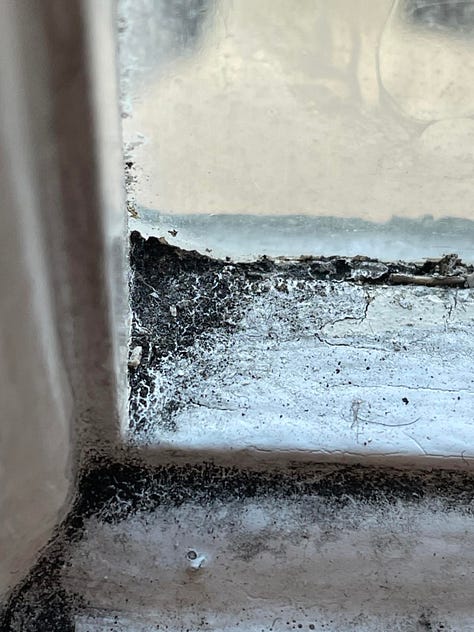
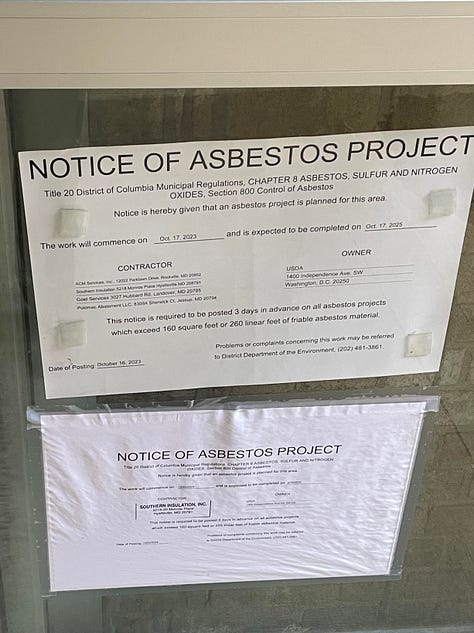
The Trump administration’s government-wide policy proclamation of “remote work is over, y’all figure it out” has heaped an endless stream of indignities on the D.C.-based federal workforce. The latest of these: Remote-work employees returning to the U.S. Department of Agriculture’s mammoth South Building this month were faced with disgusting working conditions, including mold in previously empty offices, undrinkable water in drinking fountains, roaches in the bathrooms, and notices about an ongoing “asbestos project” posted in shared spaces.

A union representing some of these employees circulated a letter documenting many of these concerns this week, saying they were requesting the agency provide “clear and enforceable health and safety protocols,” “requests for enhanced cleaning protocols,” and “confirmation that assigned workspaces are safe before occupancy.”

One USDA employee now working out of the South Building told The Bulwark that he’d spent “about two hours on my second day scrubbing moldy surfaces with my own cleaning supplies from home.” He also passed along a few pictures, which I should probably apologize for including in a morning newsletter: If you’re squeamish or eating, maybe skip on by these!

Employees also report that some are skittish about speaking out about their conditions—reasoning that the new administration’s “solution” to such a problem would simply be to place the building up for sale and lay them all off.

The White House declined to comment, directing questions from The Bulwark to the Department of Agriculture. The Department of Agriculture also declined to comment.

Wild and Free: Forest Service Recreation Moonshot

Mike’s comment about the shared Volunteer Coordinator on the Rio Grande reminded me of part of my essay in the 193 Million Acres book, edited by Steve Wilent.  My ideas were partially inspired by talking to folks about the Volunteer Coordinator position. I may have posted this part of my essay previously, but it is still relevant, plus there are many new readers out there. I put my updated thoughts  in italics. I focused on dispersed recreation, but the ideas are relevant to all recreation.

One Giant Step Forward: Every Forest Needs Friends

Everyone needs good friends, and when it comes to recreation, friends are perhaps the Forest Service’s greatest need. The agency already has lots of friends. At the national scale, the National Forest Foundation was chartered by Congress in 1993 to “bring people together to restore and enhance our National Forests and Grasslands.”

Numerous local groups focus on their specific national forest or ranger district. In Colorado, the Friends of Dillon Ranger District (fdrd.org) are one example: “Friends of the Dillon Ranger District (FDRD) leverages the power of volunteers to make sure that your national forest lands, that are enjoyed by millions of people each year, are not negatively impacted by their popularity. By volunteering with FDRD, or supporting us by becoming a member or making a financial contribution, you benefit your national forest that makes Summit County a world-class destination.”

In California, the mission of the Stewards of the Sierra National Forest (sotsnf.org) is “to unite the many people who enjoy the diverse recreation activities available in the Sierra National Forest, promoting responsible recreation and use of forest resources, through conservation and education, and ensuring public access to the forest in the present and for future generations.” In Illinois, the Friends of the Shawnee National Forest (shawneefriends.org) is a “nonprofit organization that supports the Shawnee National Forest by promoting land stewardship,  nvironmental education, and responsible outdoor recreation.”

Friends groups can accept donations for supporting a forest or district— donations the agency cannot accept. I am going hiking tomorrow on a national forest. After I use about $30 worth of gas to get to a trailhead, I think it’s fair to donate $10 to the district Friends group. I’d like to do so via a collection box at the trailhead or perhaps online. But with no Friends, the
$10 sits in my pocket despite my best intentions.

What would it take to organize grassroots groups for every national forest, or even every forest district? If recreation were the “One Big Thing” for the 21st century Forest Service, a “Friends for Every Forest” campaign would be a major step toward getting there. And establishing a friends group could be among the duties of a jointly established and funded volunteer coordinator for each national forest. If the full cost were $70,000 per annum for such a position, and it was split between the Forest Service and its partners, then for roughly $5.5 million per year the outdoor industrycould make a difference on a moonshot scale. One corporation with stores nationwide, Recreational Equipment Inc. (REI) gives $1 million to the NFF via its REI Co-op MasterCard (www.rei.com/h/shared-values). REI and outdoor gear retailer Patagonia support Volunteers for Outdoor Colorado, as do numerous other companies, foundations, and groups (voc.org/sponsors-partners). Patagonia gives 1 percent of its sales to a variety of grassroots groups via its “1% for the Planet” program (patagonia.com); since 1995 it has donated $89 million in cash and in-kind donations to a variety of not for profits.

It is not too difficult to imagine that without undue economic pain, corporations that profit from the ready supply of free outdoor recreation on the national forests could give back in game-changing ways by focusing some proportion of their donations directly on national forests, BLM, and other lands where so many people recreate.

If the CEO of a major outdoor recreation corporation were to ask me “What’s the one thing our industry could do to help that would have the biggest impact?”  my answer would be to sponsor a volunteer coordinator and a friends group on every forest, all 154 of them. Many in the recreation industry have incredible assets and are now in the right place at exactly the right time. They have a network of local businesses, technological knowhow, marketing and media skills, and unfettered creativity compared to agency employees (that’s in terms of fetters, not creativity). Just being able to collect donations at trailheads and funneling the money back to the local unit through a not-for-profit would be a powerful step forward.

What if the outdoor industry put its financial, human, and technical resources behind building nonprofit capacity to support Forest Service and BLM programs? They would be choosing a leadership role of uniting, not dividing, something our country greatly needs. What would this look like?

Here’s one possibility. The outdoor industry could set aside some percentage of their profits to give back to public lands, but at least an amount equivalent to the $5.5 million for the volunteer coordinators. The first step would be to support the development of nonprofit, nonpolitical (how counterculturalis that?) friends groups for each forest or unit of the BLM. In fact, the
San Juan Mountains Interpretive Association (sjma.org) does that for an area that is a mix of Forest Service and BLM. What that does is remove the soul-draining bureaucratic distinctions and focuses attention and work on what needs to be done.

Some forests may already work with a variety of collaborative groups, Friends groups, and statewide interagency access councils or committees, such as the Montana Interagency Access Council. Many forests, though, lack some or all of this kind of external horsepower. The hardest part is probably just getting them started, and that’s where a major effort by the
recreation industry and the Forest Service could pay off, with support for generations to come. Nevertheless, the public’s role remains foundational.

As members of the public, we need to step forward and participate. To paraphrase President Kennedy, we should be asking not what our national forests can do for us, but what we can do for our national forests.

That One Big Thing

If having high-quality, diverse dispersed recreation was the Forest Service’s “One Big Thing,” what would be most important for the agency to address?
Here are a few suggestions:
• Focus forest and volunteer resources on an “every Forest has a Friend” program. Conduct a national conversation with existing Friends groups to see what they need in terms of support. Develop volunteer or paid mentoring cadres that travel to forests to help start new Friends groups and offer support to the groups. Support Friends groups and volunteer programs that are the equivalent of The Nature Conservancy’s Fire Learning Network, which “engages dozens of multi-agency, community-based projects to accelerate the restoration of landscapes that depend on fire to sustain native plant and animal communities,” Actively involve retirees and retiree groups in these efforts.

• Work with partners to fund a volunteer coordinator for each forest who will be the contact person for incipient friends efforts.

• Reorganize such that partnerships and volunteers are crucial parts of the organization and get serious about increasing volunteer and partner involvement—say, set a goal of 10-fold in 10 years. Think about striving for the equivalent of a moonshot for NASA.

• Work with BLM to benchmark other agencies that have been successful, and look for areas where working together with Interior agencies would increase efficiency and effectiveness. Because having a variety of dispersed recreation opportunities is the focus, choose partners that match the “wild and free” character of the Forest Service, with a bucolic, not “mall”-ic, atmosphere.

• Establish, with the Interior Department, a FACA group to review current agency practices and make recommendations for appropriately collecting fees, including possible changes to FLREA. This should include reviewing successes and failures across the country, developing best practices, and explicitly considering the idea of “pricing people out of their public lands.”

• Initiate an effort (with the BLM and states in appropriate locations), or piggyback on existing efforts, to improve mapping and feedback systems on the websites and phone apps for visitors.
These would make it easy to find locations across ownerships that both include opportunities visitors want as well as exclude those they want to avoid. The website and apps would also include information about the location and a place to give feedback and donate to local friend’s groups.

We now have some fairly excellent apps, but no links to give feedback to agencies nor to donate.

• Begin a program to phase out concessionaires from developed sites within 5 years, and replace them with paid agency staffers and trained volunteers.

I still believe agency presence and visibility is important, but given the cutbacks this year that don’t affect concessionaires, plus  their performance where I recreate, which is good, I’m not so certain about this.

• Encourage volunteers and retirees to work with the Forest Service to ensure access by providing support to land management staffs and increasing the agency’s capacity to litigate to open or preserve access to recreation sites. Montana’s Public Lands and Waters Access Association serves as an example of working with the federal and state agency budgets and donors to acquire or litigate access.

For example, some of us retirees are no longer at the “clearing trails” level of physical ability, but might be at the “writing documents under the supervision of a knowledgeable person” level for volunteering.

My vision for the national forests is that my great grandchildren will still find places where they can get away to camp, ride, hunt, fish, pick berries, and collect mushrooms and firewood. These are activities that our ancestors engaged in and that rural people today and tomorrow will continue to engage in. As US citizens, these experiences are our birthright. They should only yield to more restricted access for specific reasons, in specific places, when all enforcement efforts have failed, and with the local involvement and support of the communities.

The Forest Service has struggled with budgets that cannot keep up with needs and with organizations who think the easiest way to reduce costs is to keep people out and leave the land alone. I suggest that this is not what the majority of citizens want, even if they aren’t frequent users of the national forests, or even if they never use them. The Forest Service must take advantage
of the nascent groundswell of help and support and work to increase and expand it. The agency is not alone in this; it can and should build on the good work of friends groups and other volunteers. With their help, providing for a variety of dispersed recreation can become the agency’s new primary objective as stewards of America’s best experiences, and these precious
public lands can continue being wild and free.

Three Recent Wildfire Stories

New Report by ODF on Origin of Beachie Creek Fire

Relevant (I think) to Bob Z. and Joe Reddan’s discussion is this new report on the origins of the Beachie Fire in Oregon, originally brought to my attention by The Hotshot Wakeup.

That finding was almost the opposite of a Portland jury ruling in June 2023 that PacifiCorp was not only liable, but grossly negligent for the fires. Juries have awarded millions to fire victims so far, while others have reached settlements. It’s unclear what the report could mean for fire victims in the Santiam Canyon seeking money to rebuild their lives.

“I can’t think of any situation where a verdict has been given, and then a fire investigation report comes out afterward,” said Gianni Muschetto, chief of law enforcement for Cal-Fire, who said his department’s investigation reports are typically completed in a year at most. “I’ve just never seen that happen before. I don’t know what recourse there would be.”

This raises a great many questions, as you can imagine.  I wonder whether anyone has seen a description of what funding (FEMA, insurance, settlements) go for what things in terms of a wildfire?  Does the party found responsible for the fire pay back FEMA, or the insurance companies?  Does FEMA and insurance pay for different things? If there are two fires that come together, how do they divide the responsibility?

ODF said it had trouble getting info from the FS, is that usual?  Do courts get better information from the FS than investigators?

California Governor Channels HFRA

For those of us who have been around awhile, this sounds kind of familiar.  Note the bullet on forest sector jobs, which I guess are OK again.

Building on nation-leading progress

The 2025 Key Deliverables are the next advancement made by California to increase wildfire response and forest management in the face of a hotter, drier climate. From day 1, Governor Newsom declared California’s firefighters and wildfire resilience as a top priority of his administration. Since taking office, the Governor has committed more resources and investments than ever before to significantly boost wildfire response capabilities while tackling root causes of the wildfire crisis head-on. A full list of California’s progress on wildfire resilience is available here.

Historic investments — Overall, the state has more than doubled investments in wildfire prevention and landscape resilience efforts, providing more than $2.5 billion in wildfire resilience since 2020, with an additional $1.5 billion to be allocated from the 2024 Climate Bond.

On-the-ground progress — More than 2,200 landscape health and fire prevention projects are complete or underway, and from 2021-2023, the state and its partners treated nearly 1.9 million acres, including nearly 730,000 acres in 2023.

Increasing transparency — The Governor’s Task Force launched an Interagency Treatment Dashboard to display completed federal, state, local, and private vegetation management projects across the state. The Dashboard, launched in 2023, provides transparency, tracks progress, facilitates planning, and informs firefighting efforts.

Protecting communities — Since 2019, CAL FIRE has awarded more than $450 million for 450 wildfire prevention projects across the state and conducts Defensible Space Inspections on more than 250,000 homes each year.

Leveraging cutting-edge technology — On top of expanding the world’s largest aerial firefighting fleet, CAL FIRE has doubled its use of drones and the state is utilizing AI-powered tools to spot fires quicker.

Interesting Article About Wildfire Insurance in California

Climate experts, including Wara, have historically called for a federal solution similar to the California Wildfire Fund in order to address the growing threat of wildfire litigation against utilities. But given the current policy climate, that seems unlikely. Even within the state of California, finding the will to increase the wildfire fund surcharges on residents’ electric bills could prove challenging given the current political and economic environment, Wara said.  And utilities oppose paying more into the fund without a commensurate increase in electric rates, as this would eat into shareholder’s returns, he said.

As a result, Wara and other experts are contemplating solutions outside the insurance paradigm. Eric Gray, vice president for government relationship at the Edison Electric Institute, argued that simple reforms like expedited permitting could help utilities implement mitigation strategies like undergrounding and vegetation management in a more timely manner.

Another option, Gray said, is liability reform — eliminating the strict liability paradigm that has emerged to hold utilities responsible for all damages related to fires started by their equipment, regardless of whether their actions are deemed negligent or not. He noted that some states, such as Utah, have already taken measures to limit utility liability, and that conversations surrounding this option are taking place in other states including California.

But Wara believes there’s another side of the risk equation that deserves more attention: the vulnerability of private properties to fire. For all the billions that utilities have spent trying to reduce the odds that they could start a wildfire, total state and federal spending on measures and upgrades that could stop homes from catching fire is limited to a few hundred million, he said.

“We need to be spending something like $3 billion a year as a state on this other stuff,” Wara said. “Not utility ignition avoidance, but reducing the consequence of the ignition. Because in a state with 40 million people, there are going to be ignitions. There is no way to avoid it.”

I agree that there are going to be ignitions, but there could be fewer than there currently are, and they could be detected sooner.

What Makes Centralized or Shared Services Successful? Share Your Views and Experiences

Please continue to share your RIF experiences in the comments on the previous post.

Today I’d like to start a discussion on “what makes centralization of resources or shared services work, in your experience?” This is also an opportunity to give a shout-out to services or people that work well as shared or centralized.

Shared Positions Across Districts and Forests

My very first job in the Forest Service was in 1979 as an Area Geneticist for the then-Forests Fremont, Winema, Ochoco and Deschutes in Region 6. The Forests shared an Area Ecologist, an Area Reforestation Specialist, and an Area Geneticist, and for awhile an Area Wood Utilization Specialist (yes, folks have been trying to do this for almost 50 years).

We were reviewed by the four Forest Supes at an annual meeting. There was much fighting over the time of Bill Hopkins (the ecologist) and little interest in my work (I think one of the Supes fell asleep during my presentation).   Nevertheless, the accountability was pretty much in our face, at least annually. I think later there were area fire ecologists and Bill had an assistant.

At least one of the Forests in R-2, when I was Planning Director had cross-District shared NEPA teams. This seemed to work pretty well also, as far as I could tell.

I was thinking about the sharing concept because one forest I know recently hired a new position, a full-time GS-12 Tribal Coordinator, and I wondered whether that position might also be shared. Maybe sharing across forests is more common in some places than others. Region 6 still has Area Geneticists, and probably other area folks as well. These sharing arrangements generally seem to work, perhaps because if they don’t, the Forests have direct authority to fix things.

Centralized Services Above the Area Level

Well, we all know about Albuquerque and often use that as a point in discussion. As I recall, though, we got used to getting computer help from the Helpdesk, or whatever it was called and it turned out OK after a period of adjustment. Then there are centralized groups that always seemed successful to me (shout out to them!)… the Content Analysis Team, the Forest Management Service Center in Fort Collins, various Enterprise Teams and perhaps you have your own favorites. These are ones from off the top of my head.

What makes some of these centralized efforts successful and others not so much?  What if Albuquerque is an outlier (granted, a long-term source of frustration, but still)?

So let’s develop some hypotheses for what makes a successful centralized service. Here are mine:

(1) A lead person who is knowledgeable and experienced in the work at hand, and you can talk to directly, and who gets work done, and tells you if it can’t be done in your timeframe. Good communication with knowledgeable person.

(2) Flexibility to do things the way they work best. Perhaps here is where centralized personnel falls down; they can’t solve problems because their boxes are so constrained by requirements.

In a way, RO engineers or special uses experts or minerals folks are also a centralized service. Their utility probably also depends on their expertise and how well their time is managed and prioritized.  For example at the RO level,  with RFs putting pressure on Regional Directors if Supes don’t like the priorities or performance and don’t get what they think is an adequate response from the Director.

So I guess shared services can work when there is clear communication and accountability, and perhaps a responsive back-up system for complaints. But I have to say for the Content Analysis Team, I never needed a backup, they gave me a timeline and followed it, and if there was a holdup, they had a good reason. I guess there’s an element of trust as well, and the importance of relationships with the lead person.

Perhaps this is a bit off the topic, but also in terms of expertise:

Experts in R&D

These folks are not centralized or shared, but they also serve to help folks in NFS and elsewhere. I think many are called on by forests for help and others not. For me, though I am not an employee, I’ve found forest economists to be both enormously helpful, and also fill a niche that much of academia has abandoned in search of currently faddish abstractions. Rumor has it that R&D is on the chopping block, but there is definitely a piece of that workforce that provides expertise to NFS, as well as private landowners and Tribes. Often Experimental Forests provide a long-term perspective that extramural research funding can’t achieve. Probably the people involved in these ideas don’t know the lack of utility provided by much research funded by other agencies.  Science of the scientists, by the scientists, for the scientists. The best thing IMHO to save bucks would be for each agency to take the lead in some areas and reduce duplication across agencies. Of course, that would lead to great wailing and gnashing of teeth and claims of anti-science by more powerful folks than those who stand to lose out by reduction in FSR&D funding. Perhaps that’s worth another post.